
Practical Examples SURVEYING IN ALBERTAS NATIONAL PARKS Power
Practical Examples SURVEYING IN ALBERTA’S NATIONAL PARKS Power Point Deck prepared by: Ben Giesbrecht, CLS, ALS 2018 -05 -18 brgiesbrecht@mcelhanney. net
Practical Examples SURVEYING IN ALBERTA’S NATIONAL PARKS What is covered in this Webinar? • Searching for survey and title information in National Parks • Types of plans encountered in National Parks –Compiled plans –Field notes –Administrative Plans –Bilingual plans • Practical examples for surveying in Alberta’s National Parks Real Property Reports Condominiums • Licenses of Occupation Subdivisions Explanatory Plans Deferred monumentation R/W Plans Time for Q&A 2
Practical Examples SURVEYING IN ALBERTA’S NATIONAL PARKS Searching for survey information 1. Titles for leasehold parcels in Jasper and Banff National Parks can generally be obtained from the Alberta Land Titles Office but this is not always the case. For example, a parcel in the town of Jasper used by Parks Canada for staff housing will usually not have a title registered at Land Titles. 2. Interests like licences of occupation are not found at Land Titles and must be requested from Parks Canada. 3. Compiled plans add a level of complexity to searches as you may need to dig deeper to the plans they were compiled from to get the information you need for a survey. 4. Can be a challenge to determine how to re-establish boundaries at times. Field notes in the CLSR can be very useful for re-establishments. Some field notes even have ties to old buildings that are still in existence today. 3
Practical Examples SURVEYING IN ALBERTA’S NATIONAL PARKS Types of Plans Encountered in National Parks 1. Compiled plans – Plans where survey information has been compiled from two or more sources such as past survey plans. – The Town of Jasper has multiple versions of compiled plans registered that cover the majority of the town site. These plans compile up to six different surveys in one plan. The compiled plan itself, lacks a significant amount of detail, so it is necessary to look back at the plans that were used to compile the plan to get the correct survey information. – Compiled plans are sometimes used for very large surveys like Plan 98059 prepared for the Marmot Basin Ski Resort as it would be very costly to resurvey the entire boundary again just to add on a small piece of land. – Very important to always go back to the source when working with compiled plans. 4
Practical Examples SURVEYING IN ALBERTA’S NATIONAL PARKS Types of Plans Encountered in National Parks 1. Field Notes – There are many field notes in various formats stored in the CLSR. – Plan 34569 CLSR is a good example of a survey plan that is not actually field notes, but has been created in such a way as to show posts were placed. It is source plan for the Jasper townsite compiled plans and is very useful for re-establishment calculations. – FB 13814 CLSR is another example of a source for the Jasper townsite compiled plan. The difference with this one is that it is in a raw field note format. Again, this is a very useful plan for reestablishments. – In Jasper, between 1975 and 1975 G. Olsson created a number of field note plans showing ties to legal survey monuments throughout the townsite. This plan is difficult to locate through plan searches unless you know it exists. It has proven to be an invaluable resource for reestablishments. 5
Practical Examples SURVEYING IN ALBERTA’S NATIONAL PARKS Types of Plans Encountered in National Parks 1. Administrative Plans – These plans define Parks Canada administrative areas within National Parks. – Plan 88094 CLSR is a good example of an Administrative Plan that defines the exterior boundaries of the townsite of Jasper. This plan is also a compiled plan. – Administrative Plans must be bilingual – Administrative plans are not registered at Land Titles. 6
Practical Examples SURVEYING IN ALBERTA’S NATIONAL PARKS Types of Plans Encountered in National Parks 1. Bilingual Plans – Certain types of plans must be bilingual. Some examples are as follows: • Administrative plans • Large ski resort plans • Town boundary plans – Any plan that needs to passed in a parliamentary act or referenced in a land description in a schedule to the Canada National Parks Act, will need to be bilingual – Your bilingual plan will be sent to a committee in Ottawa and they will approve the French or English, depending on who the plan has been created by. It is recommended, if at all possible, to partner with another surveyor that is proficient in the language that you are not, to minimize the back and forth that might come out of these committee reviews. 7
Practical Examples SURVEYING IN ALBERTA’S NATIONAL PARKS Real Property Reports 1. There is no standard form for Real Property Reports in National Parks. In general, the report should be in the provincial standard with a CLS seal applied. 2. The Municipality of Jasper does not handle Planning and Development. This is dealt with by Parks Canada in Jasper. 3. The Town of Banff does have Planning and Development authority so they do request Real Property Reports and supply some sort of compliance review. 4. Like any municipality, the National Park Towns may have their own unique requirements for what must be shown on the Reports. 8
Practical Examples SURVEYING IN ALBERTA’S NATIONAL PARKS Licences of Occupation 1. Licences of Occupation are not registered at Land Titles. You will need to request these directly from the Realty Services Section of Parks. 2. Licences of occupation are generally used for purposes such as administrative space in buildings and in areas outside towns and visitor centres for purposes such as visitor accommodations, trails, corrals, and alpine huts where land conflicts are not likely to occur and where exclusive use of the land is not required. 3. Surveys are not normally required for licences of occupation. The land is usually described by sketch or site plan or, for a licence in a remote area, by reference to a topographic map. 9
Practical Examples SURVEYING IN ALBERTA’S NATIONAL PARKS Explanatory Plans 1. Explanatory plans can be used for non-exclusive interests where the boundaries can be related to existing surveyed boundaries. 2. They are most commonly used for rights-of-way or easements. 10
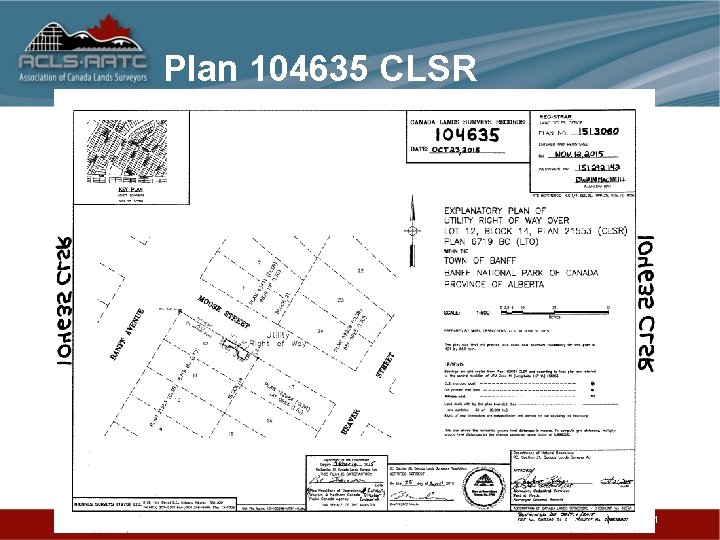
Plan 104635 CLSR 11
Practical Examples SURVEYING IN ALBERTA’S NATIONAL PARKS Condominiums 1. The only National Parks in which condominiums are recognized are located in Alberta. 2. The Condominium Property Act and Condominium Property Regulations allow for condominium subdivision in National Parks in Alberta to the extent that they can apply to leasehold interests. 3. Condominium plans for National Parks lands are registered in Alberta’s Land Titles Office, and leasehold titles to the units are issued under Alberta’s Land Titles Act. 4. Building or condo bare land units must be located on a surveyed parcel (called the parent parcel) that has a leasehold certificate of title. 5. Boundaries on parent parcel must be retraced and restored or re-established on the condominium plan or on the plan of resurvey of the parent parcel. 12
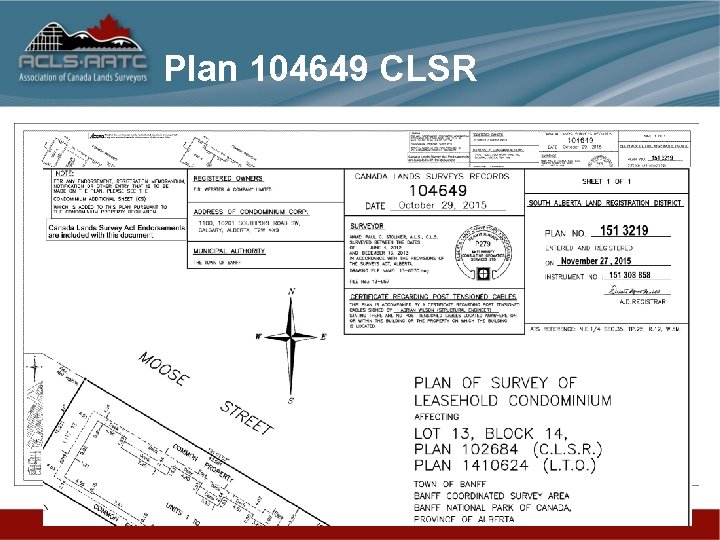
Plan 104649 CLSR 13
Practical Examples SURVEYING IN ALBERTA’S NATIONAL PARKS Subdivisions 1. Subdivision plans are done as official surveys. 2. Subdivision authority approval must be obtained from the Town of Banff, but in Jasper, this comes from Parks. 3. New leasehold titles are not automatically created upon the registration of a subdivision plan at Land Titles. The plan is similar to a R/W plan registration at Land Titles in that it is nothing more than a plan on record until a document such as a lease is registered referring to the registered plan. 14
Practical Examples SURVEYING IN ALBERTA’S NATIONAL PARKS Deferred Monumentation 1. Deferred monumentation refers to the placement of monuments that mark parcel boundaries dealt with by the plan of survey after the plan has been confirmed or approved and recorded in the Canada Lands Survey Records or after it has been file or registered in a land titles office. 1 2. Not used very often in the Parks. 3. Deferred monumentation requires a Plan of Field Notes of Control Survey Network, the Plan of Survey (for Deferred Monumentation); and Field Notes of Final Placement of Monuments. 2 4. The surveyor also needs to ensure sufficient funds will be available to complete the final placement of the monuments by posting a bond or placing money in a trust account. 1. 2. National Standards for the Survey of Canada Lands, Section 6. 1(1) 15
Acts and Regulations SURVEYING IN NATIONAL PARKS Rights-of-Way for Public Purposes 1. Rights-of-way in National Parks include leases of, and easements over, public lands for existing railway lines, oil and gas pipelines, telecommunication lines, electric power transmission and distribution lines, and related facilities. 2. An official survey carried out in accordance with the Canada Lands Surveys Act is used for rights-of-way for public purposes. For some rights-of-way, such as easements in a subdivision, an explanatory plan is used. 16
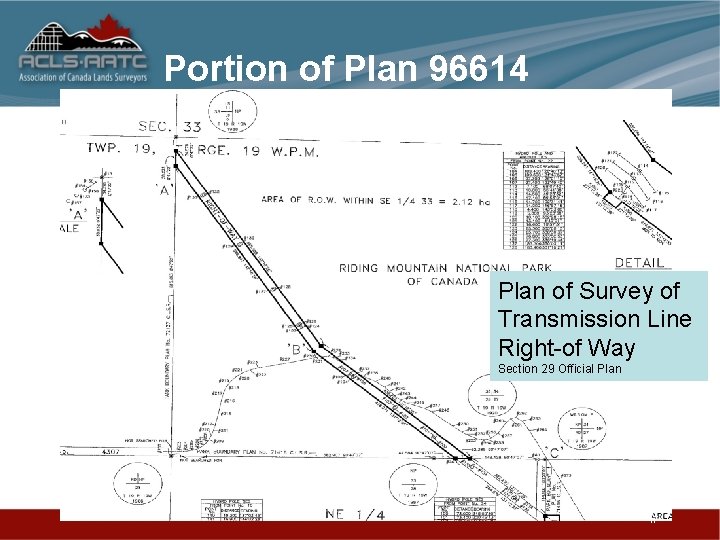
Portion of Plan 96614 Plan of Survey of Transmission Line Right-of Way Section 29 Official Plan 17
End of Presentation Power Point Deck prepared by: Ben Giesbrecht, CLS, ALS 2018 -05 -18 brgiesbrecht@mcelhanney. net
- Slides: 18