
Practical Discrete Unit Disk Cover Using an Exact









- Slides: 20
Practical Discrete Unit Disk Cover Using an Exact Line. Separable Algorithm Francisco Claude, Reza Dorrigiv, Stephane Durocher, Robert Fraser, Alejandro López-Ortiz, Alejandro Salinger
Outline �Past work �Line-separable problem �Combining our algorithm with the previous work �Conclusions & Future work
Discrete Unit Disk Cover (DUDC) �Given m unit disks D and n points Q in the plane, the discrete unit disk cover problem is to select a minimum subset of the disks to cover the points.
Applications �Wireless networks �Select minimum number of servers from a set of candidate sites. �Natural Resources �Position water bombers at airports so that active fires are within a maximum distance. �Climatology �Position weather stations at candidate sites so that all cities are covered by radar.
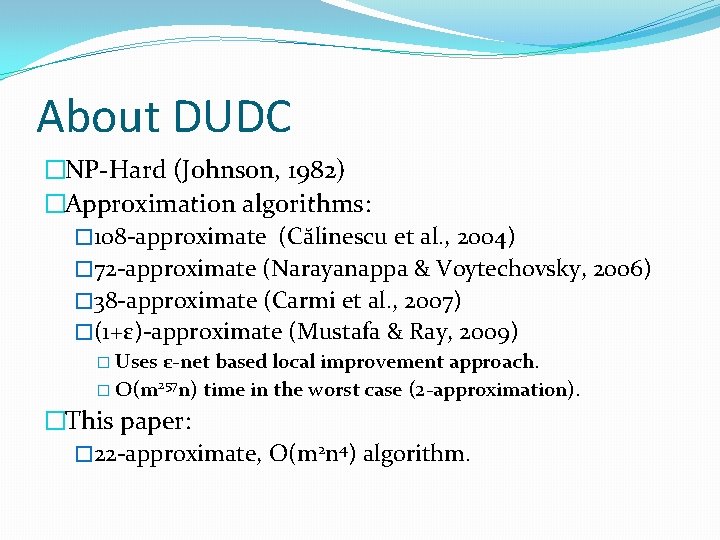
About DUDC �NP-Hard (Johnson, 1982) �Approximation algorithms: � 108 -approximate (Călinescu et al. , 2004) � 72 -approximate (Narayanappa & Voytechovsky, 2006) � 38 -approximate (Carmi et al. , 2007) �(1+ε)-approximate (Mustafa & Ray, 2009) � Uses ε-net based local improvement approach. � O(m 257 n) time in the worst case (2 -approximation). �This paper: � 22 -approximate, O(m 2 n 4) algorithm.
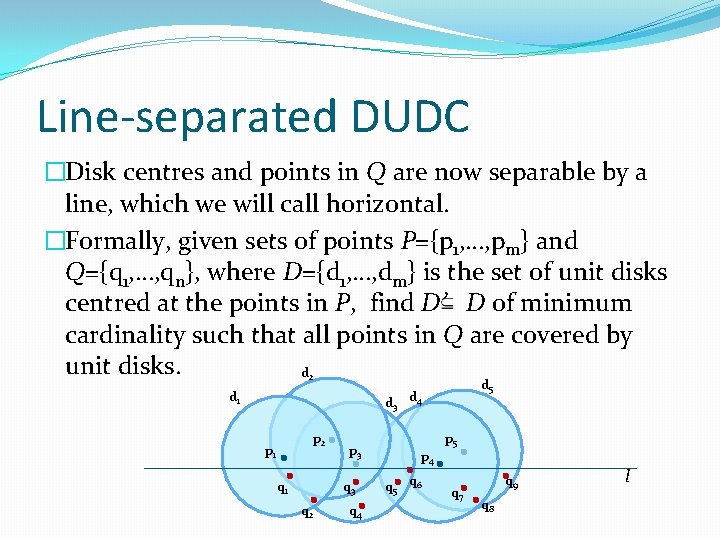
Line-separated DUDC �Disk centres and points in Q are now separable by a line, which we will call horizontal. �Formally, given sets of points P={p 1, …, pm} and Q={q 1, …, qn}, where D={d 1, …, dm} is the set of unit disks centred at the points in P, find D’ D of minimum cardinality such that all points in Q are covered by unit disks. d 2 d 1 d 3 p 2 p 1 q 1 p 3 q 2 q 4 d 5 d 4 p 4 q 5 q 6 p 5 q 7 q 9 q 8 l
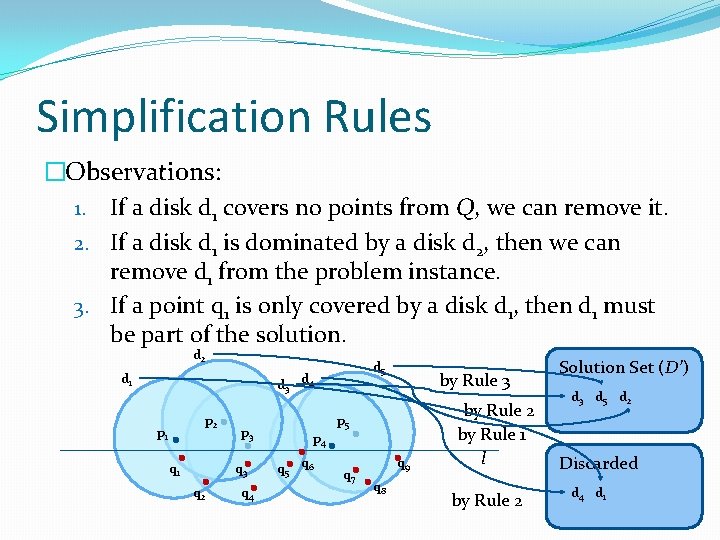
Simplification Rules �Observations: 1. If a disk d 1 covers no points from Q, we can remove it. 2. If a disk d 1 is dominated by a disk d 2, then we can remove d 1 from the problem instance. 3. If a point q 1 is only covered by a disk d 1, then d 1 must be part of the solution. d 2 d 1 d 3 p 2 p 1 q 1 p 3 q 2 q 4 d 5 d 4 p 4 q 5 q 6 by Rule 3 p 5 q 7 q 9 q 8 by Rule 2 by Rule 1 l by Rule 2 Solution Set (D’) d 3 d 5 d 2 Discarded d 4 d 1
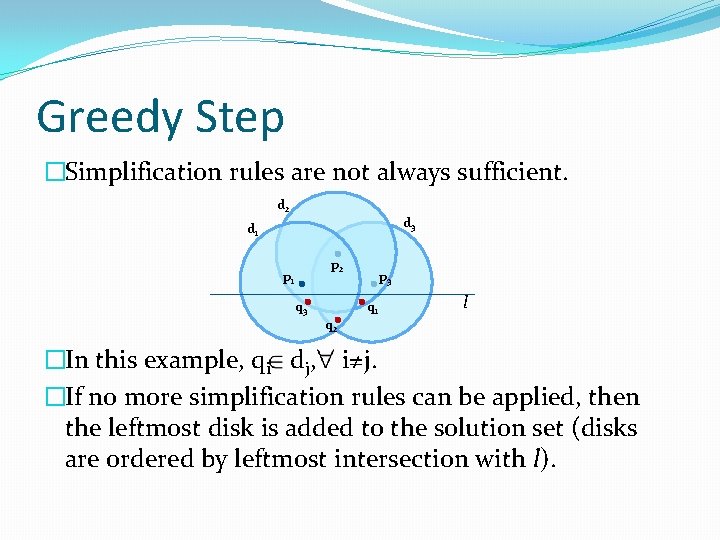
Greedy Step �Simplification rules are not always sufficient. d 2 d 3 d 1 p 2 p 1 q 3 q 2 p 3 q 1 l �In this example, qi dj, i≠j. �If no more simplification rules can be applied, then the leftmost disk is added to the solution set (disks are ordered by leftmost intersection with l).
The Greedy Algorithm
Correctness of GREEDY (1 of 4) �It needs to be proven that D’, the Greedy algorithm solution, is the minimum sized set of disks needed to cover the set of points in Q. �Assume the opposite is true, and that some algorithm OPT returns a solution DOPT, such that |DOPT |<|D’|. �Call d 1 the first disk selected by d d d GREEDY but not by OPT. p �Define C Q as the set of points p p l l l r r r covered by d 1. 2 3 1 2 1 1 2 3 3 q 1 2 3 l
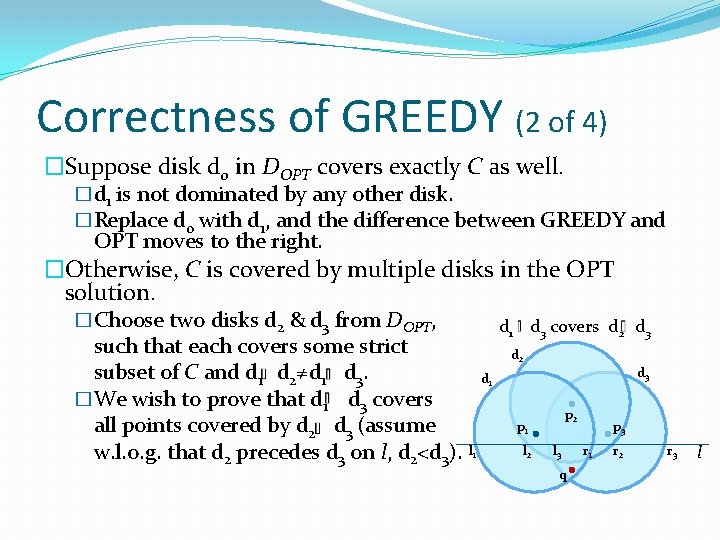
Correctness of GREEDY (2 of 4) �Suppose disk d 0 in DOPT covers exactly C as well. �d 1 is not dominated by any other disk. �Replace d 0 with d 1, and the difference between GREEDY and OPT moves to the right. �Otherwise, C is covered by multiple disks in the OPT solution. �Choose two disks d 2 & d 3 from DOPT, such that each covers some strict subset of C and d 1 d 2≠d 1 d 3. �We wish to prove that d 1 d 3 covers all points covered by d 2 d 3 (assume w. l. o. g. that d 2 precedes d 3 on l, d 2<d 3). d 1 d 3 covers d 2 d 3 d 1 p 2 p 1 l 2 l 3 q p 3 r 1 r 2 r 3 l
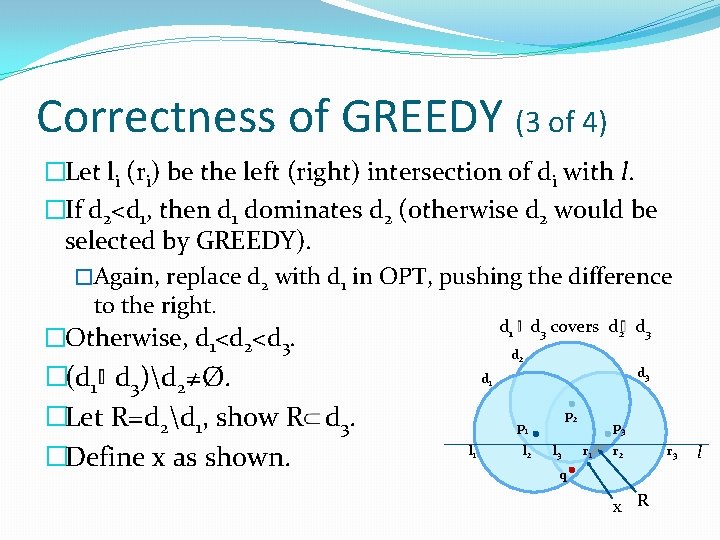
Correctness of GREEDY (3 of 4) �Let li (ri) be the left (right) intersection of di with l. �If d 2<d 1, then d 1 dominates d 2 (otherwise d 2 would be selected by GREEDY). �Again, replace d 2 with d 1 in OPT, pushing the difference to the right. d 1 d 3 covers d 2 d 3 �Otherwise, d 1<d 2<d 3. �(d 1 d 3)d 2≠Ø. �Let R=d 2d 1, show R d 3. �Define x as shown. d 2 d 3 d 1 p 2 p 1 l 2 l 3 p 3 r 1 r 2 q x R r 3 l
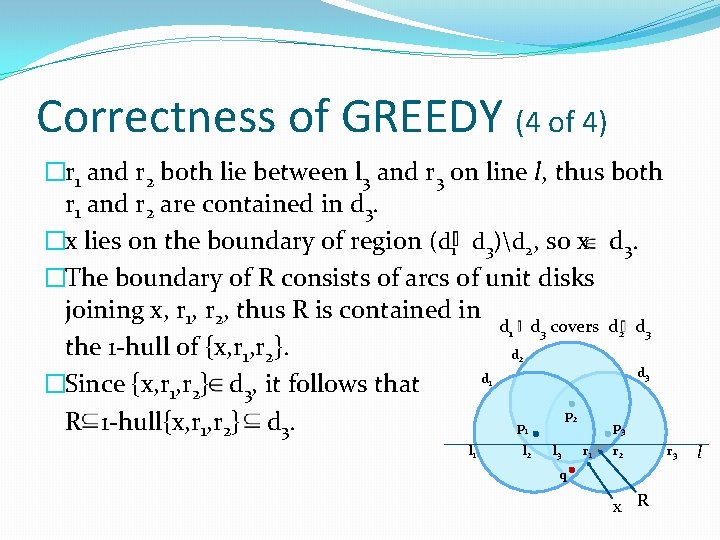
Correctness of GREEDY (4 of 4) �r 1 and r 2 both lie between l 3 and r 3 on line l, thus both r 1 and r 2 are contained in d 3. �x lies on the boundary of region (d 1 d 3)d 2, so x d 3. �The boundary of R consists of arcs of unit disks joining x, r 1, r 2, thus R is contained in d 1 d 3 covers d 2 d 3 the 1 -hull of {x, r 1, r 2}. d d d �Since {x, r 1, r 2} d 3, it follows that p R 1 -hull{x, r 1, r 2} d 3. p p 2 3 1 2 1 l 2 3 l 3 r 1 r 2 q x R r 3 l
Complexity of GREEDY �A naïve implementation of the algorithm requires O(m 3 n) time: �O(m 2 n) time to find all dominance relations for the simplification steps; �O(m) iterations of the simplification-greedy loop. �This is improved to O(m 2 n) overall worst case time by encoding all the dominance relations into a graph (our work), or with dynamic programming (Ambühl et al. , 2006). �This has been further refined to O(n(log n + m)) time in the journal version of this work, and is the product of joint work with Das and Nickerson.
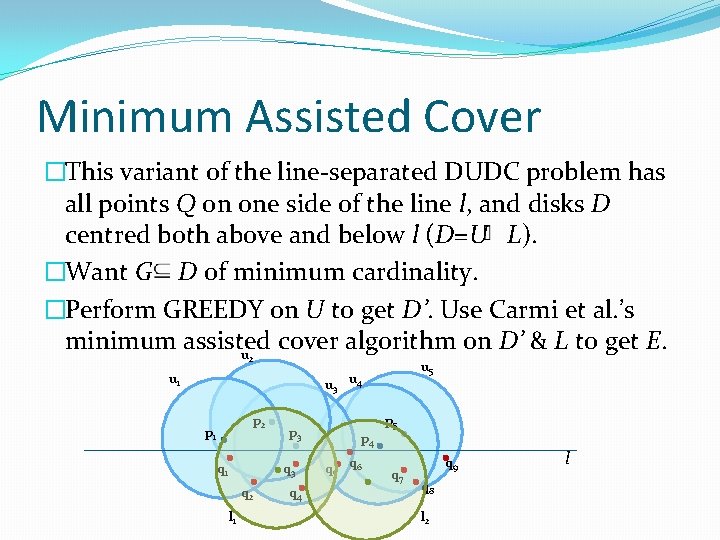
Minimum Assisted Cover �This variant of the line-separated DUDC problem has all points Q on one side of the line l, and disks D centred both above and below l (D=U L). �Want G D of minimum cardinality. �Perform GREEDY on U to get D’. Use Carmi et al. ’s minimum assisted cover algorithm on D’ & L to get E. u 2 u 1 u 3 p 2 p 1 q 1 p 3 q 2 l 1 q 4 u 5 u 4 p 4 q 5 q 6 p 5 q 7 q 9 q 8 l 2 l
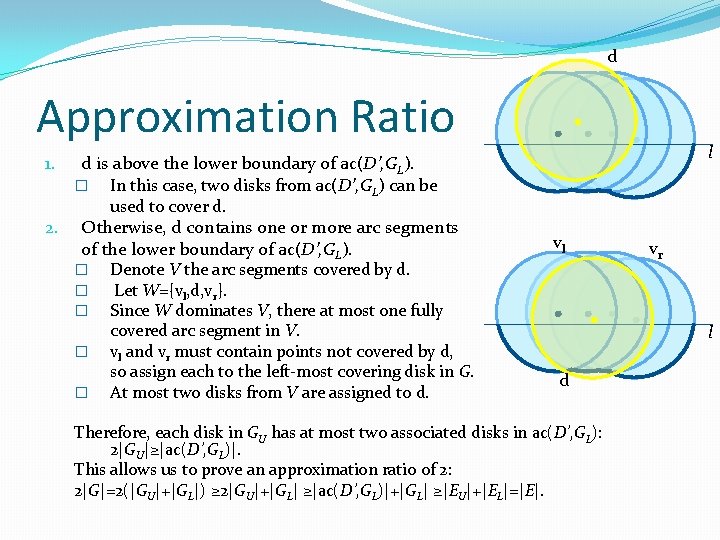
How good is E? �Separate E and G by l: EU, EL, GU, GL. �|E| = |EU|+|EL|≤|ac(D’, GL)|+|GL| �ac(D’, GL) is the smallest subset of D’ such that ac(D’, GL) is a cover when assisted by GL. �E is the minimum size assisted cover based on D’. �To show: 2|GU|≥|ac(D’, GL)| �Given a disk d GU, there are 2 cases: 1. 2. d is above the lower boundary of ac(D’, GL). Otherwise, d contains one or more arc segments of the lower boundary of ac(D’, GL).
d Approximation Ratio 1. l d is above the lower boundary of ac(D’, GL). � In this case, two disks from ac(D’, GL) can be used to cover d. 2. Otherwise, d contains one or more arc segments of the lower boundary of ac(D’, GL). � � � Denote V the arc segments covered by d. Let W={vl, d, vr}. Since W dominates V, there at most one fully covered arc segment in V. vl and vr must contain points not covered by d, so assign each to the left-most covering disk in G. At most two disks from V are assigned to d. vl vr l d Therefore, each disk in GU has at most two associated disks in ac(D’, GL): 2|GU|≥|ac(D’, GL)|. This allows us to prove an approximation ratio of 2: 2|G|=2(|GU|+|GL|) ≥ 2|GU|+|GL| ≥|ac(D’, GL)|+|GL| ≥|EU|+|EL|=|E|.
Discrete Unit Disk Cover �Carmi et al. use the assisted line separated DUDC algorithm as a subroutine in their work. �Our algorithm provides a 2 -approximation (the original paper had a 4 -approximation). �There are eight applications of this algorithm, and one other technique used has a 6 -approximation, so the total approximation factor is 8∙ 2+1∙ 6=22. �The running time of our technique is O(m 2 n) (computing the assisting cover adds nothing), and it is used a constant number of times. �Carmi et al. search for the DUDC of all 3/2 x 3/2 squares, which in the worst case can take O(m 2 n 4) time.
Conclusions �An exact line-separable discrete unit disk cover algorithm is used to provide a 22 -approximate solution to the discrete unit disk cover problem in O(m 2 n 4) worst case time. �Future work: �Can the approximation factor be improved further along these lines? �Can the running time be improved?
Thanks �Coauthors, algorithms group at Waterloo �Paz Carmi �Sariel Har-Peled �NSERC (National Sciences and Engineering Research Council of Canada)