
Practical Discrete Unit Disk Cover Using an Exact




- Slides: 32
Practical Discrete Unit Disk Cover Using an Exact Line-Separable Algorithm Alejandro Salinger University of Waterloo Joint work with Francisco Claude, Gautam K. Das, Reza Dorrigiv, Stephane Durocher, Robert Fraser, Alejandro López-Ortiz, Bradford G. Nickerson Santiago, December 2010
Outline �Discrete Unit Disc Cover Problem �Line Separable Version �Simple Greedy Algorithm �Faster Dual Algorithm �Approximating the General Problem �Recent Advances 2
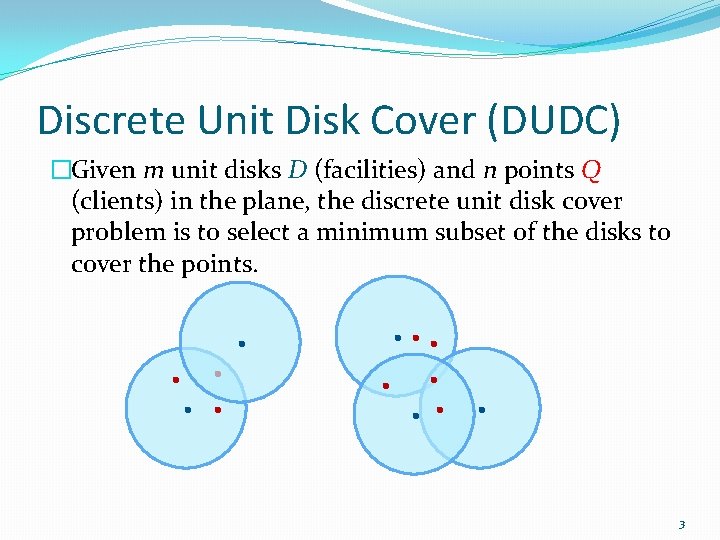
Discrete Unit Disk Cover (DUDC) �Given m unit disks D (facilities) and n points Q (clients) in the plane, the discrete unit disk cover problem is to select a minimum subset of the disks to cover the points. 3
Applications 4
Applications 5
Applications 6
s n o i t a c i l p p A
About Discrete Unit Disk Cover �NP-Hard (Johnson, 1982) �Geometric version of SET-COVER �SET-COVER is not approximable within c log n �DUDC admits constant factor approximation �Related problems: � Minimum Geometric Disk Cover: disk centres are not restricted. � Discrete k-Centre: find set of k disks minimizing largest radius. 8
About Discrete Unit Disk Cover �Approximation algorithms for DUDC: � 108 -approximate (Călinescu et al. , 2004) � 72 -approximate (Narayanappa & Voytechovsky, 2006) � 38 -approximate (Carmi et al. , 2007) �(1+ε)-approximate (Mustafa & Ray, 2009) � Uses local improvement approach � O(m 65 n) time in the worst case (3 -approximation) �This paper: � 22 -approximate, O(m 2 n 4) algorithm. 9
Line-separated DUDC � d 2 d 1 d 3 p 2 p 1 q 1 p 3 q 2 q 4 d 5 d 4 p 4 q 5 q 6 p 5 q 7 q 9 q 8 l 10
11
A Simple Greedy Algorithm �Simplification rules: 1. If a disk d 1 covers no points from Q, we can remove it. 2. If a disk d 1 is dominated by a disk d 2, then we can remove d 1 from the problem instance. 3. If a point q 1 is only covered by a disk d 1, then d 1 must be part of the solution. by Rule 3 d 2 d 1 d 3 p 2 p 1 q 1 p 3 q 2 q 4 d 5 d 4 p 4 q 5 q 6 by Rule 3 p 5 q 7 q 9 q 8 by Rule 2 by Rule 1 l by Rule 2 Solution Set (D’) d 3 d 5 d 2 Discarded d 4 d 1 12
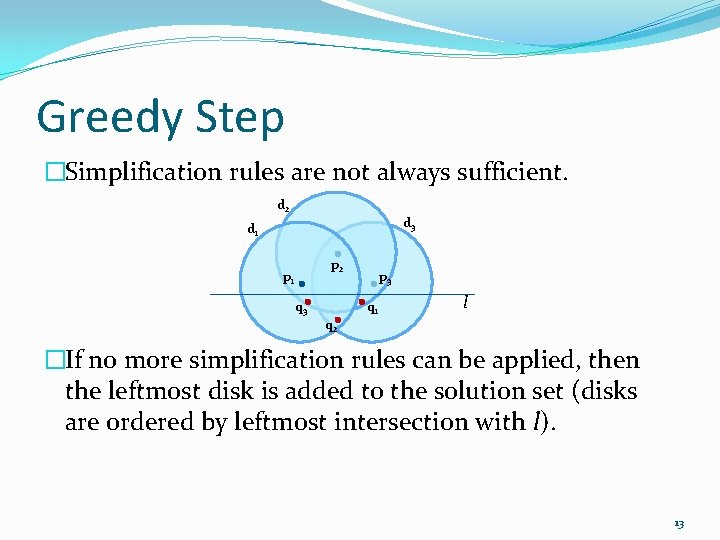
Greedy Step �Simplification rules are not always sufficient. d 2 d 3 d 1 p 2 p 1 q 3 q 2 p 3 q 1 l �If no more simplification rules can be applied, then the leftmost disk is added to the solution set (disks are ordered by leftmost intersection with l). 13
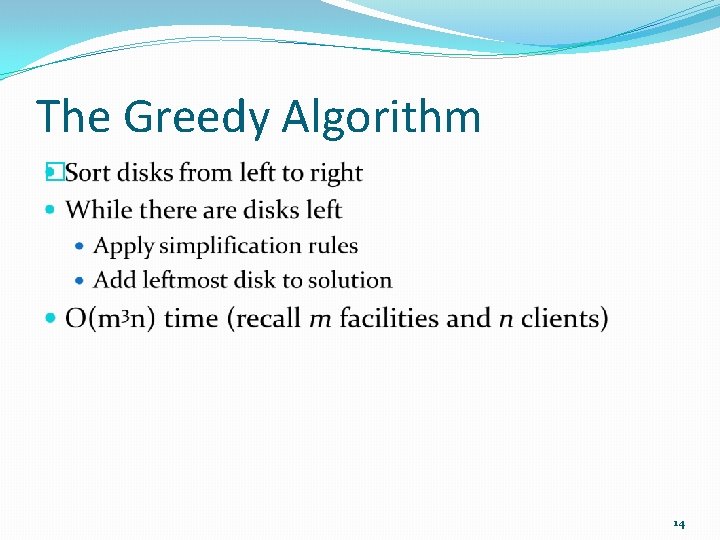
The Greedy Algorithm � 14
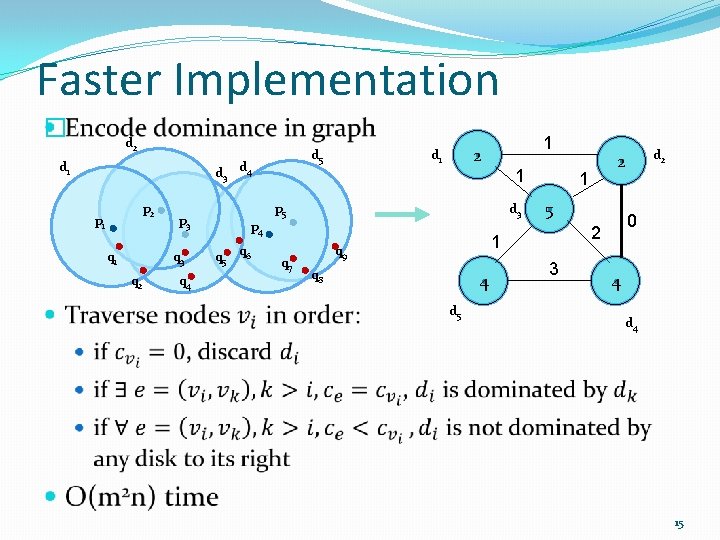
Faster Implementation � d 2 d 1 d 3 p 2 p 1 q 1 p 3 q 2 q 4 d 4 p 4 q 5 d 5 q 6 1 2 d 1 1 p 5 q 7 d 3 1 5 q 8 4 d 5 0 2 1 q 9 3 d 2 2 4 d 4 15
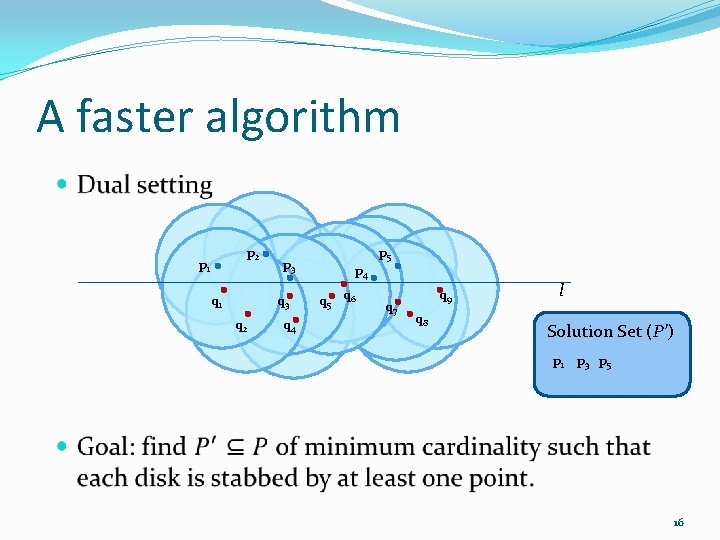
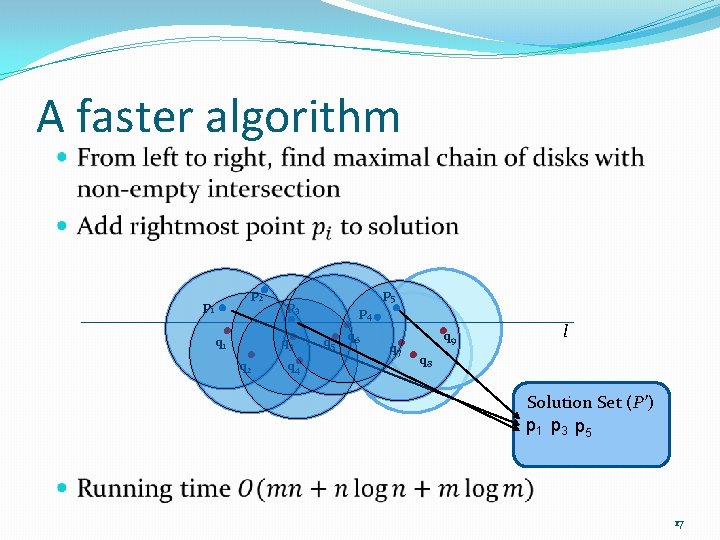
A faster algorithm p 2 p 1 q 1 p 3 q 2 q 4 p 4 q 5 q 6 p 5 q 7 q 9 q 8 l Solution Set (P’) p 1 p 3 p 5 16
A faster algorithm p 2 p 1 q 1 p 3 q 2 q 4 p 4 q 5 q 6 p 5 q 7 q 9 l q 8 Solution Set (P’) p 1 p 3 p 5 17
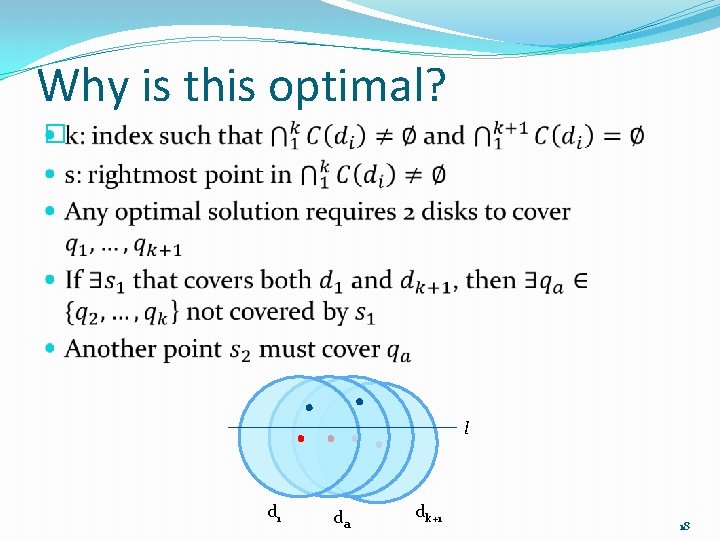
Why is this optimal? � l d 1 da dk+1 18
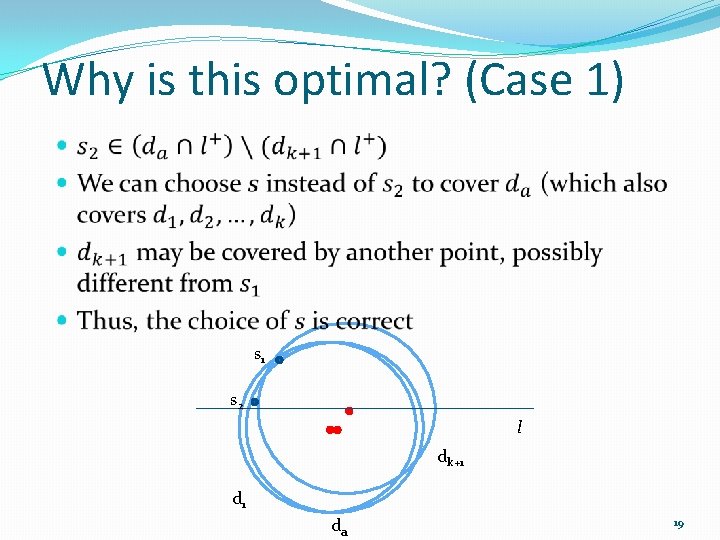
Why is this optimal? (Case 1) s 1 s 2 l dk+1 d 1 da 19
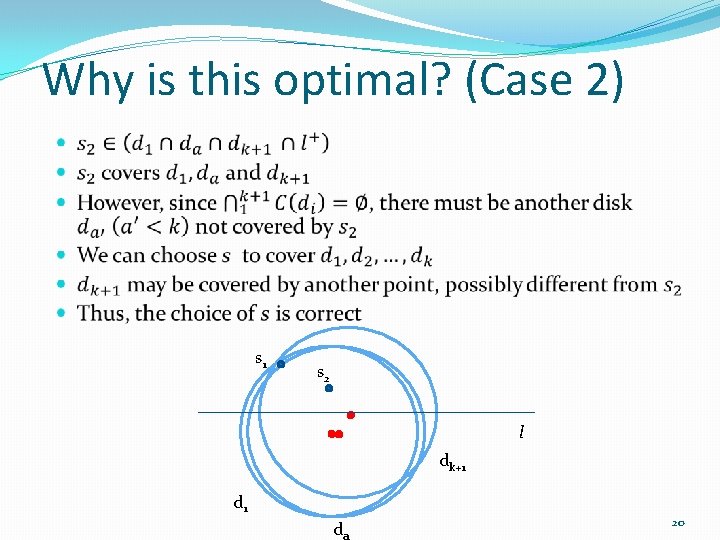
Why is this optimal? (Case 2) s 1 s 2 l dk+1 d 1 da 20
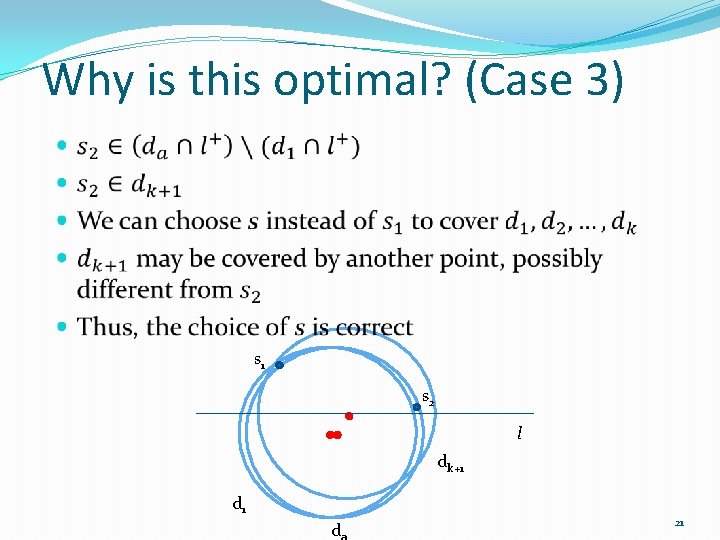
Why is this optimal? (Case 3) s 1 s 2 l dk+1 d 21
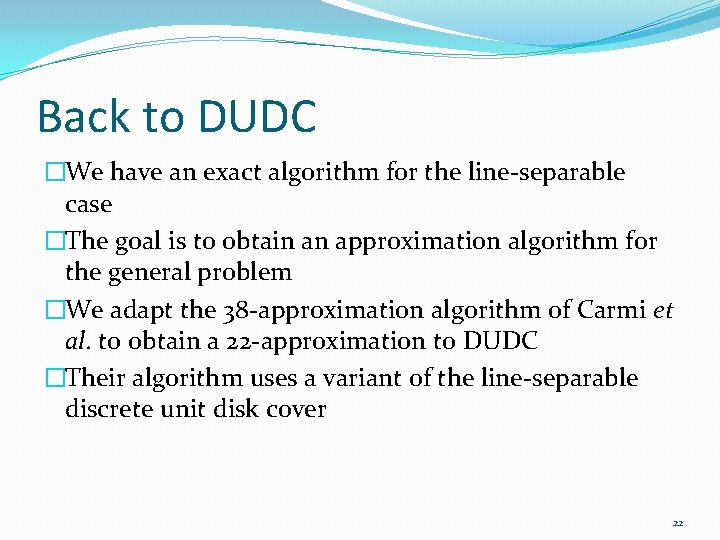
Back to DUDC �We have an exact algorithm for the line-separable case �The goal is to obtain an approximation algorithm for the general problem �We adapt the 38 -approximation algorithm of Carmi et al. to obtain a 22 -approximation to DUDC �Their algorithm uses a variant of the line-separable discrete unit disk cover 22
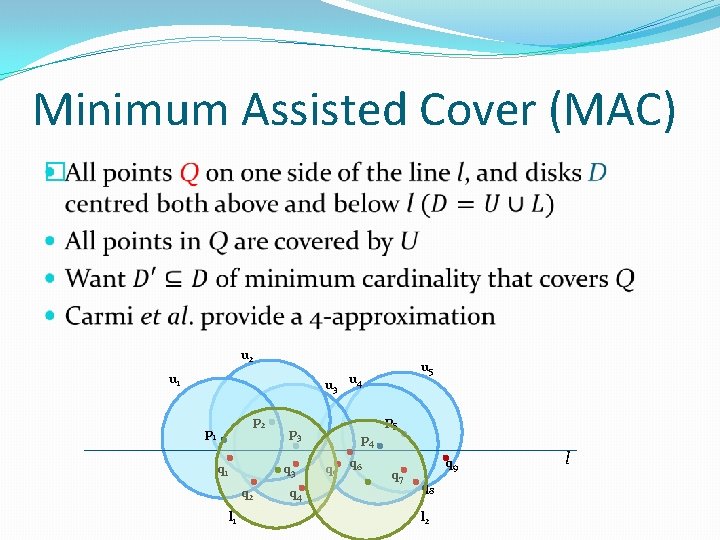
Minimum Assisted Cover (MAC) � u 2 u 1 u 3 p 2 p 1 q 1 p 3 q 2 l 1 q 4 u 5 u 4 p 4 q 5 q 6 p 5 q 7 q 9 q 8 l 2 l
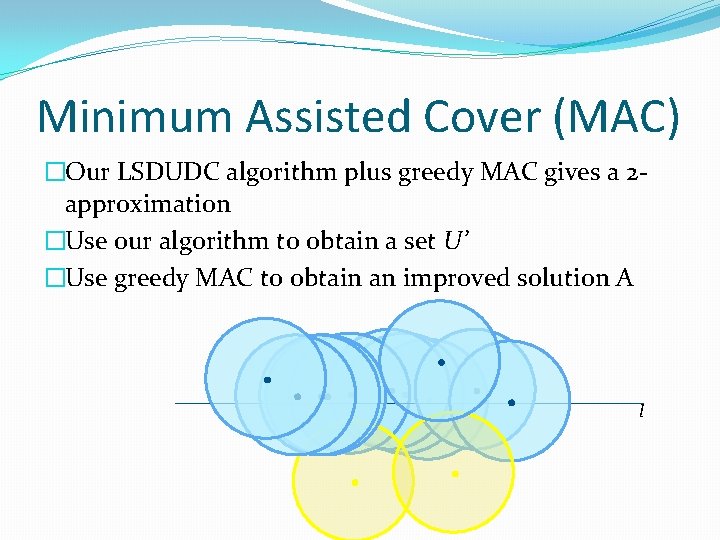
Minimum Assisted Cover (MAC) �Our LSDUDC algorithm plus greedy MAC gives a 2 approximation �Use our algorithm to obtain a set U’ �Use greedy MAC to obtain an improved solution A l
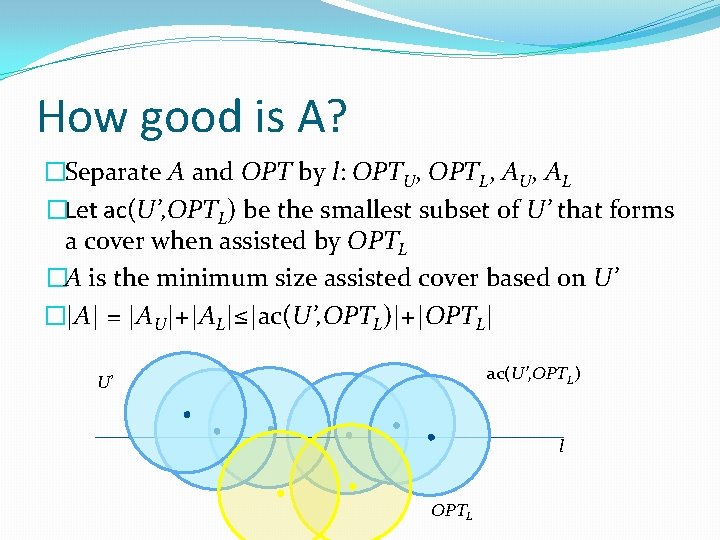
How good is A? �Separate A and OPT by l: OPTU, OPTL, AU, AL �Let ac(U’, OPTL) be the smallest subset of U’ that forms a cover when assisted by OPTL �A is the minimum size assisted cover based on U’ �|A| = |AU|+|AL|≤|ac(U’, OPTL)|+|OPTL| ac(U’, OPTL) U’ l OPTL
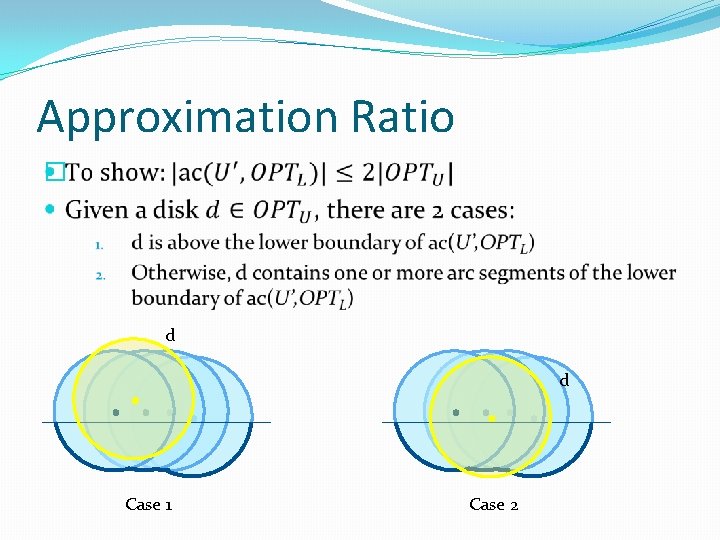
Approximation Ratio � d d Case 1 Case 2
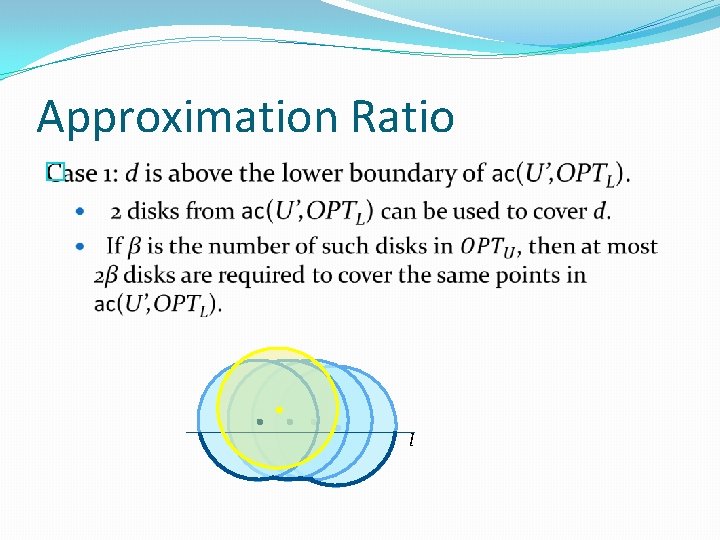
Approximation Ratio � l
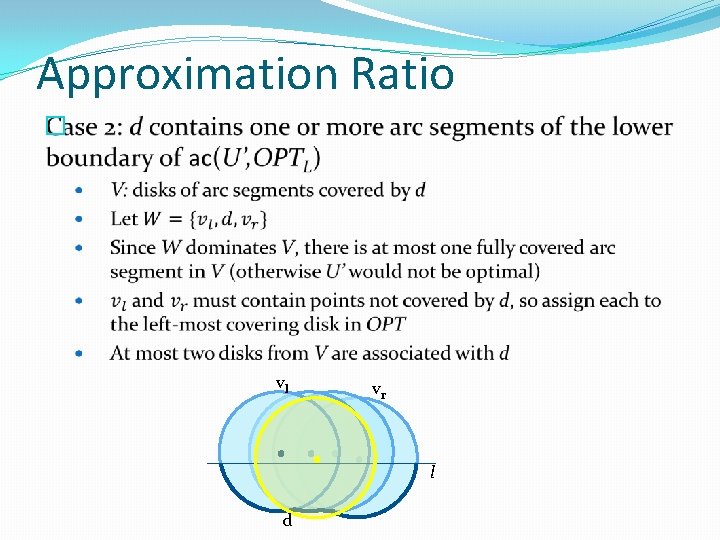
Approximation Ratio � vl vr l d
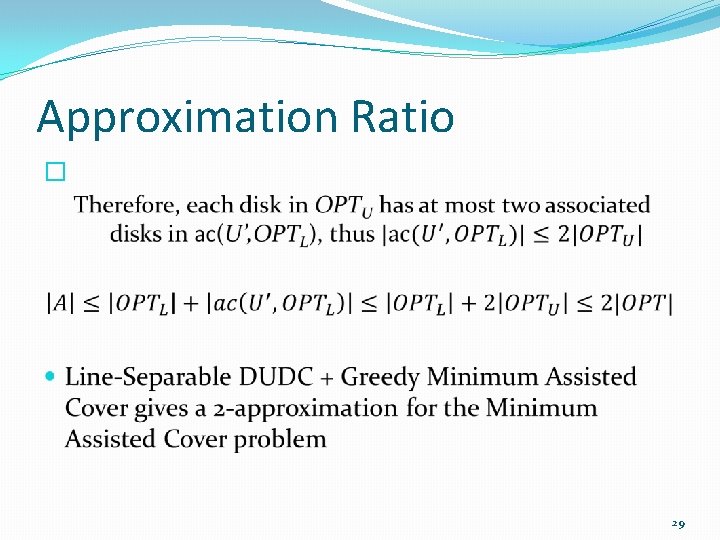
Approximation Ratio � 29
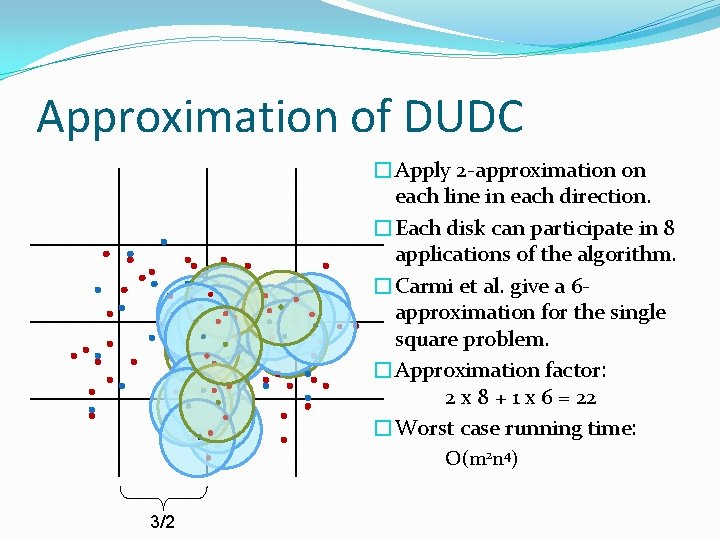
Approximation of DUDC �Apply 2 -approximation on each line in each direction. �Each disk can participate in 8 applications of the algorithm. �Carmi et al. give a 6 approximation for the single square problem. �Approximation factor: 2 x 8 + 1 x 6 = 22 �Worst case running time: O(m 2 n 4) 3/2
Summary �We presented an exact algorithm for the case when clients and facilities are separated by a line �This allowed us to improve the approximation to the Minimum Assisted Cover problem �We improved the approximation ratio from 38 to 22 for the general Discrete Unit Disk Cover problem �O(m 2 n 4) running time 31
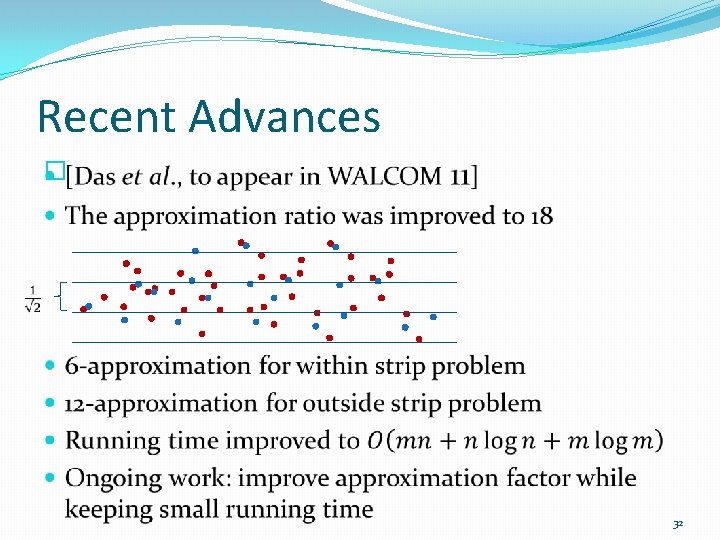
Recent Advances � 32