
Practical Criticism for BA III English Students of
Practical Criticism for BA III English Students of Mrs. Snehal R. Prabhune
Practical Criticism • Also called Applied Criticism or Critical appreciation of a poem or prose passage • Concept: Analysis of the given poem or prose passage with respect to its: • Subject • Content • Structure • Tone • Imagery • Verbal felicity • Rhythm • Metre • Figures of Speech
History and Significance • I A Richards’ Practical Criticism (1929) explains the need for Practical Criticism • New Critics in America popularized the concept through theory of ‘close reading’ • Significance: • A lively experience • Helps to identify the sources yielding pleasure in a given text • Students need to answer a question in their paper on criticism on this topic
Appreciation of Unseen Poem • Questions below the poem should be used only as hints or help in appreciating the poem. • Appreciation should be in the form of continuous prose in the form of paragraphs.
Plan of a Critical Appreciation • Three Parts: 1. What 2. How 3. Personal Impression/ Comments/ Summing up
First Part: “What” • • • Answers to questions like, What is-----the theme of the poem general meaning intention of the poet mood of the poem type of the poem special lyrical type if any comment on the period or literary age of the poem if part of British, American, African, Indian literature etc.
Second Part: “How” • This part discusses the use of various devices by the poet i. e. how the poet has conveyed the “what” of in the poem. • Devices are of three types: 1. Structural devices-Contrast -Illustration -Repetition 2. Sense devices-Simile, Metaphor and all figures of speech 3. Sound devices-rhythm, rhyme, alliteration, assonance, consonance, onomatopoeia etc.
Second Part contd. • While writing about these devices one paragraph for each type of devices is sufficient. • Regarding figures of speech and sound devices it is not just enough to locate their use; they should be explained, their significance brought out. • Use of inversion or foregrounding if any also has to be explained
Third Part • This part sums up whatever has gone before. • Your impressions about the poem or its effect on you be stated • Any comments on the poem in short
Some terms clarified • Types of poems- Descriptive, Narrative and Reflective (sometimes a poem may be a combination of two types also) • Mood could be light or serious • Lyrical type: sonnet, elegy, ballad, ode, dramatic monologue, idyll etc. • Age/ Period/ School: Renaissance or Shakespearean, Metaphysical, Neo-classical, Romantic, Modern etc. • Indian/ American/ British/ Australian/ African/ Carribean/ Canadian etc (if possible) • Intention: See if there is any hiden meaning
Structural Devices • Contrast: The idea or object intended to highlight is contrasted with an opposite idea or object. e. g. In Blake’s “Tyger” there is a line: “ Did he make the lamb Make thee? ” • Illustration: The idea that the poet intends to emphasize is explained with an example. e. g. In Wordswoth’s • “Daffodils” the poet emphasizes the huge number of the flowers by saying: “ten thousands saw at a glance”, “ a host of golden daffodils” • Repetition: A poet repeats an idea in two or more stanzas in order to highlight it. e. g. Superiority of old age is emphasized by enumerating the benefits of old age.
Sense Devices • • Simile Metaphor Personification Antithesis, Oxymoron Hyperbole Synecdoche Metonymy Irony/Paradox
Sound Devices • • Rhyme Rhythm (metres) Alliteration Consonance Assonance Repetition/ Refrain Onomatopoeia
Rhyme • Perfect rhymes/ Full Rhymes • Rime Riche- same spelling/ words, but different meanings in the two cases • Masculine Rhyme-only final stressed syllable rhymes e. g. ‘bad’ and ‘mad’ • Feminine Rhyme-final two syllables of which final syllable is unstressed rhyme e. g. ‘pester’ and ‘fester’ • Triple Rhyme- three syllables rhyme, but is quite unusual e. g. ‘revision’ and ‘division’ • Para rhyme/Half rhyme- opening and closing consonants of the rhyming words are same but the middle vowel is different e. g. ‘hall’ and ‘hell’
Effects of Rhyme • Contribute to the poetic structure • Musical , hence pleasing • Easily noticed, gets prominence and thus carries important ideas • Can bea guide to the poem’s meaning
Rhythm/ Metres/ Prosody • Prosody is the study of the metrical pattern of a poem to understand the poetic effects. • Scansion is division of words into syllables and determining whether they are stressed or unstressed and thereby deciding the metre used. • Syllable- the smallest unit of metrics- any word or part of a word that contains a single voiced vowel or a diphthong with or without any marginal element (consonant). Thus one voiced vowel= one syllable. Monosyllabic word – go, taught sea • Disyllabic words- tonight, water, Bruno • Trisyllabic / polysyllabic words-property, emphasis
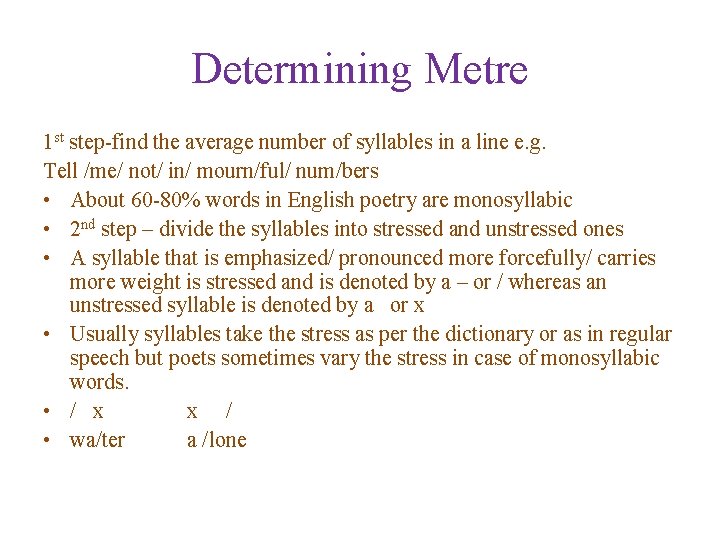
Determining Metre 1 st step-find the average number of syllables in a line e. g. Tell /me/ not/ in/ mourn/ful/ num/bers • About 60 -80% words in English poetry are monosyllabic • 2 nd step – divide the syllables into stressed and unstressed ones • A syllable that is emphasized/ pronounced more forcefully/ carries more weight is stressed and is denoted by a – or / whereas an unstressed syllable is denoted by a or x • Usually syllables take the stress as per the dictionary or as in regular speech but poets sometimes vary the stress in case of monosyllabic words. • / x x / • wa/ter a /lone
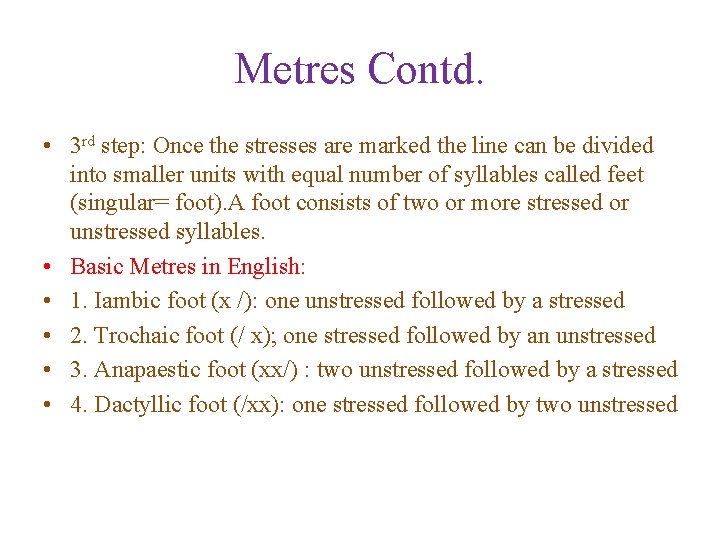
Metres Contd. • 3 rd step: Once the stresses are marked the line can be divided into smaller units with equal number of syllables called feet (singular= foot). A foot consists of two or more stressed or unstressed syllables. • Basic Metres in English: • 1. Iambic foot (x /): one unstressed followed by a stressed • 2. Trochaic foot (/ x); one stressed followed by an unstressed • 3. Anapaestic foot (xx/) : two unstressed followed by a stressed • 4. Dactyllic foot (/xx): one stressed followed by two unstressed
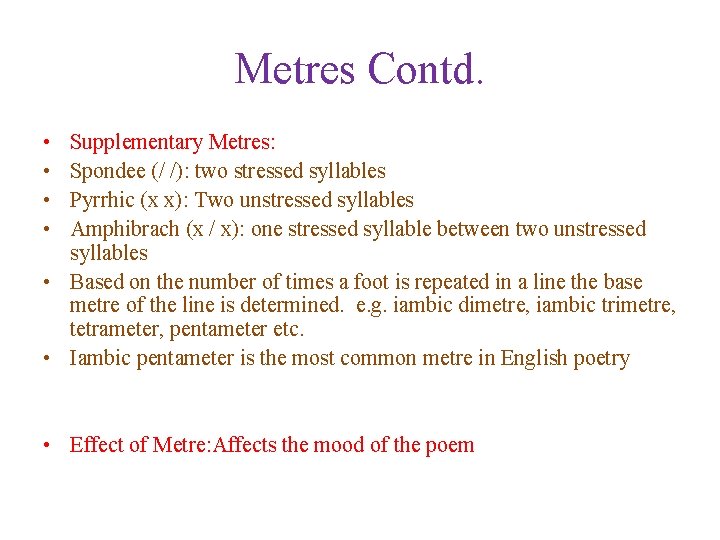
Metres Contd. • • Supplementary Metres: Spondee (/ /): two stressed syllables Pyrrhic (x x): Two unstressed syllables Amphibrach (x / x): one stressed syllable between two unstressed syllables • Based on the number of times a foot is repeated in a line the base metre of the line is determined. e. g. iambic dimetre, iambic trimetre, tetrameter, pentameter etc. • Iambic pentameter is the most common metre in English poetry • Effect of Metre: Affects the mood of the poem
Thank You
- Slides: 20