
Practical Aspects of EXAFS Data Collection How to
- Slides: 27
Practical Aspects of EXAFS Data Collection; How to Get it Right the First Time Juan S Lezama Pacheco and John R. Bargar Synchrotron X-Ray Absorption Spectroscopy Summer School June 28 - July 1, 2011
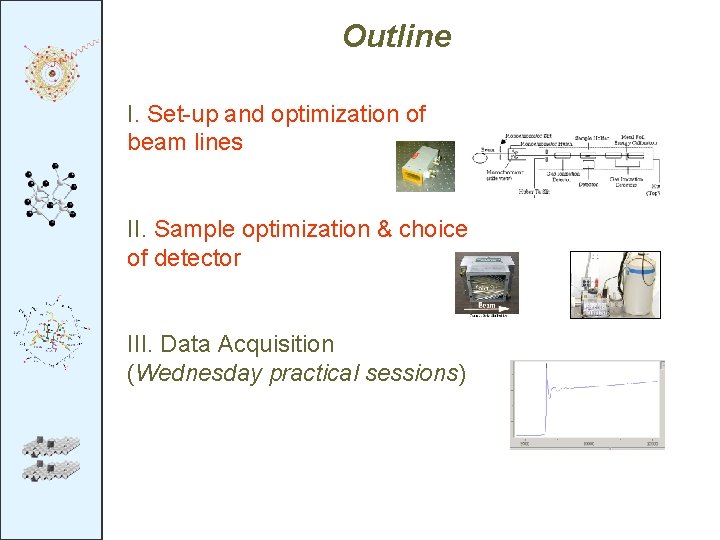
Outline I. Set-up and optimization of beam lines II. Sample optimization & choice of detector III. Data Acquisition (Wednesday practical sessions)
I. Beam line set-up and optimization • Major elements of in-hutch equipment • Major elements outside of hutch • Ion chambers and their output signal chain • Mono tuning - why, how, and how much? • Slit size for samples, impact on resolution • Energy calibration: why, how frequently?
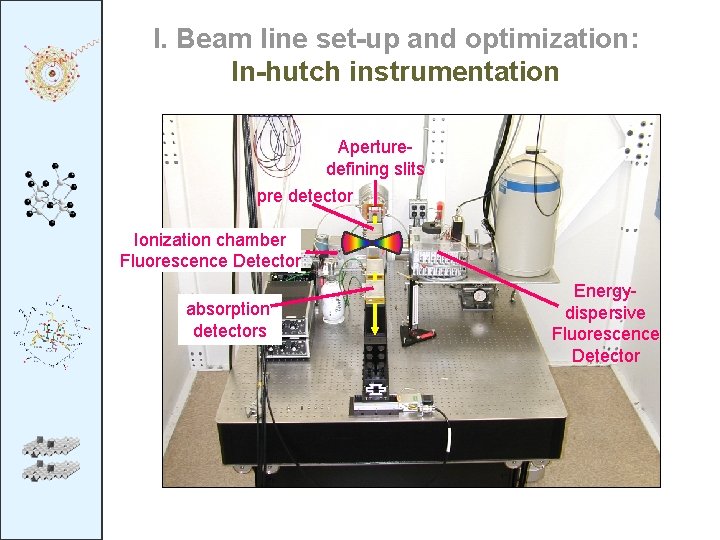
I. Beam line set-up and optimization: In-hutch instrumentation Aperturedefining slits pre-detector pre detector Ionization chamber Sample Fluorescence Detector absorption detectors Energydispersive Fluorescence Detector
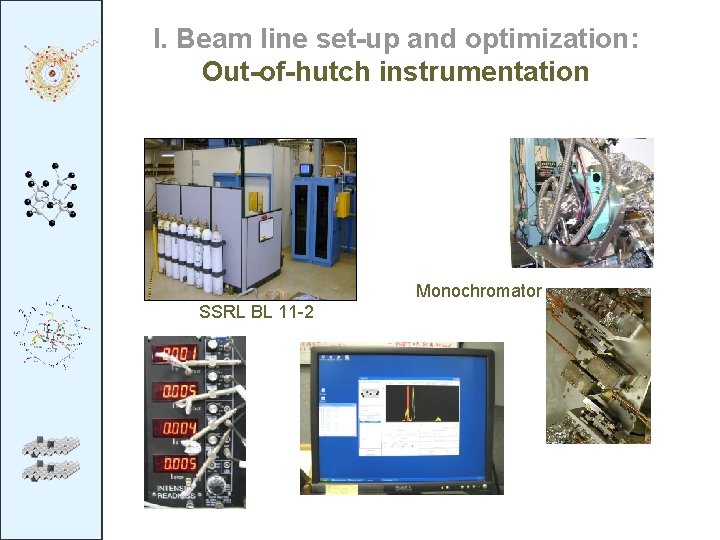
I. Beam line set-up and optimization: Out-of-hutch instrumentation Monochromator SSRL BL 11 -2
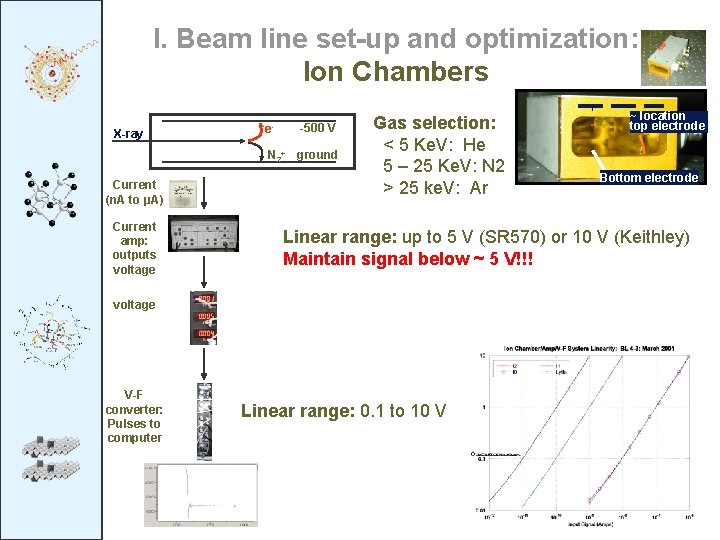
I. Beam line set-up and optimization: Ion Chambers X-ray e- -500 V N 2+ ground Current (n. A to μA) Current amp: outputs voltage Gas selection: < 5 Ke. V: He 5 – 25 Ke. V: N 2 > 25 ke. V: Ar Bottom electrode Linear range: up to 5 V (SR 570) or 10 V (Keithley) Maintain signal below ~ 5 V!!! voltage V-F converter: Pulses to computer ~ location top electrode Linear range: 0. 1 to 10 V
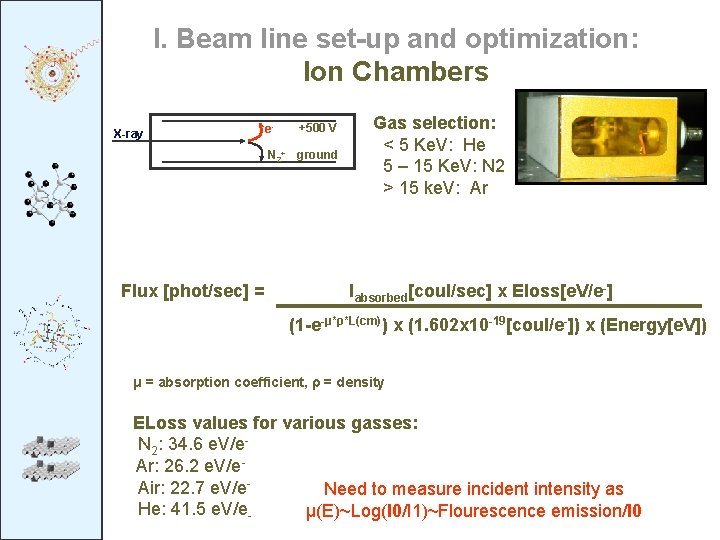
I. Beam line set-up and optimization: Ion Chambers X-ray e- +500 V N 2+ ground Flux [phot/sec] = Gas selection: < 5 Ke. V: He 5 – 15 Ke. V: N 2 > 15 ke. V: Ar Iabsorbed[coul/sec] x Eloss[e. V/e-] (1 -e-μ*ρ*L(cm)) x (1. 602 x 10 -19[coul/e-]) x (Energy[e. V]) μ = absorption coefficient, ρ = density ELoss values for various gasses: N 2: 34. 6 e. V/e. Ar: 26. 2 e. V/e. Air: 22. 7 e. V/e. Need to measure incident intensity as He: 41. 5 e. V/eμ(E)~Log(I 0/I 1)~Flourescence emission/I 0
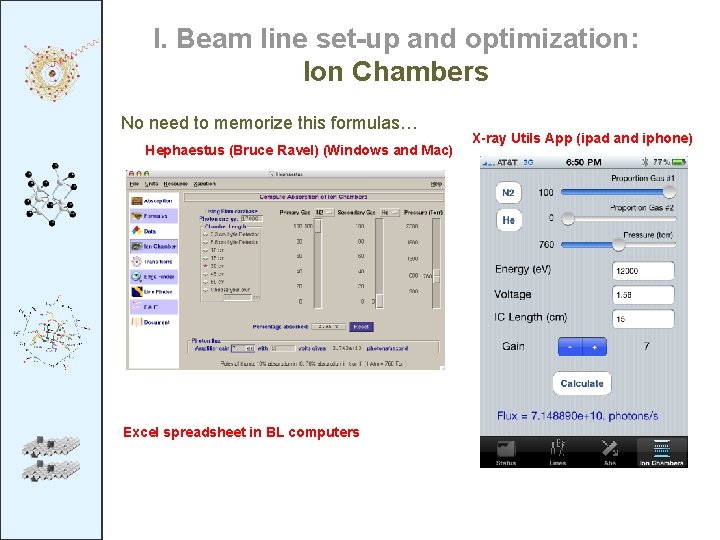
I. Beam line set-up and optimization: Ion Chambers No need to memorize this formulas… Hephaestus (Bruce Ravel) (Windows and Mac) Excel spreadsheet in BL computers X-ray Utils App (ipad and iphone)
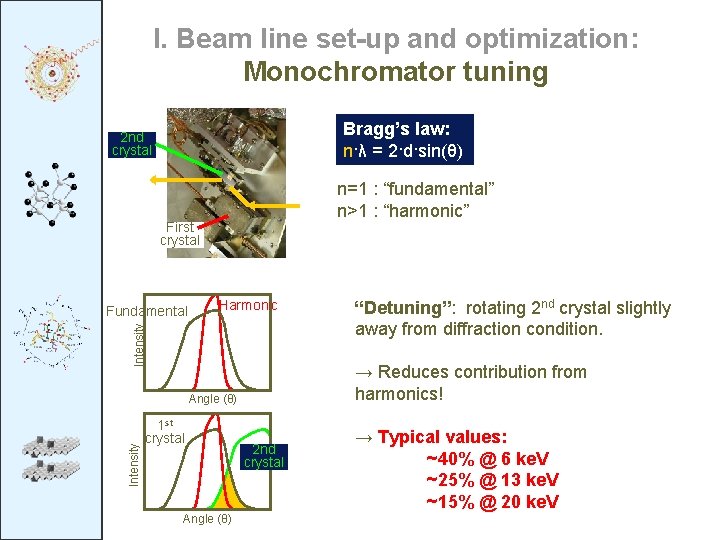
I. Beam line set-up and optimization: Monochromator tuning Bragg’s law: n·λ = 2·d·sin(θ) 2 nd crystal n=1 : “fundamental” n>1 : “harmonic” First crystal Harmonic Intensity Fundamental → Reduces contribution from harmonics! Intensity Angle (θ) 1 st crystal Angle (θ) “Detuning”: rotating 2 nd crystal slightly away from diffraction condition. 2 nd crystal → Typical values: ~40% @ 6 ke. V ~25% @ 13 ke. V ~15% @ 20 ke. V
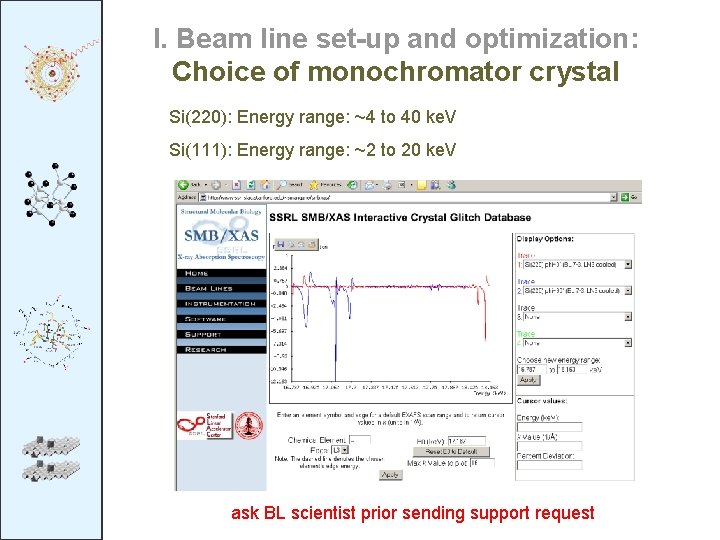
I. Beam line set-up and optimization: Choice of monochromator crystal Si(220): Energy range: ~4 to 40 ke. V Si(111): Energy range: ~2 to 20 ke. V ask BL scientist prior sending support request
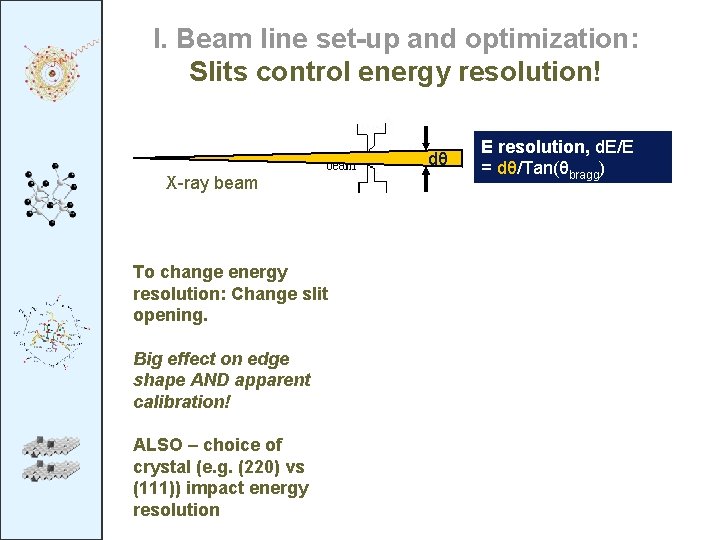
I. Beam line set-up and optimization: Slits control energy resolution! dθ X-ray beam To change energy resolution: Change slit opening. Big effect on edge shape AND apparent calibration! ALSO – choice of crystal (e. g. (220) vs (111)) impact energy resolution E resolution, d. E/E = dθ/Tan(θbragg)
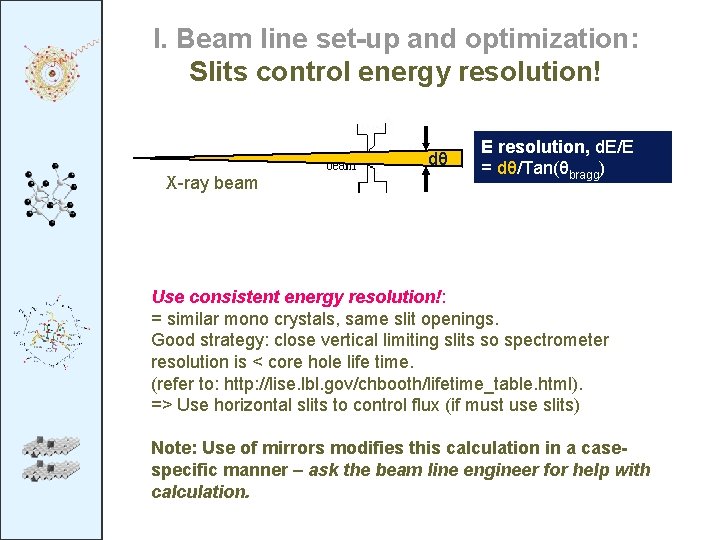
I. Beam line set-up and optimization: Slits control energy resolution! dθ X-ray beam E resolution, d. E/E = dθ/Tan(θbragg) Use consistent energy resolution!: = similar mono crystals, same slit openings. Good strategy: close vertical limiting slits so spectrometer resolution is < core hole life time. (refer to: http: //lise. lbl. gov/chbooth/lifetime_table. html). => Use horizontal slits to control flux (if must use slits) Note: Use of mirrors modifies this calculation in a casespecific manner – ask the beam line engineer for help with calculation.
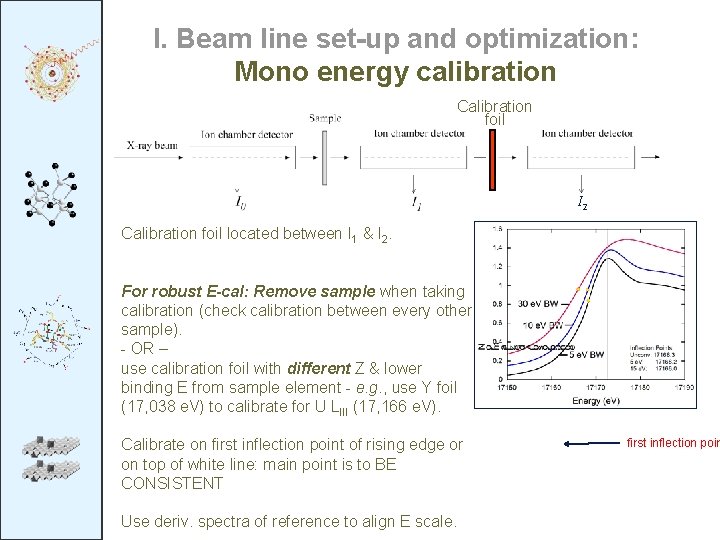
I. Beam line set-up and optimization: Mono energy calibration Calibration foil I 2 Calibration foil located between I 1 & I 2. For robust E-cal: Remove sample when taking calibration (check calibration between every other sample). - OR – use calibration foil with different Z & lower binding E from sample element - e. g. , use Y foil (17, 038 e. V) to calibrate for U LIII (17, 166 e. V). Calibrate on first inflection point of rising edge or on top of white line: main point is to BE CONSISTENT Use deriv. spectra of reference to align E scale. first inflection poin
II. Sample alignment and detectors • Transmission vs fluorescence geometry • Transmission geometry • Lytle detectors for fluorescence yield detection • Ge detector: highly dilute, chemically complex samples
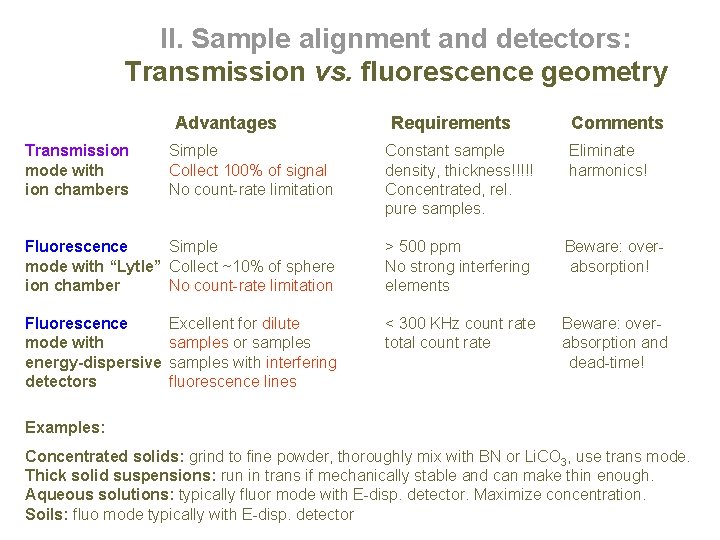
II. Sample alignment and detectors: Transmission vs. fluorescence geometry Advantages Transmission mode with ion chambers Requirements Comments Simple Collect 100% of signal No count-rate limitation Constant sample density, thickness!!!!! Concentrated, rel. pure samples. Eliminate harmonics! Fluorescence Simple mode with “Lytle” Collect ~10% of sphere ion chamber No count-rate limitation > 500 ppm No strong interfering elements Beware: overabsorption! Fluorescence mode with energy-dispersive detectors < 300 KHz count rate total count rate Beware: overabsorption and dead-time! Excellent for dilute samples or samples with interfering fluorescence lines Examples: Concentrated solids: grind to fine powder, thoroughly mix with BN or Li. CO 3, use trans mode. Thick solid suspensions: run in trans if mechanically stable and can make thin enough. Aqueous solutions: typically fluor mode with E-disp. detector. Maximize concentration. Soils: fluo mode typically with E-disp. detector
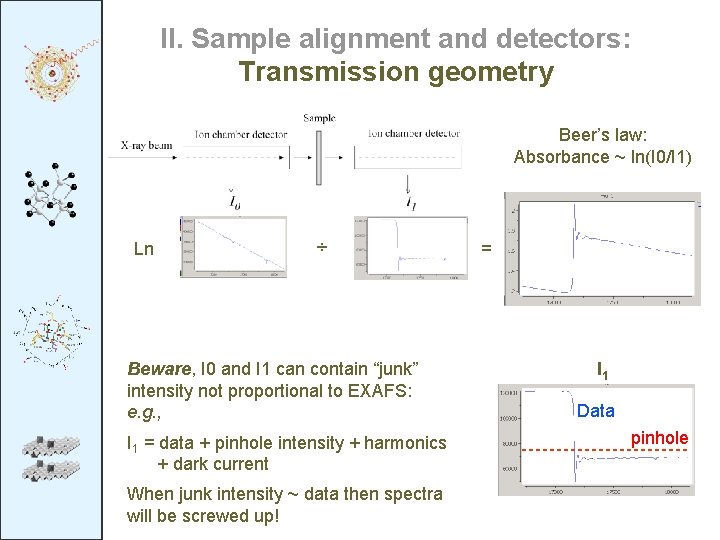
II. Sample alignment and detectors: Transmission geometry Beer’s law: Absorbance ~ ln(I 0/I 1) Ln ÷ Beware, I 0 and I 1 can contain “junk” intensity not proportional to EXAFS: e. g. , I 1 = data + pinhole intensity + harmonics + dark current When junk intensity ~ data then spectra will be screwed up! = I 1 Data pinhole
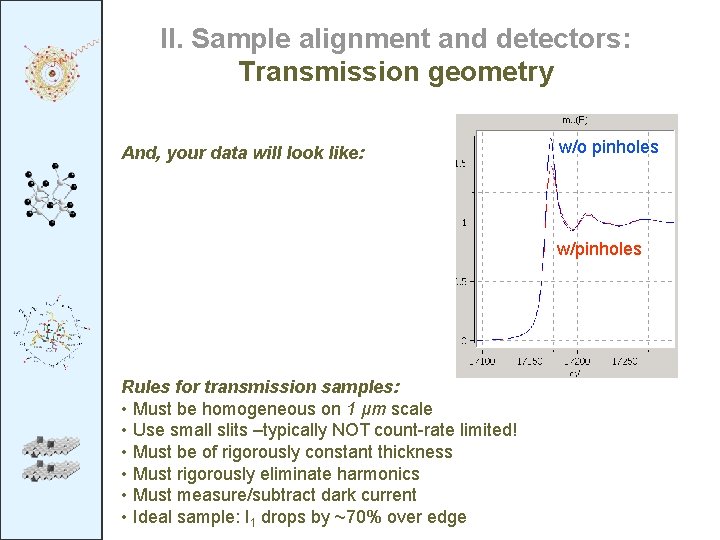
II. Sample alignment and detectors: Transmission geometry And, your data will look like: w/o pinholes w/pinholes Rules for transmission samples: • Must be homogeneous on 1 μm scale • Use small slits –typically NOT count-rate limited! • Must be of rigorously constant thickness • Must rigorously eliminate harmonics • Must measure/subtract dark current • Ideal sample: I 1 drops by ~70% over edge
II. Sample alignment and detectors: How to prepare transmission samples Ideally, wish to prepare powder samples that have the same homogeneity of a ~2 μm-thick metal foil! Mixed powder technique: Samples ~1 mm thick • Proper density – achieved by mixing small quantity of sample into a weaklyabsorbing matrix. • Typical matrices: BN, sucrose, Al 2 O 3 is often best because it is not redox active and it is very hard, so it can be used to further mill the sample. • How much compound to add? – Can be calculated using web tools at http: //www. cxro. lbl. gov/ to obtain ~80% absorption by the metal of interest above the edge. Typical ratio 1: 5 sample: matrix. • Homogeneity – is achieved by first milling your sample and matrix separately and thoroughly using mortar/pestle to obtain particle size < 1 μm. Then, weigh sample into matrix and continue to mix • Must be of rigorously constant thickness: use stiff sample holders. • Pressing pellets is helpful, beware of preferred particle orientation! • USE SMALL SLITS FOR MEASUREMENT
II. Sample alignment and detectors: How to prepare transmission samples Ideally, wish to prepare powder samples that have the same homogeneity of a ~2 μm-thick metal foil! Scotch tape technique: • Homogeneity – is achieved by first milling your sample thoroughly using mortar/pestle to obtain particle size < 1 μm. • Brush sample onto piece of scotch tape using fine camels hair brush • Need to use multiple layers of tape to obtain good homogeneity • USE SMALL SLITS FOR MEASUREMENT
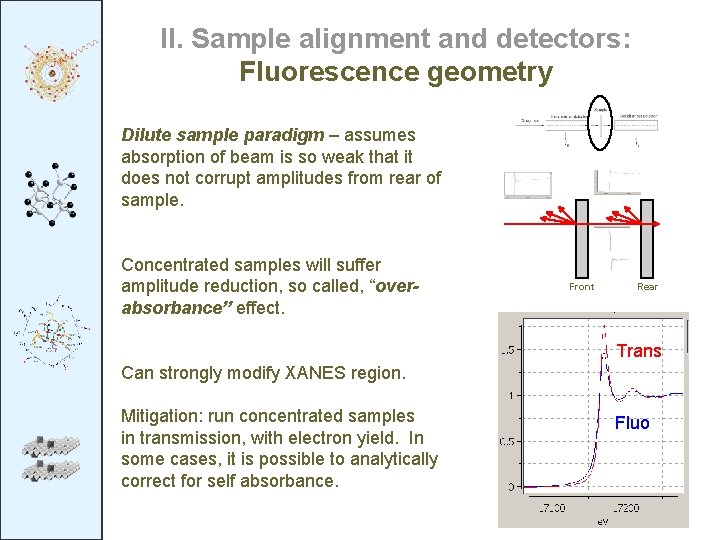
II. Sample alignment and detectors: Fluorescence geometry Dilute sample paradigm – assumes absorption of beam is so weak that it does not corrupt amplitudes from rear of sample. Concentrated samples will suffer amplitude reduction, so called, “overabsorbance” effect. Front Rear Trans Can strongly modify XANES region. Mitigation: run concentrated samples in transmission, with electron yield. In some cases, it is possible to analytically correct for self absorbance. Fluo
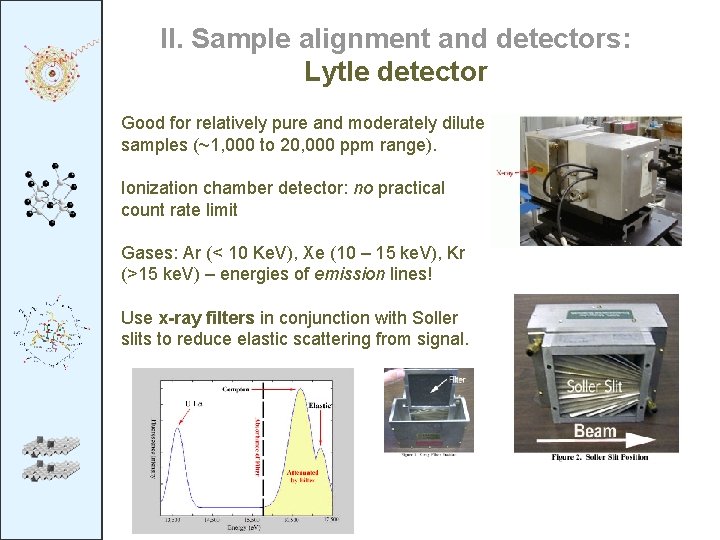
II. Sample alignment and detectors: Lytle detector Good for relatively pure and moderately dilute samples (~1, 000 to 20, 000 ppm range). Ionization chamber detector: no practical count rate limit Gases: Ar (< 10 Ke. V), Xe (10 – 15 ke. V), Kr (>15 ke. V) – energies of emission lines! Use x-ray filters in conjunction with Soller slits to reduce elastic scattering from signal.
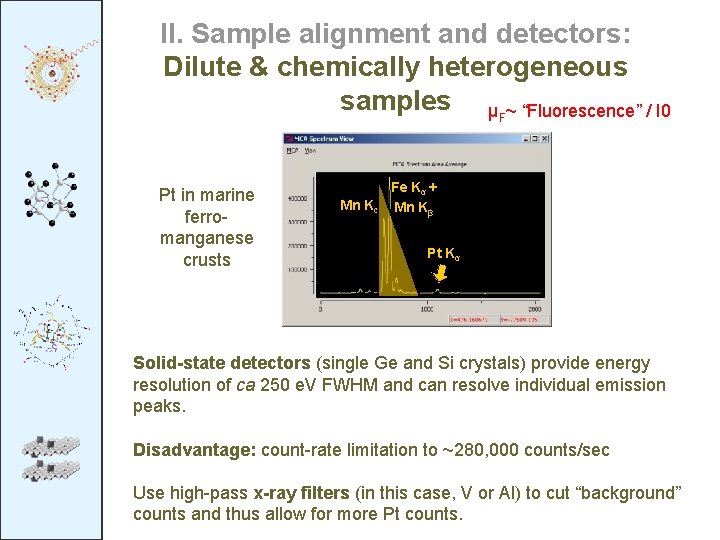
II. Sample alignment and detectors: Dilute & chemically heterogeneous samples μF~ “Fluorescence” / I 0 Pt in marine ferromanganese crusts Mn Kα Fe Kα + Mn Kβ Pt Kα Solid-state detectors (single Ge and Si crystals) provide energy resolution of ca 250 e. V FWHM and can resolve individual emission peaks. Disadvantage: count-rate limitation to ~280, 000 counts/sec Use high-pass x-ray filters (in this case, V or Al) to cut “background” counts and thus allow for more Pt counts.
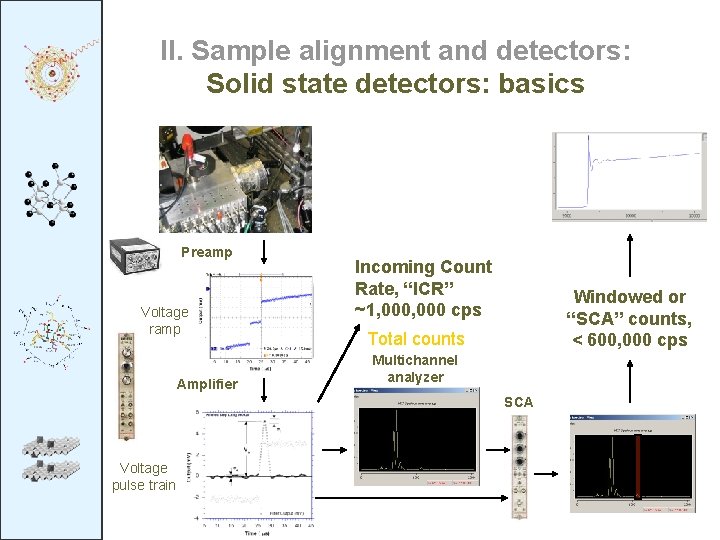
II. Sample alignment and detectors: Solid state detectors: basics Preamp Voltage ramp Amplifier Incoming Count Rate, “ICR” ~1, 000 cps Windowed or “SCA” counts, < 600, 000 cps Total counts Multichannel analyzer SCA Voltage pulse train
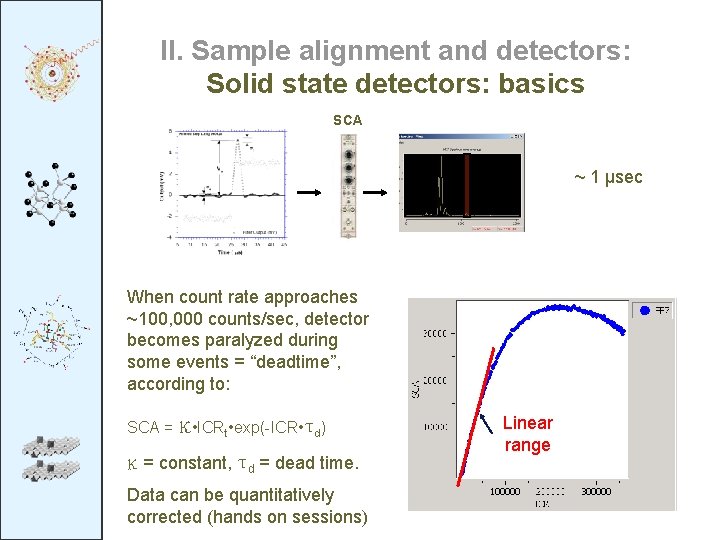
II. Sample alignment and detectors: Solid state detectors: basics SCA ~ 1 μsec When count rate approaches ~100, 000 counts/sec, detector becomes paralyzed during some events = “deadtime”, according to: SCA = κ • ICRt • exp(-ICR • τd) κ = constant, τd = dead time. Data can be quantitatively corrected (hands on sessions) Linear range
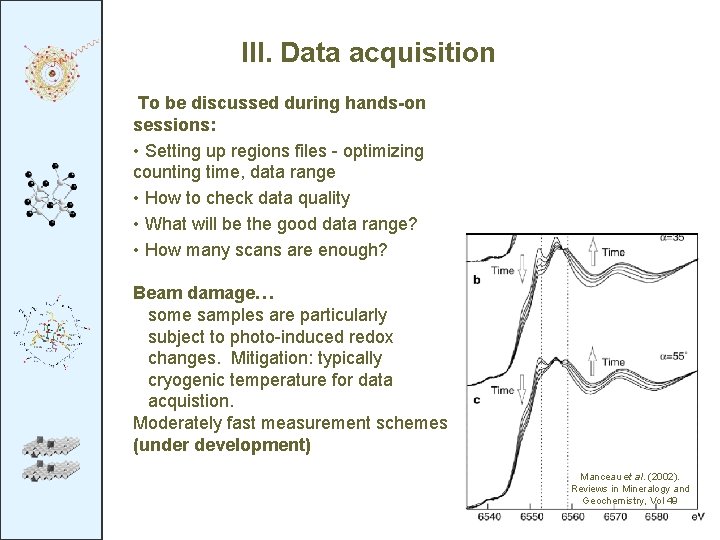
III. Data acquisition To be discussed during hands-on sessions: • Setting up regions files - optimizing counting time, data range • How to check data quality • What will be the good data range? • How many scans are enough? Beam damage… some samples are particularly subject to photo-induced redox changes. Mitigation: typically cryogenic temperature for data acquistion. Moderately fast measurement schemes (under development) Manceau et al. (2002). Reviews in Mineralogy and Geochemistry, Vol 49
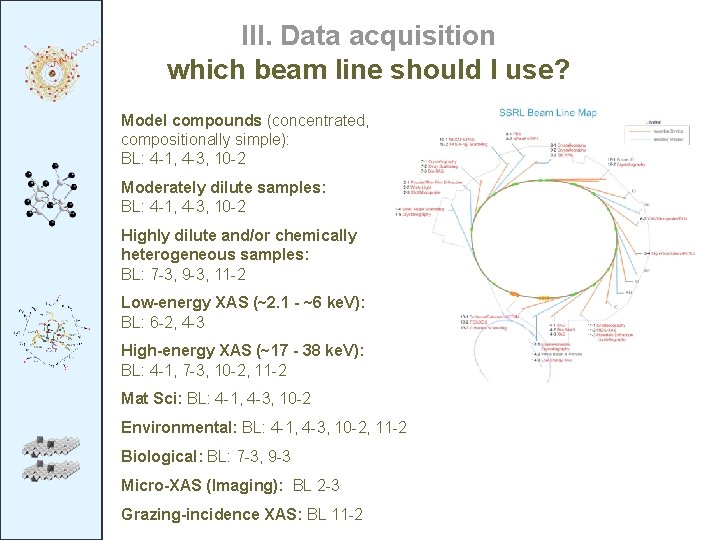
III. Data acquisition which beam line should I use? Model compounds (concentrated, compositionally simple): BL: 4 -1, 4 -3, 10 -2 Moderately dilute samples: BL: 4 -1, 4 -3, 10 -2 Highly dilute and/or chemically heterogeneous samples: BL: 7 -3, 9 -3, 11 -2 Low-energy XAS (~2. 1 - ~6 ke. V): BL: 6 -2, 4 -3 High-energy XAS (~17 - 38 ke. V): BL: 4 -1, 7 -3, 10 -2, 11 -2 Mat Sci: BL: 4 -1, 4 -3, 10 -2 Environmental: BL: 4 -1, 4 -3, 10 -2, 11 -2 Biological: BL: 7 -3, 9 -3 Micro-XAS (Imaging): BL 2 -3 Grazing-incidence XAS: BL 11 -2
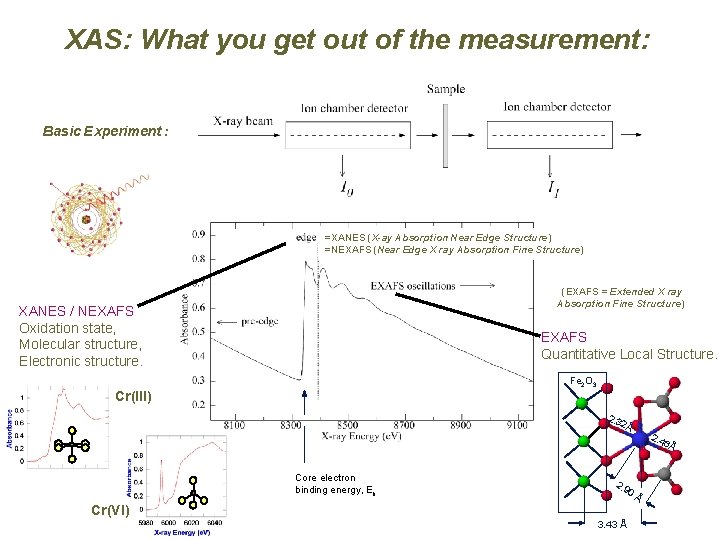
XAS: What you get out of the measurement: Basic Experiment : =XANES (X-ay Absorption Near Edge Structure) =NEXAFS (Near Edge X ray Absorption Fine Structure) (EXAFS = Extended X ray Absorption Fine Structure) Eb XANES / NEXAFS Oxidation state, Molecular structure, Electronic structure. EXAFS Quantitative Local Structure. Fe 2 O 3 Cr(III) 2. 3 2Å 2. 4 6Å Core electron binding energy, Eb 2. 9 0Å Cr(VI) 3. 43 Å