
Practical Approaches to Data Processing Using XDS Kay

- Slides: 25
Practical Approaches to Data Processing Using XDS Kay Diederichs Protein Crystallography / Molecular Bioinformatics
Overview • XDS is a data reduction program for X-ray data collected by the oscillation method on area detectors • Author: Wolfgang Kabsch (MPI Heidelberg) • Information flow within XDS • Usage; Optimization; Interfaces • XDSwiki; references • Demonstration: processing of dataset (e. g. Wladek Minor's corresponding to PDB 1 WQ 6) • Summary and questions throughout this talk: program, file 2
The XDS program suite binary distribution (by W. Kabsch) for Linux & Mac from http: //www. mpimf-heidelberg. mpg. de/~kabsch/xds/: • XDS: the main program (indexing, integrating, scaling) • XSCALE: scale several XDS intensity data sets together, statistics • XDSCONV: convert to CCP 4, CNS, SHELX, . . . format source code available from sourceforge. net: • XDS-Viewer : inspect control images written by XDS, or (single) data frames (alternatively, latest adxv may be used) my own programs: • XDSSTAT, generate_adx (both in XDSwiki) 3
Algorithms Unique features: • 3 D - profiles of reflections transformed into their own coordinate systems – makes them highly similar • Pixel-labelling method • Smooth scaling • Robust estimation of parameters throughout • Radiation-damage correction (XSCALE) 4
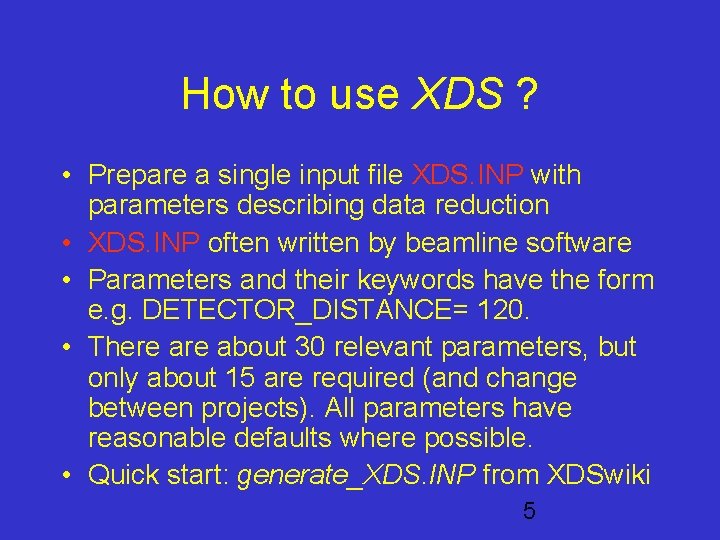
How to use XDS ? • Prepare a single input file XDS. INP with parameters describing data reduction • XDS. INP often written by beamline software • Parameters and their keywords have the form e. g. DETECTOR_DISTANCE= 120. • There about 30 relevant parameters, but only about 15 are required (and change between projects). All parameters have reasonable defaults where possible. • Quick start: generate_XDS. INP from XDSwiki 5
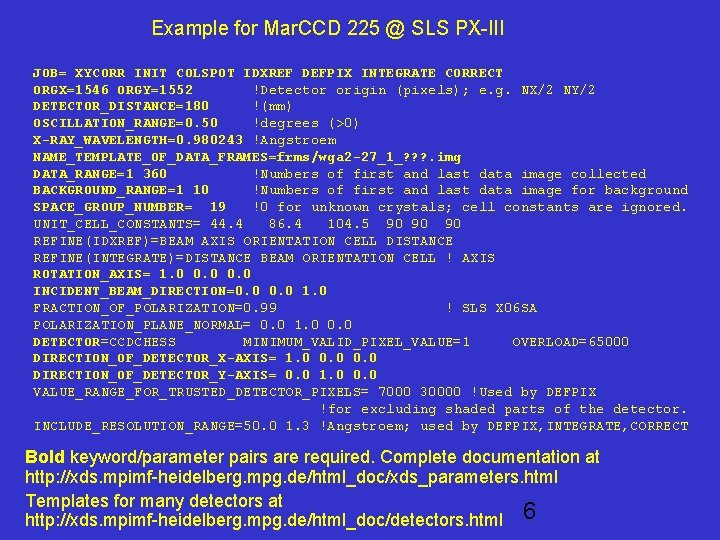
Example for Mar. CCD 225 @ SLS PX-III JOB= XYCORR INIT COLSPOT IDXREF DEFPIX INTEGRATE CORRECT ORGX=1546 ORGY=1552 !Detector origin (pixels); e. g. NX/2 NY/2 DETECTOR_DISTANCE=180 !(mm) OSCILLATION_RANGE=0. 50 !degrees (>0) X-RAY_WAVELENGTH=0. 980243 !Angstroem NAME_TEMPLATE_OF_DATA_FRAMES=frms/wga 2 -27_1_? ? ? . img DATA_RANGE=1 360 !Numbers of first and last data image collected BACKGROUND_RANGE=1 10 !Numbers of first and last data image for background SPACE_GROUP_NUMBER= 19 !0 for unknown crystals; cell constants are ignored. UNIT_CELL_CONSTANTS= 44. 4 86. 4 104. 5 90 90 90 REFINE(IDXREF)=BEAM AXIS ORIENTATION CELL DISTANCE REFINE(INTEGRATE)=DISTANCE BEAM ORIENTATION CELL ! AXIS ROTATION_AXIS= 1. 0 0. 0 INCIDENT_BEAM_DIRECTION=0. 0 1. 0 FRACTION_OF_POLARIZATION=0. 99 ! SLS X 06 SA POLARIZATION_PLANE_NORMAL= 0. 0 1. 0 0. 0 DETECTOR=CCDCHESS MINIMUM_VALID_PIXEL_VALUE=1 OVERLOAD=65000 DIRECTION_OF_DETECTOR_X-AXIS= 1. 0 0. 0 DIRECTION_OF_DETECTOR_Y-AXIS= 0. 0 1. 0 0. 0 VALUE_RANGE_FOR_TRUSTED_DETECTOR_PIXELS= 7000 30000 !Used by DEFPIX !for excluding shaded parts of the detector. INCLUDE_RESOLUTION_RANGE=50. 0 1. 3 !Angstroem; used by DEFPIX, INTEGRATE, CORRECT Bold keyword/parameter pairs are required. Complete documentation at http: //xds. mpimf-heidelberg. mpg. de/html_doc/xds_parameters. html Templates for many detectors at http: //xds. mpimf-heidelberg. mpg. de/html_doc/detectors. html 6
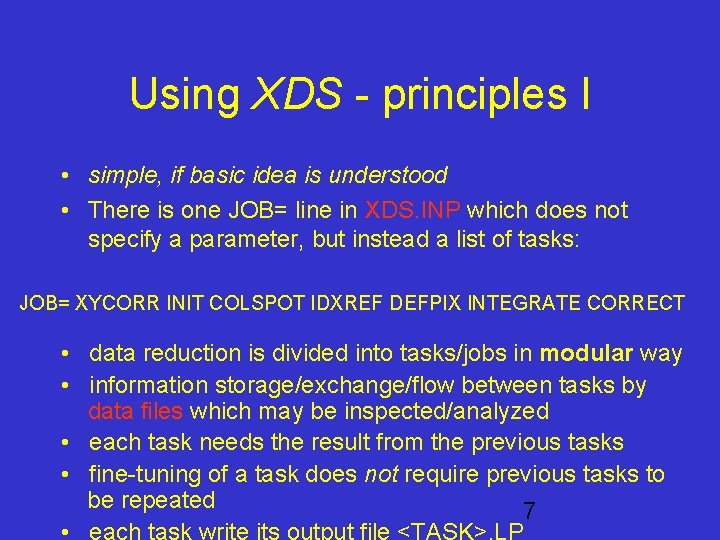
Using XDS - principles I • simple, if basic idea is understood • There is one JOB= line in XDS. INP which does not specify a parameter, but instead a list of tasks: JOB= XYCORR INIT COLSPOT IDXREF DEFPIX INTEGRATE CORRECT • data reduction is divided into tasks/jobs in modular way • information storage/exchange/flow between tasks by data files which may be inspected/analyzed • each task needs the result from the previous tasks • fine-tuning of a task does not require previous tasks to be repeated 7
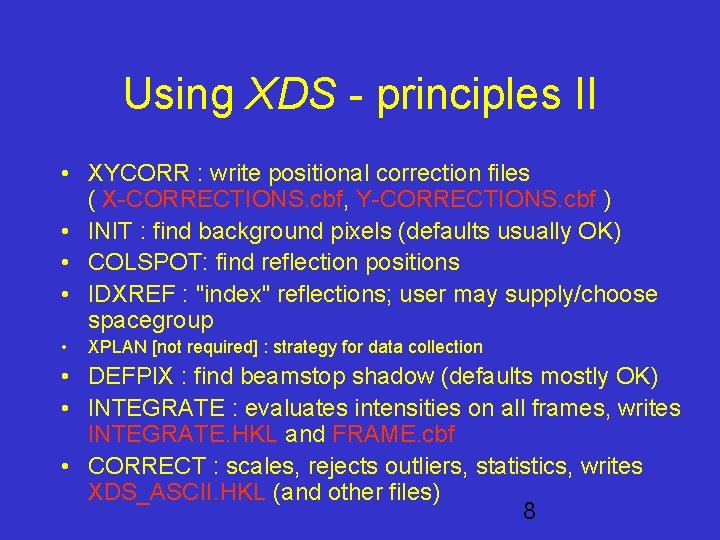
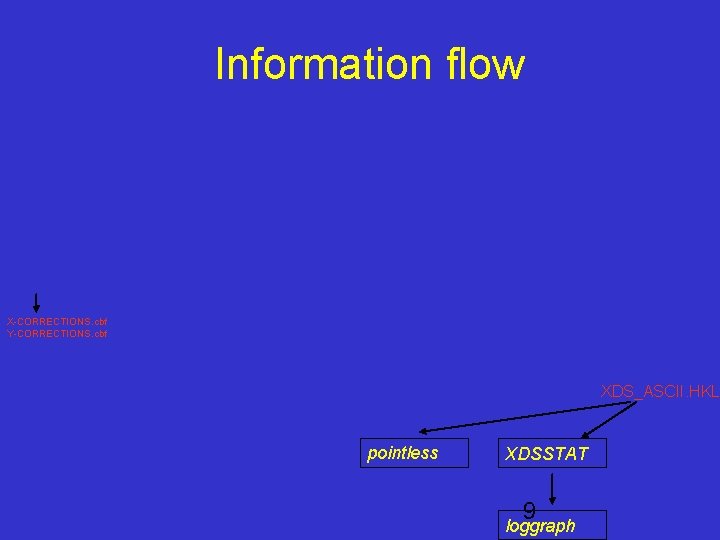
Using XDS - principles II • XYCORR : write positional correction files ( X-CORRECTIONS. cbf, Y-CORRECTIONS. cbf ) • INIT : find background pixels (defaults usually OK) • COLSPOT: find reflection positions • IDXREF : "index" reflections; user may supply/choose spacegroup • XPLAN [not required] : strategy for data collection • DEFPIX : find beamstop shadow (defaults mostly OK) • INTEGRATE : evaluates intensities on all frames, writes INTEGRATE. HKL and FRAME. cbf • CORRECT : scales, rejects outliers, statistics, writes XDS_ASCII. HKL (and other files) 8
Information flow X-CORRECTIONS. cbf Y-CORRECTIONS. cbf XDS_ASCII. HKL pointless XDSSTAT 9 loggraph
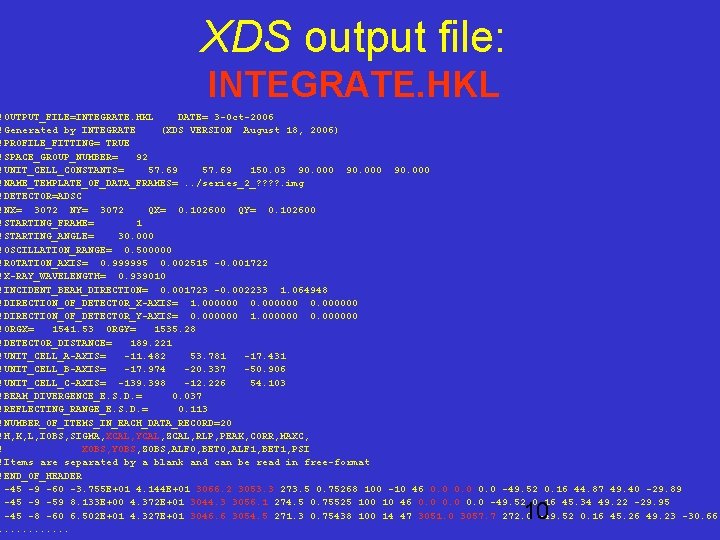
XDS output file: INTEGRATE. HKL !OUTPUT_FILE=INTEGRATE. HKL DATE= 3 -Oct-2006 !Generated by INTEGRATE (XDS VERSION August 18, 2006) !PROFILE_FITTING= TRUE !SPACE_GROUP_NUMBER= 92 !UNIT_CELL_CONSTANTS= 57. 69 150. 03 90. 000 !NAME_TEMPLATE_OF_DATA_FRAMES=. . /series_2_? ? . img !DETECTOR=ADSC !NX= 3072 NY= 3072 QX= 0. 102600 QY= 0. 102600 !STARTING_FRAME= 1 !STARTING_ANGLE= 30. 000 !OSCILLATION_RANGE= 0. 500000 !ROTATION_AXIS= 0. 999995 0. 002515 -0. 001722 !X-RAY_WAVELENGTH= 0. 939010 !INCIDENT_BEAM_DIRECTION= 0. 001723 -0. 002233 1. 064948 !DIRECTION_OF_DETECTOR_X-AXIS= 1. 000000 0. 000000 !DIRECTION_OF_DETECTOR_Y-AXIS= 0. 000000 1. 000000 0. 000000 !ORGX= 1541. 53 ORGY= 1535. 28 !DETECTOR_DISTANCE= 189. 221 !UNIT_CELL_A-AXIS= -11. 482 53. 781 -17. 431 !UNIT_CELL_B-AXIS= -17. 974 -20. 337 -50. 906 !UNIT_CELL_C-AXIS= -139. 398 -12. 226 54. 103 !BEAM_DIVERGENCE_E. S. D. = 0. 037 !REFLECTING_RANGE_E. S. D. = 0. 113 !NUMBER_OF_ITEMS_IN_EACH_DATA_RECORD=20 !H, K, L, IOBS, SIGMA, XCAL, YCAL, ZCAL, RLP, PEAK, CORR, MAXC, ! XOBS, YOBS, ZOBS, ALF 0, BET 0, ALF 1, BET 1, PSI !Items are separated by a blank and can be read in free-format !END_OF_HEADER -45 -9 -60 -3. 755 E+01 4. 144 E+01 3066. 2 3053. 3 273. 5 0. 75268 100 -10 46 0. 0 -49. 52 0. 16 44. 87 49. 40 -29. 89 -45 -9 -59 8. 133 E+00 4. 372 E+01 3044. 3 3056. 1 274. 5 0. 75525 100 10 46 0. 0 -49. 52 0. 16 45. 34 49. 22 -29. 95 -45 -8 -60 6. 502 E+01 4. 327 E+01 3046. 6 3054. 5 271. 3 0. 75438 100 14 47 3051. 0 3057. 7 272. 0 -49. 52 0. 16 45. 26 49. 23 -30. 66. . . 10
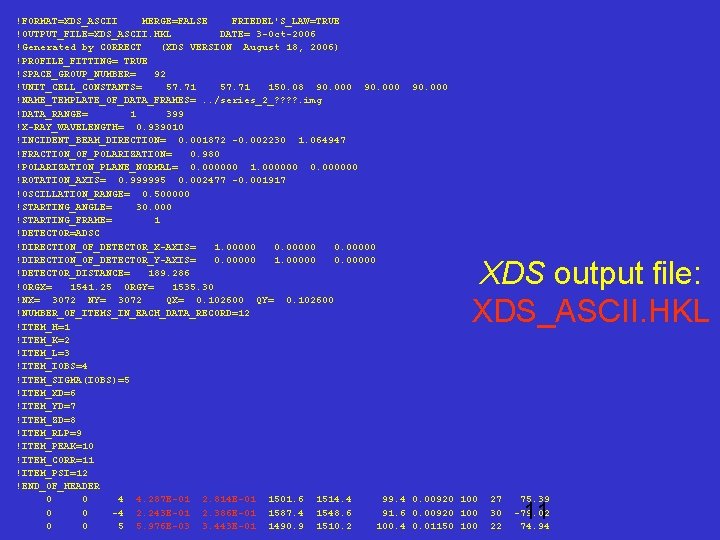
!FORMAT=XDS_ASCII MERGE=FALSE FRIEDEL'S_LAW=TRUE !OUTPUT_FILE=XDS_ASCII. HKL DATE= 3 -Oct-2006 !Generated by CORRECT (XDS VERSION August 18, 2006) !PROFILE_FITTING= TRUE !SPACE_GROUP_NUMBER= 92 !UNIT_CELL_CONSTANTS= 57. 71 150. 08 90. 000 !NAME_TEMPLATE_OF_DATA_FRAMES=. . /series_2_? ? . img !DATA_RANGE= 1 399 !X-RAY_WAVELENGTH= 0. 939010 !INCIDENT_BEAM_DIRECTION= 0. 001872 -0. 002230 1. 064947 !FRACTION_OF_POLARIZATION= 0. 980 !POLARIZATION_PLANE_NORMAL= 0. 000000 1. 000000 0. 000000 !ROTATION_AXIS= 0. 999995 0. 002477 -0. 001917 !OSCILLATION_RANGE= 0. 500000 !STARTING_ANGLE= 30. 000 !STARTING_FRAME= 1 !DETECTOR=ADSC !DIRECTION_OF_DETECTOR_X-AXIS= 1. 00000 0. 00000 !DIRECTION_OF_DETECTOR_Y-AXIS= 0. 00000 1. 00000 0. 00000 !DETECTOR_DISTANCE= 189. 286 !ORGX= 1541. 25 ORGY= 1535. 30 !NX= 3072 NY= 3072 QX= 0. 102600 QY= 0. 102600 !NUMBER_OF_ITEMS_IN_EACH_DATA_RECORD=12 !ITEM_H=1 !ITEM_K=2 !ITEM_L=3 !ITEM_IOBS=4 !ITEM_SIGMA(IOBS)=5 !ITEM_XD=6 !ITEM_YD=7 !ITEM_ZD=8 !ITEM_RLP=9 !ITEM_PEAK=10 !ITEM_CORR=11 !ITEM_PSI=12 !END_OF_HEADER 0 0 4 4. 287 E-01 2. 814 E-01 1501. 6 1514. 4 99. 4 0 0 -4 2. 243 E-01 2. 386 E-01 1587. 4 1548. 6 91. 6 0 0 5 5. 976 E-03 3. 443 E-01 1490. 9 1510. 2 100. 4 90. 000 XDS output file: XDS_ASCII. HKL 0. 00920 100 0. 01150 100 27 30 22 75. 39 -79. 02 74. 94 11
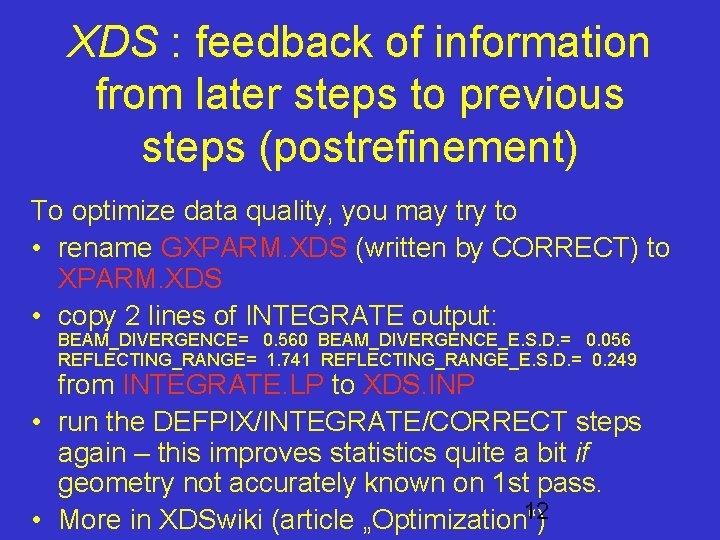
XDS : feedback of information from later steps to previous steps (postrefinement) To optimize data quality, you may try to • rename GXPARM. XDS (written by CORRECT) to XPARM. XDS • copy 2 lines of INTEGRATE output: BEAM_DIVERGENCE= 0. 560 BEAM_DIVERGENCE_E. S. D. = 0. 056 REFLECTING_RANGE= 1. 741 REFLECTING_RANGE_E. S. D. = 0. 249 from INTEGRATE. LP to XDS. INP • run the DEFPIX/INTEGRATE/CORRECT steps again – this improves statistics quite a bit if geometry not accurately known on 1 st pass. 12 • More in XDSwiki (article „Optimization“)
Visualizing Distortions and scaling problems • XDS writes. cbf files for control purposes • XDS-Viewer (or adxv) can display these files • If not corrected: systematic errors, many rejections, reduced data quality, bad anomalous signal 13
X/Y- distortions • GX-CORRECTIONS. cbf (from CORRECT task) has 10*(xobs-xcal) as a function of position • Similar for y: GY-CORRECTIONS. cbf 14
Further information from XDSSTAT • writes XDSSTAT. LP (visualize with CCP 4 loggraph) • scales. pck shows scale factor in percent as a function of position (after correction in XDS) • misfits. pck shows outliers mapped on detector • rf. pck shows R-factor mapped on detector • anom. pck shows anomalous difference mapped on detector • These files may be displayed with adxv, XDS-Viewer, or VIEW (distributed with old versions of XDS) 15
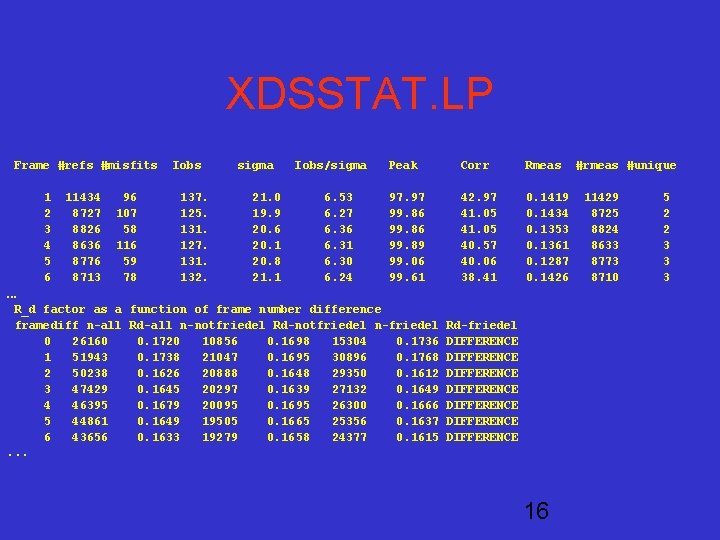
XDSSTAT. LP Frame #refs #misfits 1 2 3 4 5 6 11434 8727 8826 8636 8776 8713 96 107 58 116 59 78 Iobs 137. 125. 131. 127. 131. 132. sigma 21. 0 19. 9 20. 6 20. 1 20. 8 21. 1 Iobs/sigma 6. 53 6. 27 6. 36 6. 31 6. 30 6. 24 Peak Corr Rmeas 97. 97 99. 86 99. 89 99. 06 99. 61 42. 97 41. 05 40. 57 40. 06 38. 41 0. 1419 0. 1434 0. 1353 0. 1361 0. 1287 0. 1426 . . . R_d factor as a function of frame number difference framediff n-all Rd-all n-notfriedel Rd-notfriedel n-friedel 0 26160 0. 1720 10856 0. 1698 15304 0. 1736 1 51943 0. 1738 21047 0. 1695 30896 0. 1768 2 50238 0. 1626 20888 0. 1648 29350 0. 1612 3 47429 0. 1645 20297 0. 1639 27132 0. 1649 4 46395 0. 1679 20095 0. 1695 26300 0. 1666 5 44861 0. 1649 19505 0. 1665 25356 0. 1637 6 43656 0. 1633 19279 0. 1658 24377 0. 1615. . . Rd-friedel DIFFERENCE DIFFERENCE 16 #rmeas #unique 11429 8725 8824 8633 8773 8710 5 2 2 3 3 3
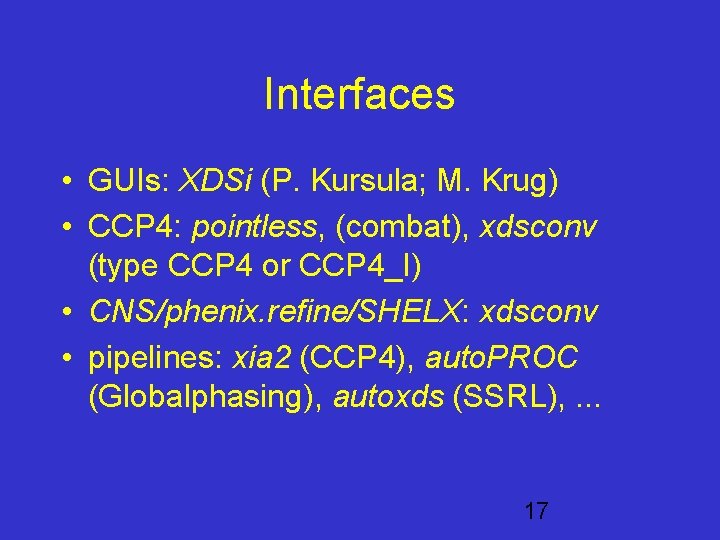
Interfaces • GUIs: XDSi (P. Kursula; M. Krug) • CCP 4: pointless, (combat), xdsconv (type CCP 4 or CCP 4_I) • CNS/phenix. refine/SHELX: xdsconv • pipelines: xia 2 (CCP 4), auto. PROC (Globalphasing), autoxds (SSRL), . . . 17
XDS References • Kabsch, W. (1988). Evaluation of single-crystal X-ray diffraction data from a position-sensitive detector. J. Appl. Cryst. 21, 916 -924. • Kabsch, W. (1993). Automatic processing of rotation diffraction data from crystals of initially unknown symmetry and cell constants. J. Appl. Cryst. 26, 795 -800. • Kabsch, W. (2001) Chapter 11. 3. Integration, scaling, space-group assignment and post refinement Kabsch, W. (2001) Chapter 25. 2. 9. XDS both in International Tables for Crystallography, Volume F. Crystallography of Biological Macromolecules, Rossmann, M. G. and Arnold, E. (2001). Editors. Dordrecht: Kluwer Academic Publishers. • Kabsch, W. (2010). XDS. Acta Cryst. D 66, 125 -132. (open access) • Kabsch, W. (2010). Integration, scaling, space-group assignment and post-refinement. Acta Cryst. D 66, 133 -144. 18 (open access)
XDSwiki • started Feb 2008; ~ 100 pages at http: //strucbio. biologie. uni-konstanz. de/xdswiki/index. php/Main_Page • • e. g. „Optimization“; explanations of task output „Tips and Tricks“ „Quality Control“ with datasets and results anybody can contribute (same holds for CCP 4 wiki: ~ 220 pages at http: //strucbio. biologie. uni-konstanz. de/ccp 4 wiki/index. php/Main_Page ) 19
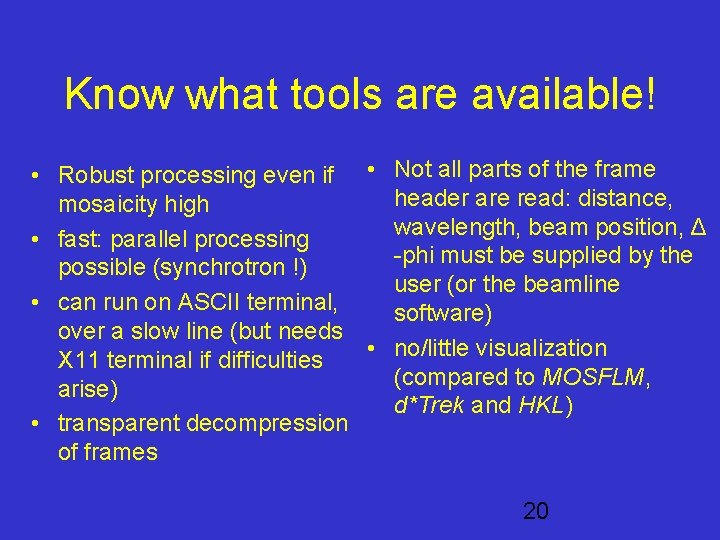
Know what tools are available! • Robust processing even if • Not all parts of the frame header are read: distance, mosaicity high wavelength, beam position, Δ • fast: parallel processing -phi must be supplied by the possible (synchrotron !) user (or the beamline • can run on ASCII terminal, software) over a slow line (but needs • no/little visualization X 11 terminal if difficulties (compared to MOSFLM, arise) d*Trek and HKL) • transparent decompression of frames 20
Some typical questions. . . • “How to scale & merge different datasets from similar or same xtal(s), using XDS? ” • “What about twinning? Is it possible to integrate small molecule data as well? ” • “Does XDS correct for radiation damage (increased B factors) without scaling all to the first data set? ” • “Will an easier to use masking system be developed? ” • More Qs and As in FAQ article of XDSwiki 21
Own current work: • Radiation damage and its computational correction: Diederichs, K. , Junk, M. (2009) „Post-processing intensity measurements at favourable dose values“ J. Appl. Cryst. 42, 48 -57 • „Simulation of X-ray frames from macromolecular crystals using a ray-tracing approach“ Diederichs K. (2009) Acta Cryst. D 65, 535 -42 • „Quantifying instrument errors in macromolecular Xray datasets“ (2010) submitted 22
Examples of simulated frames „Crystal mosaicity“ has two components: cell parameter disorder, and orientational disorder of mosaic blocks 23
Potential benefits from simulation of raw data • Test (debug) the whole data reduction / structure solution pipeline with known data • Limits of data quality, and influence of data quality on refinement results • Evaluate alternative data collection strategies (e. g. fine-slicing) before the actual data collection • Understand physical principles behind mosaicity • Simulate certain kinds of systematic errors 24 • Teaching. . .
Thank you!