
Practical application of differentiation within the classroom Jan

- Slides: 17
Practical application of differentiation within the classroom. Jan 2016
Introduction. • Video
Differentiation? • Accommodating differences between learners so that each student has the best possible chance of learning. • Each student will have a differing readiness to learn, learning needs and levels of interest. Should you treat all students as the same? • It should be a fundamental feature of any professional teachers repertoire. • There are different views to how to address different learning needs but don’t let jargon and academic debate get in the way. It is better to make an attempt to differentiate and experiment in your classroom.
My initial concerns. • • Too much jargon. Is it driven by academia and not those actually teaching? Time constraints. Teacher training was a while ago. Get inspired but then fall back into old ways. Will it ultimately make any difference to performance? Complexity? Stigma associated with the execution of differentiation.
A need to change and adapt. • Improve my teaching practice. We are not perfect and teachers are often not open to critical feedback. Who sees our class practice after teacher training? • Engage more students. Geography is an amazing subject and we could be losing some valuable students – do we want to create good citizens? • Empower more students. We all respond better when empowered and feel • • valued. Improve results from all students. Maximise my enjoyment of teaching. Take the emphasis off myself as the driver of classroom practice. Hard work! Break the cycle of ‘spoon feeding’ students that we frequently complain about.
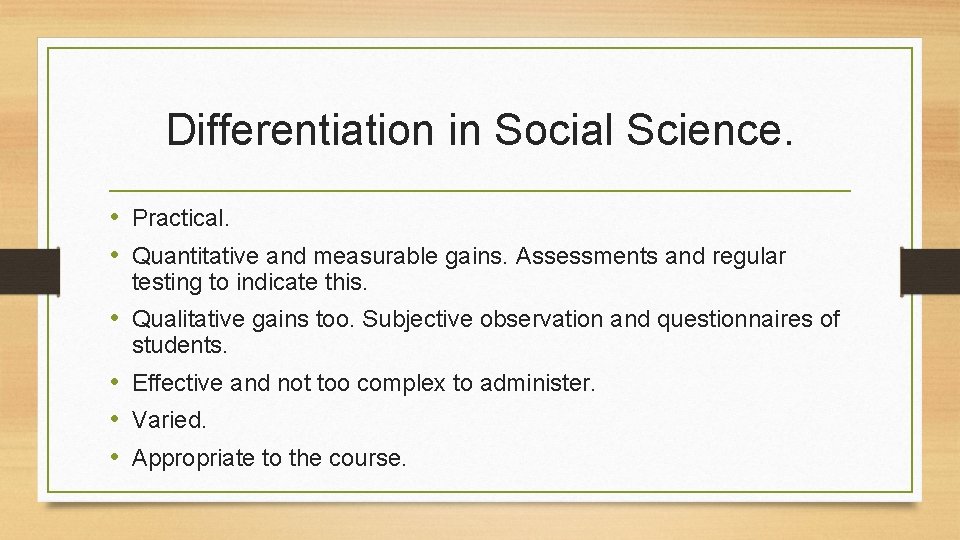
Differentiation in Social Science. • Practical. • Quantitative and measurable gains. Assessments and regular testing to indicate this. • Qualitative gains too. Subjective observation and questionnaires of students. • Effective and not too complex to administer. • Varied. • Appropriate to the course.
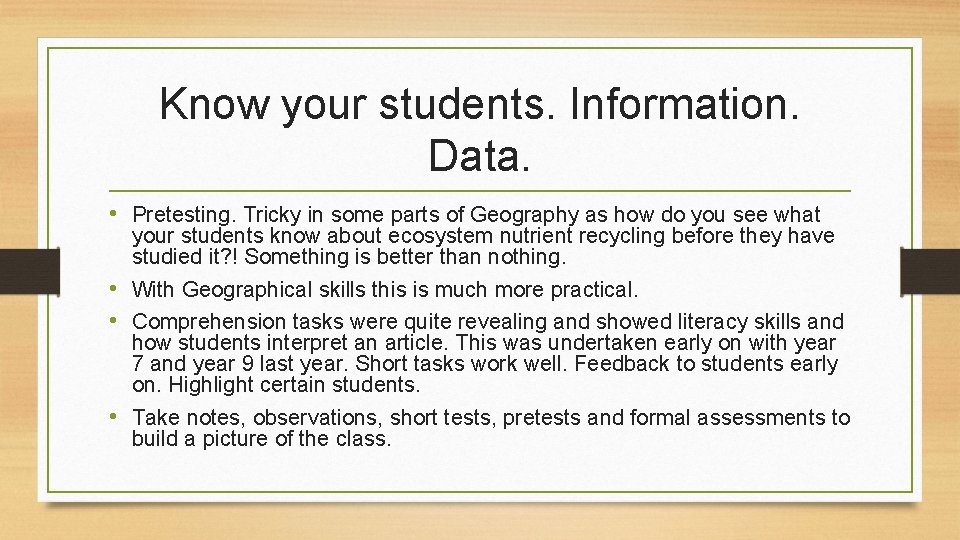
Know your students. Information. Data. • Pretesting. Tricky in some parts of Geography as how do you see what your students know about ecosystem nutrient recycling before they have studied it? ! Something is better than nothing. • With Geographical skills this is much more practical. • Comprehension tasks were quite revealing and showed literacy skills and how students interpret an article. This was undertaken early on with year 7 and year 9 last year. Short tasks work well. Feedback to students early on. Highlight certain students. • Take notes, observations, short tests, pretests and formal assessments to build a picture of the class.
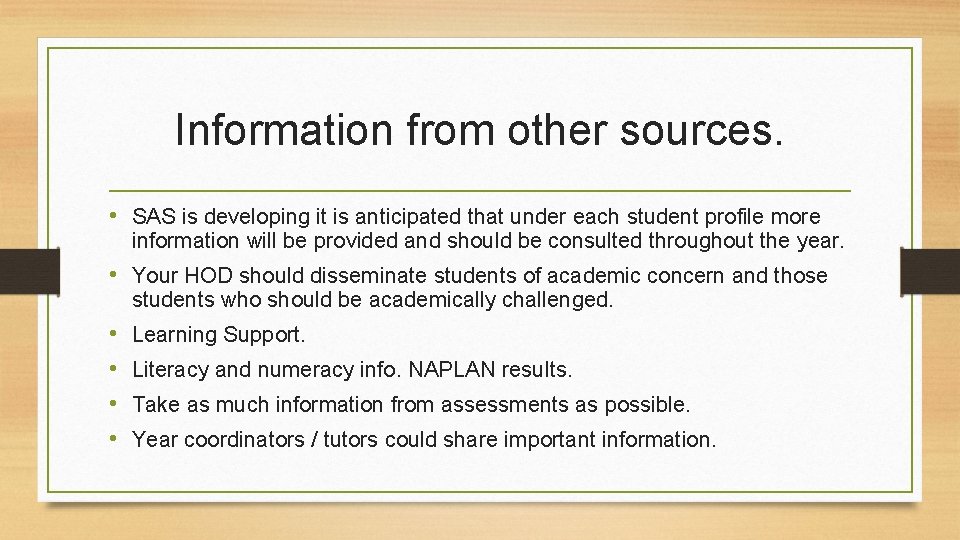
Information from other sources. • SAS is developing it is anticipated that under each student profile more information will be provided and should be consulted throughout the year. • Your HOD should disseminate students of academic concern and those students who should be academically challenged. • • Learning Support. Literacy and numeracy info. NAPLAN results. Take as much information from assessments as possible. Year coordinators / tutors could share important information.
Examples from Social Science
Differentiation by task. • Different worksheets. Good ones can be used long term and integrate well into your schemes of work. • Year 7. Comprehension activity on the ethics of climbing Everest at two levels of difficulty. • Year 7 map making. One sheet with much more structure provided. • Year 10 urban growth and decline unit of work. 2 levels of booklet. Students select the level of difficulty. • Year 9 weather map reading roll play. Differing levels of complexity with maps.
Differentiation by grouping. • Year 8 fieldwork on microclimates around Balmoral and school surrounds. Mixed ability groups led by a high achieving student. Each leader had been briefed prior to the fieldwork day regarding the process and objectives. • Year 9 weather maps reading and presenting role play. Groups consisted of higher ability using more complex weather maps. • Year 10 urban change real estate topic. Groupwork at different levels guided by more able student leader. • • Peer review used with seniors but could be expanded to all year groups. Involve shy students. Not about friendships. Everyone is accountable for success. Experiment with the layout of your classroom from the traditional format. This has great potential in other topics and year groups.
Differentiation by resources. • Year 9 Changing Australian society. Different envelopes given to different groups. The resources are fixed and weaker students / groups are given use of different resources that are generally much softer concepts and issues in Australian society. • Widening the breadth of resources used in class in all lessons. Clear instructions get the best from all ability groups. This has been important in students creating videos. • Teacher researched websites and then groups directed to different sites to extract information. Year 10 urban growth.
Differentiation with time / pace. • Allow weaker students to complete their work and not feel failures for non completion. This requires worthwhile extensions for those more able students. Not just time fillers.
Dialogue and support • We are expanding our team teaching role within Social Science. Some classes would benefit considerably from a support member in the classroom. Analytical skills and data based skills are an area where we have seen marked gains if a teacher can dedicate on one time. • Expressiveness and awareness of your intonation, level of dialogue and who is not engaged in class is highly important. An independent observer in your classroom can give you constructive feedback. • Stop certain individuals dominating in the classroom. No hands up policy.
Assessment. • • • Little and often. Vary styles. Feedback. Fair. Part of an ongoing and flexible process that adjusts accordingly to ensure learning needs are met.
The future. • • Integrate successful differentiation in our teaching practice. Experiment and learn to fail as a teacher. Change the traditional approach to teaching. Everyone is valued in a class and not just those who are confident and highly able. • Don’t dismiss differentiation as some new flowery teaching philosophy. You do it all ready.
Some viewing on differentiation. • Dylan Wiliam • Ted. X