
PR Campaign Measurement 1 2 3 4 5













- Slides: 38
PR Campaign Measurement
1
2
3
4
5
6
7
8
9
10
Answers 1. London 2. New York 3. Manchester 4. Dar es Salaam 5. Nairobi 6. Kampala 7. Barcelona 8. Sydney 9. Lusaka 10. Kigali QN: Which answer did people get wrong the most?
Barcelona Declaration of Measurement Principles The Barcelona Principles refers to the Barcelona Declaration of Research Principles A set of seven voluntary guidelines established by the public relations (PR) industry to measure the efficiency of PR campaigns. They were the first overreaching framework for effective public relations & communications measurement
Why Are The Barcelona Principles Important? ◦ Set overarching framework ◦ Alignment ◦ Basis for measurement and evaluation programs
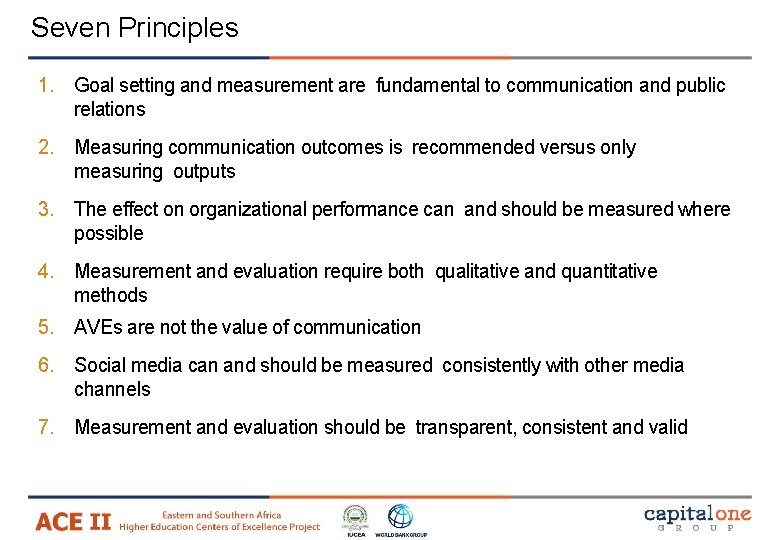
Seven Principles 1. Goal setting and measurement are fundamental to communication and public relations 2. Measuring communication outcomes is recommended versus only measuring outputs 3. The effect on organizational performance can and should be measured where possible 4. Measurement and evaluation require both qualitative and quantitative methods 5. AVEs are not the value of communication 6. Social media can and should be measured consistently with other media channels 7. Measurement and evaluation should be transparent, consistent and valid
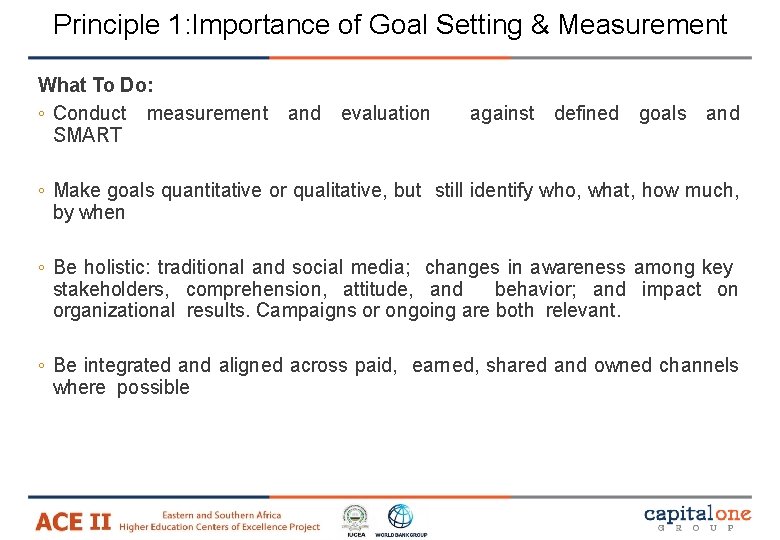
Principle 1: Importance of Goal Setting & Measurement What To Do: ◦ Conduct measurement and evaluation against defined goals and SMART ◦ Make goals quantitative or qualitative, but still identify who, what, how much, by when ◦ Be holistic: traditional and social media; changes in awareness among key stakeholders, comprehension, attitude, and behavior; and impact on organizational results. Campaigns or ongoing are both relevant. ◦ Be integrated and aligned across paid, earned, shared and owned channels where possible
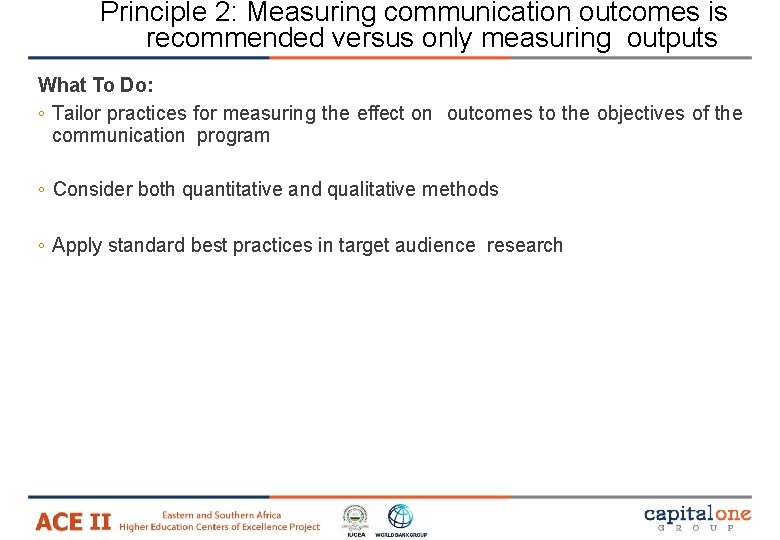
Principle 2: Measuring communication outcomes is recommended versus only measuring outputs What To Do: ◦ Tailor practices for measuring the effect on outcomes to the objectives of the communication program ◦ Consider both quantitative and qualitative methods ◦ Apply standard best practices in target audience research
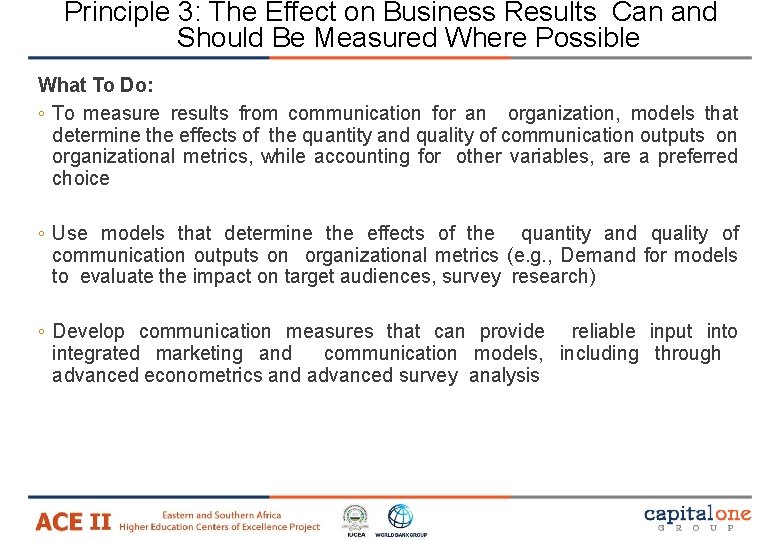
Principle 3: The Effect on Business Results Can and Should Be Measured Where Possible What To Do: ◦ To measure results from communication for an organization, models that determine the effects of the quantity and quality of communication outputs on organizational metrics, while accounting for other variables, are a preferred choice ◦ Use models that determine the effects of the quantity and quality of communication outputs on organizational metrics (e. g. , Demand for models to evaluate the impact on target audiences, survey research) ◦ Develop communication measures that can provide reliable input into integrated marketing and communication models, including through advanced econometrics and advanced survey analysis
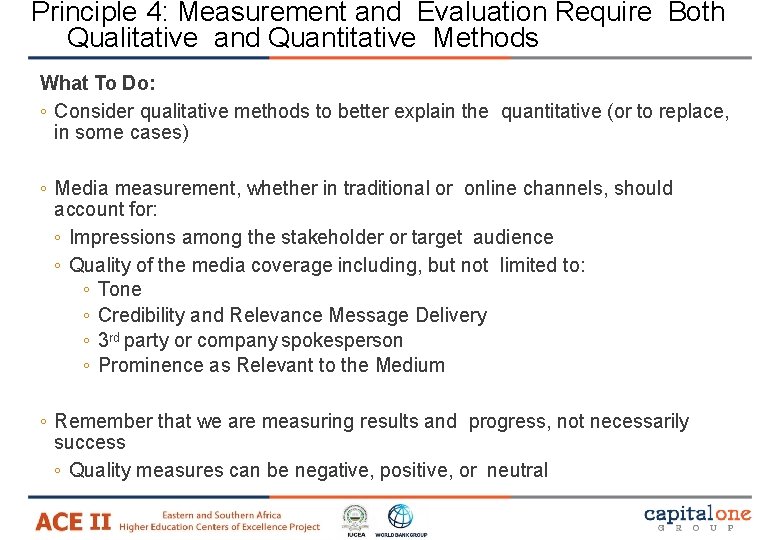
Principle 4: Measurement and Evaluation Require Both Qualitative and Quantitative Methods What To Do: ◦ Consider qualitative methods to better explain the quantitative (or to replace, in some cases) ◦ Media measurement, whether in traditional or online channels, should account for: ◦ Impressions among the stakeholder or target audience ◦ Quality of the media coverage including, but not limited to: ◦ Tone ◦ Credibility and Relevance Message Delivery ◦ 3 rd party or company spokesperson ◦ Prominence as Relevant to the Medium ◦ Remember that we are measuring results and progress, not necessarily success ◦ Quality measures can be negative, positive, or neutral
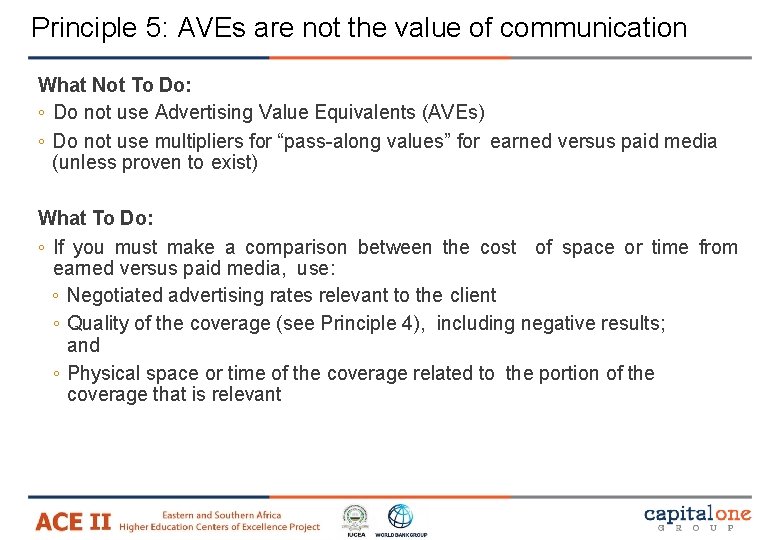
Principle 5: AVEs are not the value of communication What Not To Do: ◦ Do not use Advertising Value Equivalents (AVEs) ◦ Do not use multipliers for “pass-along values” for earned versus paid media (unless proven to exist) What To Do: ◦ If you must make a comparison between the cost of space or time from earned versus paid media, use: ◦ Negotiated advertising rates relevant to the client ◦ Quality of the coverage (see Principle 4), including negative results; and ◦ Physical space or time of the coverage related to the portion of the coverage that is relevant
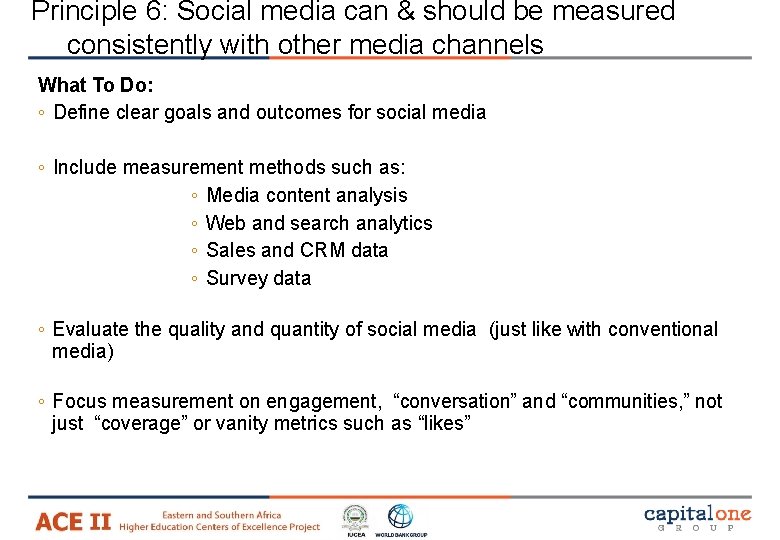
Principle 6: Social media can & should be measured consistently with other media channels What To Do: ◦ Define clear goals and outcomes for social media ◦ Include measurement methods such as: ◦ Media content analysis ◦ Web and search analytics ◦ Sales and CRM data ◦ Survey data ◦ Evaluate the quality and quantity of social media (just like with conventional media) ◦ Focus measurement on engagement, “conversation” and “communities, ” not just “coverage” or vanity metrics such as “likes”
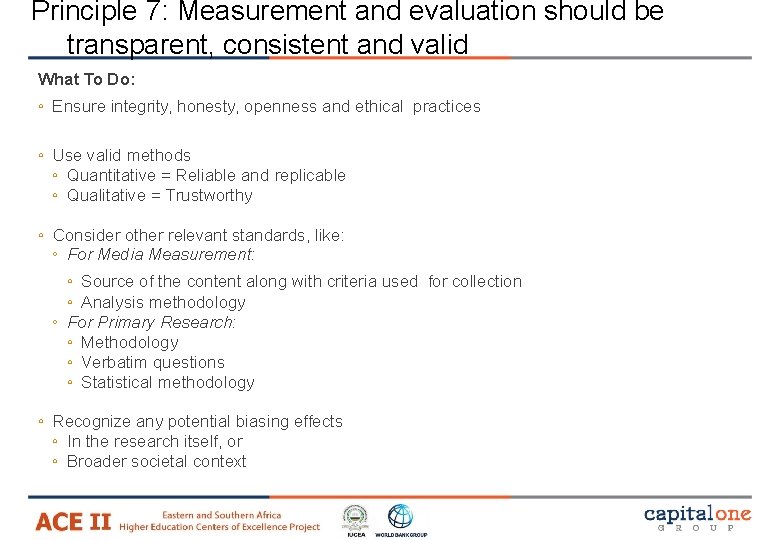
Principle 7: Measurement and evaluation should be transparent, consistent and valid What To Do: ◦ Ensure integrity, honesty, openness and ethical practices ◦ Use valid methods ◦ Quantitative = Reliable and replicable ◦ Qualitative = Trustworthy ◦ Consider other relevant standards, like: ◦ For Media Measurement: ◦ Source of the content along with criteria used for collection ◦ Analysis methodology ◦ For Primary Research: ◦ Methodology ◦ Verbatim questions ◦ Statistical methodology ◦ Recognize any potential biasing effects ◦ In the research itself, or ◦ Broader societal context
What's next? 1. Adoption and education (self exercise) 2. Be realistic about progress 3. Make measurement and evaluation a part of every communication program
Valid Metrics for PR Measurement Putting The Principles Into Action Based on the Barcelona Declaration of Measurement Principles 19. 03. 2019
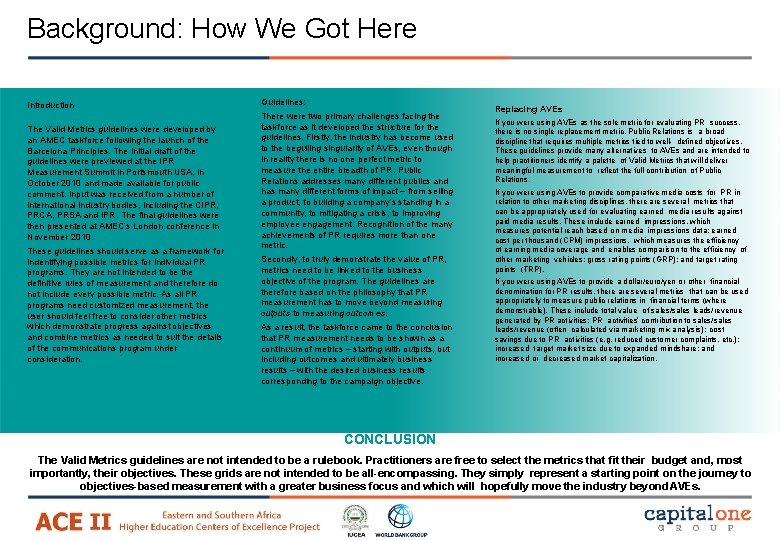
Background: How We Got Here Introduction Guidelines: The Valid Metrics guidelines were developed by an AMEC taskforce following the launch of the Barcelona Principles. The initial draft of the guidelines were previewed at the IPR Measurement Summit in Portsmouth USA, in October 2010 and made available for public comment. Input was received from a number of international industry bodies, including the CIPR, PRCA, PRSA and IPR. The final guidelines were then presented at AMEC’s London conference in November 2010. There were two primary challenges facing the taskforce as it developed the structure for the guidelines. Firstly, the industry has become used to the beguiling singularity of AVEs, even though in reality there is no one perfect metric to measure the entire breadth of PR. Public Relations addresses many different publics and has many different forms of impact – from selling a product, to building a company’s standing in a community, to mitigating a crisis, to improving employee engagement. Recognition of the many achievements of PR requires more than one metric. These guidelines should serve as a framework for indentifying possible metrics for individual PR programs. They are not intended to be the definitive rules of measurement and therefore do not include every possible metric. As all PR programs need customized measurement, the user should feel free to consider other metrics which demonstrate progress against objectives and combine metrics as needed to suit the details of the communications program under consideration. Secondly, to truly demonstrate the value of PR, metrics need to be linked to the business objective of the program. The guidelines are therefore based on the philosophy that PR measurement has to move beyond measuring outputs to measuring outcomes. As a result, the taskforce came to the conclusion that PR measurement needs to be shown as a continuum of metrics – starting with outputs, but including outcomes and ultimately business results – with the desired business results corresponding to the campaign objective. Replacing AVEs If you were using AVEs as the sole metric for evaluating PR success, there is no single replacement metric. Public Relations is a broad discipline that requires multiple metrics tied to well- defined objectives. These guidelines provide many alternatives to AVEs and are intended to help practitioners identify a palette of Valid Metrics that will deliver meaningful measurement to reflect the full contribution of Public Relations. If you were using AVEs to provide comparative media costs for PR in relation to other marketing disciplines, there are several metrics that can be appropriately used for evaluating earned media results against paid media results. These include earned impressions, which measures potential reach based on media impressions data; earned cost per thousand (CPM) impressions, which measures the efficiency of earning media coverage and enables comparison to the efficiency of other marketing vehicles; gross rating points (GRP); and target rating points (TRP). If you were using AVEs to provide a dollar/euro/yen or other financial denomination for PR results, there are several metrics that can be used appropriately to measure public relations in financial terms (where demonstrable). These include total value of sales/sales leads/revenue generated by PR activities; PR activities’ contribution to sales/sales leads/revenue (often calculated via marketing mix analysis); cost savings due to PR activities (e. g. reduced customer complaints, etc. ); increased target market size due to expanded mindshare; and increased or decreased market capitalization. CONCLUSION The Valid Metrics guidelines are not intended to be a rulebook. Practitioners are free to select the metrics that fit their budget and, most importantly, their objectives. These grids are not intended to be all-encompassing. They simply represent a starting point on the journey to objectives-based measurement with a greater business focus and which will hopefully move the industry beyond AVEs.
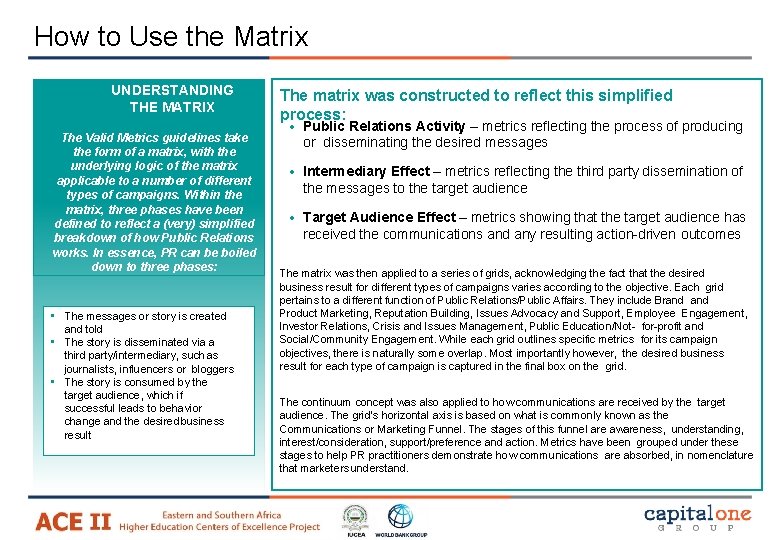
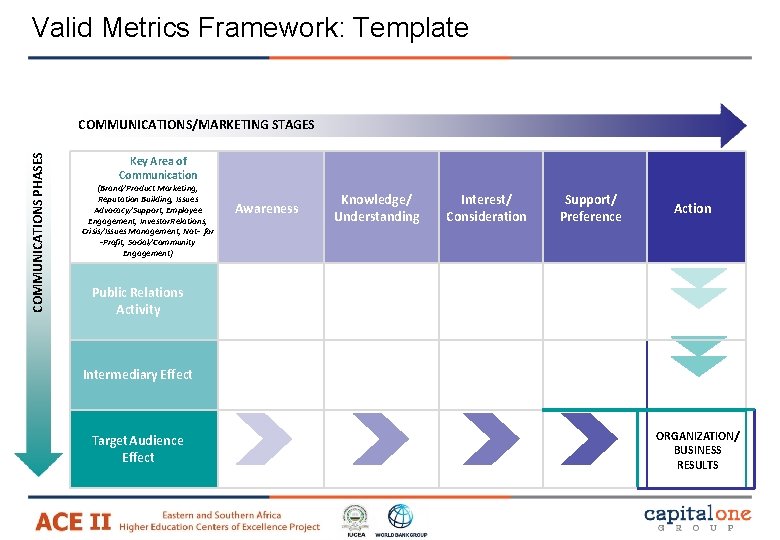
How to Use the Matrix UNDERSTANDING THE MATRIX The Valid Metrics guidelines take the form of a matrix, with the underlying logic of the matrix applicable to a number of different types of campaigns. Within the matrix, three phases have been defined to reflect a (very) simplified breakdown of how Public Relations works. In essence, PR can be boiled down to three phases: • The messages or story is created and told • The story is disseminated via a third party/intermediary, such as journalists, influencers or bloggers • The story is consumed by the target audience, which if successful leads to behavior change and the desired business result The matrix was constructed to reflect this simplified process: • Public Relations Activity – metrics reflecting the process of producing or disseminating the desired messages • Intermediary Effect – metrics reflecting the third party dissemination of the messages to the target audience • Target Audience Effect – metrics showing that the target audience has received the communications and any resulting action-driven outcomes The matrix was then applied to a series of grids, acknowledging the fact that the desired business result for different types of campaigns varies according to the objective. Each grid pertains to a different function of Public Relations/Public Affairs. They include Brand Product Marketing, Reputation Building, Issues Advocacy and Support, Employee Engagement, Investor Relations, Crisis and Issues Management, Public Education/Not- for-profit and Social/Community Engagement. While each grid outlines specific metrics for its campaign objectives, there is naturally some overlap. Most importantly however, the desired business result for each type of campaign is captured in the final box on the grid. The continuum concept was also applied to how communications are received by the target audience. The grid’s horizontal axis is based on what is commonly known as the Communications or Marketing Funnel. The stages of this funnel are awareness, understanding, interest/consideration, support/preference and action. Metrics have been grouped under these stages to help PR practitioners demonstrate how communications are absorbed, in nomenclature that marketers understand.
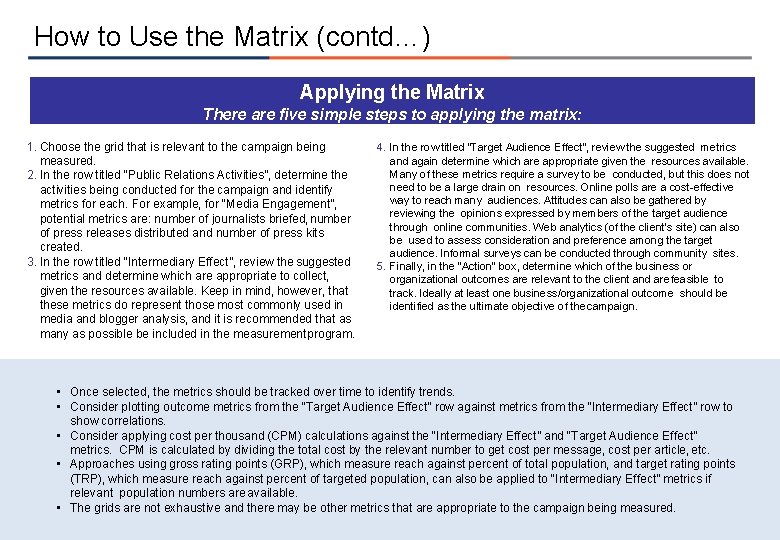
How to Use the Matrix (contd…) Applying the Matrix There are five simple steps to applying the matrix: 1. Choose the grid that is relevant to the campaign being measured. 2. In the row titled “Public Relations Activities”, determine the activities being conducted for the campaign and identify metrics for each. For example, for “Media Engagement”, potential metrics are: number of journalists briefed, number of press releases distributed and number of press kits created. 3. In the row titled “Intermediary Effect”, review the suggested metrics and determine which are appropriate to collect, given the resources available. Keep in mind, however, that these metrics do represent those most commonly used in media and blogger analysis, and it is recommended that as many as possible be included in the measurement program. 4. In the row titled “Target Audience Effect”, review the suggested metrics and again determine which are appropriate given the resources available. Many of these metrics require a survey to be conducted, but this does not need to be a large drain on resources. Online polls are a cost-effective way to reach many audiences. Attitudes can also be gathered by reviewing the opinions expressed by members of the target audience through online communities. Web analytics (of the client’s site) can also be used to assess consideration and preference among the target audience. Informal surveys can be conducted through community sites. 5. Finally, in the “Action” box, determine which of the business or organizational outcomes are relevant to the client and are feasible to track. Ideally at least one business/organizational outcome should be identified as the ultimate objective of the campaign. • Once selected, the metrics should be tracked over time to identify trends. • Consider plotting outcome metrics from the “Target Audience Effect” row against metrics from the “Intermediary Effect” row to show correlations. • Consider applying cost per thousand (CPM) calculations against the “Intermediary Effect” and “Target Audience Effect” metrics. CPM is calculated by dividing the total cost by the relevant number to get cost per message, cost per article, etc. • Approaches using gross rating points (GRP), which measure reach against percent of total population, and target rating points (TRP), which measure reach against percent of targeted population, can also be applied to “Intermediary Effect” metrics if relevant population numbers are available. • The grids are not exhaustive and there may be other metrics that are appropriate to the campaign being measured.
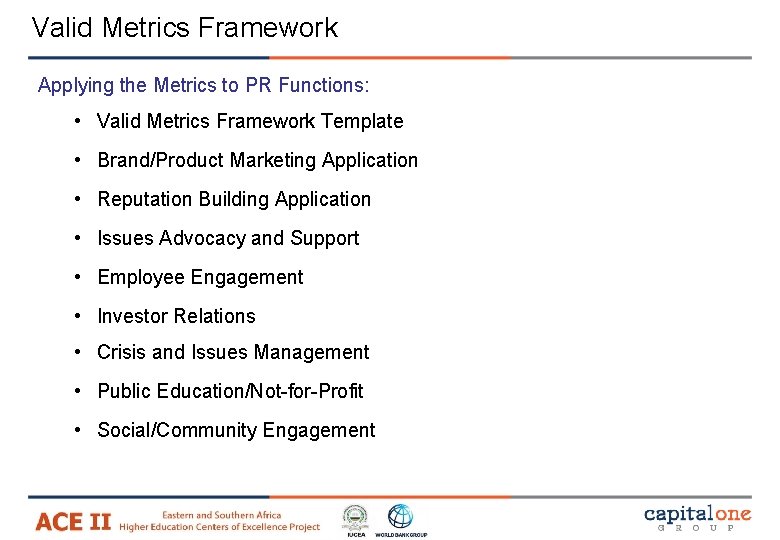
Valid Metrics Framework Applying the Metrics to PR Functions: • Valid Metrics Framework Template • Brand/Product Marketing Application • Reputation Building Application • Issues Advocacy and Support • Employee Engagement • Investor Relations • Crisis and Issues Management • Public Education/Not-for-Profit • Social/Community Engagement
Valid Metrics Framework: Template COMMUNICATIONS PHASES COMMUNICATIONS/MARKETING STAGES Key Area of Communication (Brand/Product Marketing, Reputation Building, Issues Advocacy/Support, Employee Engagement, Investor. Relations, Crisis/Issues Management, Not- for -Profit, Social/Community Engagement) Awareness Knowledge/ Understanding Interest/ Consideration Support/ Preference Action Public Relations Activity Intermediary Effect Target Audience Effect ORGANIZATION/ BUSINESS RESULTS
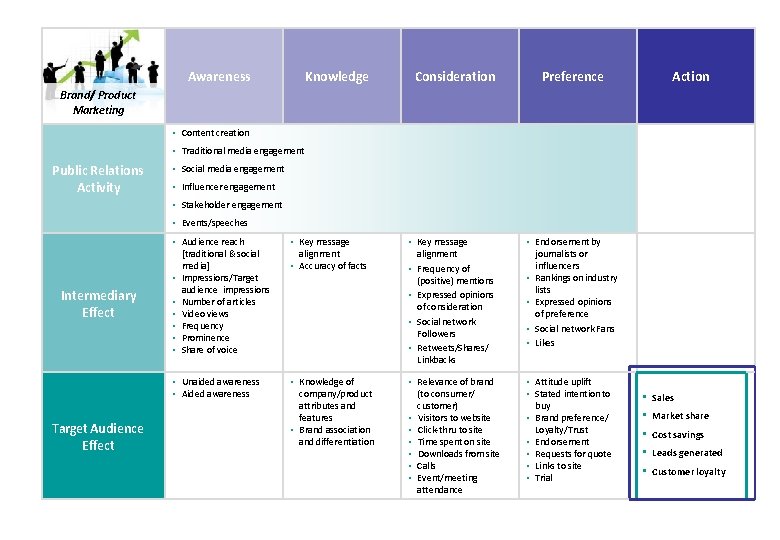
Awareness Knowledge Consideration Preference • Audience reach [traditional & social media] • Impressions/Target audience impressions • Number of articles • Video views • Frequency • Prominence • Share of voice • Key message alignment • Accuracy of facts • Key message alignment • Frequency of (positive) mentions • Expressed opinions of consideration • Social network Followers • Retweets/Shares/ Linkbacks • Endorsement by journalists or influencers • Rankings on industry lists • Expressed opinions of preference • Social network Fans • Likes • Unaided awareness • Aided awareness • Knowledge of company/product attributes and features • Brand association and differentiation • Relevance of brand (to consumer/ customer) • Visitors to website • Click-thru to site • Time spent on site • Downloads from site • Calls • Event/meeting attendance • Attitude uplift • Stated intention to buy • Brand preference/ Loyalty/Trust • Endorsement • Requests for quote • Links to site • Trial Action Brand/ Product Marketing • Content creation • Traditional media engagement Public Relations Activity • Social media engagement • Influencer engagement • Stakeholder engagement • Events/speeches Intermediary Effect Target Audience Effect • Sales • Market share • Cost savings • Leads generated • Customer loyalty
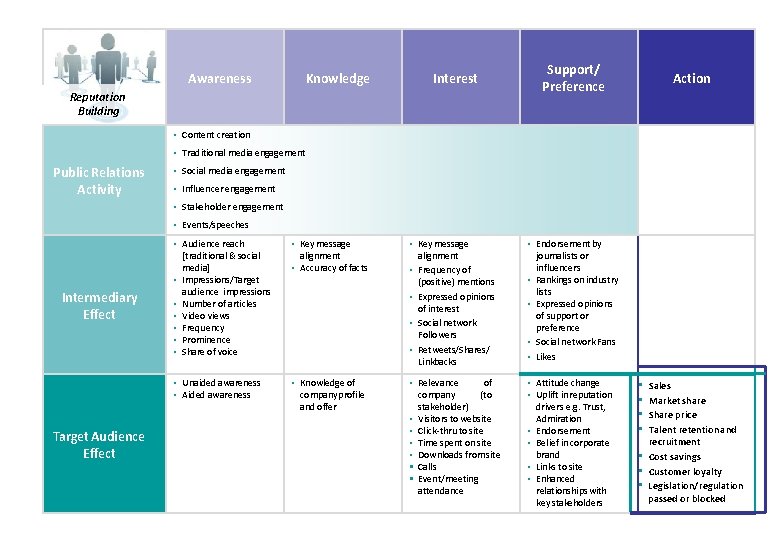
Awareness Knowledge Interest Reputation Building Support/ Preference Action • Content creation • Traditional media engagement Public Relations Activity • Social media engagement • Influencer engagement • Stakeholder engagement • Events/speeches Intermediary Effect Target Audience Effect • Audience reach [traditional & social media] • Impressions/Target audience impressions • Number of articles • Video views • Frequency • Prominence • Share of voice • Key message alignment • Accuracy of facts • Key message alignment • Frequency of (positive) mentions • Expressed opinions of interest • Social network Followers • Retweets/Shares/ Linkbacks • Endorsement by journalists or influencers • Rankings on industry lists • Expressed opinions of support or preference • Social network Fans • Likes • Unaided awareness • Aided awareness • Knowledge of company profile and offer • Relevance of company (to stakeholder) • Visitors to website • Click-thru to site • Time spent on site • Downloads from site • Calls • Event/meeting attendance • Attitude change • Uplift in reputation drivers e. g. Trust, Admiration • Endorsement • Belief in corporate brand • Links to site • Enhanced relationships with key stakeholders Sales Market share Share price Talent retention and recruitment • Cost savings • Customer loyalty • Legislation/regulation passed or blocked • •
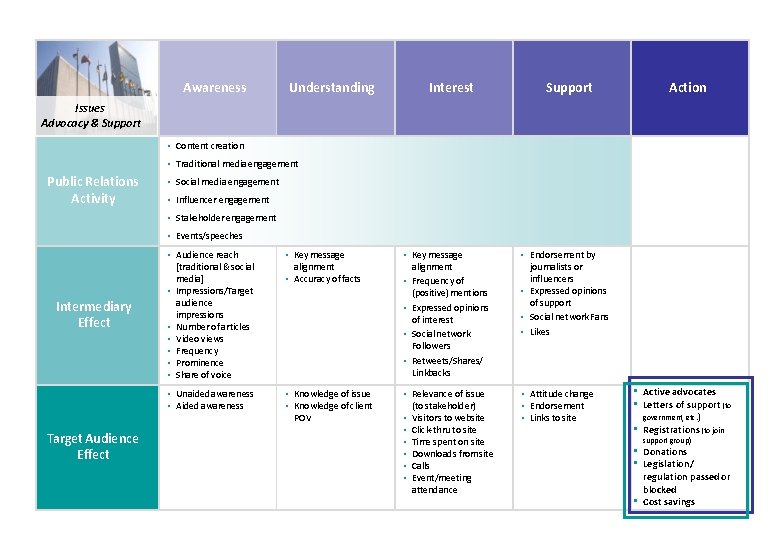
Awareness Understanding Interest Support Action Issues Advocacy & Support • Content creation • Traditional media engagement Public Relations Activity • Social media engagement • Influencer engagement • Stakeholder engagement • Events/speeches Intermediary Effect Target Audience Effect • Audience reach [traditional & social media] • Impressions/Target audience impressions • Number of articles • Video views • Frequency • Prominence • Share of voice • Key message alignment • Accuracy of facts • Key message alignment • Frequency of (positive) mentions • Expressed opinions of interest • Social network Followers • Retweets/Shares/ Linkbacks • Endorsement by journalists or influencers • Expressed opinions of support • Social network Fans • Likes • Unaided awareness • Aided awareness • Knowledge of issue • Knowledge of client POV • Relevance of issue (to stakeholder) • Visitors to website • Click-thru to site • Time spent on site • Downloads from site • Calls • Event/meeting attendance • Attitude change • Endorsement • Links to site • Active advocates • Letters of support (to government, etc. ) • Registrations (to join support group) • Donations • Legislation/ regulation passed or blocked • Cost savings
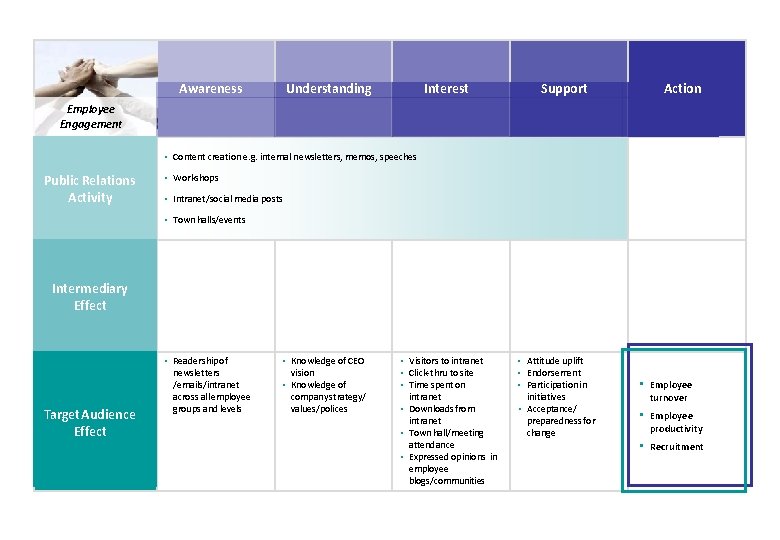
Awareness Understanding Interest Support Action Employee Engagement • Content creation e. g. internal newsletters, memos, speeches Public Relations Activity • Workshops • Intranet/social media posts • Town halls/events Intermediary Effect Target Audience Effect • Readership of newsletters /emails/intranet across all employee groups and levels • Knowledge of CEO vision • Knowledge of company strategy/ values/polices • Visitors to intranet • Click-thru to site • Time spent on intranet • Downloads from intranet • Town hall/meeting attendance • Expressed opinions in employee blogs/communities • Attitude uplift • Endorsement • Participation in initiatives • Acceptance/ preparedness for change • Employee turnover • Employee productivity • Recruitment
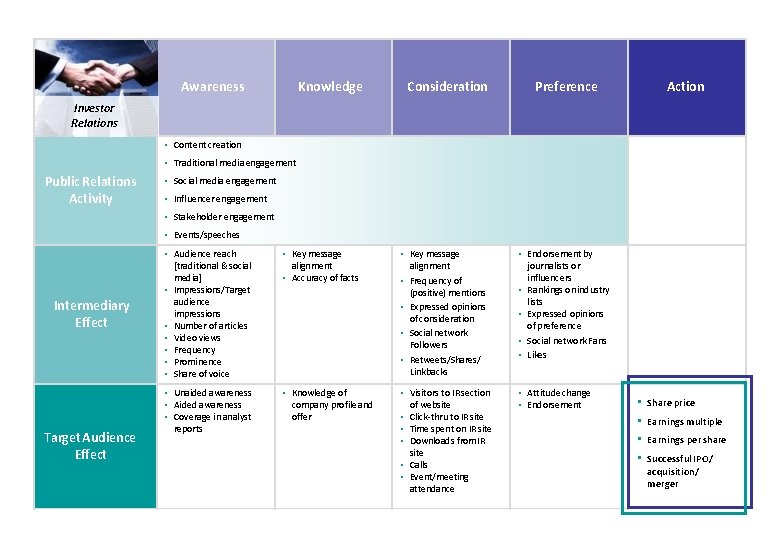
Awareness Knowledge Consideration Preference Action Investor Relations • Content creation • Traditional media engagement Public Relations Activity • Social media engagement • Influencer engagement • Stakeholder engagement • Events/speeches Intermediary Effect Target Audience Effect • Audience reach [traditional & social media] • Impressions/Target audience impressions • Number of articles • Video views • Frequency • Prominence • Share of voice • Key message alignment • Accuracy of facts • Key message alignment • Frequency of (positive) mentions • Expressed opinions of consideration • Social network Followers • Retweets/Shares/ Linkbacks • Endorsement by journalists or influencers • Rankings on industry lists • Expressed opinions of preference • Social network Fans • Likes • Unaided awareness • Aided awareness • Coverage in analyst reports • Knowledge of company profile and offer • Visitors to IR section of website • Click-thru to IR site • Time spent on IR site • Downloads from IR site • Calls • Event/meeting attendance • Attitude change • Endorsement • Share price • Earnings multiple • Earnings per share • Successful IPO/ acquisition/ merger
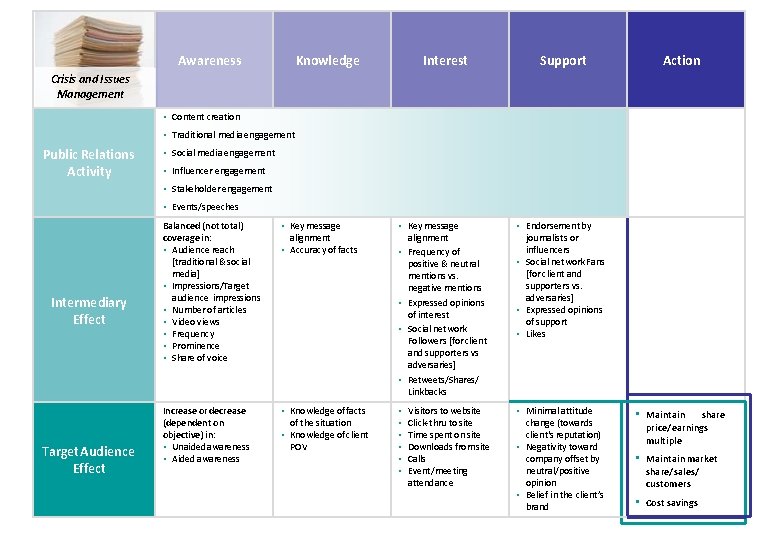
Awareness Knowledge Interest Support • Endorsement by journalists or influencers • Social network Fans [for client and supporters vs. adversaries] • Expressed opinions of support • Likes Action Crisis and Issues Management • Content creation • Traditional media engagement Public Relations Activity • Social media engagement • Influencer engagement • Stakeholder engagement • Events/speeches Intermediary Effect Target Audience Effect Balanced (not total) coverage in: • Audience reach [traditional & social media] • Impressions/Target audience impressions • Number of articles • Video views • Frequency • Prominence • Share of voice • Key message alignment • Accuracy of facts • Key message alignment • Frequency of positive & neutral mentions vs. negative mentions • Expressed opinions of interest • Social network Followers [for client and supporters vs adversaries] • Retweets/Shares/ Linkbacks Increase or decrease (dependent on objective) in: • Unaided awareness • Aided awareness • Knowledge of facts of the situation • Knowledge of client POV • • • Visitors to website Click-thru to site Time spent on site Downloads from site Calls Event/meeting attendance • Minimal attitude change (towards client's reputation) • Negativity toward company offset by neutral/positive opinion • Belief in the client’s brand • Maintain share price/earnings multiple • Maintain market share/sales/ customers • Cost savings
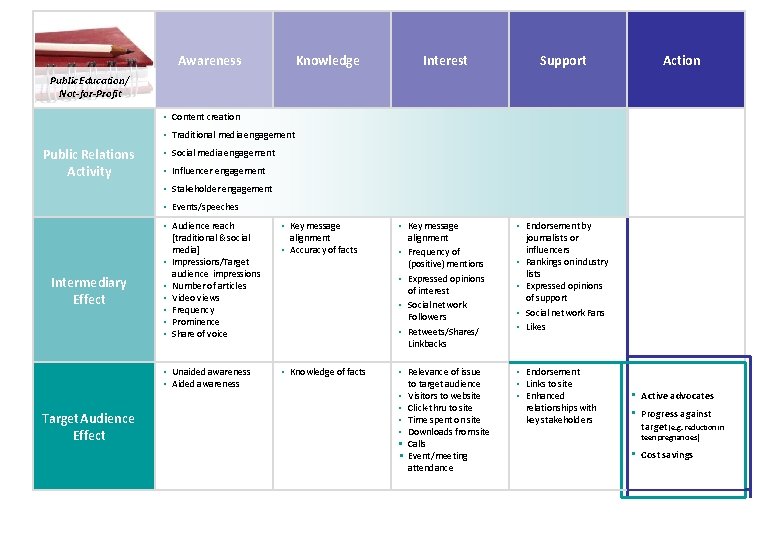
Awareness Knowledge Interest Support Action Public Education/ Not-for-Profit • Content creation • Traditional media engagement Public Relations Activity • Social media engagement • Influencer engagement • Stakeholder engagement • Events/speeches Intermediary Effect Target Audience Effect • Audience reach [traditional & social media] • Impressions/Target audience impressions • Number of articles • Video views • Frequency • Prominence • Share of voice • Key message alignment • Accuracy of facts • Key message alignment • Frequency of (positive) mentions • Expressed opinions of interest • Social network Followers • Retweets/Shares/ Linkbacks • Endorsement by journalists or influencers • Rankings on industry lists • Expressed opinions of support • Social network Fans • Likes • Unaided awareness • Aided awareness • Knowledge of facts • Relevance of issue to target audience • Visitors to website • Click-thru to site • Time spent on site • Downloads from site • Calls • Event/meeting attendance • Endorsement • Links to site • Enhanced relationships with key stakeholders • Active advocates • Progress against target (e. g. reduction in teen pregnancies) • Cost savings
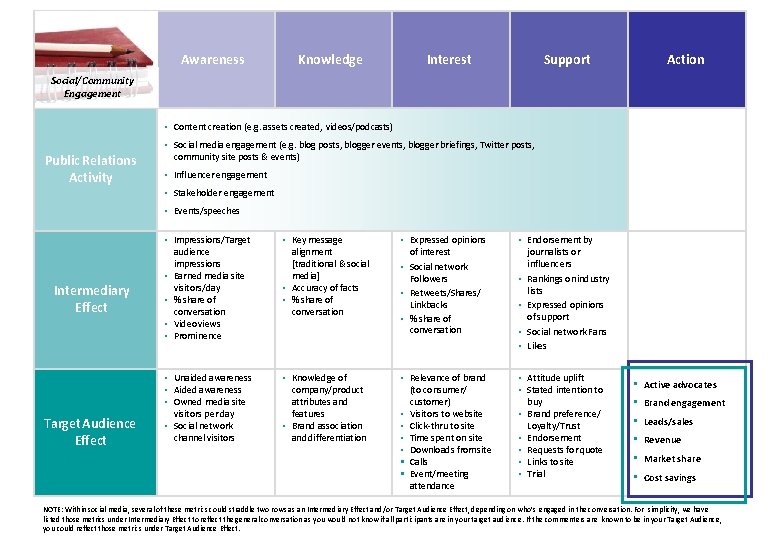
Awareness Knowledge Interest Support Action Social/Community Engagement • Content creation (e. g. assets created, videos/podcasts) Public Relations Activity • Social media engagement (e. g. blog posts, blogger events, blogger briefings, Twitter posts, community site posts & events) • Influencer engagement • Stakeholder engagement • Events/speeches Intermediary Effect Target Audience Effect • Impressions/Target audience impressions • Earned media site visitors/day • % share of conversation • Video views • Prominence • Key message alignment [traditional & social media] • Accuracy of facts • % share of conversation • Expressed opinions of interest • Social network Followers • Retweets/Shares/ Linkbacks • % share of conversation • Endorsement by journalists or influencers • Rankings on industry lists • Expressed opinions of support • Social network Fans • Likes • Unaided awareness • Aided awareness • Owned media site visitors per day • Social network channel visitors • Knowledge of company/product attributes and features • Brand association and differentiation • Relevance of brand (to consumer/ customer) • Visitors to website • Click-thru to site • Time spent on site • Downloads from site • Calls • Event/meeting attendance • Attitude uplift • Stated intention to buy • Brand preference/ Loyalty/Trust • Endorsement • Requests for quote • Links to site • Trial • Active advocates • Brand engagement • Leads/sales • Revenue • Market share • Cost savings NOTE: Within social media, several of these metrics could straddle two rows as an Intermediary Effect and/or Target Audience Effect, depending on who’s engaged in the conversation. For simplicity, we have listed those metrics under Intermediary Effect to reflect the general conversation as you would not know if all participants are in your target audience. If the commenters are known to be in your Target Audience, you could reflect those metrics under Target Audience Effect.