
PPTs for teaching learning for course BUSINESS RESEARCH
PPTs for teaching & learning for course BUSINESS RESEARCH METHODS MBA Sem I Savitribai Phule Pune University, Pune, India. By Prof. Swapnil Undale & Dr. Padmavati Undale This work is licensed under the Creative Commons Attribution-Share. Alike 4. 0 International License. You are free to use, distribute and modify it, including for commercial purposes, provided you acknowledge the source and share-alike. To view a copy of this license, visit http: //creativecommons. org/licenses/by-sa/4. 0/.
Probability & Non probability Sampling. Non-Probability sampling. Also called as ‘deliberate’ or ‘purposive’ or ‘judgment’ sampling. Items are selected deliberately. Researcher’s choice of selecting element and include them in sample. No assurance that every element will get equal chance to be selected as sample
Probability & Non probability Sampling. Non-Probability sampling. Convenience. A non-probability sampling technique where researcher use any readily available individuals as participants Most cheapest & easiest to conduct Least reliable Researcher is free to select anybody as sample Purposive sampling. A non probability sample that conforms to certain criteria. The units or elements are purposively selected.
Probability & Non probability Sampling. Non-Probability sampling. Judgment sampling. A purposive sampling where the researcher arbitrarily selects sample units to conform to some criterion. An experts may be asked to select sample. e. g. Problem – Sales de-growth across all territories (500+) Study of all territories not practical. Expert in Sales management will be asked to select sample territories for study. On the basis of certain criterions (applying his judgment) he select sample territories Criteria – market conditions, seniority of employee etc
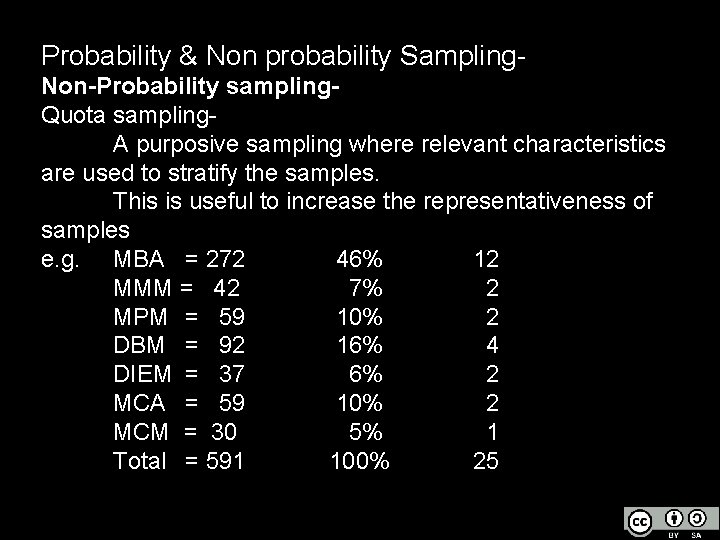
Probability & Non probability Sampling. Non-Probability sampling. Quota sampling. A purposive sampling where relevant characteristics are used to stratify the samples. This is useful to increase the representativeness of samples e. g. MBA = 272 46% 12 MMM = 42 7% 2 MPM = 59 10% 2 DBM = 92 16% 4 DIEM = 37 6% 2 MCA = 59 10% 2 MCM = 30 5% 1 Total = 591 100% 25
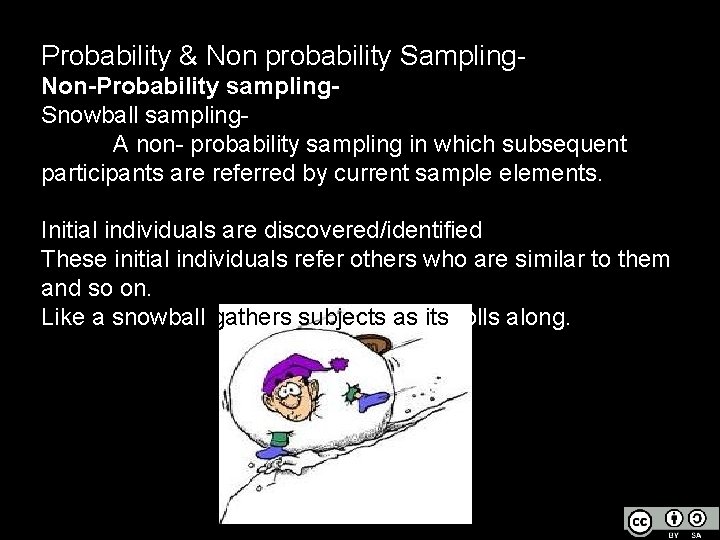
Probability & Non probability Sampling. Non-Probability sampling. Snowball sampling. A non- probability sampling in which subsequent participants are referred by current sample elements. Initial individuals are discovered/identified These initial individuals refer others who are similar to them and so on. Like a snowball gathers subjects as its rolls along.

THANK YOU
- Slides: 7