
Pozzolanic Matarials The types of pozzolanic materials are
- Slides: 28
Pozzolanic Matarials • The types of pozzolanic materials are divided into two as natural and artificial. • Natural ; volcanic ash, volcanic tuff, clay and shale. • Artificial ; fly ash, silica fume, blast furnace slag
Uses of Pozzolans • 1) Direct use of Pozzolan by Mixing it with Calcium Hydroxide Extensively used in ancient times but not very common now. • 2) Use of Pozzolan in Producing Blended Cements Grinding “Clinker+Pozzolan+Gypsum”→ Portland Pozzolan Cements Extensively used • 3) Use of Pozzolan as an Admixture “Cement+Pozzolan+Aggregate+Water”→ Concrete
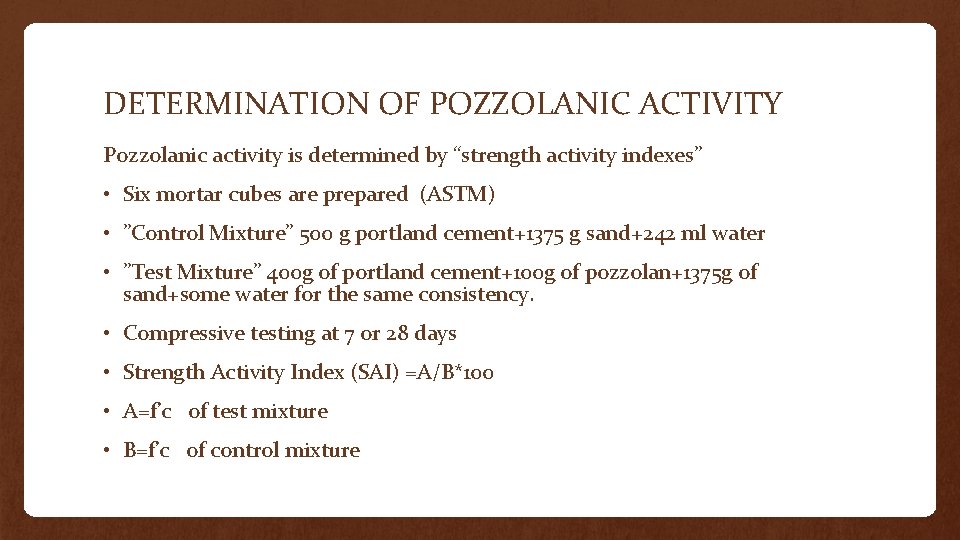
DETERMINATION OF POZZOLANIC ACTIVITY Pozzolanic activity is determined by “strength activity indexes” • Six mortar cubes are prepared (ASTM) • ”Control Mixture” 500 g portland cement+1375 g sand+242 ml water • ”Test Mixture” 400 g of portland cement+100 g of pozzolan+1375 g of sand+some water for the same consistency. • Compressive testing at 7 or 28 days • Strength Activity Index (SAI) =A/B*100 • A=f’c of test mixture • B=f’c of control mixture
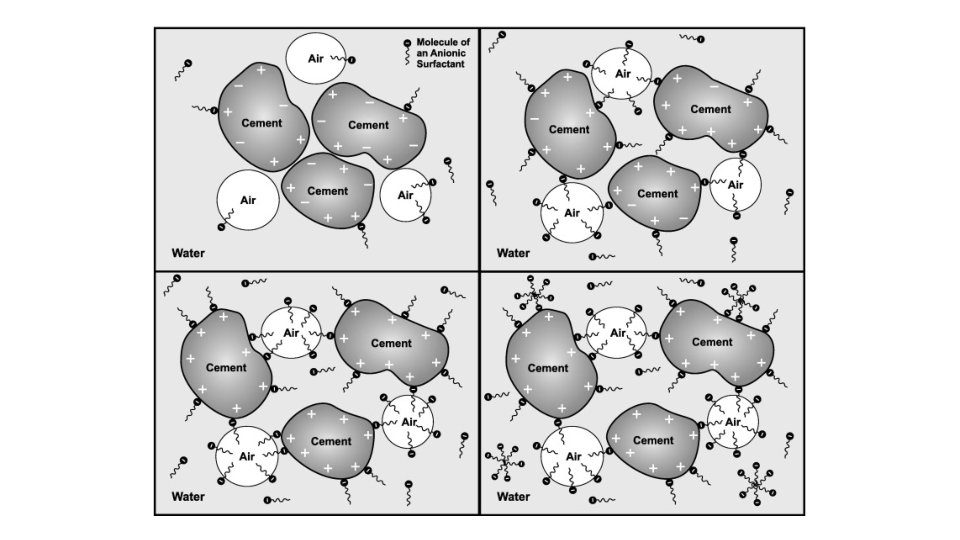
Air entrainment is an essential component of concrete mixtures subject to freezing and thawing environments.
EFFECTS ON FRESH CONCRETE Increase workability without increasing water content. Retard or accelerate the time of initial setting. Reduce or prevent settlement or create a slight expansion. Modify bleeding characteristics. Reduce segregation. Improve pumbability. Reduce the rate of slump loss.
EFFECTS ON HARDENED CONCRETE Reduce the rate of heat evolution during early cement hydration. Accelerate the rate of strength development of early ages. Increase resistance to freezing and thawing. Decrease permeability. Reduce expansion caused by alkali-agg. reaction. Reduce drying shrinkage.
1. Air-entrainment—The introduction of air in the form of discrete air-voids or bubbles dispersed throughout the mixture as a result of the use of air-entraining materials. 2. Entrained Air—The air, made up of discrete air-voids, that becomes part of a mixture during the process of airentrainment.
3. Entrapped Air-voids—Air-voids not resulting from intentional air-entrainment. Such voids are larger than those resulting from intentional air-entrainment and are at times referred to as natural air-voids. 4. Entrained Air-voids—Air-voids resulting from the use of intentional air-entrainment. Such voids are generally spherical in shape and considerably smaller than the natural air-voids.
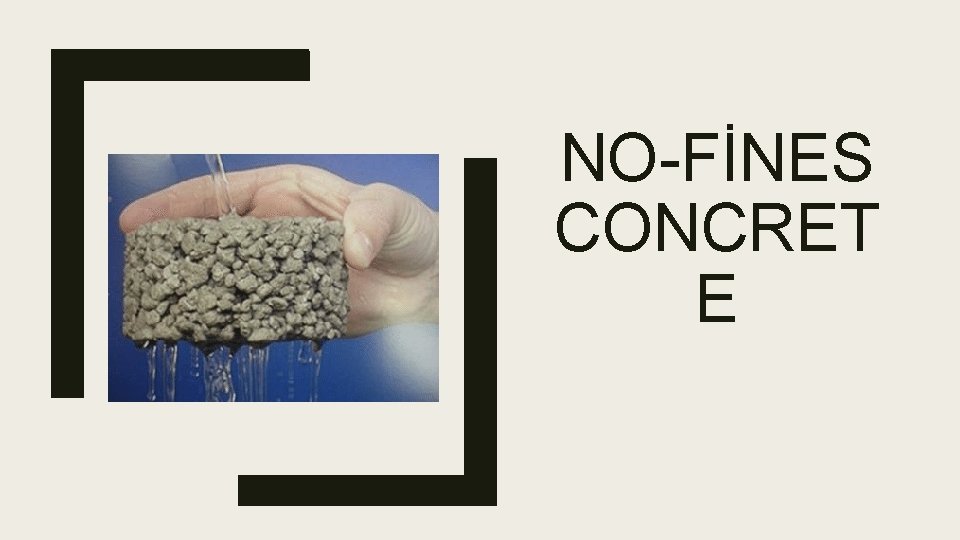
NO-FİNES CONCRET E
İNTRODUCTİON ■ No fines concrete is one type of light weight concrete. As the name indicates, this a concrete mix without fine aggregate or sand. This type of concrete consists of only water, cement and coarse aggregate.
IMPORTANT NOTES ON NO FINES CONCRETE ■ Normally coarse aggregates passing 20 mm sieve and retained on 10 mm sieves used for production of this type of concrete. ■ The aggregates to cement ratio of no fines concrete generally vary from 6: 1 to 10: 1.
■ The water cement ratio is kept within the range of 0. 38 to 0. 52. Water cement ratio should be chosen very carefully considering the cohesiveness of the mixture. ■ Density of no fines concrete with normal aggregate vary from 1600 to 1900 kg/m 3. When light weight aggregates are used density can be as low as 300 kg/m 3. ■ The compressive strength of no fines concrete varies between 4 MPa to 14 MPa.
FIBRE REINFORCED CONCRETE
■ Fiber-reinforced concrete (FRC) is a composite concrete material containing uniformly distributed fibers whose high tensile strength helps to prevent the material from rupturing internally and enables it to withstand the extension of cracks. ■ FRC is thus stronger and more resistant to cracks, impacts, shocks, and abrasion than normal concrete
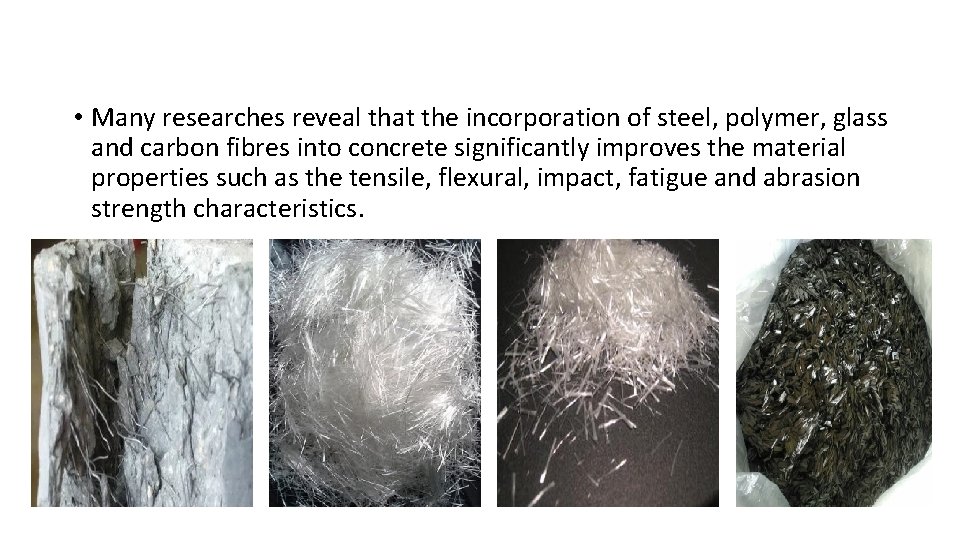
• Many researches reveal that the incorporation of steel, polymer, glass and carbon fibres into concrete significantly improves the material properties such as the tensile, flexural, impact, fatigue and abrasion strength characteristics.
• Since the limited amount of short fibre addition into the fresh concrete during the mixing process increases the toughness of concrete. • The increase in the toughness of concrete and in the reduction of the size and amount of defects subsequently improve the performance of the concrete by remedying its brittle behaviour that mostly provokes the low values of properties such as tensile strength, ductility and energy absorption.
• Factors such as the aspect ratio of fibers, their shape, their dosage, orientation and distribution within the concrete, proved to strongly affect the mechanical response of the concrete. • it is beneficial to the performance that as flexural strength improves and compressive strength reduces accordingly, thus lowering the compression ratio and the concrete brittleness.
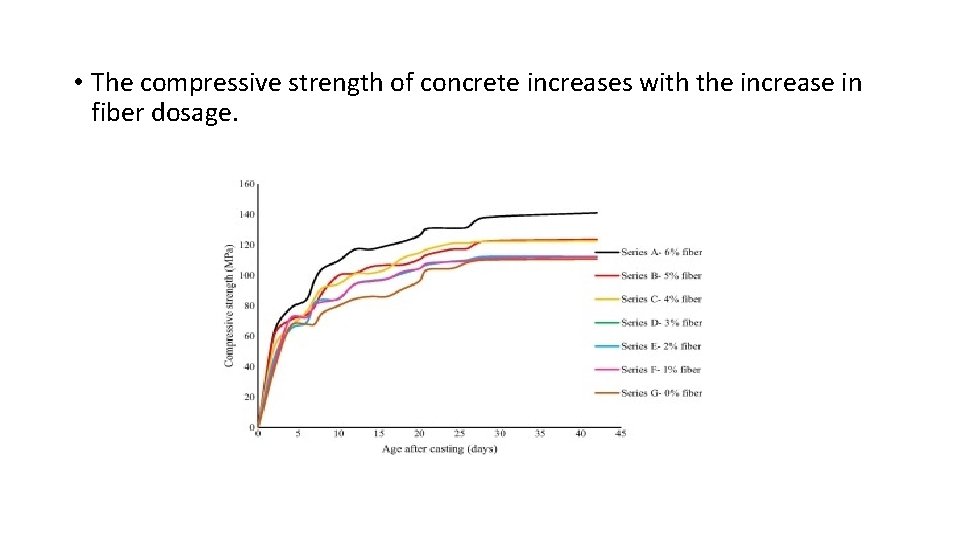
• The compressive strength of concrete increases with the increase in fiber dosage.
SLURRY INFILTRATED FIBRE CONCRETE (SIFCON)
Fiber content in traditional fiber concrete 0. 25% - 2 -3% Fiber content in SIFCON 6 -20%
• High mechanical properties and high energy absorbing ability is improve the potential usage of SIFCON. • SIFCON is used in/for; -structures that can be exposed to explosion and impact. -areas where high energy absorption capacity is desired. -strengthening against earthquake effects.
General Properties Of SIFCON Slurry • • CEMENT WATER SILICA FUME SUPERPLASTICIZER It is produced in a very flowing consistency.
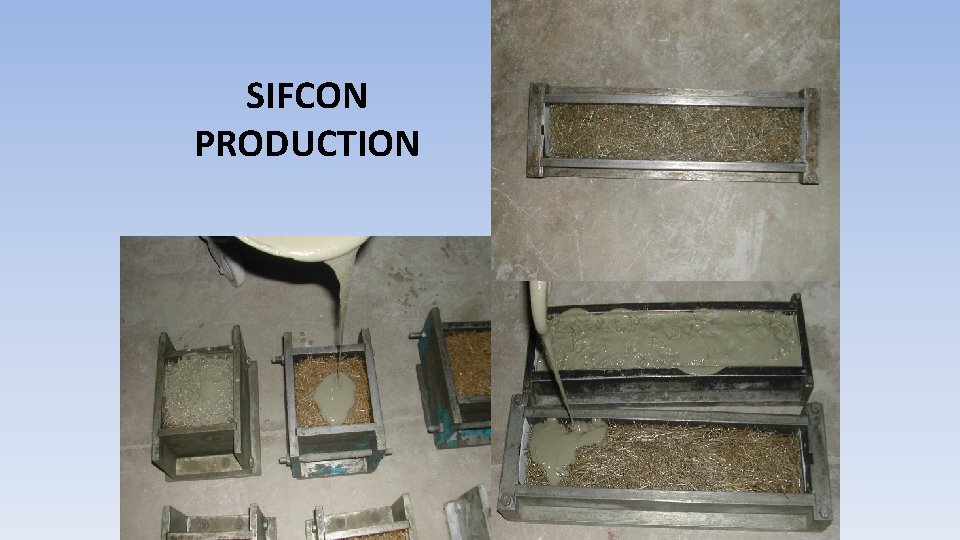
SIFCON PRODUCTION
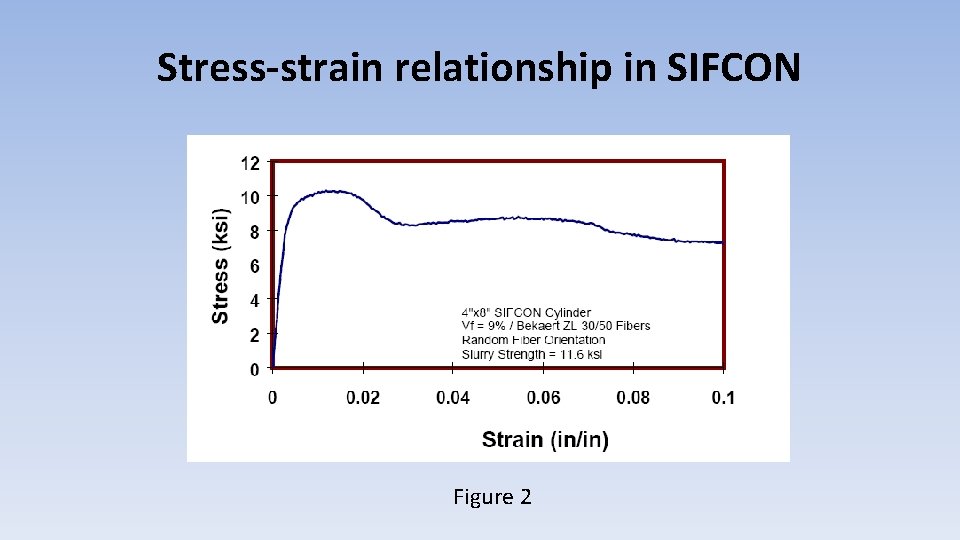
Stress-strain relationship in SIFCON Figure 2
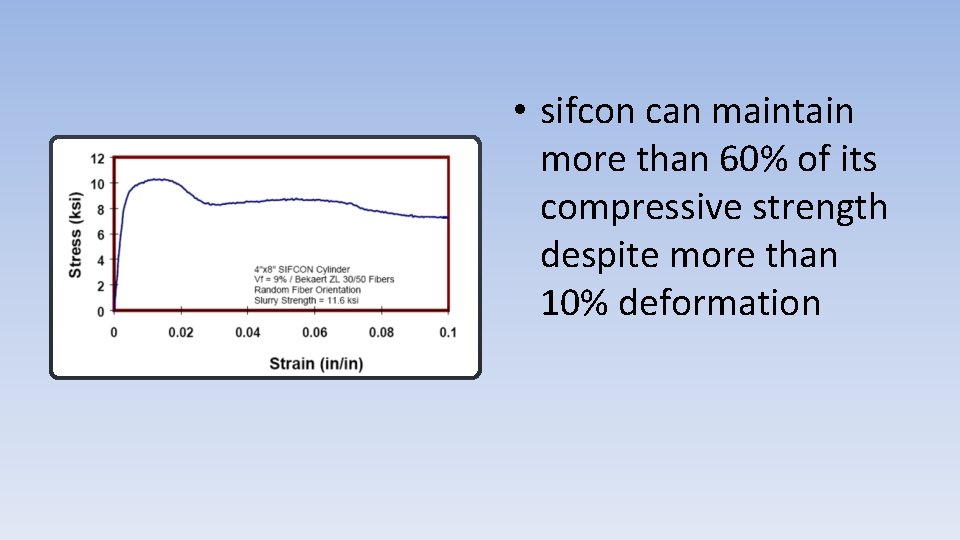
• sifcon can maintain more than 60% of its compressive strength despite more than 10% deformation
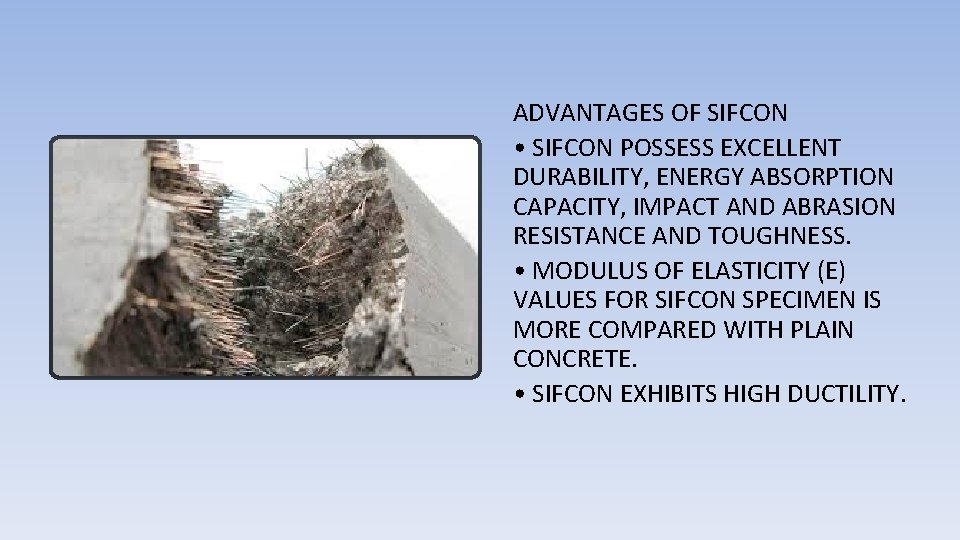
ADVANTAGES OF SIFCON • SIFCON POSSESS EXCELLENT DURABILITY, ENERGY ABSORPTION CAPACITY, IMPACT AND ABRASION RESISTANCE AND TOUGHNESS. • MODULUS OF ELASTICITY (E) VALUES FOR SIFCON SPECIMEN IS MORE COMPARED WITH PLAIN CONCRETE. • SIFCON EXHIBITS HIGH DUCTILITY.
MAIN PARAMETERS THAT AFFECT THE ENGINEERING CHARACTERISTICS OF SIFCON • REOLOGY AND RESISTANCE OF CEMENT SLURRY • FIBER TYPE AND QUANTITY • FIBER DIRECTION