
POWERPOINT SLIDES SUPERVISORS AND MANAGERS SERIES Marketing and



- Slides: 59
POWERPOINT SLIDES SUPERVISORS AND MANAGERS SERIES Marketing and Sales
Agenda 8: 30 -8: 45 Icebreaker: Bingo 8: 45 -9: 00 Session One: Course Overview 9: 00 -9: 15 Session Two: Pre-Assignment Review 9: 15 -9: 30 Session Three: Defining Marketing 9: 30 -9: 45 Session Four: Recognizing Trends 9: 45 -10: 00 Session Five: Doing Market Research 10: 00 -10: 15 Break 10: 15 -11: 30 Session Six: Strategies for Success 11: 30 -11: 45 Session Seven: Mission Statements 11: 45 -12: 00 Morning Wrap-Up 12: 00 -1: 00 Lunch 1: 00 -1: 15 Energizer: Bunkum Bosh 1: 15 -1: 30 Session Eight: Brochures 1: 30 -2: 15 Session Nine: Trade Shows 2: 15 -2: 30 Break 2: 30 -3: 15 Session Ten: Developing a Marketing Plan 3: 15 -3: 30 Session Eleven: Increasing Business 3: 30 -3: 45 Session Twelve: Saying No to New Business 3: 45 -4: 00 Session Thirteen: Advertising Myths 4: 00 -4: 15 Session Fourteen: Networking Tips 4: 15 -4: 30 Workshop Wrap-Up
Session One: Course Overview Learning Objectives • Recognize what we mean by the term “marketing. ” • Discover how to use low-cost publicity to get your name known. • Know how to develop a marketing plan and a marketing campaign. • Use your time rather than your money to market your company effectively. • Understand how to perform a SWOT analysis.
Session Two: Pre-Assignment Review (I) • Have you reviewed your marketing plan in the last three to six months? If so, did you make changes to it? Why or why not? • What kinds of things stimulate changes to your marketing plan (changes in the economy, changes in sales results, etc. )?
Session Two: Pre-Assignment Review (II) • Is your marketing plan fully integrated with your business plan? Why or why not? • What books, journals, or websites are you currently reading? What are your favorite, most enticing, and most exciting aspects of marketing and sales?
Session Three: Defining Marketing (I) • Sales and marketing are evolving from being product-focused to more customer -focused. • Marketing professionals use advertising to raise awareness of the brand. • Sales activities focus on serving that target market and converting prospects to paying customers.
Session Three: Defining Marketing (II) • Both marketing and sales activities keep in mind that keeping customers is easier than finding new customers. • Marketing activities are specifically directed toward: – Finding out what your customers need or want. – Directing efforts to make sure your customers are able to get what they need or want from you.
Session Three: Defining Marketing (III) • The best marketing is not about our products or services and their features or benefits. • It is about how what you offer your prospects and your customers will change their lives for the better.
Session Three: Defining Marketing (IV) • We should spend enough time getting our message right so it will persuade others to want what we are offering. • Once we have it right, we will want to repeat that message again and again, so people will hear it, remember it, and act upon it.
Session Three: Defining Marketing (V) Glossary of Terms • Market Segment • Mission Statement • Objectives • Plan of Action • Strategies • Tactics • Targeting
Session Four: Recognizing Trends (I) • We can anticipate trends just by analyzing what we see on television and the Internet. • Watch messages with a marketer's eye. • Fads come and go within months. • Trends take a decade to grow and then another decade to go away (roughly).
Session Four: Recognizing Trends (II) • What are some trends you see changing the world today? • What changes do you see in your industry? • How are these trends changing your industry? • How can you take advantage of these trends?
Session Five: Doing Market Research (I) • Research is one step that you cannot afford to gloss over. • Luckily, we have lots of ways that we can conduct research inexpensively. • If you think you cannot afford to do any research, think again!
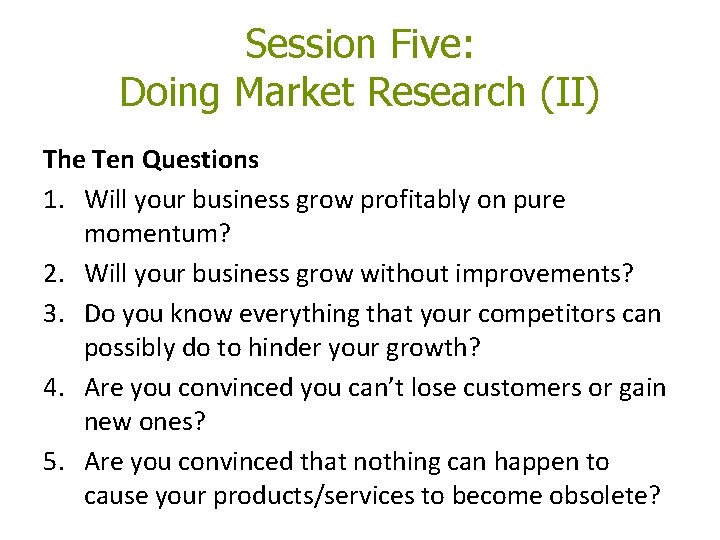
Session Five: Doing Market Research (II) The Ten Questions 1. Will your business grow profitably on pure momentum? 2. Will your business grow without improvements? 3. Do you know everything that your competitors can possibly do to hinder your growth? 4. Are you convinced you can’t lose customers or gain new ones? 5. Are you convinced that nothing can happen to cause your products/services to become obsolete?
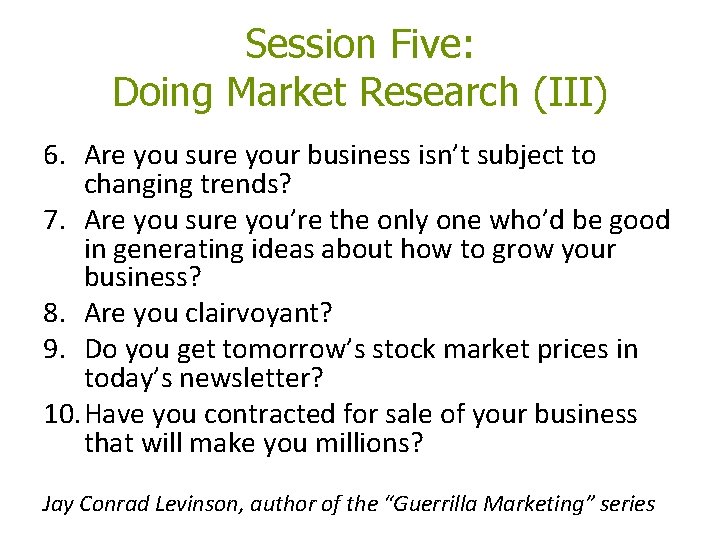
Session Five: Doing Market Research (III) 6. Are you sure your business isn’t subject to changing trends? 7. Are you sure you’re the only one who’d be good in generating ideas about how to grow your business? 8. Are you clairvoyant? 9. Do you get tomorrow’s stock market prices in today’s newsletter? 10. Have you contracted for sale of your business that will make you millions? Jay Conrad Levinson, author of the “Guerrilla Marketing” series
Session Five: Doing Market Research (IV) • Things are changing so quickly in business. • Sometimes the type of information you want about your potential customers is not readily available. • When that happens, you may have to conduct original market research.
Session Five: Doing Market Research (V) Primary Research Methods • Research projects • Personal interviews • Focus groups • Mail or e-mail surveys
Session Five: Doing Market Research (VI) Questions to Consider • If I’m wrong, how much will it cost me? • Have I asked for some input from people who have no stake in whether I succeed or fail? • Have I asked customers and prospects what they need and want from me and my business? • Do I really know if my customers think I am giving them what they want and need? • What else can I provide my customers so they’ll pay me more and be happier about it?
Session Five: Doing Market Research (VII) Secondary Research Methods • Statistics organizations • Tourism statistics collected by your local tourism agency • Information compiled by industry associations • Federal, provincial, or municipal statistics • Directories and lists • General publications
Session Five: Doing Market Research (VIII) Secondary Research Methods ctd. • Institutional publications • Trade association newsletters and reports • Trade journals and periodicals • Chamber of Commerce • Economic Development Commission • Customers, competitors, and suppliers
Session Six: Strategies for Success Top Ten Strategies for Success (I) • A consistent look • A service attitude • Ad agency • Advisory board • Affinity credit cards • Annual reports • Anniversaries and birthday • • • cards A-thons Audio files (MP 3’s), Video, DVD’s Awards and award dinners Billboards Blogging Board of Directors • • • Bookmarks Books Brochures Business cards Bumper stickers Catalogues Celebrities Certificates Challenge fundraising
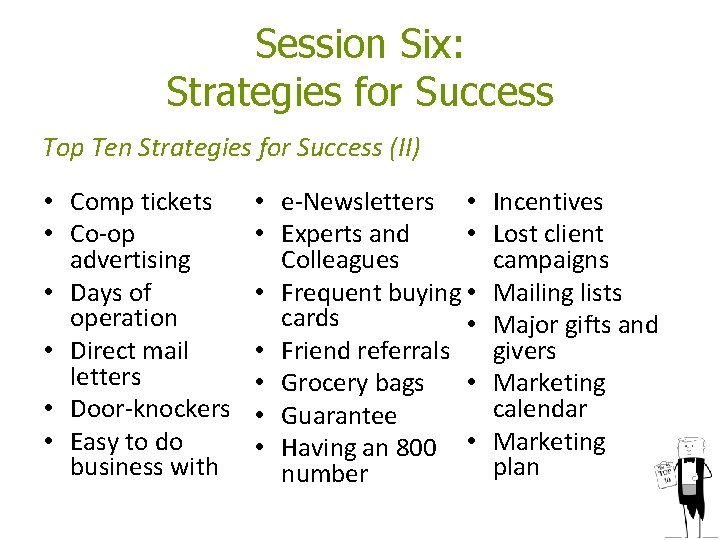
Session Six: Strategies for Success Top Ten Strategies for Success (II) • Comp tickets • Co-op advertising • Days of operation • Direct mail letters • Door-knockers • Easy to do business with • e-Newsletters • • • Experts and Colleagues • Frequent buying • cards • • Friend referrals • Grocery bags • • Guarantee • Having an 800 • number Incentives Lost client campaigns Mailing lists Major gifts and givers Marketing calendar Marketing plan
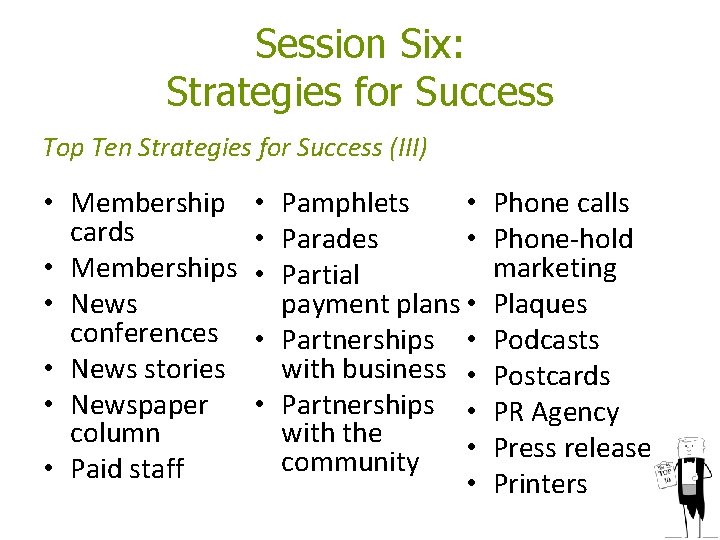
Session Six: Strategies for Success Top Ten Strategies for Success (III) • Membership cards • Memberships • News conferences • News stories • Newspaper column • Paid staff • Pamphlets • • Parades • • Partial payment plans • • Partnerships • with business • • Partnerships • with the • community • Phone calls Phone-hold marketing Plaques Podcasts Postcards PR Agency Press release Printers
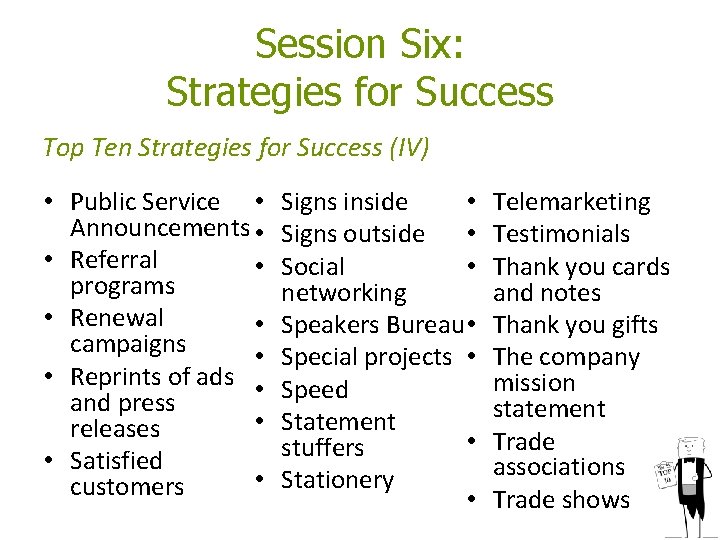
Session Six: Strategies for Success Top Ten Strategies for Success (IV) • Public Service • Announcements • • Referral • programs • Renewal • campaigns • • Reprints of ads • and press • releases • Satisfied • customers Signs inside • Signs outside • • Social networking Speakers Bureau • Special projects • Speed Statement • stuffers Stationery • Telemarketing Testimonials Thank you cards and notes Thank you gifts The company mission statement Trade associations Trade shows
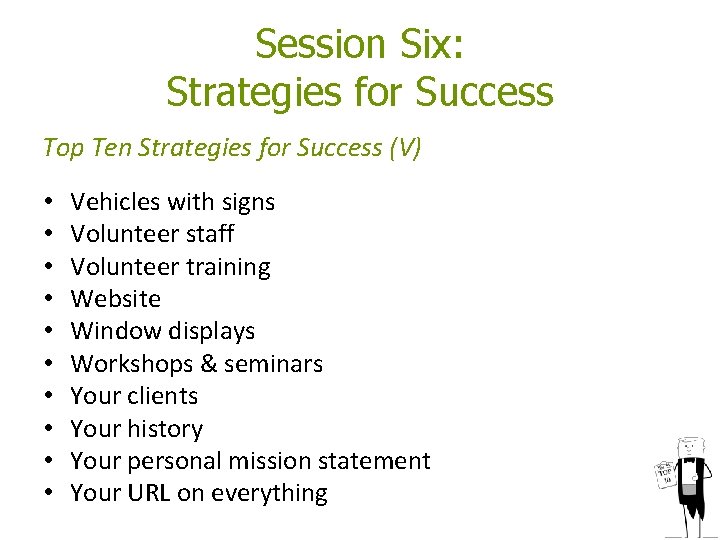
Session Six: Strategies for Success Top Ten Strategies for Success (V) • • • Vehicles with signs Volunteer staff Volunteer training Website Window displays Workshops & seminars Your clients Your history Your personal mission statement Your URL on everything
Session Seven: Mission Statements (I) • Often, organizations spend a tremendous amount of time and energy in developing a mission statement. • Without reinforcement, they become ignored or forgotten. • A good mission statement, like your marketing efforts, should communicate your true intent to solve problems and match your capabilities to the needs of others.
Session Seven: Mission Statements (II) Sample Mission Statements • At Microsoft, our mission and values are to help people and businesses throughout the world realize their full potential. • The Department of Peacekeeping Operations is dedicated to assisting the Member States and the Secretary-General in their efforts to maintain international peace and security. • At PBS, our mission is to create content that educates, informs, and inspires.
Session Seven: Mission Statements (III) A Personal Mission Statement • Think of your personal mission statement as your own personal purpose statement. • Keep this statement to one meaningful sentence. • Make it generic enough to allow you to serve your purpose in many everyday situations, yet make it meaningful enough that others will understand what you are trying to achieve.
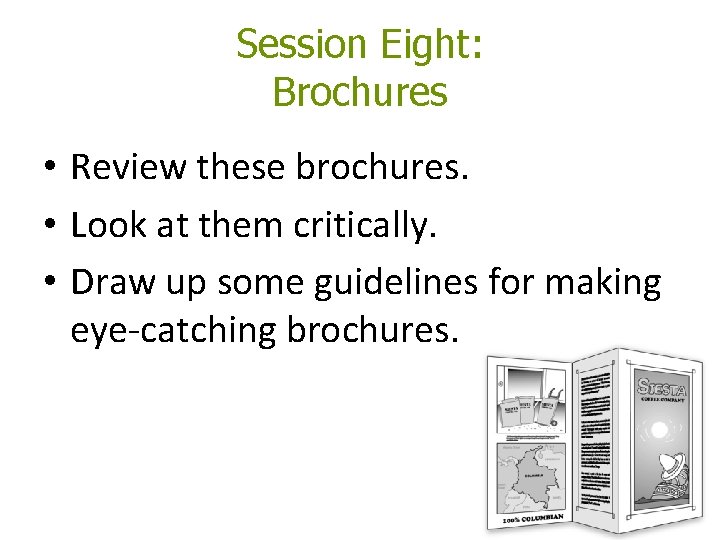
Session Eight: Brochures • Review these brochures. • Look at them critically. • Draw up some guidelines for making eye-catching brochures.
Session Nine: Trade Shows Why Attend a Trade Show? (I) • Trade shows can be one of your prime sources of marketing if you handle them properly. • Generally, decision makers attend shows. • A well thought-out display can help you create awareness for your company and your brand.
Session Nine: Trade Shows Why Attend a Trade Show? (II) • You get to network with potential clients and with your competitors. • You can also gain new perspectives on your industry and find new ideas. • To make a trade show truly worthwhile for you, there is a lot of work to be done.
Session Nine: Trade Shows Debrief (I) Before the Show • Prepare an attractive booth or display. • Plan what you will promote. • Have materials ready. • Try to get your booth in a high traffic area. • Decide on giveaways and draws. • Send invitations out to decision-makers. • If you will be hiring staff, train them.
Session Nine: Trade Shows Debrief (II) During the Show • Set up your booth so people can see your display yet will not feel threatened or trapped. • Be friendly, but learn how to disengage yourself from the “cruisers. ” • Do not eat in your display area. • Be friendly to other exhibitors. • Take a few minutes each day to walk around.
Session Nine: Trade Shows Debrief (III) After the Show • Send out thank-you notes to anyone who helped you out. • Send out notes to all the potential buyers who stopped by and include any materials you promised. • Make notes on what worked and what didn’t for future reference.
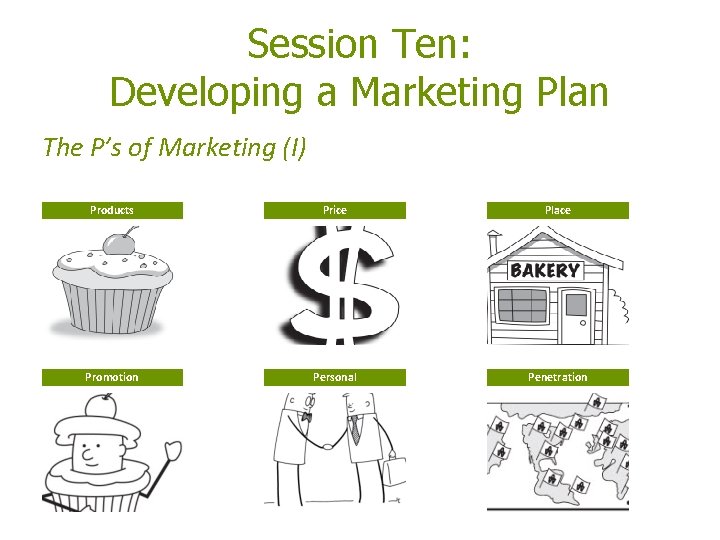
Session Ten: Developing a Marketing Plan The P’s of Marketing (I) Products Price Place Promotion Personal Penetration
Session Ten: Developing a Marketing Plan The P’s of Marketing (II) Bringing it All Together • Your personality • Your budget • Your business • Your time
Session Ten: Developing a Marketing Plan The P’s of Marketing (III) Remember: • Choose methods you will look forward to trying. • Choose methods that will provide you the easiest and least costly access to specific people. • Never rely on only one method at a time. • Select activities that complement one another. • Review the methods your competition are using. • Track the results of your marketing efforts.
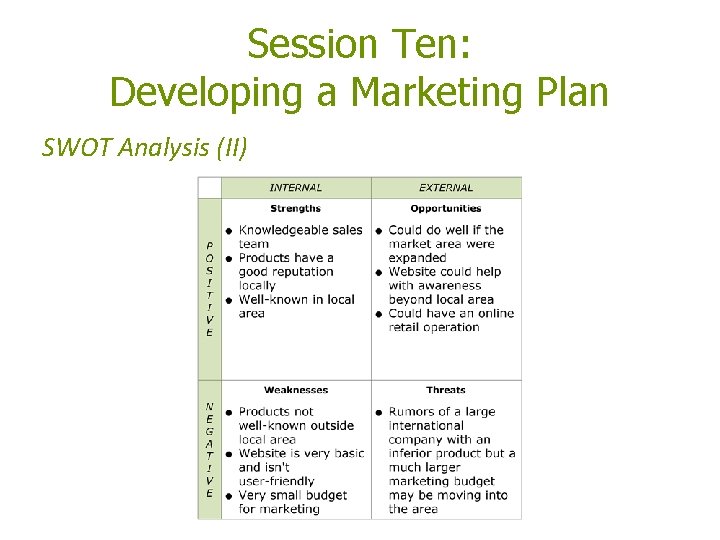
Session Ten: Developing a Marketing Plan SWOT Analysis (I) Consider: • Your company’s strengths and its weaknesses • Your products and/or services • Your community • Your primary and secondary target markets • The competition and what they are doing • The external forces that will affect your business • Opportunities
Session Ten: Developing a Marketing Plan SWOT Analysis (II)
Session Ten: Developing a Marketing Plan A Simple Marketing Plan for Small Budgets (I) The Minimal Marketing Budget • Free e-mail and a free website • A series of press releases faxed, e-mailed, or hand -delivered • Appearances as a talk or radio show guest • A flier posted on bulletin boards (including the electronic ones) • Free classified ads on sites like Craigslist, Kijiji, Facebook, etc.
Session Ten: Developing a Marketing Plan A Simple Marketing Plan for Small Budgets (II) The Small Marketing Budget • Same as above but with an Internet domain and a newsletter • A wider geographic reach for press releases and articles • Conducting a small local seminar • Walking the floor at trade shows • Ad swaps with other newsletters
Session Ten: Developing a Marketing Plan A Simple Marketing Plan for Small Budgets (III) The $3, 000 Marketing Budget • Same as above plus sponsorship of targeting e-zines • A Yellow Pages and or online ad • An active program of appearances as a radio guest • Bigger seminars • A brochure • Getting noticed in the community • SEO (search engine optimization)
Session Eleven: Increasing Business (I) Ultimately there are only three ways to increase your business: • Increase the number of clients you have • Increase the average size of sale per client • Increase the number of times clients return and buy again
Session Eleven: Increasing Business (II) With this formula firmly in mind, you can easily increase your business. • Calculate the number of clients you have • Figure the average amount they spend on each transaction • Determine how often they make a purchase in a year
Session Eleven: Increasing Business (III) • Let’s say you have 1000 clients. They each average $100 per transaction/sale, and they make two purchases a year. • What is the total income you would earn? • What if you were able to make a 10% increase across the board? • With a 25% increase, what would your total income be?
Session Twelve: Saying No to New Business (I) Reasons To Say No to New Business 1. Your gut instinct says no. 2. The customer does not appreciate your value. 3. The customer expects you to invest in them without making any financial commitment. 4. The customer does not treat you in a courteous or professional manner.
Session Twelve: Saying No to New Business (II) Reasons To Say No to New Business ctd. 5. The customer asks for products or services that you don't provide. 6. The customer's requests are too large for your operation. 7. The customer doesn't share your values.
Session Twelve: Saying No to New Business (III) Discussion Questions • Why do we not want to accept all potential clients as customers? • Do any of you have personal stories to attest to that? • Do you have any other reasons we may not want new customers? • What are some ways we can say no to customers?
Session Thirteen: Advertising Myths (I) • You have to advertise to get business. • Advertising is too expensive for small business. • There is one best advertising method. • Advertising is a one-shot deal. • If you put your money into advertising, the advertisement does the work for you.
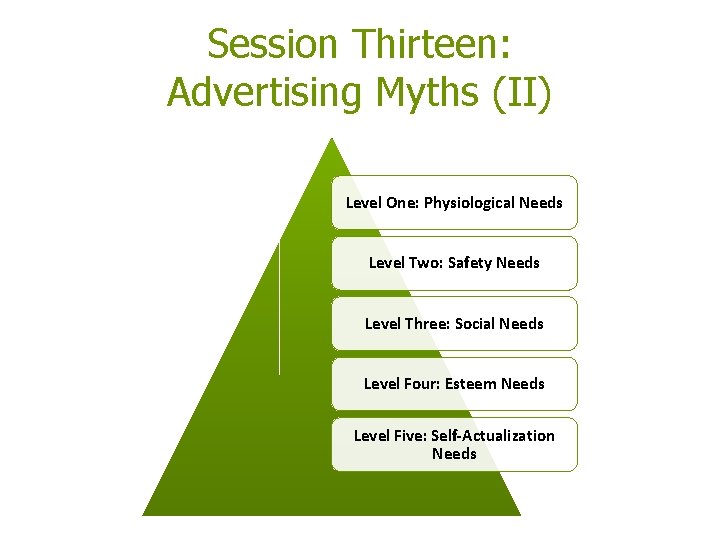
Session Thirteen: Advertising Myths (II) Level One: Physiological Needs Level Two: Safety Needs Level Three: Social Needs Level Four: Esteem Needs Level Five: Self-Actualization Needs
Session Fourteen: Networking Tips (I) • For some of us, entering a room full of strangers can be pretty daunting. • Even people who are introverts often learn to behave like extroverts in order to make connections and develop relationships. • For business and social reasons, we are obliged to get out and meet people.
Session Fourteen: Networking Tips (II) Networking with the right intent means: • Meeting the right people who can lead them to new, paying customers • Meeting people who have the information that will lead to new, paying customers
Session Fourteen: Networking Tips (III) • The challenge is that at many networking events, members or groups agree to do business with other members before looking outside the attendees. • However, many of these groups are attended by small/medium businesses. • They are not going to give you access to buyers in larger businesses.
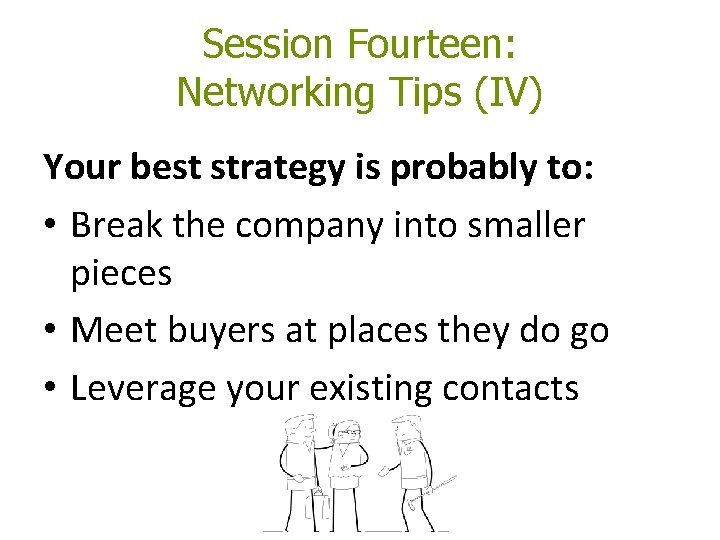
Session Fourteen: Networking Tips (IV) Your best strategy is probably to: • Break the company into smaller pieces • Meet buyers at places they do go • Leverage your existing contacts
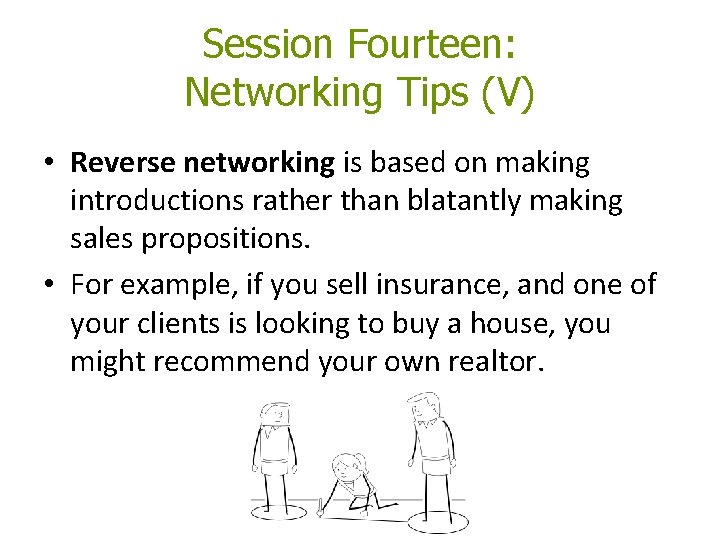
Session Fourteen: Networking Tips (V) • Reverse networking is based on making introductions rather than blatantly making sales propositions. • For example, if you sell insurance, and one of your clients is looking to buy a house, you might recommend your own realtor.
Session Fourteen: Networking Tips (VI) Networking Tips to Consider • Say “Hello” first. • Take risks and anticipate success. • Show others you are a good listener. • Be able to tell others what you do in a few sentences. • Use eye contact and a smile when you meet people. • Greet people you see regularly.
Session Fourteen: Networking Tips (VII) Networking Tips to Consider ctd. • Find common ground. • Ask others for their opinions. • Show interest in things the other person is interested in. • Find some good in every person you meet. • Remember things people told you in previous conversations.
Session Fourteen: Networking Tips (VIII) Networking Tips to Consider ctd. • Know when to stop talking. • Compliment others about what they are doing or saying, and say so sincerely. • Be aware of open and closed body language and monitor your own body language. • Do an anonymous act of kindness every day.
Session Fourteen: Networking Tips (IX) • What kind of networking are you focused on right now? • Are you getting the benefits that you expected? • What will you change as a result of what you have learned today?