
POWERPOINT LECTURE SLIDE PRESENTATION by LYNN CIALDELLA MBA
POWERPOINT® LECTURE SLIDE PRESENTATION by LYNN CIALDELLA, MBA, The University of Texas at Austin Additional Text by J Padilla exclusively for Physiolgy at ECC UNIT 4 21 PART A The Digestive System HUMAN PHYSIOLOGY AN INTEGRATED APPROACH DEE UNGLAUB SILVERTHORN Copyright © 2007 Pearson Education, Inc. , publishing as Benjamin Cummings FOURTH EDITION

Basic Processes of the Digestive System Ingestion Mechanical Digestion Chemical Digestion Absorption Defication Peristalsis (motility) Secretion Copyright © 2007 Pearson Education, Inc. , publishing as Benjamin Cummings Figure 21 -1
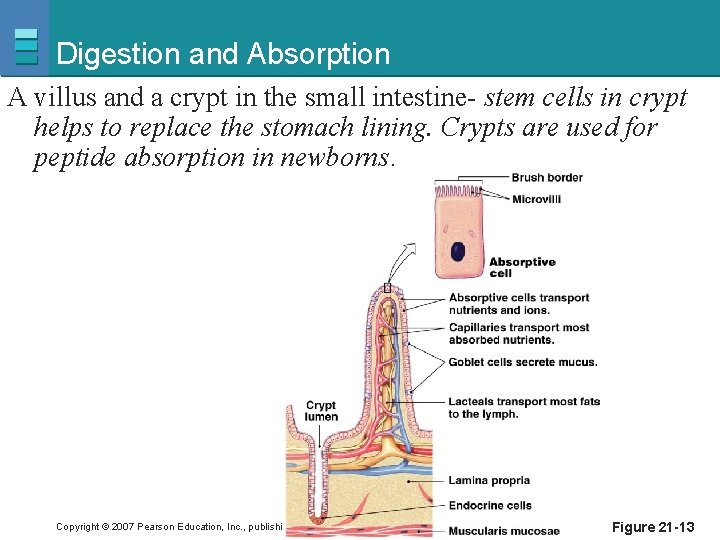
Digestion and Absorption A villus and a crypt in the small intestine- stem cells in crypt helps to replace the stomach lining. Crypts are used for peptide absorption in newborns. Copyright © 2007 Pearson Education, Inc. , publishing as Benjamin Cummings Figure 21 -13
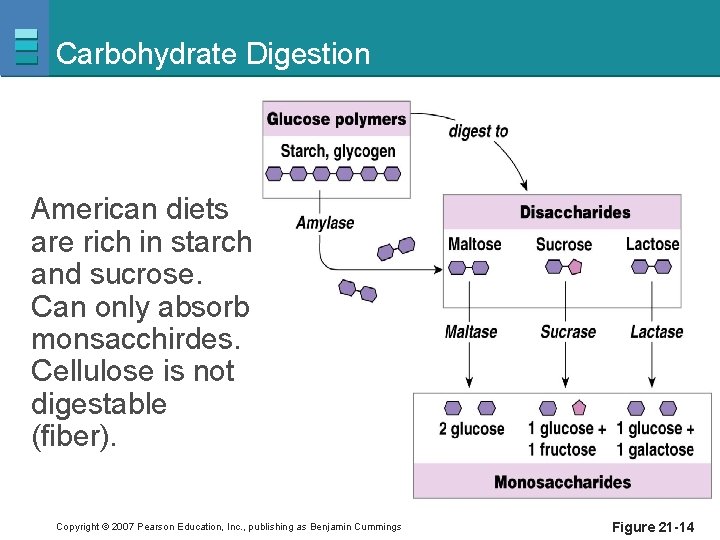
Carbohydrate Digestion American diets are rich in starch and sucrose. Can only absorb monsacchirdes. Cellulose is not digestable (fiber). Copyright © 2007 Pearson Education, Inc. , publishing as Benjamin Cummings Figure 21 -14
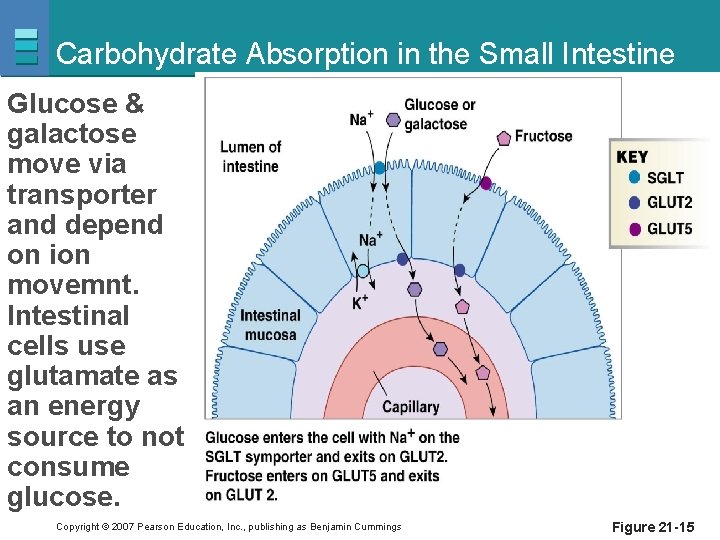
Carbohydrate Absorption in the Small Intestine Glucose & galactose move via transporter and depend on ion movemnt. Intestinal cells use glutamate as an energy source to not consume glucose. Copyright © 2007 Pearson Education, Inc. , publishing as Benjamin Cummings Figure 21 -15

Enzymes for Protein Digestion Endopeptidases (proteases) break down polypeptides to smaller peptide fragments that are then broken down by exopeptidases in amino acids. Endopeptidases are usually released in an inactive form (proenzymes) that once activated have a different name: pepsin, trypsin, and chymotrypsin. *egg protein is the easiest to digest and absorb Copyright © 2007 Pearson Education, Inc. , publishing as Benjamin Cummings Figure 21 -16
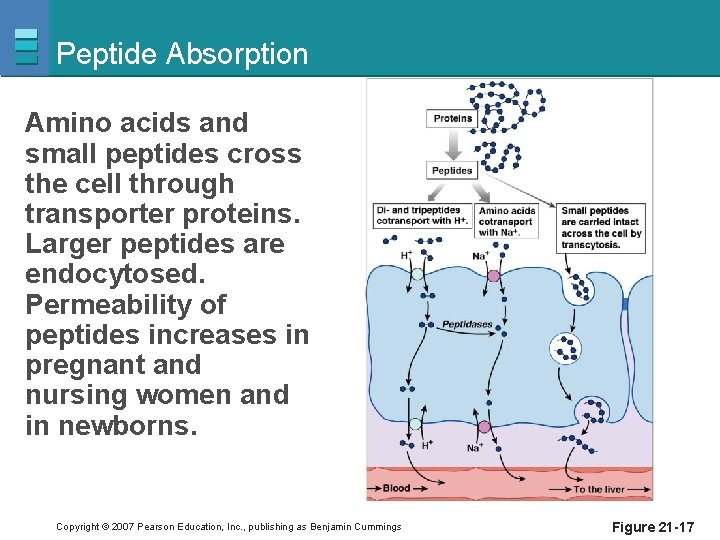
Peptide Absorption Amino acids and small peptides cross the cell through transporter proteins. Larger peptides are endocytosed. Permeability of peptides increases in pregnant and nursing women and in newborns. Copyright © 2007 Pearson Education, Inc. , publishing as Benjamin Cummings Figure 21 -17

Digestion and Absorption Triglycerides digest into monoglycerides and free fatty acids – lipases free the fatty acid chains, phospholipase digest glycerol, and free cholesterol is not digested. Copyright © 2007 Pearson Education, Inc. , publishing as Benjamin Cummings Figure 21 -18
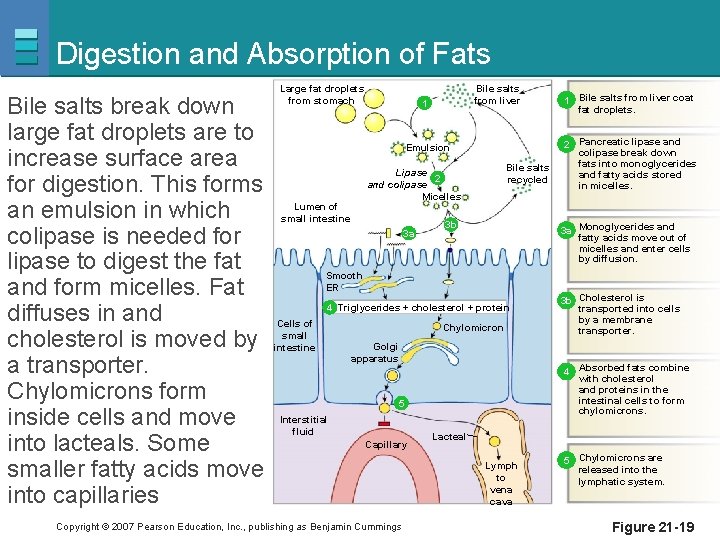
Digestion and Absorption of Fats Bile salts break down large fat droplets are to increase surface area for digestion. This forms an emulsion in which colipase is needed for lipase to digest the fat and form micelles. Fat diffuses in and cholesterol is moved by a transporter. Chylomicrons form inside cells and move into lacteals. Some smaller fatty acids move into capillaries Large fat droplets from stomach Bile salts from liver 1 Emulsion Bile salts recycled Lipase 2 and colipase Micelles Lumen of small intestine 3 a 3 b 4 Triglycerides + cholesterol + protein Chylomicron Golgi apparatus Capillary Copyright © 2007 Pearson Education, Inc. , publishing as Benjamin Cummings 3 b Cholesterol is transported into cells by a membrane transporter. 4 Absorbed fats combine with cholesterol and proteins in the intestinal cells to form chylomicrons. 5 Interstitial fluid 2 Pancreatic lipase and colipase break down fats into monoglycerides and fatty acids stored in micelles. 3 a Monoglycerides and fatty acids move out of micelles and enter cells by diffusion. Smooth ER Cells of small intestine 1 Bile salts from liver coat fat droplets. Lacteal Lymph to vena cava 5 Chylomicrons are released into the lymphatic system. Figure 21 -19
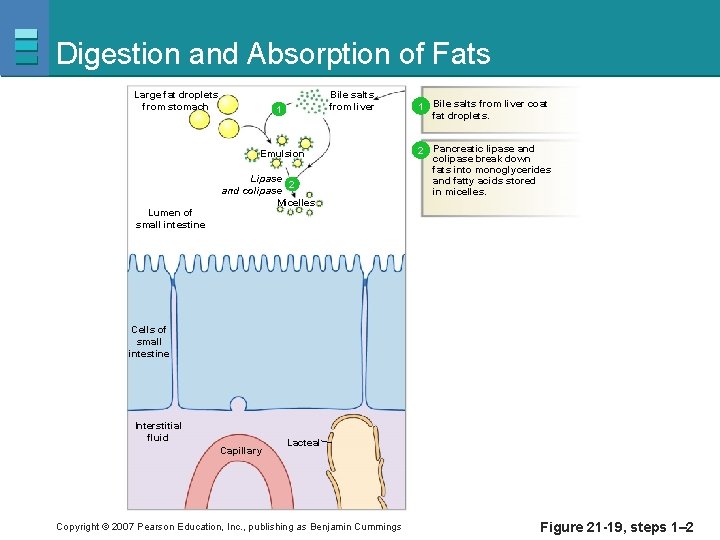
Digestion and Absorption of Fats Large fat droplets from stomach Bile salts from liver 1 Emulsion Lumen of small intestine Lipase 2 and colipase Micelles 1 Bile salts from liver coat fat droplets. 2 Pancreatic lipase and colipase break down fats into monoglycerides and fatty acids stored in micelles. Cells of small intestine Interstitial fluid Capillary Lacteal Copyright © 2007 Pearson Education, Inc. , publishing as Benjamin Cummings Figure 21 -19, steps 1– 2
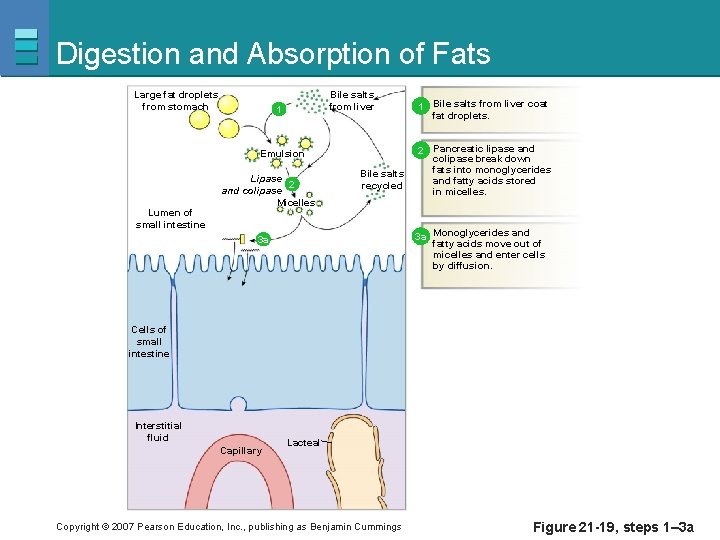
Digestion and Absorption of Fats Large fat droplets from stomach Bile salts from liver 1 Emulsion Lumen of small intestine Lipase 2 and colipase Micelles Bile salts recycled 1 Bile salts from liver coat fat droplets. 2 Pancreatic lipase and colipase break down fats into monoglycerides and fatty acids stored in micelles. 3 a Monoglycerides and fatty acids move out of micelles and enter cells by diffusion. 3 a Cells of small intestine Interstitial fluid Capillary Lacteal Copyright © 2007 Pearson Education, Inc. , publishing as Benjamin Cummings Figure 21 -19, steps 1– 3 a
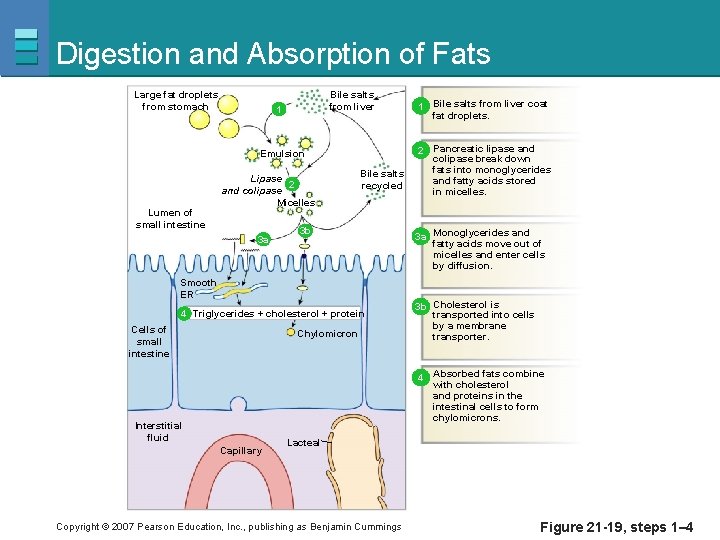
Digestion and Absorption of Fats Large fat droplets from stomach Bile salts from liver 1 Emulsion Lumen of small intestine Lipase 2 and colipase Micelles 3 a Bile salts recycled 3 b Smooth ER 4 Triglycerides + cholesterol + protein Cells of small intestine Chylomicron 1 Bile salts from liver coat fat droplets. 2 Pancreatic lipase and colipase break down fats into monoglycerides and fatty acids stored in micelles. 3 a Monoglycerides and fatty acids move out of micelles and enter cells by diffusion. 3 b Cholesterol is transported into cells by a membrane transporter. 4 Absorbed fats combine with cholesterol and proteins in the intestinal cells to form chylomicrons. Interstitial fluid Capillary Lacteal Copyright © 2007 Pearson Education, Inc. , publishing as Benjamin Cummings Figure 21 -19, steps 1– 4
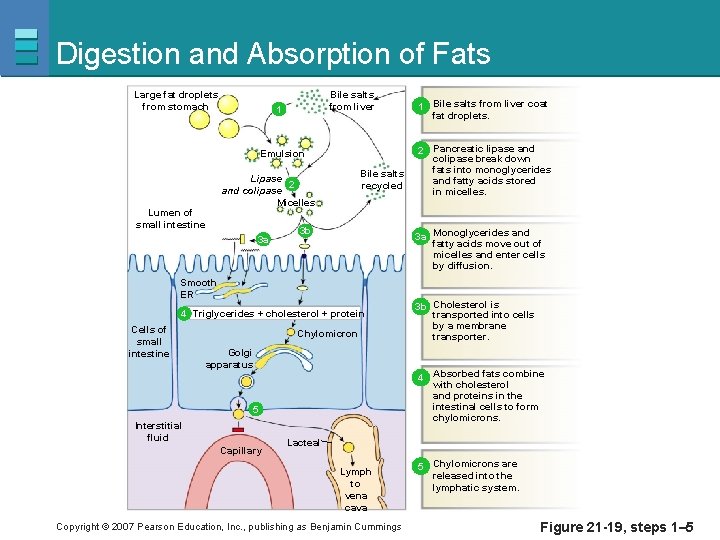
Digestion and Absorption of Fats Large fat droplets from stomach Bile salts from liver 1 Emulsion Bile salts recycled Lipase 2 and colipase Micelles Lumen of small intestine 3 a 3 b 4 Triglycerides + cholesterol + protein Chylomicron Golgi apparatus Capillary 3 b Cholesterol is transported into cells by a membrane transporter. 4 Absorbed fats combine with cholesterol and proteins in the intestinal cells to form chylomicrons. 5 Interstitial fluid 2 Pancreatic lipase and colipase break down fats into monoglycerides and fatty acids stored in micelles. 3 a Monoglycerides and fatty acids move out of micelles and enter cells by diffusion. Smooth ER Cells of small intestine 1 Bile salts from liver coat fat droplets. Lacteal Lymph to vena cava Copyright © 2007 Pearson Education, Inc. , publishing as Benjamin Cummings 5 Chylomicrons are released into the lymphatic system. Figure 21 -19, steps 1– 5
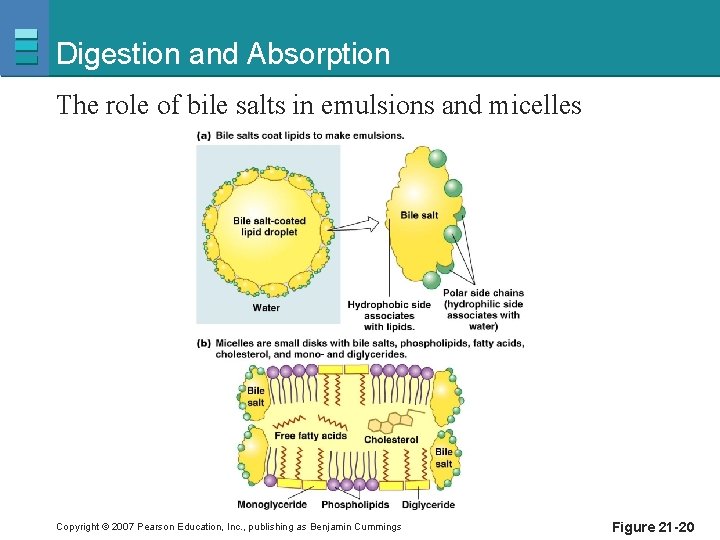
Digestion and Absorption The role of bile salts in emulsions and micelles Copyright © 2007 Pearson Education, Inc. , publishing as Benjamin Cummings Figure 21 -20
Digestion and Absorption § Nucleic acids are digested into nitrogenous bases and monosaccharides – all components are absorbed by transport mechanisms, they are not considered a calorie source and make up a small % of the diet. § Intestine absorbs vitamins and minerals – some vitamins must be coupled with fats or proteins to be better absorbed. § Fat-soluble absorbed with fats – excessive quantities and cause toxicity. Incorrect fat ingestion cause vitamin deficiency. § Water-soluble by mediated transport – (C and most B vitamins), can be excreted if there is excess § Vitamin B 12 when complexed to intrinsic factor and absorbed in ileum – found in meats, sea food, and milk products. § Mineral by active transport – Fe and Ca absorption is based on need. Fe is absorbed as heme and Ca absorption is hormone mediated or by passive movement. Copyright © 2007 Pearson Education, Inc. , publishing as Benjamin Cummings
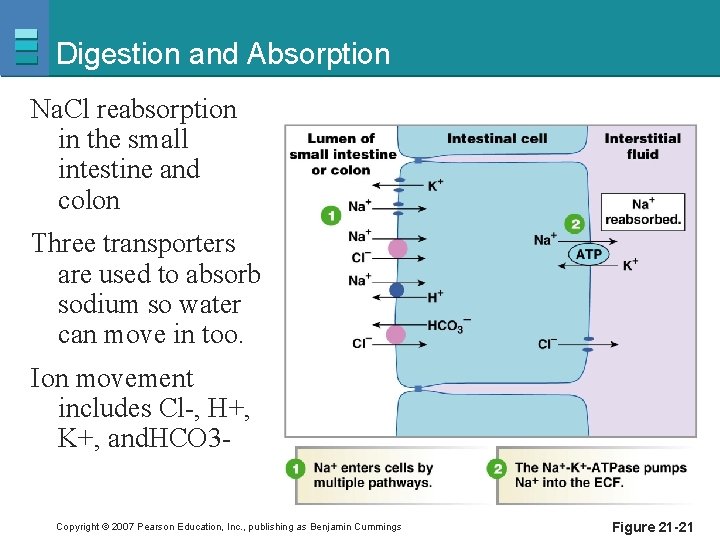
Digestion and Absorption Na. Cl reabsorption in the small intestine and colon Three transporters are used to absorb sodium so water can move in too. Ion movement includes Cl-, H+, K+, and. HCO 3 Copyright © 2007 Pearson Education, Inc. , publishing as Benjamin Cummings Figure 21 -21
- Slides: 16