
Powerless Language In Interpretations of ASL By Sara
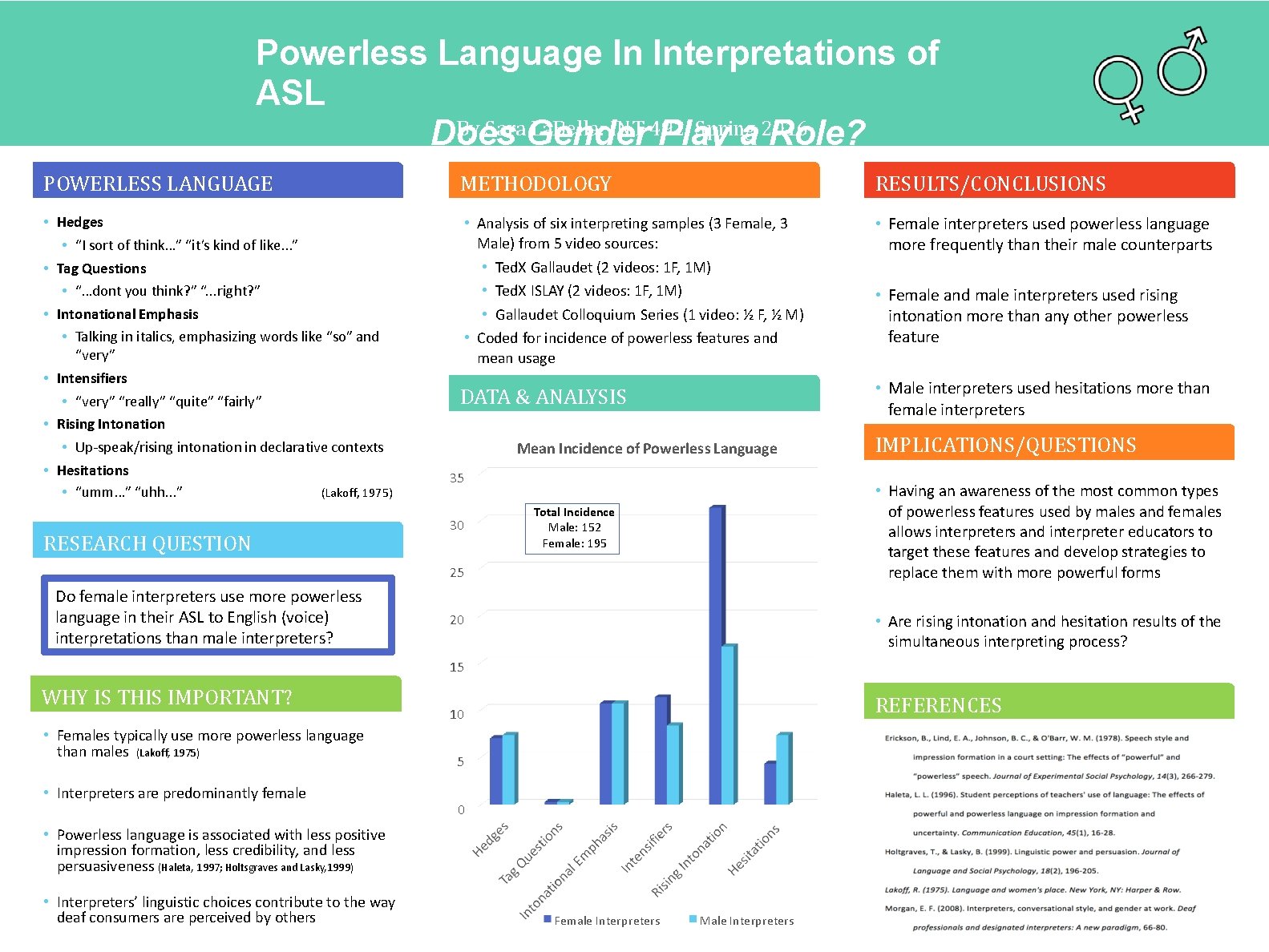
Powerless Language In Interpretations of ASL By Sara. Gender La. Bella: INT 492, Spring Does Play a 2016 Role? POWERLESS LANGUAGE METHODOLOGY RESULTS/CONCLUSIONS • Hedges • “I sort of think…” “it’s kind of like. . . ” • Tag Questions • “…dont you think? ” “. . . right? ” • Intonational Emphasis • Talking in italics, emphasizing words like “so” and “very” • Intensifiers • “very” “really” “quite” “fairly” • Rising Intonation • Up-speak/rising intonation in declarative contexts • Hesitations • “umm…” “uhh. . . ” (Lakoff, 1975) • Analysis of six interpreting samples (3 Female, 3 Male) from 5 video sources: • Ted. X Gallaudet (2 videos: 1 F, 1 M) • Ted. X ISLAY (2 videos: 1 F, 1 M) • Gallaudet Colloquium Series (1 video: ½ F, ½ M) • Coded for incidence of powerless features and mean usage • Female interpreters used powerless language more frequently than their male counterparts DATA & ANALYSIS • Male interpreters used hesitations more than female interpreters RESEARCH QUESTION Mean Incidence of Powerless Language 35 30 IMPLICATIONS/QUESTIONS • Having an awareness of the most common types of powerless features used by males and females allows interpreters and interpreter educators to target these features and develop strategies to replace them with more powerful forms Total Incidence Male: 152 Female: 195 25 Do female interpreters use more powerless language in their ASL to English (voice) interpretations than male interpreters? • Female and male interpreters used rising intonation more than any other powerless feature 20 • Are rising intonation and hesitation results of the simultaneous interpreting process? 15 WHY IS THIS IMPORTANT? • Females typically use more powerless language than males (Lakoff, 1975) • Interpreters are predominantly female REFERENCES 10 5 0 • Powerless language is associated with less positive impression formation, less credibility, and less persuasiveness (Haleta, 1997; Holtsgraves and Lasky, 1999) • Interpreters’ linguistic choices contribute to the way deaf consumers are perceived by others Female Interpreters Male Interpreters
- Slides: 1