
POWERAWARE JOB SCHEDULING Maximizing Data Center Performance Under

POWER-AWARE JOB SCHEDULING Maximizing Data Center Performance Under Strict Power Budget Osman Sarood, Akhil Langer, Abhishek Gupta, Laxmikant Kale Parallel Programming Laboratory Department of Computer Science University of Illinois at Urbana-Champaign 29 th April 2014

Major Challenges to Achieve Exascale 1 q. Energy and Power Challenge q. Memory and Storage Challenge q. Concurrency and Locality Challenge q. Resiliency Challenge Kogge, Peter, et al. "Exascale computing study: Technology challenges in achieving exascale systems. " (2008). 3/5/2021 Power-Aware Job Scheduling 2
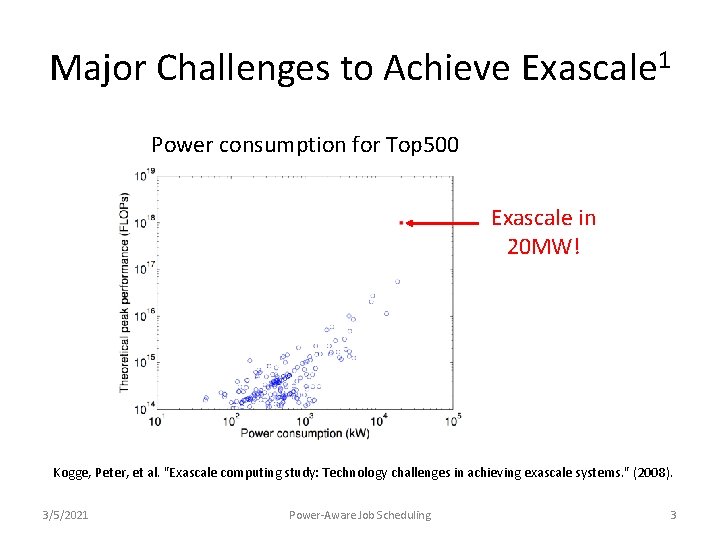
Major Challenges to Achieve Exascale 1 Power consumption for Top 500 Exascale in 20 MW! Kogge, Peter, et al. "Exascale computing study: Technology challenges in achieving exascale systems. " (2008). 3/5/2021 Power-Aware Job Scheduling 3
Data Center Power How is data center power need calculated? qusing Thermal Design Power (TDP) of nodes However, TDP is hardly reached!! Solution q constrain power consumption of nodes q Overprovisioning - Use more nodes than conventional data center for the same power budget 3/5/2021 Power-Aware Job Scheduling 4
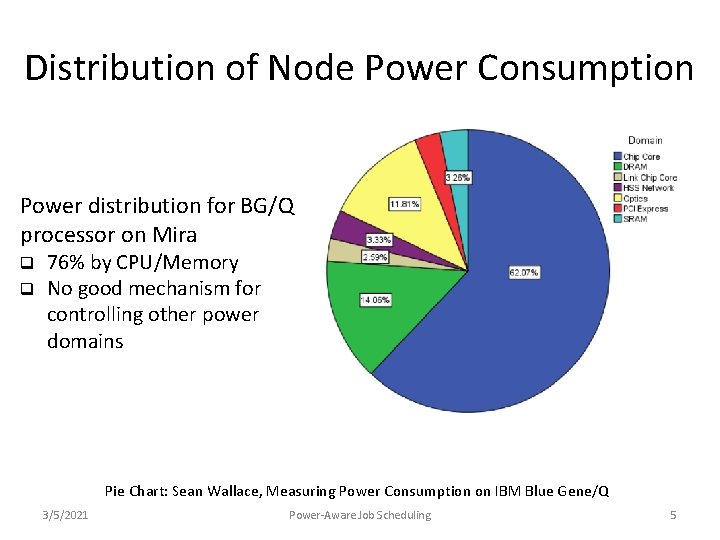
Distribution of Node Power Consumption Power distribution for BG/Q processor on Mira q q 76% by CPU/Memory No good mechanism for controlling other power domains Pie Chart: Sean Wallace, Measuring Power Consumption on IBM Blue Gene/Q 3/5/2021 Power-Aware Job Scheduling 5
Constraining CPU/Memory Power Intel Sandy Bridge q. Running Average Power Limit (RAPL) library Ømeasure and set CPU/memory power 3/5/2021 Power-Aware Job Scheduling 6
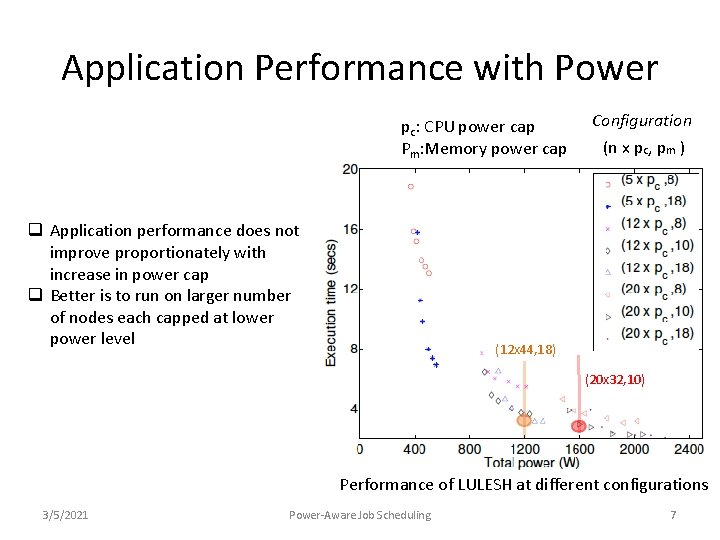
Application Performance with Power pc: CPU power cap Pm: Memory power cap q Application performance does not improve proportionately with increase in power cap q Better is to run on larger number of nodes each capped at lower power level Configuration (n x pc, pm ) (12 x 44, 18) (20 x 32, 10) Performance of LULESH at different configurations 3/5/2021 Power-Aware Job Scheduling 7
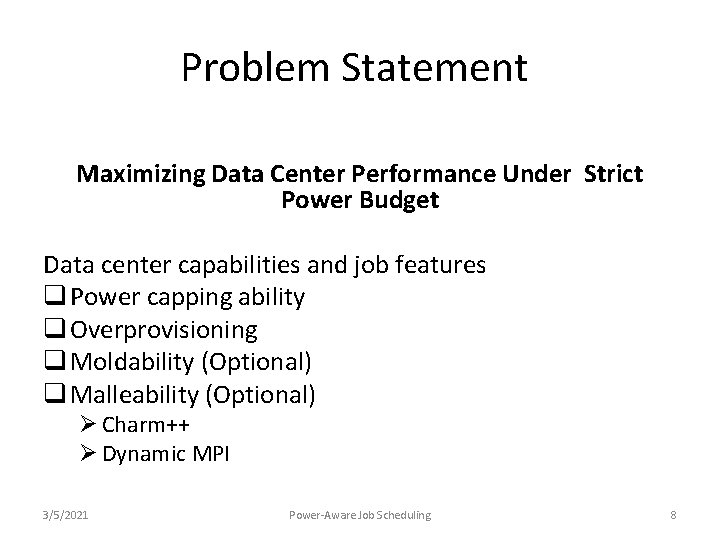
Problem Statement Maximizing Data Center Performance Under Strict Power Budget Data center capabilities and job features q Power capping ability q Overprovisioning q Moldability (Optional) q Malleability (Optional) Ø Charm++ Ø Dynamic MPI 3/5/2021 Power-Aware Job Scheduling 8
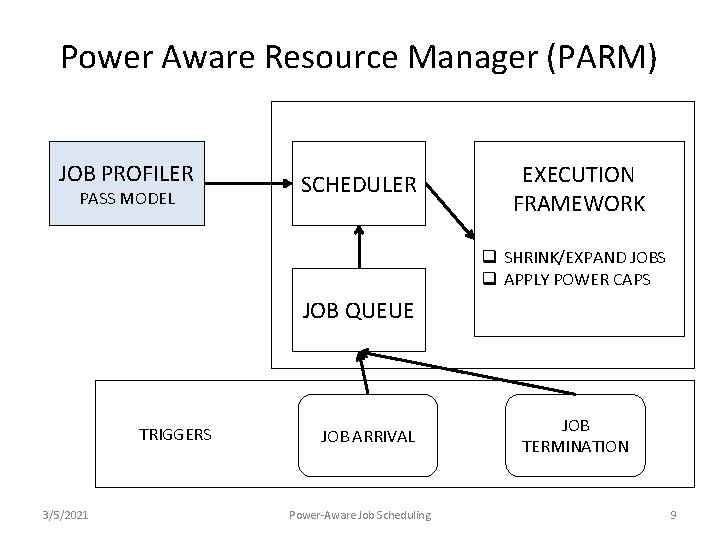
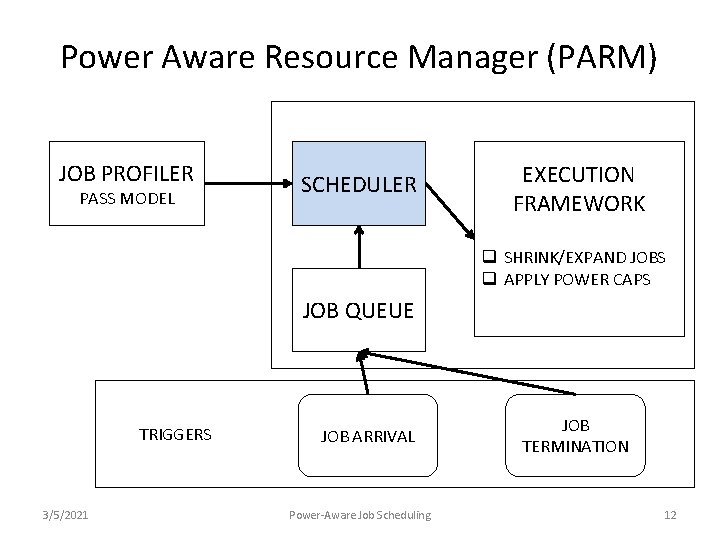
Power Aware Resource Manager (PARM) JOB PROFILER PASS MODEL SCHEDULER EXECUTION FRAMEWORK q SHRINK/EXPAND JOBS q APPLY POWER CAPS JOB QUEUE TRIGGERS 3/5/2021 JOB ARRIVAL Power-Aware Job Scheduling JOB TERMINATION 9
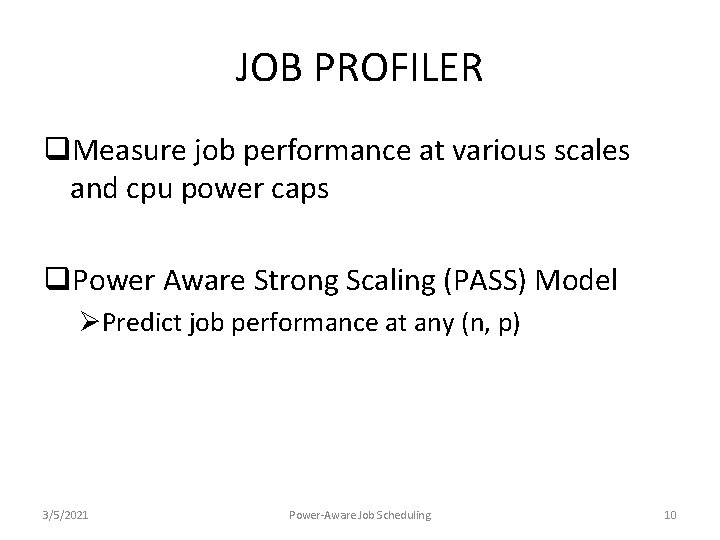
JOB PROFILER q. Measure job performance at various scales and cpu power caps q. Power Aware Strong Scaling (PASS) Model ØPredict job performance at any (n, p) 3/5/2021 Power-Aware Job Scheduling 10
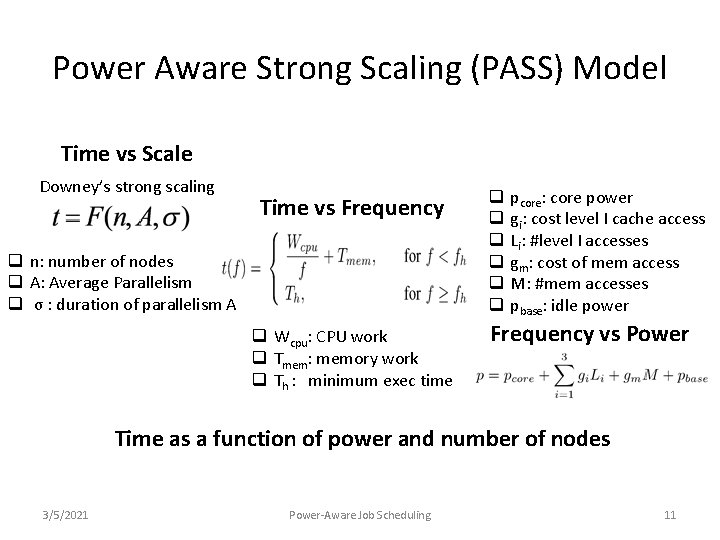
Power Aware Strong Scaling (PASS) Model Time vs Scale Downey’s strong scaling Time vs Frequency q n: number of nodes q A: Average Parallelism q σ : duration of parallelism A q Wcpu: CPU work q Tmem: memory work q Th : minimum exec time q q q pcore: core power gi: cost level I cache access Li: #level I accesses gm: cost of mem access M: #mem accesses pbase: idle power Frequency vs Power Time as a function of power and number of nodes 3/5/2021 Power-Aware Job Scheduling 11
Power Aware Resource Manager (PARM) JOB PROFILER PASS MODEL SCHEDULER EXECUTION FRAMEWORK q SHRINK/EXPAND JOBS q APPLY POWER CAPS JOB QUEUE TRIGGERS 3/5/2021 JOB ARRIVAL Power-Aware Job Scheduling JOB TERMINATION 12
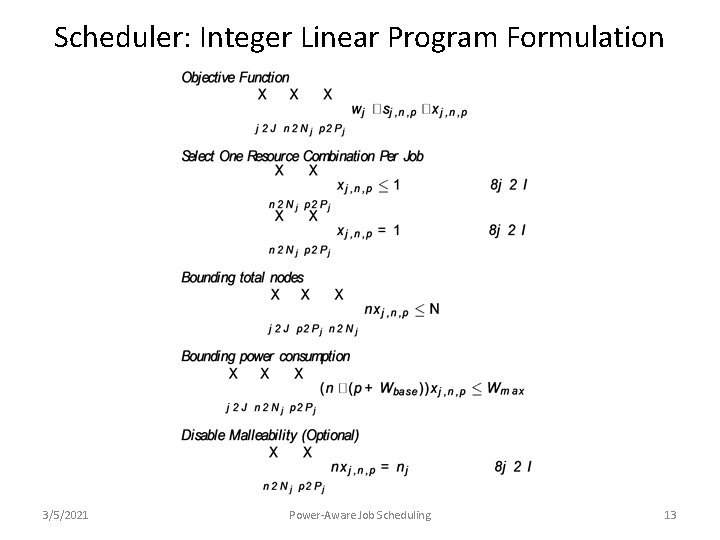
Scheduler: Integer Linear Program Formulation 3/5/2021 Power-Aware Job Scheduling 13
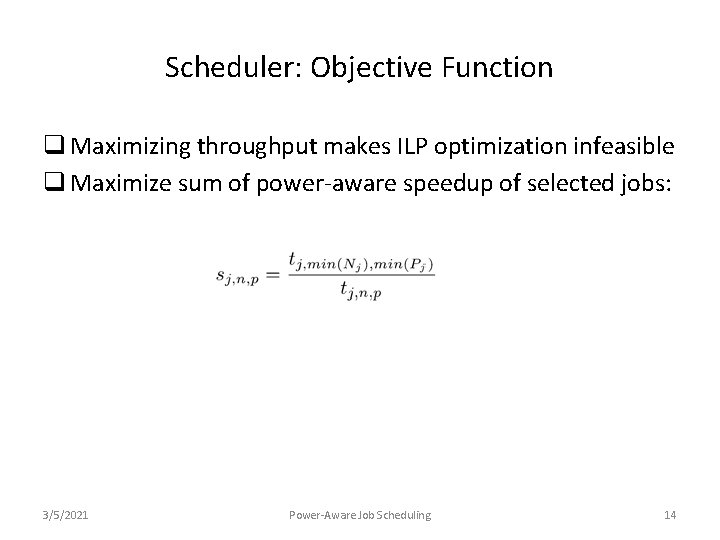
Scheduler: Objective Function q Maximizing throughput makes ILP optimization infeasible q Maximize sum of power-aware speedup of selected jobs: 3/5/2021 Power-Aware Job Scheduling 14
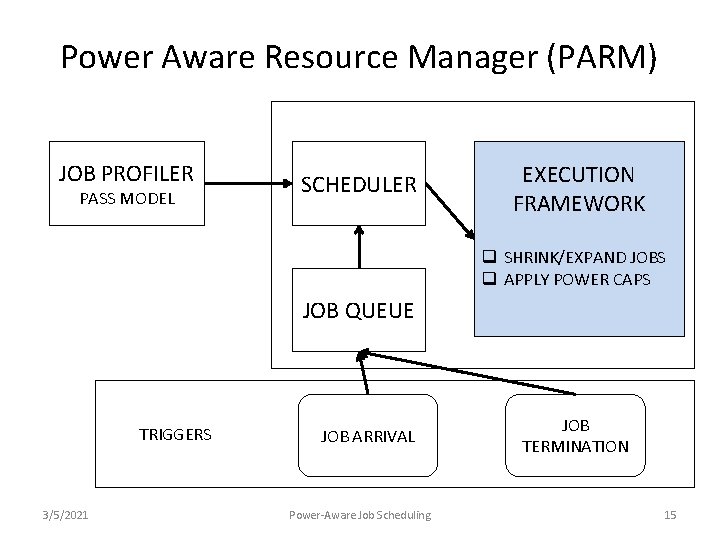
Power Aware Resource Manager (PARM) JOB PROFILER PASS MODEL SCHEDULER EXECUTION FRAMEWORK q SHRINK/EXPAND JOBS q APPLY POWER CAPS JOB QUEUE TRIGGERS 3/5/2021 JOB ARRIVAL Power-Aware Job Scheduling JOB TERMINATION 15
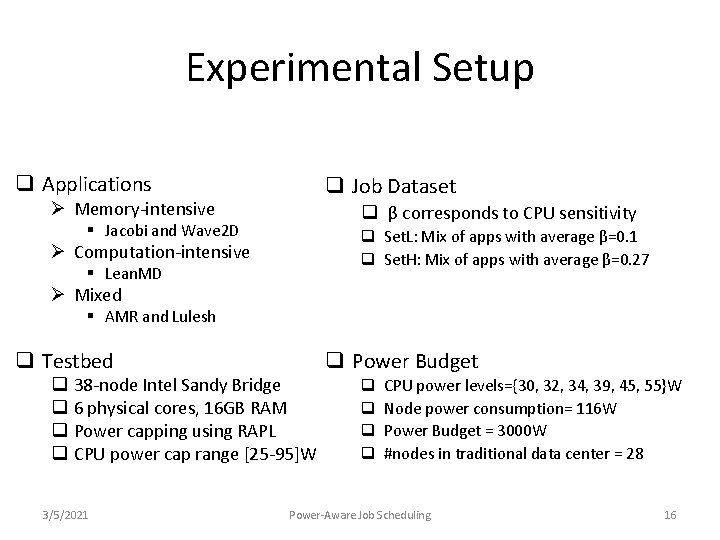
Experimental Setup q Applications q Job Dataset Ø Memory-intensive q β corresponds to CPU sensitivity § Jacobi and Wave 2 D q Set. L: Mix of apps with average β=0. 1 q Set. H: Mix of apps with average β=0. 27 Ø Computation-intensive § Lean. MD Ø Mixed § AMR and Lulesh q Testbed q 38 -node Intel Sandy Bridge q 6 physical cores, 16 GB RAM q Power capping using RAPL q CPU power cap range [25 -95]W 3/5/2021 q Power Budget q q CPU power levels={30, 32, 34, 39, 45, 55}W Node power consumption= 116 W Power Budget = 3000 W #nodes in traditional data center = 28 Power-Aware Job Scheduling 16
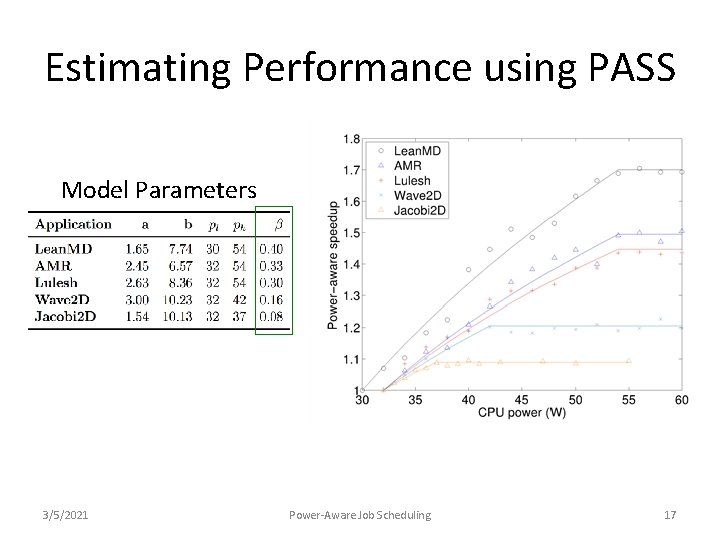
Estimating Performance using PASS Model Parameters 3/5/2021 Power-Aware Job Scheduling 17
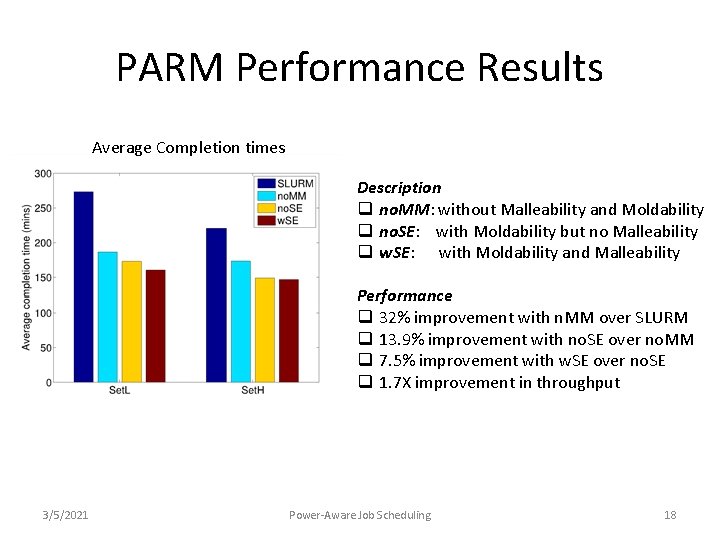
PARM Performance Results Average Completion times Description q no. MM: without Malleability and Moldability q no. SE: with Moldability but no Malleability q w. SE: with Moldability and Malleability Performance q 32% improvement with n. MM over SLURM q 13. 9% improvement with no. SE over no. MM q 7. 5% improvement with w. SE over no. SE q 1. 7 X improvement in throughput 3/5/2021 Power-Aware Job Scheduling 18
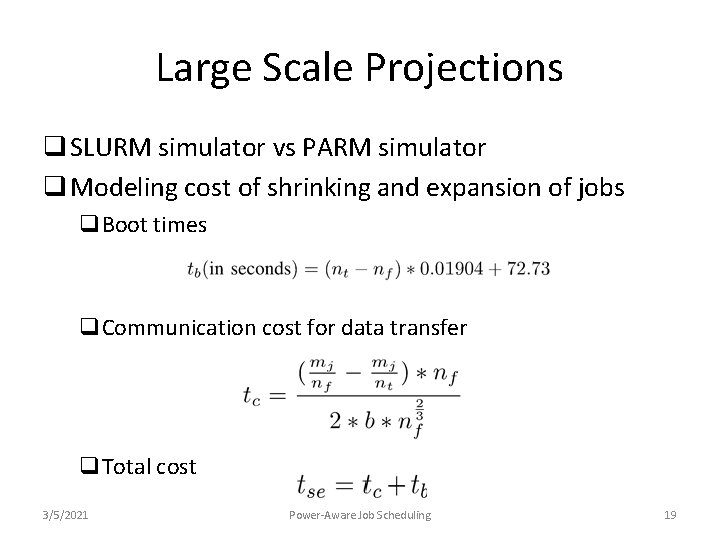
Large Scale Projections q SLURM simulator vs PARM simulator q Modeling cost of shrinking and expansion of jobs q. Boot times q. Communication cost for data transfer q. Total cost 3/5/2021 Power-Aware Job Scheduling 19
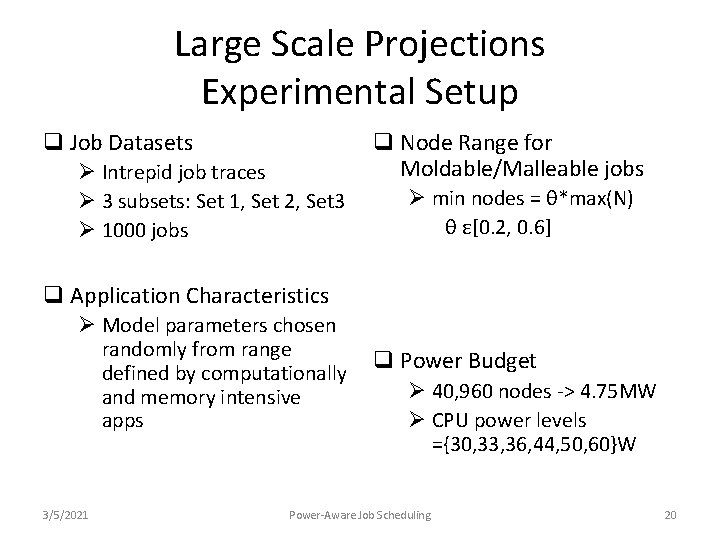
Large Scale Projections Experimental Setup q Job Datasets Ø Intrepid job traces Ø 3 subsets: Set 1, Set 2, Set 3 Ø 1000 jobs q Node Range for Moldable/Malleable jobs Ø min nodes = θ*max(N) θ ε[0. 2, 0. 6] q Application Characteristics Ø Model parameters chosen randomly from range defined by computationally and memory intensive apps 3/5/2021 q Power Budget Ø 40, 960 nodes -> 4. 75 MW Ø CPU power levels ={30, 33, 36, 44, 50, 60}W Power-Aware Job Scheduling 20
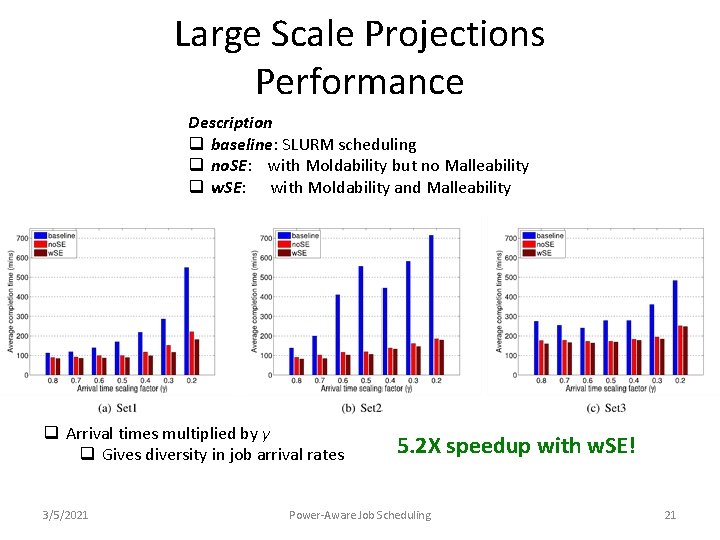
Large Scale Projections Performance Description q baseline: SLURM scheduling q no. SE: with Moldability but no Malleability q w. SE: with Moldability and Malleability q Arrival times multiplied by γ q Gives diversity in job arrival rates 3/5/2021 5. 2 X speedup with w. SE! Power-Aware Job Scheduling 21
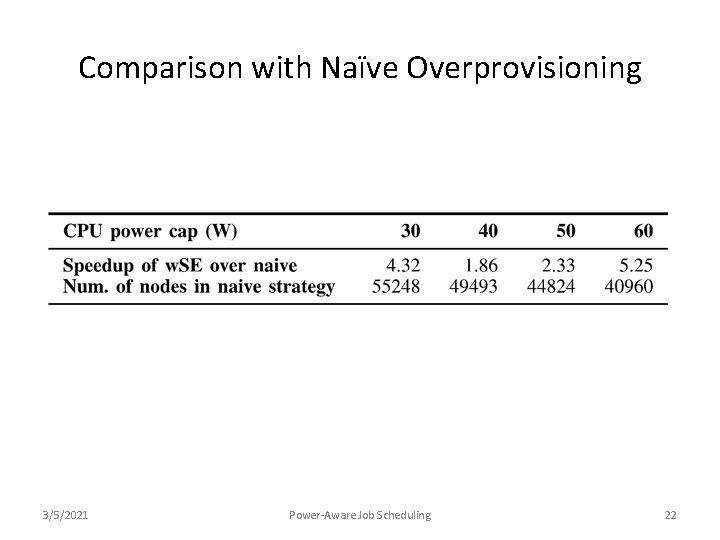
Comparison with Naïve Overprovisioning 3/5/2021 Power-Aware Job Scheduling 22
CONCLUSIONS/TAKEAWAYS Conclusion q Significant improvement in throughputs Ø Power-aware characteristics (PASS model) Ø CPU power capping Ø Overprovisioning q Sophisticated ILP scheduling methodology useful for resource assignment q Adaptive runtime system further increases benefits by allowing malleability q Non-malleable jobs also benefit Future Work q Enable/disable caches q Thermal constraints Ø To improve system reliability and improve cooling costs q Rich support for user priorities 3/5/2021 Power-Aware Job Scheduling 24

THANK YOU! POWER-AWARE JOB SCHEDULING Maximizing Data Center Performance Under Strict Power Budget Osman Sarood, Akhil Langer, Abhishek Gupta, Laxmikant Kale Parallel Programming Laboratory Department of Computer Science University of Illinois at Urbana-Champaign 29 th April 2014
- Slides: 24