
Power Wheelchairs 101 Objectives Identify components of a
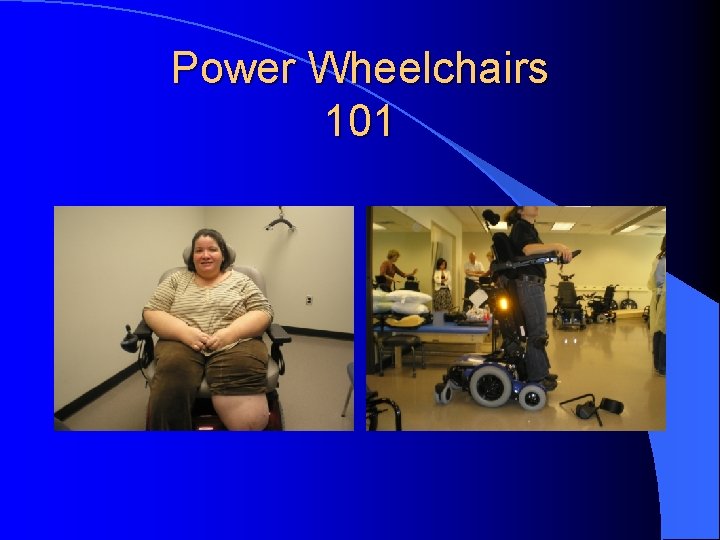
Power Wheelchairs 101
Objectives Identify components of a power obility evaluation Recognize the functional benefits/limitations of power seating systems Identify specialty controls and discuss potential benefits and limitations of each. Recognize risks and discuss power mobility safety. Discuss driver training programs Discuss power mobility options

Medicare Hierarchy of Mobility Aids 1. 2. 3. 4. 5. 6. 7. Cane or crutches Walker Rollator Manual Wheelchair Power assist POV (Scooter) Power wheelchair

Power Wheelchairs l l l POV/scooter Transportable power Basic power (nonadjustable) Power assist Power Base Off Road
Manual vs. Power l Client Considerations – – – – Function Cognitive Status Safety/Seizures Vision Pain Strength/Endurance Sensation l Equipment Considerations – – – Environment Range/speed Size Accessibility Transportation Cost/Funding

Functional Status l l l Upper Extremity Involvement/ Strength / Symmetry Scapular Stability Endurance Pre-existing impairments l l l Orthopedic limitations Age Mobility related activities of daily living
Cognitive Status Understands cause and effect l Free of seizures l Psychological Stability l
Vision Vertical sitting tolerance l Visual acuity l Restrictions l
Transportation / Accessibility l l l l l Safe environment? Does the person have the means to transport a power wheelchair/scooter? If not how do they plan to get around the community? How will they secure the wheelchair in the vehicle? Where do they plan to ride in the vehicle? Can they transfer independentlly? What is the overall width and length of the wheelchair? What is the turning radius? Knee and head clearance? Foot rest width?

Funding of Power Prior authorization l Medicare-must be needed for in the home mobility. l Medicare just released new reimbursements and groupings of power wheelchairs. l Assigned versus non-assigned l Discuss the percentage that the individual will have to pay? l
Sequence of Evaluation l Postural support and seating needs? – Will the person require power seat functions? l Selection of Input Device – What is the most reliable and functional access point? l Essential Controller Functions – What programming functions are needed for safe operation of the wheelchair (if any) l Selection of Powered Mobility Base – Where does the person plan to use the chair and what performance characteristics are needed?

Seating System Symmetrical sitting posture? l Level of Balance? l Vertical Tolerance? l Stability for operation of Input Device? l Need for Positional Changes? l

Interfacing Powered Seating Systems Tilt l Recline l Standing l Seat Elevation l Standing l Power Elevating Leg Rest l

Medical Considerations Pressure Distribution l Gravity Assisted positioning l Accommodation of Contractures l Spasticity l Compensate for Postural Hypotension l Intermittent Catheterization l
Electonrics/Input Devices Proportional l Non-proportional l
Questions When Choosing an Electronics System cont. l l l Can I plug more than one input device into the system? Advanced programming, is it global or profile specific? Does the system allow me to grow with the user as they progress or digress? Is it an aesthetically pleasing system? Less wires and boxes. Does it use current technology and lend itself to easy interface with current specialty controls in the future? Know your options.
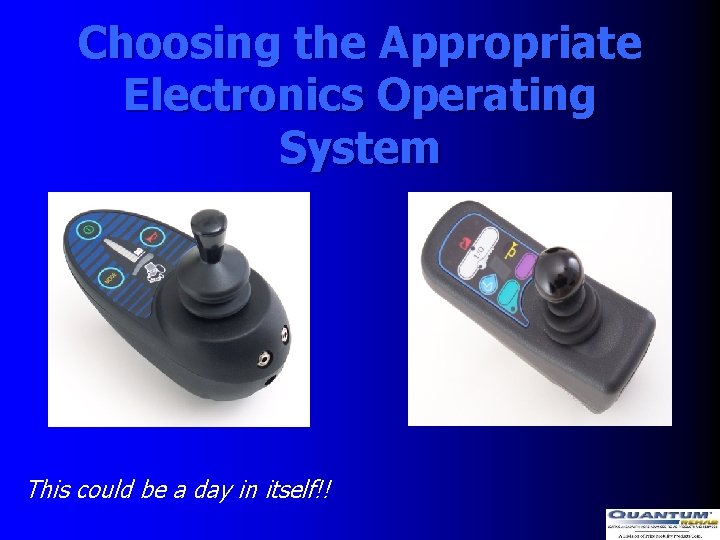
Choosing the Appropriate Electronics Operating System This could be a day in itself!!
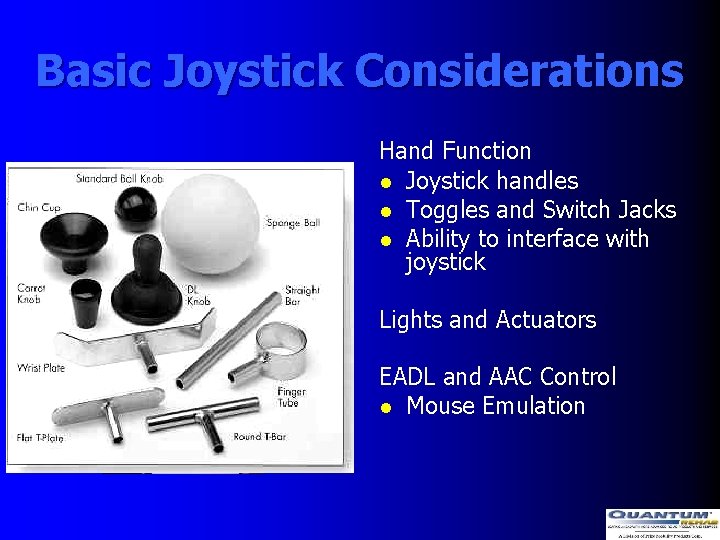
Basic Joystick Considerations Hand Function l Joystick handles l Toggles and Switch Jacks l Ability to interface with joystick Lights and Actuators EADL and AAC Control l Mouse Emulation
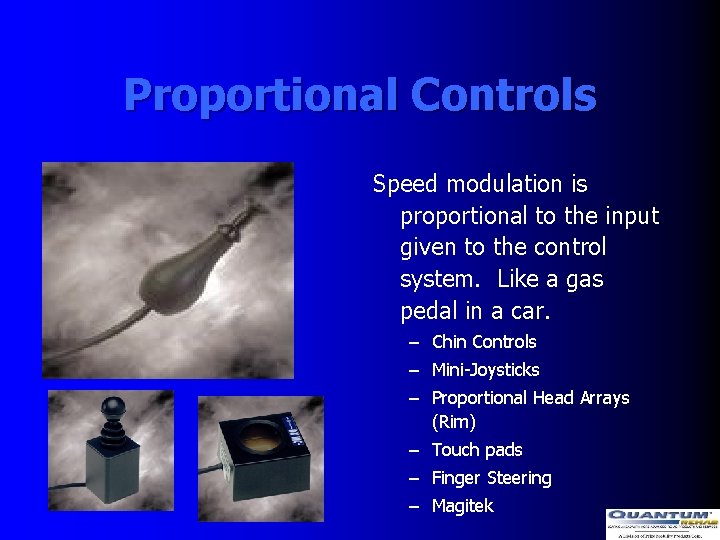
Proportional Controls Speed modulation is proportional to the input given to the control system. Like a gas pedal in a car. – Chin Controls – Mini-Joysticks – Proportional Head Arrays (Rim) – Touch pads – Finger Steering – Magitek
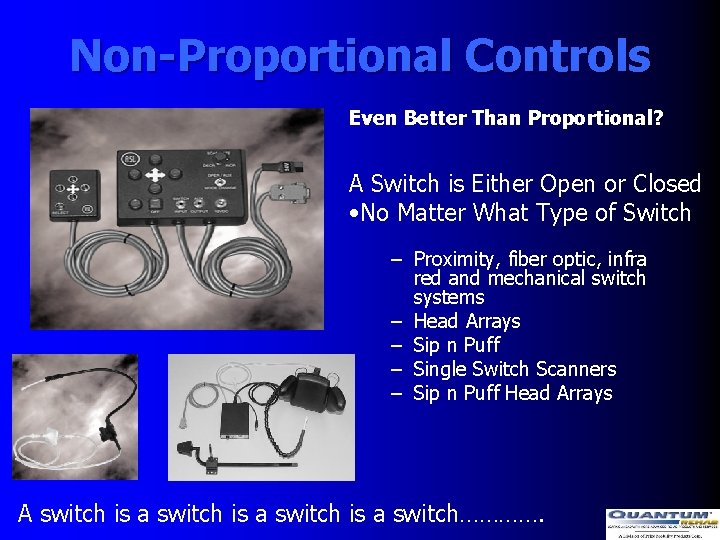
Non-Proportional Controls Even Better Than Proportional? A Switch is Either Open or Closed • No Matter What Type of Switch – Proximity, fiber optic, infra red and mechanical switch systems – Head Arrays – Sip n Puff – Single Switch Scanners – Sip n Puff Head Arrays A switch is a switch………….
Positioning of Input Devices l. Can the person get to the on/off switch? l. Can person access the input device independently and move in all planes of motion required to operate the device? l. Can person maintain access throughout the range of the power seat functions?
Basic Controller Functions l l Preprogrammed functions forward speed turn speed reverse speed l l l acceleration deceleration turn acceleration turn deceleration Sensitivity Power level
Additional Controller Functions l l l l momentary/latched Tremor dampening RIM control Switch direction swap Standby Reset/mode selection Joystick Throw Drive Selection
Powered Mobility Technology
Basic Considerations Growth - Will the base and seating platform grow with the needs, present and future, of the user? Performance - Will the base I choose accommodate the seating without sacrificing the performance of the chair? Modularity - Can I add to my seating as needs change, can my seating adapt to changes made to the base or power positioning system? Accessories - Will the seating and seating platform accept current and future accessories?
Basic Considerations cont. Repair - If my base goes down, will it be easy to move my seating to a temporary base? Ease of Adjustment - How easy is it to make basic adjustments to COG, depth, STF, seat angle and width? Will I need to justify additional parts? Durability - Will the seating platform and seating hold-up to the rigors of the individual user(s)? Caregiver - What can I do to the seating platform and interface to make it easier on the caregiver? Aesthetics - Can I match colors? Hide wires? Use minimal amounts of hardware?
Rear Wheel Drive directional stability (tracks in a straight line) l Largest turning radius l Pivot point behind the user l Excellent traction up inclines, poor down inclines l Fastest speeds l
Front Wheel Drive Slightly slower l May fish tail at higher speeds l Good traction down hill l Best climbing ability l Smoothest on rough terrain because of long wheel base. l Shorter turning radius than rear wheel drive l
Midwheel Drive l. Smallest turning radius l. Slower than rear wheel drive for safe control l. Traction about equal for up and down inclines l. Pivot point under the driver l. Additional casters for stability. l. May experience a more significant rocking motion over obstacles
- Slides: 29