
Power Transmission Distribution Insulator and its Types Lecture
Power Transmission & Distribution Insulator and its Types Lecture #3 (Week 2) By Engr. Bilal Ahmad
Insulator • The overhead line conductors are supported on the poles or towers. In order to prevent the flow of current to earth through supports, the line conductors must be properly insulated from supports. This is achieved by securing line conductors to supports with the help of overhead line insulators. • These insulators provide necessary insulation between the line conductors and supports and hence prevent any leakage current from conductors to earth. • Thus the over head line insulators play an important part in the successful operation of power system.
Properties of Insulator Material In general, overhead line insulators should have the following desirable properties: 1. High mechanical strength in order to withstand conductor load and wind load. 2. High insulation resistance in order to prevent leakage current. 3. The insulator material should be nonporous and free from impurities. 4. High ratio of strength to flashover voltage. 5. The insulator material should not be affected by the change in temperature.
Materials of Insulator: The materials used for insulators used in overhead transmission lines are: • Silicon Rubber for sheds/ housing. • Glass-fiber reinforced epoxy resin rod (ECR type) for core. • Hop dip galvanized cast steel for metal fittings.
Types of Electrical Insulator (Overhead Insulator) There are mainly three types of insulator used as overhead insulator. • 1. Pin Insulator • 2. Suspension Insulator • 3. Strain Insulator There are other two types of electrical insulator for low voltage application. 1. Stay Insulator 2. Shackle Insulator.
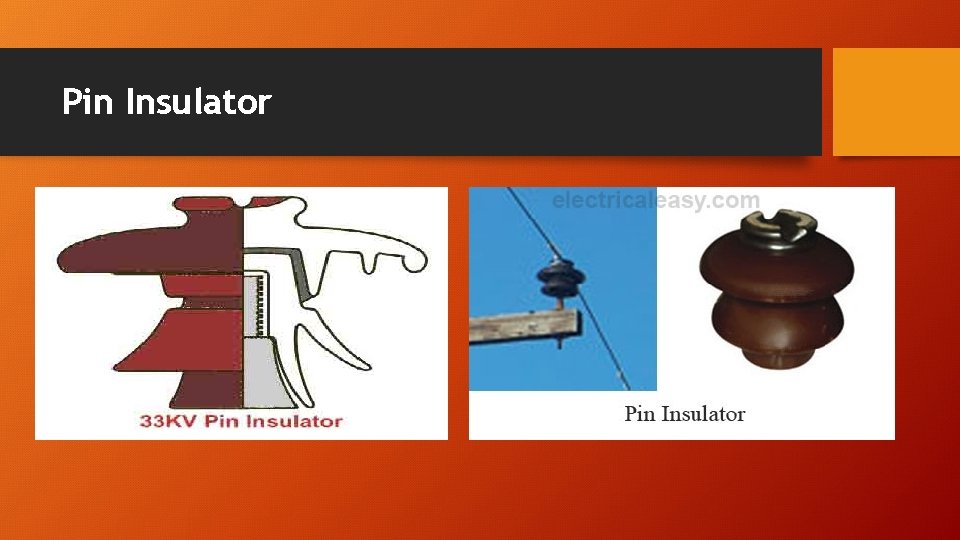
Pin Insulator • Pin Insulator is earliest developed overhead insulator, but still popularly used in power network up to 33 KV system. • Pin type insulator can be one part, two parts or three parts type, depending upon application voltage. • In 11 KV system we generally use one part type insulator where whole pin insulator is one piece of properly shaped porcelain or glass. • As the leakage path of insulator is through its surface, it is desirable to increase the vertical length of the insulator surface area for lengthening leakage path. In order to obtain lengthy leakage path, one, two or more rain sheds or petticoats are provided on the insulator body. • In addition to that rain shed or petticoats on an insulator serve another purpose. These rain sheds or petticoats are so designed, that during raining the outer surface of the rain shed becomes wet but the inner surface remains dry and non-conductive.
Pin Insulator • So there will be discontinuations of conducting path through the wet pin insulator surface. • In higher voltage like 33 KV and 66 KV manufacturing of one part porcelain pin insulator becomes difficult. Because in higher voltage, the thickness of the insulator become more and a quite thick single piece porcelain insulator cannot manufactured practically. • In this case we use multiple part pin insulator, where a number of properly designed porcelain shells are fixed together by Portland cement to form one complete insulator unit. For 33 KV tow parts and for 66 KV three parts pin insulator are generally used.
Pin Insulator
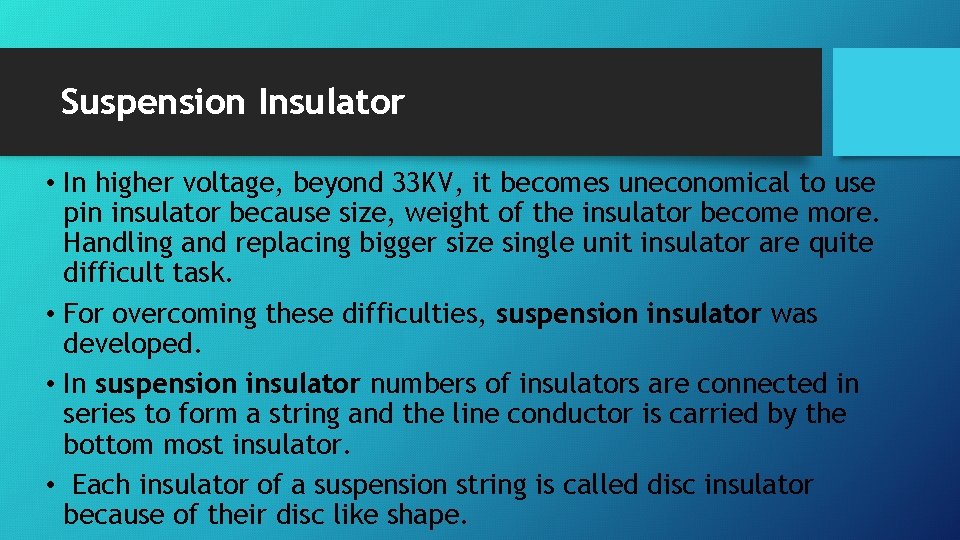
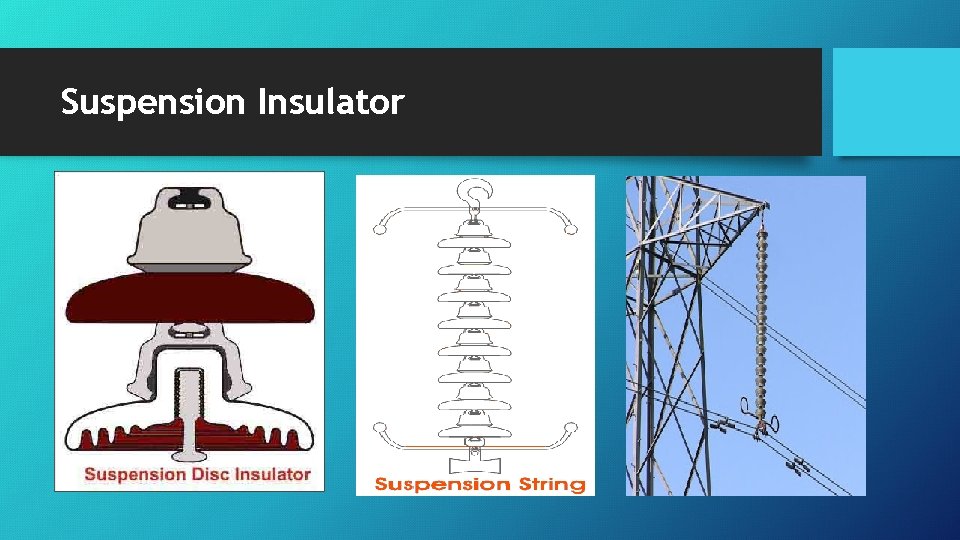
Suspension Insulator • In higher voltage, beyond 33 KV, it becomes uneconomical to use pin insulator because size, weight of the insulator become more. Handling and replacing bigger size single unit insulator are quite difficult task. • For overcoming these difficulties, suspension insulator was developed. • In suspension insulator numbers of insulators are connected in series to form a string and the line conductor is carried by the bottom most insulator. • Each insulator of a suspension string is called disc insulator because of their disc like shape.
Suspension Insulator
Advantages of Suspension Insulator • Each suspension disc is designed for normal voltage rating 11 KV(Higher voltage rating 15 KV), so by using different numbers of discs, a suspension string can be made suitable for any voltage level. • If any one of the disc insulators in a suspension string is damaged, it can be replaced much easily. • Mechanical stresses on the suspension insulator is less since the line hanged on a flexible suspension string.
Disadvantages of Suspension Insulator • Suspension insulator string costlier than pin and post type insulator. • Suspension string requires more height of supporting structure than that for pin or post insulator to maintain same ground clearance of current conductor. • The amplitude of free swing of conductors is larger in suspension insulator system, hence, more spacing between conductors should be provided.
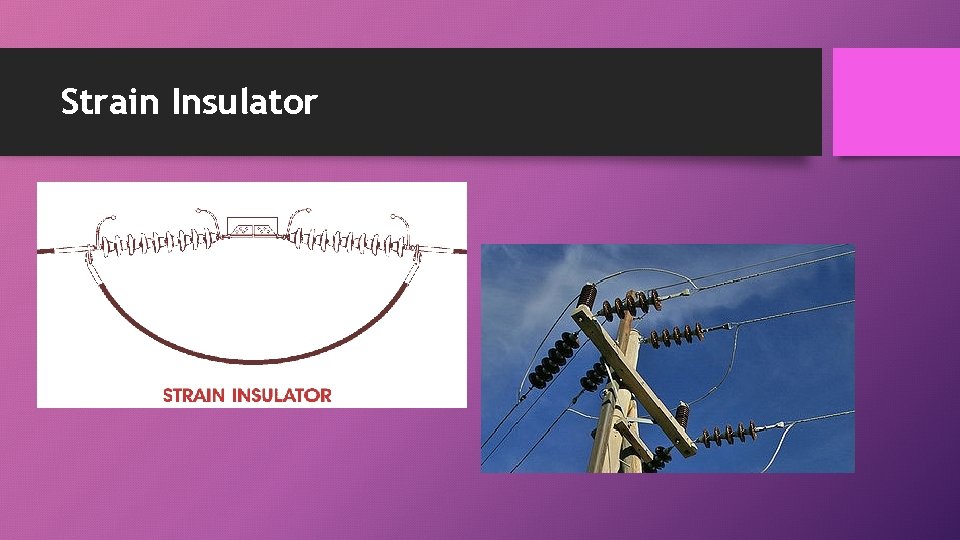
Strain Insulator • When suspension string is used to sustain extraordinary tensile load of conductor it is referred as string insulator. • When there is a dead end or there is a sharp corner in transmission line, the line has to sustain a great tensile load of conductor or strain. • A strain insulator must have considerable mechanical strength as well as the necessary electrical insulating properties.
Strain Insulator
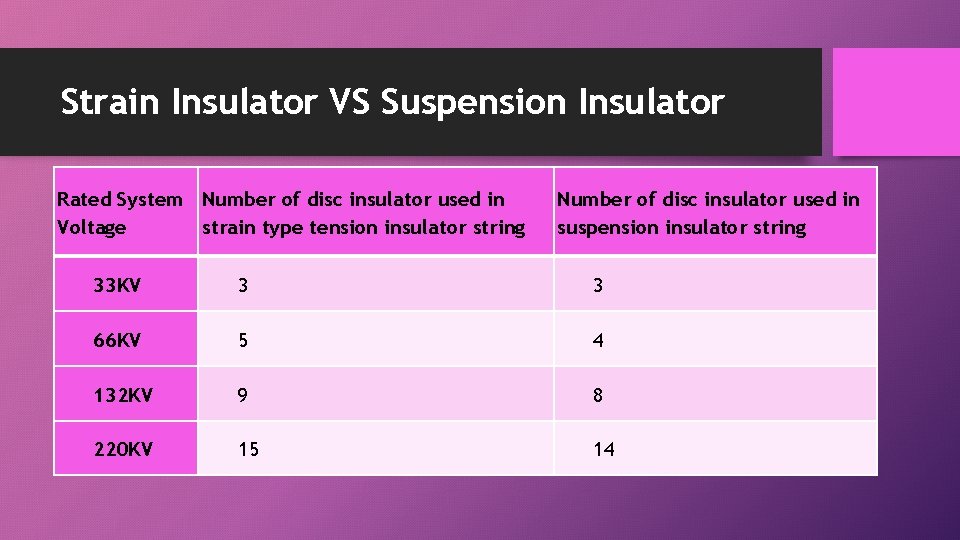
Strain Insulator VS Suspension Insulator Rated System Number of disc insulator used in Voltage strain type tension insulator string Number of disc insulator used in suspension insulator string 33 KV 3 3 66 KV 5 4 132 KV 9 8 220 KV 15 14
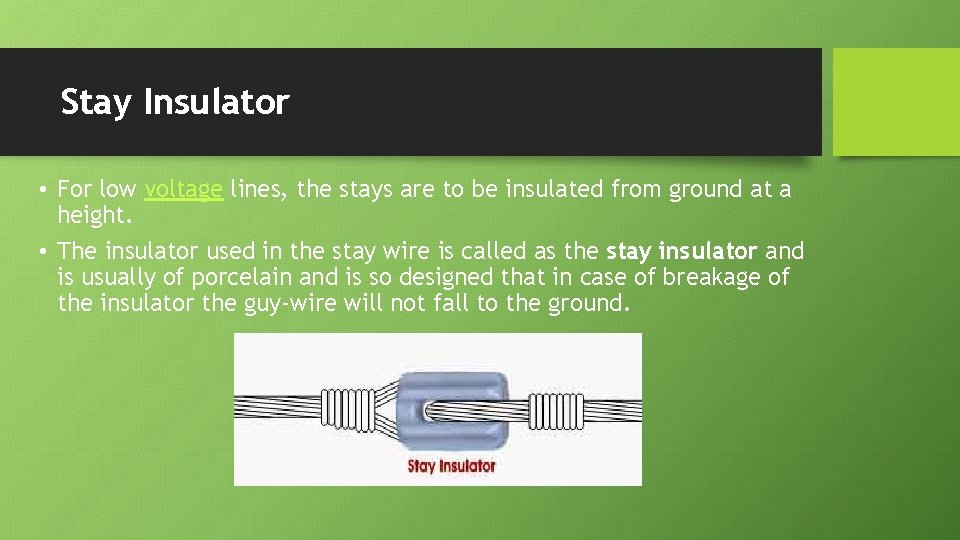
Stay Insulator • For low voltage lines, the stays are to be insulated from ground at a height. • The insulator used in the stay wire is called as the stay insulator and is usually of porcelain and is so designed that in case of breakage of the insulator the guy-wire will not fall to the ground.
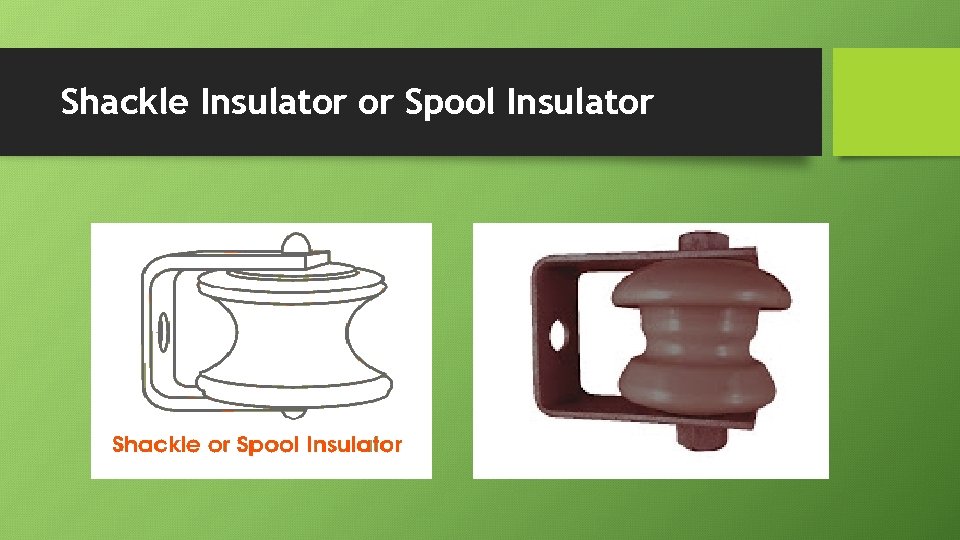
Shackle Insulator or Spool Insulator • The shackle insulator or spool insulator is usually used in low voltage distribution network. • It can be used both in horizontal and vertical position. The use of such insulator has decreased recently after increasing the using of underground cable for distribution purpose. • The tapered hole of the spool insulator distributes the load more evenly and minimizes the possibility of breakage when heavily loaded. The conductor in the groove of shackle insulator is fixed with the help of soft binding wire.
Shackle Insulator or Spool Insulator

Thanks
- Slides: 19