
POWER TRANSMISSION AND DISTRIBUTION Basics of electrical engineering
POWER TRANSMISSION AND DISTRIBUTION Basics of electrical engineering
INTRODUCTION 1. Electric energy is generated at the power stations which are far away from the urban areas 2. Large network of conductors between generating station and the consumers called as transmission and distribution system 3. Transmission system is to deliver power from generating stations to the load centres 4. Distribution system is to deliver power from substations to the various consumers 5. Electrical power can be transmitted and distributed by either A. C. or D. C. but in practice 3 phase, 3 wire A. C. system is universally adopted for transmission of large blocks of power and 3 phase, 4 wire A. C. system is usually adopted for distribution of electric power. 23/10/17 2
Various systems of power transmission a. D. C. systems D. C. two wire with mid-point earthed D. C. three wire system b. Single phase A. C. systems Single phase two wire with mid-point earthed Single phase three wire c. Two phase A. C. systems Two phase four wire Two phase three wire d. 23/10/17 Three phase A. C. systems Three phase 3 -wire Three phase 4 -wire 3
Various systems of power transmission 1. It is difficult to select the best system without comparison 2. Basis of comparison between the various systems is usually economy, i. e. the volume of conductor required (the volume of the conductor material required is minimum) 3. While comparing the amount of conductor material required for different systems of transmission, the following assumptions are to be made The power to be transmitted is same The distance over which power is transmitted remains the same The line losses are same The maximum voltage to earth is same 23/10/17 4
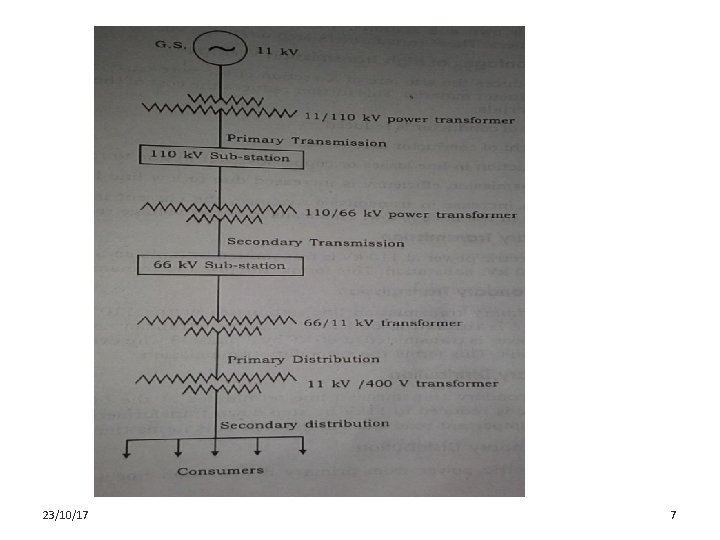
POWER TRANSMISSION SCHEME 1. Layout of a typical A. C. power supply scheme by a single line diagram 2. G. S. represents the generating station where the electric power is produced - generation voltage is 11 k. V 3. For economy in the transmission, the generation voltage is stepped up to 110 k. V at the generating station with the help of power transformer 4. The electric power at 110 k. V is transmitted through overhead lines 5. The 110 k. V line terminates at the 110 k. V substation 6. At substation, the voltage is reduced to 66 k. V - step-down transformer 23/10/17 5
POWER TRANSMISSION SCHEME 1. Then electric power is transmitted at 66 k. V by 3 phase, 3 wire overhead system - 66 k. V line terminates at the 66 k. V substation voltage is reduced to 11 k. V using step-down transformers 2. 11 k. V lines run along the important road sides of the city - big consumers are supplied power at 11 k. V for further handling with their own sub-stations 3. Power at 11 k. V is delivered to distribution transformers - step down the voltage to 400 V. 23/10/17 6
23/10/17 7
Advantages of high transmission voltage 1. It reduces the size (arc of X-section of the core carrying the current) of the conductor material. This further reduces the cost of the supporting structure materials 2. Cost of conductor is reduced 3. Weight of conductor is reduced 4. Reduction inline losses or copper losses (I 2 R) due to reduced current 5. Transmission efficiency is increased due to low line losses 6. With increase in transmission voltage, the current is reduced and voltage drop in the lines is low. This leads to better voltage regulation 23/10/17 8
TRANSMISSION Primary transmission Electric power at 110 k. V is transmitted by 3 phase, 3 wire overhead system to the 110 k. V substation Secondary transmission Primary transmission line terminates at the 110 k. V substation. Here the voltage is reduced to 66 k. V by step-down transformers. From this station, electric power is transmitted at 66 k. V by 3 phase, 3 wire overhead system to other substations 23/10/17 9
DISTRIBUTION Primary distribution The secondary transmission line terminates at the 66 k. V substation. Here the voltage is reduced to 11 k. V by step down transformers. The 11 k. V lines run along the important road sides of the city Secondary distribution The electric power from primary distribution line (11 k. V) is delivered to distribution transformers. Here the voltage is reduced to 400 V. from the distribution transformers, electric power is transmitted at 400 V, 3 phase 4 wire overhead system to the low voltage consumers 23/10/17 10
substation The main functions of a substation are 1. To receive energy transmitted at high voltage from the generating stations 2. To reduce the voltage to a value appropriate for local distribution 3. To provide facilities for switching Substations have some additional functions 1. They provide points where safety devices may be installed to disconnect equipment or circuit in the event of fault 2. Voltage on the outgoing feeders can be regulated at a substation 23/10/17 11
Classification of substations ACCORDING TO SERVICE REQUIREMENT 1. Transformer Substations – which change the voltage level of electric supply are called transformer sub-stations 2. Switching Substations – perform the switching operations of the power lines – do not change the voltage level 3. Frequency changer Substations – change the supply frequency 4. Power factor correction Substations – improve the power factor of the system – located in receiving end 5. Converting Substations – change ac power to dc – traction purposes, electroplating and electric welding 23/10/17 12
Classification of substations ACCORDING TO CONSTRUCTIONAL FEATURES 1. Indoor substations – The equipment of the substation is installed indoor up to 11 k. V voltage. If the atmosphere is contaminated with impurities, these can be erected up to 66 k. V 2. Outdoor substations – For voltages beyond 66 k. V, equipment is invariably installed outdoor. The outdoor substations are further subdivided in to pole mounted substations and foundation mounted substations 3. Underground substations – In thickly populated areas, there is scarcity of land as well as the prices of land are very high. This has led to the development of underground substation. In such substations, the equipment is placed underground 23/10/17 13
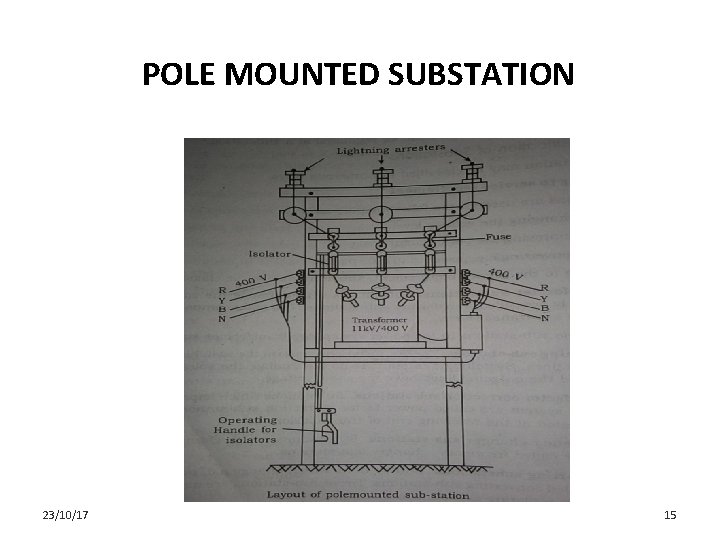
POLE MOUNTED SUBSTATION Erected for mounting distribution transformers of capacity up to 250 KVA Outdoor type and the equipment's are mounted on the supporting structure of H. T line Triple pole mechanically operated switch – for on and off H. T. fuse unit is installed for protection of H. T. side – to control L. T. side iron clad low tension switch of suitable capacity with fuses is installed Lightening arresters are installed over the H. T. – earthed at two or more places Transformers up to 100 k. VA are mounted on double pole structure and for transformers of capacity above 100 k. VA but <250 k. VA, 4 pole structure with suitable platform is used. 23/10/17 14
POLE MOUNTED SUBSTATION 23/10/17 15
Substation equipment’s Bus-bars - a main bar or conductor carrying an electric current to which many connection may be made - operate at constant voltage – made of aluminium - the incoming and outgoing lines in a substation are connected to the bus-bars Insulators - supports and insulation of the bus-bars – porcelain - types of insulators - Pin type, suspension type and shackle insulator Isolators - or disconnecting switch is used to open a circuit under no load - operated only when the lines in which they are connected carry no current - types of isolators - Single pole isolator and three pole isolator. Circuit breaker - equipment which can open or close a circuit under any condition. i. e. no load, full load or fault conditions - to isolate the 23/10/17 16
Substation equipment’s plant and lines rapidly and safely by automatic means under fault conditions - since fault current in a power system are very high in magnitude, therefore, the construction of a circuit breaker should be mechanically very strong Power transformer - used to step-up or step-down the voltage naturally cooled oil immersed, two winding, three phase transformers are used up to the rating of 10 MVA - the transformers of rating higher than 10 MVA are usually air blast cooled Current transformer - to transfer current in the power line to a value which is convenient for the operation of measuring instruments and relays - the measuring instruments and protective devices are designed for low voltages (110 V) and currents (5 A) - will not work satisfactorily if mounted directly on the power lines 23/10/17 17
Substation equipment’s Potential transformer - to transfer voltage in the power line to a value which is convenient for the operation of measuring instruments and relays - a step-down transformer and steps-down the voltage in a known ratio - primary winding of the potential transformer is connected to the main bus-bars and to the secondary windings, various indicating and metering equipment’s are connected Protective relays - sense the dangerous conditions and based on this sensing, to isolate the circuit - when the fault occurs the relay operates to complete the trip coil circuit which results in the opening of the circuit breaker and therefore isolation of the faulty section from the rest of the system - ensure the safety of the circuit equipment from damage and normal working of the health portion of the system 23/10/17 18
Substation equipment’s Lighting arrestor - protect the equipment against electric surges installed as near the transformer as possible because it is the most costly equipment of the sub-station Carrier-Current equipment - equipment is required for communication, relaying and telemetering - connected to the line through coupling capacitor and a wave trap - connected at the line entrance vertically or horizontally - coupling capacitors are installed on the line side of a wave trap and are normally base mounted 23/10/17 19
Advantages of underground system overhead system 1. More safe 2. Low maintenance cost 3. Very few chances of fault 4. Few chances of accidents 5. Good appearance 6. Free from lightning effects 7. No interference with communication circuits 23/10/17 20
Dis-advantages of underground system overhead system 1. More expensive 2. Difficult to locate the fault 3. Cannot be worked above 66 k. V due to installation difficulties 23/10/17 21
Distribution system Single phase A. C. supply using 2 wire (1 phase and 1 neutral) Three phase A. C. supply using 4 wire (3 phase wires and 1 neutral) Large consumers with heavy motor loads are provided with a 3 phase, 4 wire supply - voltage between any phase wire and the neutral wire is called phase voltage - voltage between any two phase wires is called line voltage The standard voltage of single phase and three phase are 240 V and 415 V respectively - voltage between any two of the phase wire in 3 phase system is √ 3 times the voltage between any phase and the neutral 23/10/17 22
Three phase 4 wire distribution scheme 23/10/17 23
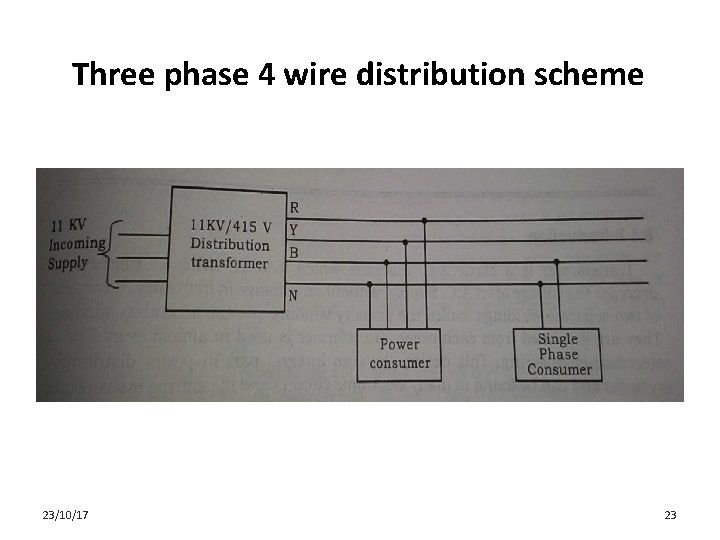
Three phase 4 wire distribution scheme R, Y, B are the phase wires and N is the neutral wire The 11 k. V supply from the substation is delivered to the distribution transformer Voltage is reduced to 415 V. from the distribution transformers, electric power is transmitted to 415 V, 3 phase, 4 wire overhead system to the low voltage consumers Consumers with high connected load receive power 415/250 V where they can use both three phase and single phase supply Very small domestic and commercial consumers are often provided with single phase supply at 240 V 23/10/17 24
FEEDERS, DISTRIBUTORS, SERVICE LINES Feeders are the conductors which connect the substations and the distribution transformers - current loading of feeder remains the same along its length - designed mainly from the point of view of its current carrying capacity Distributors are the conductors from which numerous tapings for the supply to the consumers are taken - current loading of a distributor varies along its length - designed from the point of view of the voltage drop in them Service mains Conductors which deliver electric power from the supply pole to the consumer’s premises up to the metering apparatus -25 23/10/17
questions 1. With a neat block diagram, explain the working of a thermal power plant. List the advantages and disadvantages 2. Draw the block schematic diagram of a Nuclear power plant 3. Explain primary transmission system 4. Write in detail about two methods of non-conventional energy sources 5. Draw a typical electrical power transmission scheme 6. Explain the different equipment’s used in a substation 7. Why wind energy is called a renewable source of energy 8. Explain any one of the conventional method of power generation with a neat sketch 9. How are substations classified? With the help of a neat layout of a typical substation explain the different substation equipment’s 10. Name the different sources of non-conventional energy 11. What are the advantages of high voltage transmission 23/10/17 26
- Slides: 26