
Power System Protection and switchgear Introduction to Protection

- Slides: 11
Power System Protection and switchgear Introduction to Protection System
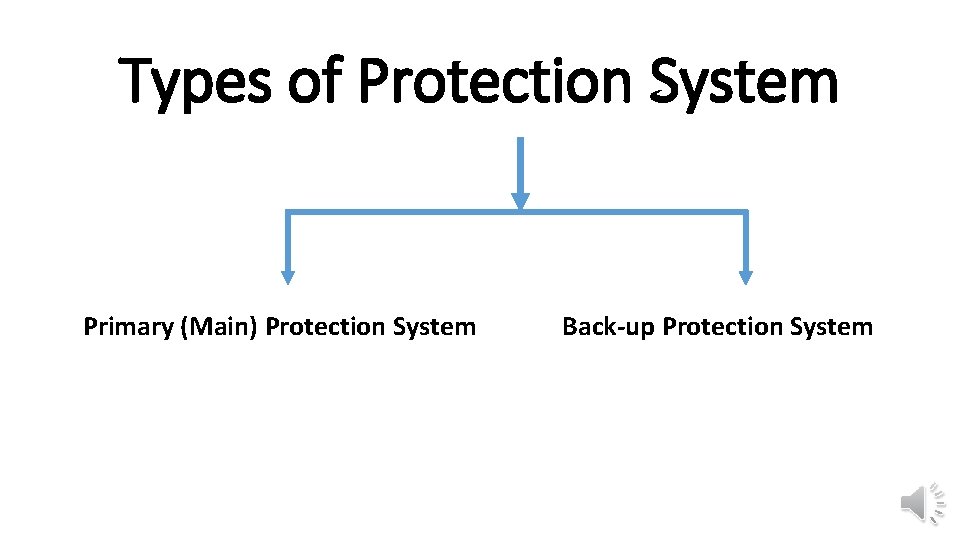
Types of Protection System Primary (Main) Protection System Back-up Protection System
Primary (Main) Protection System • A primary protection system should operate every time one of its elements detects a fault. It therefore covers a protection zone made up of one or more of the elements of the power system. It is possible for a power-system element to have various primary protection devices. However, this does not imply that these will all operate for the same fault. It should be noted that the primary protection of one item of system equipment may not necessarily be installed at the same location as the system equipment, in some cases it can be sited in an adjacent substation.
Primary (Main) Protection System A primary protection system or circuit breaker may fail to operate and, as a result, fail to clear a fault. It is thus essential that provision be made to clear the fault by some alternate protection system or systems. These alternate protection system(s) are referred to back-up protection systems.
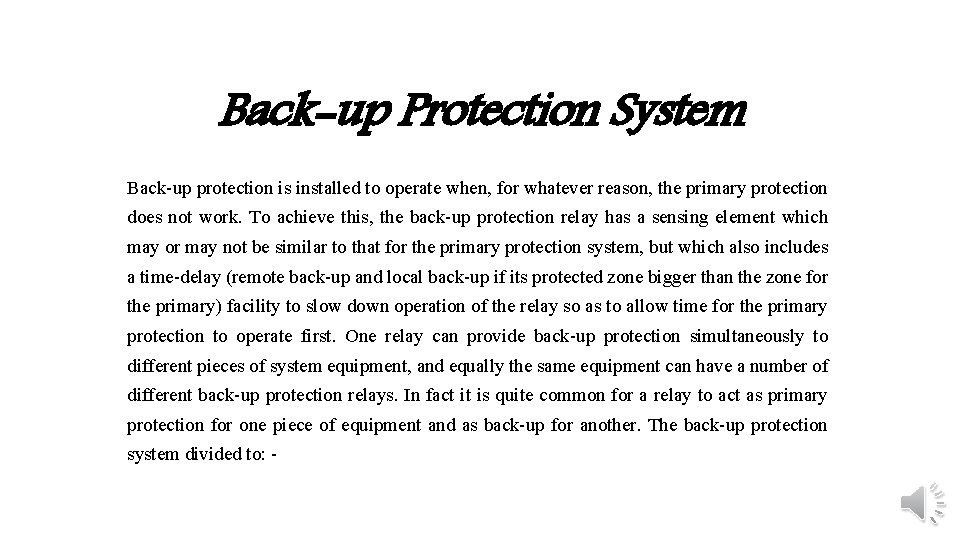
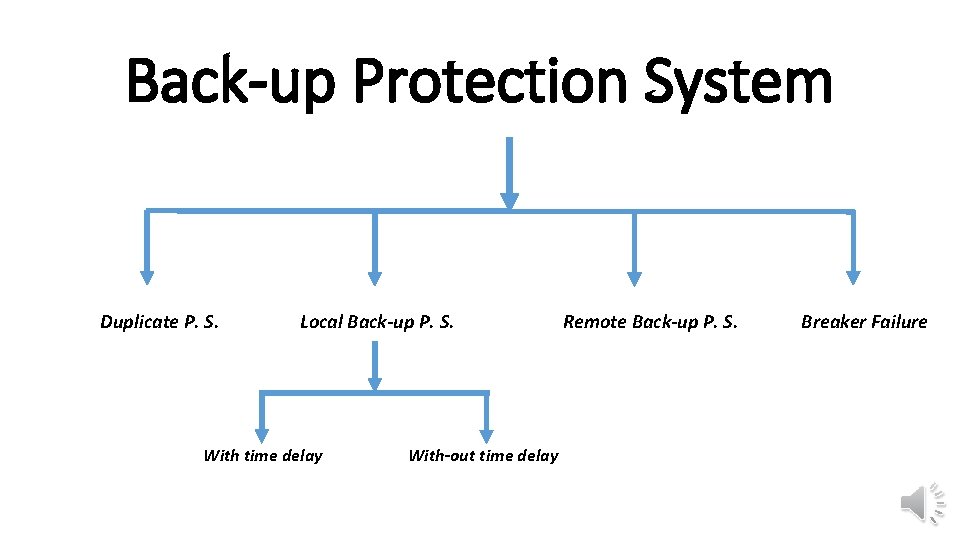
Back-up Protection System Back-up protection is installed to operate when, for whatever reason, the primary protection does not work. To achieve this, the back-up protection relay has a sensing element which may or may not be similar to that for the primary protection system, but which also includes a time-delay (remote back-up and local back-up if its protected zone bigger than the zone for the primary) facility to slow down operation of the relay so as to allow time for the primary protection to operate first. One relay can provide back-up protection simultaneously to different pieces of system equipment, and equally the same equipment can have a number of different back-up protection relays. In fact it is quite common for a relay to act as primary protection for one piece of equipment and as back-up for another. The back-up protection system divided to: -
Back-up Protection System Duplicate P. S. Local Back-up P. S. With time delay With-out time delay Remote Back-up P. S. Breaker Failure
Duplicate Protection System The primary protection operates in the fastest time possible and removes the least amount of equipment from service. On EHV systems it is common to use duplicate primary protection systems in case an element in one primary protection chain may fail to operate. This duplication is therefore intended to cover the failure of the relays themselves. One may use relays from a different manufacturer, or relays based upon a different principle of operation, so that some inadequacy in the design of one of the primary relays is not repeated in the duplicate system. The operating time of the primary and the duplicate system are the same. It is not always practical to duplicate every element of the protection chain- on HV and EHV systems the transducers or the circuit breakers are very expensive, and the cost of duplicate equipment may not be justified. On lower voltage systems, even the relays themselves may not duplicate.
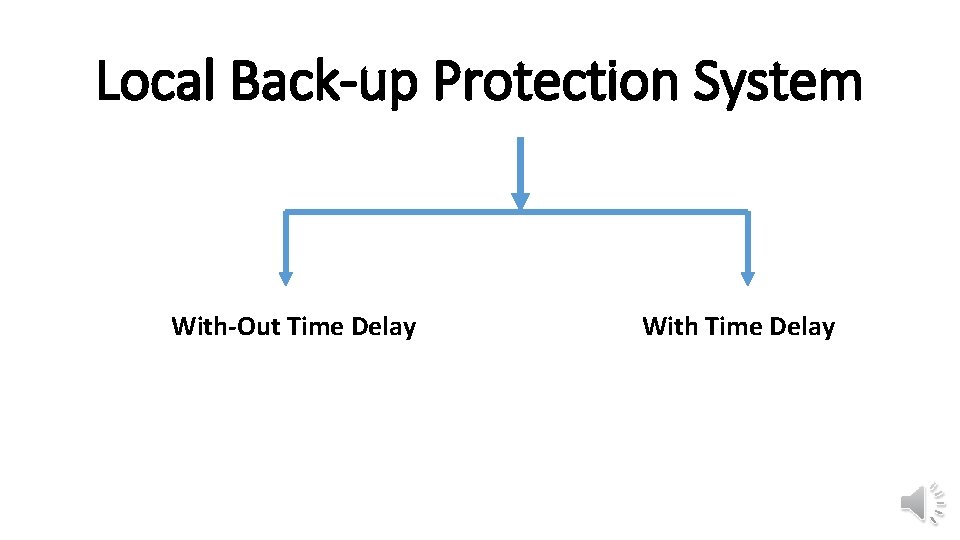
Local Back-up Protection System With-Out Time Delay With Time Delay
Local Back-up Protection System In this type, the back-up relaying installed in the same substation as the primary protection. Local back-up protection system has the same operating time for primary protection system if the zone of protection is the same (no time delay), but if the protection zone of the local back-up system is bigger than the primary protection one, a delay time should be used with the local back-up system. Also, the local back-up system uses another battery, transducers secondary winding and another coil of the circuit breakers
Remote Back-up Protection System In this type, the back-up relaying installed remotely from the primary protection. Remote back-up relays are completely independent of the relays, transducers, batteries and circuit breakers of the protection system they are backing-up. There are no common failures that can affect both sets of relays. However, complex system configurations may significantly affect the ability of remote back-up relays to see all the faults for which back-up is desired. In addition, remote back-up relays may remove more sources in the system than can be allowed.
Breaker failure Relay Breaker failure relays are a subset of local back-up relaying that is provided specifically to cover a failure of the circuit breaker. This can be accomplished in a variety of ways. The most common, and simplest, breaker failure relay system consists of a separate timer that is energized whenever the breaker trip coil is energized and is de-energized when the fault current through the breaker disappears. If the fault current persists for longer than the timer setting, a trip signal is given to all local and remote breakers that are required to clear the fault. Occasionally a separate set of relays is installed to provide this breaker failure protection, in which case it uses independent transducers and batteries.