
Power Supply Design an introduction Power Supplies Overview

- Slides: 17
Power Supply Design -an introduction
Power Supplies Overview • Linear Regulators • Switching “DC-to-DC Converter” Regulators • Design Help • Conclusion
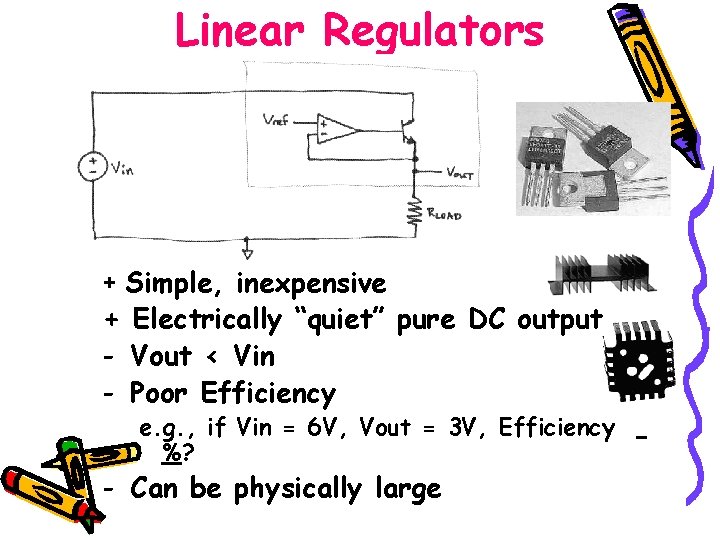
Linear Regulators + Simple, inexpensive + Electrically “quiet” pure DC output - Vout < Vin - Poor Efficiency e. g. , if Vin = 6 V, Vout = 3 V, Efficiency %? - Can be physically large
Switching Regulators • Also known as “DC-DC Converters” or “Switchmode Regulators” + Wide range of input voltages + Multiple output voltages possible + High Efficiency (sometimes >90%!) + Compact - Complex, more expensive - Electrically “noisy” (not pure DC)
Switching Regulators A few types… • Buck (step-down) • Boost (step-up) • Flyback (supports multiple outputs; transformer needed) • Buck-boost (step-up or –down) • SEPIC, Zeta, Cuk (specialized buckboost) • Forward (requires transformer) • Charge Pump (no inductor)
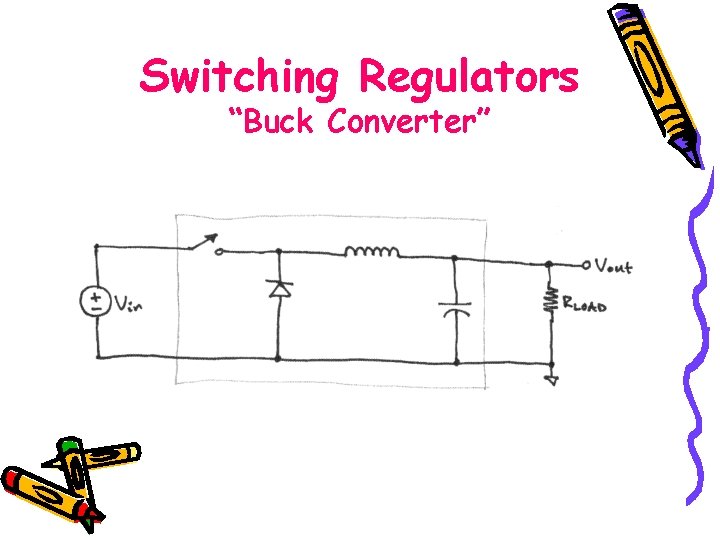
Switching Regulators “Buck Converter”
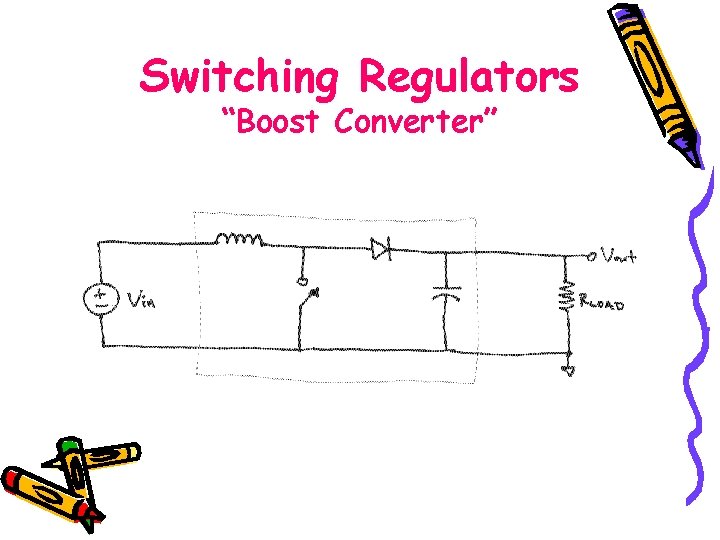
Switching Regulators “Boost Converter”
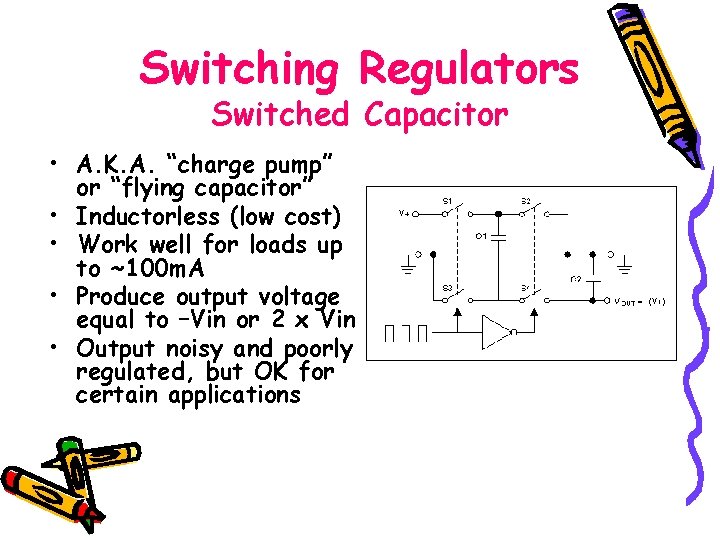
Switching Regulators Switched Capacitor • A. K. A. “charge pump” or “flying capacitor” • Inductorless (low cost) • Work well for loads up to ~100 m. A • Produce output voltage equal to –Vin or 2 x Vin • Output noisy and poorly regulated, but OK for certain applications
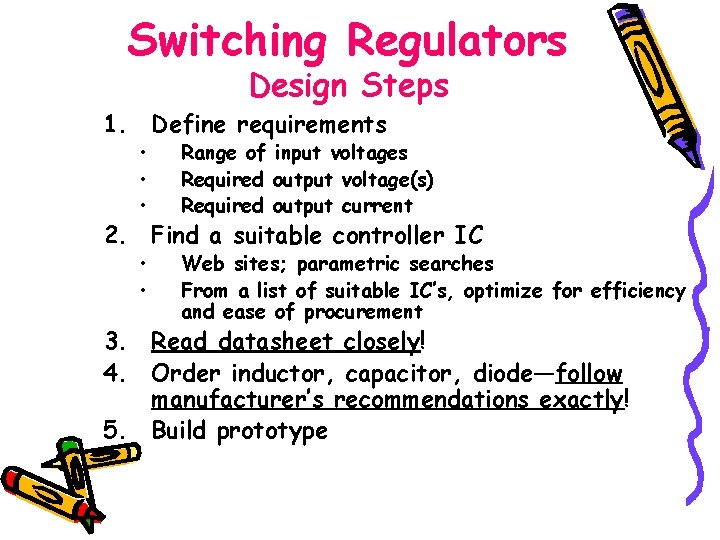
Switching Regulators Design Steps 1. Define requirements • • • Range of input voltages Required output voltage(s) Required output current • • Web sites; parametric searches From a list of suitable IC’s, optimize for efficiency and ease of procurement 2. Find a suitable controller IC 3. Read datasheet closely! 4. Order inductor, capacitor, diode—follow manufacturer’s recommendations exactly! 5. Build prototype
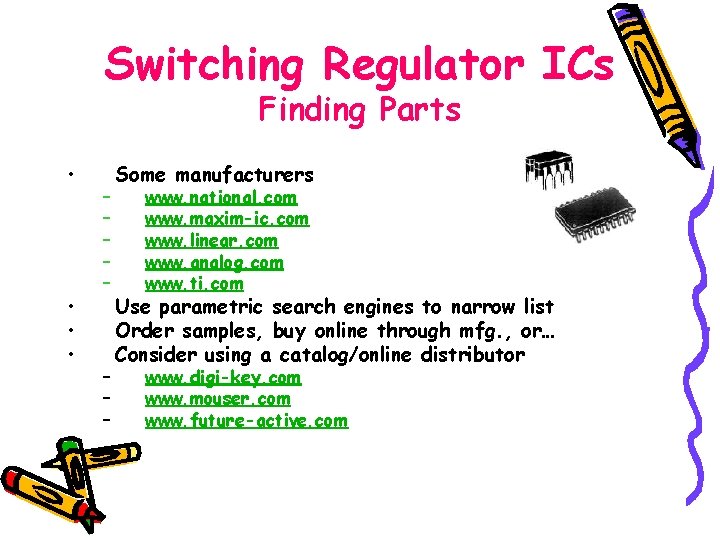
Switching Regulator ICs Finding Parts • • – – – – Some manufacturers www. national. com www. maxim-ic. com www. linear. com www. analog. com www. ti. com Use parametric search engines to narrow list Order samples, buy online through mfg. , or… Consider using a catalog/online distributor www. digi-key. com www. mouser. com www. future-active. com
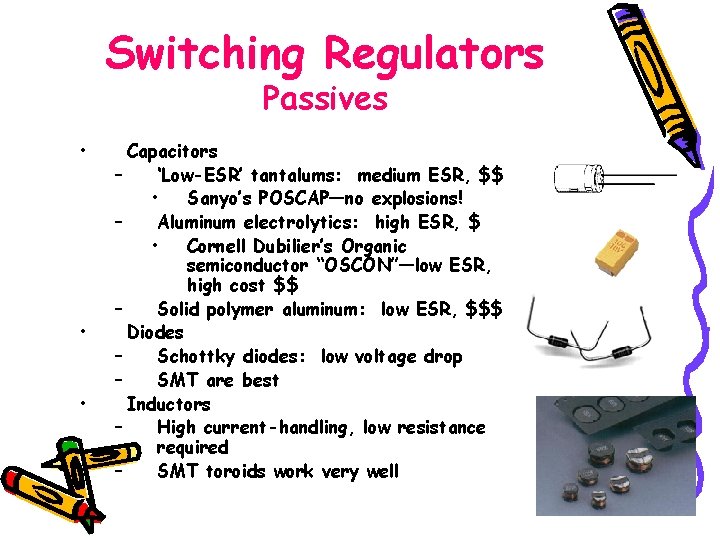
Switching Regulators Passives • • • Capacitors – ‘Low-ESR’ tantalums: medium ESR, $$ • Sanyo’s POSCAP—no explosions! – Aluminum electrolytics: high ESR, $ • Cornell Dubilier’s Organic semiconductor “OSCON”—low ESR, high cost $$ – Solid polymer aluminum: low ESR, $$$ Diodes – Schottky diodes: low voltage drop – SMT are best Inductors – High current-handling, low resistance required – SMT toroids work very well
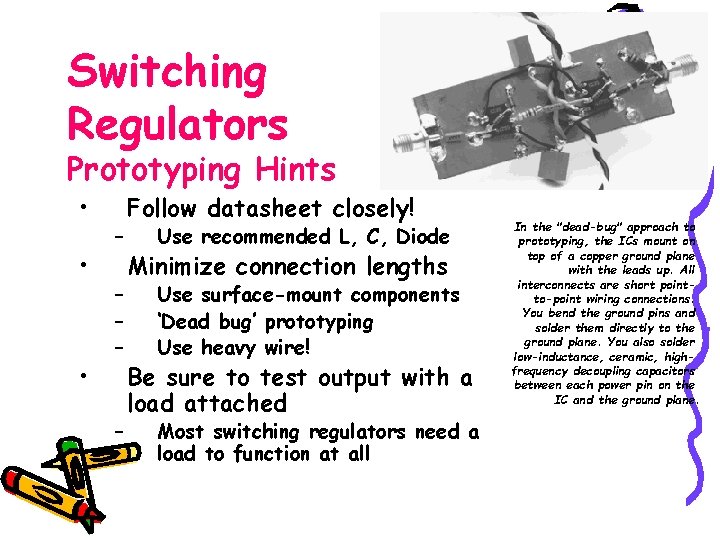
Switching Regulators Prototyping Hints • • • – – – Follow datasheet closely! Use recommended L, C, Diode Minimize connection lengths Use surface-mount components ‘Dead bug’ prototyping Use heavy wire! Be sure to test output with a load attached Most switching regulators need a load to function at all In the "dead-bug" approach to prototyping, the ICs mount on top of a copper ground plane with the leads up. All interconnects are short pointto-point wiring connections. You bend the ground pins and solder them directly to the ground plane. You also solder low-inductance, ceramic, highfrequency decoupling capacitors between each power pin on the IC and the ground plane.
Power Supply Design • • • Helpful Hints Efficiency not an issue? Linear regulators may be best. Battery powered? Consider switcher for efficiency. Vout > Vin? Use a switcher. With switchers, stick to simple topologies like Boost and Buck. Advanced topologies not for the faint of heart! Use a combination of switchers and linear regulators to get multiple output voltages. Wall-powered (120 volts AC)? Strongly consider use of ‘wall wart’ AC adapter. Electrical noise an issue (e. g. , with A/D converters)? Strongly consider post-regulation using a linear regulator. Need to double (2 x Vin) or invert (-Vin)? Consider a capacitive ‘charge pump’ (see web sites for details. ) Put batteries in series, not parallel. Parallel batteries can rapidly self-discharge, wasting battery life.
Power Supplies Case Studies • – • • – 2 -AA batteries to +5 V digital Boost 2 -AA batteries to +5 V for an A/D Boost with post-regulation +12 VDC ‘wall wart’ to +5 V, +3. 3 V Buck to +5 V, linear regulate to +3. 3 V Others?
Power Supplies Summary • Linear Regulators – • a simple, inexpensive circuit that produces a quiet output voltage less than the input voltage Switching Regulators – more complex circuit that’s efficient, compact, and versatile in its input/output voltages
Appendix A Some web sites of interest • – – • • – – – Intro Switching Supplies http: // dbserv. maximic. com/tarticle/view_article. cfm? article_id=120 http: //www. electronics-tutorials. com/basics/switched-modepower-supplies. htm Switched Capacitor: http: //dbserv. maximic. com/tarticle/view_article. cfm? article_id=108 More technical… http: //www. semiconductors. philips. com/acrobat/applicationnotes/ AN 120. pdf http: //www. linear-tech. com/pdf/an 46. pdf http: //www. linear-tech. com/pdf/an 30. pdf http: //www. linear-tech. com/pdf/an 25. pdf
Appendix B Switching Frequency • • • Typical switching supplies use switching frequencies between 15 k. Hz and 300 k. Hz. Faster switching frequencies (up to 1 GHz+) enable smaller inductors, simpler filtering Slower frequencies produce fewer spurious RF emissions (RFI), are less sensitive to parasitic capacitance/inductance in layout