
Power Series is an infinite polynomial in x

- Slides: 20
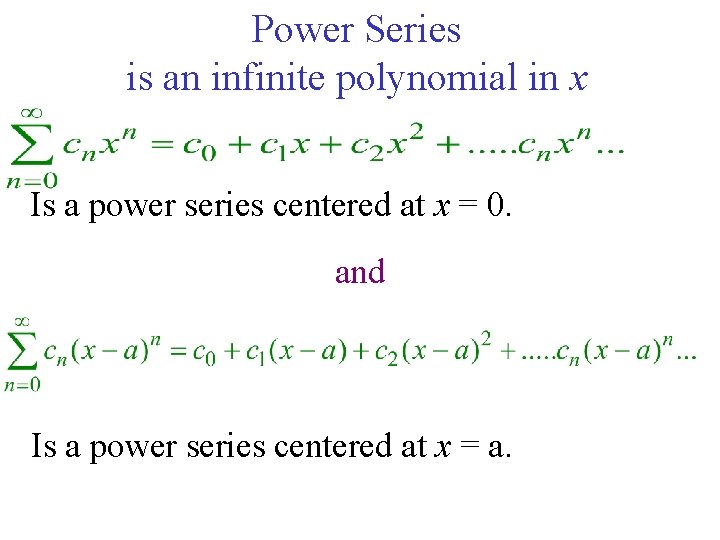
Power Series is an infinite polynomial in x Is a power series centered at x = 0. and Is a power series centered at x = a.
Examples of Power Series Is a power series centered at x = 0. and Is a power series centered at x = -1.
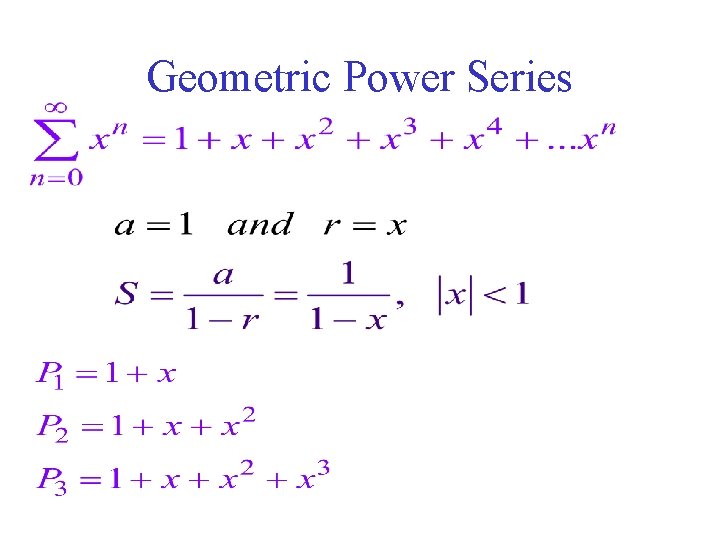
Geometric Power Series
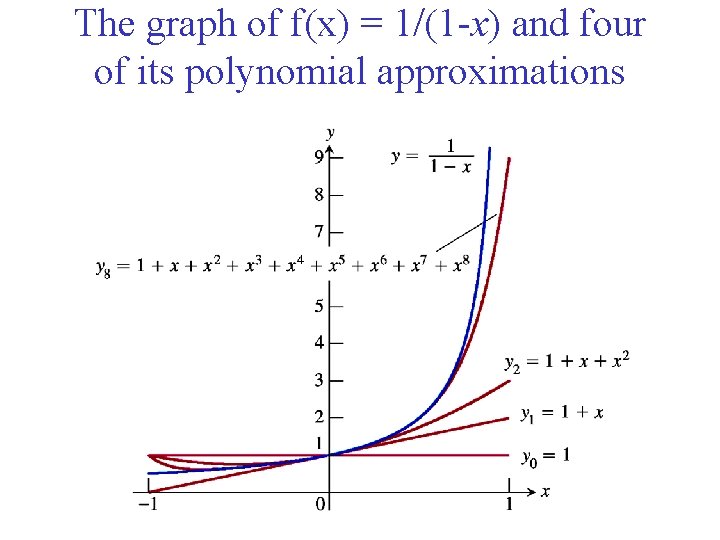
. The graph of f(x) = 1/(1 -x) and four of its polynomial approximations
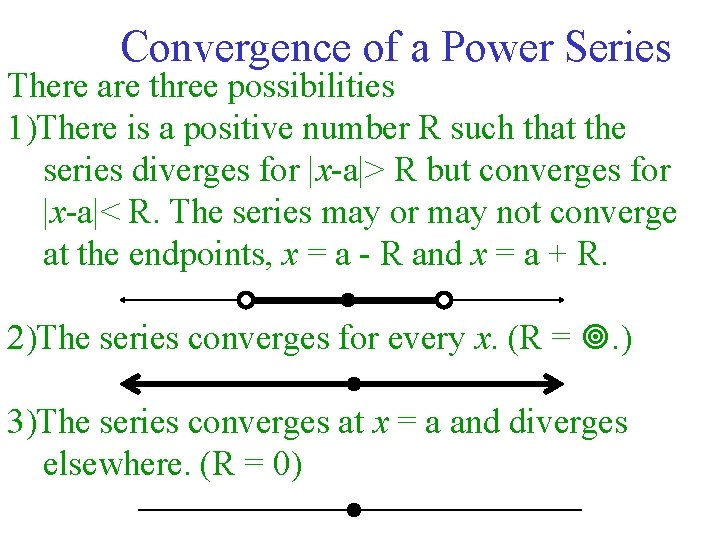
Convergence of a Power Series There are three possibilities 1)There is a positive number R such that the series diverges for |x-a|> R but converges for |x-a|< R. The series may or may not converge at the endpoints, x = a - R and x = a + R. 2)The series converges for every x. (R = . ) 3)The series converges at x = a and diverges elsewhere. (R = 0)
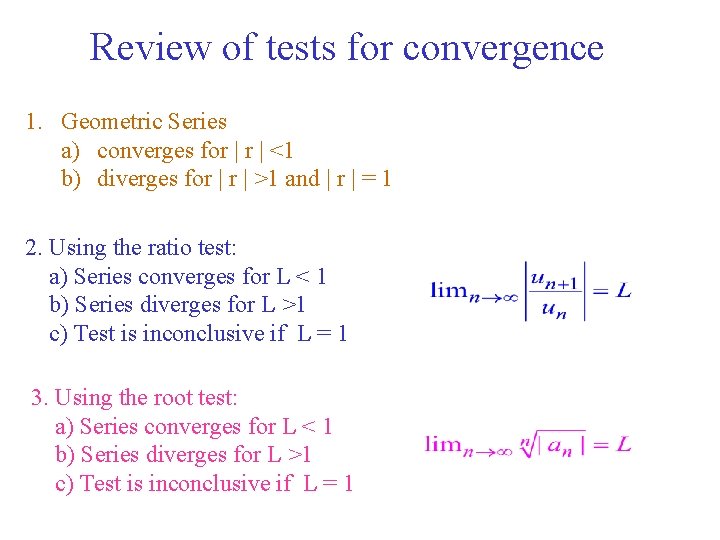
Review of tests for convergence 1. Geometric Series a) converges for | <1 b) diverges for | >1 and | r | = 1 2. Using the ratio test: a) Series converges for L < 1 b) Series diverges for L >1 c) Test is inconclusive if L = 1 3. Using the root test: a) Series converges for L < 1 b) Series diverges for L >1 c) Test is inconclusive if L = 1
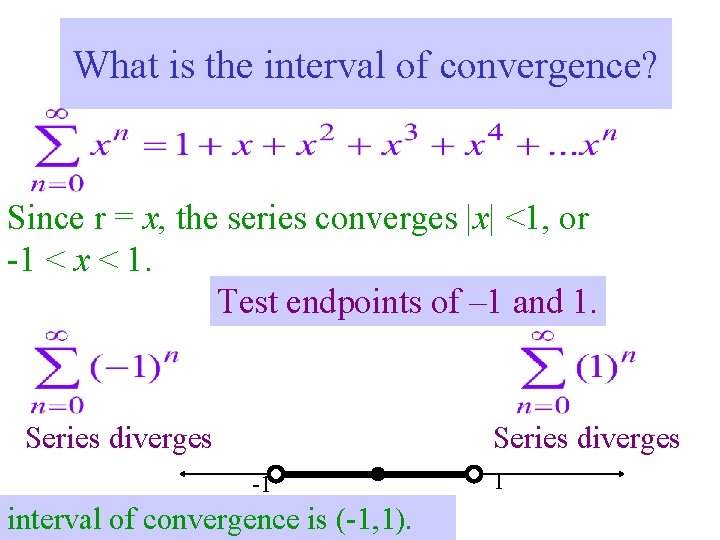
What is the interval of convergence? Since r = x, the series converges |x| <1, or -1 < x < 1. Test endpoints of – 1 and 1. Series diverges -1 interval of convergence is (-1, 1). 1
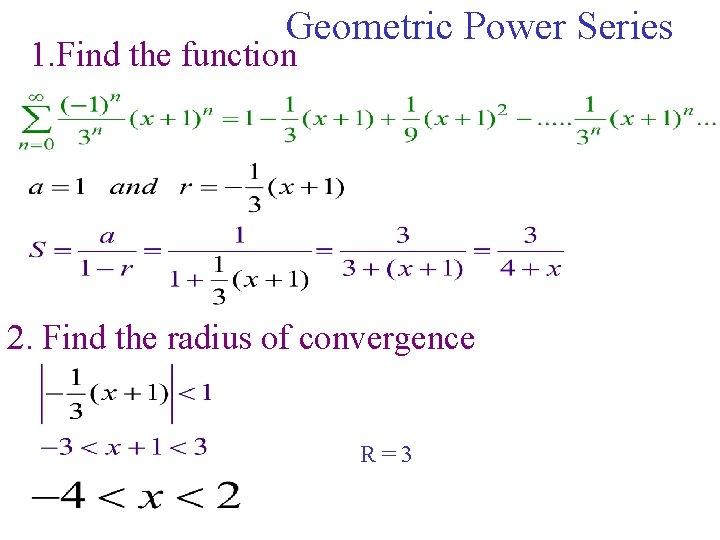
Geometric Power Series 1. Find the function 2. Find the radius of convergence R=3
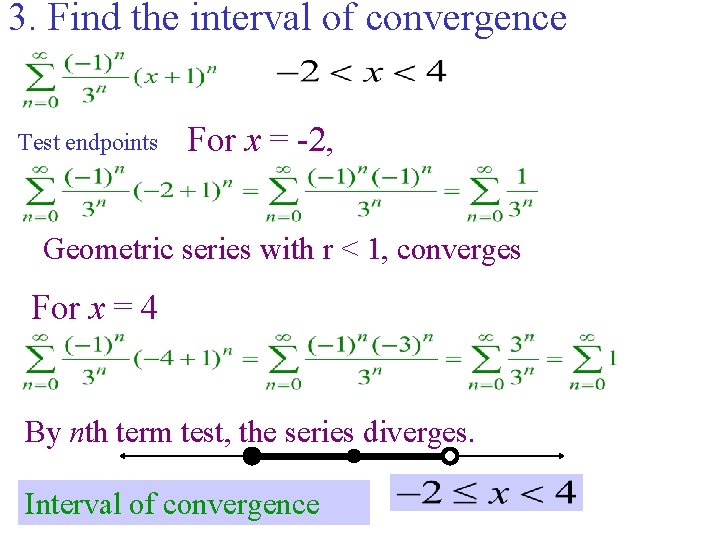
3. Find the interval of convergence Test endpoints For x = -2, Geometric series with r < 1, converges For x = 4 By nth term test, the series diverges. Interval of convergence
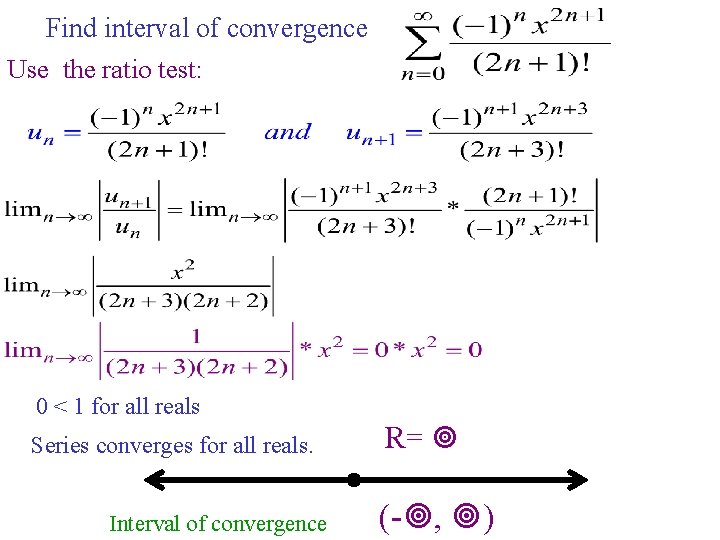
Find interval of convergence Use the ratio test: 0 < 1 for all reals Series converges for all reals. Interval of convergence R= (- , )
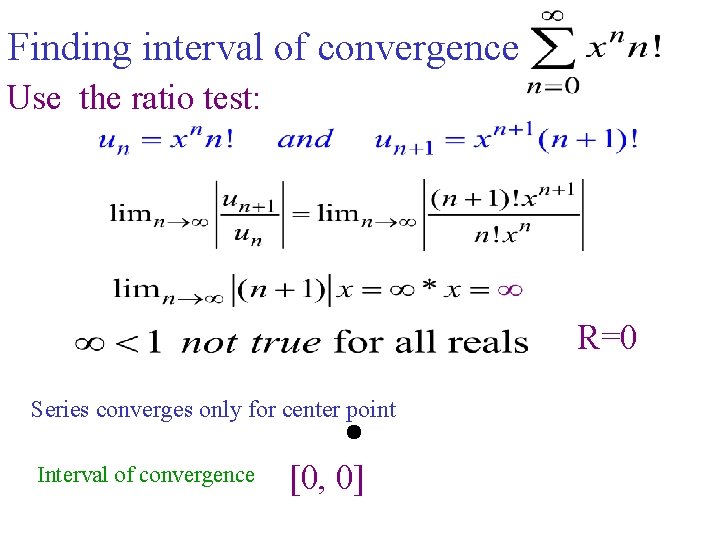
Finding interval of convergence Use the ratio test: R=0 Series converges only for center point Interval of convergence [0, 0]
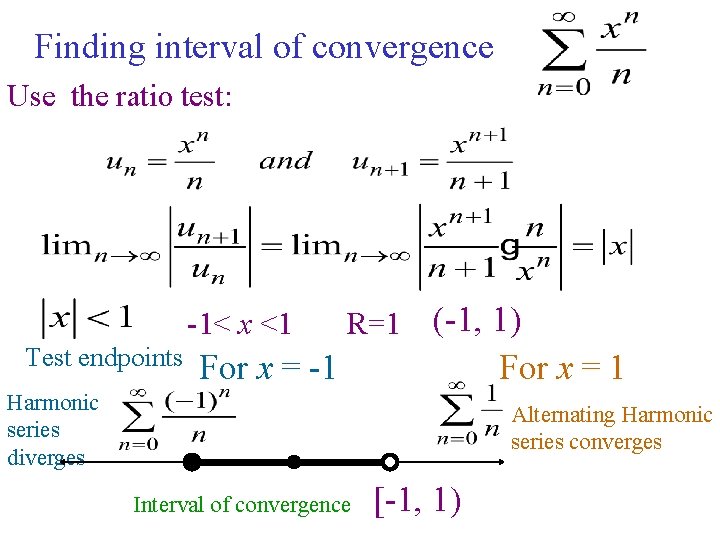
Finding interval of convergence Use the ratio test: -1< x <1 Test endpoints R=1 For x = -1 (-1, 1) For x = 1 Harmonic series diverges Alternating Harmonic series converges Interval of convergence [-1, 1)
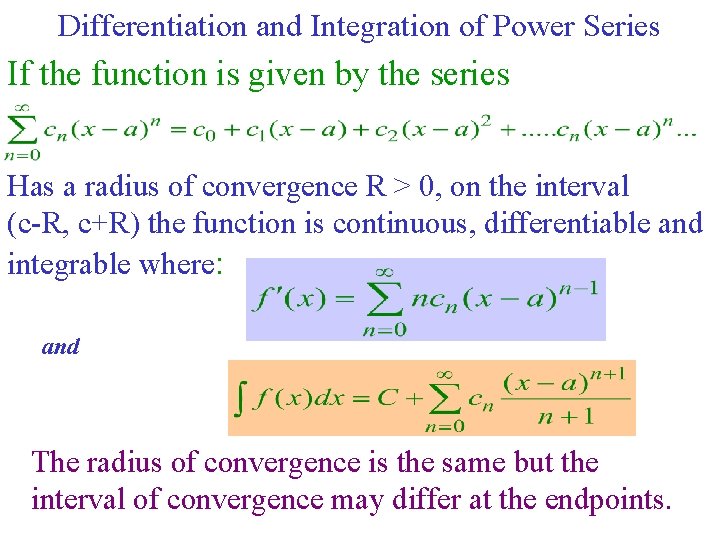
Differentiation and Integration of Power Series If the function is given by the series Has a radius of convergence R > 0, on the interval (c-R, c+R) the function is continuous, differentiable and integrable where: and The radius of convergence is the same but the interval of convergence may differ at the endpoints.
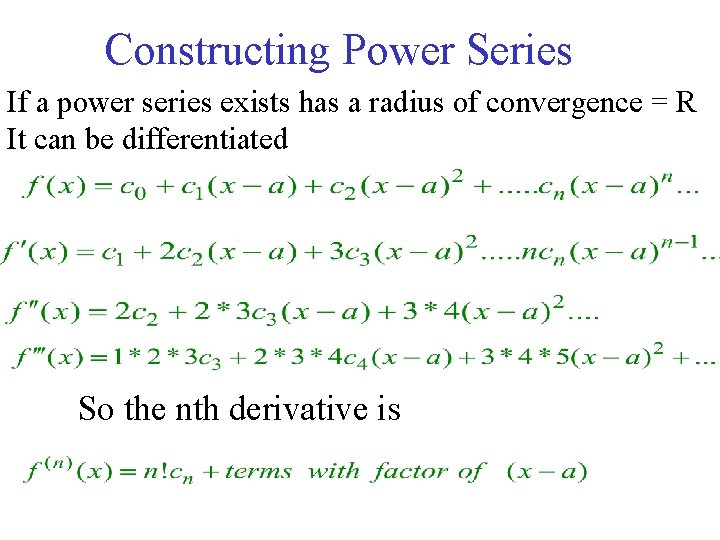
Constructing Power Series If a power series exists has a radius of convergence = R It can be differentiated So the nth derivative is
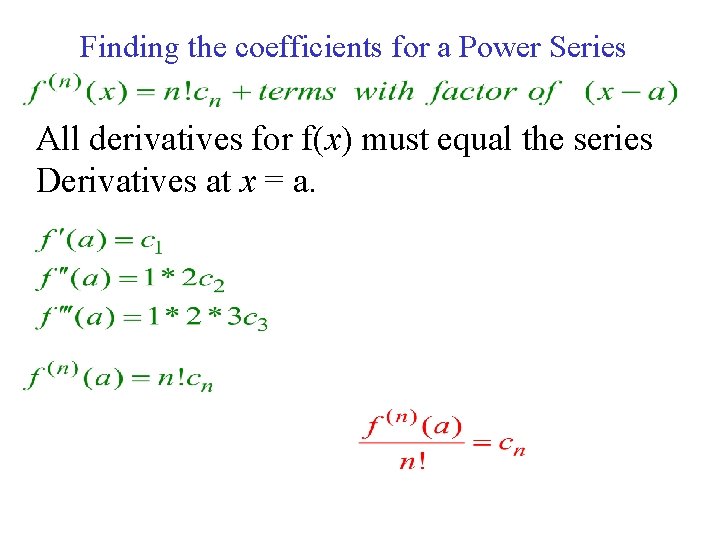
Finding the coefficients for a Power Series All derivatives for f(x) must equal the series Derivatives at x = a.
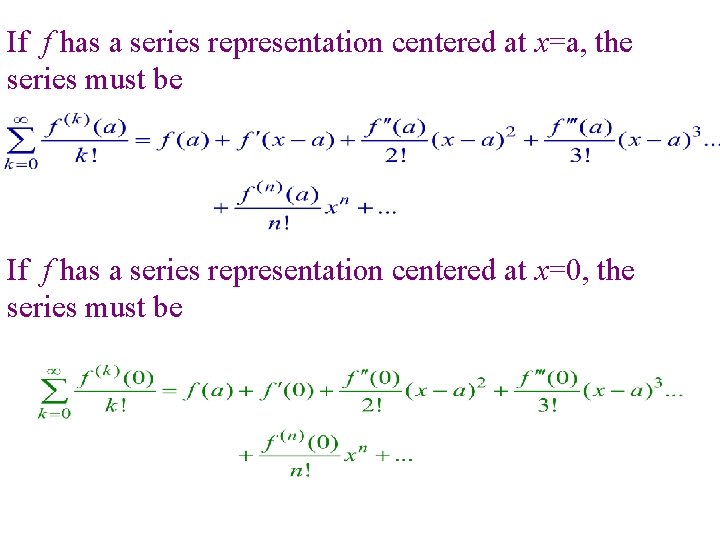
If f has a series representation centered at x=a, the series must be If f has a series representation centered at x=0, the series must be
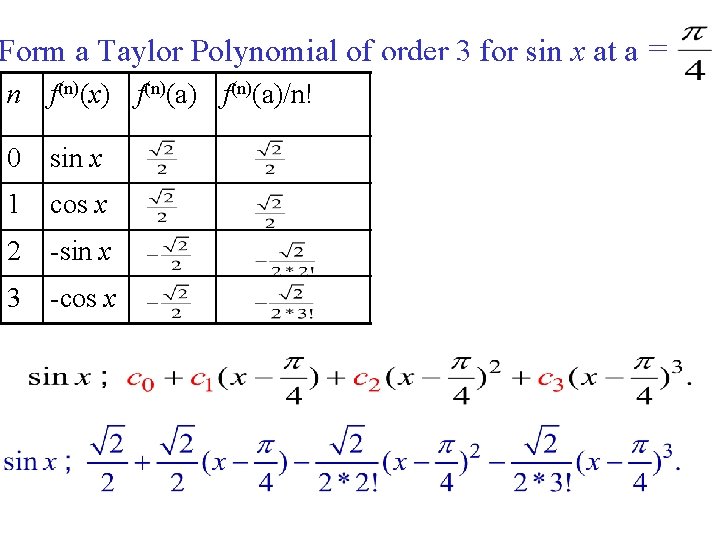
Form a Taylor Polynomial of order 3 for sin x at a = n f(n)(x) f(n)(a)/n! 0 sin x 1 cos x 2 -sin x 3 -cos x
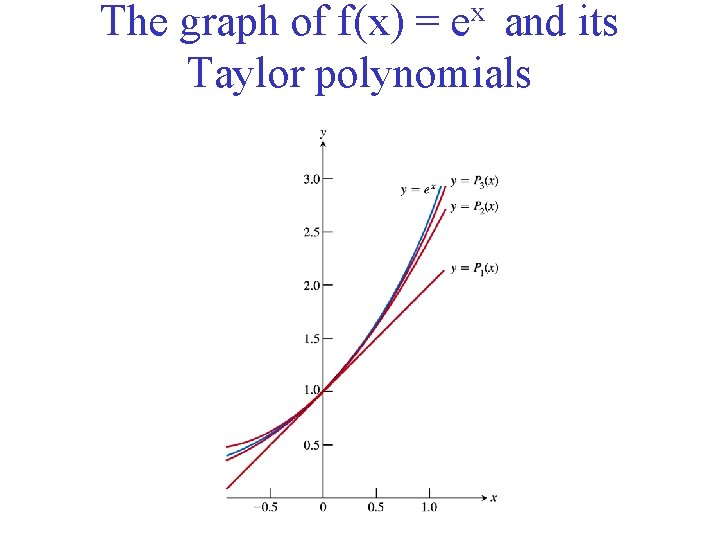
The graph of f(x) = ex and its Taylor polynomials
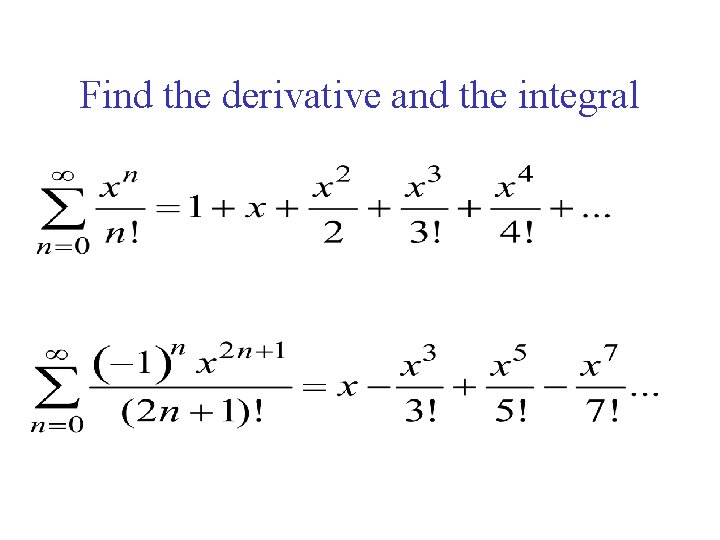
Find the derivative and the integral
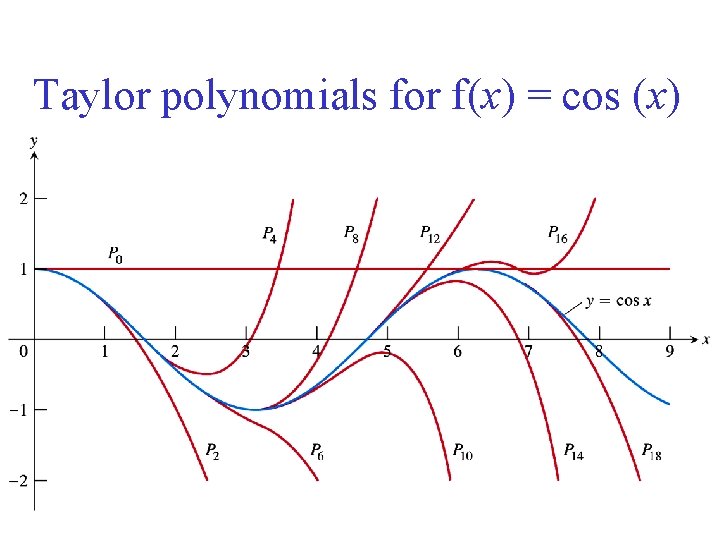
Taylor polynomials for f(x) = cos (x)