
POWER SEMICONDUCTOR CONVERTERS The following are the various
- Slides: 9
POWER SEMICONDUCTOR CONVERTERS The following are the various types of converters that are frequently used to control electric machines: AC Voltage Controller (AC to AC): An ac voltage controller converts a fixed-voltage ac to a variable-voltage ac. It can be used to control the speed of an induction motor (voltage control method) and for smooth induction motor starting. Controlled Rectifier (AC to DC): A controlled rectifier converts a fixed-voltage ac to a variable-voltage dc. It is used primarily to control the speed of dc motors, such as those used in rolling mills. Chopper (DC to DC): A chopper converts a fixed-voltage dc to a variable-voltage dc. It is used primarily to control the speed of dc motors.
Inverter (DC to AC): An inverter converts a fixed-voltage dc to a fixed- (or variable-) voltage ac with variable frequency. It can be used to control the speed of ac motors. Cycloconverter (AC to AC): A cycloconverter converts a fixed-voltage and fixed-frequency ac to a variable -voltage and variable- (lower-) frequency ac. It can be used to control the speed of ac motors.
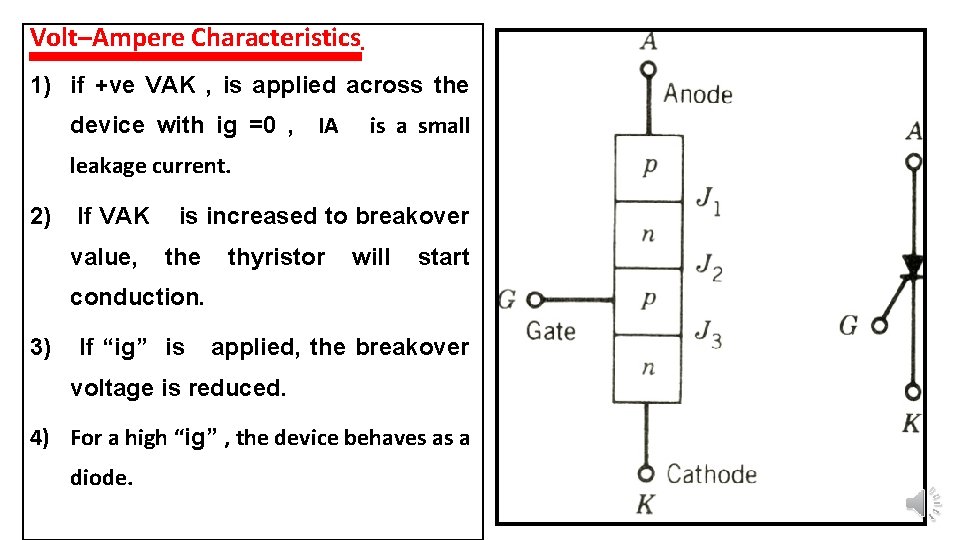
POWER SEMICONDUCTOR DEVICES : The power semiconductor devices that are generally used in converters can be grouped as follows: a) Thyristors (SCR). b) Power transistors. c) Diode rectifiers. THYRISTOR (SCR): § It has 4 - layer p–n–p–n structure with three terminals, anode (A), cathode (K), and gate (G). § The anode and cathode are connected to the main power circuit. § The gate terminal controls the thristor operation. § The thyristor operates in two stable states: on or off.
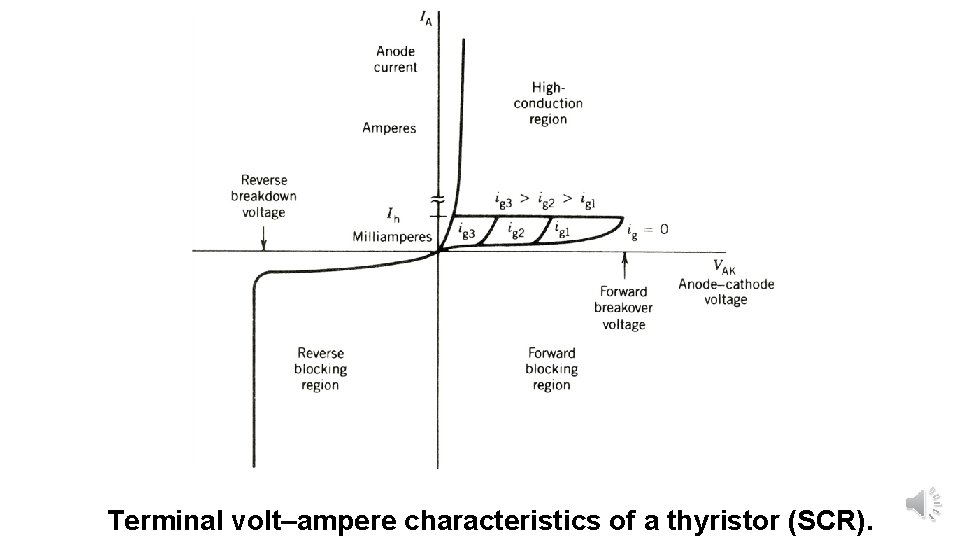
Volt–Ampere Characteristics : 1) if +ve VAK , is applied across the device with ig =0 , IA is a small leakage current. 2) If VAK value, is increased to breakover the thyristor will start conduction. 3) If “ig” is applied, the breakover voltage is reduced. 4) For a high “ig” , the device behaves as a diode.
Terminal volt–ampere characteristics of a thyristor (SCR).
• When the device is conducting, “ig” can be removed and the device remains in the on state. • If the anode current falls below a critical limit, called the holding current Ih, the device returns to its forward blocking state. • If a reverse voltage is applied across the device, the junctions J 1 and J 3 are reverse biased and J 2 is forward biased. • Therefore, only a small leakage current flows. If the reverse voltage is increased, then at a critical breakdown level the current will increase sharply.
§ If this current is not limited to a safe value, power dissipation will increase to a dangerous level that will destroy the device. Switching Characteristics: § If a thyristor is forward biased and a gate pulse is applied, the thyristor switches on. once thyristor starts conducting, the gate looses control on the device. § natural commutation: The thyristor will turn off if the anode current becomes zero naturally. § forced commutation: The thyristor will turn off if the anode current is forced to become zero.
It is therefore necessary to keep the device reverse biased for a finite period before a forward anode voltage can be applied. This period is known as the turnoff time (toff). turnoff time: (10 -100 us) the minimum time interval between the instant at which the anode current becomes zero and the instant at which the device is capable of blocking the forward voltage. Gate pulse: width = 10 -50 us VAK : , amplitude = 20 – 200 m. A 1 - 2. 5 volt during conduction
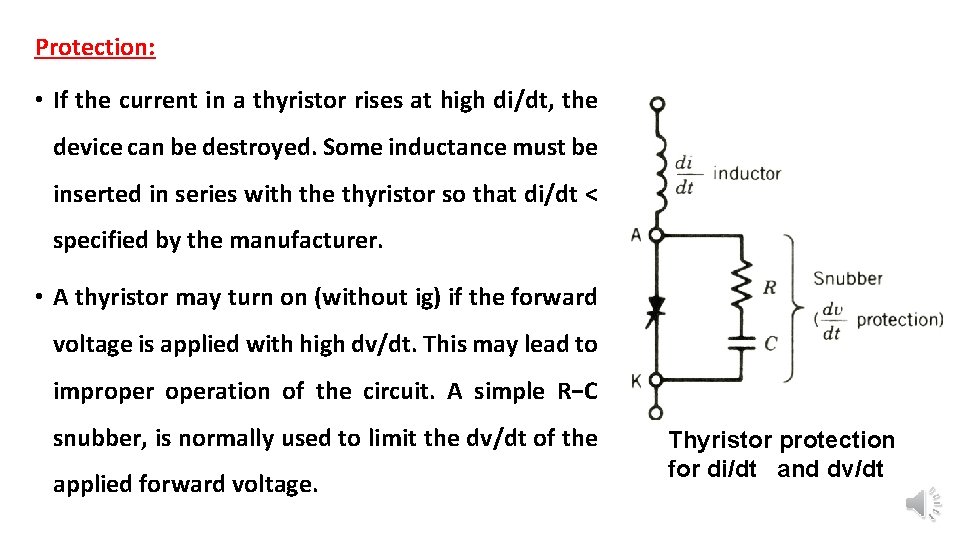
Protection: • If the current in a thyristor rises at high di/dt, the device can be destroyed. Some inductance must be inserted in series with the thyristor so that di/dt < specified by the manufacturer. • A thyristor may turn on (without ig) if the forward voltage is applied with high dv/dt. This may lead to improperation of the circuit. A simple R−C snubber, is normally used to limit the dv/dt of the applied forward voltage. Thyristor protection for di/dt and dv/dt