
Power Quality 101 Jason Pause Electric Distribution Systems
Power Quality 101 Jason Pause Electric Distribution Systems December 2013
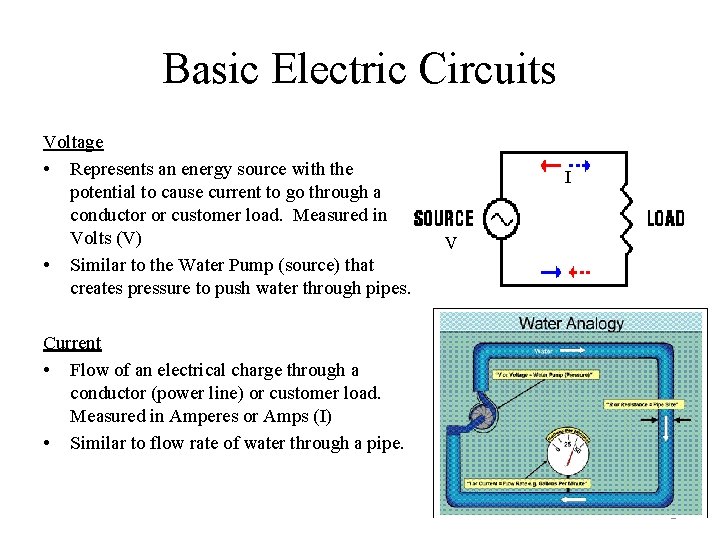
Basic Electric Circuits Voltage • Represents an energy source with the potential to cause current to go through a conductor or customer load. Measured in Volts (V) • Similar to the Water Pump (source) that creates pressure to push water through pipes. I V Current • Flow of an electrical charge through a conductor (power line) or customer load. Measured in Amperes or Amps (I) • Similar to flow rate of water through a pipe. 2
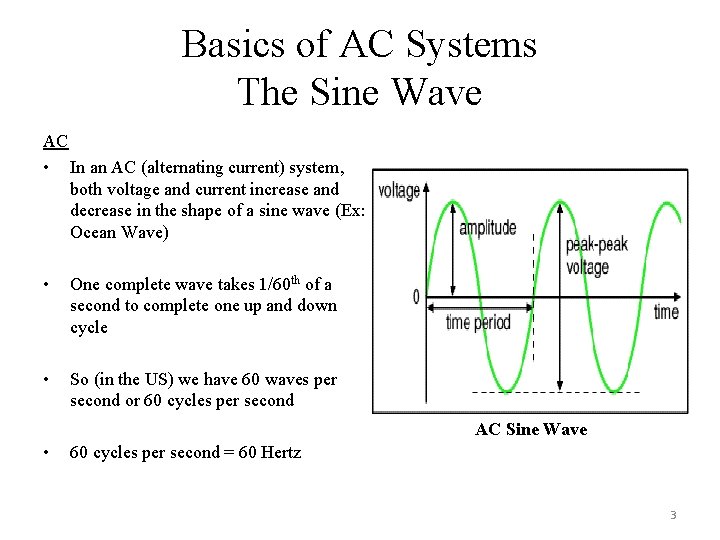
Basics of AC Systems The Sine Wave AC • In an AC (alternating current) system, both voltage and current increase and decrease in the shape of a sine wave (Ex: Ocean Wave) • One complete wave takes 1/60 th of a second to complete one up and down cycle • So (in the US) we have 60 waves per second or 60 cycles per second AC Sine Wave • 60 cycles per second = 60 Hertz 3
Basics of Power Quality • Power Quality determines the quality of the voltage in an electrical circuit or the fitness of electrical power to consumer devices. • ANSI C 84. 1 – Voltage Standards – Steady-state (continuous) voltage remains within a +/- range of 5% – Based on a service voltage of 120 volts, this ranges from 114 volts to 126 volts • Voltage Wave Frequency – 60 Hz +/- 0. 05 Hz (59. 95 Hz – 60. 05 Hz) – Average Frequency must = 60. 000… Hz • Typical Power Quality Disturbances – Transients – Voltage Sags & Swells – Harmonics 4

Power Quality - Issues Transients: • Temporary short duration voltage disturbances in which there is a high amplitude voltage change. • Causes – lightning, faults (utility or facility), capacitor switching, switching of large inductive loads (motors). • Effects – Unexpected fuse operation, tripping of motor drives, computer system issues, microprocessor control errors, damage to electronic equipment, damage to electrical contactors. 5
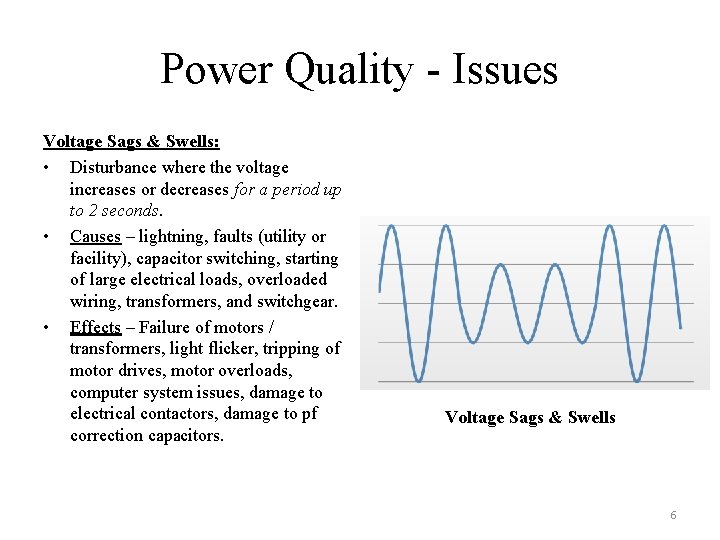
Power Quality - Issues Voltage Sags & Swells: • Disturbance where the voltage increases or decreases for a period up to 2 seconds. • Causes – lightning, faults (utility or facility), capacitor switching, starting of large electrical loads, overloaded wiring, transformers, and switchgear. • Effects – Failure of motors / transformers, light flicker, tripping of motor drives, motor overloads, computer system issues, damage to electrical contactors, damage to pf correction capacitors. Voltage Sags & Swells 6

Power Quality - Issues Harmonics: • Deviation of the voltage sine wave from a true sinusoidal shape. Harmonic is an integer multiple of the fundamental frequency of 60 Hz. (Ex: 2 nd harmonic is 120 Hz and 3 rd harmonic is 180 Hz…) • Causes - Non-linear electrical loads on the system such as: motor drives, computers and electronics, electronic ballasts, battery chargers, etc. . . • Effects – degrades the overall performance of the electrical system by increasing losses and temperatures in electrical components such as cables, transformers, and motors. 7
- Slides: 7