
Power Power is how much work is accomplished

- Slides: 27
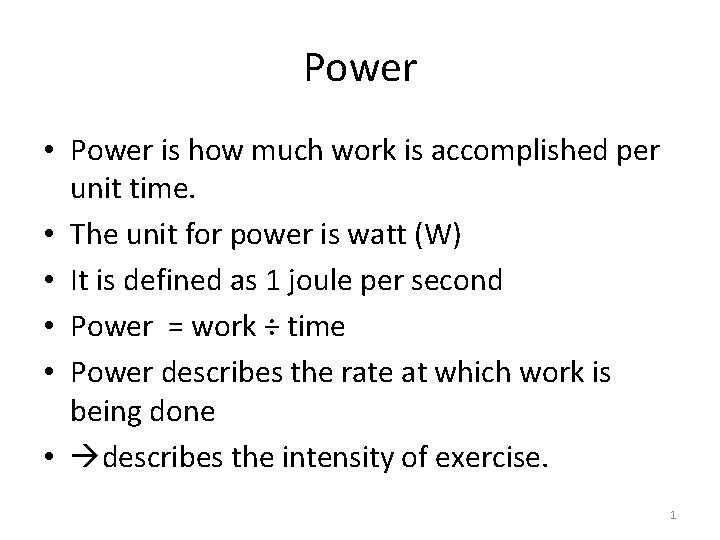
Power • Power is how much work is accomplished per unit time. • The unit for power is watt (W) • It is defined as 1 joule per second • Power = work ÷ time • Power describes the rate at which work is being done • describes the intensity of exercise. 1
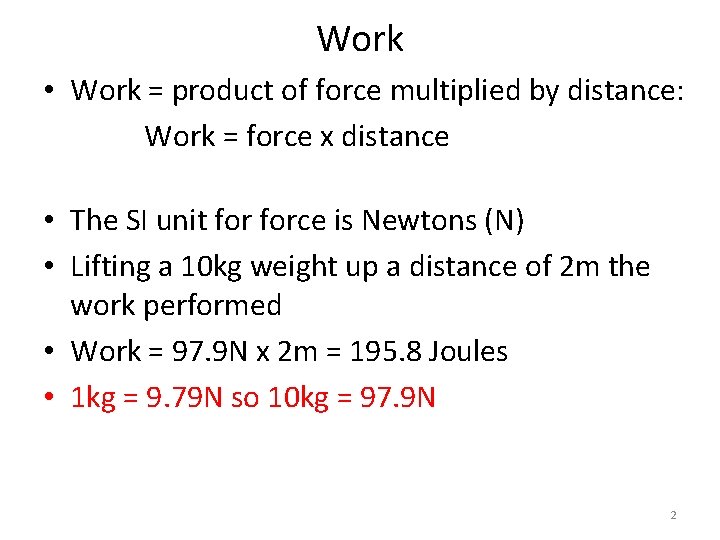
Work • Work = product of force multiplied by distance: Work = force x distance • The SI unit force is Newtons (N) • Lifting a 10 kg weight up a distance of 2 m the work performed • Work = 97. 9 N x 2 m = 195. 8 Joules • 1 kg = 9. 79 N so 10 kg = 97. 9 N 2
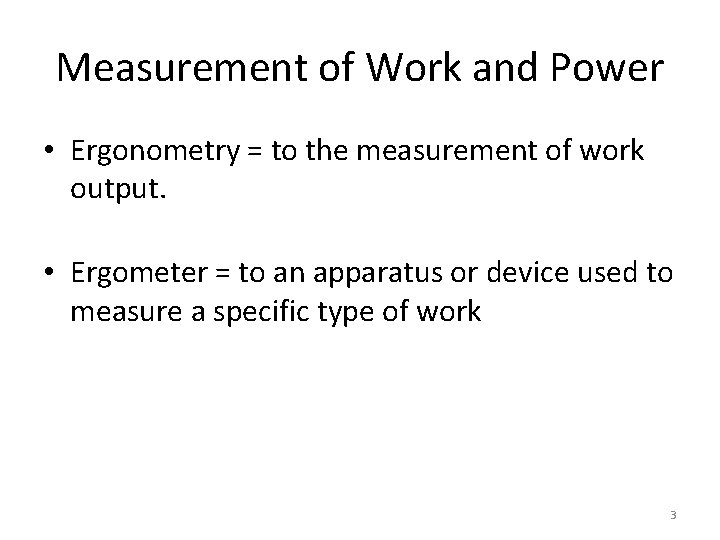
Measurement of Work and Power • Ergonometry = to the measurement of work output. • Ergometer = to an apparatus or device used to measure a specific type of work 3
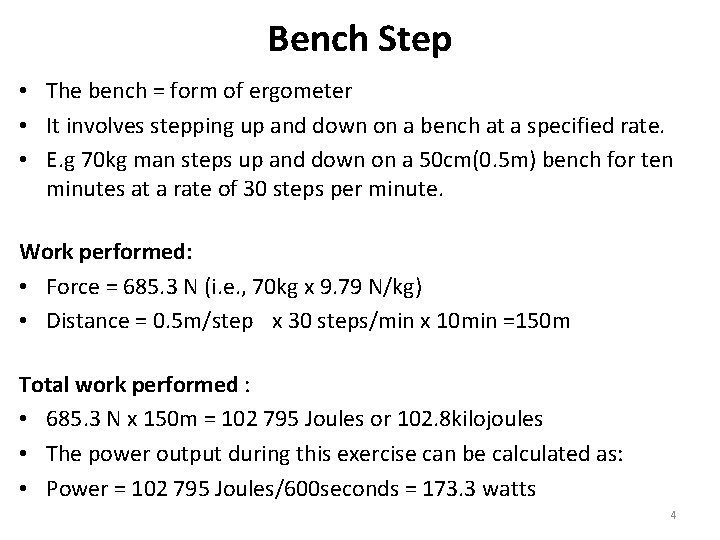
Bench Step • The bench = form of ergometer • It involves stepping up and down on a bench at a specified rate. • E. g 70 kg man steps up and down on a 50 cm(0. 5 m) bench for ten minutes at a rate of 30 steps per minute. Work performed: • Force = 685. 3 N (i. e. , 70 kg x 9. 79 N/kg) • Distance = 0. 5 m/step x 30 steps/min x 10 min =150 m Total work performed : • 685. 3 N x 150 m = 102 795 Joules or 102. 8 kilojoules • The power output during this exercise can be calculated as: • Power = 102 795 Joules/600 seconds = 173. 3 watts 4
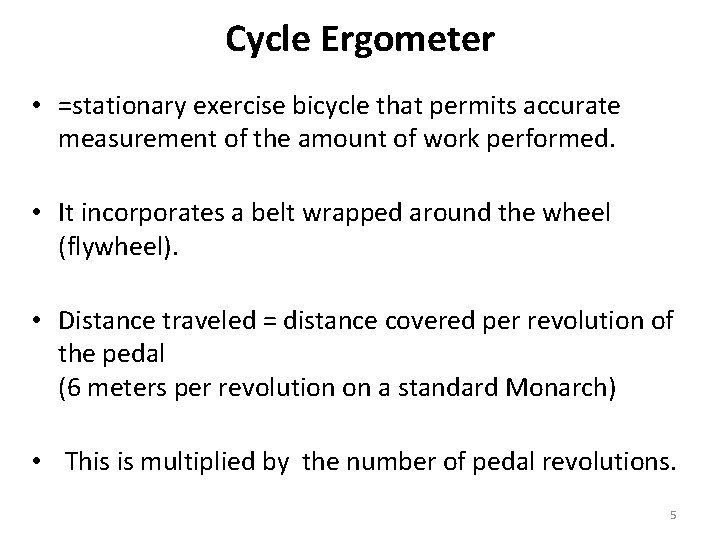
Cycle Ergometer • =stationary exercise bicycle that permits accurate measurement of the amount of work performed. • It incorporates a belt wrapped around the wheel (flywheel). • Distance traveled = distance covered per revolution of the pedal (6 meters per revolution on a standard Monarch) • This is multiplied by the number of pedal revolutions. 5
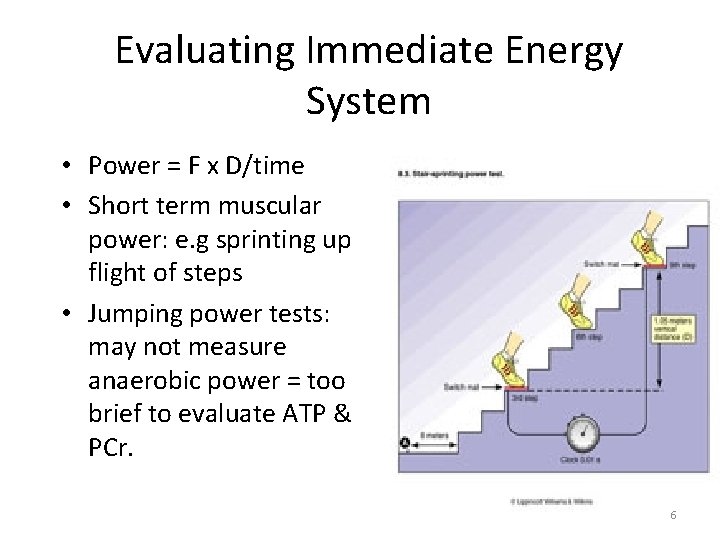
Evaluating Immediate Energy System • Power = F x D/time • Short term muscular power: e. g sprinting up flight of steps • Jumping power tests: may not measure anaerobic power = too brief to evaluate ATP & PCr. 6
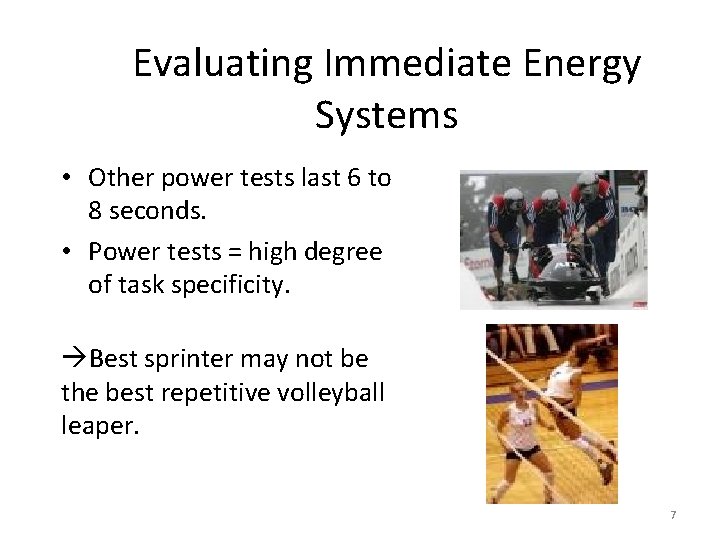
Evaluating Immediate Energy Systems • Other power tests last 6 to 8 seconds. • Power tests = high degree of task specificity. Best sprinter may not be the best repetitive volleyball leaper. 7
Evaluating Short-Term Glycolytic Energy System • Glycogen depletion in specific muscles activated = indication of contribution of glycolysis to exercise • Tests demanding maximal work for up to 3 min = best estimate of glycolytic power. 8
Measuring Anaerobic Capacity • No clear method for measuring anaerobic capacity • Accepted methods: – Maximal accumulated O 2 deficit – Wingate anaerobic test – Critical power test 9
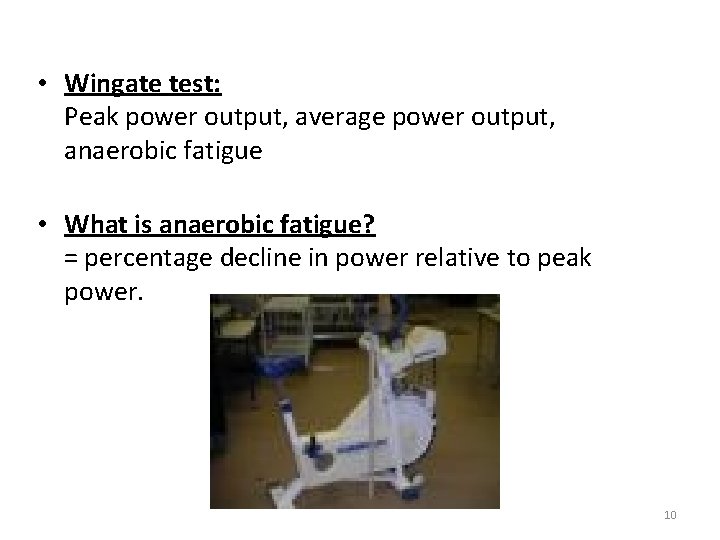
• Wingate test: Peak power output, average power output, anaerobic fatigue • What is anaerobic fatigue? = percentage decline in power relative to peak power. 10
Energy Expenditure During Maximal Anaerobic Exercise • No activity = 100% aerobic or anaerobic • Estimates of anaerobic effort involved – Excess post exercise O 2 consumption (EPOC) – Lactate threshold 11
Anaerobic Energy Expenditure: EPOC • O 2 demand > O 2 consumed in early exercise – Body = experiences O 2 deficit – Occurs when anaerobic pathways used for ATP production • O 2 consumed > O 2 demand in early recovery – Excess post-exercise O 2 consumption (EPOC) 12
Anaerobic Energy Expenditure: Lactate Threshold • Lactate threshold: point at which blood lactate accumulation • Lactate production rate > lactate clearance rate – Good indicator of potential for endurance exercise 13
Anaerobic Energy Expenditure: Lactate Threshold • Lactate accumulation fatigue – Ability to exercise hard without accumulating lactate = beneficial to athletic performance – Higher lactate threshold = higher sustained exercise intensity = better endurance performance • For 2 athletes with same VO 2 max higher lactate threshold predicts better performance 14
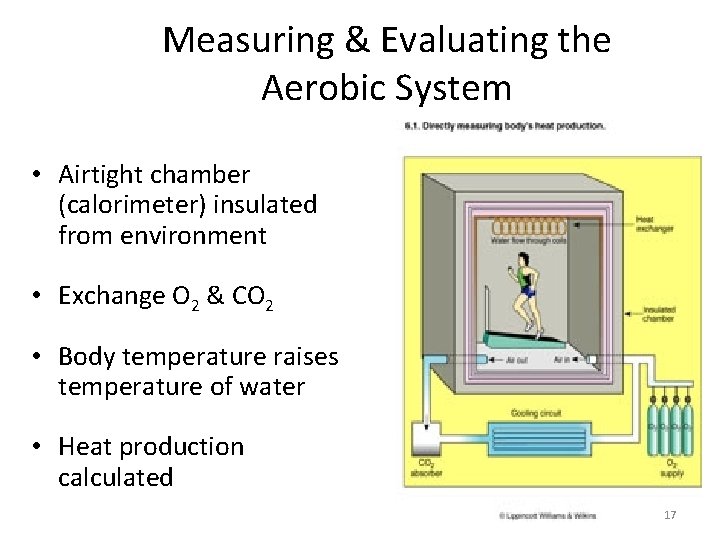
Measuring & Evaluating the Aerobic System Direct Calorimetry: = Process of measuring metabolic rate via measurement of heat 15
Direct Calorimetry • Theory: when body uses energy to do work, heat is given off. measure heat production (calorimetry) gives a direct measurement of metabolic work. 16
Measuring & Evaluating the Aerobic System • Airtight chamber (calorimeter) insulated from environment • Exchange O 2 & CO 2 • Body temperature raises temperature of water • Heat production calculated 17
Measuring & Evaluating the Aerobic System Indirect Calorimetry • Theory: Since direct relationship between O 2 consumed & amount of heat produced by body measurement of O 2 consumption provides estimate of metabolic rate. • Measurement of O 2 consumption is indirect, since heat not measured directly. 18
Respiratory Quotient • Respiratory quotient (RQ) is ratio of volume of carbon dioxide produced to volume of oxygen consumed. RQ for Carbohydrate is 1. 0. 19
Respiratory Exchange Ratio is ratio of carbon dioxide exhaled to oxygen consumed when CO 2 and O 2 exchange does not reflect food oxidation. 20
Measuring Maximal Oxygen Consumption Test of Aerobic Power • Two general criteria needed: – Test that is independent of muscle strength, speed, body size, skill – Test that consists of graded exercise to point of exhaustion (without muscular fatigue) 21
Measuring Maximal Oxygen Consumption Criteria for true max VO 2 is leveling off or peaking in oxygen uptake. • Other criteria: – Oxygen uptake fails to increase by some value – Maximum lactic acid – Maximum predicted HR – R > 1. 0 22
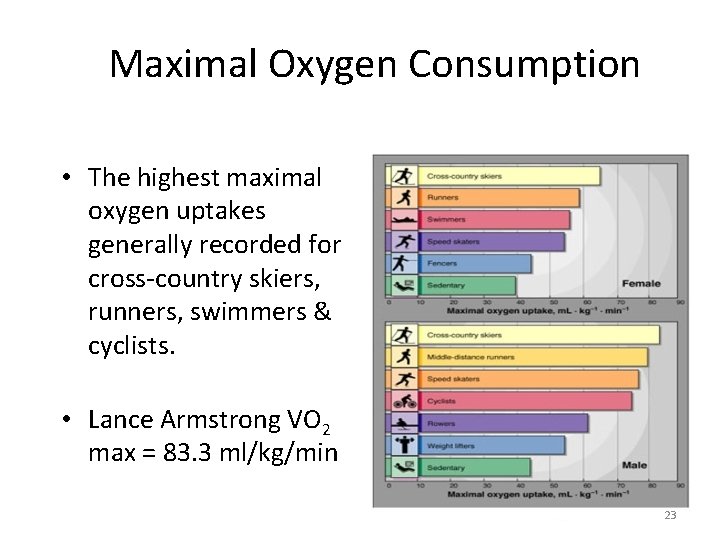
Maximal Oxygen Consumption • The highest maximal oxygen uptakes generally recorded for cross-country skiers, runners, swimmers & cyclists. • Lance Armstrong VO 2 max = 83. 3 ml/kg/min 23
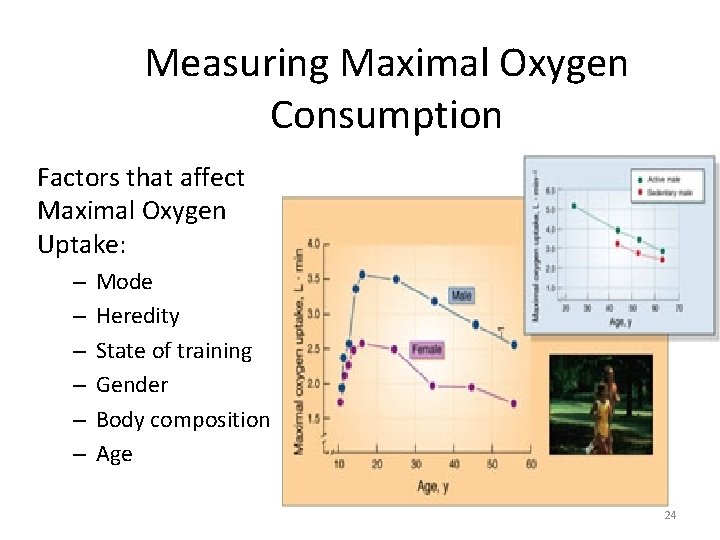
Measuring Maximal Oxygen Consumption Factors that affect Maximal Oxygen Uptake: – – – Mode Heredity State of training Gender Body composition Age 24
Energy Expenditure During Maximal Aerobic Exercise • VO 2 max : – Point at which O 2 consumption doesn’t with further in intensity – Best single measurement of aerobic fitness – Not best predictor of endurance performance – Plateaus after 8 to 12 weeks of training • Performance continues to improve • More training = compete at higher percentage of VO 2 max 25
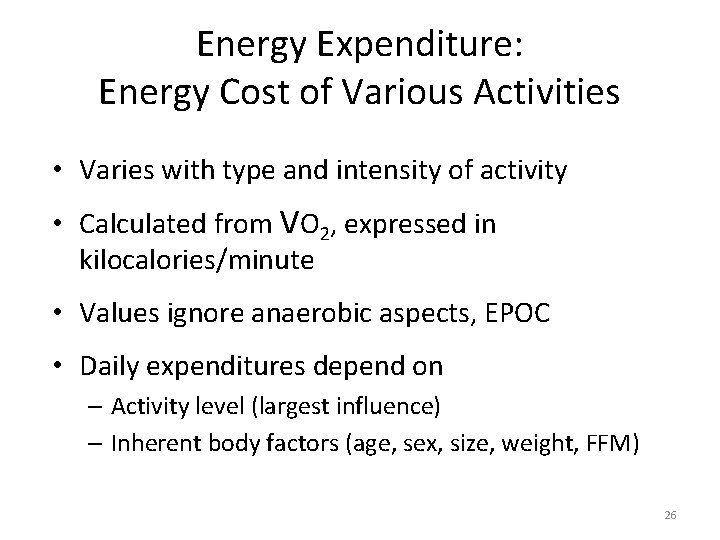
Energy Expenditure: Energy Cost of Various Activities • Varies with type and intensity of activity • Calculated from VO 2, expressed in kilocalories/minute • Values ignore anaerobic aspects, EPOC • Daily expenditures depend on – Activity level (largest influence) – Inherent body factors (age, sex, size, weight, FFM) 26
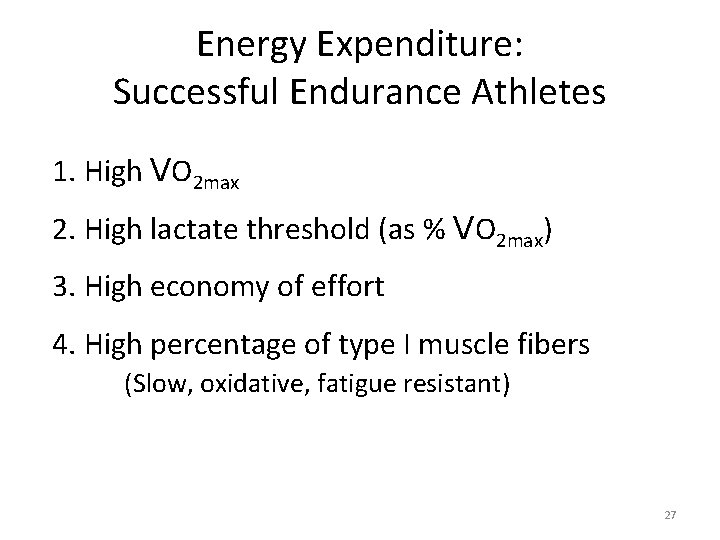
Energy Expenditure: Successful Endurance Athletes 1. High VO 2 max 2. High lactate threshold (as % VO 2 max) 3. High economy of effort 4. High percentage of type I muscle fibers (Slow, oxidative, fatigue resistant) 27