
Power Politics and Empowerment Week 8 1 Learning

- Slides: 36
Power, Politics and Empowerment Week 8 1
Learning Objectives l l l l Define power and influence Identify and discuss the five bases of organisation power Identify the relationship between information and power Identify the four contingencies of power Discuss the advantages role of organisational politics Interpersonal influence and politics Ethics, power, and politics Empowerment 2
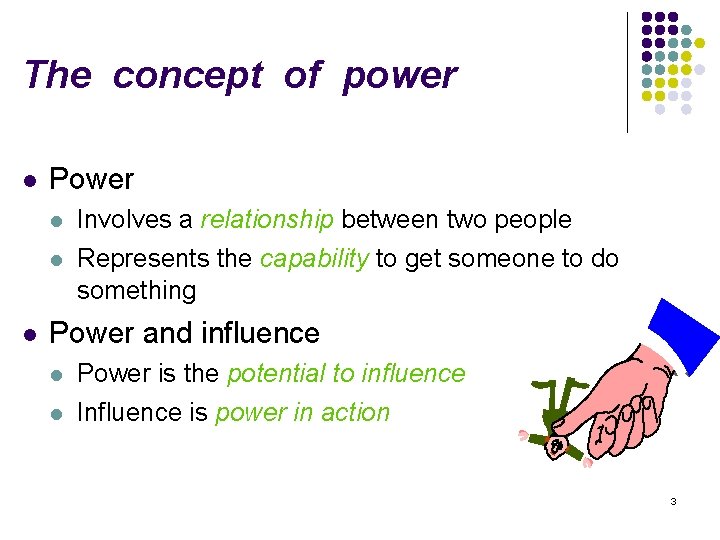
The concept of power l Power l l l Involves a relationship between two people Represents the capability to get someone to do something Power and influence l l Power is the potential to influence Influence is power in action 3
Definitions l Power. . . l l Authority. . . l l the capacity to influence the behaviour of others the right to influence another person Influence. . . l the process by which people. . . persuade others to follow their advice, suggestions, or orders 4
Definitions l Politics. . . l the management of influence to obtain ends not sanctioned by the organisation or to obtain sanctioned ends through non-sanctioned influence means 5
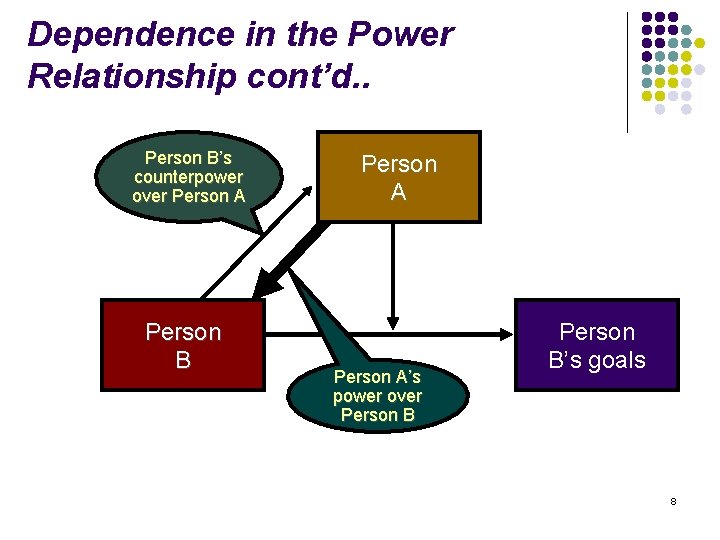
Dependence in the Power Relationship l While power requires dependence, it is really more accurate to say that the parties are interdependent. l One party may be more dependent than the other l l But the relationship exists only when both parties have something of value to the other which results in: Counterpower l the capacity of a person, team or organisation to keep a more powerful person or group in the exchange relationship 6
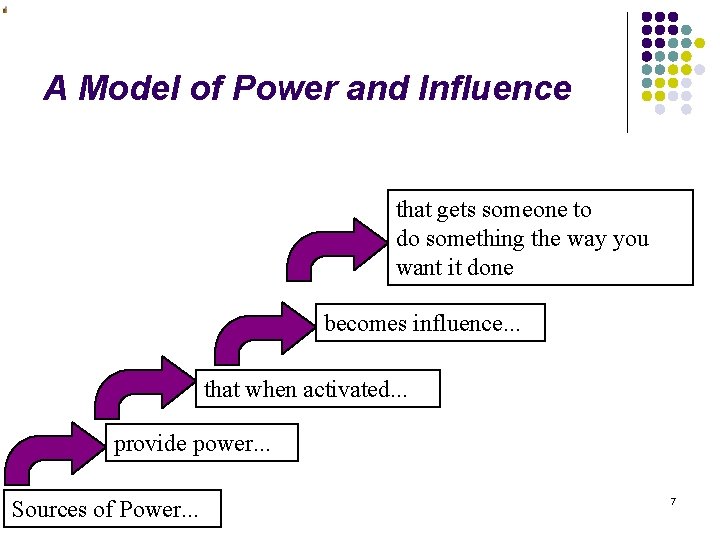
A Model of Power and Influence that gets someone to do something the way you want it done becomes influence. . . that when activated. . . provide power. . . Sources of Power. . . 7
Dependence in the Power Relationship cont’d. . Person B’s counterpower over Person A Person B Person A’s power over Person B’s goals 8
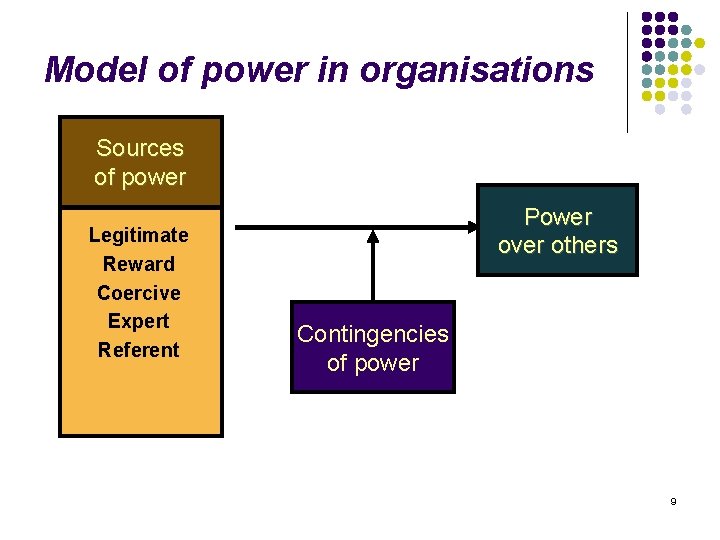
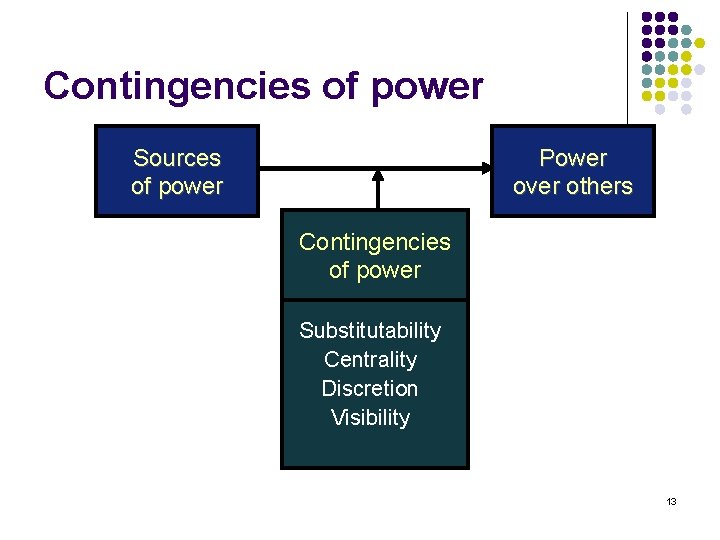
Model of power in organisations Sources of power Legitimate Reward Coercive Expert Referent Power over others Contingencies of power 9
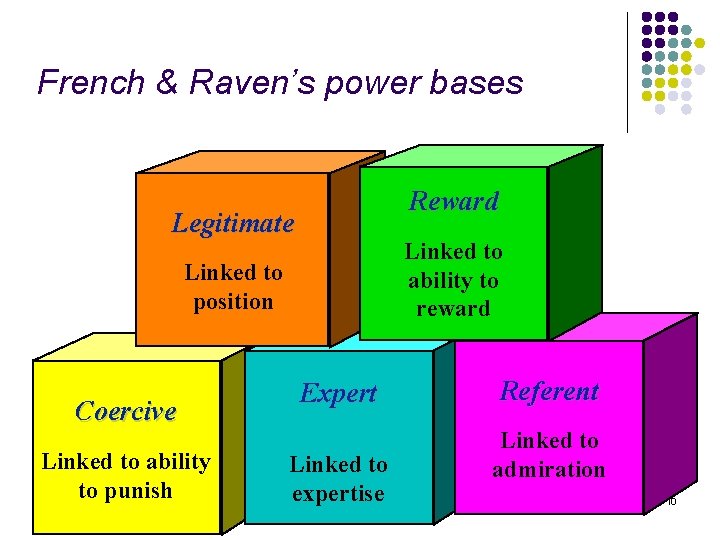
French & Raven’s power bases Reward Legitimate Linked to ability to reward Linked to position Coercive Linked to ability to punish Expert Linked to expertise Referent Linked to admiration 10
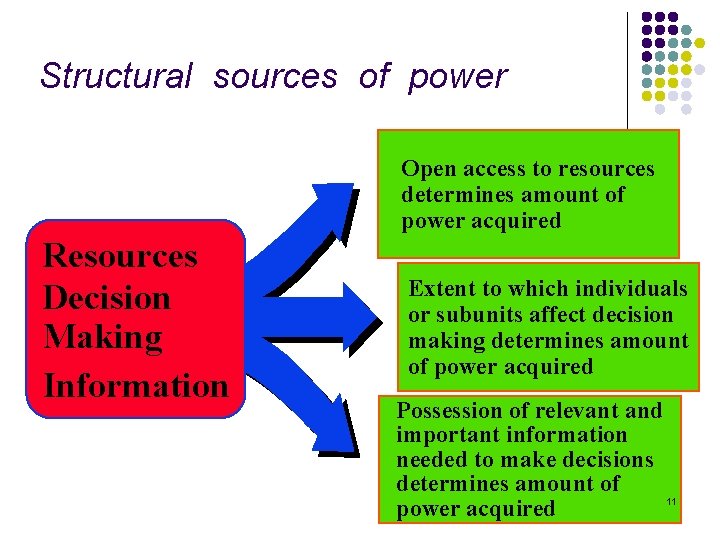
Structural sources of power Open access to resources determines amount of power acquired Resources Decision Making Information Extent to which individuals or subunits affect decision making determines amount of power acquired Possession of relevant and important information needed to make decisions determines amount of 11 power acquired
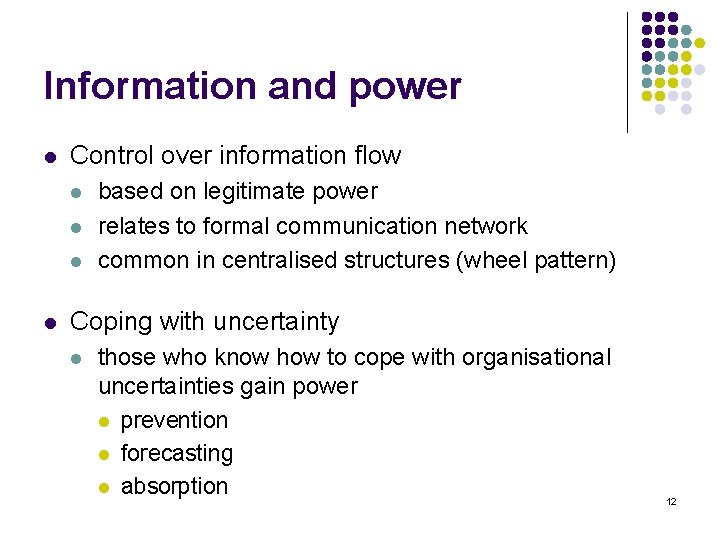
Information and power l Control over information flow l l based on legitimate power relates to formal communication network common in centralised structures (wheel pattern) Coping with uncertainty l those who know how to cope with organisational uncertainties gain power l prevention l forecasting l absorption 12
Contingencies of power Sources of power Power over others Contingencies of power Substitutability Centrality Discretion Visibility 13
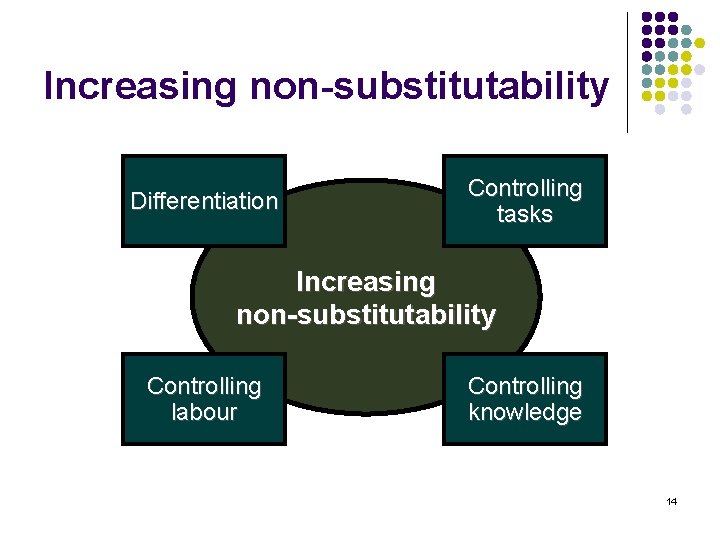
Increasing non-substitutability Differentiation Controlling tasks Increasing non-substitutability Controlling labour Controlling knowledge 14
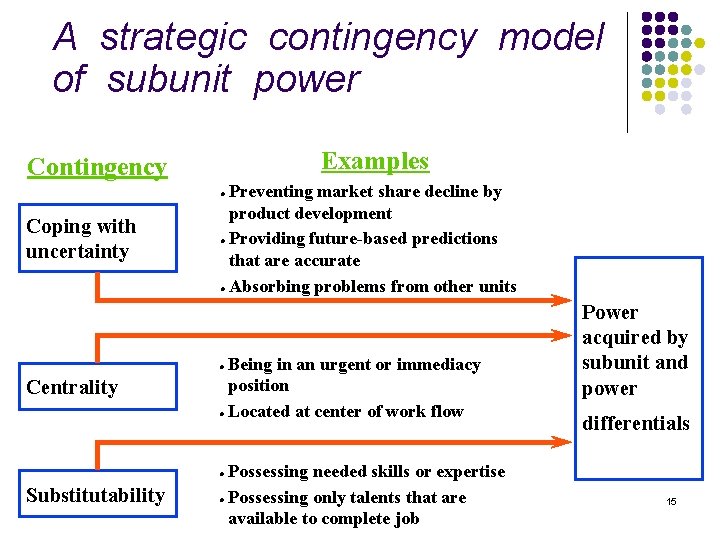
A strategic contingency model of subunit power Examples Contingency l Coping with uncertainty l l l Centrality l l Substitutability l Preventing market share decline by product development Providing future-based predictions that are accurate Absorbing problems from other units Being in an urgent or immediacy position Located at center of work flow Possessing needed skills or expertise Possessing only talents that are available to complete job Power acquired by subunit and power differentials 15
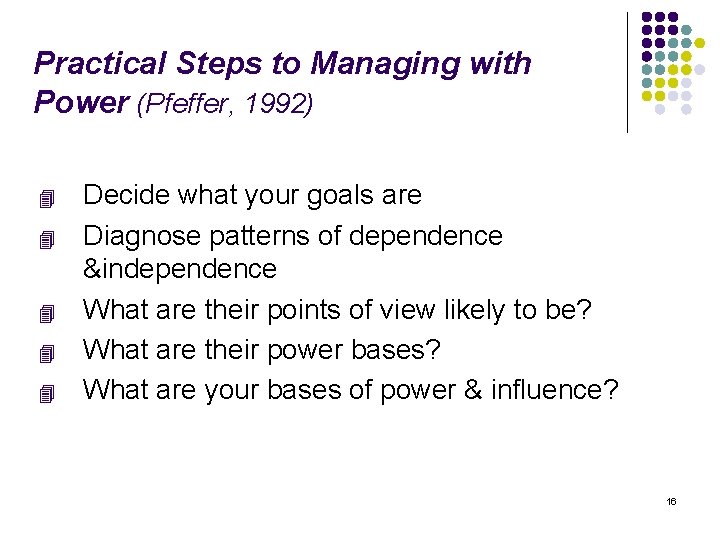
Practical Steps to Managing with Power (Pfeffer, 1992) 4 4 4 Decide what your goals are Diagnose patterns of dependence &independence What are their points of view likely to be? What are their power bases? What are your bases of power & influence? 16
Practical Steps to Managing with Power (Pfeffer, 1992) Which strategies & tactics for exercising power are likely to be effective? 4 Based on the above, choose a course of action to get something DONE. . . 4 17
Tactics for increasing the power base l Enter areas of high uncertainty l Create dependencies l Provide resources l Satisfy strategic contingencies 18
Strategies for increasing power l Position-based l l Person-centred l l exchange pressure legitimating rational persuasion personal appeals inspirational appeals consultation 19
Politics l Political behavior in organisations are those activities that are not required as part of one’s formal role in the organisation but that influence or attempt to influence the distribution of advantages and disadvantages with the organisation. 20
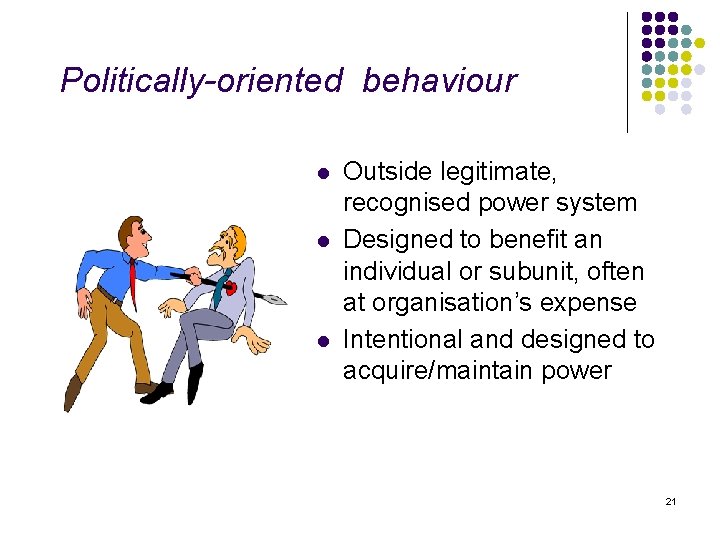
Politically-oriented behaviour l l l Outside legitimate, recognised power system Designed to benefit an individual or subunit, often at organisation’s expense Intentional and designed to acquire/maintain power 21
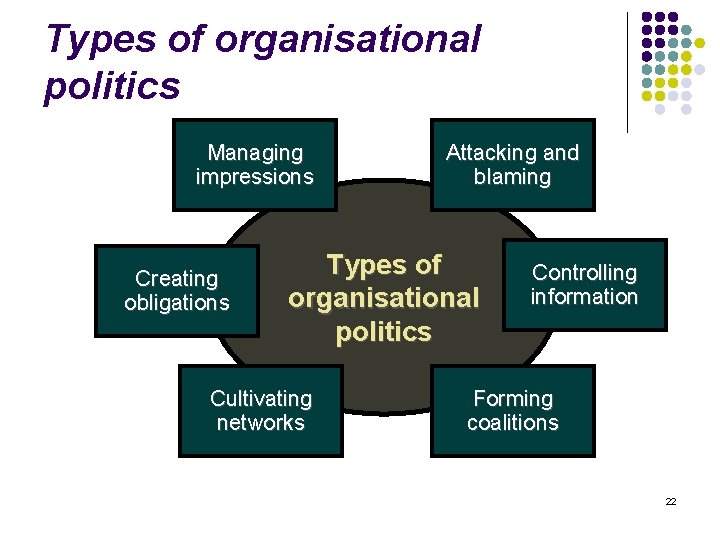
Types of organisational politics Managing impressions Creating obligations Attacking and blaming Types of organisational politics Cultivating networks Controlling information Forming coalitions 22
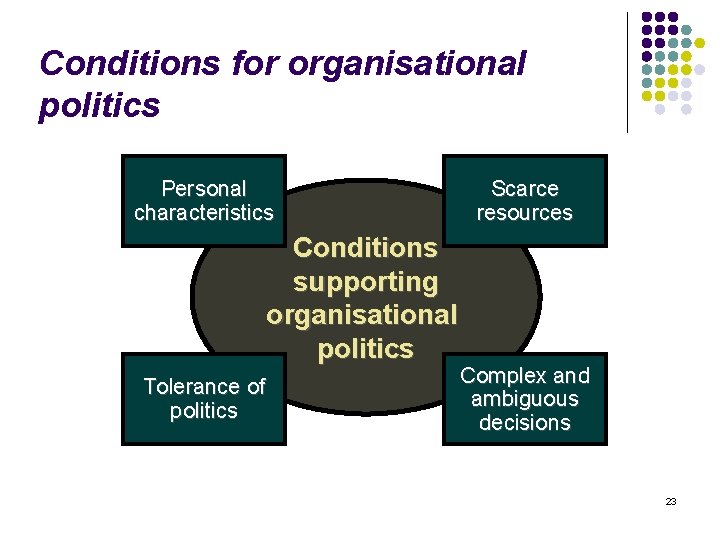
Conditions for organisational politics Personal characteristics Conditions supporting organisational politics Tolerance of politics Scarce resources Complex and ambiguous decisions 23
The Inevitability of Office Politics l l Organisational philosophy. Resource scarcity and a competitive work environment. Subjective performance standards, unclear job definitions and desire to goof off. Imitating power holders and win-lose 24
The Inevitability of Office Politics l l l Power cravings and Machiavellian tendencies of people. Emotional insecurity of people and beliefs in external forces. Hunger for acceptance and self-interest. 25
Machiavelli (15 th century) “Everyone knows how praiseworthy it is for a ruler to keep his word, and to live with integrity, and not be cunning: nevertheless experience shows that in our times, princes have cared little about good faith, and used cunning to confuse the minds of men, have achieved great things: so that in the end they have outstripped those who founded themselves on honesty. ” 26
Domains of political activity l Structural change l Interdepartmental coordination l Management succession l Resource Allocation 27
Political strategies for increasing power Control lines of communication l Build coalitions l Use outside experts l Expand networks l Control decision premises l Image building l 28
Politics. . . Does the exercise of power in: • • • Decision making Agenda setting The shaping of “felt” needs 29
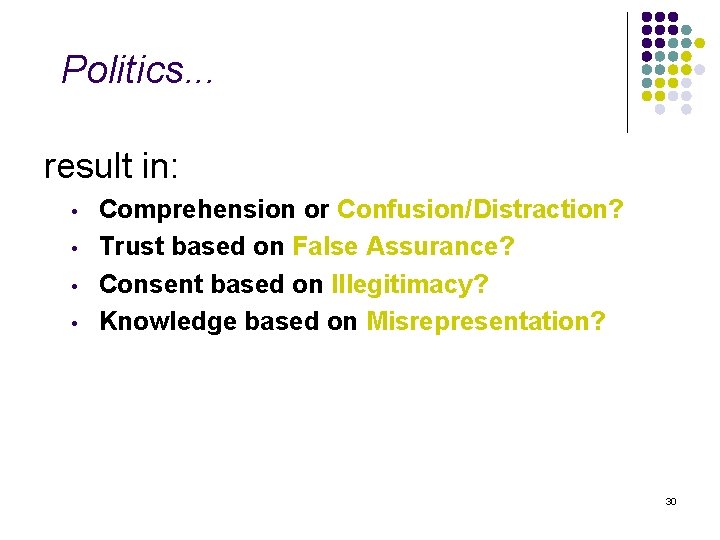
Politics. . . result in: • • Comprehension or Confusion/Distraction? Trust based on False Assurance? Consent based on Illegitimacy? Knowledge based on Misrepresentation? 30
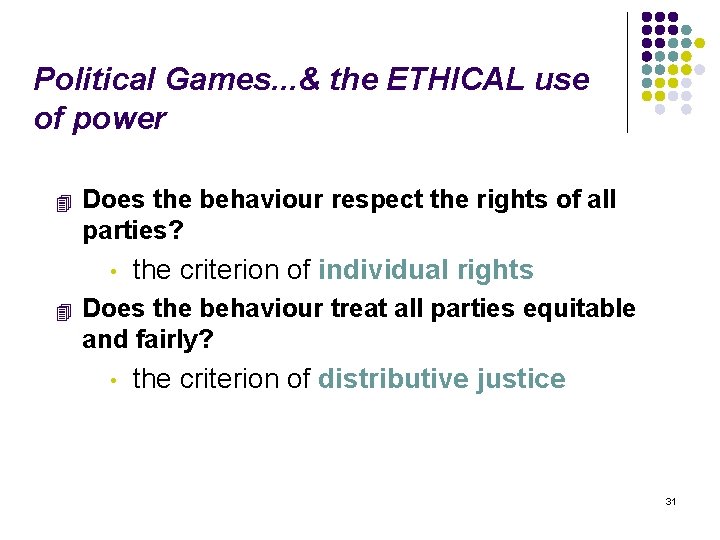
Political Games. . . & the ETHICAL use of power 4 Does the behaviour respect the rights of all parties? • 4 the criterion of individual rights Does the behaviour treat all parties equitable and fairly? • the criterion of distributive justice 31
Political Games. . . & the ETHICAL use of power 4 Does the behaviour produce a good outcome for people both inside and outside the organisation? • the criterion of utilitarian outcomes 32
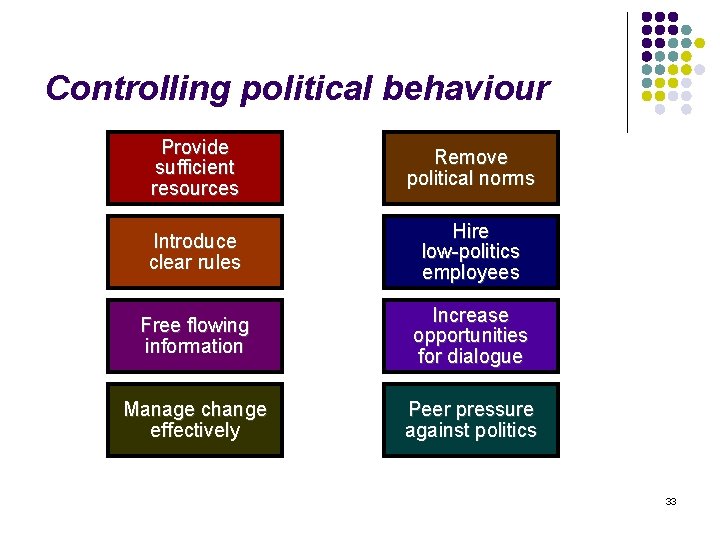
Controlling political behaviour Provide sufficient resources Remove political norms Introduce clear rules Hire low-politics employees Free flowing information Increase opportunities for dialogue Manage change effectively Peer pressure against politics 33
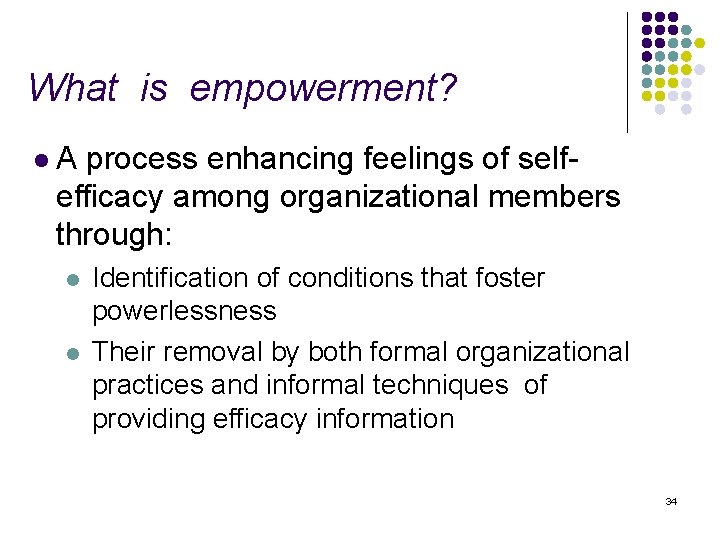
What is empowerment? l. A process enhancing feelings of selfefficacy among organizational members through: l l Identification of conditions that foster powerlessness Their removal by both formal organizational practices and informal techniques of providing efficacy information 34
Empowerment “Empowerment is the creation of conditions within organisations that result in the ability of individuals to contribute their maximum potential energy, creativity, quality efforts and effectiveness to achieving the mission and strategy of the organisation” Covey, 1992 35
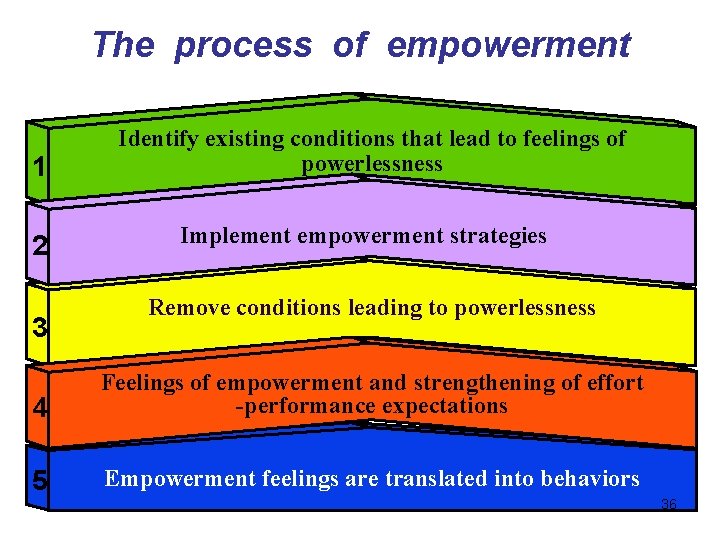
The process of empowerment 1 2 3 Identify existing conditions that lead to feelings of powerlessness Implement empowerment strategies Remove conditions leading to powerlessness 4 Feelings of empowerment and strengthening of effort -performance expectations 5 Empowerment feelings are translated into behaviors 36