
Power Point to accompany Chapter 9 Monopolistic competition
- Slides: 67
Power. Point to accompany Chapter 9 Monopolistic competition and oligopoly
Learning Objectives 1. Explain why a monopolistically competitive firm has downward-sloping demand marginal revenue curves. 2. Explain how a monopolistically competitive firm decides the quantity to produce and the price to charge. 3. Analyse the situation of a monopolistically competitive firm in the long run. Hubbard, Garnett, Lewis and O’Brien: Essentials of Economics © 2010 Pearson Australia
Learning Objectives 4. Compare the efficiency of monopolistic competition and perfect competition. 5. Show barriers to entry explain the existence of oligopolies. 6. Use game theory to analyse the actions of oligopolistic firms. Hubbard, Garnett, Lewis and O’Brien: Essentials of Economics © 2010 Pearson Australia
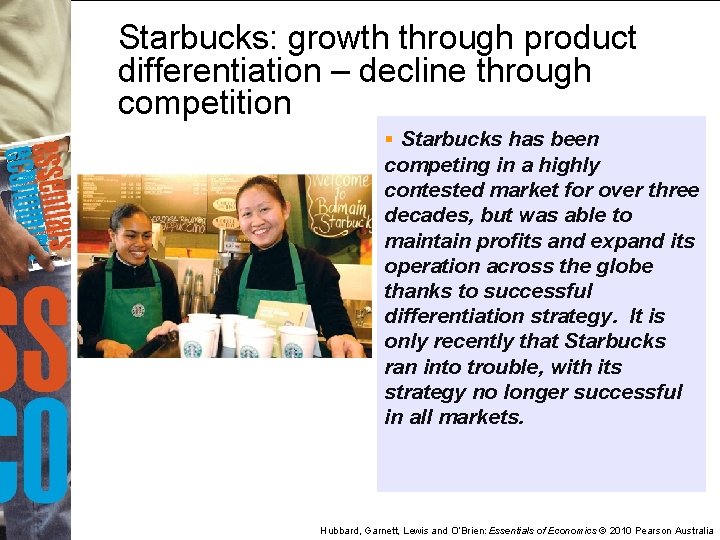
Starbucks: growth through product differentiation – decline through competition § Starbucks has been competing in a highly contested market for over three decades, but was able to maintain profits and expand its operation across the globe thanks to successful differentiation strategy. It is only recently that Starbucks ran into trouble, with its strategy no longer successful in all markets. Hubbard, Garnett, Lewis and O’Brien: Essentials of Economics © 2010 Pearson Australia
Monopolistic competition § Monopolistic competition: A market structure in which barriers to entry are low, and many firms compete by selling similar, but not identical, products. § Oligopoly: A market structure in which a small number of interdependent firms compete. Hubbard, Garnett, Lewis and O’Brien: Essentials of Economics © 2010 Pearson Australia
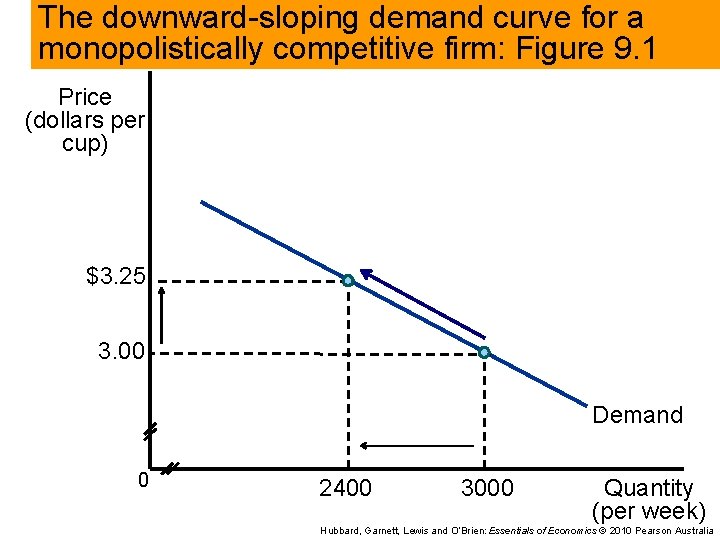
The downward-sloping demand curve for a monopolistically competitive firm: Figure 9. 1 Price (dollars per cup) $3. 25 3. 00 Demand 0 2400 3000 Quantity (per week) Hubbard, Garnett, Lewis and O’Brien: Essentials of Economics © 2010 Pearson Australia
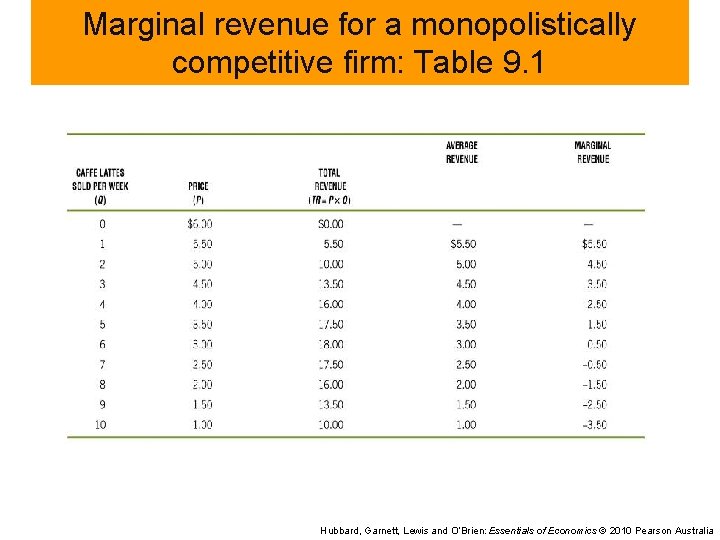
Marginal revenue for a monopolistically competitive firm: Table 9. 1 Hubbard, Garnett, Lewis and O’Brien: Essentials of Economics © 2010 Pearson Australia
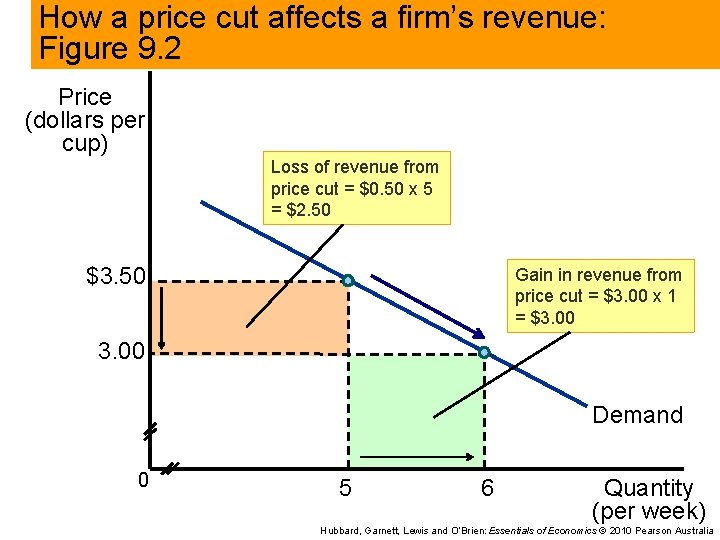
How a price cut affects a firm’s revenue: Figure 9. 2 Price (dollars per cup) Loss of revenue from price cut = $0. 50 x 5 = $2. 50 $3. 50 Gain in revenue from price cut = $3. 00 x 1 = $3. 00 Demand 0 5 6 Quantity (per week) Hubbard, Garnett, Lewis and O’Brien: Essentials of Economics © 2010 Pearson Australia
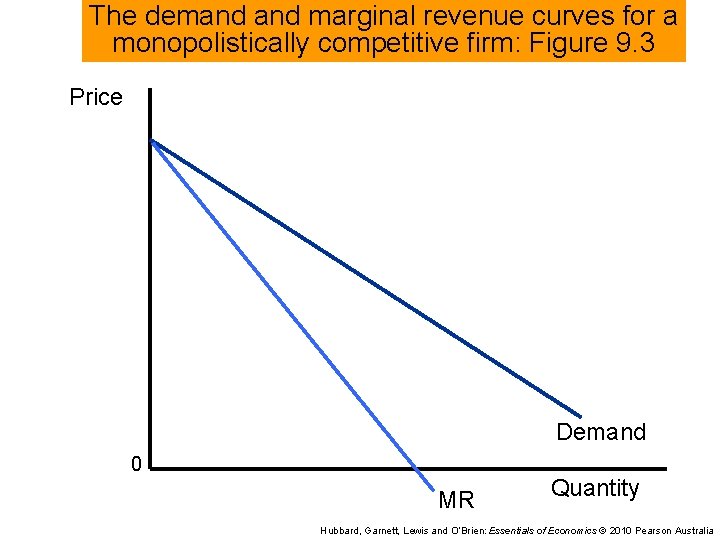
LEARNING OBJECTIVE 1 Demand marginal revenue for a firm in a monopolistically competitive market Marginal revenue for a firm with a downward-sloping demand curve § Every firm that has the ability to affect the price of the good or service it sells will have a marginal revenue curve that is below its demand curve. Hubbard, Garnett, Lewis and O’Brien: Essentials of Economics © 2010 Pearson Australia
The demand marginal revenue curves for a monopolistically competitive firm: Figure 9. 3 Price Demand 0 MR Quantity Hubbard, Garnett, Lewis and O’Brien: Essentials of Economics © 2010 Pearson Australia
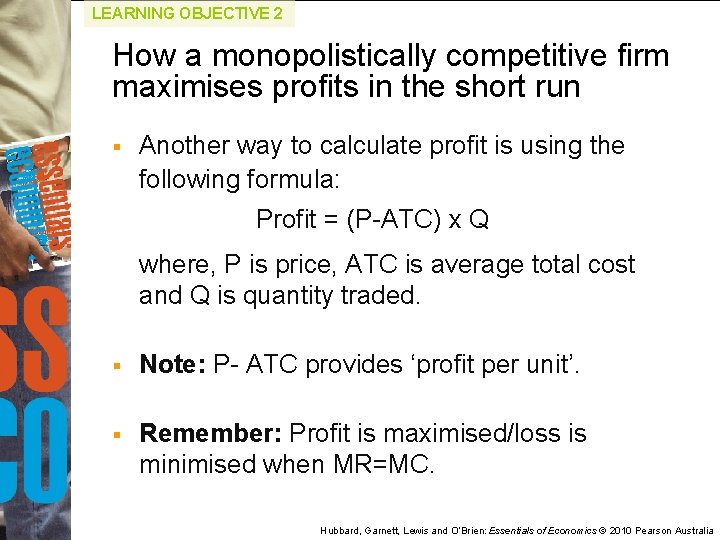
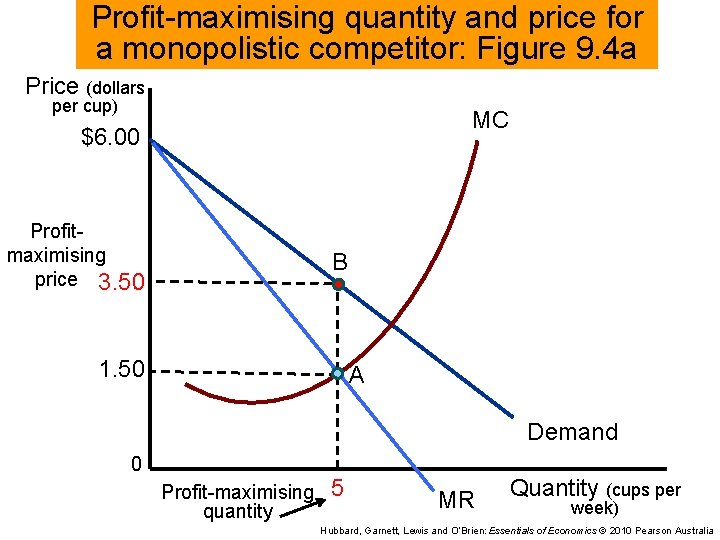
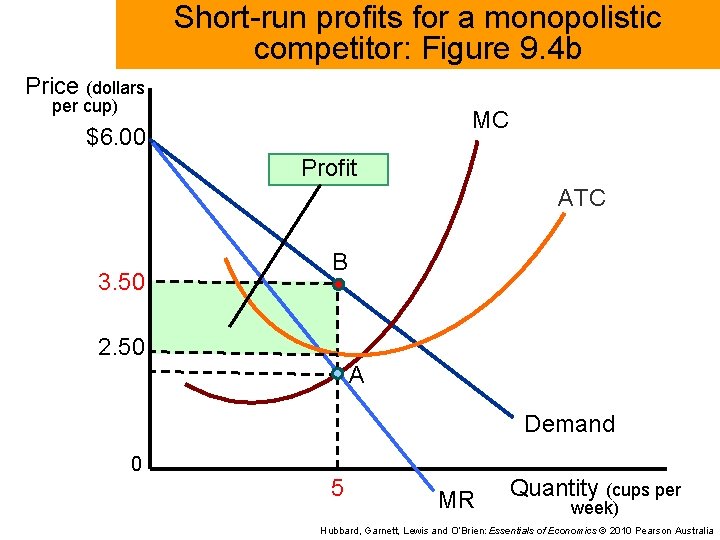
LEARNING OBJECTIVE 2 How a monopolistically competitive firm maximises profits in the short run § Another way to calculate profit is using the following formula: Profit = (P-ATC) x Q where, P is price, ATC is average total cost and Q is quantity traded. § Note: P- ATC provides ‘profit per unit’. § Remember: Profit is maximised/loss is minimised when MR=MC. Hubbard, Garnett, Lewis and O’Brien: Essentials of Economics © 2010 Pearson Australia
Profit-maximising quantity and price for a monopolistic competitor: Figure 9. 4 a Price (dollars per cup) MC $6. 00 Profitmaximising price 3. 50 B 1. 50 A Demand 0 Profit-maximising quantity 5 MR Quantity (cups per week) Hubbard, Garnett, Lewis and O’Brien: Essentials of Economics © 2010 Pearson Australia
Short-run profits for a monopolistic competitor: Figure 9. 4 b Price (dollars per cup) MC $6. 00 Profit ATC 3. 50 B 2. 50 A Demand 0 5 MR Quantity (cups per week) Hubbard, Garnett, Lewis and O’Brien: Essentials of Economics © 2010 Pearson Australia
LEARNING OBJECTIVE 3 Wrong approach to profit maximisation § Anton is a restaurant owner primarily specialising in light evening meals. Business generates revenues of $8 000 per week. Total cost of rent, labour, overheads and ingredients of cooking 400 meals (per week) is $6 000 per week. § He would like to expand his business by offering good quality but inexpensive take-away lunches for students of a nearby college. Anton expects to sell 100 take-away lunches per week for $8 each. The cost of each lunch is expected to be $6. Hubbard, Garnett, Lewis and O’Brien: Essentials of Economics © 2010 Pearson Australia
LEARNING OBJECTIVE 3 Wrong approach to profit maximisation § § § Anton believes that price of each sold meal should be compared with ATC. Price of each of these extra 100 meals is $8. Anton calculates ATC of all meals = [(6 000 + (6 x 100)]/(400+100) = $13. 20 As revenue from each extra meal to be sold is smaller than ATC, he decides against the expansion of the business. Do you think Anton is right? If not, why? Hubbard, Garnett, Lewis and O’Brien: Essentials of Economics © 2010 Pearson Australia
LEARNING OBJECTIVE 3 Wrong approach to profit maximisation § § STEP 1: : Review the chapter material. The problem is about how monopolistically competitive firms maximise profits, so you may want to review the section ‘How a monopolistically competitive firm maximises profit in the short run’. STEP 2: Analyse the costs described in the problem. To maximise profits, Anton should base the decision on expansion on the interaction of marginal revenue and marginal cost. Rent, labour and other overheads related to preparation of evening meals have nothing to do with lunch meals and should be treated as fixed costs in this decision. Therefore, it is wrong to include those costs in the decision making process (ATC). Hubbard, Garnett, Lewis and O’Brien: Essentials of Economics © 2010 Pearson Australia
LEARNING OBJECTIVE 3 Wrong approach to profit maximisation § STEP 3: Explain whether Anton should expand his business. Anton should compare the MR from producing each of these 100 meals with MC of producing these extra meals. § Marginal revenue is 8 x 100 = $800 § Marginal cost is 6 x 100 = $600. § It is evident that expansion of the business is profitable, since it will add $200 ($800 -$600) to the total weekly profits. Hubbard, Garnett, Lewis and O’Brien: Essentials of Economics © 2010 Pearson Australia
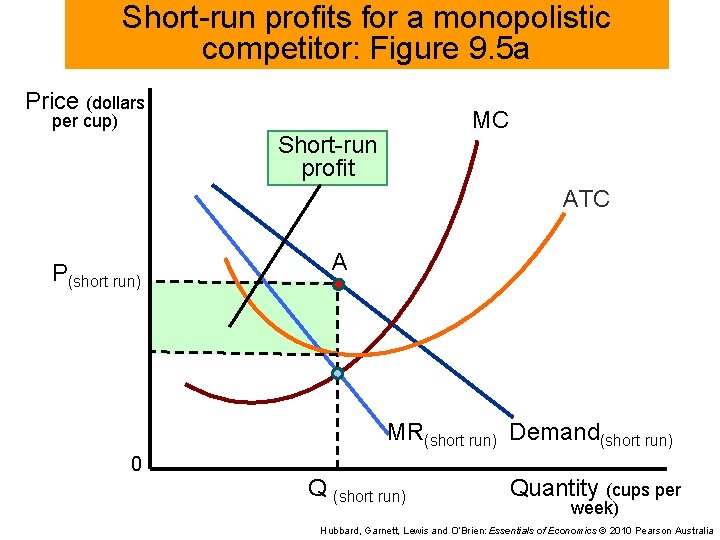
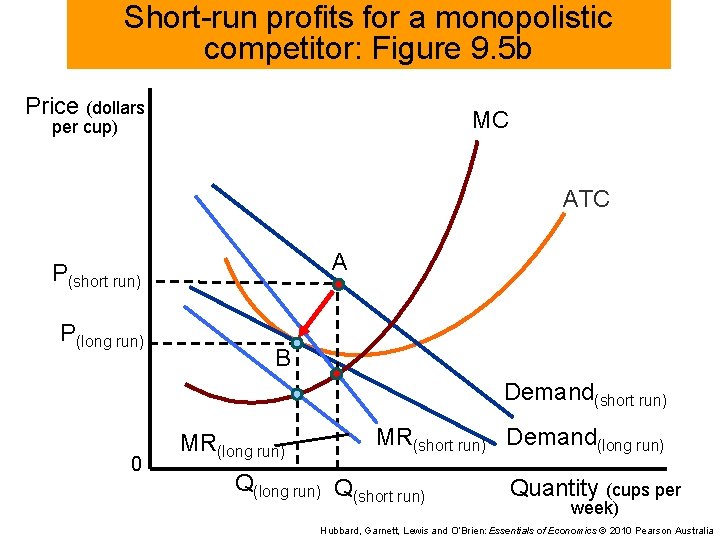
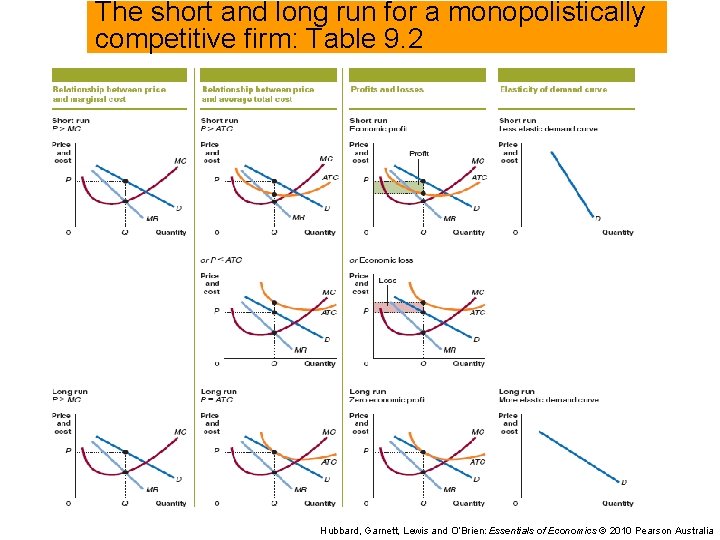
LEARNING OBJECTIVE 3 What happens to profits in the long run? Is zero economic profit inevitable in the long run? § Relatively easy entry into the market causes the disappearance of economic profits in the long run. § Exception: If a firm finds new ways of differentiating its product/service or finds new ways of lowering the cost of producing its product/service, it can maintain economic profits, even in the long run. Hubbard, Garnett, Lewis and O’Brien: Essentials of Economics © 2010 Pearson Australia
Short-run profits for a monopolistic competitor: Figure 9. 5 a Price (dollars MC per cup) Short-run profit ATC P(short run) A MR(short run) Demand(short run) 0 Q (short run) Quantity (cups per week) Hubbard, Garnett, Lewis and O’Brien: Essentials of Economics © 2010 Pearson Australia
Short-run profits for a monopolistic competitor: Figure 9. 5 b Price (dollars MC per cup) ATC A P(short run) P(long run) B Demand(short run) 0 MR(long run) MR(short run) Demand(long run) Q(short run) Quantity (cups per week) Hubbard, Garnett, Lewis and O’Brien: Essentials of Economics © 2010 Pearson Australia
The short and long run for a monopolistically competitive firm: Table 9. 2 Hubbard, Garnett, Lewis and O’Brien: Essentials of Economics © 2010 Pearson Australia
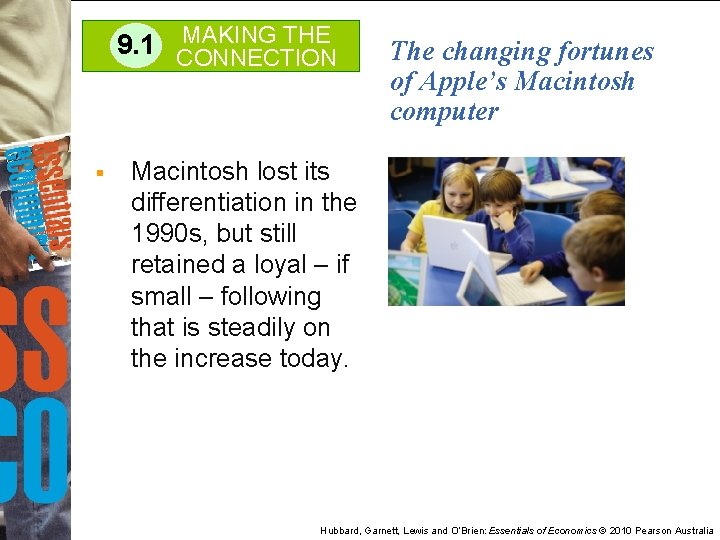
MAKING THE 9. 1 CONNECTION § The changing fortunes of Apple’s Macintosh computer Macintosh lost its differentiation in the 1990 s, but still retained a loyal – if small – following that is steadily on the increase today. Hubbard, Garnett, Lewis and O’Brien: Essentials of Economics © 2010 Pearson Australia
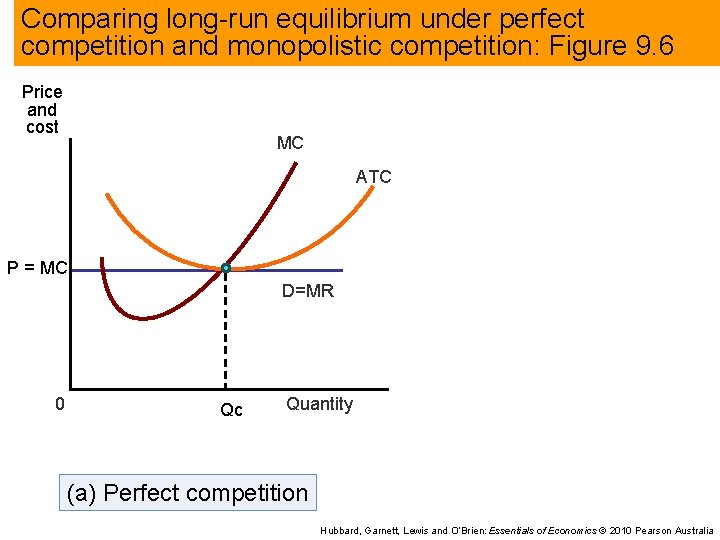
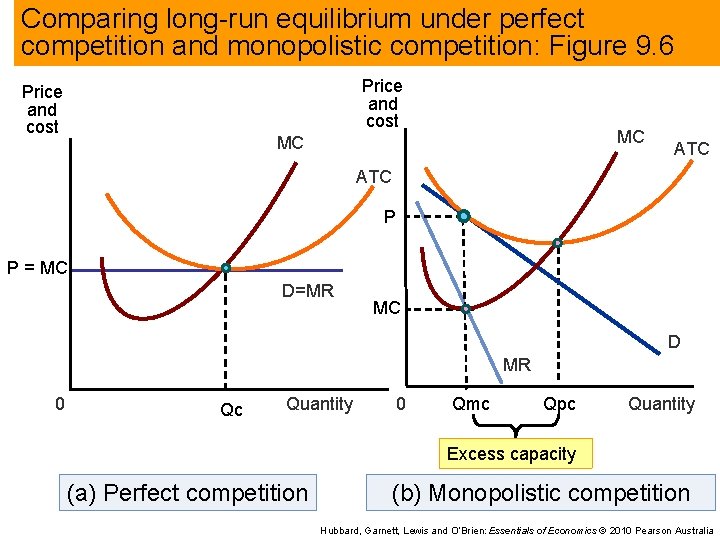
LEARNING OBJECTIVE 4 Comparing perfect competition and monopolistic competition § There are two important differences between long-run equilibrium in the two markets. 1. Monopolistically competitive firms charge a price greater than marginal cost. 2. Monopolistically competitive firms do not produce at minimum average total cost. Hubbard, Garnett, Lewis and O’Brien: Essentials of Economics © 2010 Pearson Australia
Comparing long-run equilibrium under perfect competition and monopolistic competition: Figure 9. 6 Price and cost MC ATC P = MC D=MR 0 Qc Quantity (a) Perfect competition Hubbard, Garnett, Lewis and O’Brien: Essentials of Economics © 2010 Pearson Australia
Comparing long-run equilibrium under perfect competition and monopolistic competition: Figure 9. 6 Price and cost MC MC ATC P P = MC D=MR MC D MR 0 Qc Quantity 0 Qmc Qpc Quantity Excess capacity (a) Perfect competition (b) Monopolistic competition Hubbard, Garnett, Lewis and O’Brien: Essentials of Economics © 2010 Pearson Australia
LEARNING OBJECTIVE 4 Comparing Perfect Competition and Monopolistic Competition Excess capacity under monopolistic competition § The profit-maximising level of output for a monopolistically competitive firm is at a level of output where MR=MC. Thus, price is greater than marginal cost and the firm is not at the minimum point of its average total cost curve. Hubbard, Garnett, Lewis and O’Brien: Essentials of Economics © 2010 Pearson Australia
LEARNING OBJECTIVE 4 Comparing perfect competition and monopolistic competition Is monopolistic competition inefficient? § Monopolistic competition is inefficient in terms of allocative and productive efficiency. § However, it is more efficient in terms of dynamic efficiency. How consumers benefit from monopolistic competition. § From being able to purchase a product that is differentiated and more closely suited to their tastes. Hubbard, Garnett, Lewis and O’Brien: Essentials of Economics © 2010 Pearson Australia
LEARNING OBJECTIVE 5 Oligopoly § Oligopoly: A market structure in which a small number of interdependent firms compete. § Game theory is the approach used to analyse competition among oligopolists. Hubbard, Garnett, Lewis and O’Brien: Essentials of Economics © 2010 Pearson Australia
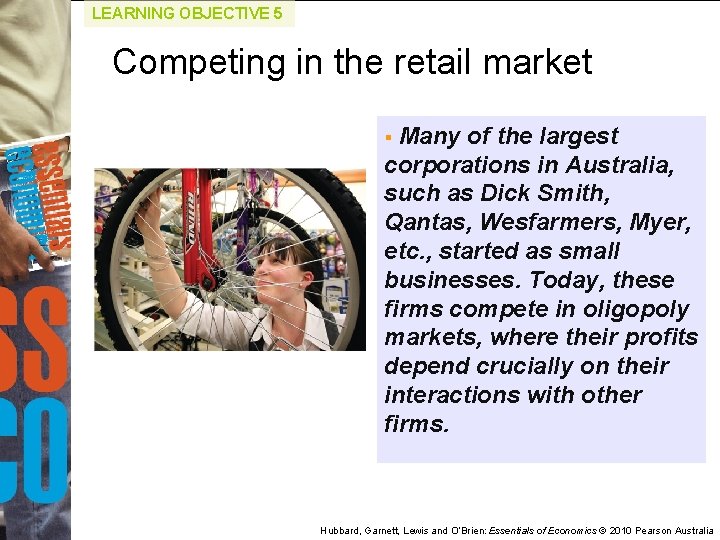
LEARNING OBJECTIVE 5 Competing in the retail market Many of the largest corporations in Australia, such as Dick Smith, Qantas, Wesfarmers, Myer, etc. , started as small businesses. Today, these firms compete in oligopoly markets, where their profits depend crucially on their interactions with other firms. § Hubbard, Garnett, Lewis and O’Brien: Essentials of Economics © 2010 Pearson Australia
LEARNING OBJECTIVE 5 Oligopoly and barriers to entry § Barrier to entry: Anything that keeps new firms from entering an industry in which existing firms are earning economic profits. § Examples are economies of scale, ownership of a key input and governmentimposed barriers. § Economies of scale: Economies of scale exist when a firm’s long-run average costs fall as it increases output. Hubbard, Garnett, Lewis and O’Brien: Essentials of Economics © 2010 Pearson Australia
LEARNING OBJECTIVE 6 Using game theory to analyse oligopoly § Game theory: The study of how people make decisions in situations where attaining their goals depends on their interactions with others; in economics, the study of the decisions of firms in industries where the profits of each firm depend on its interactions with other firms. Hubbard, Garnett, Lewis and O’Brien: Essentials of Economics © 2010 Pearson Australia
LEARNING OBJECTIVE 6 Using game theory to analyse oligopoly § § Key characteristics of all games: § Rules that determine what actions are allowable. § Strategies that players employ to attain their objectives in the game. § Payoffs that are the results of the interaction among the players’ strategies. Business strategy: Actions taken by a firm to achieve a goal, such as maximising profits. Hubbard, Garnett, Lewis and O’Brien: Essentials of Economics © 2010 Pearson Australia
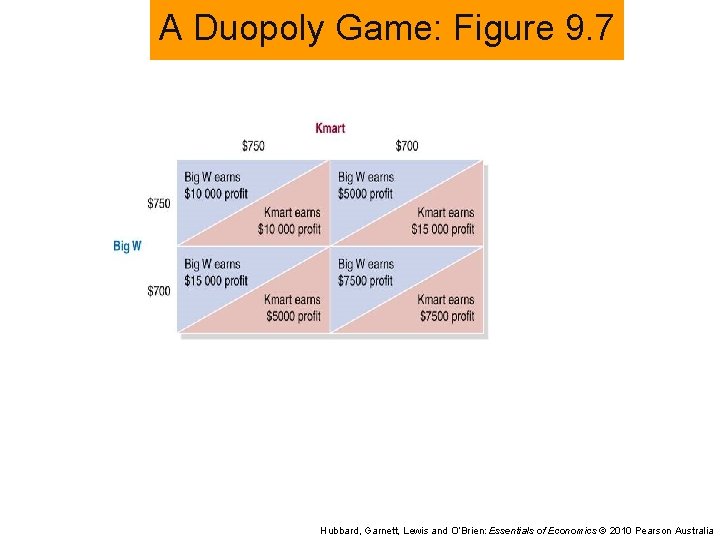
LEARNING OBJECTIVE 6 Using game theory to analyse oligopoly § A Duopoly Game: Price competition between two firms. § Payoff matrix: A table that shows the payoffs that each firm earns from every combination of strategies adopted by the firms. Hubbard, Garnett, Lewis and O’Brien: Essentials of Economics © 2010 Pearson Australia
A Duopoly Game: Figure 9. 7 Hubbard, Garnett, Lewis and O’Brien: Essentials of Economics © 2010 Pearson Australia
LEARNING OBJECTIVE 6 Using game theory to analyse oligopoly § Collusion: An agreement among firms to charge the same price, or to otherwise not compete. § Dominant Strategy: A strategy that is the best for a firm, no matter what strategies other firms use. § Nash equilibrium: A situation where each firm chooses the best strategy, given the strategies chosen by other firms. Hubbard, Garnett, Lewis and O’Brien: Essentials of Economics © 2010 Pearson Australia
LEARNING OBJECTIVE 6 Using game theory to analyse oligopoly Firm behaviour and the prisoners’ dilemma dominant strategy § Cooperative equilibrium: An equilibrium in a game in which players cooperate to increase their mutual payoff. § Non-cooperative equilibrium: An equilibrium in a game in which players do not cooperate but pursue their own selfinterest. Hubbard, Garnett, Lewis and O’Brien: Essentials of Economics © 2010 Pearson Australia
LEARNING OBJECTIVE 6 Using game theory to analyse oligopoly Firm behaviour and the prisoners’ dilemma dominant strategy. § Prisoners’ dilemma: A game where pursuing dominant strategies results in non-cooperation that leaves everyone worse off. Hubbard, Garnett, Lewis and O’Brien: Essentials of Economics © 2010 Pearson Australia
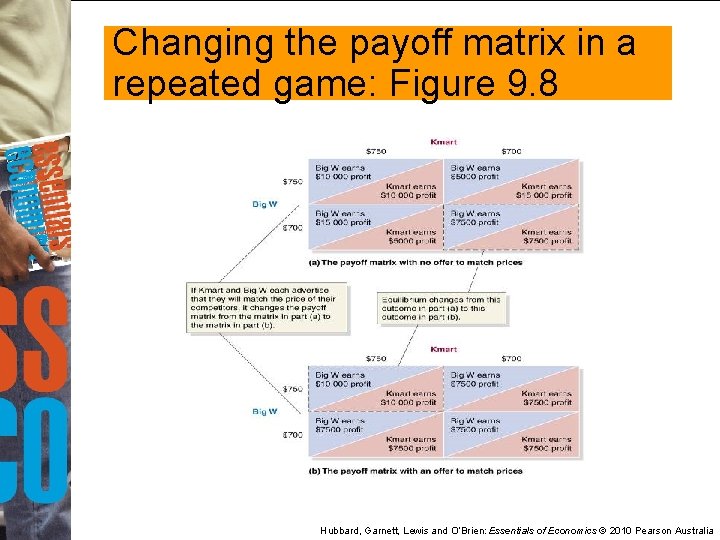
LEARNING OBJECTIVE 6 Using game theory to analyse oligopoly Can firm’s escape the prisoner’s dilemma? § The prisoner’s dilemma is not always applicable as it assumes the game will only be played once. § Most of the time, managers are playing a repeated game. Hubbard, Garnett, Lewis and O’Brien: Essentials of Economics © 2010 Pearson Australia
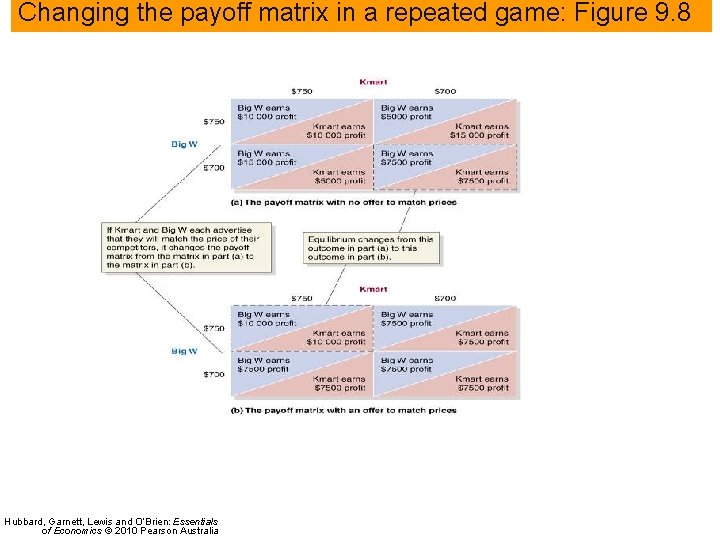
LEARNING OBJECTIVE 6 Using game theory to analyse oligopoly Can firm’s escape the prisoner’s dilemma? § Losses for not cooperating are greater in a repeated game. § § Retaliation strategies can be used against those who don’t cooperate Are more likely to see cooperative behaviour in repeated games. Hubbard, Garnett, Lewis and O’Brien: Essentials of Economics © 2010 Pearson Australia
Changing the payoff matrix in a repeated game: Figure 9. 8 Hubbard, Garnett, Lewis and O’Brien: Essentials of Economics © 2010 Pearson Australia
Changing the payoff matrix in a repeated game: Figure 9. 8 Hubbard, Garnett, Lewis and O’Brien: Essentials of Economics © 2010 Pearson Australia
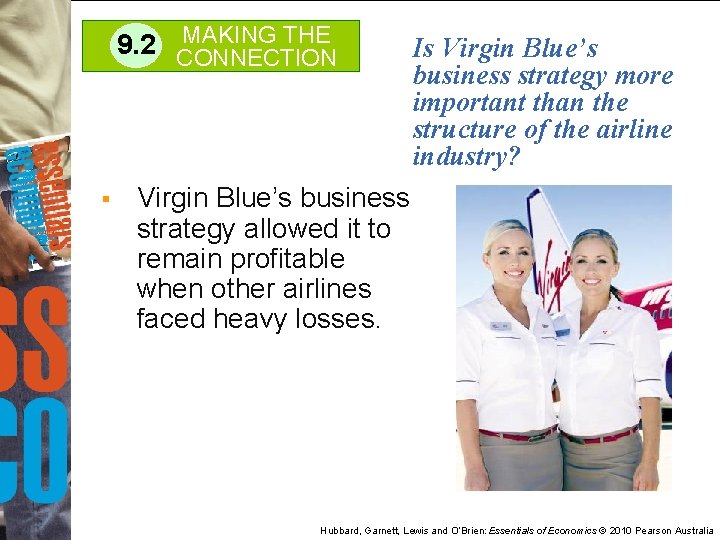
MAKING THE 9. 2 CONNECTION § Is Virgin Blue’s business strategy more important than the structure of the airline industry? Virgin Blue’s business strategy allowed it to remain profitable when other airlines faced heavy losses. Hubbard, Garnett, Lewis and O’Brien: Essentials of Economics © 2010 Pearson Australia
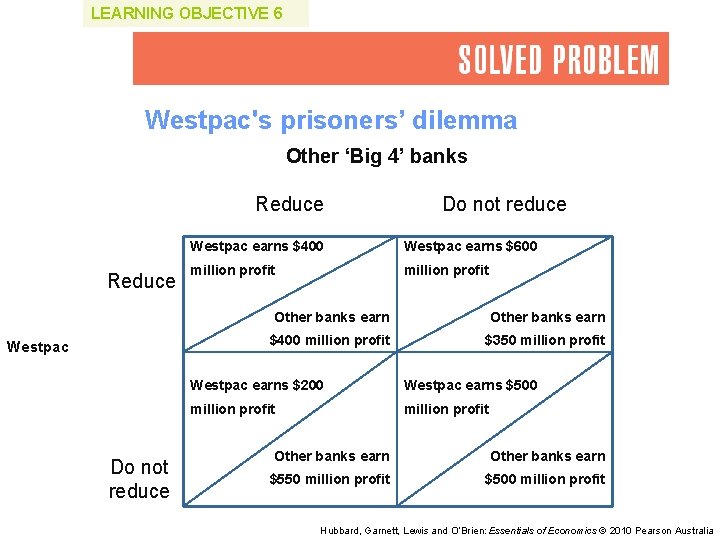
LEARNING OBJECTIVE 6 Westpac's prisoners’ dilemma § § § In just three months in 2008, the Reserve Bank of Australia, reduced its cash rate (interest rate) by a combined value of 2%. Assume that Westpac is deciding whether to introduce the reduction in its lending rates. The impact on profitability for Westpac depends upon the actions of its competitors (other three big banks of ‘Big 4 group’ – CBA, ANZ and NAB). Construct the payoff matrix using the following hypothetical information: Hubbard, Garnett, Lewis and O’Brien: Essentials of Economics © 2010 Pearson Australia
LEARNING OBJECTIVE 6 Westpac's prisoners’ dilemma § § If neither Westpac nor the other ‘Big 4’ banks reduce their lending rates: All banks earn $500 million per year. If all banks reduce: All banks earn $400 million per year. If Westpac reduces but other ‘Big 4’ banks do not: Westpac (due to large increase in the number of customers) earns 600 million and other Big 4 banks earn $350 million per year in profits. If Westpac does not reduce but the other ‘Big 4’ banks do: Westpac earns 200 million and other Big 4 banks earn $550 million per year in profits. Hubbard, Garnett, Lewis and O’Brien: Essentials of Economics © 2010 Pearson Australia
LEARNING OBJECTIVE 6 Westpac's prisoners’ dilemma § If Westpac wants to maximise profit, will it reduce its lending rates? Briefly explain. § If other banks want to maximise profits will they reduce their lending rates? Briefly explain. Is there a Nash equilibrium to this rate reduction exercise? If so, what is it? § Hubbard, Garnett, Lewis and O’Brien: Essentials of Economics © 2010 Pearson Australia
LEARNING OBJECTIVE 6 Westpac's prisoners’ dilemma § STEP 1: : Review the chapter material. The problem uses payoff matrices to analyse the business situation, so you may want to review the section ‘A duopoly game: price competition between two firms’. § STEP 2: Construct payoff matrix. Hubbard, Garnett, Lewis and O’Brien: Essentials of Economics © 2010 Pearson Australia
LEARNING OBJECTIVE 6 Westpac's prisoners’ dilemma Other ‘Big 4’ banks Reduce Westpac Do not reduce Westpac earns $400 Westpac earns $600 million profit Other banks earn $400 million profit $350 million profit Westpac earns $200 Westpac earns $500 million profit Other banks earn $550 million profit $500 million profit Hubbard, Garnett, Lewis and O’Brien: Essentials of Economics © 2010 Pearson Australia
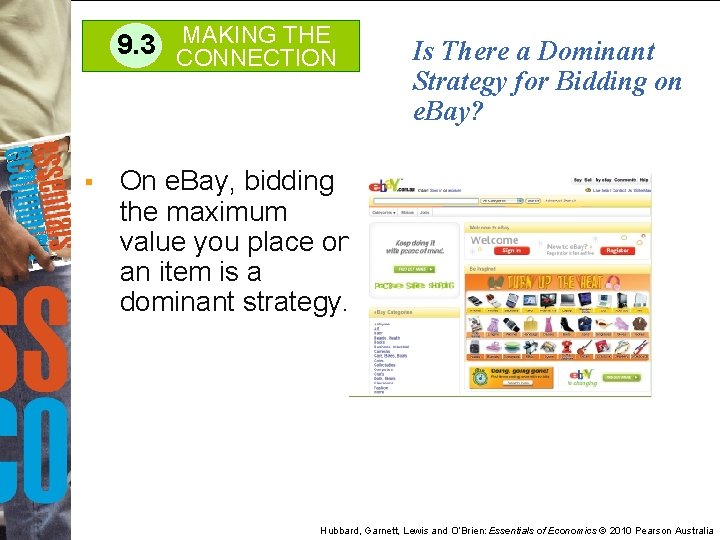
MAKING THE 9. 3 CONNECTION § Is There a Dominant Strategy for Bidding on e. Bay? On e. Bay, bidding the maximum value you place on an item is a dominant strategy. Hubbard, Garnett, Lewis and O’Brien: Essentials of Economics © 2010 Pearson Australia
An Inside Look Maccas coffee bars to take on Starbucks Hubbard, Garnett, Lewis and O’Brien: Essentials of Economics © 2010 Pearson Australia
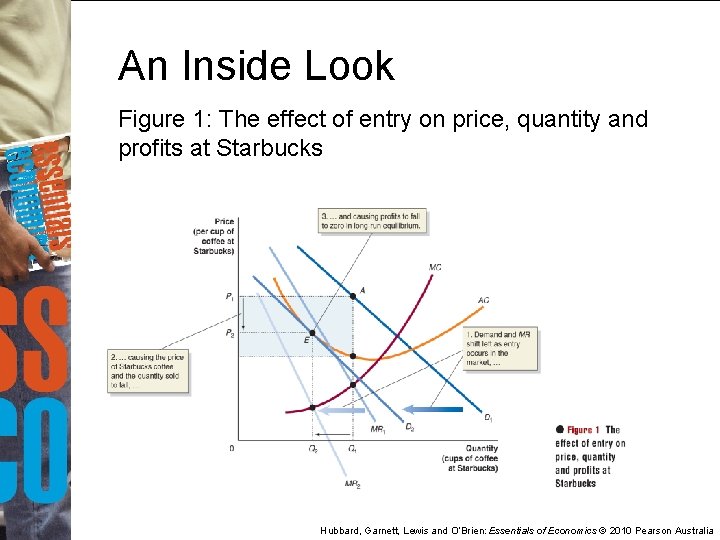
An Inside Look Figure 1: The effect of entry on price, quantity and profits at Starbucks Insert Figure 1 from page 281, as large as possible while retaining clarity Hubbard, Garnett, Lewis and O’Brien: Essentials of Economics © 2010 Pearson Australia
Key Terms § Barrier to entry § Business strategy § § § Collusion Cooperative equilibrium Dominant strategy Economies of scale Game theory § Monopolistic competition § Nash equilibrium § Non-cooperative equilibrium § Oligopoly § Payoff matrix § Prisoners’ dilemma Hubbard, Garnett, Lewis and O’Brien: Essentials of Economics © 2010 Pearson Australia
Get Thinking! Good examples of monopolistic competition can be found in the hospitality business. Think about a street in your suburb with large number of restaurants. Use some Internet search engines to assist you http: //www. restaurant. org. au http: //www. restaurantsofaustralia. com. au Answer the following questions: a. How many restaurants are there? b. What prices do these restaurants charge? If higher, why do you think they are able to do that and do not lose customers? c. If restaurants were a perfectly competitive market, what benefits and disadvantages would it bring to you, as a consumer? Hubbard, Garnett, Lewis and O’Brien: Essentials of Economics © 2010 Pearson Australia
Get Thinking! In May 2008, the 3 rd largest Australian bank Westpac made a merger offer to the 5 th largest bank – St. George. This merger was approved by the Federal Court of Australia in November 2008. 1. What do you think this merger means for the Australian banking sector in terms of competition? 2. What do you think customers of both banks gain and/or lose from this merger? 3. How do you think this merger will affect the new entity’s competitive position on the international market? Hubbard, Garnett, Lewis and O’Brien: Essentials of Economics © 2010 Pearson Australia
Check Your Knowledge Q 1. When a monopolistically competitive firm cuts price, good and bad things happen. Which of the following is considered a good thing? a. The price effect. b. The output effect. c. The revenue effect. d. All of the above are good things. Hubbard, Garnett, Lewis and O’Brien: Essentials of Economics © 2010 Pearson Australia
Check Your Knowledge Q 1. When a monopolistically competitive firm cuts price, good and bad things happen. Which of the following is considered a good thing? a. The price effect. b. The output effect. c. The revenue effect. d. All of the above are good things. Hubbard, Garnett, Lewis and O’Brien: Essentials of Economics © 2010 Pearson Australia
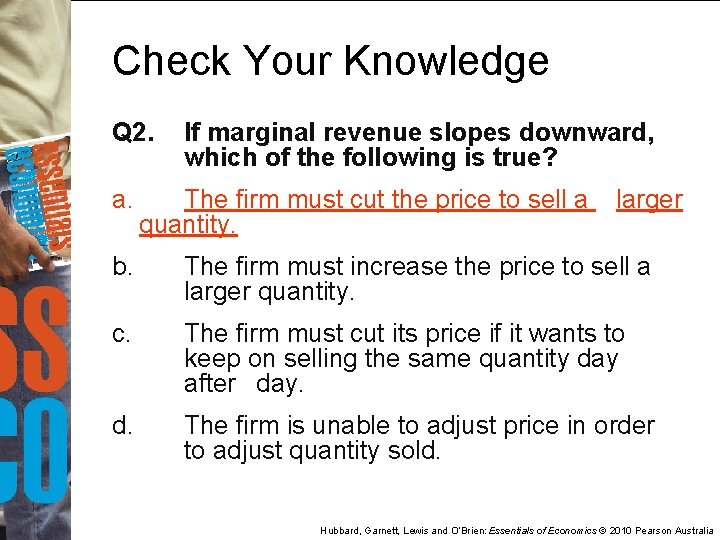
Check Your Knowledge Q 2. a. If marginal revenue slopes downward, which of the following is true? The firm must cut the price to sell a quantity. larger b. The firm must increase the price to sell a larger quantity. c. The firm must cut its price if it wants to keep on selling the same quantity day after day. d. The firm is unable to adjust price in order to adjust quantity sold. Hubbard, Garnett, Lewis and O’Brien: Essentials of Economics © 2010 Pearson Australia
Check Your Knowledge Q 2. a. If marginal revenue slopes downward, which of the following is true? The firm must cut the price to sell a quantity. larger b. The firm must increase the price to sell a larger quantity. c. The firm must cut its price if it wants to keep on selling the same quantity day after day. d. The firm is unable to adjust price in order to adjust quantity sold. Hubbard, Garnett, Lewis and O’Brien: Essentials of Economics © 2010 Pearson Australia
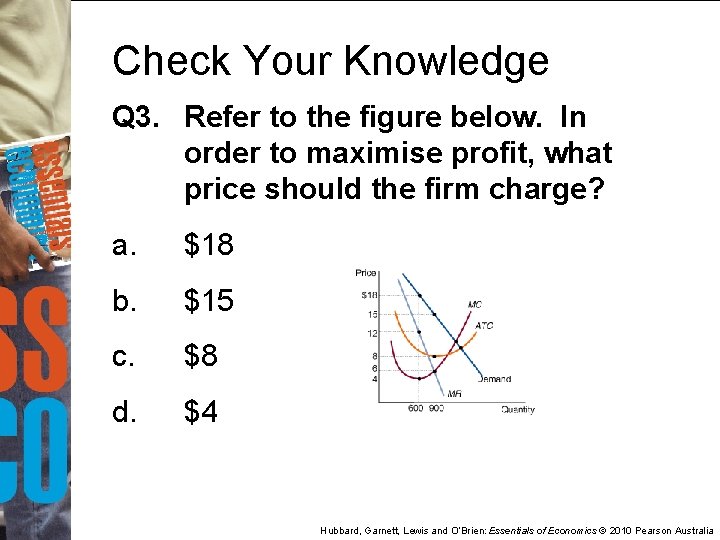
Check Your Knowledge Q 3. Refer to the figure below. In order to maximise profit, what price should the firm charge? a. $18 b. $15 c. $8 d. $4 Hubbard, Garnett, Lewis and O’Brien: Essentials of Economics © 2010 Pearson Australia
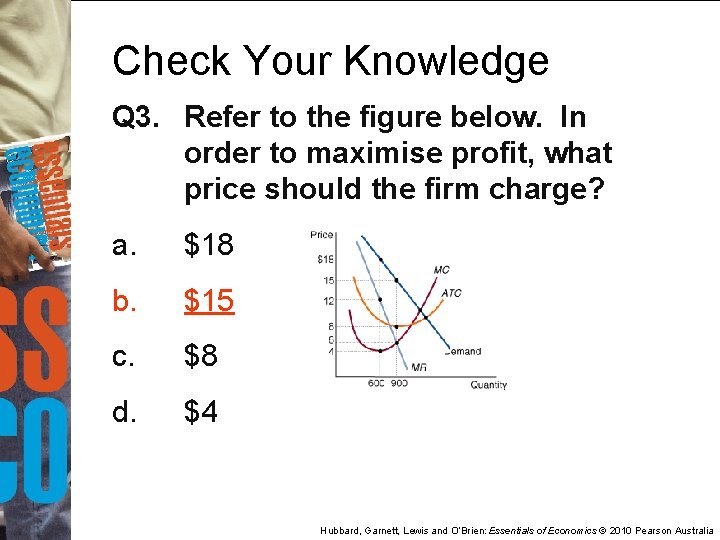
Check Your Knowledge Q 3. Refer to the figure below. In order to maximise profit, what price should the firm charge? a. $18 b. $15 c. $8 d. $4 Hubbard, Garnett, Lewis and O’Brien: Essentials of Economics © 2010 Pearson Australia
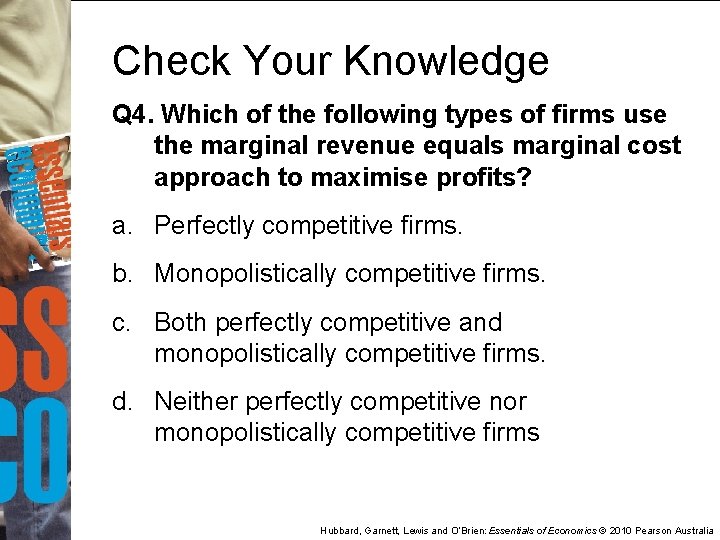
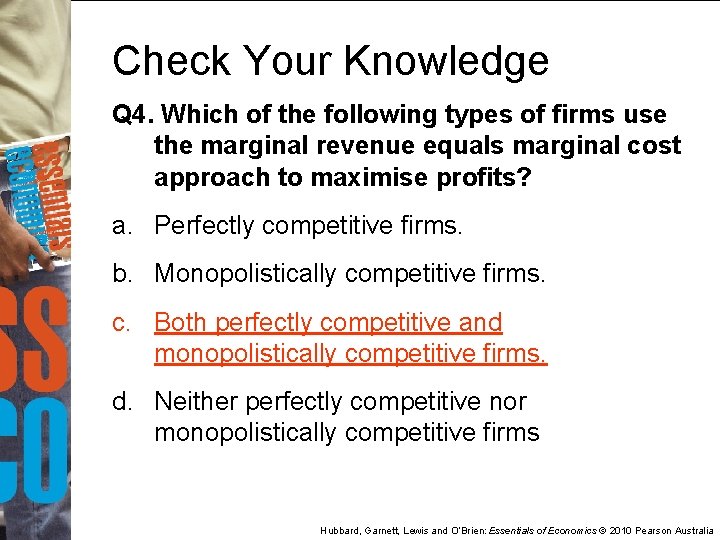
Check Your Knowledge Q 4. Which of the following types of firms use the marginal revenue equals marginal cost approach to maximise profits? a. Perfectly competitive firms. b. Monopolistically competitive firms. c. Both perfectly competitive and monopolistically competitive firms. d. Neither perfectly competitive nor monopolistically competitive firms Hubbard, Garnett, Lewis and O’Brien: Essentials of Economics © 2010 Pearson Australia
Check Your Knowledge Q 4. Which of the following types of firms use the marginal revenue equals marginal cost approach to maximise profits? a. Perfectly competitive firms. b. Monopolistically competitive firms. c. Both perfectly competitive and monopolistically competitive firms. d. Neither perfectly competitive nor monopolistically competitive firms Hubbard, Garnett, Lewis and O’Brien: Essentials of Economics © 2010 Pearson Australia
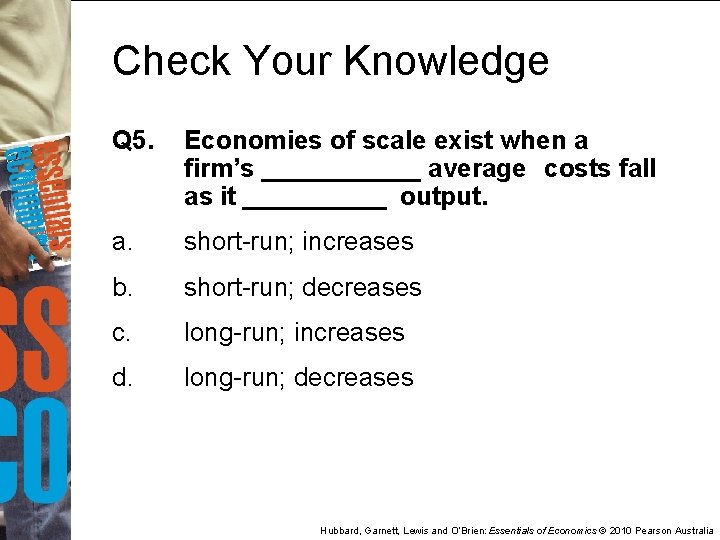
Check Your Knowledge Q 5. Economies of scale exist when a firm’s ______ average costs fall as it _____ output. a. short-run; increases b. short-run; decreases c. long-run; increases d. long-run; decreases Hubbard, Garnett, Lewis and O’Brien: Essentials of Economics © 2010 Pearson Australia
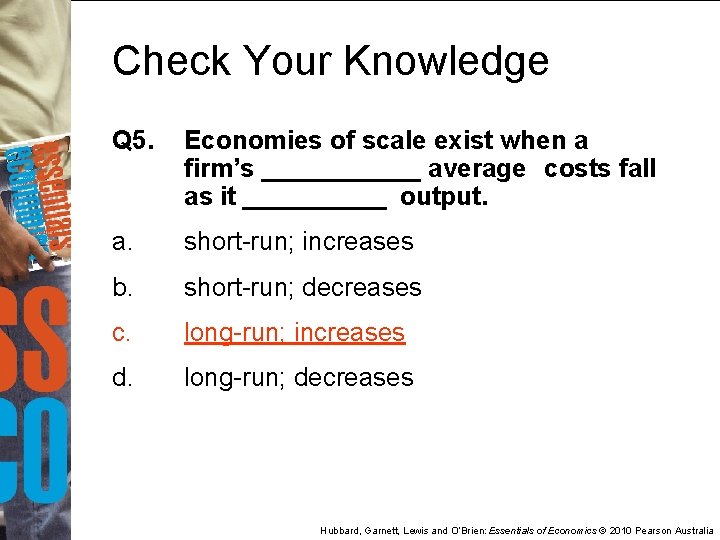
Check Your Knowledge Q 5. Economies of scale exist when a firm’s ______ average costs fall as it _____ output. a. short-run; increases b. short-run; decreases c. long-run; increases d. long-run; decreases Hubbard, Garnett, Lewis and O’Brien: Essentials of Economics © 2010 Pearson Australia
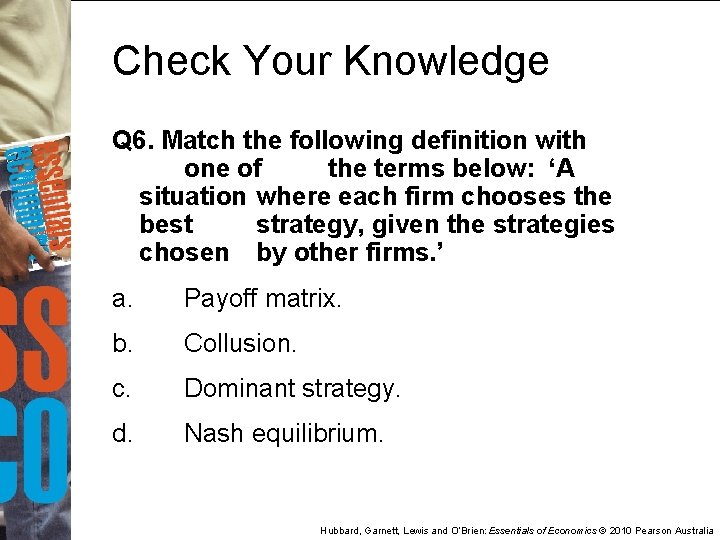
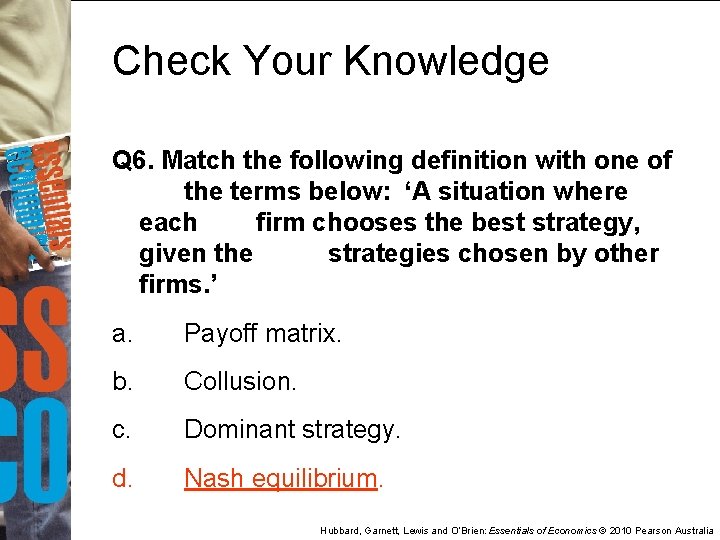
Check Your Knowledge Q 6. Match the following definition with one of the terms below: ‘A situation where each firm chooses the best strategy, given the strategies chosen by other firms. ’ a. Payoff matrix. b. Collusion. c. Dominant strategy. d. Nash equilibrium. Hubbard, Garnett, Lewis and O’Brien: Essentials of Economics © 2010 Pearson Australia
Check Your Knowledge Q 6. Match the following definition with one of the terms below: ‘A situation where each firm chooses the best strategy, given the strategies chosen by other firms. ’ a. Payoff matrix. b. Collusion. c. Dominant strategy. d. Nash equilibrium. Hubbard, Garnett, Lewis and O’Brien: Essentials of Economics © 2010 Pearson Australia
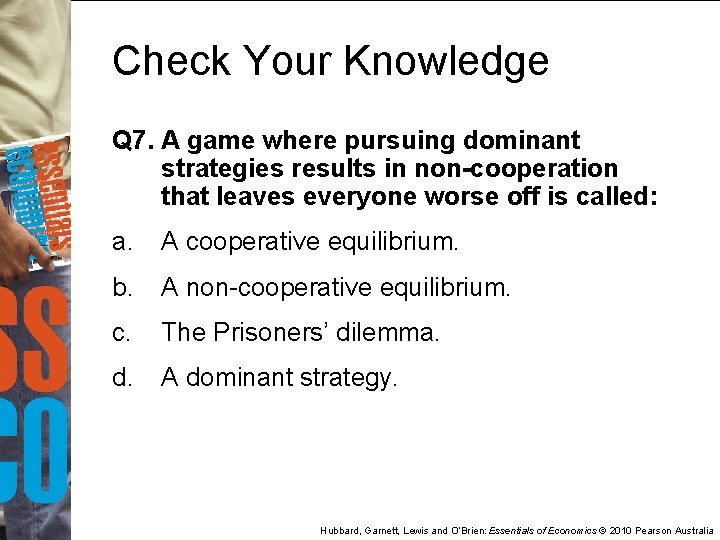
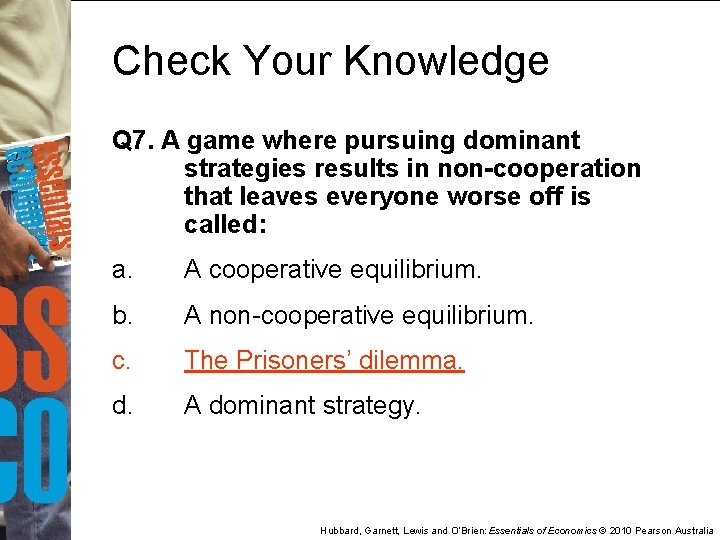
Check Your Knowledge Q 7. A game where pursuing dominant strategies results in non-cooperation that leaves everyone worse off is called: a. A cooperative equilibrium. b. A non-cooperative equilibrium. c. The Prisoners’ dilemma. d. A dominant strategy. Hubbard, Garnett, Lewis and O’Brien: Essentials of Economics © 2010 Pearson Australia
Check Your Knowledge Q 7. A game where pursuing dominant strategies results in non-cooperation that leaves everyone worse off is called: a. A cooperative equilibrium. b. A non-cooperative equilibrium. c. The Prisoners’ dilemma. d. A dominant strategy. Hubbard, Garnett, Lewis and O’Brien: Essentials of Economics © 2010 Pearson Australia