
Power Point to accompany Chapter 10 Introduction to
- Slides: 49
Power. Point to accompany Chapter 10 Introduction to Investments & Risk and Return in Capital Markets
Investing § Purchase of assets with the goal of increasing future income § Focuses on wealth accumulation § Underlying investment decisions: the tradeoff between expected return and risk § Expected return is not usually the same as realized return § Risk: the possibility that the realized return will be different than the expected return Copyright © 2011 Pearson Australia (a division of Pearson Australia Group Ltd) – 9781442502000 / Berk/De. Marzo/Harford / Fundamentals of Corporate Finance / 1 st edition 2
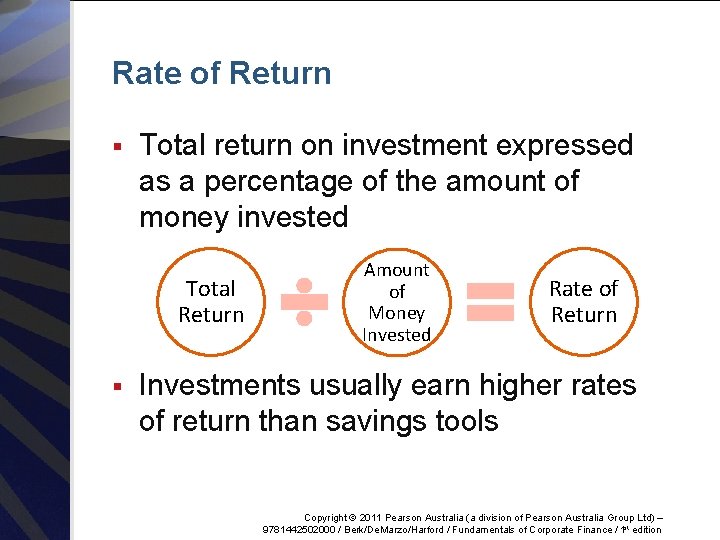
Rate of Return § Total return on investment expressed as a percentage of the amount of money invested Total Return § Amount of Money Invested Rate of Return Investments usually earn higher rates of return than savings tools Copyright © 2011 Pearson Australia (a division of Pearson Australia Group Ltd) – 9781442502000 / Berk/De. Marzo/Harford / Fundamentals of Corporate Finance / 1 st edition
Risk § Risk- uncertainty regarding the outcome of a situation or event § Investment Risk- possibility that an investment will fail to pay the expected return or fail to pay a return at all § All investment tools carry some level of risk Copyright © 2011 Pearson Australia (a division of Pearson Australia Group Ltd) – 9781442502000 / Berk/De. Marzo/Harford / Fundamentals of Corporate Finance / 1 st edition
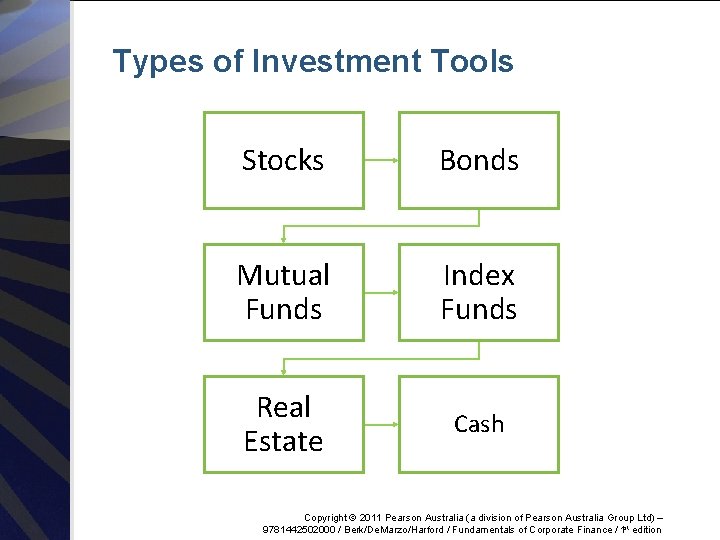
Types of Investment Tools Stocks Bonds Mutual Funds Index Funds Real Estate Cash Copyright © 2011 Pearson Australia (a division of Pearson Australia Group Ltd) – 9781442502000 / Berk/De. Marzo/Harford / Fundamentals of Corporate Finance / 1 st edition
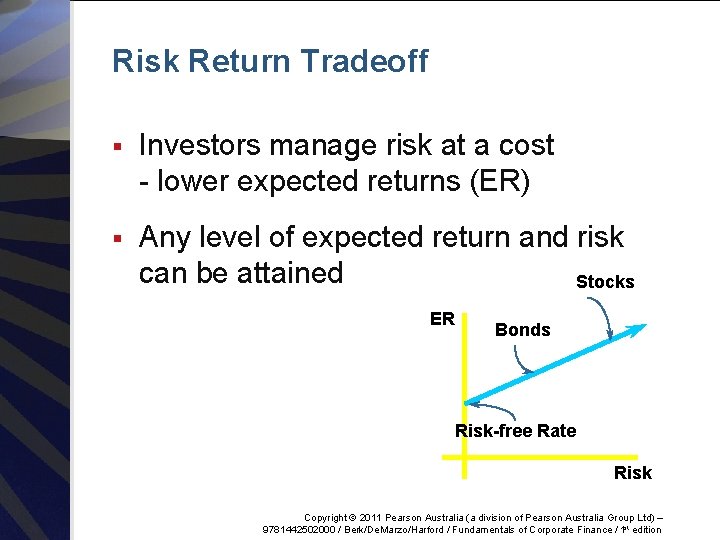
Risk Return Tradeoff § Investors manage risk at a cost - lower expected returns (ER) § Any level of expected return and risk can be attained Stocks ER Bonds Risk-free Rate Risk Copyright © 2011 Pearson Australia (a division of Pearson Australia Group Ltd) – 9781442502000 / Berk/De. Marzo/Harford / Fundamentals of Corporate Finance / 1 st edition
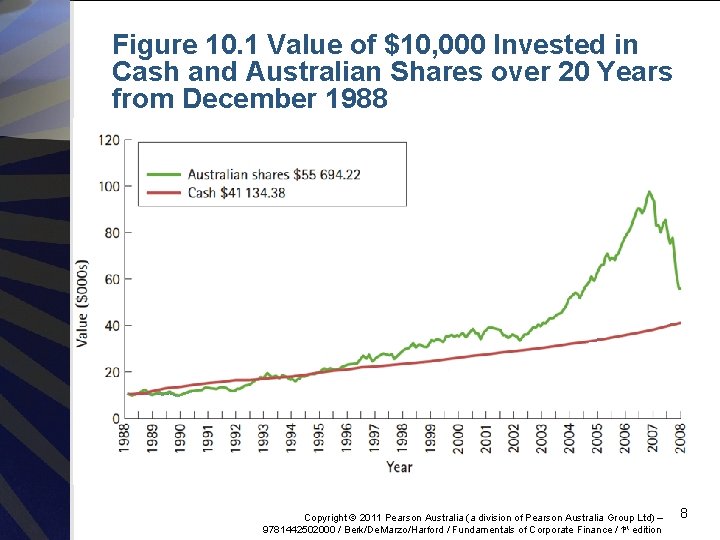
10. 1 A First Look at Risk and Return § We begin our look at risk and return by illustrating how the risk premium affects investor decisions and returns: § Suppose you won $10, 000 in a raffle in December 1988 and decided to invest it all in a portfolio of Australian shares, with dividends being reinvested. § By December 2008, 20 years later, your share portfolio would be worth $55, 695 and a comparable portfolio of cash $41, 134 as shown in Figure 10. 1. § The impact of the stock market decline of 2007 and the global slowdown that occurred from 2008 is evident in the sharp decline of the graph. Copyright © 2011 Pearson Australia (a division of Pearson Australia Group Ltd) – 9781442502000 / Berk/De. Marzo/Harford / Fundamentals of Corporate Finance / 1 st edition 7
Figure 10. 1 Value of $10, 000 Invested in Cash and Australian Shares over 20 Years from December 1988 Copyright © 2011 Pearson Australia (a division of Pearson Australia Group Ltd) – 9781442502000 / Berk/De. Marzo/Harford / Fundamentals of Corporate Finance / 1 st edition 8
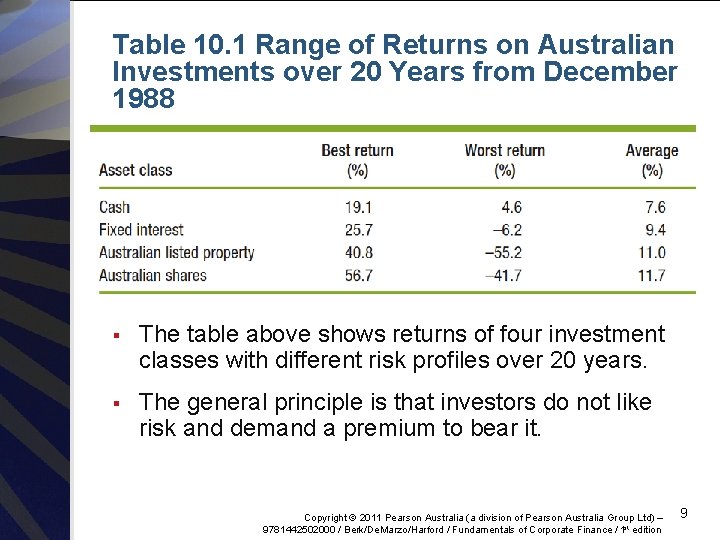
Table 10. 1 Range of Returns on Australian Investments over 20 Years from December 1988 § The table above shows returns of four investment classes with different risk profiles over 20 years. § The general principle is that investors do not like risk and demand a premium to bear it. Copyright © 2011 Pearson Australia (a division of Pearson Australia Group Ltd) – 9781442502000 / Berk/De. Marzo/Harford / Fundamentals of Corporate Finance / 1 st edition 9
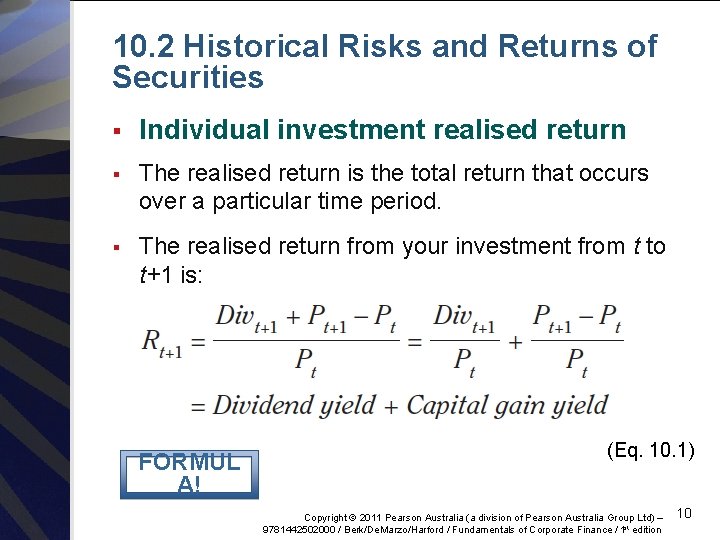
10. 2 Historical Risks and Returns of Securities § Individual investment realised return § The realised return is the total return that occurs over a particular time period. § The realised return from your investment from t to t+1 is: FORMUL A! (Eq. 10. 1) Copyright © 2011 Pearson Australia (a division of Pearson Australia Group Ltd) – 9781442502000 / Berk/De. Marzo/Harford / Fundamentals of Corporate Finance / 1 st edition 10
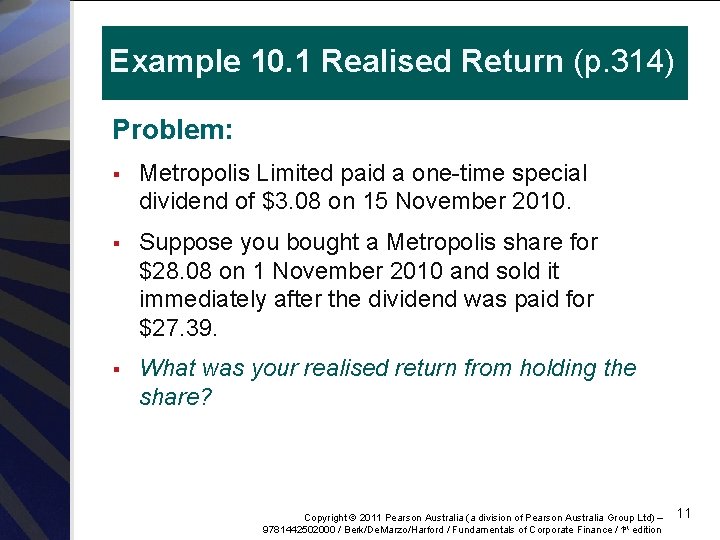
Example 10. 1 Realised Return (p. 314) Problem: § Metropolis Limited paid a one-time special dividend of $3. 08 on 15 November 2010. § Suppose you bought a Metropolis share for $28. 08 on 1 November 2010 and sold it immediately after the dividend was paid for $27. 39. § What was your realised return from holding the share? Copyright © 2011 Pearson Australia (a division of Pearson Australia Group Ltd) – 9781442502000 / Berk/De. Marzo/Harford / Fundamentals of Corporate Finance / 1 st edition 11
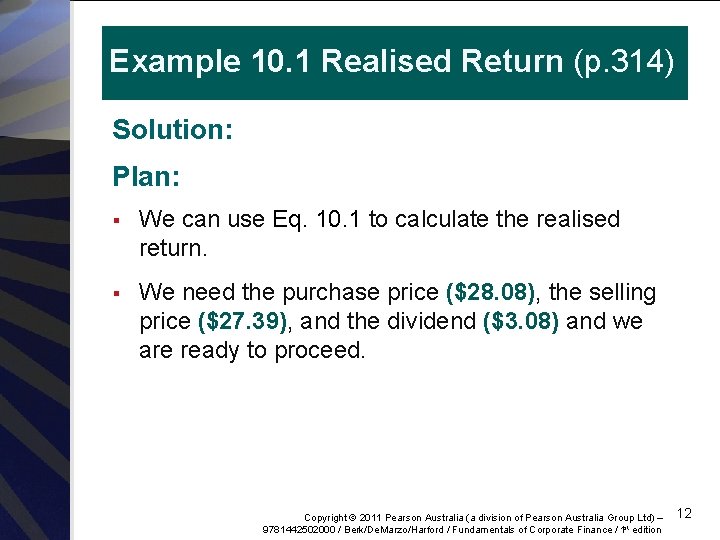
Example 10. 1 Realised Return (p. 314) Solution: Plan: § We can use Eq. 10. 1 to calculate the realised return. § We need the purchase price ($28. 08), the selling price ($27. 39), and the dividend ($3. 08) and we are ready to proceed. Copyright © 2011 Pearson Australia (a division of Pearson Australia Group Ltd) – 9781442502000 / Berk/De. Marzo/Harford / Fundamentals of Corporate Finance / 1 st edition 12
Example 10. 1 Realised Return (p. 314) § Execute: Copyright © 2011 Pearson Australia (a division of Pearson Australia Group Ltd) – 9781442502000 / Berk/De. Marzo/Harford / Fundamentals of Corporate Finance / 1 st edition 13
Example 10. 1 Realised Return (p. 314) Evaluate: § These returns include both the capital gain (or in this case a capital loss) and the return generated from receiving dividends. § Both dividends and capital gains contribute to the total realised return—ignoring either one would give a very misleading impression of Metropolis’ performance. Copyright © 2011 Pearson Australia (a division of Pearson Australia Group Ltd) – 9781442502000 / Berk/De. Marzo/Harford / Fundamentals of Corporate Finance / 1 st edition 14
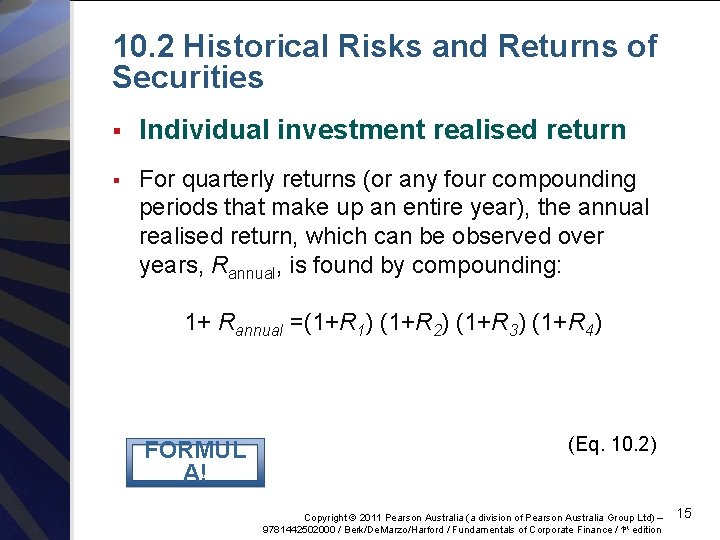
10. 2 Historical Risks and Returns of Securities § Individual investment realised return § For quarterly returns (or any four compounding periods that make up an entire year), the annual realised return, which can be observed over years, Rannual, is found by compounding: 1+ Rannual =(1+R 1) (1+R 2) (1+R 3) (1+R 4) FORMUL A! (Eq. 10. 2) Copyright © 2011 Pearson Australia (a division of Pearson Australia Group Ltd) – 9781442502000 / Berk/De. Marzo/Harford / Fundamentals of Corporate Finance / 1 st edition 15
Example 10. 2 Compounding Realised Returns (pp. 315 -6) Problem: § § Suppose you purchased Metropolis shares on 1 November 2010 and held them for one year, selling on 31 October 2011. All dividends you earned were re-invested in the same Metropolis shares. What was your realised return? Copyright © 2011 Pearson Australia (a division of Pearson Australia Group Ltd) – 9781442502000 / Berk/De. Marzo/Harford / Fundamentals of Corporate Finance / 1 st edition 16
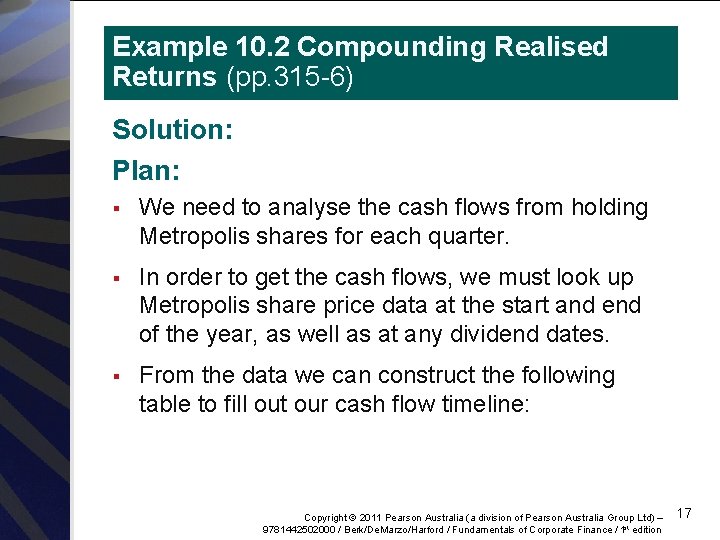
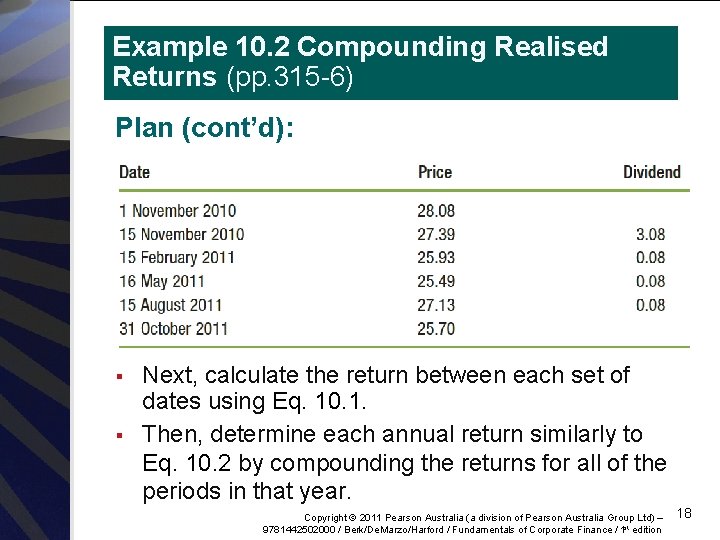
Example 10. 2 Compounding Realised Returns (pp. 315 -6) Solution: Plan: § We need to analyse the cash flows from holding Metropolis shares for each quarter. § In order to get the cash flows, we must look up Metropolis share price data at the start and end of the year, as well as at any dividend dates. § From the data we can construct the following table to fill out our cash flow timeline: Copyright © 2011 Pearson Australia (a division of Pearson Australia Group Ltd) – 9781442502000 / Berk/De. Marzo/Harford / Fundamentals of Corporate Finance / 1 st edition 17
Example 10. 2 Compounding Realised Returns (pp. 315 -6) Plan (cont’d): § § Next, calculate the return between each set of dates using Eq. 10. 1. Then, determine each annual return similarly to Eq. 10. 2 by compounding the returns for all of the periods in that year. Copyright © 2011 Pearson Australia (a division of Pearson Australia Group Ltd) – 9781442502000 / Berk/De. Marzo/Harford / Fundamentals of Corporate Finance / 1 st edition 18
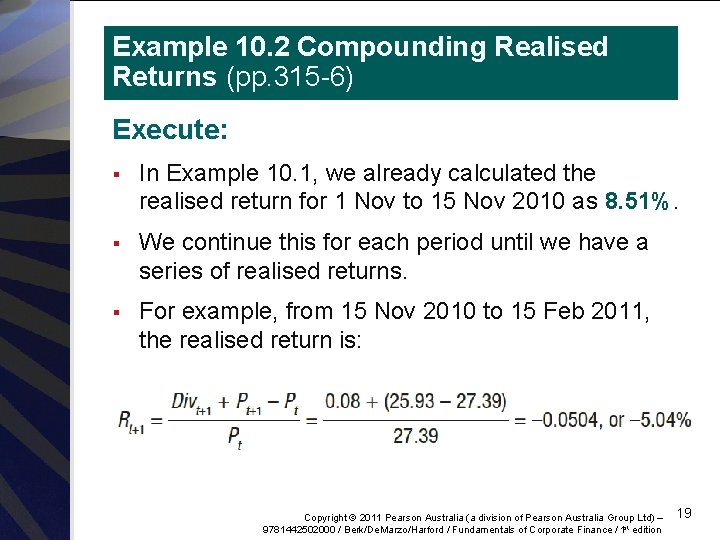
Example 10. 2 Compounding Realised Returns (pp. 315 -6) Execute: § In Example 10. 1, we already calculated the realised return for 1 Nov to 15 Nov 2010 as 8. 51%. § We continue this for each period until we have a series of realised returns. § For example, from 15 Nov 2010 to 15 Feb 2011, the realised return is: Copyright © 2011 Pearson Australia (a division of Pearson Australia Group Ltd) – 9781442502000 / Berk/De. Marzo/Harford / Fundamentals of Corporate Finance / 1 st edition 19
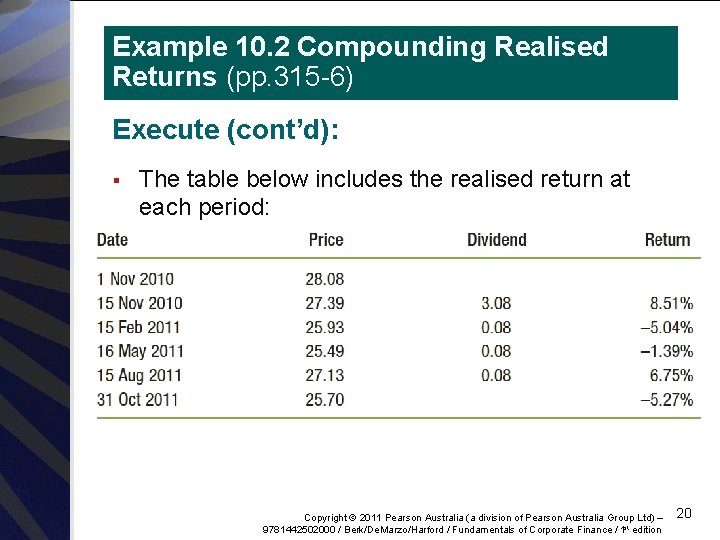
Example 10. 2 Compounding Realised Returns (pp. 315 -6) Execute (cont’d): § The table below includes the realised return at each period: Copyright © 2011 Pearson Australia (a division of Pearson Australia Group Ltd) – 9781442502000 / Berk/De. Marzo/Harford / Fundamentals of Corporate Finance / 1 st edition 20
Example 10. 2 Compounding Realised Returns (pp. 315 -6) Execute (cont’d): § We then determine the one-year return by compounding: Copyright © 2011 Pearson Australia (a division of Pearson Australia Group Ltd) – 9781442502000 / Berk/De. Marzo/Harford / Fundamentals of Corporate Finance / 1 st edition 21
Example 10. 2 Compounding Realised Returns (pp. 315 -6) Evaluate: § By repeating these steps, we have successfully calculated the realised annual returns for an investor holding Metropolis shares over this oneyear period. § From this exercise, we can see that returns are risky. § Metropolis fluctuated up and down over the year and ended up only slightly up (2. 75%) at the end. Copyright © 2011 Pearson Australia (a division of Pearson Australia Group Ltd) – 9781442502000 / Berk/De. Marzo/Harford / Fundamentals of Corporate Finance / 1 st edition 22
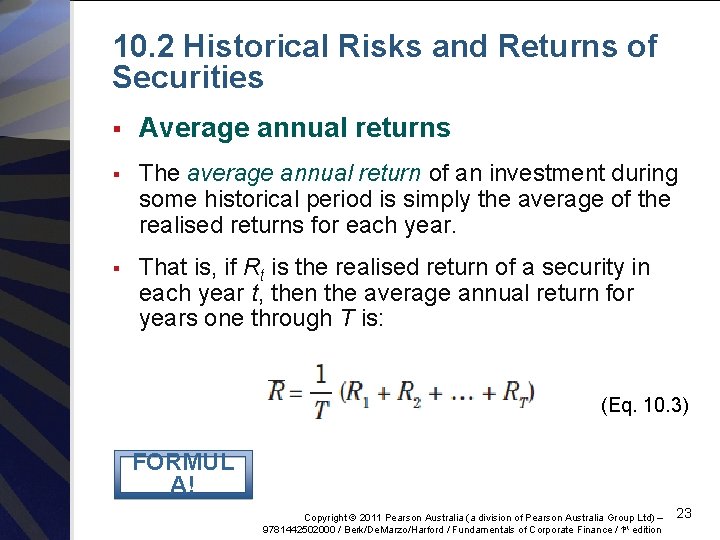
10. 2 Historical Risks and Returns of Securities § Average annual returns § The average annual return of an investment during some historical period is simply the average of the realised returns for each year. § That is, if Rt is the realised return of a security in each year t, then the average annual return for years one through T is: (Eq. 10. 3) FORMUL A! Copyright © 2011 Pearson Australia (a division of Pearson Australia Group Ltd) – 9781442502000 / Berk/De. Marzo/Harford / Fundamentals of Corporate Finance / 1 st edition 23
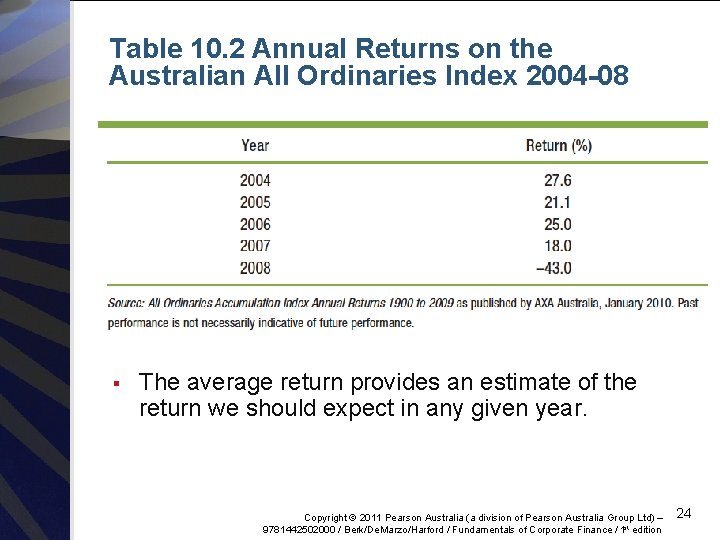
Table 10. 2 Annual Returns on the Australian All Ordinaries Index 2004 -08 § The average return provides an estimate of the return we should expect in any given year. Copyright © 2011 Pearson Australia (a division of Pearson Australia Group Ltd) – 9781442502000 / Berk/De. Marzo/Harford / Fundamentals of Corporate Finance / 1 st edition 24
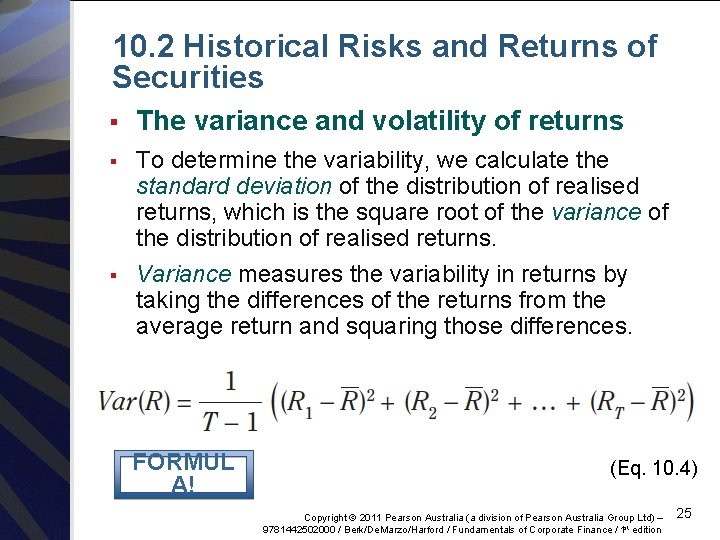
10. 2 Historical Risks and Returns of Securities § The variance and volatility of returns § To determine the variability, we calculate the standard deviation of the distribution of realised returns, which is the square root of the variance of the distribution of realised returns. Variance measures the variability in returns by taking the differences of the returns from the average return and squaring those differences. § FORMUL A! (Eq. 10. 4) Copyright © 2011 Pearson Australia (a division of Pearson Australia Group Ltd) – 9781442502000 / Berk/De. Marzo/Harford / Fundamentals of Corporate Finance / 1 st edition 25
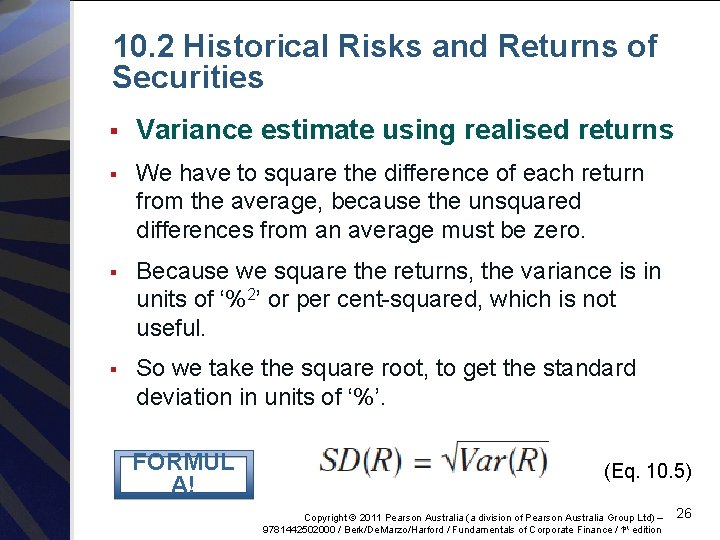
10. 2 Historical Risks and Returns of Securities § Variance estimate using realised returns § We have to square the difference of each return from the average, because the unsquared differences from an average must be zero. § Because we square the returns, the variance is in units of ‘%2’ or per cent-squared, which is not useful. § So we take the square root, to get the standard deviation in units of ‘%’. FORMUL A! (Eq. 10. 5) Copyright © 2011 Pearson Australia (a division of Pearson Australia Group Ltd) – 9781442502000 / Berk/De. Marzo/Harford / Fundamentals of Corporate Finance / 1 st edition 26
Example 10. 3 Calculating Historical Volatility (pp. 318 -9) Problem: § Using the data from Table 10. 2, what is the standard deviation of the return on the All Ordinaries Index for the years 2004– 08? Copyright © 2011 Pearson Australia (a division of Pearson Australia Group Ltd) – 9781442502000 / Berk/De. Marzo/Harford / Fundamentals of Corporate Finance / 1 st edition 27
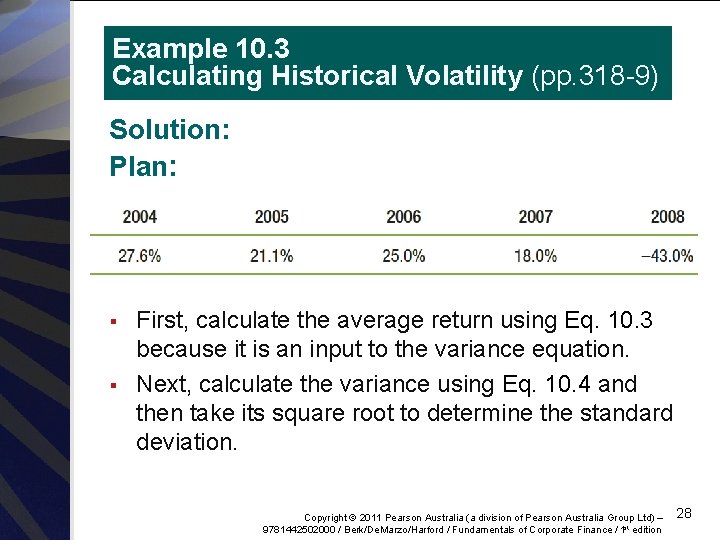
Example 10. 3 Calculating Historical Volatility (pp. 318 -9) Solution: Plan: § § First, calculate the average return using Eq. 10. 3 because it is an input to the variance equation. Next, calculate the variance using Eq. 10. 4 and then take its square root to determine the standard deviation. Copyright © 2011 Pearson Australia (a division of Pearson Australia Group Ltd) – 9781442502000 / Berk/De. Marzo/Harford / Fundamentals of Corporate Finance / 1 st edition 28
Example 10. 3 Calculating Historical Volatility (pp. 318 -9) Copyright © 2011 Pearson Australia (a division of Pearson Australia Group Ltd) – 9781442502000 / Berk/De. Marzo/Harford / Fundamentals of Corporate Finance / 1 st edition 29
Example 10. 3 Calculating Historical Volatility (pp. 318 -9) Copyright © 2011 Pearson Australia (a division of Pearson Australia Group Ltd) – 9781442502000 / Berk/De. Marzo/Harford / Fundamentals of Corporate Finance / 1 st edition 30
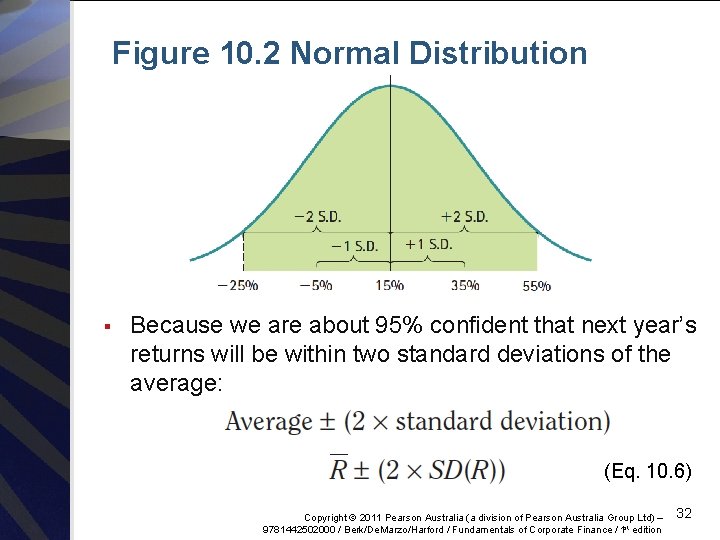
10. 2 Historical Risks and Returns of Securities § The normal distribution § Standard deviations are useful for more than just ranking the investments from riskiest to least risky. § It also describes a normal distribution, shown in Figure 10. 2: § About two-thirds of all possible outcomes fall within one standard deviation above or below the average. § About 95% of all possible outcomes fall within two standard deviations above and below the average. § Figure 10. 2 shows these outcomes for the shares of a hypothetical company. Copyright © 2011 Pearson Australia (a division of Pearson Australia Group Ltd) – 9781442502000 / Berk/De. Marzo/Harford / Fundamentals of Corporate Finance / 1 st edition 31
Figure 10. 2 Normal Distribution § Because we are about 95% confident that next year’s returns will be within two standard deviations of the average: (Eq. 10. 6) Copyright © 2011 Pearson Australia (a division of Pearson Australia Group Ltd) – 9781442502000 / Berk/De. Marzo/Harford / Fundamentals of Corporate Finance / 1 st edition 32
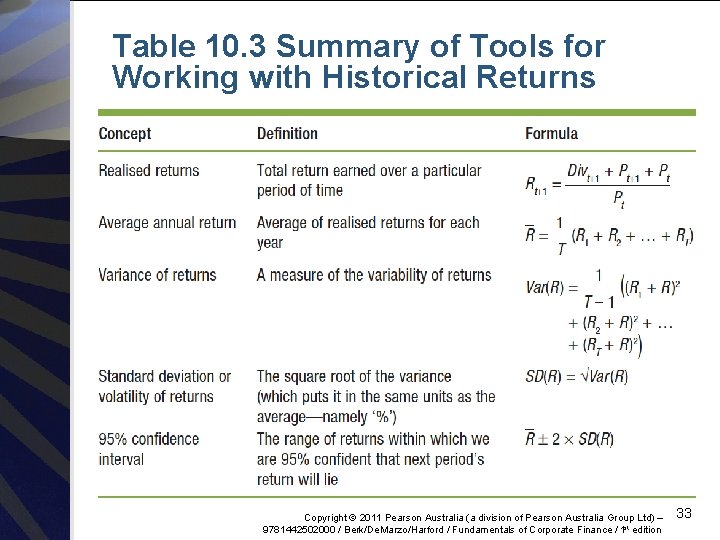
Table 10. 3 Summary of Tools for Working with Historical Returns Copyright © 2011 Pearson Australia (a division of Pearson Australia Group Ltd) – 9781442502000 / Berk/De. Marzo/Harford / Fundamentals of Corporate Finance / 1 st edition 33
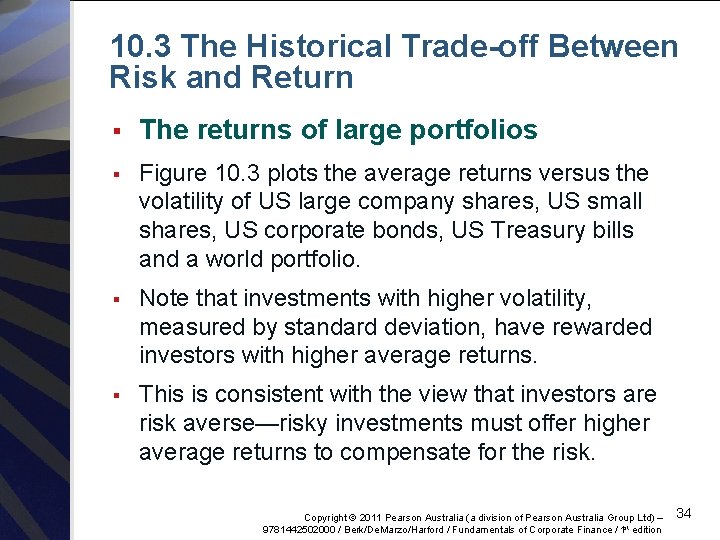
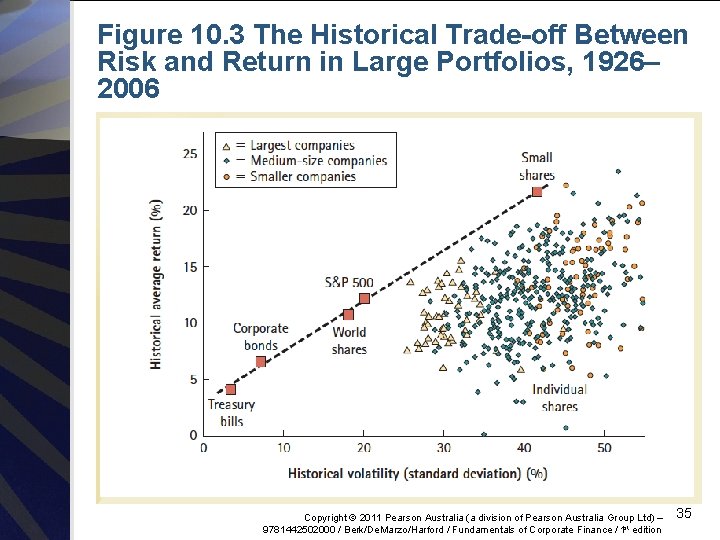
10. 3 The Historical Trade-off Between Risk and Return § The returns of large portfolios § Figure 10. 3 plots the average returns versus the volatility of US large company shares, US small shares, US corporate bonds, US Treasury bills and a world portfolio. § Note that investments with higher volatility, measured by standard deviation, have rewarded investors with higher average returns. § This is consistent with the view that investors are risk averse—risky investments must offer higher average returns to compensate for the risk. Copyright © 2011 Pearson Australia (a division of Pearson Australia Group Ltd) – 9781442502000 / Berk/De. Marzo/Harford / Fundamentals of Corporate Finance / 1 st edition 34
Figure 10. 3 The Historical Trade-off Between Risk and Return in Large Portfolios, 1926– 2006 Copyright © 2011 Pearson Australia (a division of Pearson Australia Group Ltd) – 9781442502000 / Berk/De. Marzo/Harford / Fundamentals of Corporate Finance / 1 st edition 35
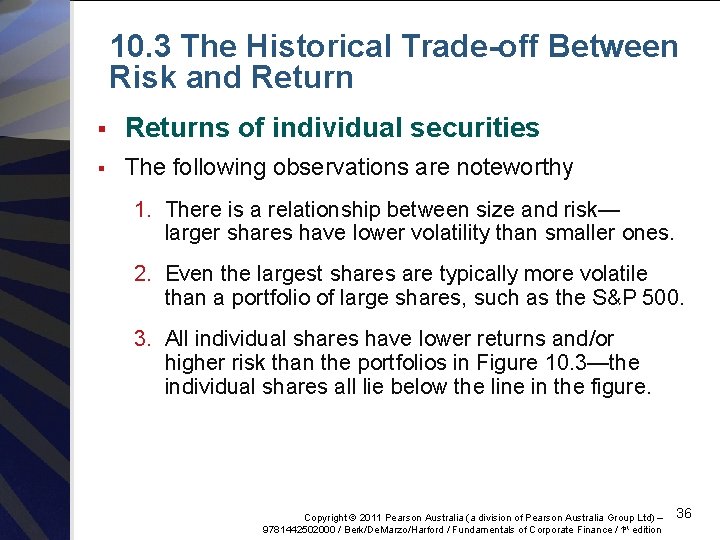
10. 3 The Historical Trade-off Between Risk and Return § Returns of individual securities § The following observations are noteworthy 1. There is a relationship between size and risk— larger shares have lower volatility than smaller ones. 2. Even the largest shares are typically more volatile than a portfolio of large shares, such as the S&P 500. 3. All individual shares have lower returns and/or higher risk than the portfolios in Figure 10. 3—the individual shares all lie below the line in the figure. Copyright © 2011 Pearson Australia (a division of Pearson Australia Group Ltd) – 9781442502000 / Berk/De. Marzo/Harford / Fundamentals of Corporate Finance / 1 st edition 36
10. 3 The Historical Trade-off Between Risk and Return § Individual securities § While volatility (standard deviation) seems to be a reasonable measure of risk when evaluating a large portfolio, the volatility of an individual security doesn’t explain the size of its average return. Copyright © 2011 Pearson Australia (a division of Pearson Australia Group Ltd) – 9781442502000 / Berk/De. Marzo/Harford / Fundamentals of Corporate Finance / 1 st edition 37
10. 4 Common versus Independent Risk § Example: Theft vs earthquake insurance § Consider two types of home insurance: theft insurance and earthquake insurance. § Assume that the risk of each of these two hazards is similar for a given home in Sydney. Each year there is about a 1% chance the home will be robbed, and also a 1% chance the home will be damaged by an earthquake. § Suppose an insurance company writes 100, 000 policies of each type of insurance for homeowners in Sydney. Are the risks of the two portfolios of policies similar? Copyright © 2011 Pearson Australia (a division of Pearson Australia Group Ltd) – 9781442502000 / Berk/De. Marzo/Harford / Fundamentals of Corporate Finance / 1 st edition 38
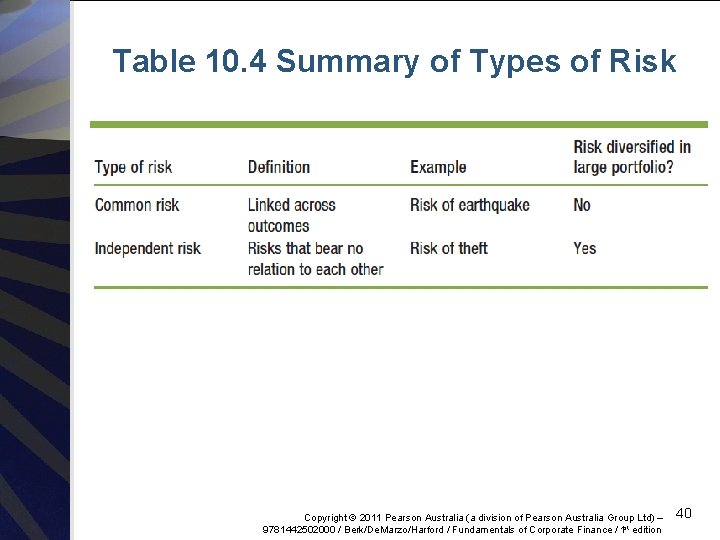
10. 4 Common versus Independent Risk § Example: Theft vs earthquake insurance § Why are the portfolios of insurance policies so different when the individual policies themselves are quite similar? § § Intuitively, the key difference between them is that an earthquake affects all houses simultaneously, so the risk is linked across homes—common risk. § The risk of theft is not linked across homes, some homeowners are unlucky, others lucky—independent risk. Diversification: the averaging out of independent risk in a large portfolio. Copyright © 2011 Pearson Australia (a division of Pearson Australia Group Ltd) – 9781442502000 / Berk/De. Marzo/Harford / Fundamentals of Corporate Finance / 1 st edition 39
Table 10. 4 Summary of Types of Risk Copyright © 2011 Pearson Australia (a division of Pearson Australia Group Ltd) – 9781442502000 / Berk/De. Marzo/Harford / Fundamentals of Corporate Finance / 1 st edition 40
10. 5 Diversification in Share Portfolios § As the insurance example indicates, the risk of a portfolio depends upon whether the individual risks within it are common or independent. § Independent risks are diversified in a large portfolio, whereas common risks are not. § Our goal is to understand the relation between risk and return in the capital markets, so let’s consider the implication of this distinction for the risk of stock portfolios. Copyright © 2011 Pearson Australia (a division of Pearson Australia Group Ltd) – 9781442502000 / Berk/De. Marzo/Harford / Fundamentals of Corporate Finance / 1 st edition 41
10. 5 Diversification in Share Portfolios § Unsystematic vs systematic risk § Share prices and dividends fluctuate due to two types of news: § Company- or industry-specific news: good or bad news about a company (or industry) itself. For example, a firm might announce that it has been successful in gaining market share within its industry. § Market-wide news: news that affects the economy as a whole and therefore affects all shares. For example, the Reserve Bank might announce that it will lower interest rates to boost the economy. Copyright © 2011 Pearson Australia (a division of Pearson Australia Group Ltd) – 9781442502000 / Berk/De. Marzo/Harford / Fundamentals of Corporate Finance / 1 st edition 42
10. 5 Diversification in Share Portfolios § Unsystematic vs systematic risk § Fluctuations of a share’s return that are due to company- or industry-specific news are independent risks. § Like theft across homes, these risks are unrelated across shares and are also referred to as unsystematic risk. § On the other hand, fluctuations of a share’s return that are due to market-wide news represent common risk, which affect all shares simultaneously. § This type of risk is also called systematic risk. Copyright © 2011 Pearson Australia (a division of Pearson Australia Group Ltd) – 9781442502000 / Berk/De. Marzo/Harford / Fundamentals of Corporate Finance / 1 st edition 43
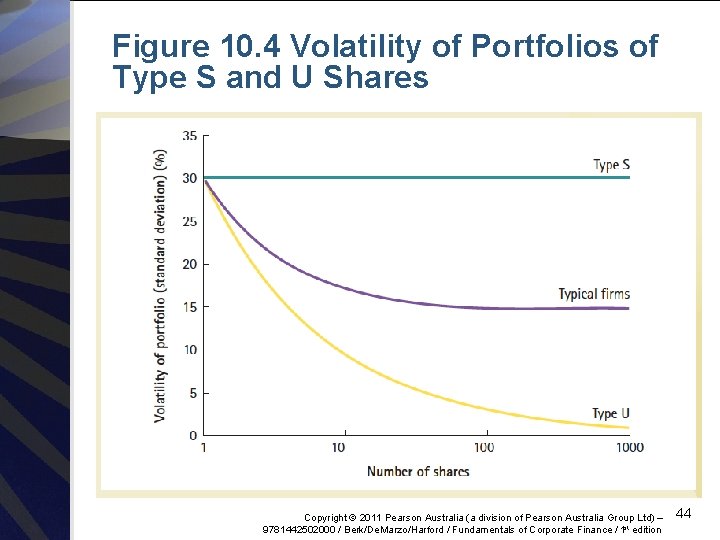
Figure 10. 4 Volatility of Portfolios of Type S and U Shares Copyright © 2011 Pearson Australia (a division of Pearson Australia Group Ltd) – 9781442502000 / Berk/De. Marzo/Harford / Fundamentals of Corporate Finance / 1 st edition 44
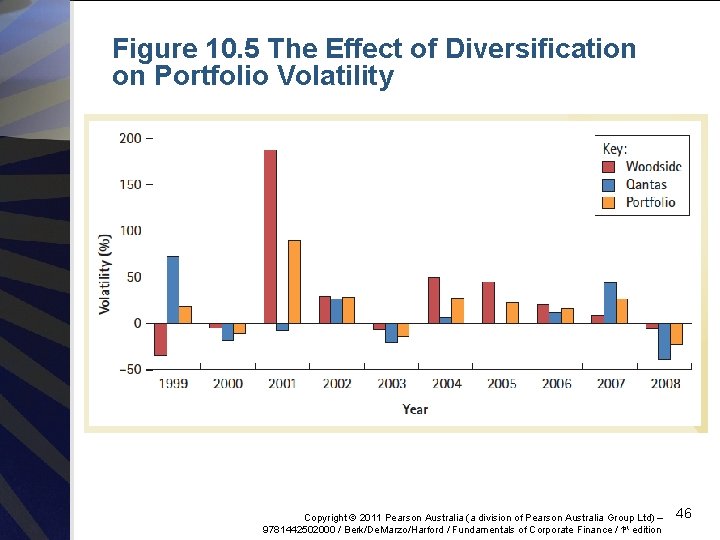
10. 5 Diversification in Share Portfolios § Unsystematic vs systematic risk § When firms carry both types of risk, only the unsystematic risk will be diversified away when we combine many firms into a portfolio. § The volatility will therefore decline until only the systematic risk, which affects all firms, remains. Copyright © 2011 Pearson Australia (a division of Pearson Australia Group Ltd) – 9781442502000 / Berk/De. Marzo/Harford / Fundamentals of Corporate Finance / 1 st edition 45
Figure 10. 5 The Effect of Diversification on Portfolio Volatility Copyright © 2011 Pearson Australia (a division of Pearson Australia Group Ltd) – 9781442502000 / Berk/De. Marzo/Harford / Fundamentals of Corporate Finance / 1 st edition 46
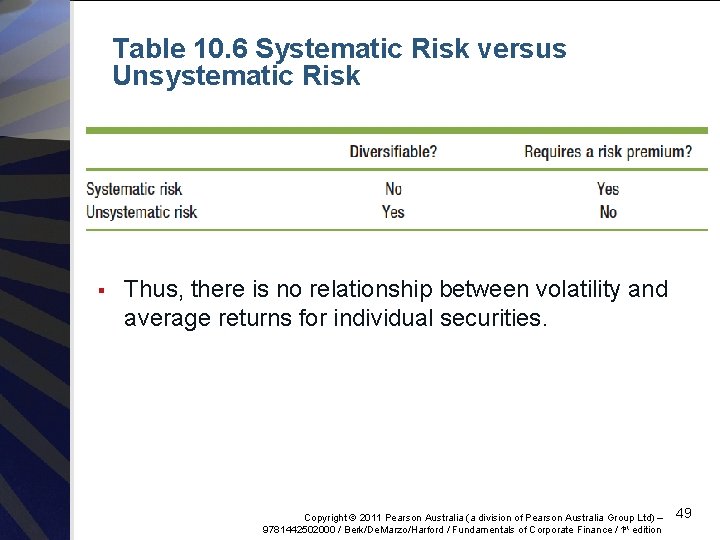
10. 5 Diversification in Share Portfolios § Diversifiable risk and the risk premium § Competition among investors ensures that no additional return can be earned for diversifiable risk. § The risk premium of a share is not affected by its diversifiable, unsystematic risk. § The risk premium for diversifiable risk is zero. § Thus, investors are not compensated for holding unsystematic risk. Copyright © 2011 Pearson Australia (a division of Pearson Australia Group Ltd) – 9781442502000 / Berk/De. Marzo/Harford / Fundamentals of Corporate Finance / 1 st edition 47
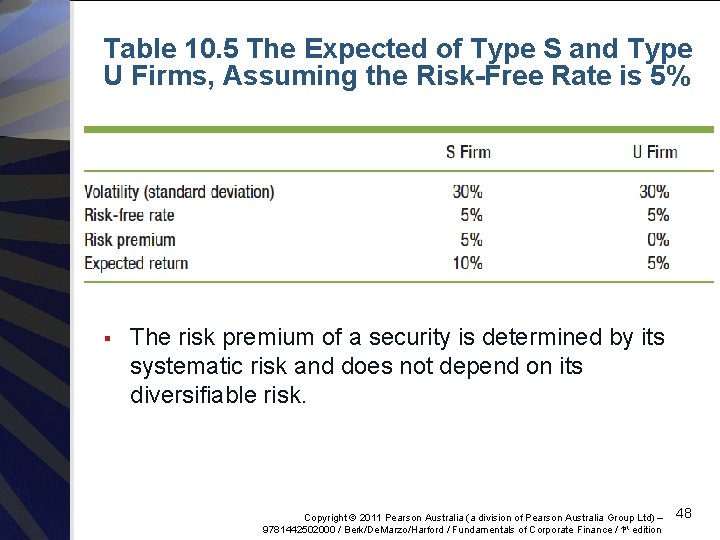
Table 10. 5 The Expected of Type S and Type U Firms, Assuming the Risk-Free Rate is 5% § The risk premium of a security is determined by its systematic risk and does not depend on its diversifiable risk. Copyright © 2011 Pearson Australia (a division of Pearson Australia Group Ltd) – 9781442502000 / Berk/De. Marzo/Harford / Fundamentals of Corporate Finance / 1 st edition 48
Table 10. 6 Systematic Risk versus Unsystematic Risk § Thus, there is no relationship between volatility and average returns for individual securities. Copyright © 2011 Pearson Australia (a division of Pearson Australia Group Ltd) – 9781442502000 / Berk/De. Marzo/Harford / Fundamentals of Corporate Finance / 1 st edition 49