
Power Point to accompany Chapter 1 Economics Foundations
- Slides: 45
Power. Point to accompany Chapter 1 Economics: Foundations and Models
Learning Objectives 1. Discuss these three important economic ideas: people are rational; people respond to incentives; optimal decisions are made at the margin. 2. Understand the issues of scarcity and tradeoffs, and how the market makes decisions on these issues. 3. Understand the role of economics in modern analysis. 4. Distinguish between microeconomics and macroeconomics. Hubbard, Garnett, Lewis and O’Brien: Essentials of Economics © 2010 Pearson Australia
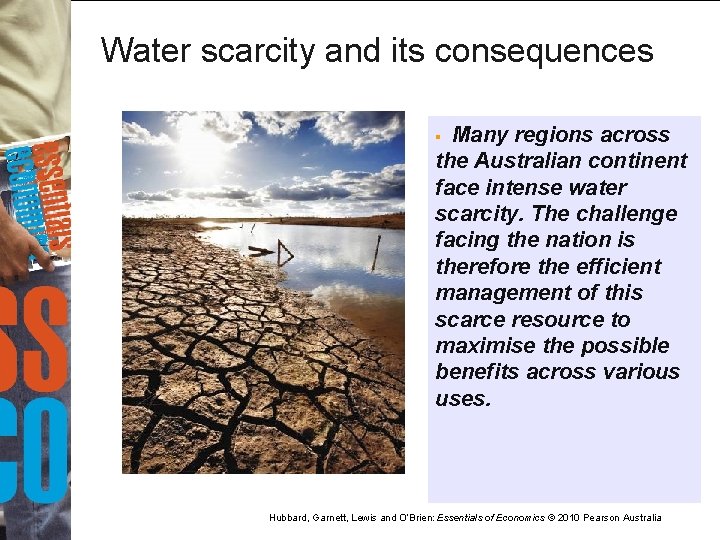
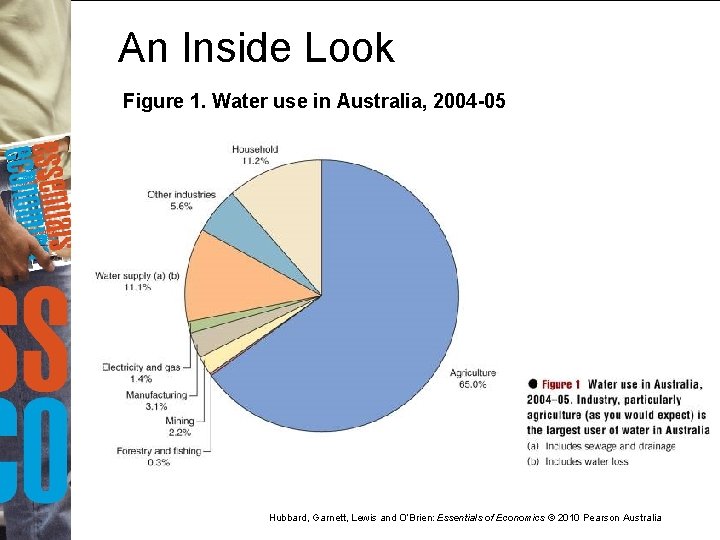
Water scarcity and its consequences Many regions across the Australian continent face intense water scarcity. The challenge facing the nation is therefore the efficient management of this scarce resource to maximise the possible benefits across various uses. § Hubbard, Garnett, Lewis and O’Brien: Essentials of Economics © 2010 Pearson Australia
LEARNING OBJECTIVE 1 Economics and Individual Decisions Economics is the study of the choices people and societies make to attain their unlimited wants, given their scarce resources. § In this subject we study how people make choices and interact in markets. § § Market: A group of buyers and sellers of a good or service and the institution or arrangement by which they come together to trade. Hubbard, Garnett, Lewis and O’Brien: Essentials of Economics © 2010 Pearson Australia
LEARNING OBJECTIVE 1 Economics and Individual Decisions § Three ideas are primary throughout the subject: 1. People are rational. 2. People respond to economic incentives. 3. Optimal decisions are made at the margin. § Marginal Analysis: Analysis that involves comparing marginal benefits and marginal costs. Hubbard, Garnett, Lewis and O’Brien: Essentials of Economics © 2010 Pearson Australia
LEARNING OBJECTIVE 2 Scarcity and Trade-offs Scarcity: The situation in which unlimited wants exceed the limited resources available to fulfill those wants. § Trade-off: The idea that, because of scarcity, producing more of one good or service means producing less of another good or service. § Hubbard, Garnett, Lewis and O’Brien: Essentials of Economics © 2010 Pearson Australia
LEARNING OBJECTIVE 2 Scarcity and Trade-offs § Trade-offs force society to make choices. § This is especially true with respect to three fundamental questions: 1. What goods and services will be produced? 2. How will the goods and services be produced? 3. Who will receive the goods and services produced? Hubbard, Garnett, Lewis and O’Brien: Essentials of Economics © 2010 Pearson Australia
LEARNING OBJECTIVE 2 Scarcity and Trade-offs 1. What goods and services will be produced? § When choosing between alternative options, economists use the concept of opportunity cost. § Opportunity cost: The opportunity cost of any activity is the highest-valued alternative that must be given up to engage in the activity under consideration. Hubbard, Garnett, Lewis and O’Brien: Essentials of Economics © 2010 Pearson Australia
LEARNING OBJECTIVE 2 Scarcity and Trade-offs 2. How will the goods and services be produced? § In many cases, firms face a trade-off between using more workers and using more machines. 3. Who will receive the goods and services produced? § This largely depends on how income is distributed. Hubbard, Garnett, Lewis and O’Brien: Essentials of Economics © 2010 Pearson Australia
LEARNING OBJECTIVE 2 Scarcity and Trade-offs Centrally planned economies versus market economies Centrally planned economy: An economy in which the government decides how economic resources will be allocated. § Market economy: An economy in which the decisions of households and firms interacting in markets determine the allocation of economic resources. § Hubbard, Garnett, Lewis and O’Brien: Essentials of Economics © 2010 Pearson Australia
LEARNING OBJECTIVE 2 Scarcity and Trade-offs A central feature of market economies is consumer sovereignty. § Consumer sovereignty occurs because firms must produce goods and services that meet the wants of the consumers, in order to be successful. § It is therefore consumers who ultimately decide what will be produced. § Hubbard, Garnett, Lewis and O’Brien: Essentials of Economics © 2010 Pearson Australia
LEARNING OBJECTIVE 2 Scarcity and Trade-offs § The modern economy is a ‘mixed’ economy: § Mixed economy: An economy in which most economic decisions result from the interaction of buyers and sellers in markets, but in which the government plays a significant role in the allocation of resources. Hubbard, Garnett, Lewis and O’Brien: Essentials of Economics © 2010 Pearson Australia
LEARNING OBJECTIVE 2 Scarcity and Trade-offs Efficiency and Equity Productive efficiency: The situation in which a good or service is produced using the least amount of resources. § Allocative efficiency: A state of the economy in which production reflects consumer preferences; in particular, every good or service is produced up to the point where the last unit provides a marginal benefit to consumers equal to the marginal cost of producing it. § Dynamic efficiency: Occurs when new technology and innovation are adopted over time. § Hubbard, Garnett, Lewis and O’Brien: Essentials of Economics © 2010 Pearson Australia
LEARNING OBJECTIVE 2 Scarcity and Trade-offs Voluntary exchange: The situation that occurs in markets when both buyer and seller of a product are made better off by the transaction. § Equity: A fair distribution of economic benefits between individuals and between societies. § An efficient outcome may or may not be considered by society to be equitable. § Hubbard, Garnett, Lewis and O’Brien: Essentials of Economics © 2010 Pearson Australia
LEARNING OBJECTIVE 2 Scarcity and trade-offs Fortunately for the world’s developed nations, they no longer face the problem of scarcity. As a result, they can direct their efforts to addressing scarcity in developing nations. Do you agree with this statement? Explain why or why not. Hubbard, Garnett, Lewis and O’Brien: Essentials of Economics © 2010 Pearson Australia
LEARNING OBJECTIVE 2 Scarcity and trade-offs Solving the problem: § STEP 1: Review the material. This problem is about the concept of scarcity as it is defined in economics. This is covered on pages 4 and 7 of the text. § STEP 2: The concept of scarcity as defined in economics is based on the assumption of unlimited human wants. Resources will always be scarce in this context, regardless of whether we are in the developed or developing world. Human beings will always want more than they have, and every society is therefore faced with the problem of allocating its scarce resources to maximise the satisfaction of wants. Hubbard, Garnett, Lewis and O’Brien: Essentials of Economics © 2010 Pearson Australia
LEARNING OBJECTIVE 3 Economic Models Economic models: Simplified versions of reality used to analyse real-world economic situations. § Hubbard, Garnett, Lewis and O’Brien: Essentials of Economics © 2010 Pearson Australia
LEARNING OBJECTIVE 3 Economic Models § To develop a model economists generally follow these steps: 1. Decide on the assumptions to be used in developing the model. 2. Formulate a testable hypothesis. 3. Use economic data to test the hypothesis. 4. Revise the model if it fails to explain the economic data. 5. Retain the revised model to help answer similar economic questions in the future. Hubbard, Garnett, Lewis and O’Brien: Essentials of Economics © 2010 Pearson Australia
LEARNING OBJECTIVE 3 Economic Models Forming and testing hypotheses in economic models. A hypothesis in an economic model: A statement about an economic variable that may be either correct or incorrect. § Economic variable: Something measurable that relates to resources that can have different values, for example, wages, prices, litres of water. § In testing hypotheses, economists distinguish between correlation and causality. § Hubbard, Garnett, Lewis and O’Brien: Essentials of Economics © 2010 Pearson Australia
LEARNING OBJECTIVE 3 Economic Models Normative and positive analysis Positive analysis: Analysis concerned with what is. § Involves value-free statements that can be tested by using the facts. § Normative analysis: Analysis concerned with what ought to be. § Involves making value judgments which cannot be tested. § Hubbard, Garnett, Lewis and O’Brien: Essentials of Economics © 2010 Pearson Australia
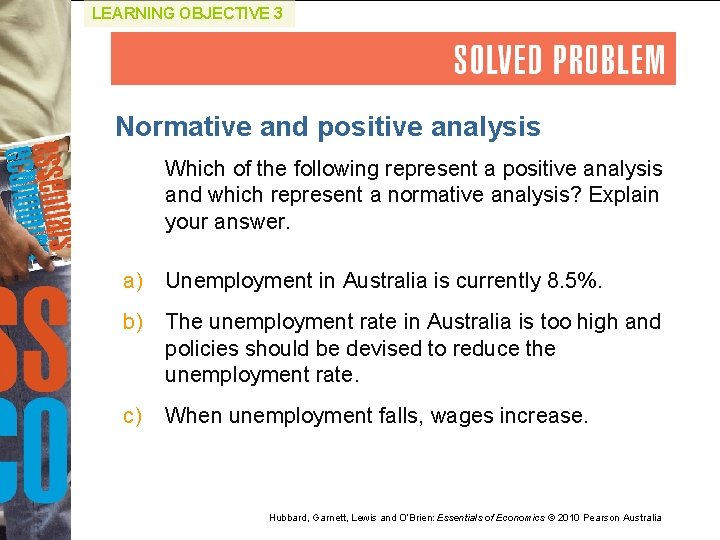
LEARNING OBJECTIVE 3 Normative and positive analysis Which of the following represent a positive analysis and which represent a normative analysis? Explain your answer. a) Unemployment in Australia is currently 8. 5%. b) The unemployment rate in Australia is too high and policies should be devised to reduce the unemployment rate. c) When unemployment falls, wages increase. Hubbard, Garnett, Lewis and O’Brien: Essentials of Economics © 2010 Pearson Australia
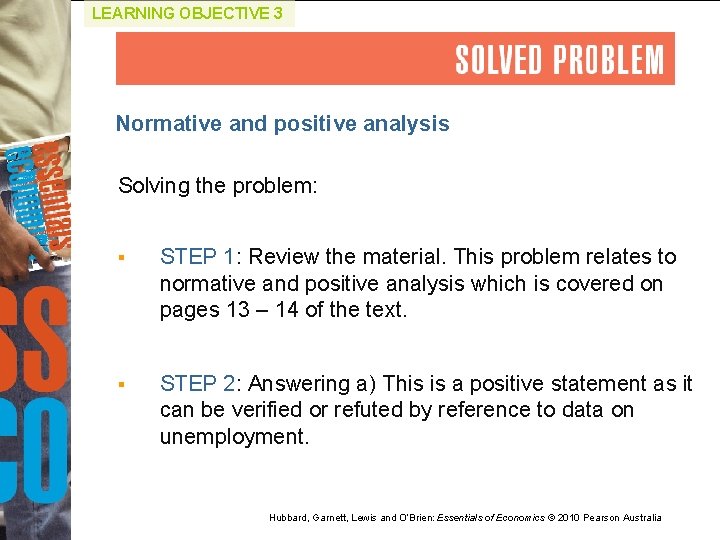
LEARNING OBJECTIVE 3 Normative and positive analysis Solving the problem: § STEP 1: Review the material. This problem relates to normative and positive analysis which is covered on pages 13 – 14 of the text. § STEP 2: Answering a) This is a positive statement as it can be verified or refuted by reference to data on unemployment. Hubbard, Garnett, Lewis and O’Brien: Essentials of Economics © 2010 Pearson Australia
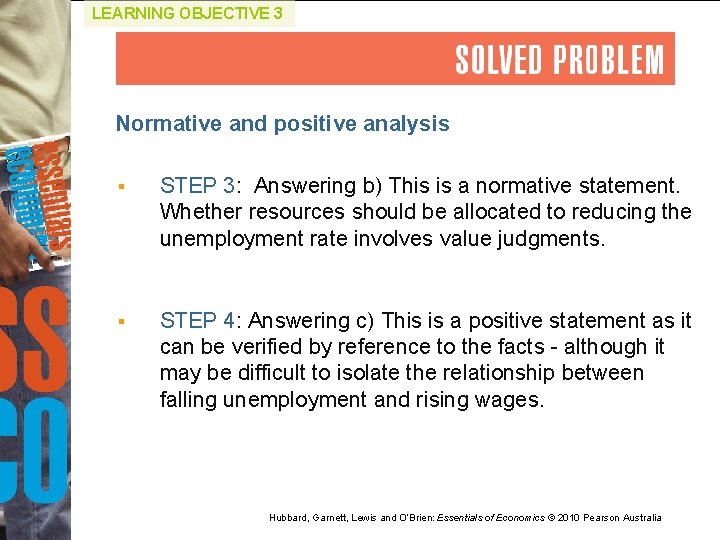
LEARNING OBJECTIVE 3 Normative and positive analysis § STEP 3: Answering b) This is a normative statement. Whether resources should be allocated to reducing the unemployment rate involves value judgments. § STEP 4: Answering c) This is a positive statement as it can be verified by reference to the facts - although it may be difficult to isolate the relationship between falling unemployment and rising wages. Hubbard, Garnett, Lewis and O’Brien: Essentials of Economics © 2010 Pearson Australia
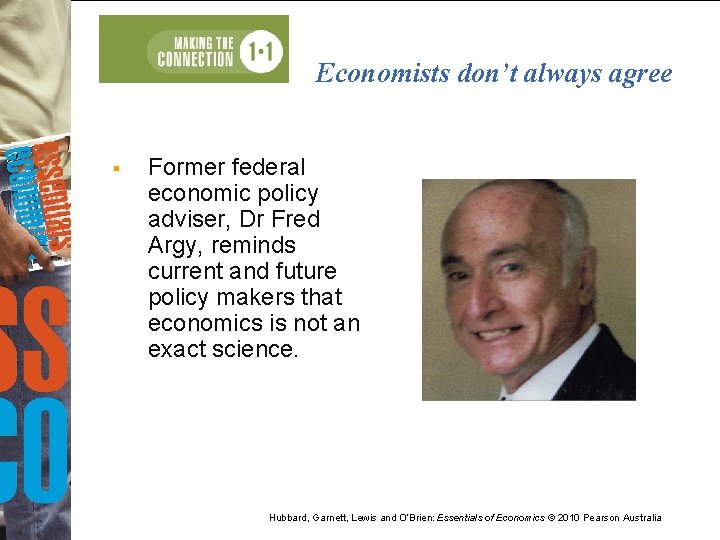
Economists don’t always agree § Former federal economic policy adviser, Dr Fred Argy, reminds current and future policy makers that economics is not an exact science. Hubbard, Garnett, Lewis and O’Brien: Essentials of Economics © 2010 Pearson Australia
LEARNING OBJECTIVE 4 Microeconomics and Macroeconomics Microeconomics: The study of how households and firms make choices, how they interact in markets, and how the government attempts to influence their choices. § Macroeconomics: The study of the economy as a whole, including topics such as inflation, unemployment, and economic growth. § Hubbard, Garnett, Lewis and O’Brien: Essentials of Economics © 2010 Pearson Australia
An Inside Look Figure 1. Water use in Australia, 2004 -05 Hubbard, Garnett, Lewis and O’Brien: Essentials of Economics © 2010 Pearson Australia
Key Terms § § § § § Allocative efficiency Centrally planned economy Consumer sovereignty Dynamic efficiency Economic models Economic variable Economics Equity Macroeconomics Marginal analysis § § § Market economy Microeconomics Mixed economy Normative analysis Opportunity cost Positive analysis Productive (technical) efficiency Scarcity Trade-off Voluntary exchange Hubbard, Garnett, Lewis and O’Brien: Essentials of Economics © 2010 Pearson Australia
Check Your Knowledge Q 1. Which of the following statements best describes scarcity? a. Scarcity studies the choices people make to attain their goals. b. Scarcity is a situation where unlimited wants exceed limited resources. c. Scarcity is an imbalance between buyers and sellers in a specific market. d. Scarcity refers to a lack of trade-offs. Hubbard, Garnett, Lewis and O’Brien: Essentials of Economics © 2010 Pearson Australia
Check Your Knowledge Q 1. Which of the following statements best describes scarcity? a. Scarcity studies the choices people make to attain their goals. b. Scarcity is a situation where unlimited wants exceed limited resources. c. Scarcity is an imbalance between buyers and sellers in a specific market. d. Scarcity refers to a lack of trade-offs. Hubbard, Garnett, Lewis and O’Brien: Essentials of Economics © 2010 Pearson Australia
Check Your Knowledge Q 2. What does an economy achieve by producing a good or service using the least amount of resources? a. Productive efficiency b. Allocative efficiency c. Voluntary exchange d. Equity Hubbard, Garnett, Lewis and O’Brien: Essentials of Economics © 2010 Pearson Australia
Check Your Knowledge Q 2. What does an economy achieve by producing a good or service using the least amount of resources? a. Productive efficiency b. Allocative efficiency c. Voluntary exchange d. Equity Hubbard, Garnett, Lewis and O’Brien: Essentials of Economics © 2010 Pearson Australia
Check Your Knowledge Q 3. What is the purpose of an economic hypothesis? a. To establish a behavioural assumption. b. To establish a causal relationship. c. To make a statement based on fact. d. To determine the validity of statistical analyses used in testing a model. Hubbard, Garnett, Lewis and O’Brien: Essentials of Economics © 2010 Pearson Australia
Check Your Knowledge Q 3. What is the purpose of an economic hypothesis? a. To establish a behavioural assumption. b. To establish a causal relationship. c. To make a statement based on fact. d. To determine the validity of statistical analyses used in testing a model. Hubbard, Garnett, Lewis and O’Brien: Essentials of Economics © 2010 Pearson Australia
Check Your Knowledge Q 4. What type of statement would ‘A minimum wage actually reduces unemployment’ be considered? a. A positive statement b. A marginal statement c. A normative statement d. An irrational conclusion Hubbard, Garnett, Lewis and O’Brien: Essentials of Economics © 2010 Pearson Australia
Check Your Knowledge Q 4. What type of statement would ‘A minimum wage actually reduces unemployment’ be considered? a. A positive statement b. A marginal statement c. A normative statement d. An irrational conclusion Hubbard, Garnett, Lewis and O’Brien: Essentials of Economics © 2010 Pearson Australia
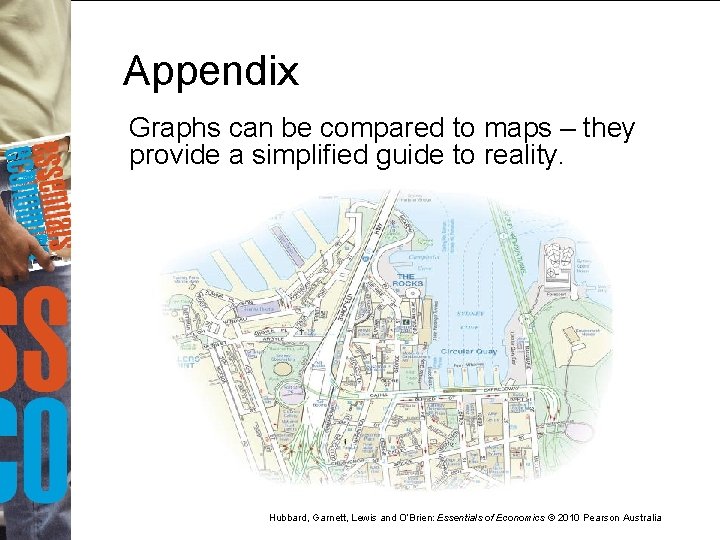
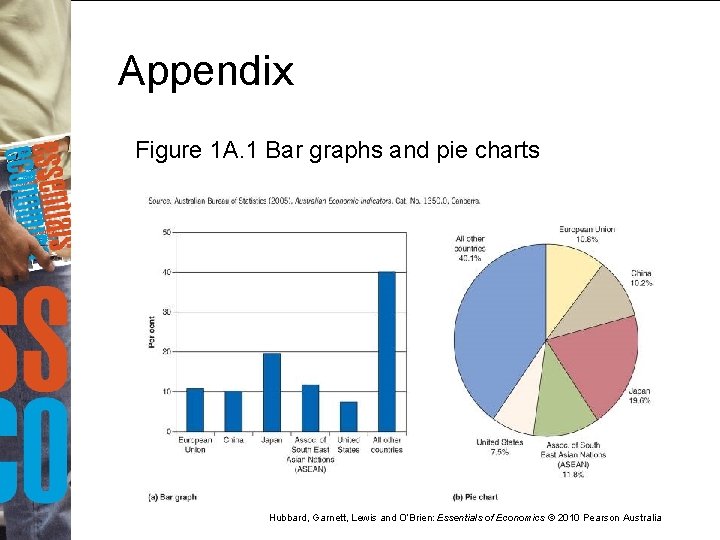
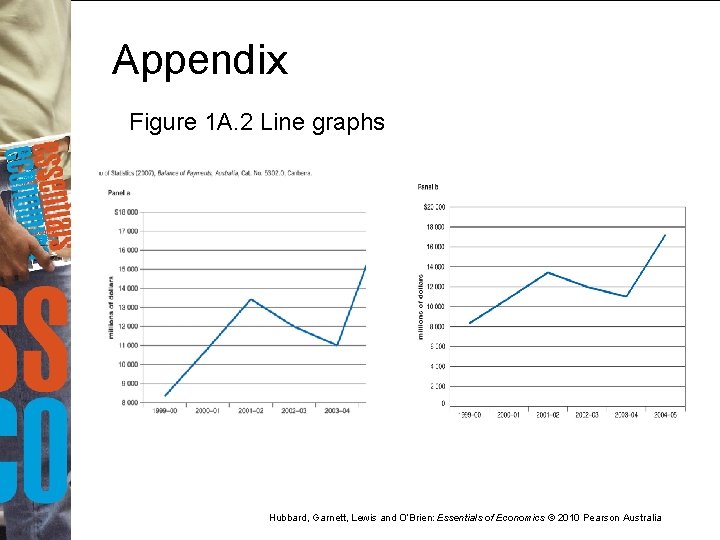
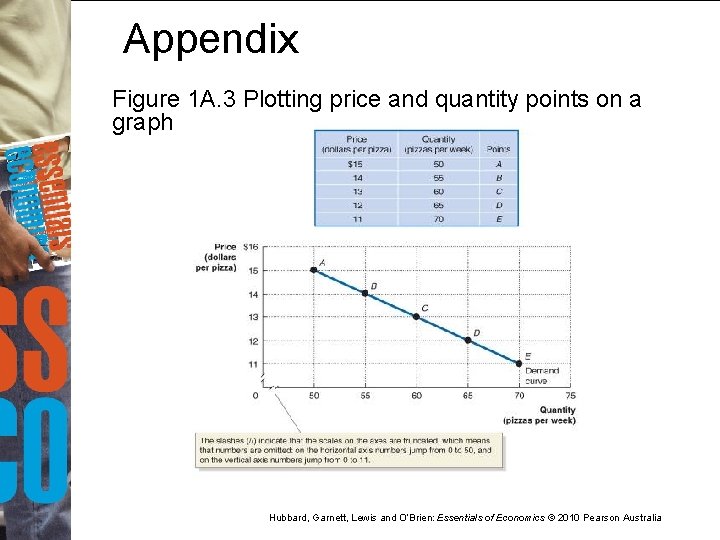
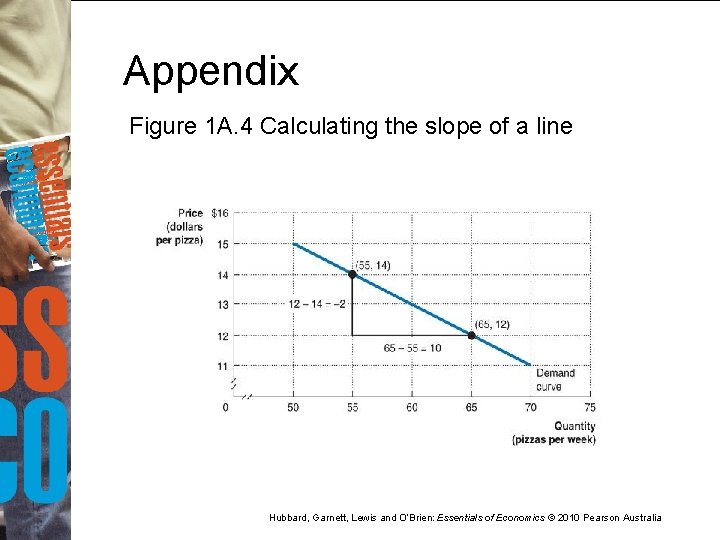
Appendix Graphs can be compared to maps – they provide a simplified guide to reality. Hubbard, Garnett, Lewis and O’Brien: Essentials of Economics © 2010 Pearson Australia
Appendix Figure 1 A. 1 Bar graphs and pie charts Hubbard, Garnett, Lewis and O’Brien: Essentials of Economics © 2010 Pearson Australia
Appendix Figure 1 A. 2 Line graphs Hubbard, Garnett, Lewis and O’Brien: Essentials of Economics © 2010 Pearson Australia
Appendix Figure 1 A. 3 Plotting price and quantity points on a graph Hubbard, Garnett, Lewis and O’Brien: Essentials of Economics © 2010 Pearson Australia
Appendix Figure 1 A. 4 Calculating the slope of a line Hubbard, Garnett, Lewis and O’Brien: Essentials of Economics © 2010 Pearson Australia
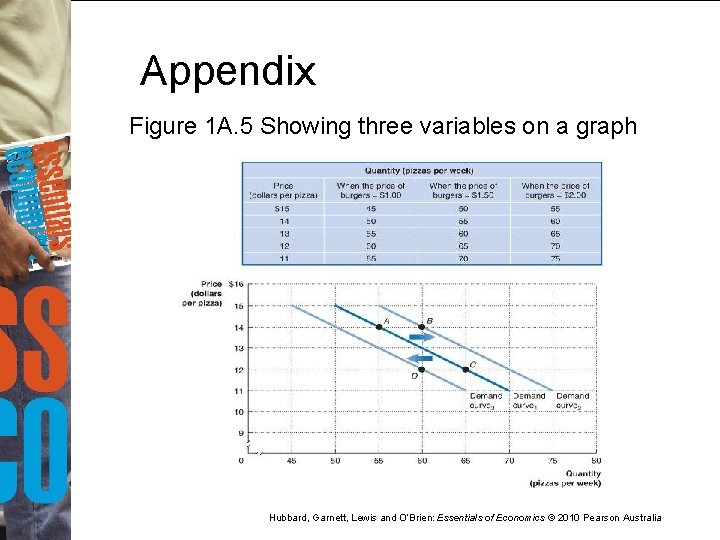
Appendix Figure 1 A. 5 Showing three variables on a graph Hubbard, Garnett, Lewis and O’Brien: Essentials of Economics © 2010 Pearson Australia
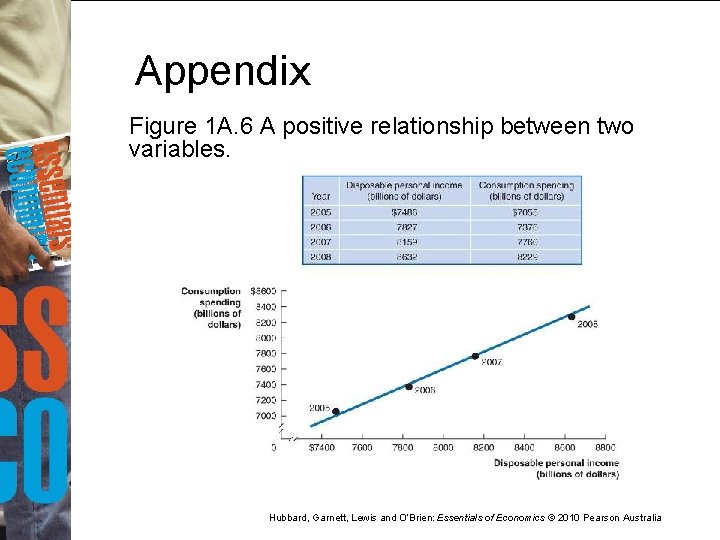
Appendix Figure 1 A. 6 A positive relationship between two variables. Hubbard, Garnett, Lewis and O’Brien: Essentials of Economics © 2010 Pearson Australia
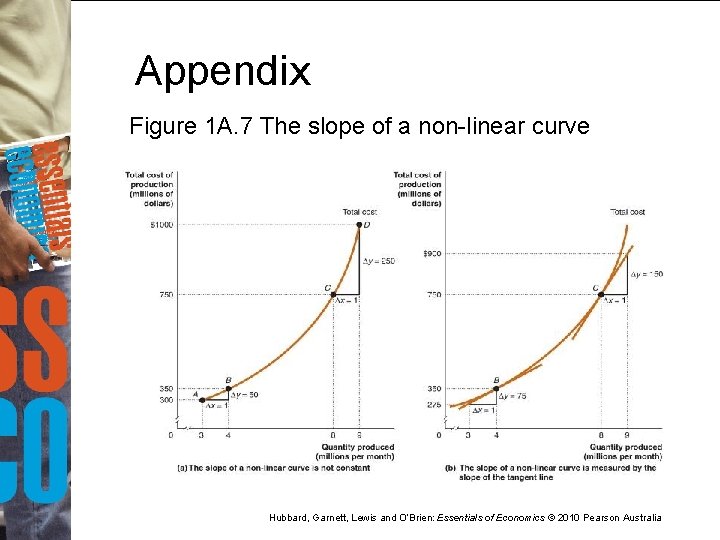
Appendix Figure 1 A. 7 The slope of a non-linear curve Hubbard, Garnett, Lewis and O’Brien: Essentials of Economics © 2010 Pearson Australia
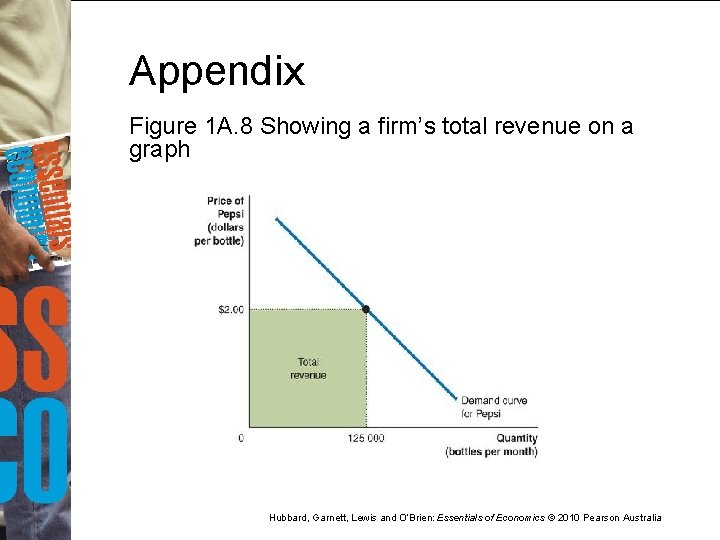
Appendix Figure 1 A. 8 Showing a firm’s total revenue on a graph Hubbard, Garnett, Lewis and O’Brien: Essentials of Economics © 2010 Pearson Australia
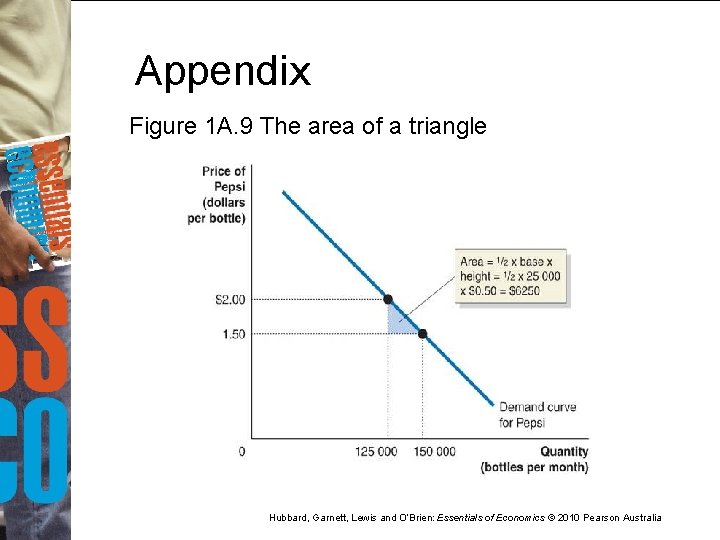
Appendix Figure 1 A. 9 The area of a triangle Hubbard, Garnett, Lewis and O’Brien: Essentials of Economics © 2010 Pearson Australia