
Power Point Slides to accompany prepared by Sally
Power. Point® Slides to accompany prepared by Sally Wylie and Kristine Fenning Copyright © 2012 by Nelson Education Ltd. 1
CHAPTER 4 Observing and Recording Unanticipated Behaviours 2
Internet Class Exercise This exercise examines the site http: //ecrp. uiuc. edu/v 7 n 2/forman. html In what ways does this site confirm and expand on the practices described in this chapter? Reflect and discuss in small groups. 3
Anecdotal Records • record unanticipated behaviours • used in informal settings to record behaviour that is natural and spontaneous – Natural observation vs. contrived observation • record contextual information: – Make appropriate reference to other children, adults, and the environment • consist of objective observations and subjective interpretations 4
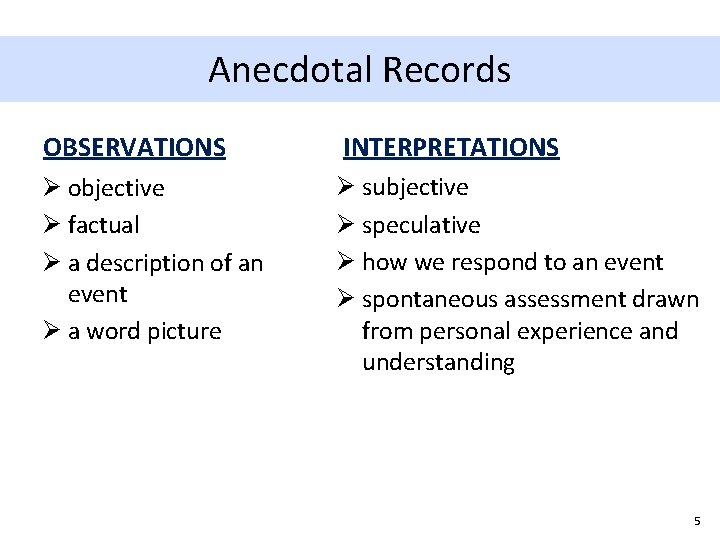
Anecdotal Records OBSERVATIONS Ø objective Ø factual Ø a description of an event Ø a word picture INTERPRETATIONS Ø subjective Ø speculative Ø how we respond to an event Ø spontaneous assessment drawn from personal experience and understanding 5
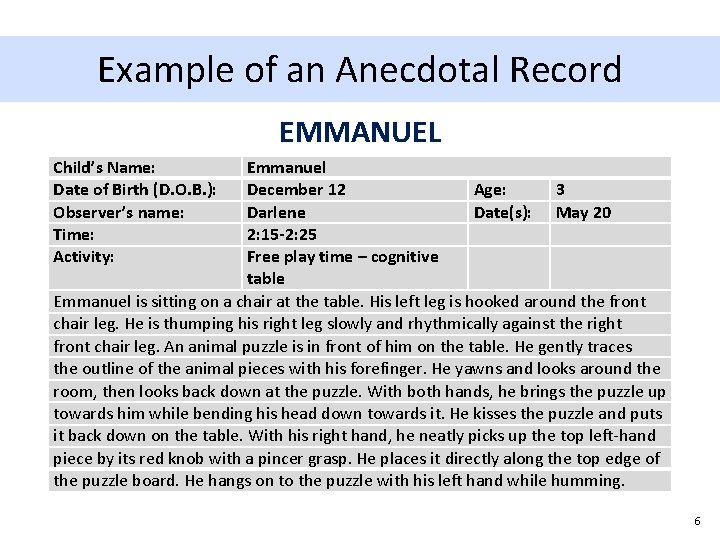
Example of an Anecdotal Record EMMANUEL Child’s Name: Date of Birth (D. O. B. ): Observer’s name: Time: Activity: Emmanuel December 12 Age: 3 Darlene Date(s): May 20 2: 15 -2: 25 Free play time – cognitive table Emmanuel is sitting on a chair at the table. His left leg is hooked around the front chair leg. He is thumping his right leg slowly and rhythmically against the right front chair leg. An animal puzzle is in front of him on the table. He gently traces the outline of the animal pieces with his forefinger. He yawns and looks around the room, then looks back down at the puzzle. With both hands, he brings the puzzle up towards him while bending his head down towards it. He kisses the puzzle and puts it back down on the table. With his right hand, he neatly picks up the top left-hand piece by its red knob with a pincer grasp. He places it directly along the top edge of the puzzle board. He hangs on to the puzzle with his left hand while humming. 6
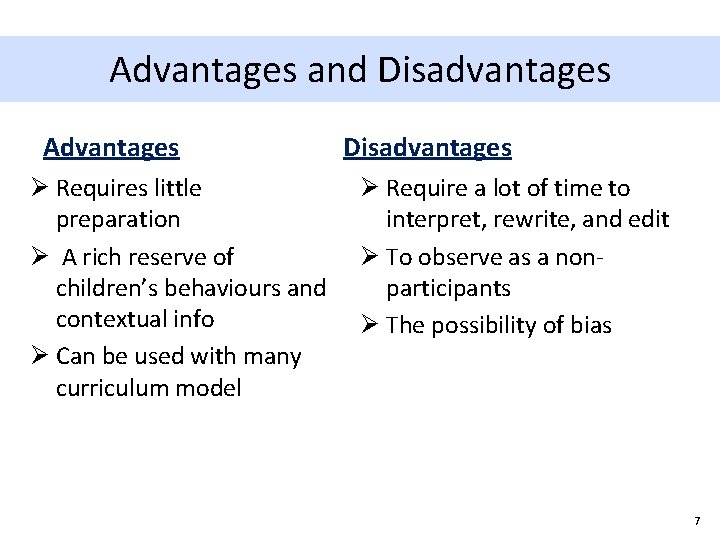
Advantages and Disadvantages Advantages Ø Requires little preparation Ø A rich reserve of children’s behaviours and contextual info Ø Can be used with many curriculum model Disadvantages Ø Require a lot of time to interpret, rewrite, and edit Ø To observe as a nonparticipants Ø The possibility of bias 7
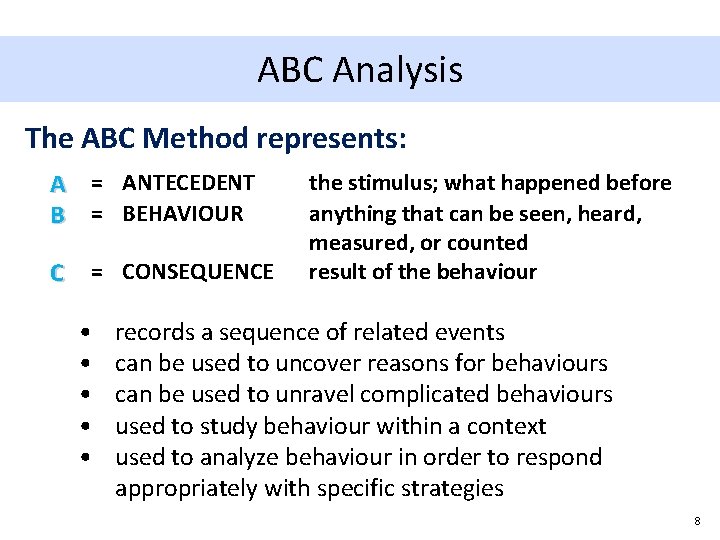
ABC Analysis The ABC Method represents: A = ANTECEDENT B = BEHAVIOUR C = CONSEQUENCE • • • the stimulus; what happened before anything that can be seen, heard, measured, or counted result of the behaviour records a sequence of related events can be used to uncover reasons for behaviours can be used to unravel complicated behaviours used to study behaviour within a context used to analyze behaviour in order to respond appropriately with specific strategies 8
Internet Class Discussion Go to the source located at http: //ecrp. uiuc. edu/v 7 n 2/forman. html Discuss the terms “abbreviated action” and “meta-cognition”. How are these terms dependent on the role of observation? Reflect and discuss in small groups. 9
Behaviouristic Approach Ø Pavlov, Skinner, and Watson Ø Use external stimuli in the learning environment rather than the internal states of conditions of the learner to explain learning behaviours Ø Skinner’s concepts of operant conditioning and reinforcement Ø Behaviours that are rewarded are likely to be repeated: Rewards (consequences) 10
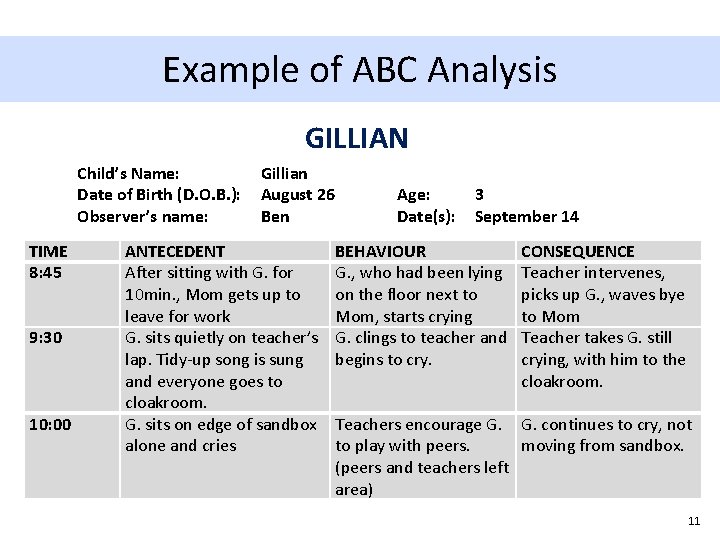
Example of ABC Analysis GILLIAN Child’s Name: Date of Birth (D. O. B. ): Observer’s name: TIME 8: 45 9: 30 10: 00 Gillian August 26 Ben ANTECEDENT After sitting with G. for 10 min. , Mom gets up to leave for work G. sits quietly on teacher’s lap. Tidy-up song is sung and everyone goes to cloakroom. G. sits on edge of sandbox alone and cries Age: Date(s): 3 September 14 BEHAVIOUR G. , who had been lying on the floor next to Mom, starts crying G. clings to teacher and begins to cry. CONSEQUENCE Teacher intervenes, picks up G. , waves bye to Mom Teacher takes G. still crying, with him to the cloakroom. Teachers encourage G. continues to cry, not to play with peers. moving from sandbox. (peers and teachers left area) 11
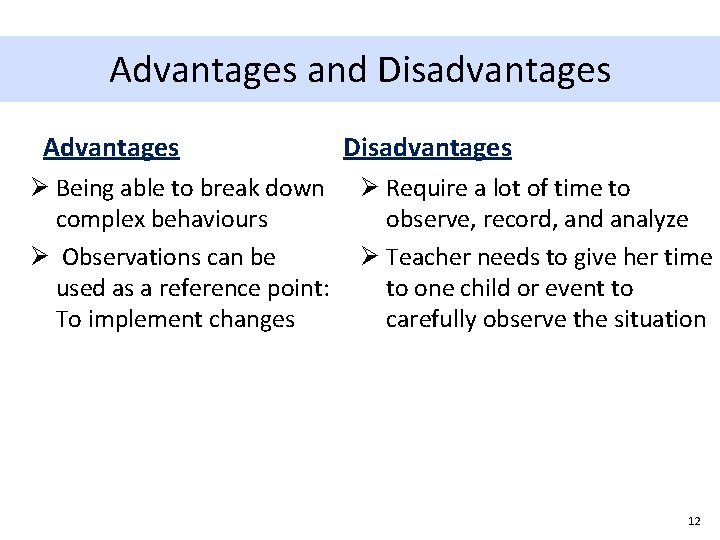
Advantages and Disadvantages Advantages Disadvantages Ø Being able to break down Ø Require a lot of time to complex behaviours observe, record, and analyze Ø Observations can be Ø Teacher needs to give her time used as a reference point: to one child or event to To implement changes carefully observe the situation 12
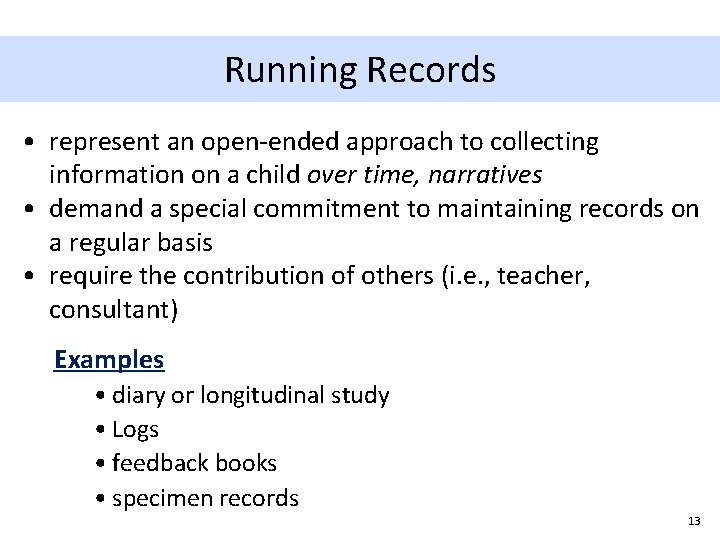
Running Records • represent an open-ended approach to collecting information on a child over time, narratives • demand a special commitment to maintaining records on a regular basis • require the contribution of others (i. e. , teacher, consultant) Examples • diary or longitudinal study • Logs • feedback books • specimen records 13
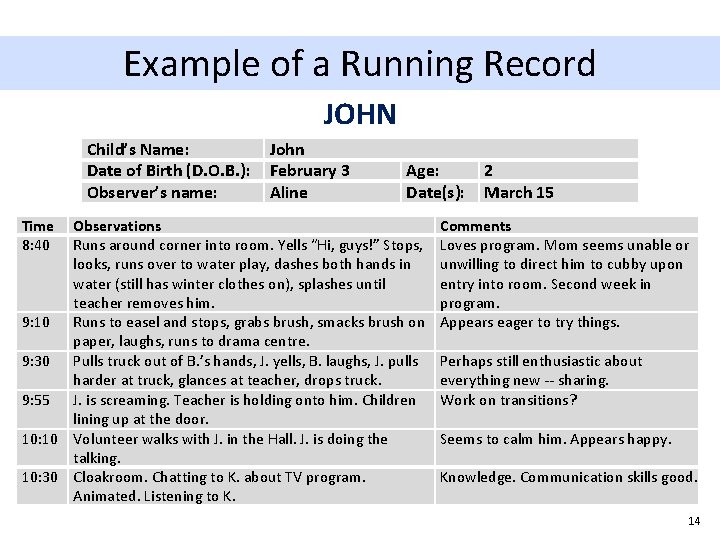
Example of a Running Record JOHN Child’s Name: Date of Birth (D. O. B. ): Observer’s name: Time 8: 40 John February 3 Aline Age: Date(s): Observations Runs around corner into room. Yells “Hi, guys!” Stops, looks, runs over to water play, dashes both hands in water (still has winter clothes on), splashes until teacher removes him. 9: 10 Runs to easel and stops, grabs brush, smacks brush on paper, laughs, runs to drama centre. 9: 30 Pulls truck out of B. ’s hands, J. yells, B. laughs, J. pulls harder at truck, glances at teacher, drops truck. 9: 55 J. is screaming. Teacher is holding onto him. Children lining up at the door. 10: 10 Volunteer walks with J. in the Hall. J. is doing the talking. 10: 30 Cloakroom. Chatting to K. about TV program. Animated. Listening to K. 2 March 15 Comments Loves program. Mom seems unable or unwilling to direct him to cubby upon entry into room. Second week in program. Appears eager to try things. Perhaps still enthusiastic about everything new -- sharing. Work on transitions? Seems to calm him. Appears happy. Knowledge. Communication skills good. 14
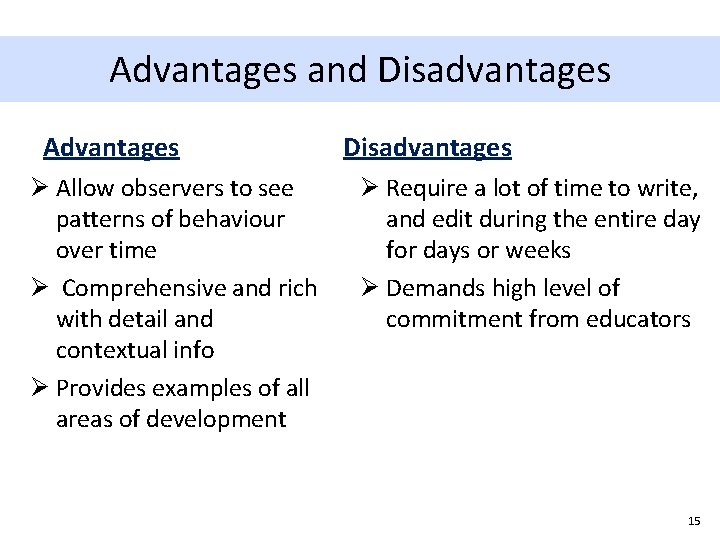
Advantages and Disadvantages Advantages Ø Allow observers to see patterns of behaviour over time Ø Comprehensive and rich with detail and contextual info Ø Provides examples of all areas of development Disadvantages Ø Require a lot of time to write, and edit during the entire day for days or weeks Ø Demands high level of commitment from educators 15
The Halls of Fanshawe Observation • Follow up
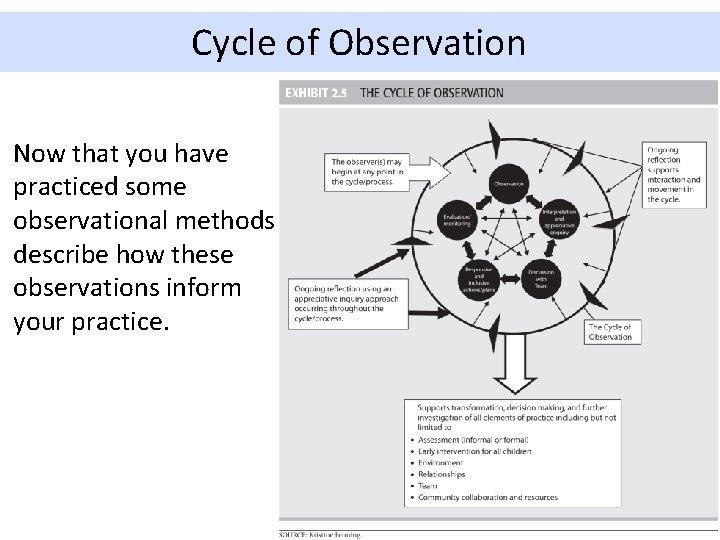
Cycle of Observation Now that you have practiced some observational methods, describe how these observations inform your practice. 17
Values Clarification • Solo work: fill up the form individually • Share with a partner
- Slides: 18