
Power Point Slides The Language of Bits Computer
Power. Point Slides The Language of Bits Computer Organisation and Architecture Smruti Ranjan Sarangi, IIT Delhi Chapter 2 The Language of Bits PROPRIETARY MATERIAL. © 2014 The Mc. Graw-Hill Companies, Inc. All rights reserved. No part of this Power. Point slide may be displayed, reproduced or distributed in any form or by any means, without the prior written permission of the publisher, or used beyond the limited distribution to teachers and educators permitted by Mc. Graw-Hill for their individual course preparation. Power. Point Slides are being provided only to authorized professors and instructors for use in preparing for classes using the affiliated textbook. No other use or distribution of this Power. Point slide is permitted. The Power. Point slide may not be sold and may not be distributed or be used by any student or any other third party. No part of the slide may be reproduced, displayed or distributed in any form or by any means, electronic or otherwise, without the prior written permission of Mc. Graw Hill Education (India) Private Limited. 1
These slides are meant to be used along with the book: Computer Organisation and Architecture, Smruti Ranjan Sarangi, Mc. Graw. Hill 2015 Visit: http: //www. cse. iitd. ernet. in/~srsarangi/archbooksoft. html
Outline Boolean Algebra Positive Integers Negative Integers Floating-Point Numbers Strings 3

What does a Computer Understand ? Computers do not understand natural human languages, nor programming languages They only understand the language of bits Bit 0 or 1 Byte 08 or bits 1 Word 40 bytes or 1 1024 0 or 1 bytes kilo. Byte 1006 or bytes 1 mega. Byte 4 4
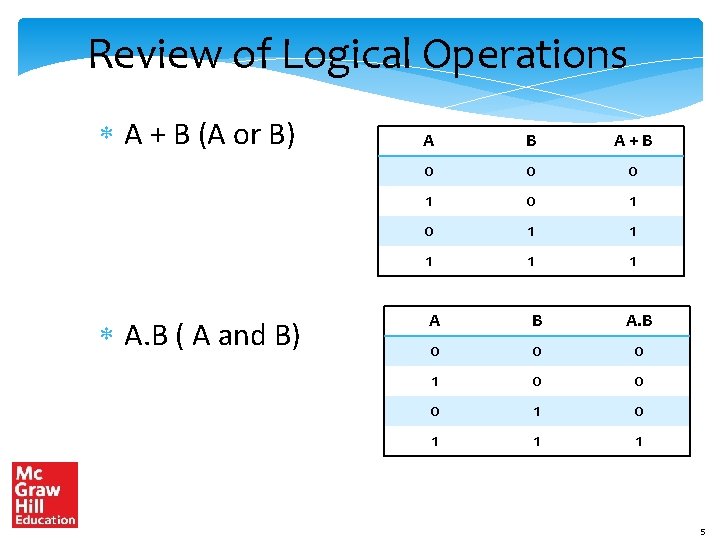
Review of Logical Operations A + B (A or B) A. B ( A and B) A B A+B 0 0 0 1 0 1 1 1 A B A. B 0 0 0 1 0 1 1 1 5
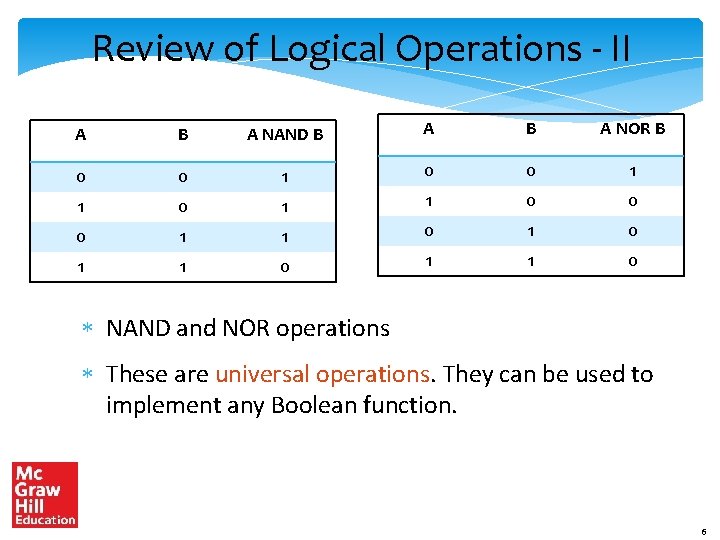
Review of Logical Operations - II A B A NAND B A NOR B 0 0 1 1 0 1 1 0 NAND and NOR operations These are universal operations. They can be used to implement any Boolean function. 6

Review of Logical Operations XOR Operation : (A B) A B A XOR B 0 0 0 1 0 1 1 0 7
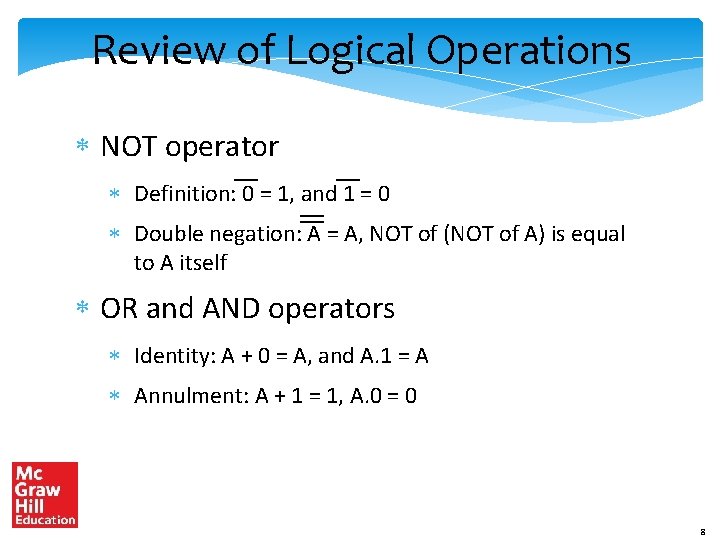
Review of Logical Operations NOT operator Definition: 0 = 1, and 1 = 0 Double negation: A = A, NOT of (NOT of A) is equal to A itself OR and AND operators Identity: A + 0 = A, and A. 1 = A Annulment: A + 1 = 1, A. 0 = 0 8
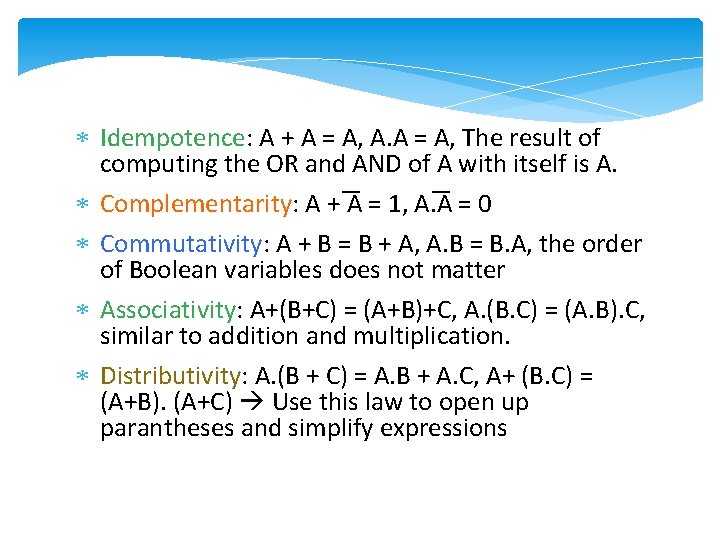
Idempotence: A + A = A, A. A = A, The result of computing the OR and AND of A with itself is A. Complementarity: A + A = 1, A. A = 0 Commutativity: A + B = B + A, A. B = B. A, the order of Boolean variables does not matter Associativity: A+(B+C) = (A+B)+C, A. (B. C) = (A. B). C, similar to addition and multiplication. Distributivity: A. (B + C) = A. B + A. C, A+ (B. C) = (A+B). (A+C) Use this law to open up parantheses and simplify expressions
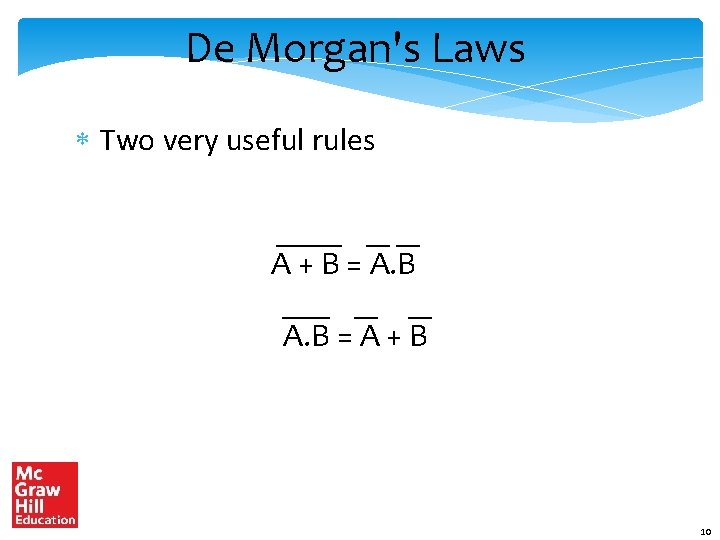
De Morgan's Laws Two very useful rules A + B = A + B 10
Consensus Theorem Prove : X. Y + X. Z + Y. Z = X. Y + X. Z 11
Outline Boolean Algebra Positive Integers Negative Integers Floating Point Numbers Strings 12
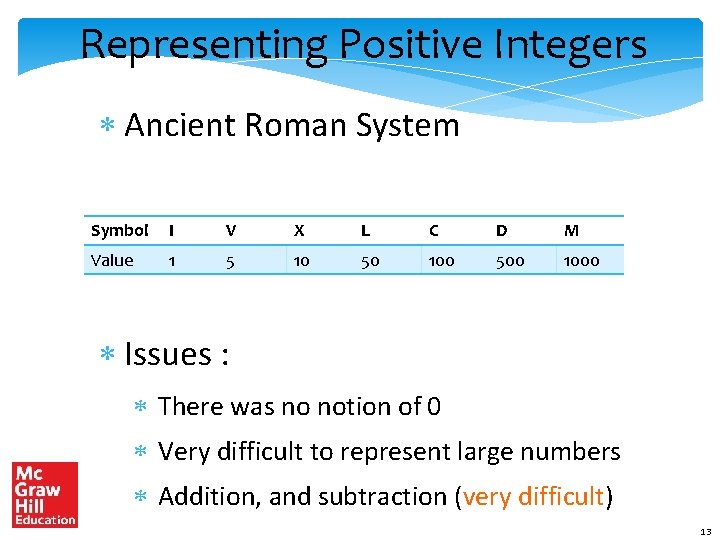
Representing Positive Integers Ancient Roman System Symbol I V X L C D M Value 1 5 10 50 100 500 1000 Issues : There was no notion of 0 Very difficult to represent large numbers Addition, and subtraction (very difficult) 13
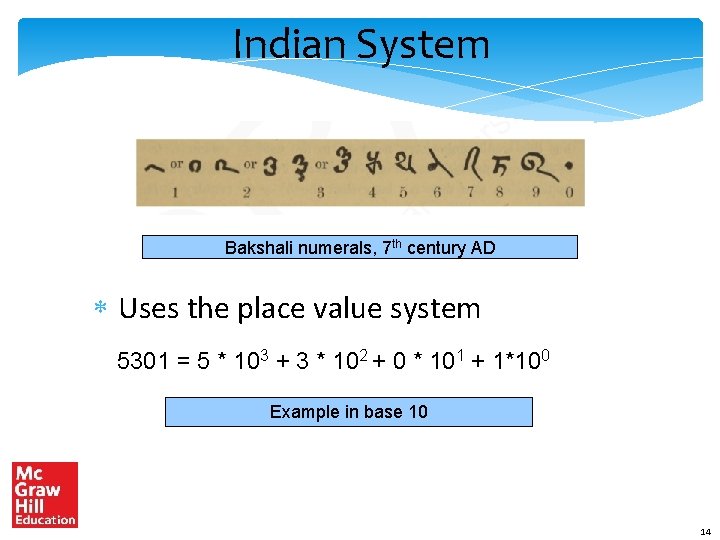
Indian System Bakshali numerals, 7 th century AD Uses the place value system 5301 = 5 * 103 + 3 * 102 + 0 * 101 + 1*100 Example in base 10 14
Number Systems in Other Bases Why do we use base 10 ? because. . . 15
What if we had a world in which. . . People had only two fingers. 16
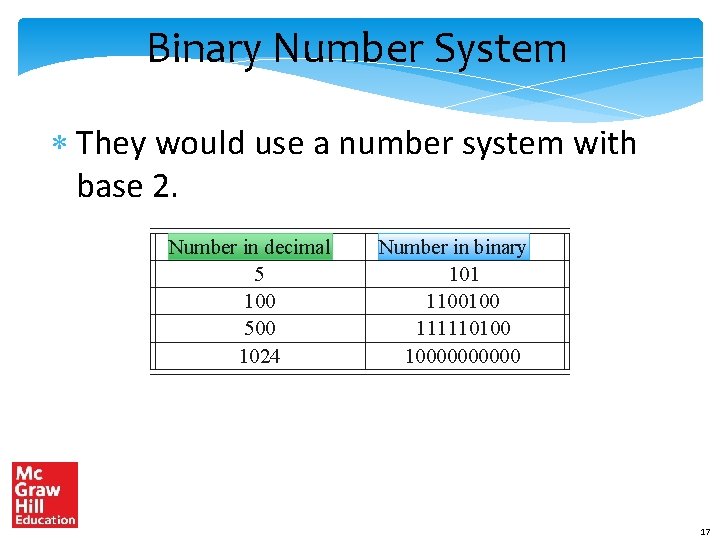
Binary Number System They would use a number system with base 2. Number in decimal 5 100 500 1024 Number in binary 101 1100100 111110100 100000 17
MSB and LSB MSB (Most Significant Bit) The leftmost bit of a binary number. E. g. , MSB of 1110 is 1 LSB (Least Significant Bit) The rightmost bit of a binary number. E. g. , LSB of 1110 is 0 18
Hexadecimal and Octal Numbers Hexadecimal numbers Base 16 numbers – 0, 1, 2, 3, 4, 5, 6, 7, 8, 9, A, B, C, D, E, F Start with 0 x Octal Numbers Base 8 numbers – 0, 1, 2, 3, 4, 5, 6, 7 Start with 0 19
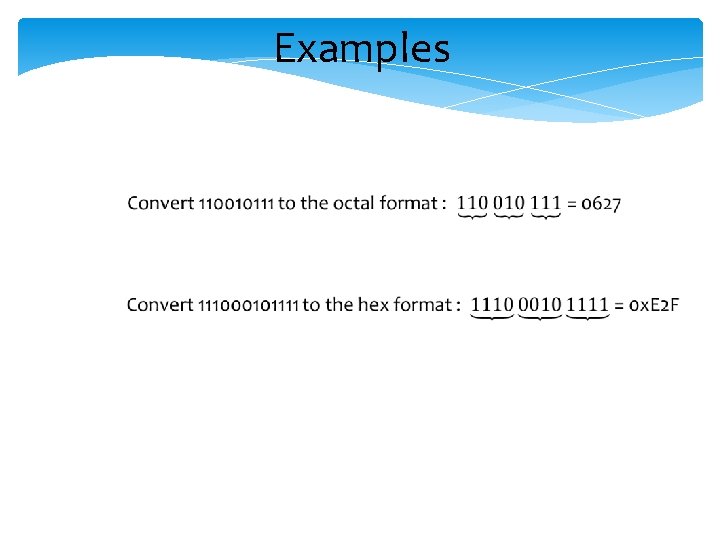
Examples
Outline Boolean Algebra Positive Integers Negative Integers Floating Point Numbers Strings 21
Representing Negative Integers Problem Assign a binary representation to a negative integer Consider a negative integer, S Let its binary representation be : xnxn-1…. x 2 x 1 (xi=0/1) We can also expand it to represent an unsigned, +ve, number, N If we interpret the binary sequence as : An unsigned number, we get N A signed number, we get S 22
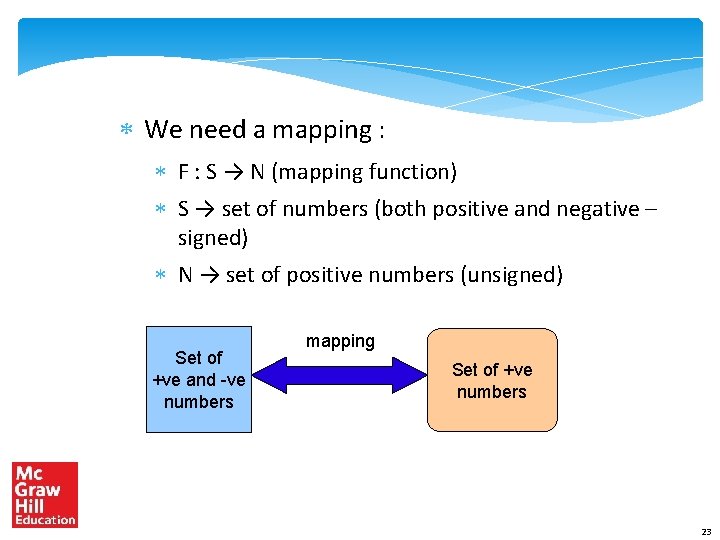
We need a mapping : F : S → N (mapping function) S → set of numbers (both positive and negative – signed) N → set of positive numbers (unsigned) Set of +ve and -ve numbers mapping Set of +ve numbers 23
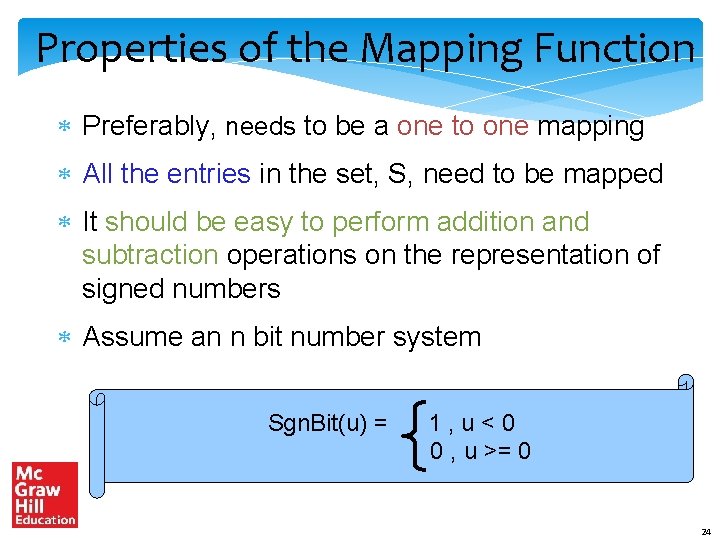
Properties of the Mapping Function Preferably, needs to be a one to one mapping All the entries in the set, S, need to be mapped It should be easy to perform addition and subtraction operations on the representation of signed numbers Assume an n bit number system Sgn. Bit(u) = 1, u<0 0 , u >= 0 24
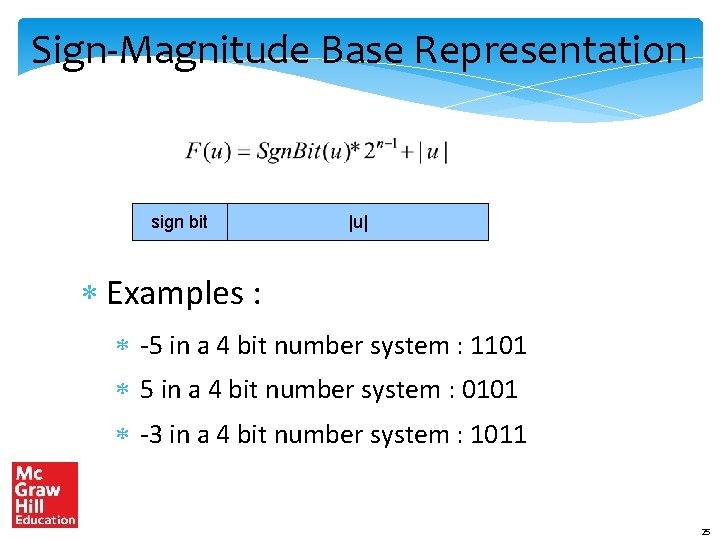
Sign-Magnitude Base Representation sign bit |u| Examples : -5 in a 4 bit number system : 1101 5 in a 4 bit number system : 0101 -3 in a 4 bit number system : 1011 25
Problems There are two representations for 0 000000 100000 Addition and subtraction are difficult The most important takeaway point : Notion of the sign bit 26
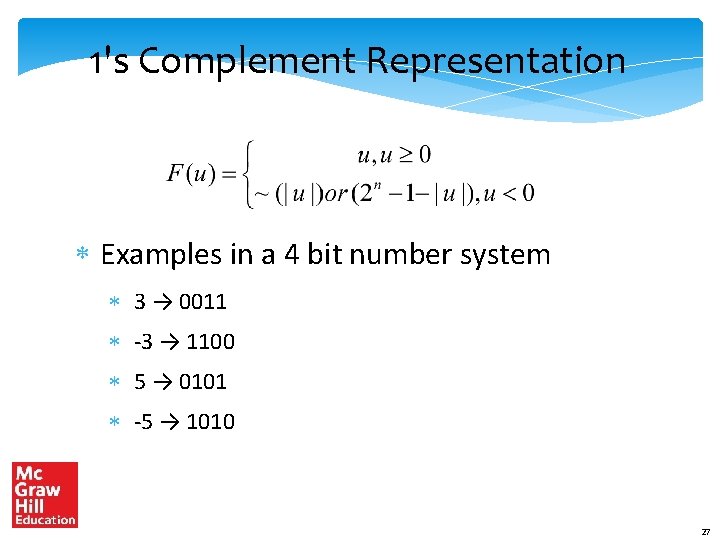
1's Complement Representation Examples in a 4 bit number system 3 → 0011 -3 → 1100 5 → 0101 -5 → 1010 27
Problems Two representations for 0 0000000 1111111 Easy to add +ve numbers Hard to add -ve numbers Point to note : The idea of a complement 28
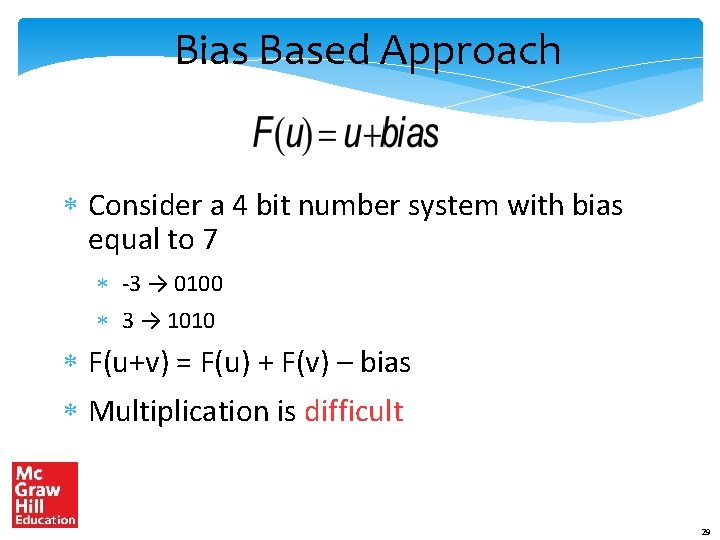
Bias Based Approach Consider a 4 bit number system with bias equal to 7 -3 → 0100 3 → 1010 F(u+v) = F(u) + F(v) – bias Multiplication is difficult 29
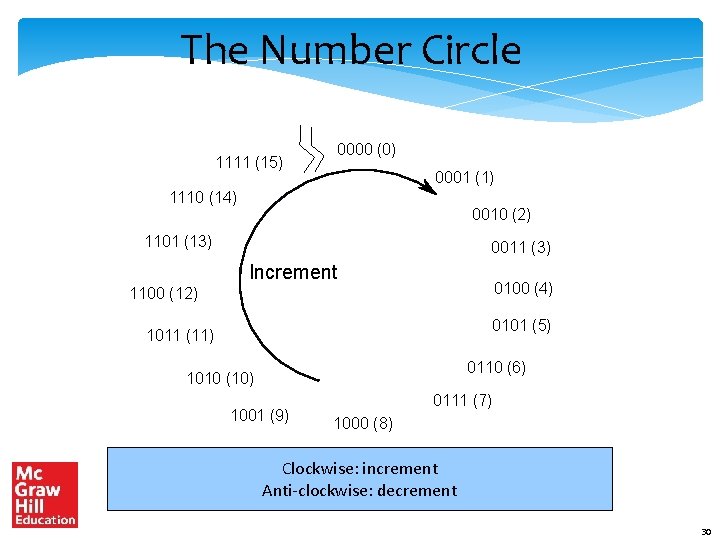
The Number Circle 1111 (15) 0000 (0) 0001 (1) 1110 (14) 0010 (2) 1101 (13) 0011 (3) Increment 0100 (4) 1100 (12) 0101 (5) 1011 (11) 0110 (6) 1010 (10) 1001 (9) 0111 (7) 1000 (8) Clockwise: increment Anti-clockwise: decrement 30
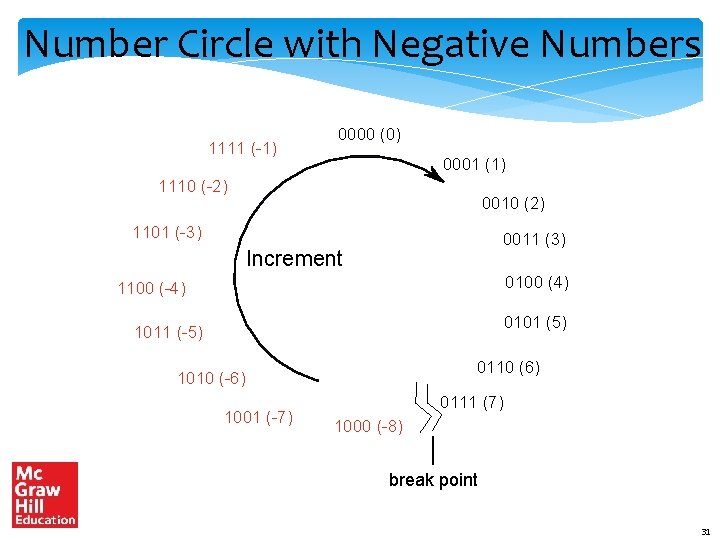
Number Circle with Negative Numbers 1111 (-1) 0000 (0) 0001 (1) 1110 (-2) 0010 (2) 1101 (-3) 0011 (3) Increment 0100 (4) 1100 (-4) 0101 (5) 1011 (-5) 0110 (6) 1010 (-6) 1001 (-7) 0111 (7) 1000 (-8) break point 31
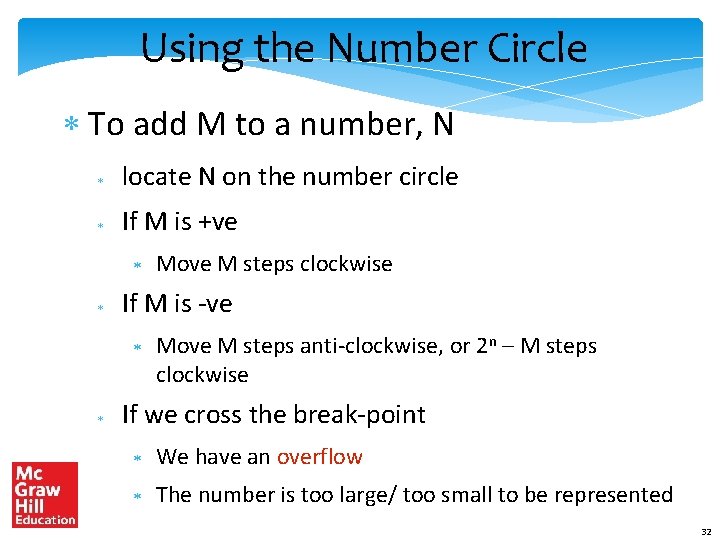
Using the Number Circle To add M to a number, N locate N on the number circle If M is +ve If M is -ve Move M steps clockwise Move M steps anti-clockwise, or 2 n – M steps clockwise If we cross the break-point We have an overflow The number is too large/ too small to be represented 32
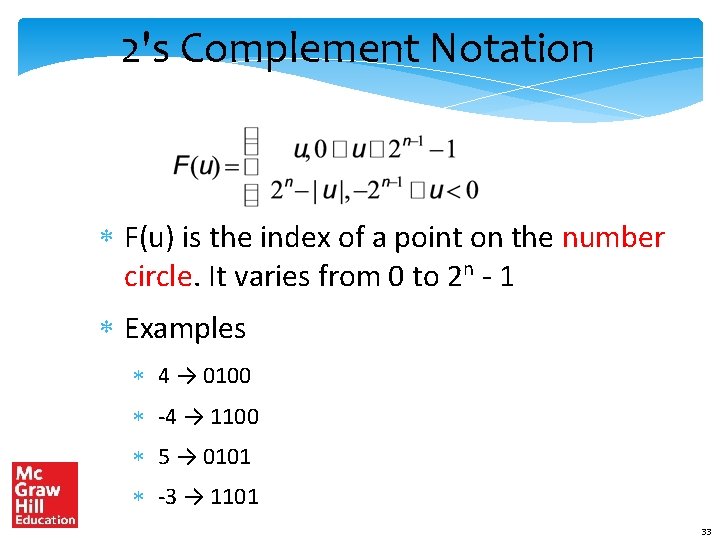
2's Complement Notation F(u) is the index of a point on the number circle. It varies from 0 to 2 n - 1 Examples 4 → 0100 -4 → 1100 5 → 0101 -3 → 1101 33
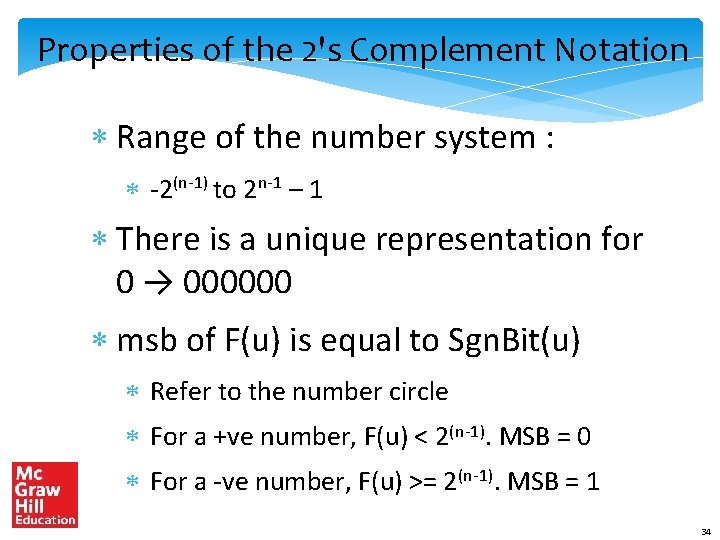
Properties of the 2's Complement Notation Range of the number system : -2(n-1) to 2 n-1 – 1 There is a unique representation for 0 → 000000 msb of F(u) is equal to Sgn. Bit(u) Refer to the number circle For a +ve number, F(u) < 2(n-1). MSB = 0 For a -ve number, F(u) >= 2(n-1). MSB = 1 34
![Properties - II Every number in the range [-2(n-1), 2(n-1) – 1] Has a](http://slidetodoc.com/presentation_image_h2/d2acfdab82d5fcd502a8f63ac28e4108/image-35.jpg "Properties - II Every number in the range [-2(n-1), 2(n-1) – 1] Has a")
Properties - II Every number in the range [-2(n-1), 2(n-1) – 1] Has a unique mapping Unique point in the number circle a ≡ b → (a = b mod 2 n) ≡ means same point on the number circle F(-u) ≡ 2 n – F(u) Moving F(u) steps counter clock wise is the same as moving 2 n – F(u) steps clockwise from 0 35
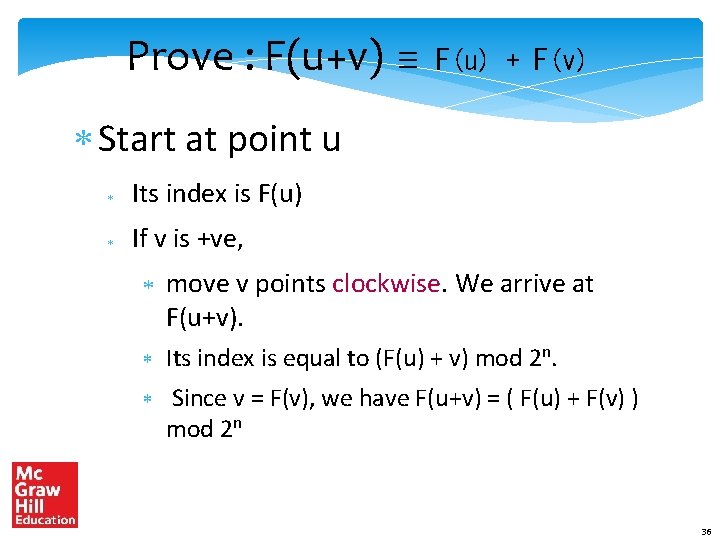
Prove : F(u+v) ≡ F(u) + F(v) Start at point u Its index is F(u) If v is +ve, move v points clockwise. We arrive at F(u+v). Its index is equal to (F(u) + v) mod 2 n. Since v = F(v), we have F(u+v) = ( F(u) + F(v) ) mod 2 n 36
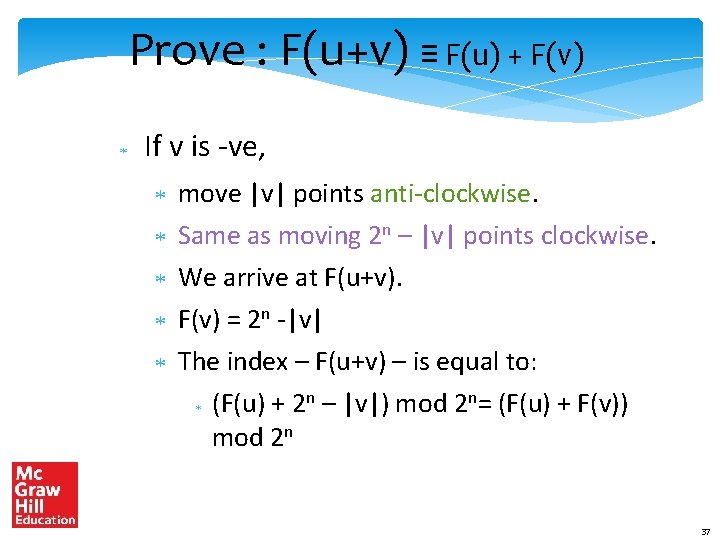
Prove : F(u+v) ≡ F(u) + F(v) If v is -ve, move |v| points anti-clockwise. Same as moving 2 n – |v| points clockwise. We arrive at F(u+v). F(v) = 2 n -|v| The index – F(u+v) – is equal to: (F(u) + 2 n – |v|) mod 2 n= (F(u) + F(v)) mod 2 n 37
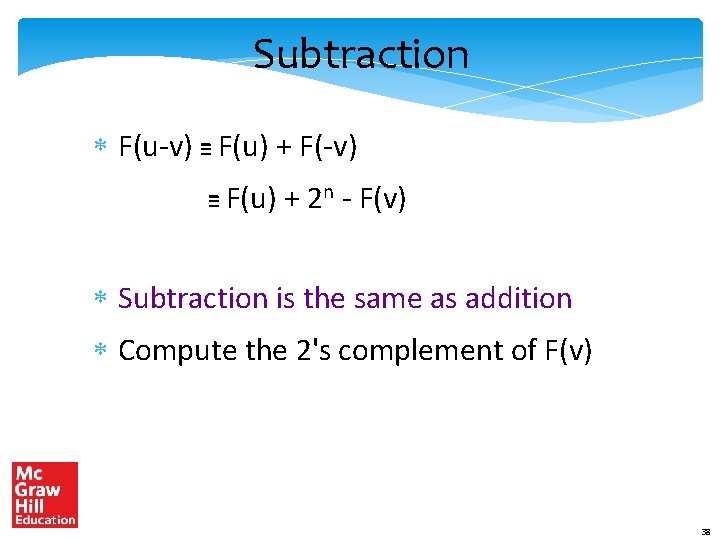
Subtraction F(u-v) ≡ F(u) + F(-v) ≡ F(u) + 2 n - F(v) Subtraction is the same as addition Compute the 2's complement of F(v) 38
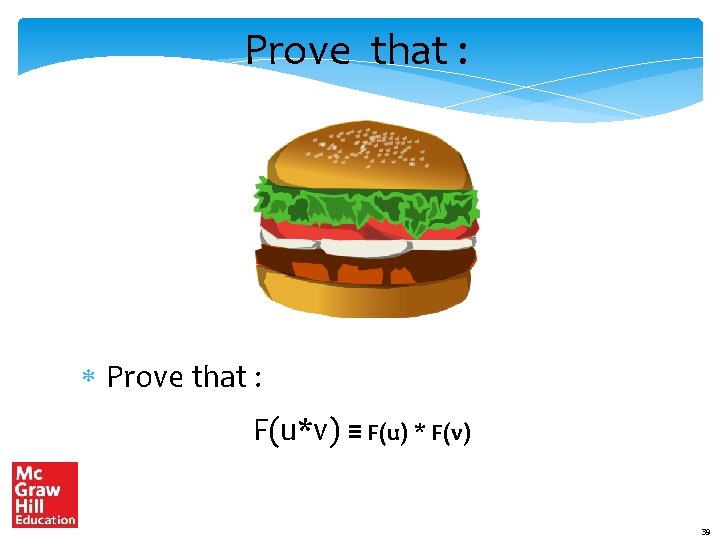
Prove that : F(u*v) ≡ F(u) * F(v) 39
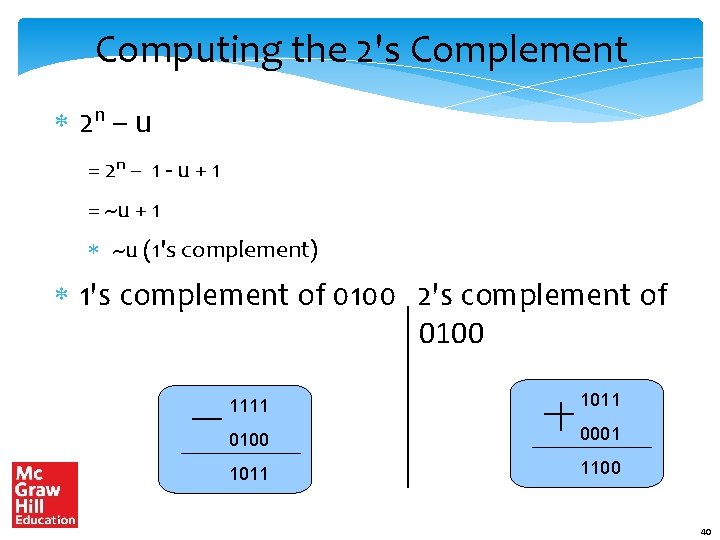
Computing the 2's Complement 2 n – u = 2 n – 1 - u + 1 = ~u + 1 ~u (1's complement) 1's complement of 0100 2's complement of 0100 1111 1011 0100 0001 1011 1100 40
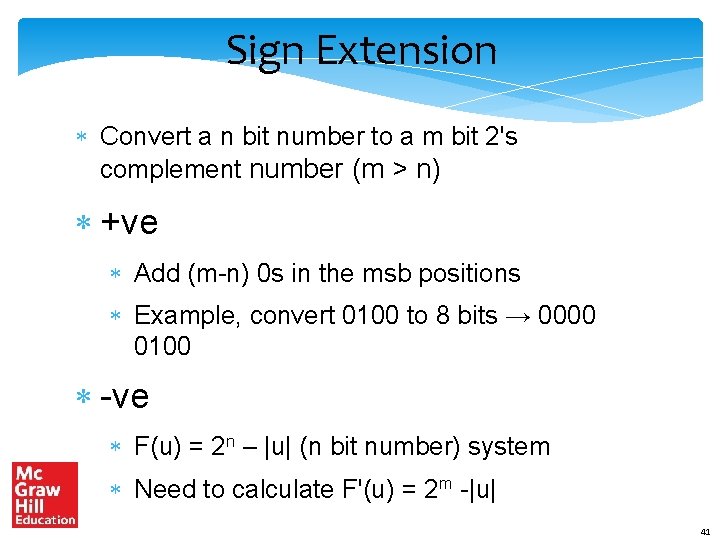
Sign Extension Convert a n bit number to a m bit 2's complement number (m > n) +ve Add (m-n) 0 s in the msb positions Example, convert 0100 to 8 bits → 0000 0100 -ve F(u) = 2 n – |u| (n bit number) system Need to calculate F'(u) = 2 m -|u| 41
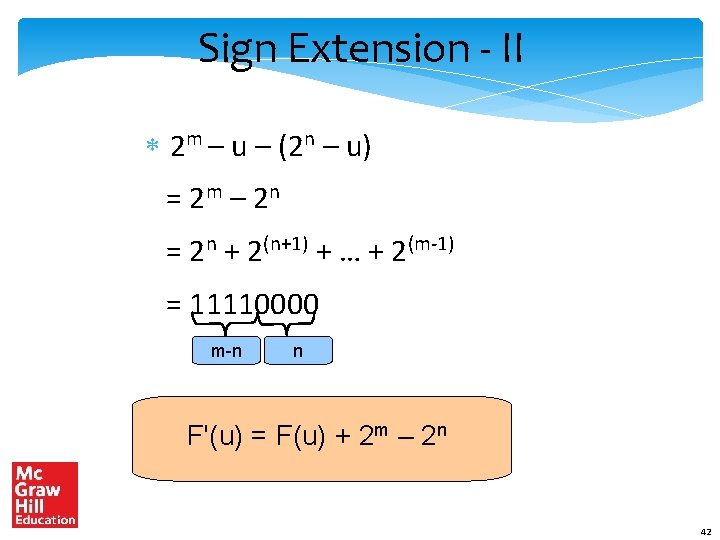
Sign Extension - II 2 m – u – (2 n – u) = 2 m – 2 n = 2 n + 2(n+1) + … + 2(m-1) = 11110000 m-n n F'(u) = F(u) + 2 m – 2 n 42
Sign Extension - III To convert a negative number : Add (m-n) 1 s in the msb positions In both cases, extend the sign bit by : (m-n) positions 43
The Overflow Theorem Add : u + v If uv < 0, there will never be an overflow Let us go back to the number circle There is an overflow only when we cross the break-point If uv = 0, one of the numbers is 0 (no overflow) If uv > 0, an overflow is possible 44
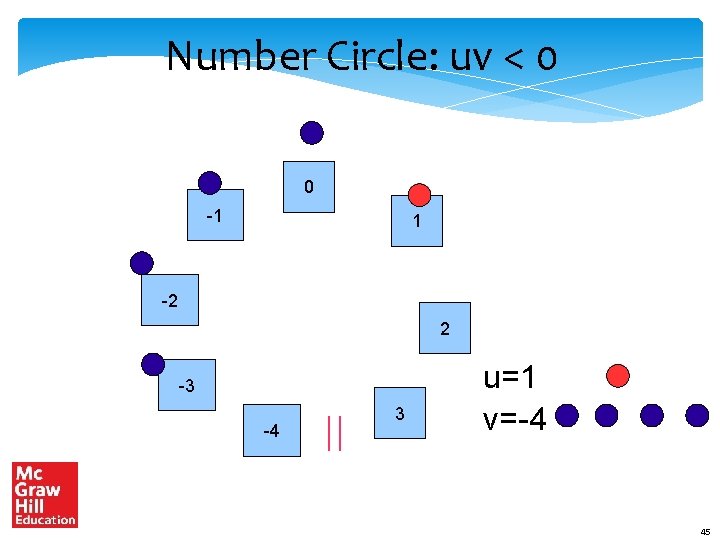
Number Circle: uv < 0 0 -1 1 -2 2 -3 -4 3 u=1 v=-4 45
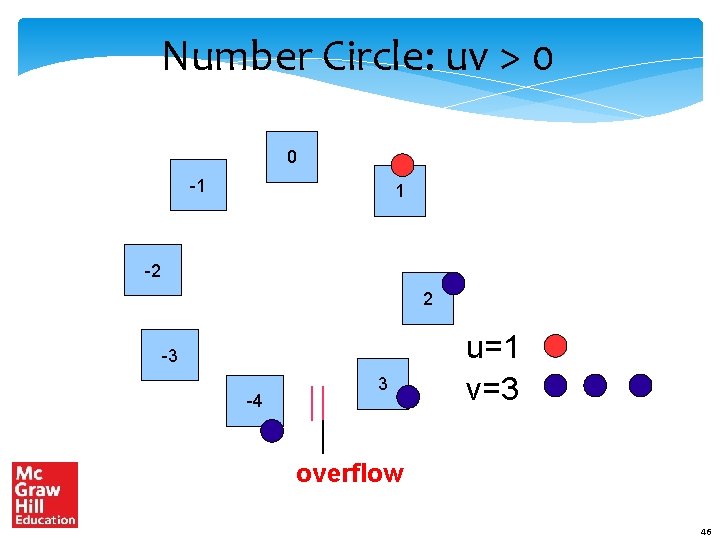
Number Circle: uv > 0 0 -1 1 -2 2 -3 -4 3 u=1 v=3 overflow 46
Conditions for an Overflow uv <= 0 Never uv > 0 ( u and v have the same sign) The sign of the result is different from the sign of u 47
Outline Boolean Algebra Positive Integers Negative Integers Floating-Point Numbers Strings 48
Floating-Point Numbers What is a floating-point number ? 2. 356 1. 3 e-10 -2. 3 e+5 What is a fixed-point number ? Number of digits after the decimal point is fixed 3. 29, -1. 83 49
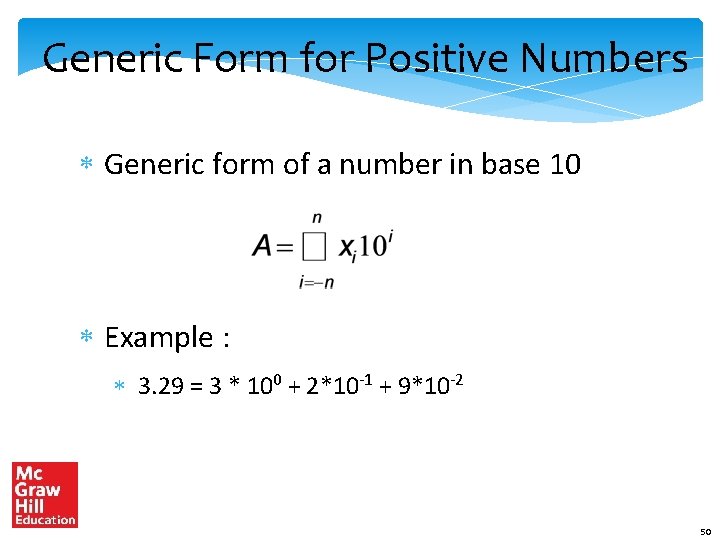
Generic Form for Positive Numbers Generic form of a number in base 10 Example : 3. 29 = 3 * 100 + 2*10 -1 + 9*10 -2 50
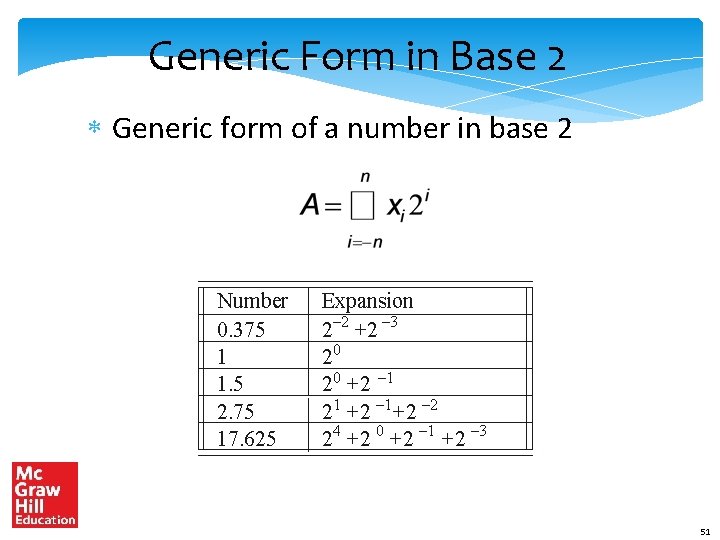
Generic Form in Base 2 Generic form of a number in base 2 Number 0. 375 1 1. 5 2. 75 17. 625 Expansion 2– 2 +2 – 3 20 20 +2 – 1 21 +2 – 2 24 +2 0 +2 – 1 +2 – 3 51
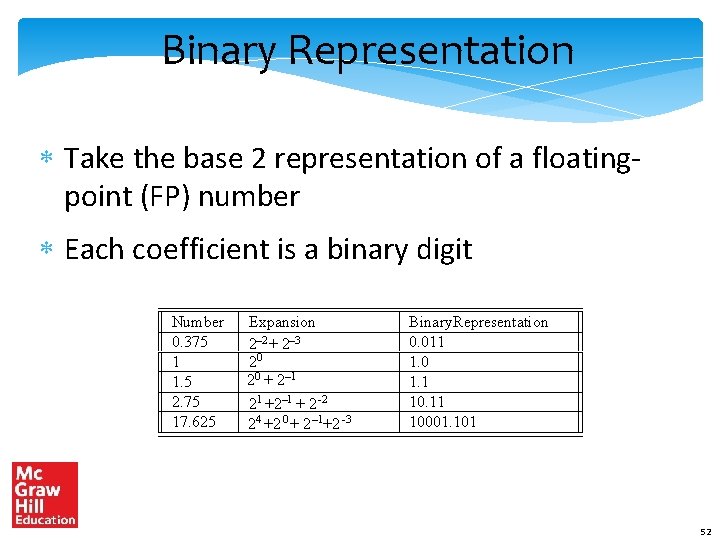
Binary Representation Take the base 2 representation of a floatingpoint (FP) number Each coefficient is a binary digit Number 0. 375 1 1. 5 2. 75 17. 625 Expansion 2– 2 + 2– 3 20 20 + 2– 1 21 +2– 1 + 2 -2 24 +2 0 + 2 – 1+2 -3 Binary. Representation 0. 011 1. 0 1. 1 10. 11 10001. 101 52
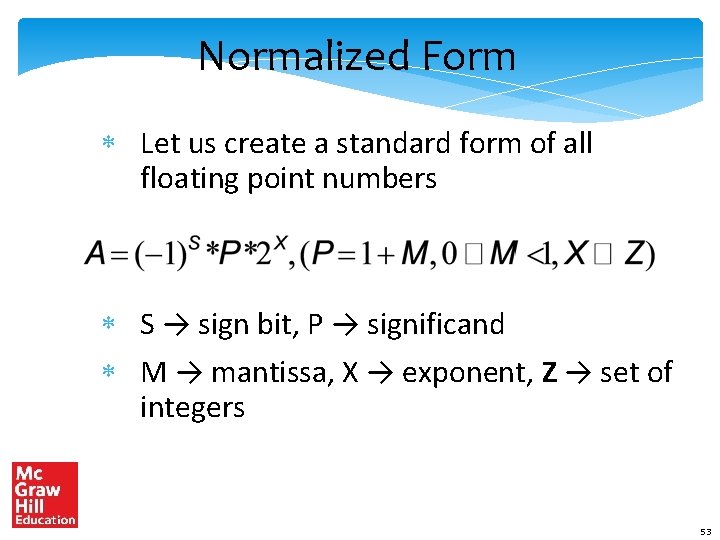
Normalized Form Let us create a standard form of all floating point numbers S → sign bit, P → significand M → mantissa, X → exponent, Z → set of integers 53
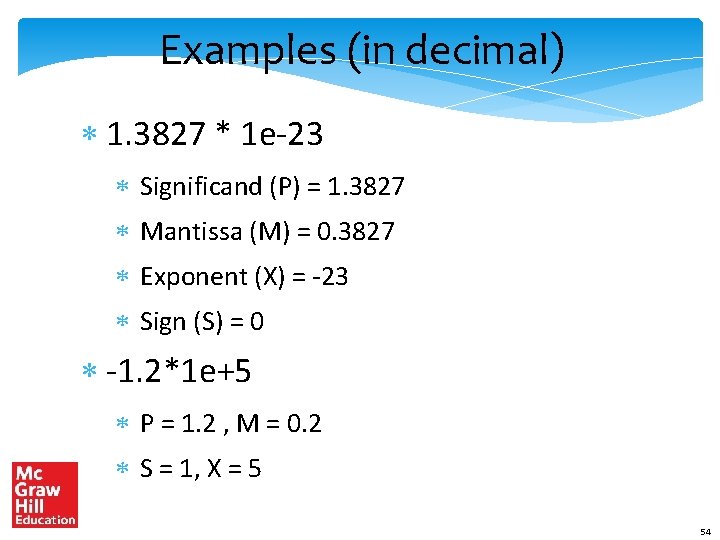
Examples (in decimal) 1. 3827 * 1 e-23 Significand (P) = 1. 3827 Mantissa (M) = 0. 3827 Exponent (X) = -23 Sign (S) = 0 -1. 2*1 e+5 P = 1. 2 , M = 0. 2 S = 1, X = 5 54
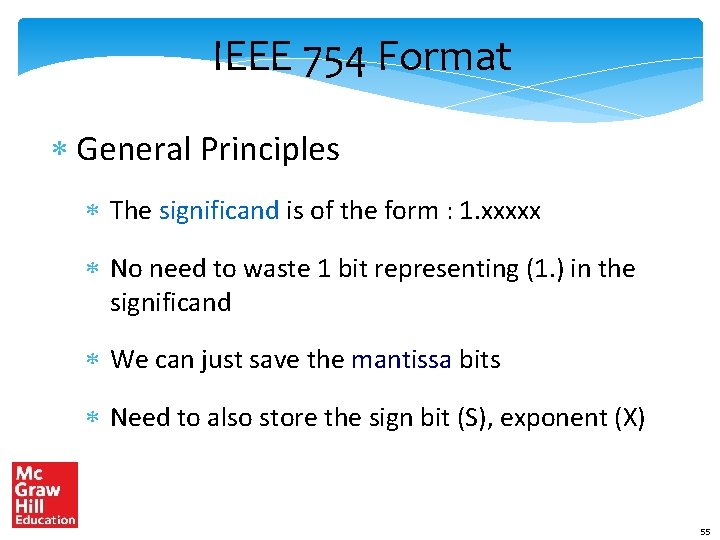
IEEE 754 Format General Principles The significand is of the form : 1. xxxxx No need to waste 1 bit representing (1. ) in the significand We can just save the mantissa bits Need to also store the sign bit (S), exponent (X) 55
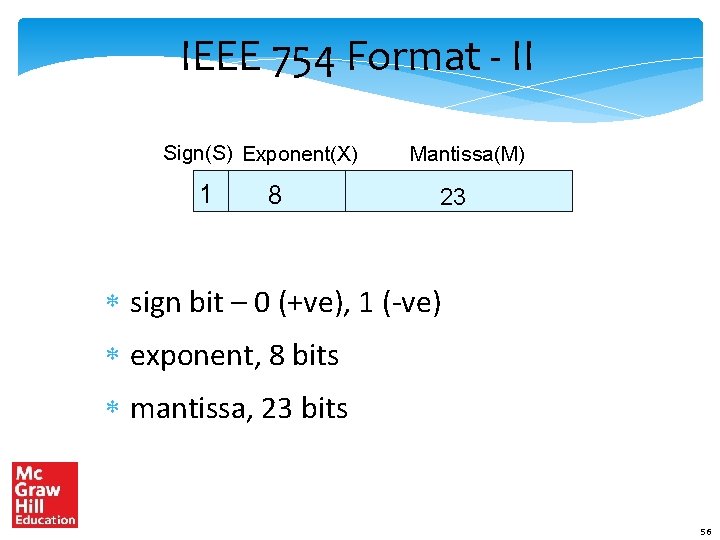
IEEE 754 Format - II Sign(S) Exponent(X) 1 8 Mantissa(M) 23 sign bit – 0 (+ve), 1 (-ve) exponent, 8 bits mantissa, 23 bits 56
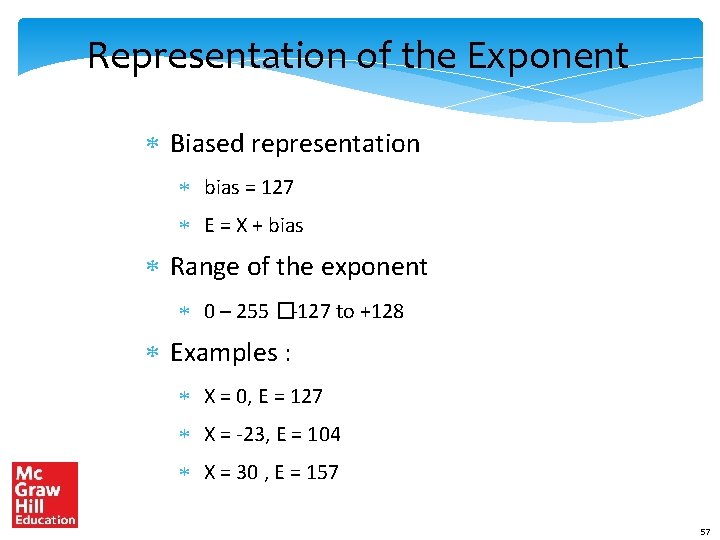
Representation of the Exponent Biased representation bias = 127 E = X + bias Range of the exponent 0 – 255 �-127 to +128 Examples : X = 0, E = 127 X = -23, E = 104 X = 30 , E = 157 57
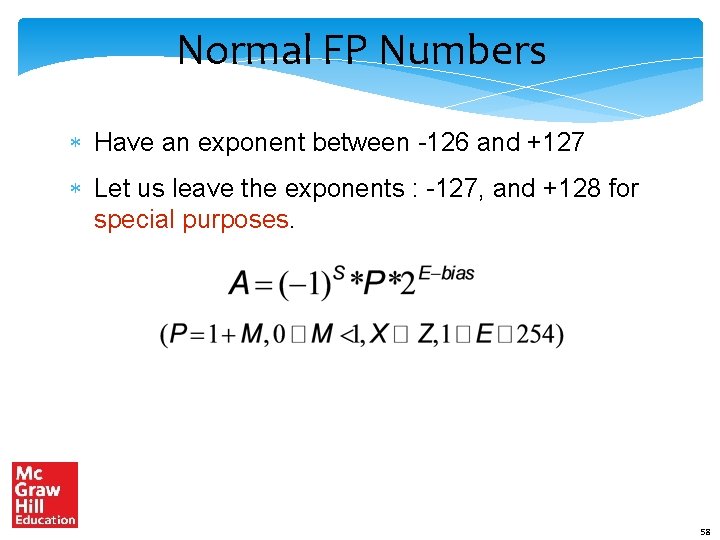
Normal FP Numbers Have an exponent between -126 and +127 Let us leave the exponents : -127, and +128 for special purposes. 58
What is the largest +ve normal FP number ? What is the smallest –ve normal FP number ? 59
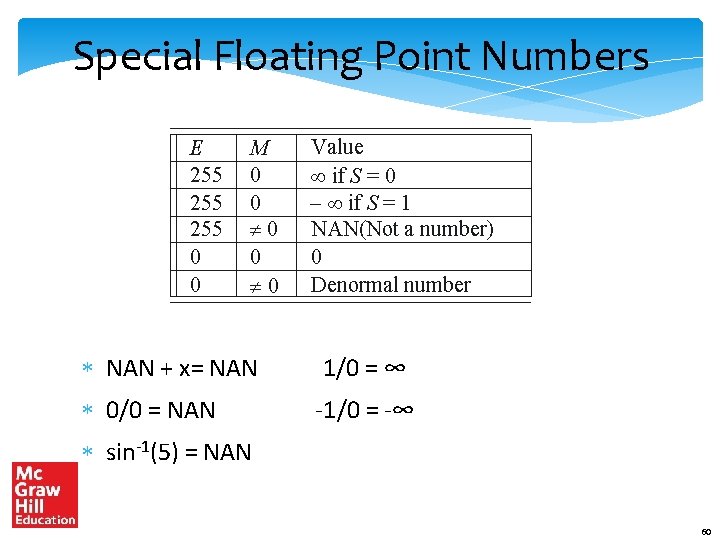
Special Floating Point Numbers E 255 255 0 0 M 0 0 0 Value if S = 0 – if S = 1 NAN(Not a number) 0 Denormal number NAN + x= NAN 1/0 = ∞ 0/0 = NAN -1/0 = -∞ sin-1(5) = NAN 60
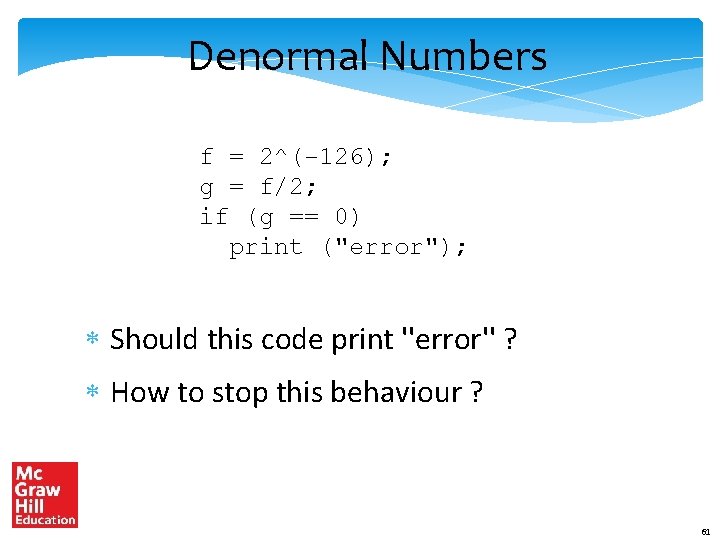
Denormal Numbers f = 2^(-126); g = f/2; if (g == 0) print ("error"); Should this code print ''error'' ? How to stop this behaviour ? 61
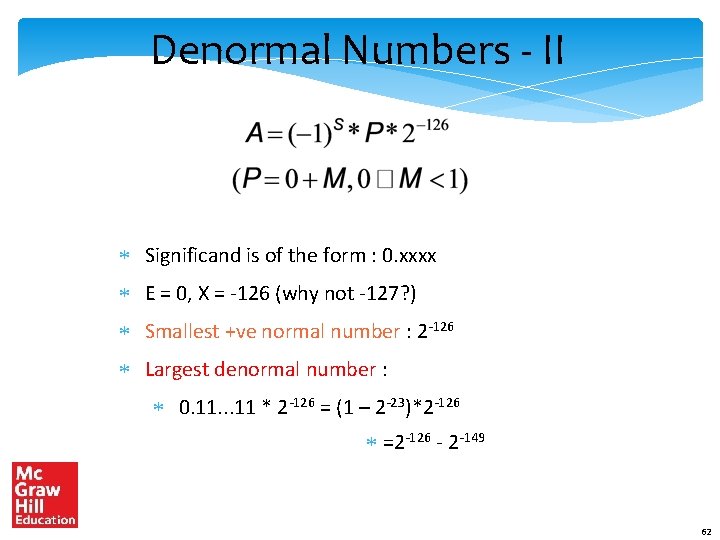
Denormal Numbers - II Significand is of the form : 0. xxxx E = 0, X = -126 (why not -127? ) Smallest +ve normal number : 2 -126 Largest denormal number : 0. 11. . . 11 * 2 -126 = (1 – 2 -23)*2 -126 =2 -126 - 2 -149 62
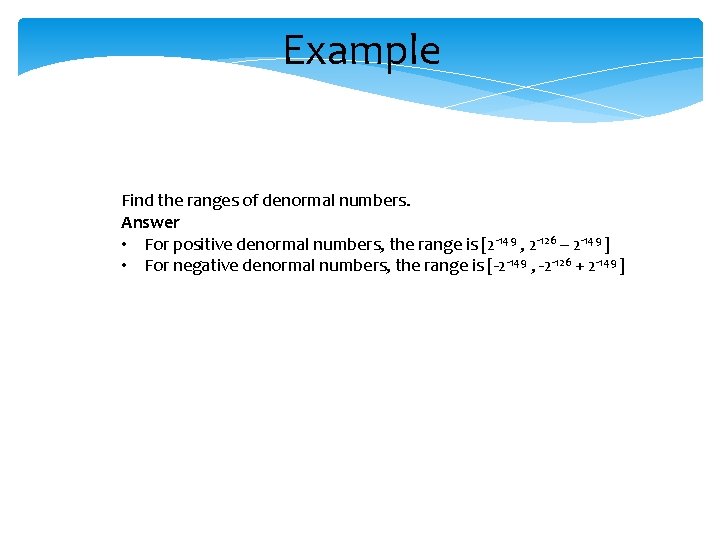
Example Find the ranges of denormal numbers. Answer • For positive denormal numbers, the range is [2 -149 , 2 -126 – 2 -149 ] • For negative denormal numbers, the range is [-2 -149 , -2 -126 + 2 -149 ]
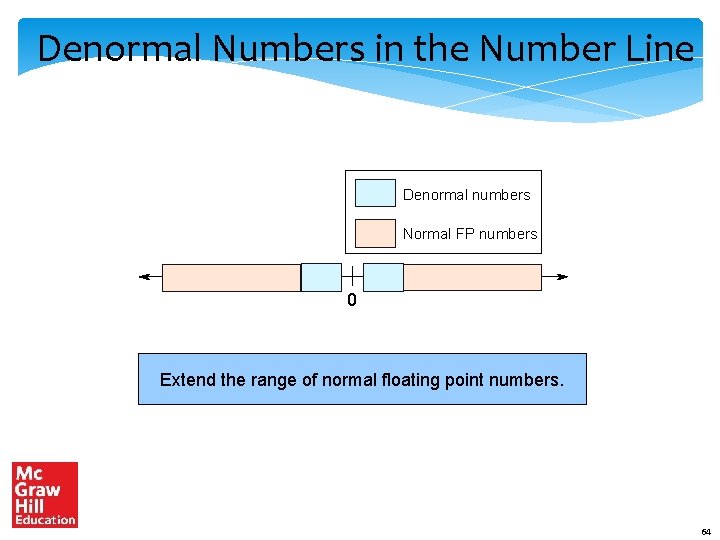
Denormal Numbers in the Number Line Denormal numbers Normal FP numbers 0 Extend the range of normal floating point numbers. 64
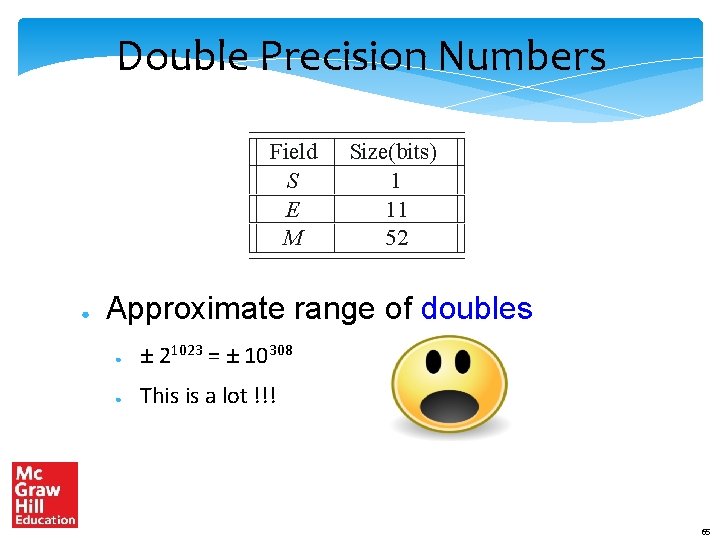
Double Precision Numbers Field S E M ● Size(bits) 1 11 52 Approximate range of doubles ● ± 21023 = ± 10308 ● This is a lot !!! 65

Floating Point Mathematics A = 2^(50); B = 2^(10); C = (B+A)- A; C will be computed to be 0 There is no way of representing A+B in the IEEE 754 format A smart compiler can reorder the operations to increase precision Floating point math is approximate 66
Outline Boolean Algebra Positive Integers Negative Integers Floating Point Numbers Strings 67
ASCII Character Set ASCII – American Standard Code for Information Interchange It has 128 characters First 32 characters (control operations) backspace (8) line feed (10) escape (27) Each character is encoded using 7 bits 68
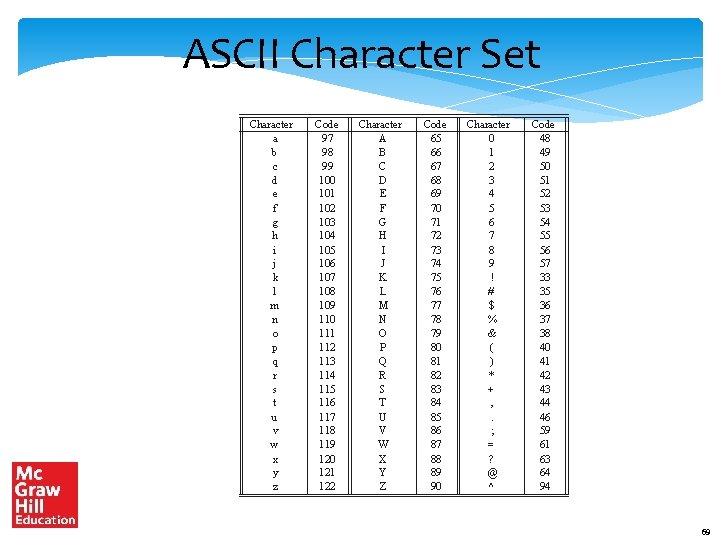
ASCII Character Set Character a b c d e f g h i j k l m n o p q r s t u v w x y z Code 97 98 99 100 101 102 103 104 105 106 107 108 109 110 111 112 113 114 115 116 117 118 119 120 121 122 Character A B C D E F G H I J K L M N O P Q R S T U V W X Y Z Code 65 66 67 68 69 70 71 72 73 74 75 76 77 78 79 80 81 82 83 84 85 86 87 88 89 90 Character 0 1 2 3 4 5 6 7 8 9 ! # $ % & ( ) * + , . ; = ? @ ^ Code 48 49 50 51 52 53 54 55 56 57 33 35 36 37 38 40 41 42 43 44 46 59 61 63 64 94 69
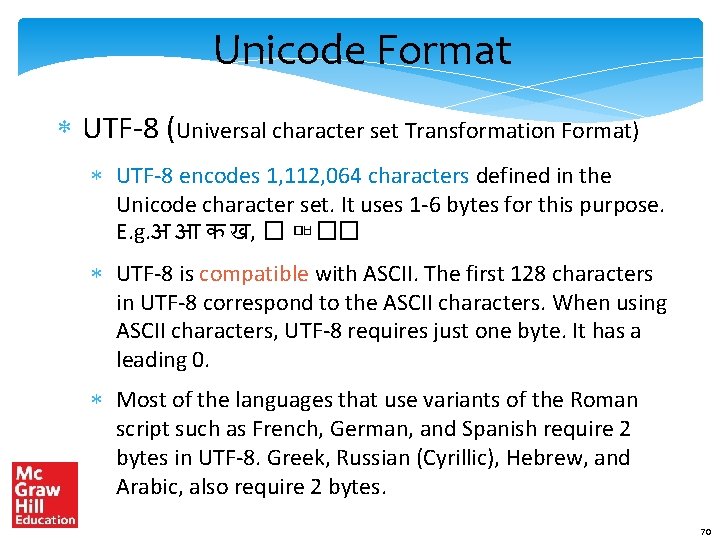
Unicode Format UTF-8 (Universal character set Transformation Format) UTF-8 encodes 1, 112, 064 characters defined in the Unicode character set. It uses 1 -6 bytes for this purpose. E. g. अ आ क ख, � ᇜ�� UTF-8 is compatible with ASCII. The first 128 characters in UTF-8 correspond to the ASCII characters. When using ASCII characters, UTF-8 requires just one byte. It has a leading 0. Most of the languages that use variants of the Roman script such as French, German, and Spanish require 2 bytes in UTF-8. Greek, Russian (Cyrillic), Hebrew, and Arabic, also require 2 bytes. 70
UTF-16 and 32 Unicode is a standard across all browsers and operating systems UTF-8 has been superseded by UTF-16, and UTF-32 UTF-16 uses 2 byte or 4 byte encodings (Java and Windows) UTF-32 uses 4 bytes for every character (rarely used) 71

THE END 72
- Slides: 72