
Power Point Slides for Introduction to Genetic Analysis
- Slides: 45
• Power. Point Slides for • Introduction to Genetic Analysis • • Ninth Edition Anthony J. F. Griffiths, Susan R. Wessler, Richard C. Lewontin, and Sean B. Carroll • CHAPTER 10 • Regulation of Gene Expression in Bacteria and Their Viruses Copyright 2008 © W H Freeman and Company
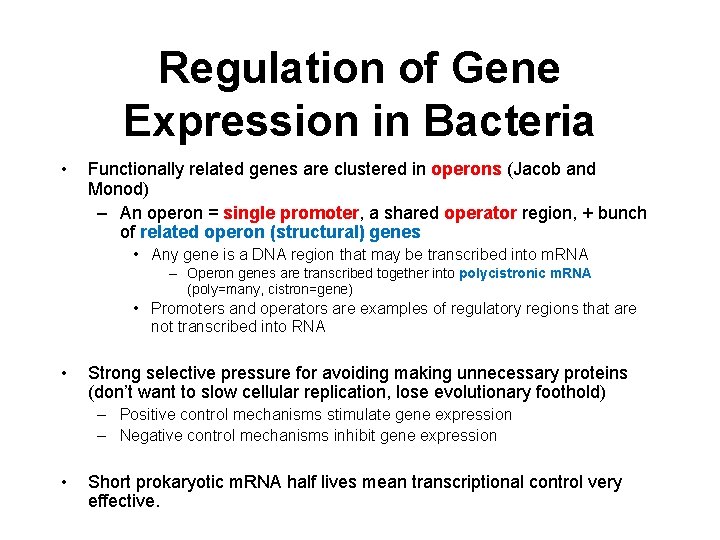
Regulation of Gene Expression in Bacteria • Functionally related genes are clustered in operons (Jacob and Monod) – An operon = single promoter, a shared operator region, + bunch of related operon (structural) genes • Any gene is a DNA region that may be transcribed into m. RNA – Operon genes are transcribed together into polycistronic m. RNA (poly=many, cistron=gene) • Promoters and operators are examples of regulatory regions that are not transcribed into RNA • Strong selective pressure for avoiding making unnecessary proteins (don’t want to slow cellular replication, lose evolutionary foothold) – Positive control mechanisms stimulate gene expression – Negative control mechanisms inhibit gene expression • Short prokaryotic m. RNA half lives mean transcriptional control very effective.
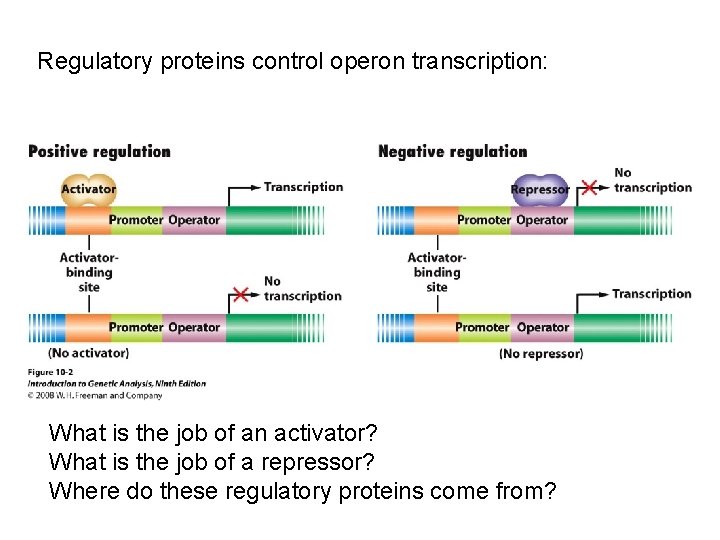
Regulatory proteins control operon transcription: What is the job of an activator? What is the job of a repressor? Where do these regulatory proteins come from?
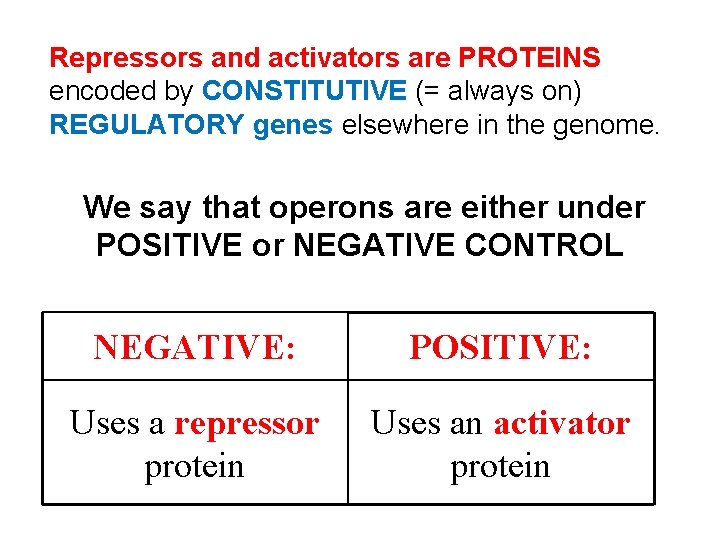
Repressors and activators are PROTEINS encoded by CONSTITUTIVE (= always on) REGULATORY genes elsewhere in the genome. We say that operons are either under POSITIVE or NEGATIVE CONTROL NEGATIVE: POSITIVE: Uses a repressor protein Uses an activator protein
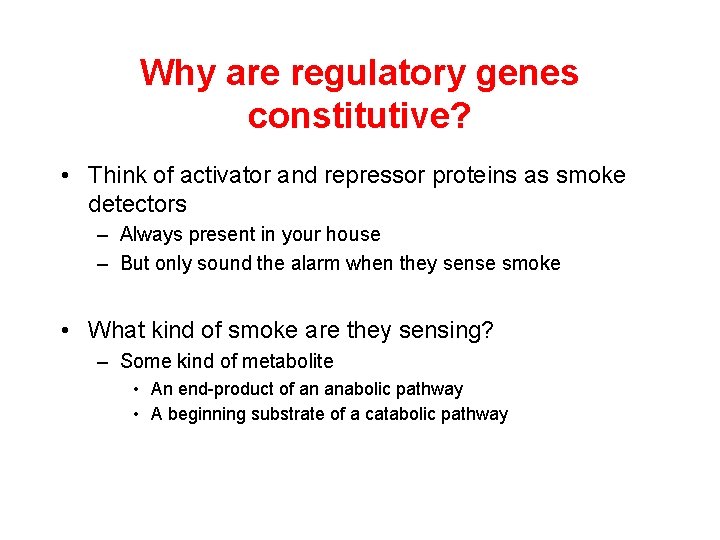
Why are regulatory genes constitutive? • Think of activator and repressor proteins as smoke detectors – Always present in your house – But only sound the alarm when they sense smoke • What kind of smoke are they sensing? – Some kind of metabolite • An end-product of an anabolic pathway • A beginning substrate of a catabolic pathway
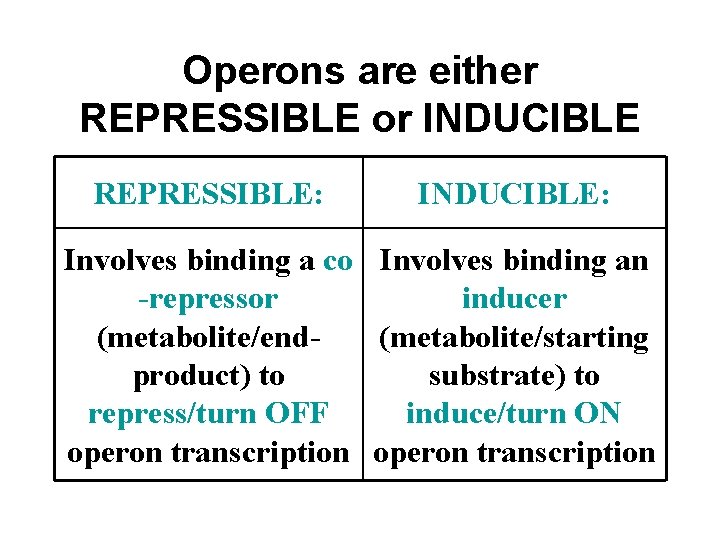
Operons are either REPRESSIBLE or INDUCIBLE REPRESSIBLE: INDUCIBLE: Involves binding a co Involves binding an -repressor inducer (metabolite/end(metabolite/starting product) to substrate) to repress/turn OFF induce/turn ON operon transcription
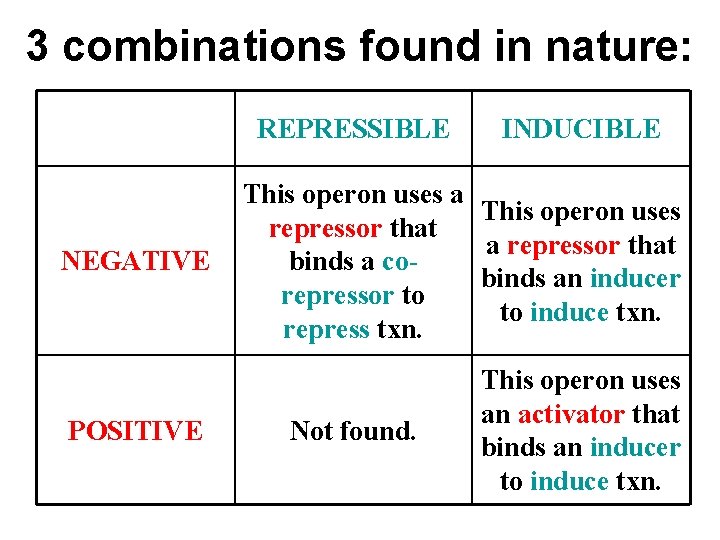
3 combinations found in nature: REPRESSIBLE INDUCIBLE NEGATIVE This operon uses a This operon uses repressor that a repressor that binds a cobinds an inducer repressor to to induce txn. repress txn. POSITIVE This operon uses an activator that binds an inducer to induce txn. Not found.
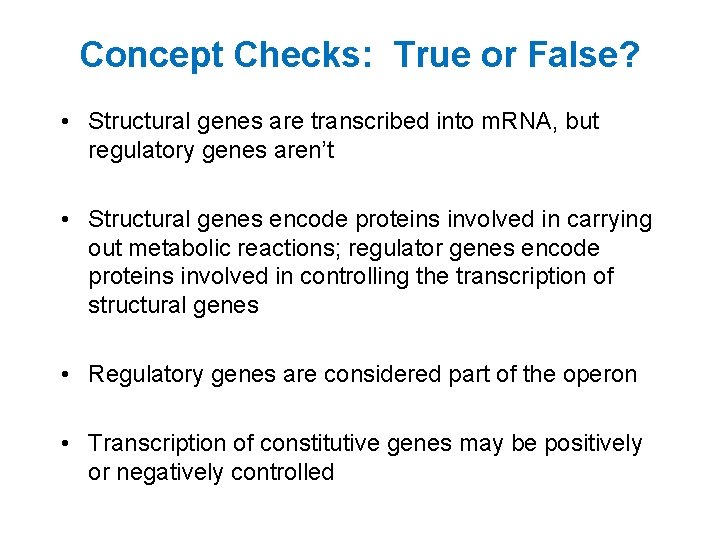
Concept Checks: True or False? • Structural genes are transcribed into m. RNA, but regulatory genes aren’t • Structural genes encode proteins involved in carrying out metabolic reactions; regulator genes encode proteins involved in controlling the transcription of structural genes • Regulatory genes are considered part of the operon • Transcription of constitutive genes may be positively or negatively controlled
Concept Checks: True or False? • In a repressible operon, transcription is on until it is turned off • In an inducible operon, transcription is off until it is turned on
Example #1: The Lac operon of E. coli makes the three enzymes needed for lactose breakdown: • Lac. Z encodes Beta-galactosidase – breaks up lactose into glucose and galactose (galactose also converted to glucose for metabolism) – Isomerizes lactose into allolactose inducer (presence of lactose means presence of allolactose) • Lac. Y encodes permease – For lactose transport across cell membrane • Lac. A encodes transacetylase – Poorly understood function
The Lac operon has 2 control circuits: • NEGATIVE INDUCIBLE – Uses a repressor that binds an inducer (allolactose) to induce operon txn. – Car ignition – Requires presence of lactose • POSITIVE INDUCIBLE – Uses an activator (CAP) that binds an inducer (cyclic AMP) to induce operon txn. – Gas pedal – Requires absence of (preferred) glucose
So how does it work? First we’ll need allolactose to start the car:
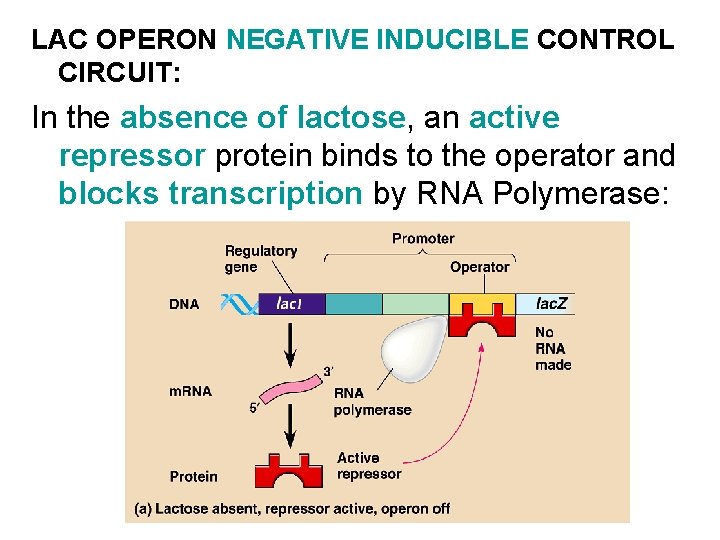
LAC OPERON NEGATIVE INDUCIBLE CONTROL CIRCUIT: In the absence of lactose, an active repressor protein binds to the operator and blocks transcription by RNA Polymerase:
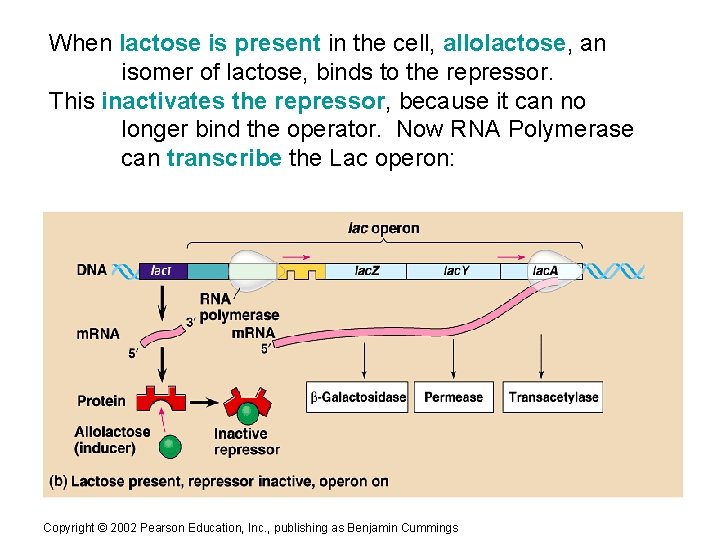
When lactose is present in the cell, allolactose, an isomer of lactose, binds to the repressor. This inactivates the repressor, because it can no longer bind the operator. Now RNA Polymerase can transcribe the Lac operon: Copyright © 2002 Pearson Education, Inc. , publishing as Benjamin Cummings
But RNA Polymerase has low affinity for the Lac operon promoter…. so even though the Lac operon is turned on by the presence of lactose, it is transcribed at low levels (like your car merely starting to roll forward after the ignition key is turned).
So once the car is turned on, how do we step on the gas?
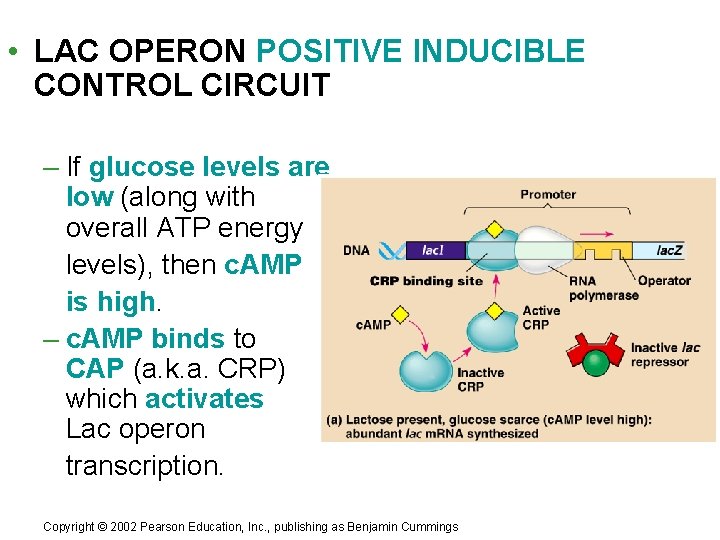
• LAC OPERON POSITIVE INDUCIBLE CONTROL CIRCUIT – If glucose levels are low (along with overall ATP energy levels), then c. AMP is high. – c. AMP binds to CAP (a. k. a. CRP) which activates Lac operon transcription. Copyright © 2002 Pearson Education, Inc. , publishing as Benjamin Cummings
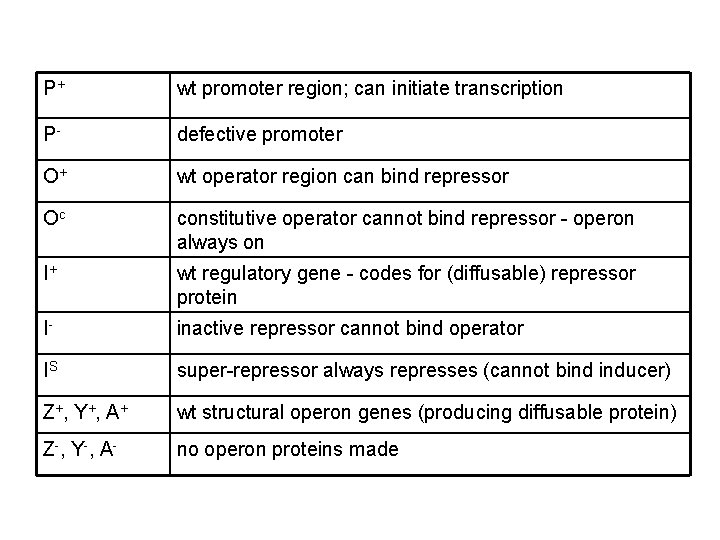
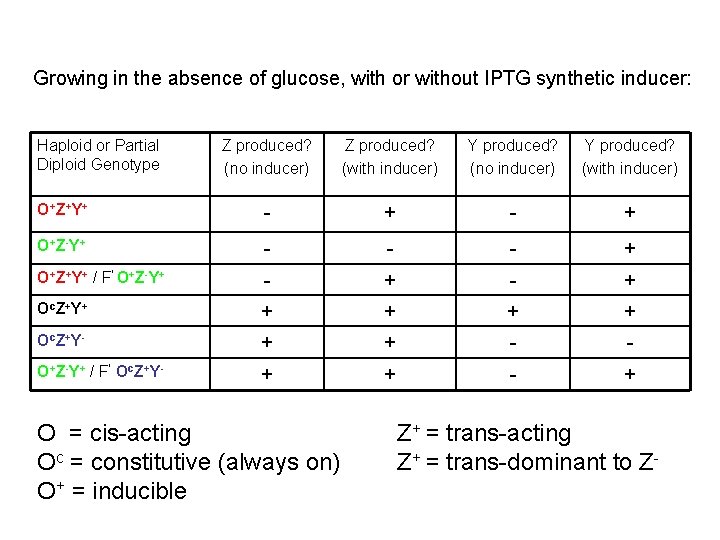
P+ wt promoter region; can initiate transcription P- defective promoter O+ wt operator region can bind repressor Oc constitutive operator cannot bind repressor - operon always on I+ wt regulatory gene - codes for (diffusable) repressor protein I- inactive repressor cannot bind operator IS super-repressor always represses (cannot bind inducer) Z+ , Y + , A + wt structural operon genes (producing diffusable protein) Z-, Y-, A- no operon proteins made
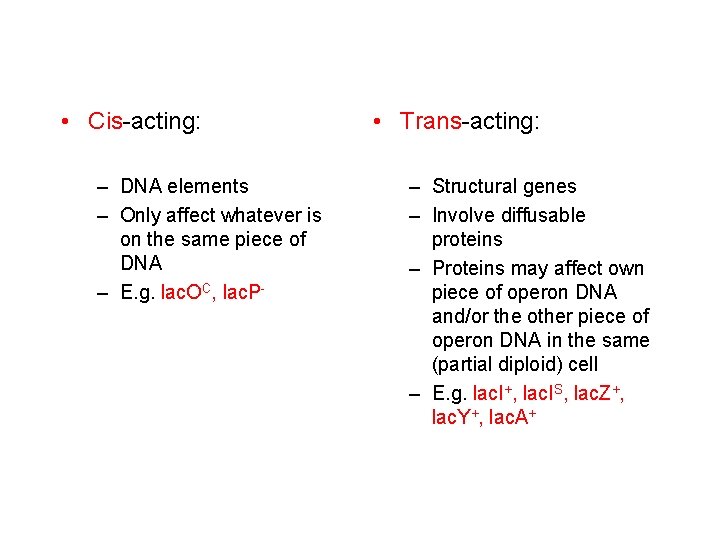
• Cis-acting: – DNA elements – Only affect whatever is on the same piece of DNA – E. g. lac. OC, lac. P- • Trans-acting: – Structural genes – Involve diffusable proteins – Proteins may affect own piece of operon DNA and/or the other piece of operon DNA in the same (partial diploid) cell – E. g. lac. I+, lac. IS, lac. Z+, lac. Y+, lac. A+
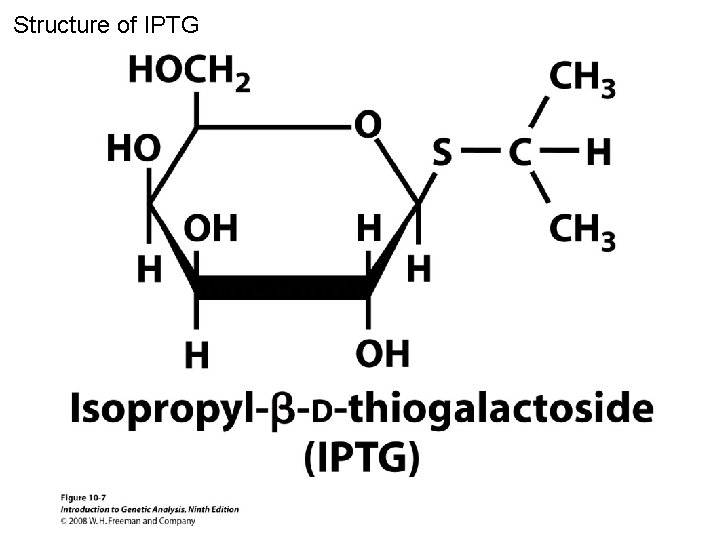
Structure of IPTG Figure 10 -7
Growing in the absence of glucose, with or without IPTG synthetic inducer: Haploid or Partial Diploid Genotype Z produced? (no inducer) Z produced? (with inducer) Y produced? (no inducer) Y produced? (with inducer) O+Z+Y+ - + O+Z-Y+ - - - + O+Z+Y+ / F’ O+Z-Y+ - + Oc. Z+Y+ + + Oc. Z+Y- + + - - O+Z-Y+ / F’ Oc. Z+Y- + + - + O = cis-acting Oc = constitutive (always on) O+ = inducible Z+ = trans-acting Z+ = trans-dominant to Z-
Lac Operon Animations • • • Lac operon animations from Bio. Coach: http: //www. phschool. com/science/biology_place/biocoach/lacoperon/int ro. html I+P+O+Z+Y+ wild type animation: http: //www. biostudio. com/d_Lac. Operon. htm I+P+OCZ+Y+ animation: http: //www. biostudio. com/d_Lac. Operon. Oclac. Operator. Mutations. htm I- P+O+Z+Y+ animation: http: //www. biostudio. com/d_Lac. Operon. ILac. Repressor. Mutations. htm IS P+O+Z+Y+ animation: http: //www. biostudio. com/d_Lac. Operon. ISLac. Super. Repressor. Mutations. htm
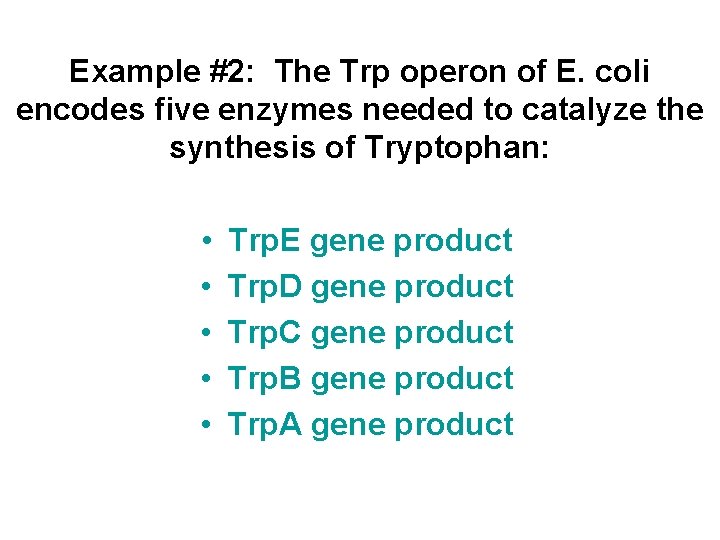
Example #2: The Trp operon of E. coli encodes five enzymes needed to catalyze the synthesis of Tryptophan: • • • Trp. E gene product Trp. D gene product Trp. C gene product Trp. B gene product Trp. A gene product
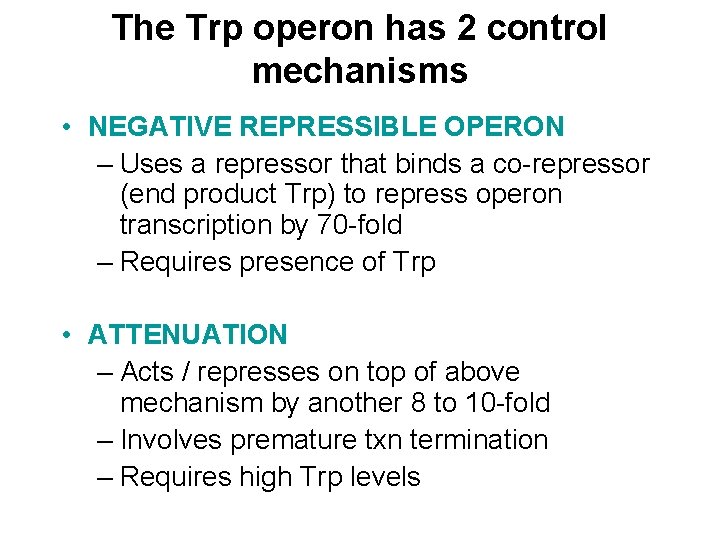
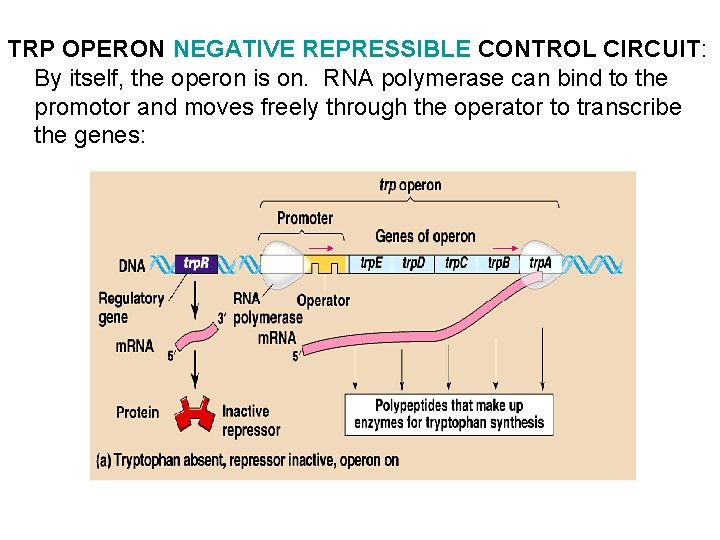
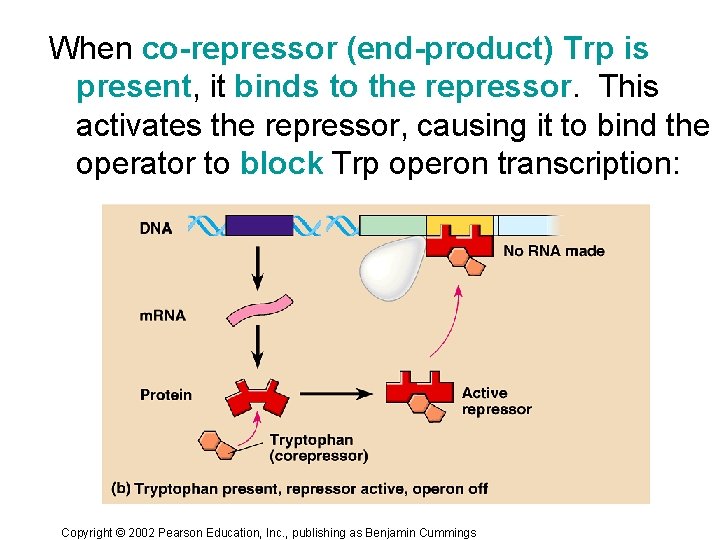
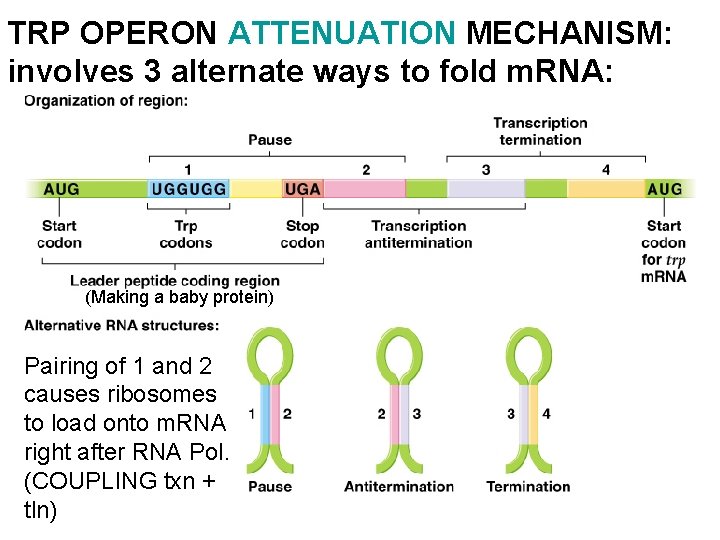
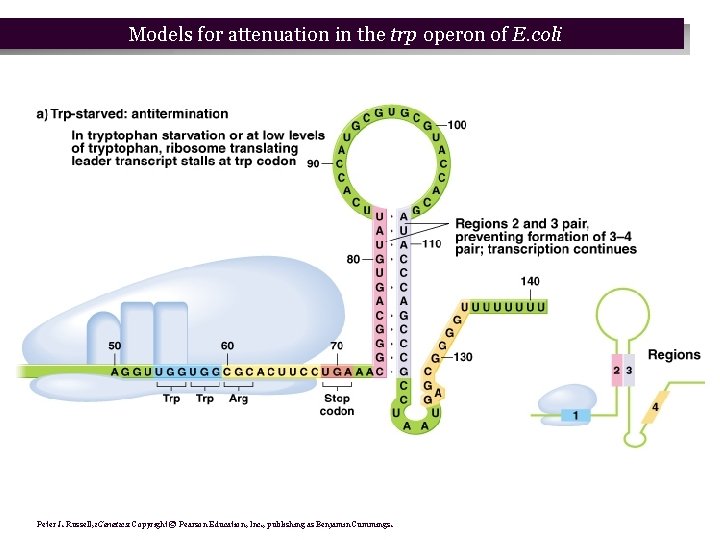
The Trp operon has 2 control mechanisms • NEGATIVE REPRESSIBLE OPERON – Uses a repressor that binds a co-repressor (end product Trp) to repress operon transcription by 70 -fold – Requires presence of Trp • ATTENUATION – Acts / represses on top of above mechanism by another 8 to 10 -fold – Involves premature txn termination – Requires high Trp levels
TRP OPERON NEGATIVE REPRESSIBLE CONTROL CIRCUIT: By itself, the operon is on. RNA polymerase can bind to the promotor and moves freely through the operator to transcribe the genes:
When co-repressor (end-product) Trp is present, it binds to the repressor. This activates the repressor, causing it to bind the operator to block Trp operon transcription: Copyright © 2002 Pearson Education, Inc. , publishing as Benjamin Cummings
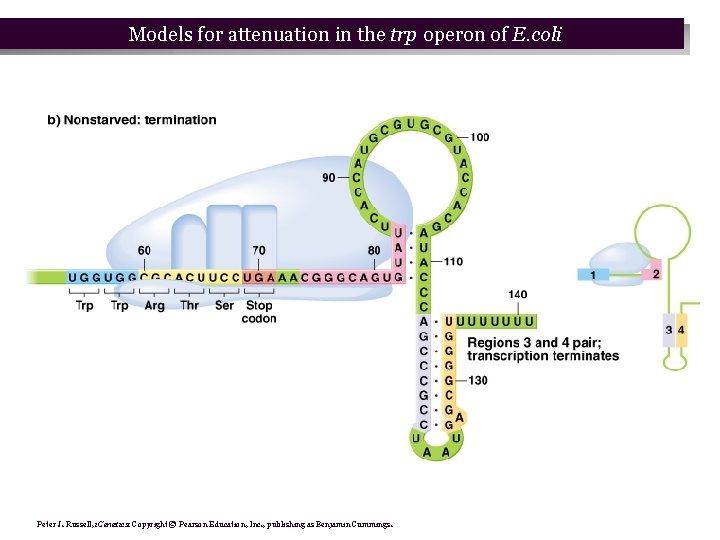
TRP OPERON ATTENUATION MECHANISM: involves 3 alternate ways to fold m. RNA: (Making a baby protein) Pairing of 1 and 2 causes ribosomes to load onto m. RNA right after RNA Pol. (COUPLING txn + tln)
Models for attenuation in the trp operon of E. coli Peter J. Russell, i. Genetics: Copyright © Pearson Education, Inc. , publishing as Benjamin Cummings.
Models for attenuation in the trp operon of E. coli Peter J. Russell, i. Genetics: Copyright © Pearson Education, Inc. , publishing as Benjamin Cummings.
Lac Operon and Trp Operon Animations • Lac and Trp Operon Control by Mc. Graw-Hill: http: //highered. mcgrawhill. com/sites/0072437316/student_view 0/chapter 18/ animations. html • Trp Operon Negative Repressible Control and Attenuation: http: //learning. hccs. edu/faculty/tineke. berends/favorit e-links/animation-library/trp-operon-animations-1/trpoperon-animation-negative-repressible-controlattenuation
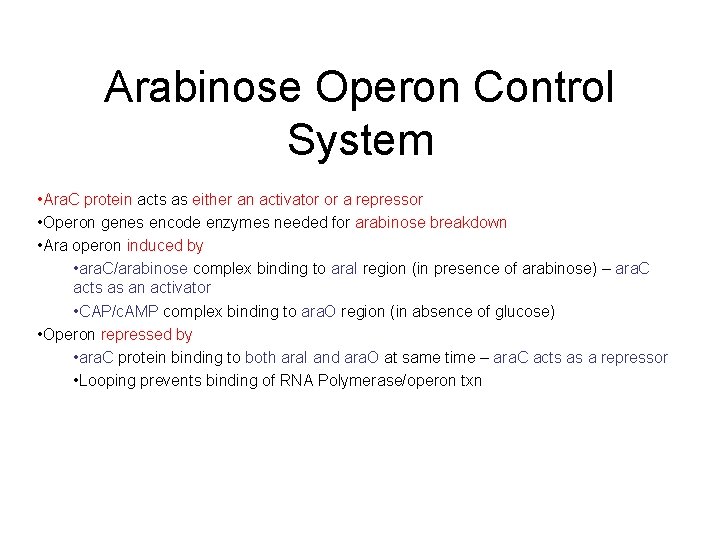
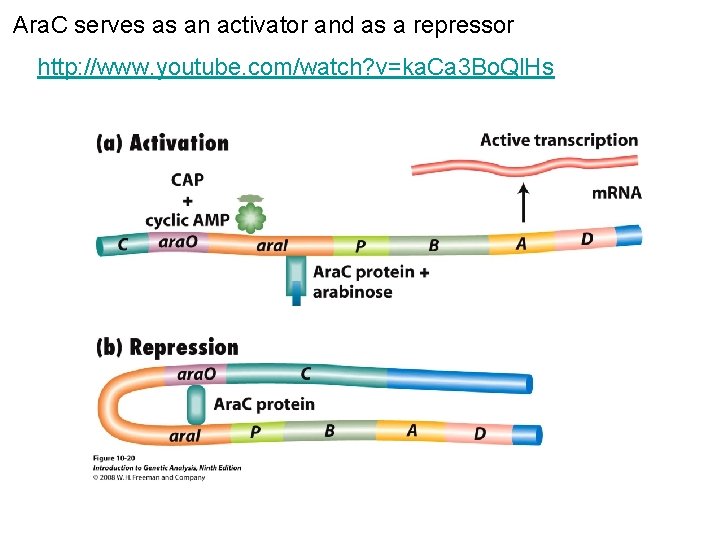
Arabinose Operon Control System • Ara. C protein acts as either an activator or a repressor • Operon genes encode enzymes needed for arabinose breakdown • Ara operon induced by • ara. C/arabinose complex binding to ara. I region (in presence of arabinose) – ara. C acts as an activator • CAP/c. AMP complex binding to ara. O region (in absence of glucose) • Operon repressed by • ara. C protein binding to both ara. I and ara. O at same time – ara. C acts as a repressor • Looping prevents binding of RNA Polymerase/operon txn
Ara. C serves as an activator and as a repressor http: //www. youtube. com/watch? v=ka. Ca 3 Bo. Ql. Hs
Regulation of gene expression in Lambda Phage - overview • Recall lysogeny (integrated prophage) vs. lytic cycle:
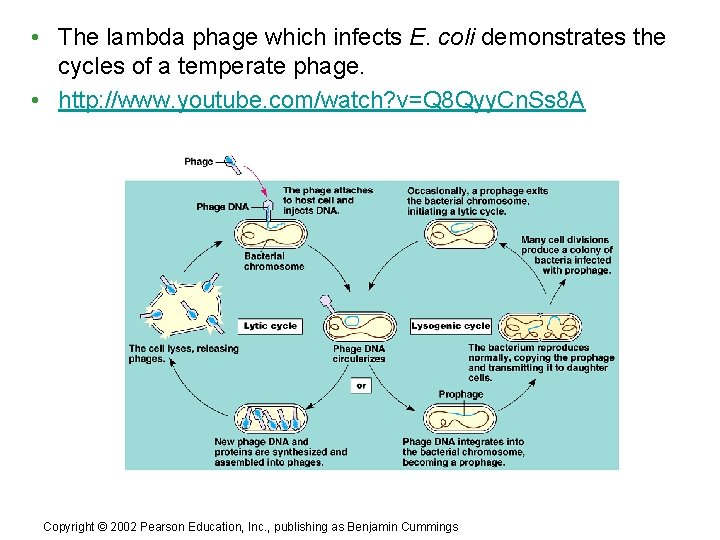
• The lambda phage which infects E. coli demonstrates the cycles of a temperate phage. • http: //www. youtube. com/watch? v=Q 8 Qyy. Cn. Ss 8 A Copyright © 2002 Pearson Education, Inc. , publishing as Benjamin Cummings
How does Lambda choose between lysogeny and lytic cycle?
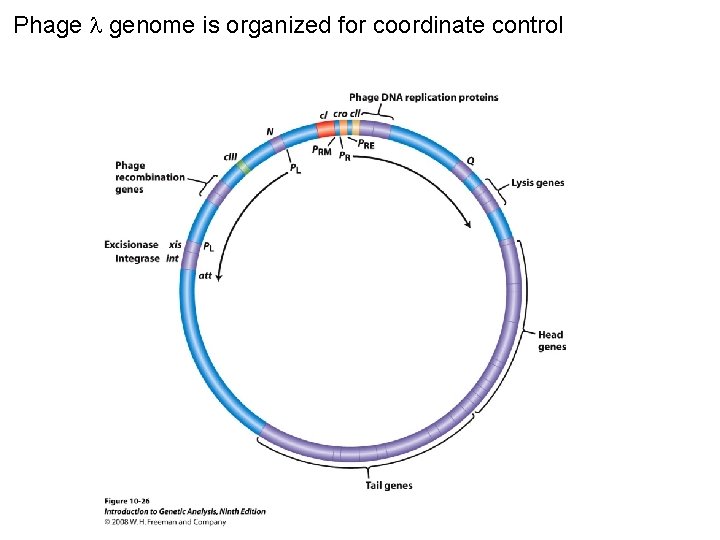
Phage genome is organized for coordinate control
Most of the Lambda genes are necessary for lytic cycle. These genes will need to be turned ON for Lambda to do the lytic cycle, while the genes associated with lysogenesis must be off. Only a few are needed for lysogenic cycle. These genes will need to be ON to for Lambda to do the lysogenenic cycle, while the genes associated with lysis will need to be turned off.
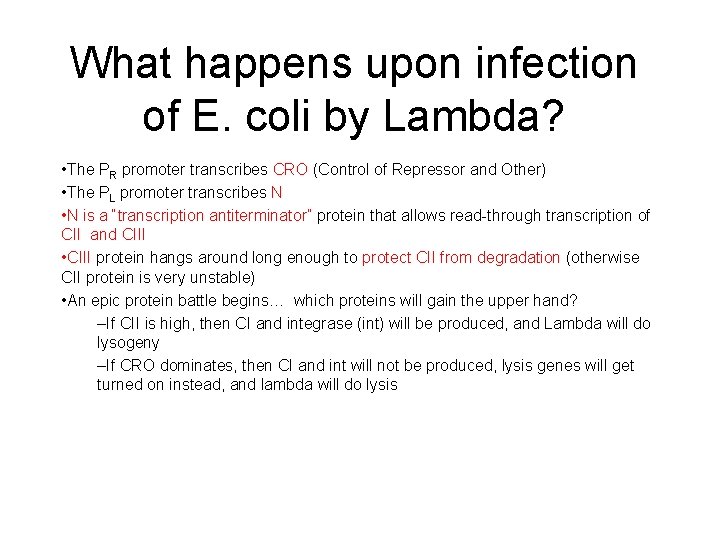
What happens upon infection of E. coli by Lambda? • The PR promoter transcribes CRO (Control of Repressor and Other) • The PL promoter transcribes N • N is a “transcription antiterminator” protein that allows read-through transcription of CII and CIII • CIII protein hangs around long enough to protect CII from degradation (otherwise CII protein is very unstable) • An epic protein battle begins… which proteins will gain the upper hand? –If CII is high, then CI and integrase (int) will be produced, and Lambda will do lysogeny –If CRO dominates, then CI and int will not be produced, lysis genes will get turned on instead, and lambda will do lysis
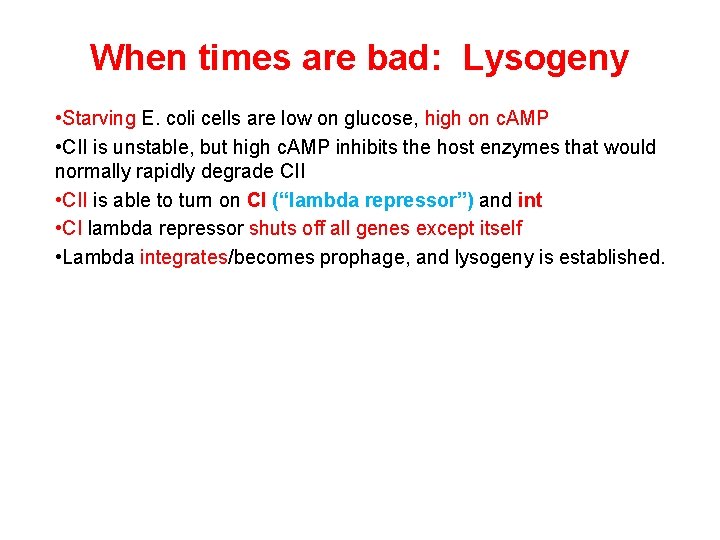
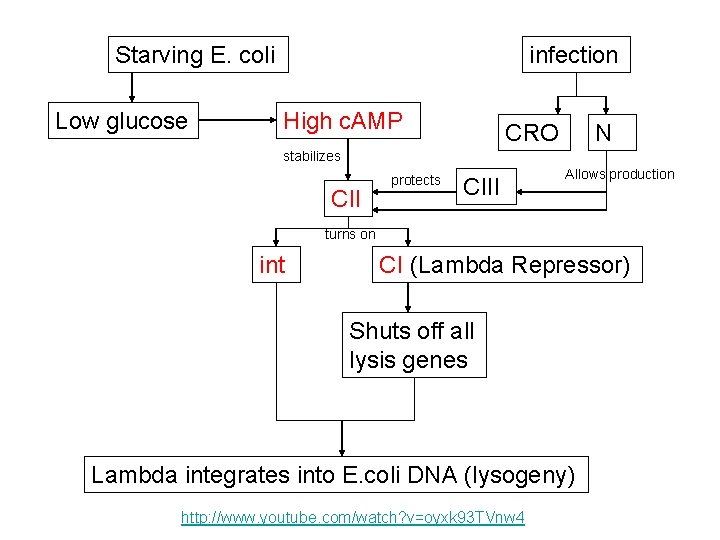
When times are bad: Lysogeny • Starving E. coli cells are low on glucose, high on c. AMP • CII is unstable, but high c. AMP inhibits the host enzymes that would normally rapidly degrade CII • CII is able to turn on CI (“lambda repressor”) and int • CI lambda repressor shuts off all genes except itself • Lambda integrates/becomes prophage, and lysogeny is established.
Starving E. coli Low glucose infection High c. AMP CRO N stabilizes CII protects CIII Allows production turns on int CI (Lambda Repressor) Shuts off all lysis genes Lambda integrates into E. coli DNA (lysogeny) http: //www. youtube. com/watch? v=oyxk 93 TVnw 4
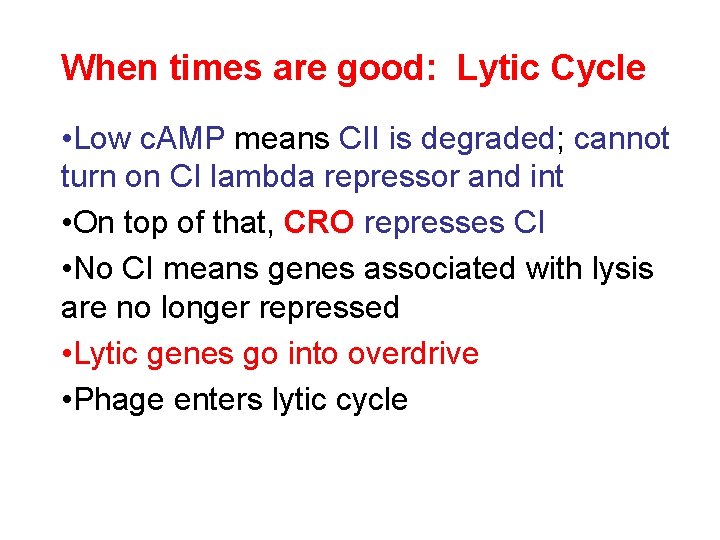
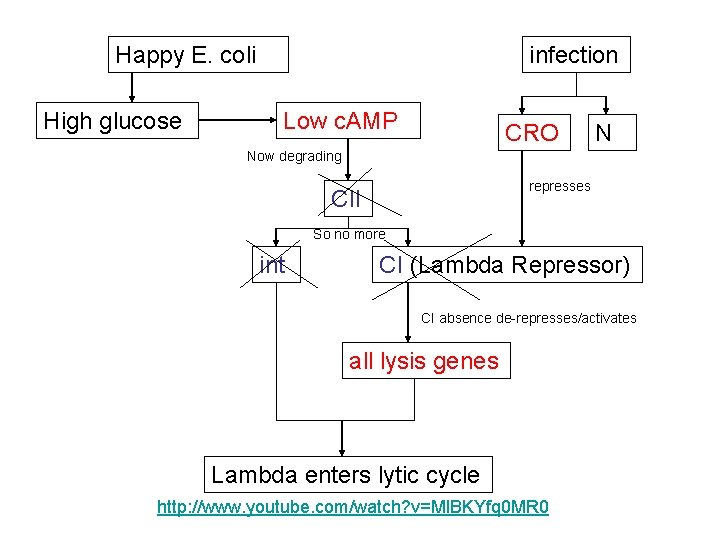
When times are good: Lytic Cycle • Low c. AMP means CII is degraded; cannot turn on CI lambda repressor and int • On top of that, CRO represses CI • No CI means genes associated with lysis are no longer repressed • Lytic genes go into overdrive • Phage enters lytic cycle
Happy E. coli High glucose infection Low c. AMP CRO N Now degrading represses CII So no more int CI (Lambda Repressor) CI absence de-represses/activates all lysis genes Lambda enters lytic cycle http: //www. youtube. com/watch? v=Ml. BKYfq 0 MR 0
CH 10 Problems Solved problems 1 -3, and problems 1, 2, 4, 15
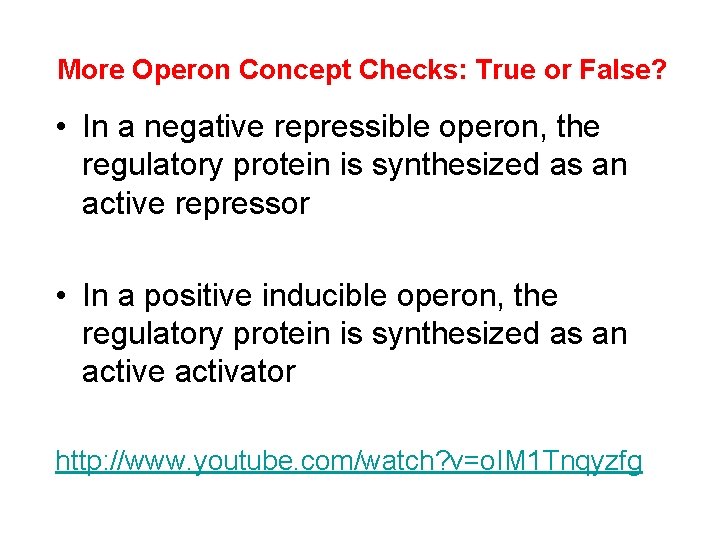
More Operon Concept Checks: True or False? • In a negative repressible operon, the regulatory protein is synthesized as an active repressor • In a positive inducible operon, the regulatory protein is synthesized as an active activator http: //www. youtube. com/watch? v=o. IM 1 Tnqyzfg
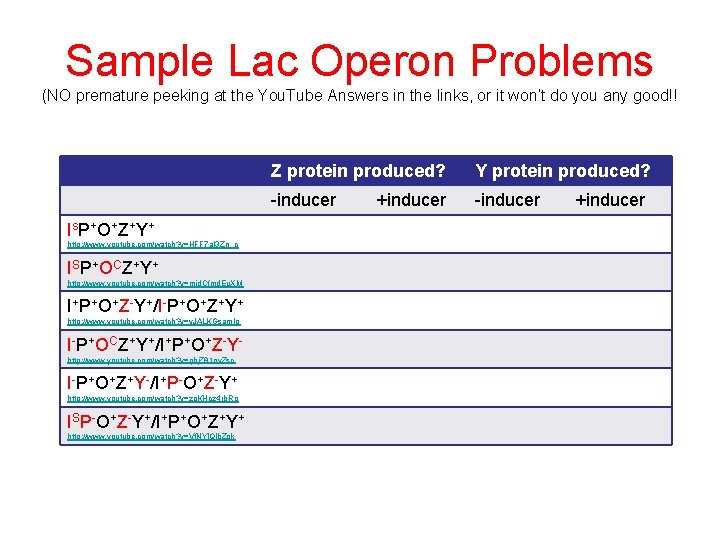
Sample Lac Operon Problems (NO premature peeking at the You. Tube Answers in the links, or it won’t do you any good!! Is P+ O+ Z+ Y+ http: //www. youtube. com/watch? v=HFF 7 a. I 3 Zn_c ISP+OCZ+Y+ http: //www. youtube. com/watch? v=mjd. Cfmd. Eu. XM I+P+O+Z-Y+/I-P+O+Z+Y+ http: //www. youtube. com/watch? v=y. JALKGsam. Io I-P+OCZ+Y+/I+P+O+Z-Yhttp: //www. youtube. com/watch? v=ghj. Z 81 ov. Zsc I-P+O+Z+Y-/I+P-O+Z-Y+ http: //www. youtube. com/watch? v=zo. KHcz 4 rb. Ro ISP-O+Z-Y+/I+P+O+Z+Y+ http: //www. youtube. com/watch? v=Vf. NYl. Qlb. Zpk Z protein produced? Y protein produced? -inducer +inducer