
Power Point Slides Computer Organisation and Architecture Smruti

- Slides: 58
Power. Point Slides Computer Organisation and Architecture Smruti Ranjan Sarangi, IIT Delhi Chapter 7 Computer Arithmetic 2 PROPRIETARY MATERIAL. © 2014 The Mc. Graw-Hill Companies, Inc. All rights reserved. No part of this Power. Point slide may be displayed, reproduced or distributed in any form or by any means, without the prior written permission of the publisher, or used beyond the limited distribution to teachers and educators permitted by Mc. Graw-Hill for their individual course preparation. Power. Point Slides are being provided only to authorized professors and instructors for use in preparing for classes using the affiliated textbook. No other use or distribution of this Power. Point slide is permitted. The Power. Point slide may not be sold and may not be distributed or be used by any student or any other third party. No part of the slide may be reproduced, displayed or distributed in any form or by any means, electronic or otherwise, without the prior written permission of Mc. Graw Hill Education (India) Private Limited. 1
These slides are meant to be used along with the book: Computer Organisation and Architecture, Smruti Ranjan Sarangi, Mc. Graw. Hill 2015 Visit: http: //www. cse. iitd. ernet. in/~srsarangi/archbooksoft. html 2
Outline * Addition * Multiplication * Division * Floating Point Addition * Floating Point Multiplication * Floating Point Division 3
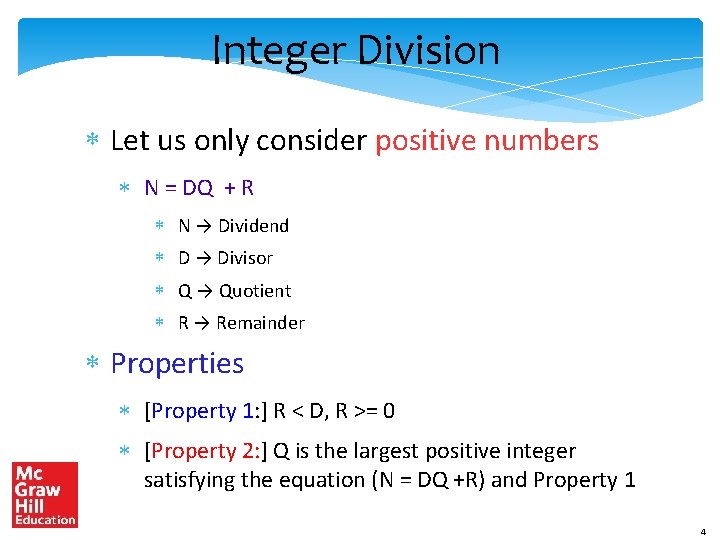
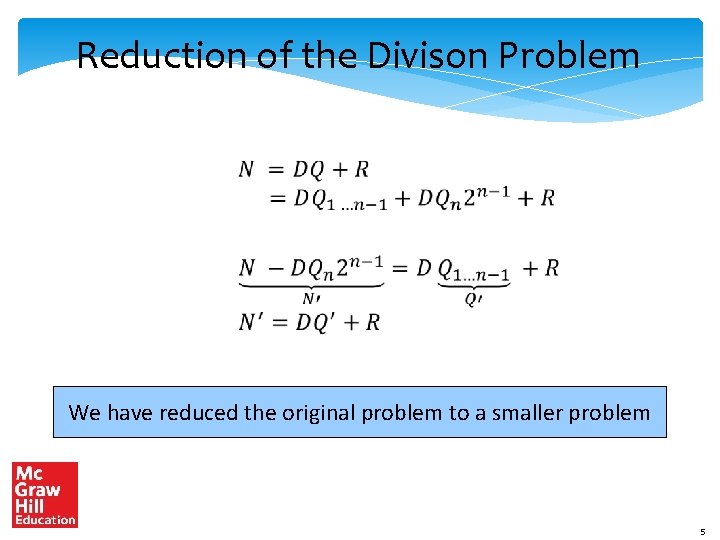
Integer Division * Let us only consider positive numbers * N = DQ + R * N → Dividend * D → Divisor * Q → Quotient * R → Remainder * Properties * [Property 1: ] R < D, R >= 0 * [Property 2: ] Q is the largest positive integer satisfying the equation (N = DQ +R) and Property 1 4
Reduction of the Divison Problem We have reduced the original problem to a smaller problem 5
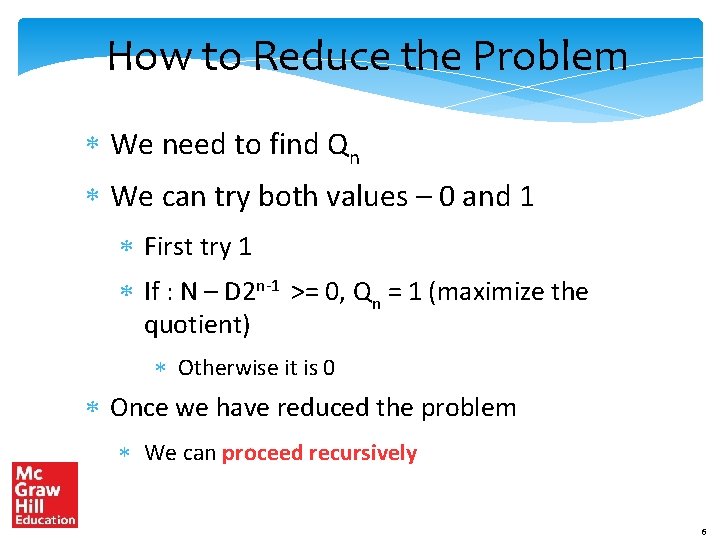
How to Reduce the Problem * We need to find Qn * We can try both values – 0 and 1 * First try 1 * If : N – D 2 n-1 >= 0, Qn = 1 (maximize the quotient) * Otherwise it is 0 * Once we have reduced the problem * We can proceed recursively 6
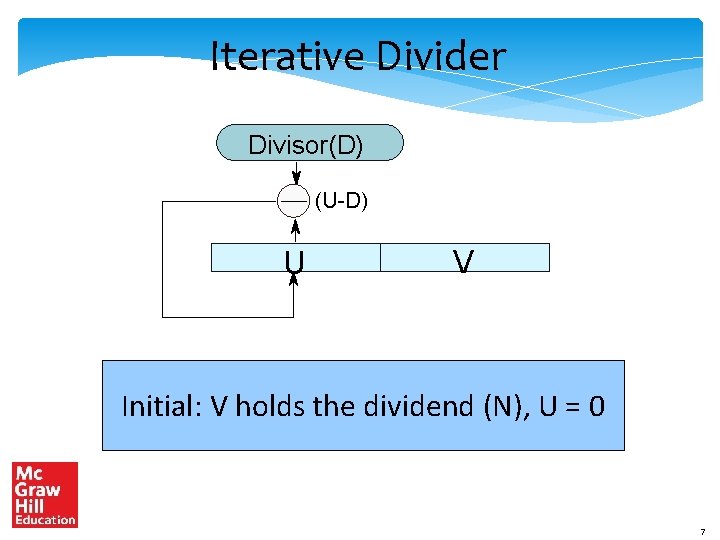
Iterative Divider Divisor(D) (U-D) U V Initial: V holds the dividend (N), U = 0 7
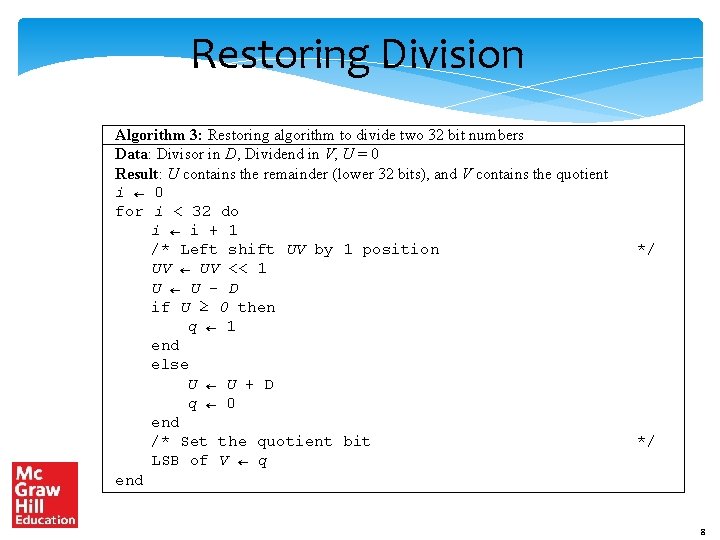
Restoring Division Algorithm 3: Restoring algorithm to divide two 32 bit numbers Data: Divisor in D, Dividend in V, U = 0 Result: U contains the remainder (lower 32 bits), and V contains the quotient i ← 0 for i < 32 do i ← i + 1 /* Left shift UV by 1 position UV ← UV << 1 U ← U - D if U ≥ 0 then q ← 1 end else U ← U + D q ← 0 end /* Set the quotient bit LSB of V ← q end */ */ 8
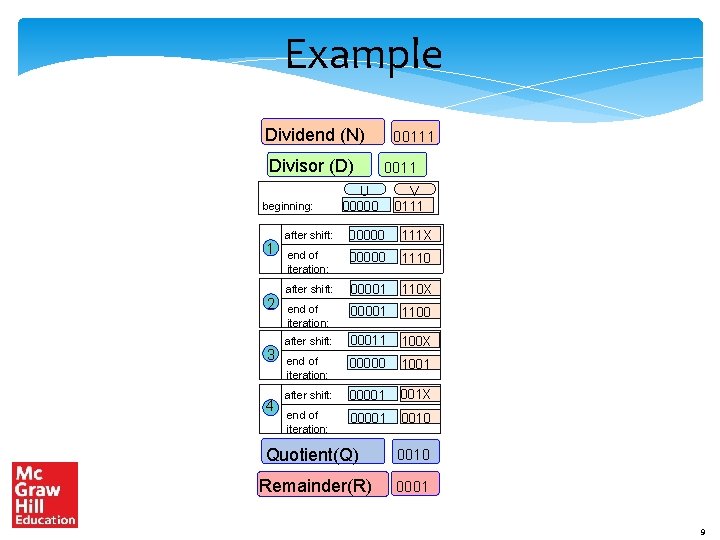
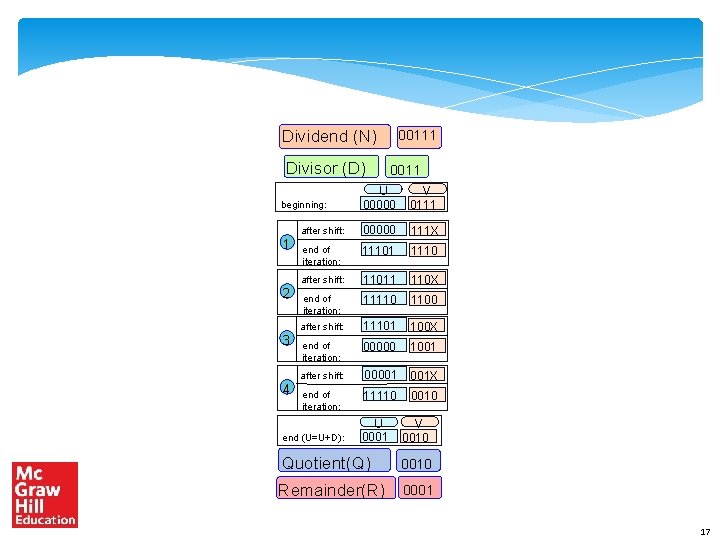
Example Dividend (N) Divisor (D) beginning: 1 2 3 4 00111 0011 U 00000 V 0111 after shift: 00000 111 X end of iteration: 00000 1110 after shift: 00001 110 X end of iteration: 00001 1100 after shift: 00011 100 X end of iteration: 00000 1001 after shift: 00001 001 X end of iteration: 00001 0010 Quotient(Q) 0010 Remainder(R) 0001 9
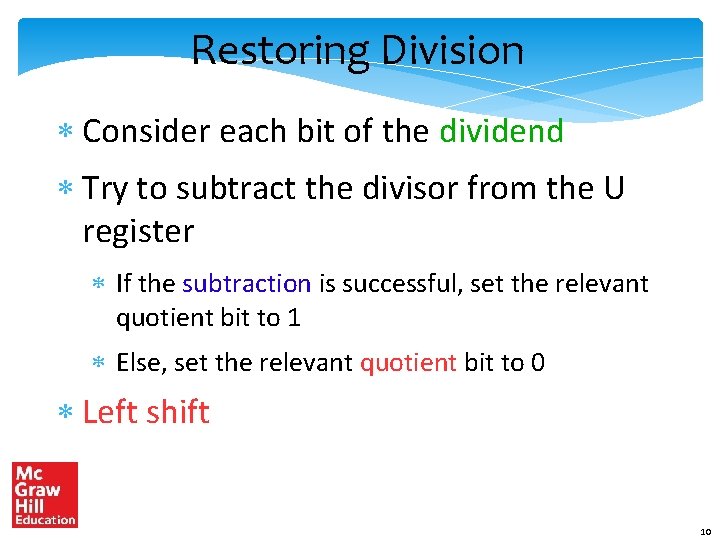
Restoring Division * Consider each bit of the dividend * Try to subtract the divisor from the U register * If the subtraction is successful, set the relevant quotient bit to 1 * Else, set the relevant quotient bit to 0 * Left shift 10
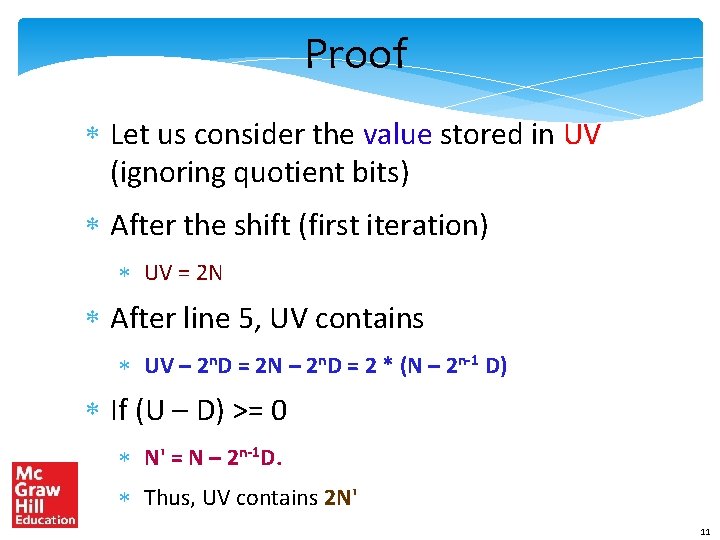
Proof * Let us consider the value stored in UV (ignoring quotient bits) * After the shift (first iteration) * UV = 2 N * After line 5, UV contains * UV – 2 n. D = 2 N – 2 n. D = 2 * (N – 2 n-1 D) * If (U – D) >= 0 * N' = N – 2 n-1 D. * Thus, UV contains 2 N' 11
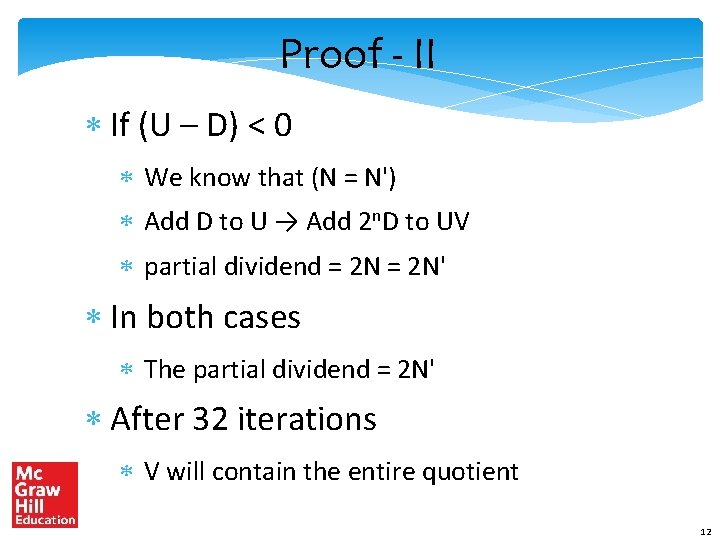
Proof - II * If (U – D) < 0 * We know that (N = N') * Add D to U → Add 2 n. D to UV * partial dividend = 2 N' * In both cases * The partial dividend = 2 N' * After 32 iterations * V will contain the entire quotient 12
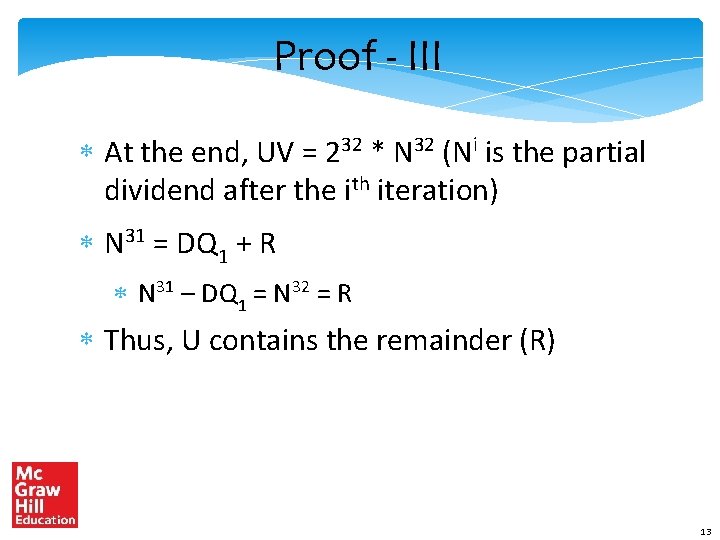
Proof - III * At the end, UV = 232 * N 32 (Ni is the partial dividend after the ith iteration) * N 31 = DQ 1 + R * N 31 – DQ 1 = N 32 = R * Thus, U contains the remainder (R) 13
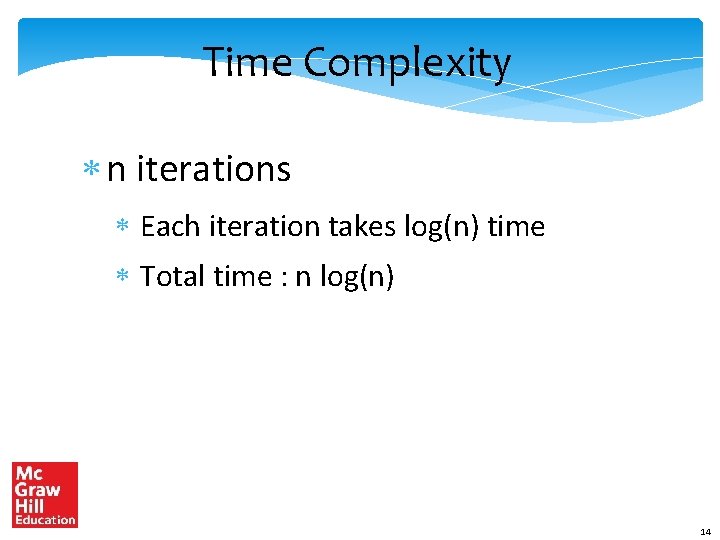
Time Complexity * n iterations * Each iteration takes log(n) time * Total time : n log(n) 14
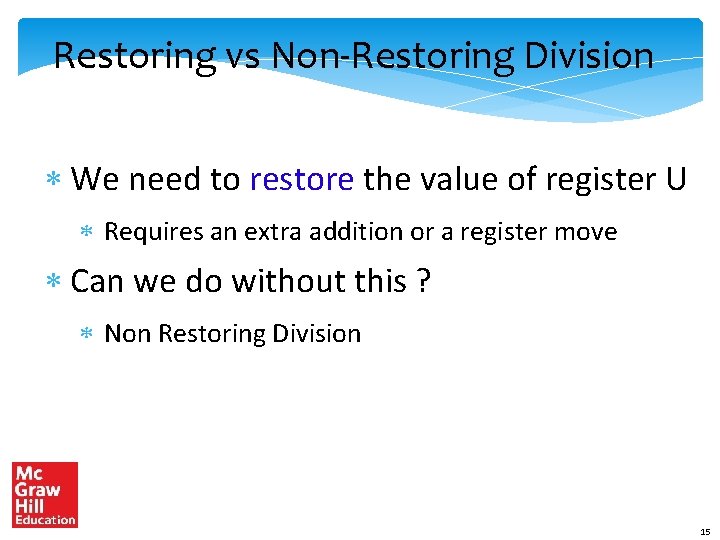
Restoring vs Non-Restoring Division * We need to restore the value of register U * Requires an extra addition or a register move * Can we do without this ? * Non Restoring Division 15
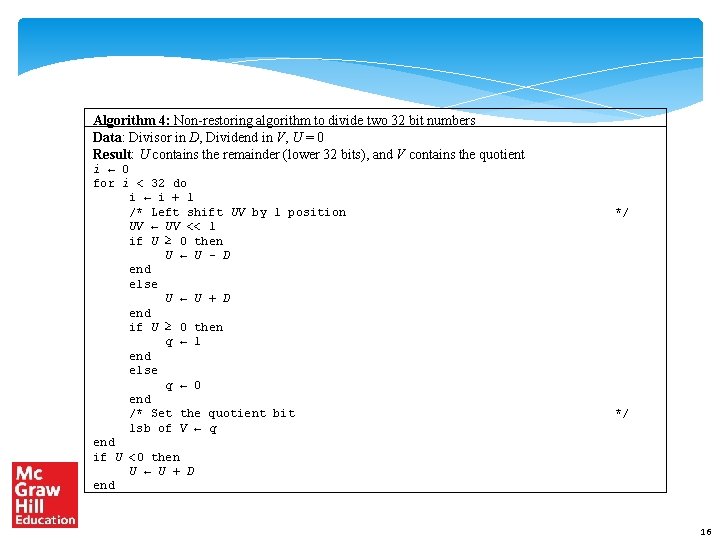
Algorithm 4: Non-restoring algorithm to divide two 32 bit numbers Data: Divisor in D, Dividend in V, U = 0 Result: U contains the remainder (lower 32 bits), and V contains the quotient i ← 0 for i < 32 do i ← i + 1 /* Left shift UV by 1 position UV ← UV << 1 if U ≥ 0 then U ← U − D end else U ← U + D end if U ≥ 0 then q ← 1 end else q ← 0 end /* Set the quotient bit lsb of V ← q end if U <0 then U ← U + D end */ */ 16
Dividend (N) Divisor (D) 2 3 4 0011 U 00000 V 0111 after shift: 00000 111 X end of iteration: 11101 1110 after shift: 11011 110 X end of iteration: 11110 1100 after shift: 11101 100 X end of iteration: 00000 1001 after shift: 00001 001 X end of iteration: 11110 0010 beginning: 1 00111 end (U=U+D): U 0001 V 0010 Quotient(Q) 0010 Remainder(R) 0001 17
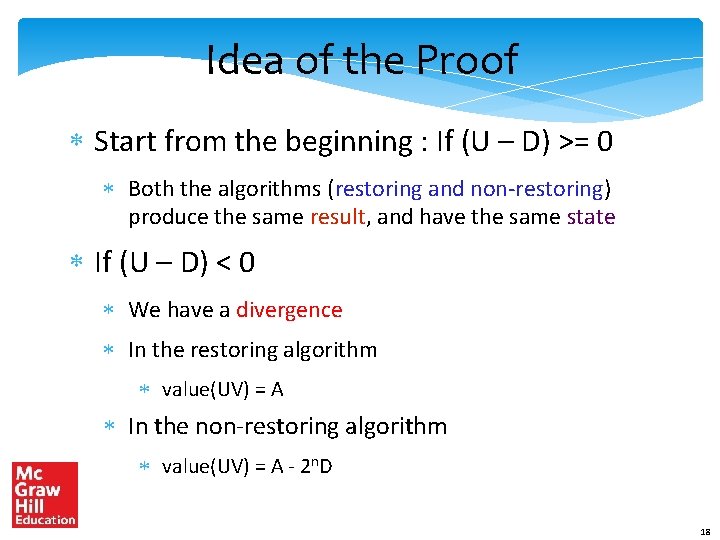
Idea of the Proof * Start from the beginning : If (U – D) >= 0 * Both the algorithms (restoring and non-restoring) produce the same result, and have the same state * If (U – D) < 0 * We have a divergence * In the restoring algorithm * value(UV) = A * In the non-restoring algorithm * value(UV) = A - 2 n. D 18
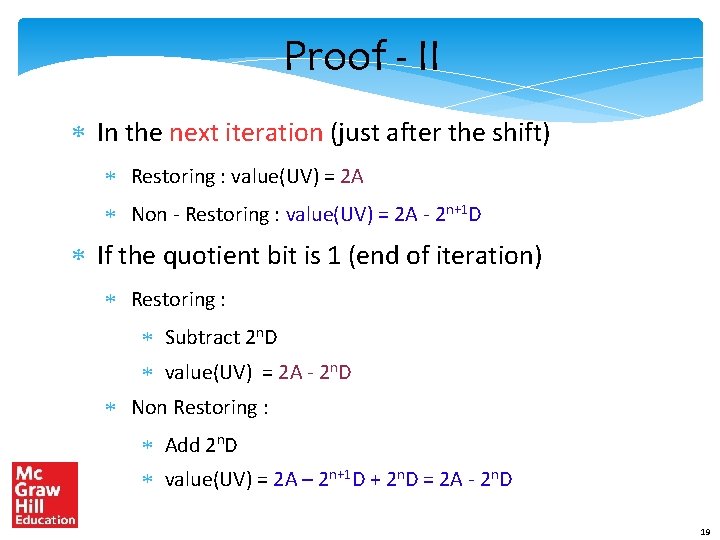
Proof - II * In the next iteration (just after the shift) * Restoring : value(UV) = 2 A * Non - Restoring : value(UV) = 2 A - 2 n+1 D * If the quotient bit is 1 (end of iteration) * Restoring : * Subtract 2 n. D * value(UV) = 2 A - 2 n. D * Non Restoring : * Add 2 n. D * value(UV) = 2 A – 2 n+1 D + 2 n. D = 2 A - 2 n. D 19
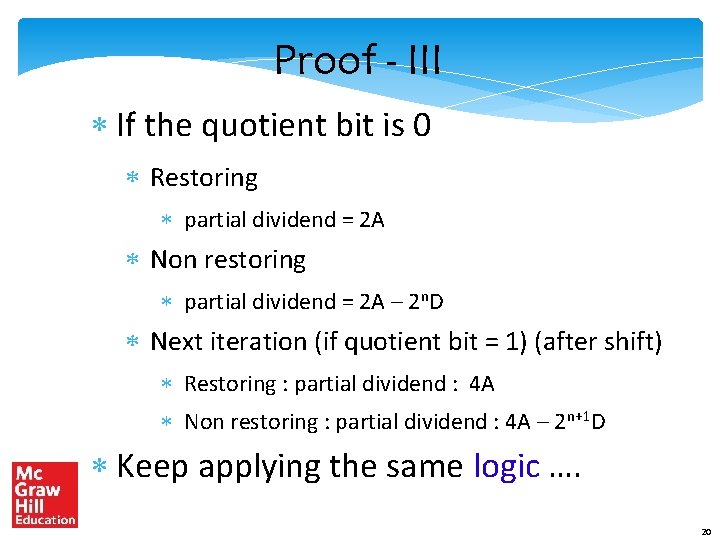
Proof - III * If the quotient bit is 0 * Restoring * partial dividend = 2 A * Non restoring * partial dividend = 2 A – 2 n. D * Next iteration (if quotient bit = 1) (after shift) * Restoring : partial dividend : 4 A * Non restoring : partial dividend : 4 A – 2 n+1 D * Keep applying the same logic …. 20
Outline * Addition * Multiplication * Division * Floating Point Addition * Floating Point Multiplication * Floating Point Division 21
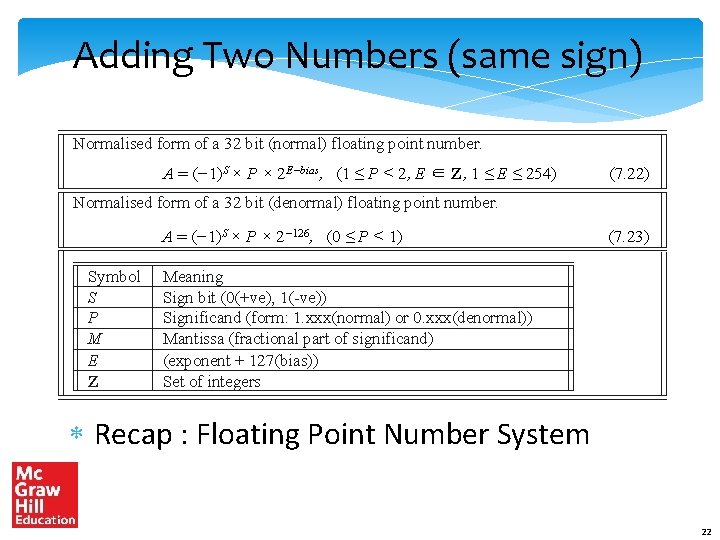
Adding Two Numbers (same sign) Normalised form of a 32 bit (normal) floating point number. A = (− 1)S × P × 2 E−bias, (1 ≤ P < 2, E ∈ Z, 1 ≤ E ≤ 254) (7. 22) Normalised form of a 32 bit (denormal) floating point number. A = (− 1)S × P × 2− 126, (0 ≤ P < 1) Symbol S P M E Z (7. 23) Meaning Sign bit (0(+ve), 1(-ve)) Significand (form: 1. xxx(normal) or 0. xxx(denormal)) Mantissa (fractional part of significand) (exponent + 127(bias)) Set of integers * Recap : Floating Point Number System 22
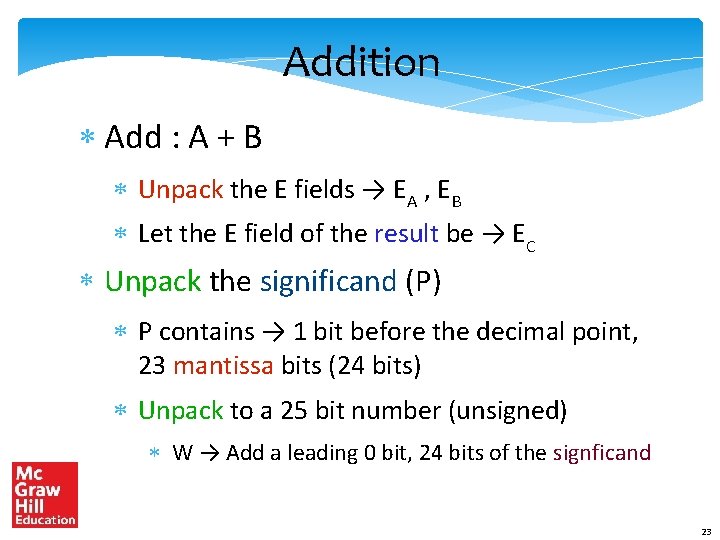
Addition * Add : A + B * Unpack the E fields → EA , EB * Let the E field of the result be → EC * Unpack the significand (P) * P contains → 1 bit before the decimal point, 23 mantissa bits (24 bits) * Unpack to a 25 bit number (unsigned) * W → Add a leading 0 bit, 24 bits of the signficand 23
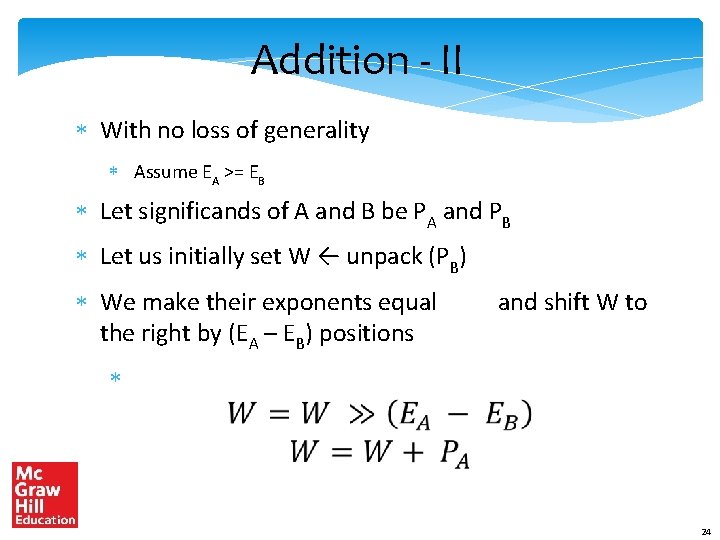
Addition - II * With no loss of generality * Assume EA >= EB * Let significands of A and B be PA and PB * Let us initially set W ← unpack (PB) * We make their exponents equal the right by (EA – EB) positions and shift W to * 24
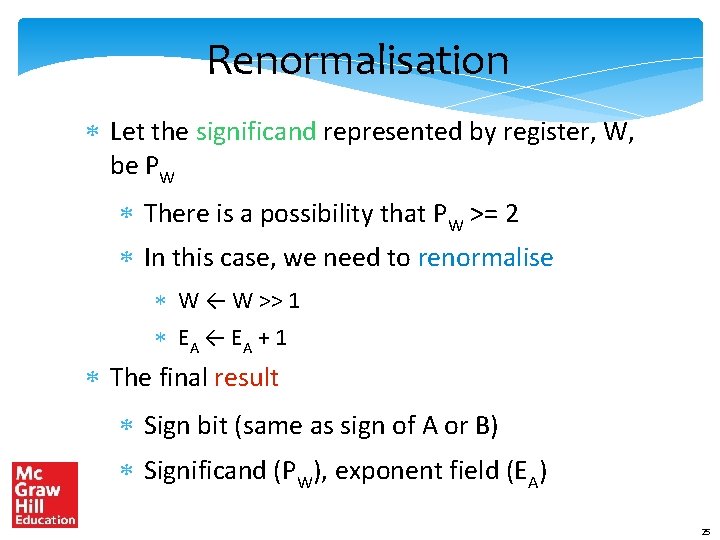
Renormalisation * Let the significand represented by register, W, be PW * There is a possibility that PW >= 2 * In this case, we need to renormalise * W ← W >> 1 * EA ← EA + 1 * The final result * Sign bit (same as sign of A or B) * Significand (PW), exponent field (EA) 25
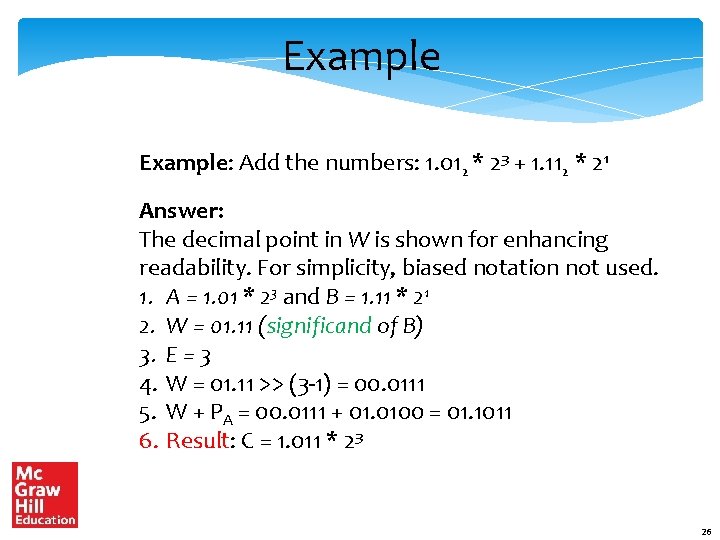
Example: Add the numbers: 1. 012 * 23 + 1. 112 * 21 Answer: The decimal point in W is shown for enhancing readability. For simplicity, biased notation not used. 1. A = 1. 01 * 23 and B = 1. 11 * 21 2. W = 01. 11 (significand of B) 3. E = 3 4. W = 01. 11 >> (3 -1) = 00. 0111 5. W + PA = 00. 0111 + 01. 0100 = 01. 1011 6. Result: C = 1. 011 * 23 26
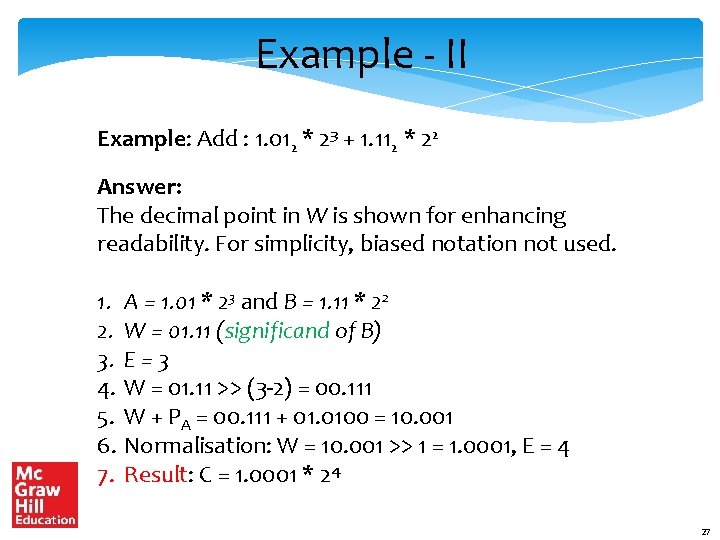
Example - II Example: Add : 1. 012 * 23 + 1. 112 * 22 Answer: The decimal point in W is shown for enhancing readability. For simplicity, biased notation not used. 1. 2. 3. 4. 5. 6. 7. A = 1. 01 * 23 and B = 1. 11 * 22 W = 01. 11 (significand of B) E=3 W = 01. 11 >> (3 -2) = 00. 111 W + PA = 00. 111 + 01. 0100 = 10. 001 Normalisation: W = 10. 001 >> 1 = 1. 0001, E = 4 Result: C = 1. 0001 * 24 27
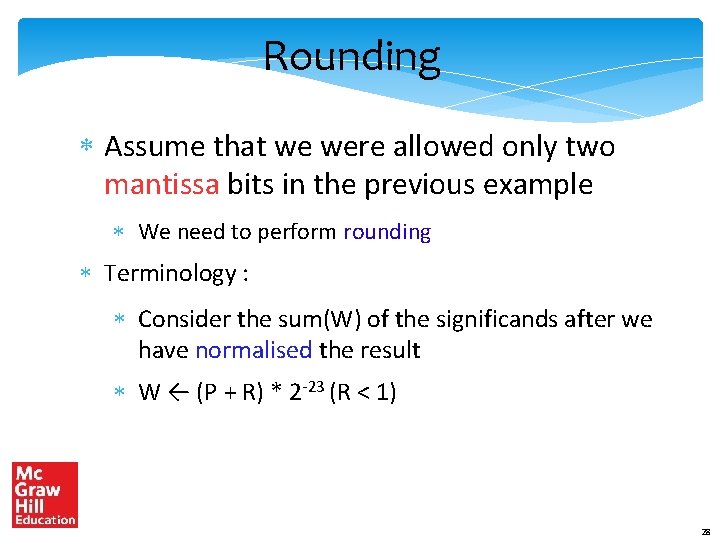
Rounding * Assume that we were allowed only two mantissa bits in the previous example * We need to perform rounding * Terminology : * Consider the sum(W) of the significands after we have normalised the result * W ← (P + R) * 2 -23 (R < 1) 28
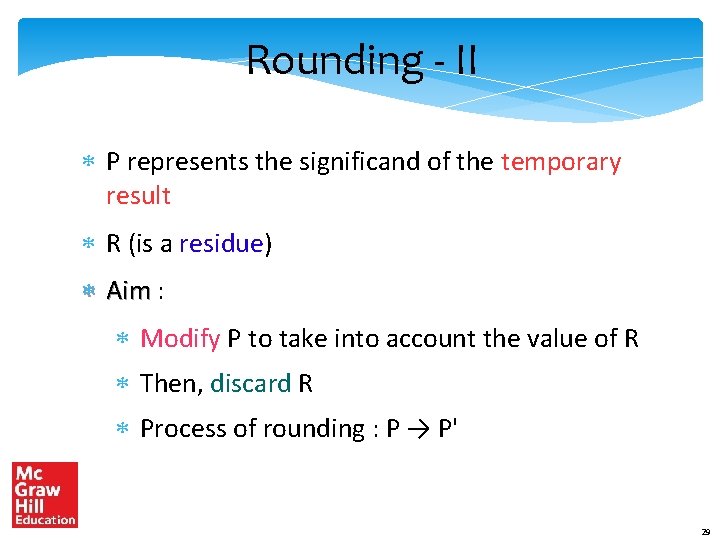
Rounding - II * P represents the significand of the temporary result * R (is a residue) * Aim : Aim * Modify P to take into account the value of R * Then, discard R * Process of rounding : P → P' 29
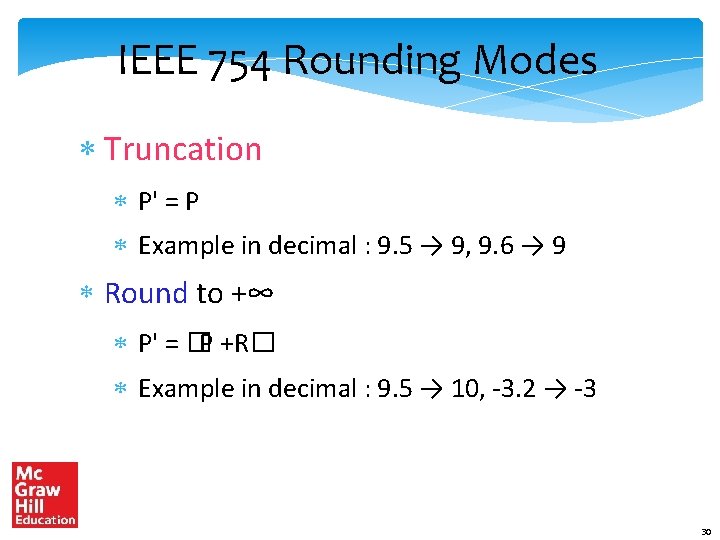
IEEE 754 Rounding Modes * Truncation * P' = P * Example in decimal : 9. 5 → 9, 9. 6 → 9 * Round to +∞ * P' = �P +R� * Example in decimal : 9. 5 → 10, -3. 2 → -3 30
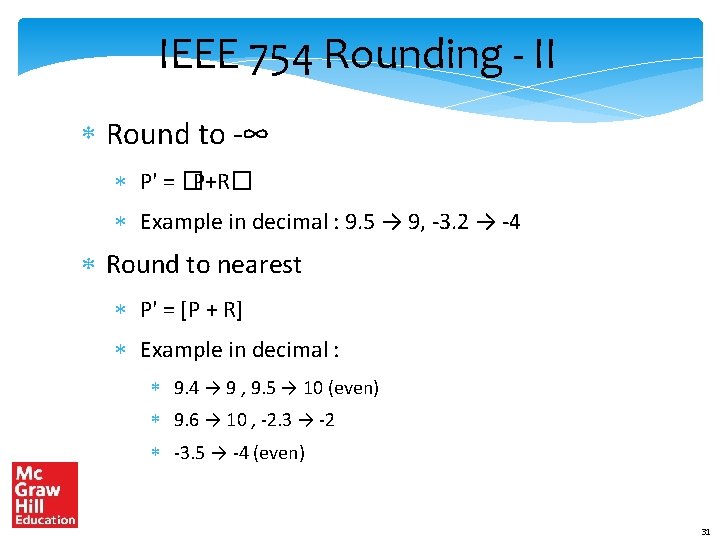
IEEE 754 Rounding - II * Round to -∞ * P' = �P+R� * Example in decimal : 9. 5 → 9, -3. 2 → -4 * Round to nearest * P' = [P + R] * Example in decimal : * 9. 4 → 9 , 9. 5 → 10 (even) * 9. 6 → 10 , -2. 3 → -2 * -3. 5 → -4 (even) 31
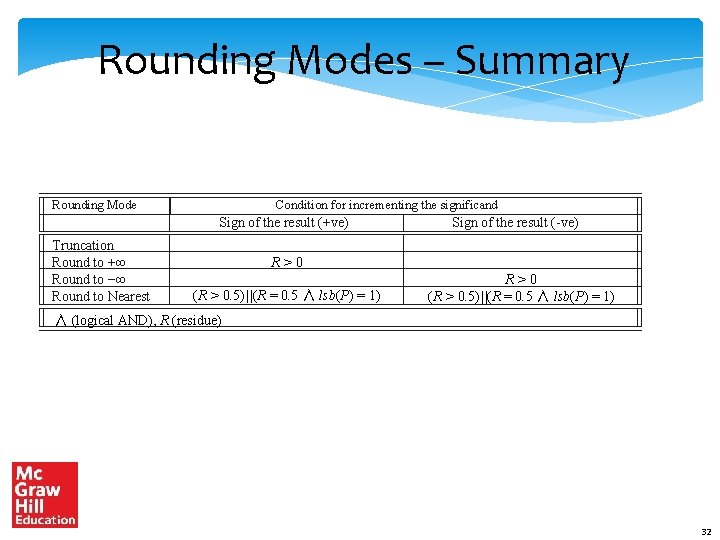
Rounding Modes – Summary Rounding Mode Condition for incrementing the significand Sign of the result (+ve) Truncation Round to +∞ Round to −∞ Round to Nearest Sign of the result (-ve) R>0 (R > 0. 5)||(R = 0. 5 ∧ lsb(P) = 1) ∧ (logical AND), R (residue) 32
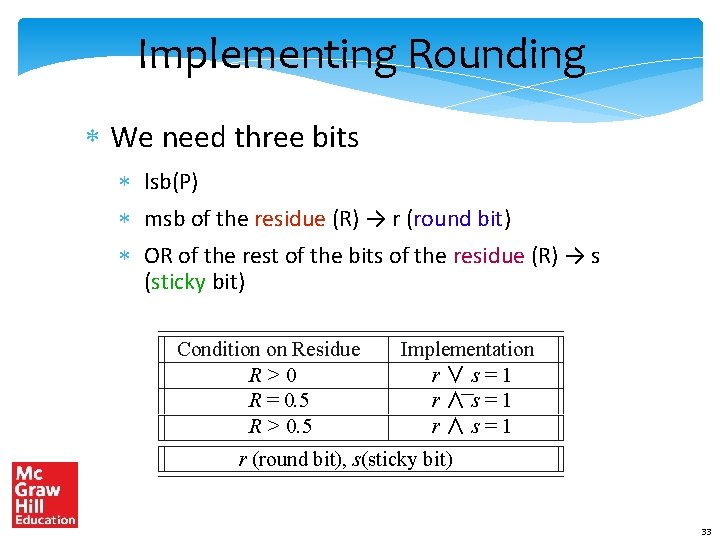
Implementing Rounding * We need three bits * lsb(P) * msb of the residue (R) → r (round bit) * OR of the rest of the bits of the residue (R) → s (sticky bit) Condition on Residue R>0 R = 0. 5 R > 0. 5 Implementation r∨s=1 r∧s=1 r (round bit), s(sticky bit) 33
Renormalisation after Rounding * In rounding : we might increment the significand * We might need to renormalise * After renormalisation * Possible that E becomes equal to 255 * In this, case declare an overflow 34
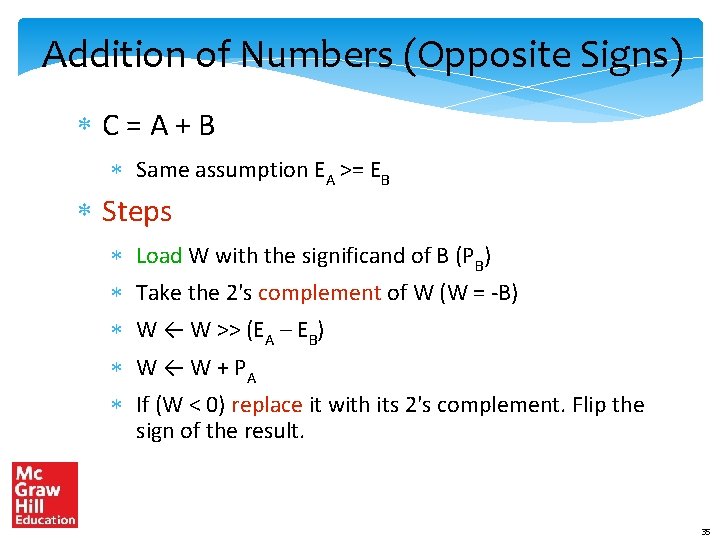
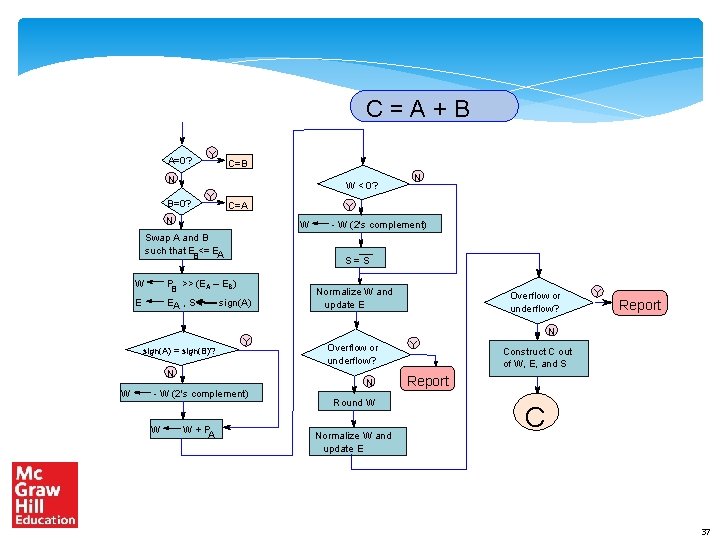
Addition of Numbers (Opposite Signs) * C = A + B * Same assumption EA >= EB * Steps * Load W with the significand of B (PB) * Take the 2's complement of W (W = -B) * W ← W >> (EA – EB) * W ← W + PA * If (W < 0) replace it with its 2's complement. Flip the sign of the result. 35
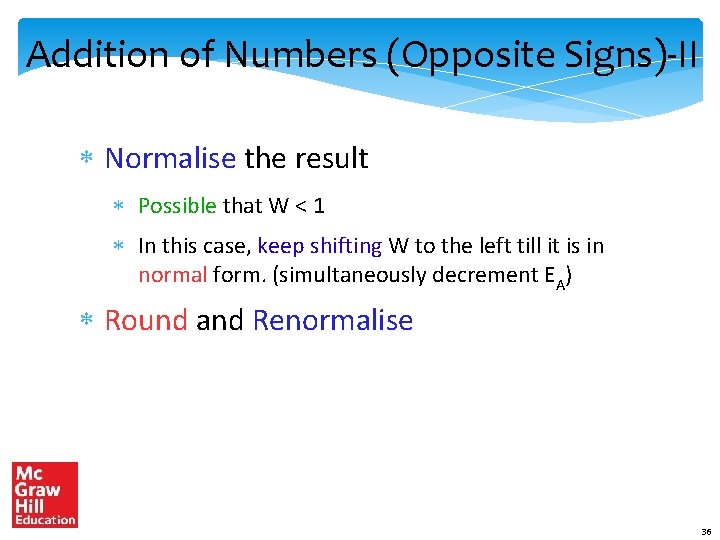
Addition of Numbers (Opposite Signs)-II * Normalise the result * Possible that W < 1 * In this case, keep shifting W to the left till it is in normal form. (simultaneously decrement EA) * Round and Renormalise 36
C=A+B A=0? Y C=B N B=0? W < 0? Y C=A N W P >> (EA – EB) E EA , S sign(A) Y N - W (2's complement) W W + PA - W (2's complement) S=S B sign(A) = sign(B)? W Y W Swap A and B such that EB<= EA N Normalize W and update E Overflow or underflow? Y Report N Overflow or underflow? N Round W Normalize W and update E Y Construct C out of W, E, and S Report C 37
Outline * * * Addition Multiplication Division Floating Point Addition Floating Point Multiplication Floating Point Division 38
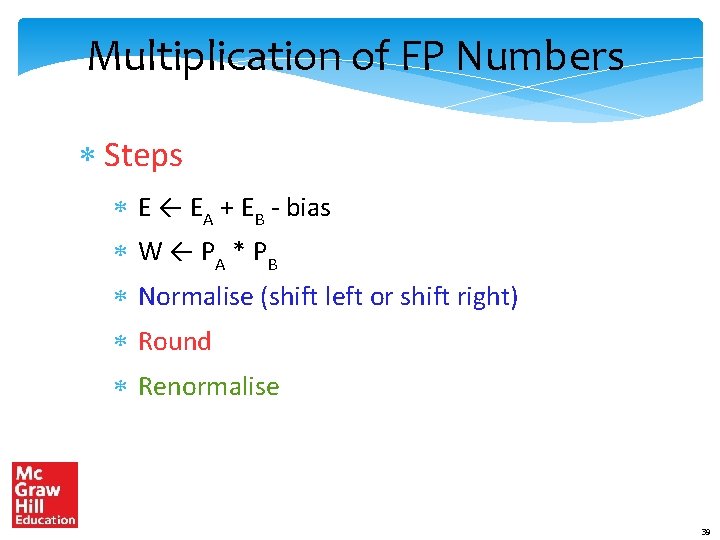
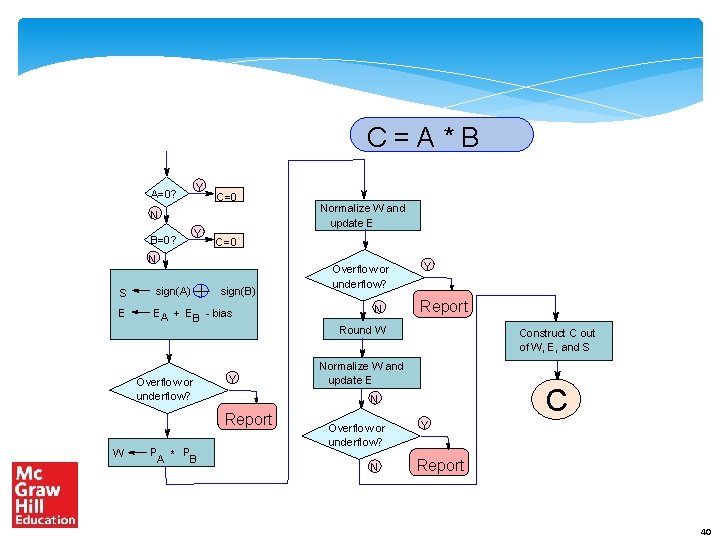
Multiplication of FP Numbers * Steps * E ← EA + EB - bias * W ← PA * PB * Normalise (shift left or shift right) * Round * Renormalise 39
C=A*B A=0? Y C=0 N B=0? Y C=0 N S sign(A) E EA + EB - bias Overflow or underflow? sign(B) Y P * P A B Overflow or underflow? N Y Report Round W Construct C out of W, E, and S Normalize W and update E C N Report W Normalize W and update E Overflow or underflow? N Y Report 40
Outline * * * Addition Multiplication Division Floating Point Addition Floating Point Multiplication Floating Point Division 41
Simple Division Algorithm * Divide A/B to produce C * There is no notion of a remainder in FP division * Algorithm * E ← EA – EB + bias * W ← PA / PB * normalise, round, renormalise * Complexity : O(n log(n)) 42
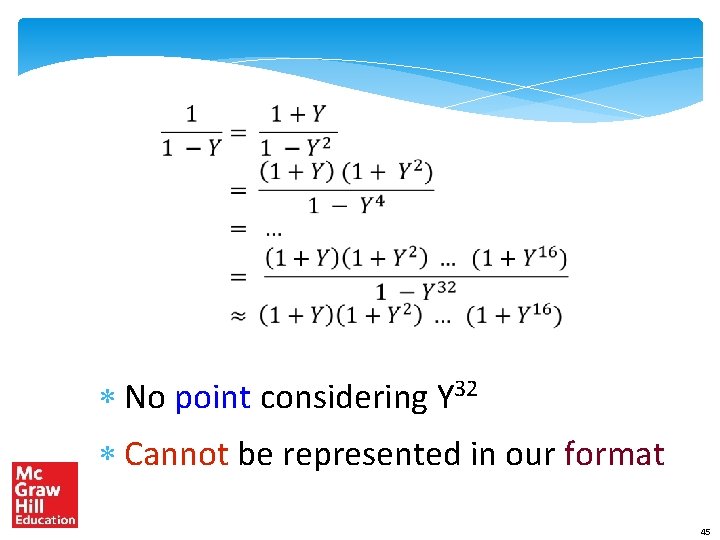
Goldschmidt Division * Let us compute the reciprocal of B (1/B) * Then, we can use the standard floating point multiplication algorithm * Ignoring the exponent * Let us compute (1/PB) * If B is a normal floating point number * 1 <= PB < 2 * PB = 1 + X (X < 1) 43
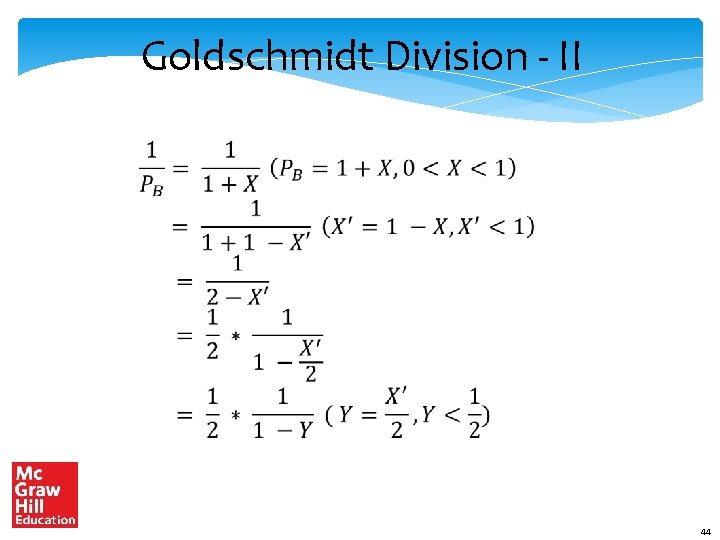
Goldschmidt Division - II 44
* No point considering Y 32 * Cannot be represented in our format 45
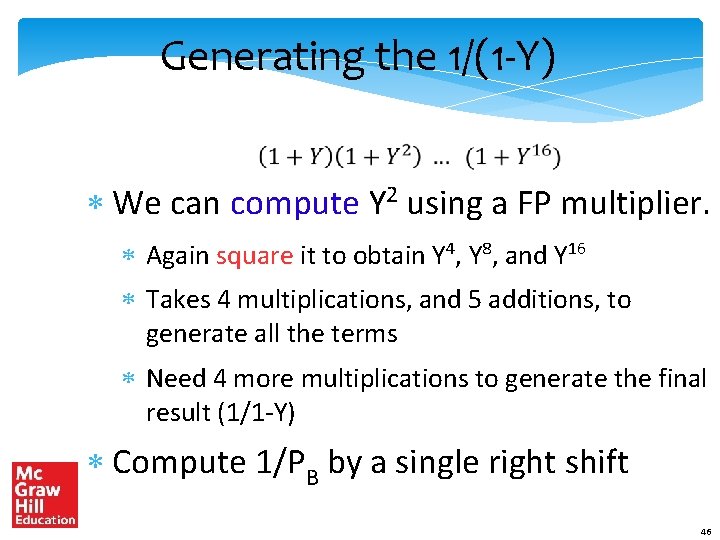
Generating the 1/(1 -Y) * We can compute Y 2 using a FP multiplier. * Again square it to obtain Y 4, Y 8, and Y 16 * Takes 4 multiplications, and 5 additions, to generate all the terms * Need 4 more multiplications to generate the final result (1/1 -Y) * Compute 1/PB by a single right shift 46
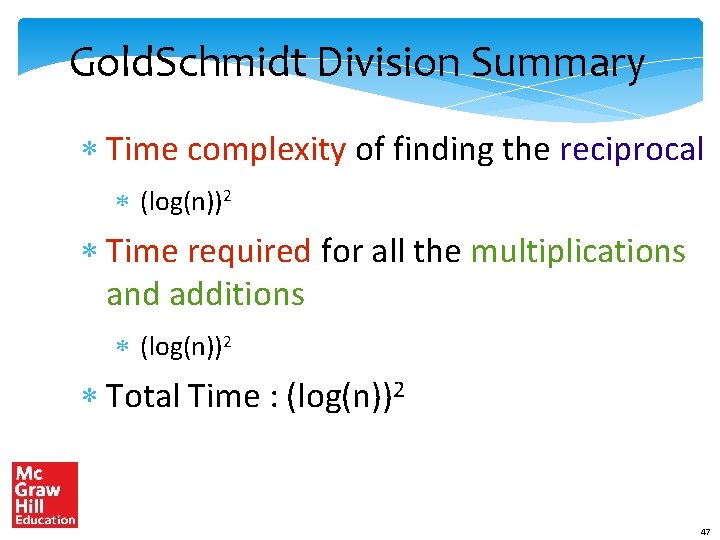
Gold. Schmidt Division Summary * Time complexity of finding the reciprocal * (log(n))2 * Time required for all the multiplications and additions * (log(n))2 * Total Time : (log(n))2 47
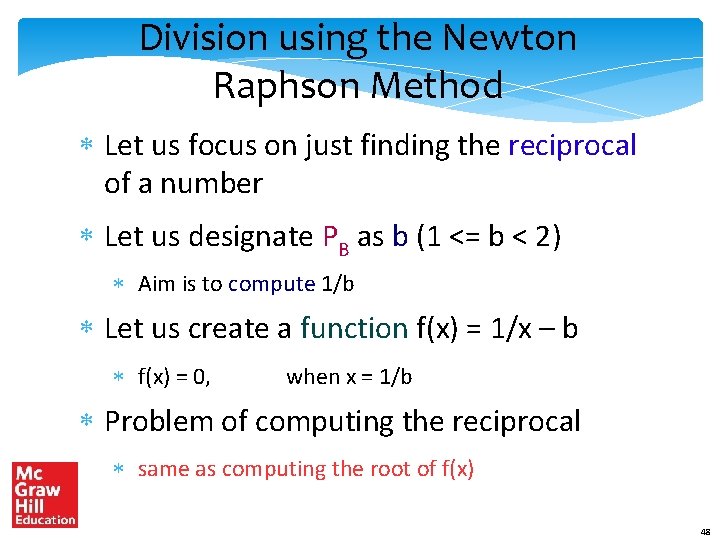
Division using the Newton Raphson Method * Let us focus on just finding the reciprocal of a number * Let us designate PB as b (1 <= b < 2) * Aim is to compute 1/b * Let us create a function f(x) = 1/x – b * f(x) = 0, when x = 1/b * Problem of computing the reciprocal * same as computing the root of f(x) 48
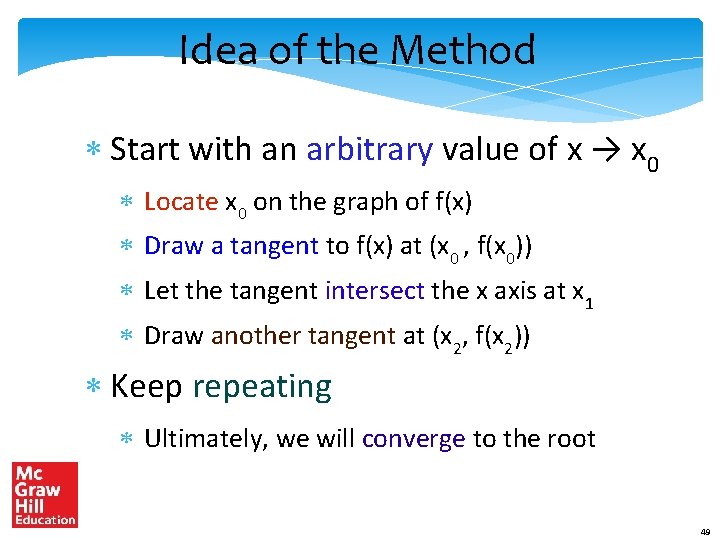
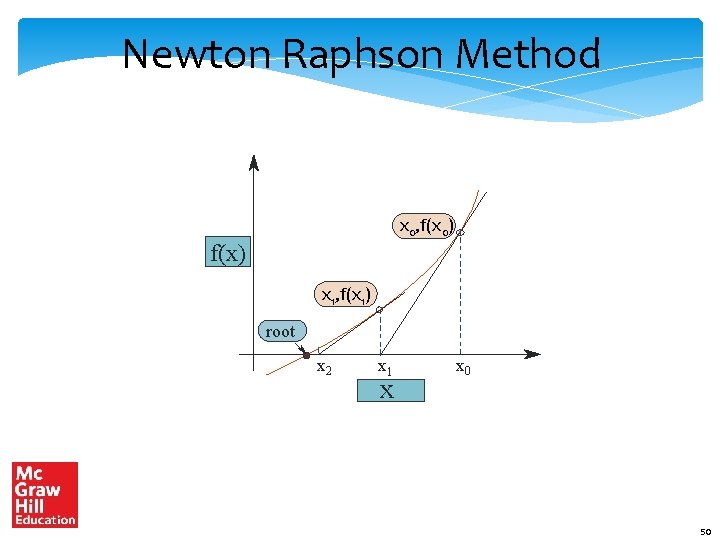
Idea of the Method * Start with an arbitrary value of x → x 0 * Locate x 0 on the graph of f(x) * Draw a tangent to f(x) at (x 0 , f(x 0)) * Let the tangent intersect the x axis at x 1 * Draw another tangent at (x 2, f(x 2)) * Keep repeating * Ultimately, we will converge to the root 49
Newton Raphson Method x 0, f(x 0) f(x) x 1, f(x 1) root x 2 x 1 x x 0 50
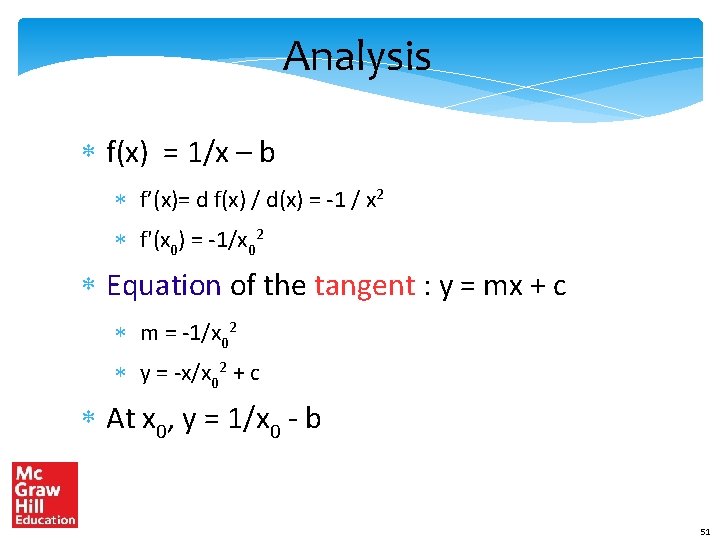
Analysis * f(x) = 1/x – b * f’(x)= d f(x) / d(x) = -1 / x 2 * f'(x 0) = -1/x 02 * Equation of the tangent : y = mx + c * m = -1/x 02 * y = -x/x 02 + c * At x 0, y = 1/x 0 - b 51
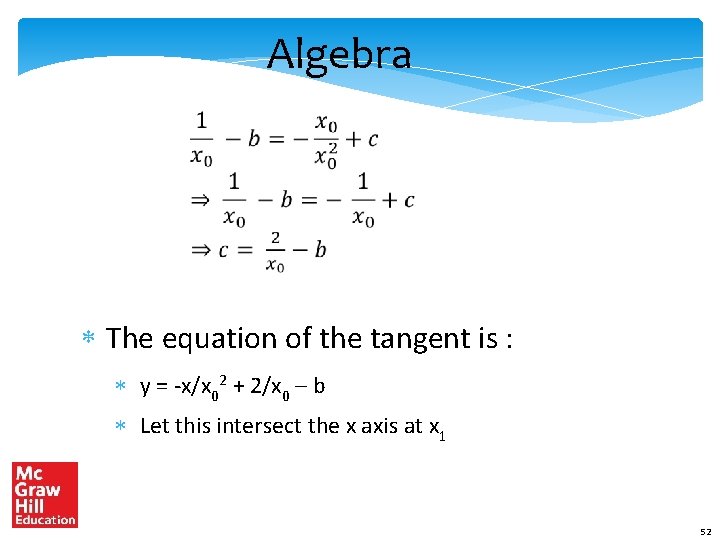
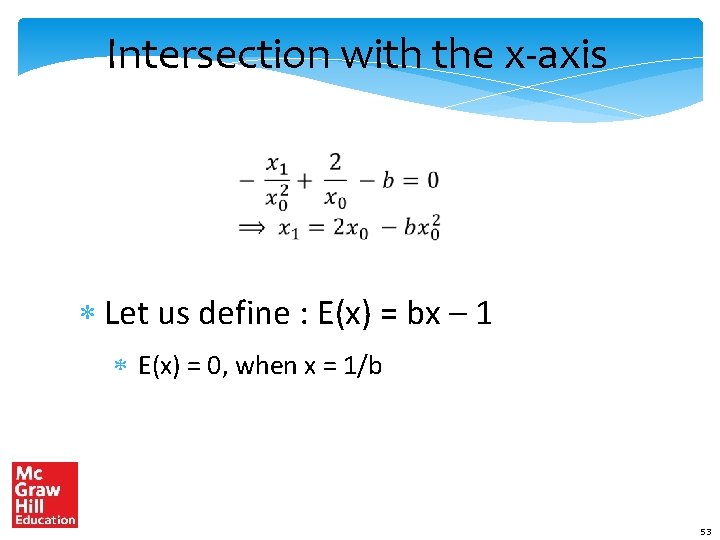
Algebra * The equation of the tangent is : * y = -x/x 02 + 2/x 0 – b * Let this intersect the x axis at x 1 52
Intersection with the x-axis * Let us define : E(x) = bx – 1 * E(x) = 0, when x = 1/b 53
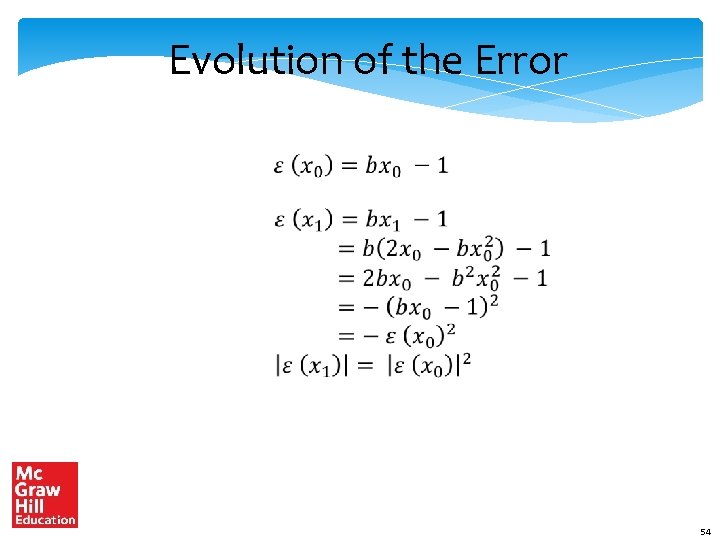
Evolution of the Error 54
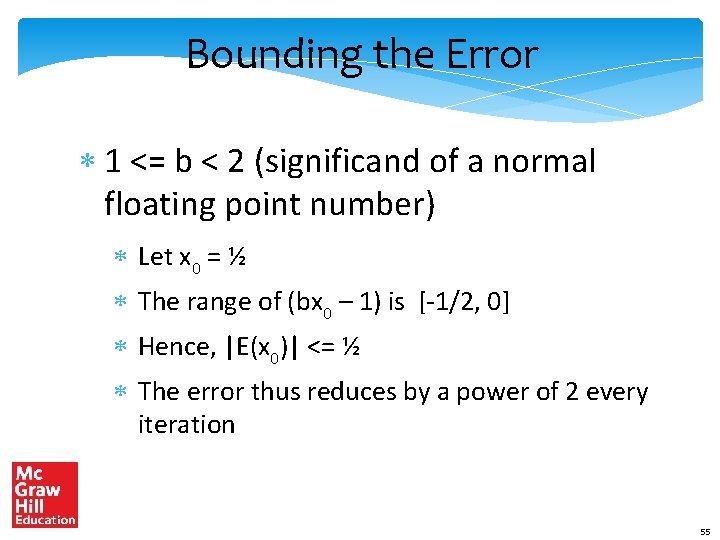
Bounding the Error * 1 <= b < 2 (significand of a normal floating point number) * Let x 0 = ½ * The range of (bx 0 – 1) is [-1/2, 0] * Hence, |E(x 0)| <= ½ * The error thus reduces by a power of 2 every iteration 55
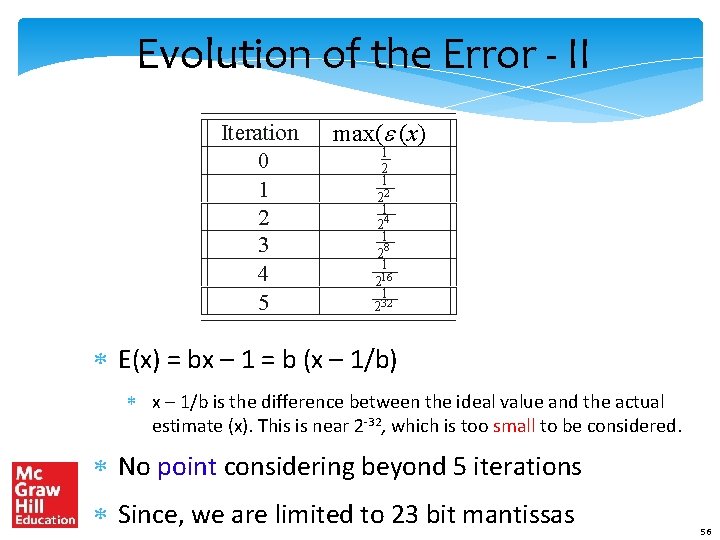
Evolution of the Error - II Iteration 0 1 2 3 4 5 max(e (x) 1 22 1 24 1 28 1 216 1 232 * E(x) = bx – 1 = b (x – 1/b) * x – 1/b is the difference between the ideal value and the actual estimate (x). This is near 2 -32, which is too small to be considered. * No point considering beyond 5 iterations * Since, we are limited to 23 bit mantissas 56
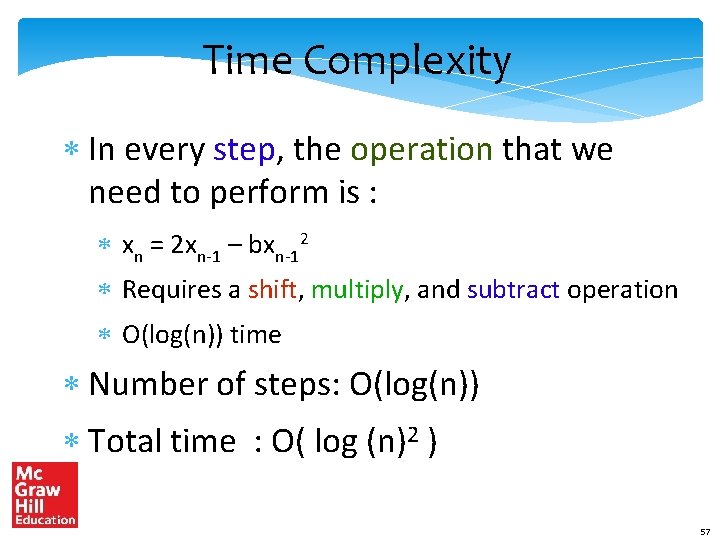
Time Complexity * In every step, the operation that we need to perform is : * xn = 2 xn-1 – bxn-12 * Requires a shift, multiply, and subtract operation * O(log(n)) time * Number of steps: O(log(n)) * Total time : O( log (n)2 ) 57
THE END 58