
Power Point Presentation to Accompany Phlebotomy A CompetencyBased
Power. Point ® Presentation to Accompany Phlebotomy: A Competency-Based Approach Booth and Mundt
Chapter 9 9 -2 Blood Specimen Handling Mc. Graw-Hill © 2013 by Mc. Graw-Hill Education. All rights reserved.

9 -3 Upon completion of this chapter, you should be able to: Explain methods for transporting and processing blood specimens for routine and special testing and reference laboratories. l Describe clerical errors that can occur during specimen processing. l Recognize criteria for special specimen handling. l List the circumstances that would lead to recollection or rejection of a patient sample. l Mc. Graw-Hill © 2013 by Mc. Graw-Hill Education. All rights reserved.

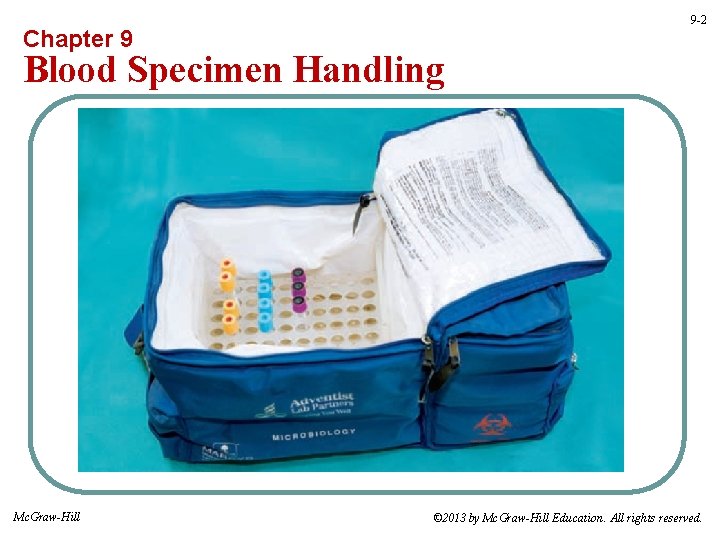
Specimen Transport Within a Facility (LO 9. 1) 9 -4 l Pneumatic tube system l Dumbwaiter l Automated tracks l Robotics l Conveyor belts Mc. Graw-Hill © 2013 by Mc. Graw-Hill Education. All rights reserved.
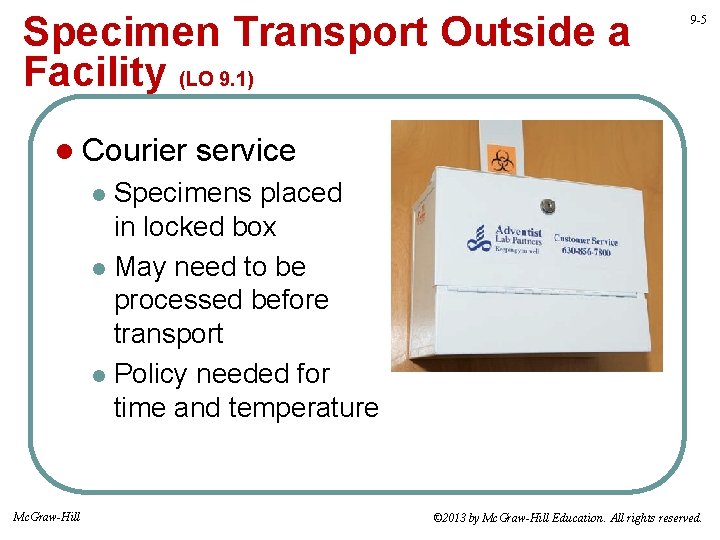
Specimen Transport Outside a Facility (LO 9. 1) l Courier 9 -5 service Specimens placed in locked box l May need to be processed before transport l Policy needed for time and temperature l Mc. Graw-Hill © 2013 by Mc. Graw-Hill Education. All rights reserved.

Specimen Transport to Other Facilities (LO 9. 1) 9 -6 l Reference laboratories Courier service l Shipping l Mc. Graw-Hill © 2013 by Mc. Graw-Hill Education. All rights reserved.
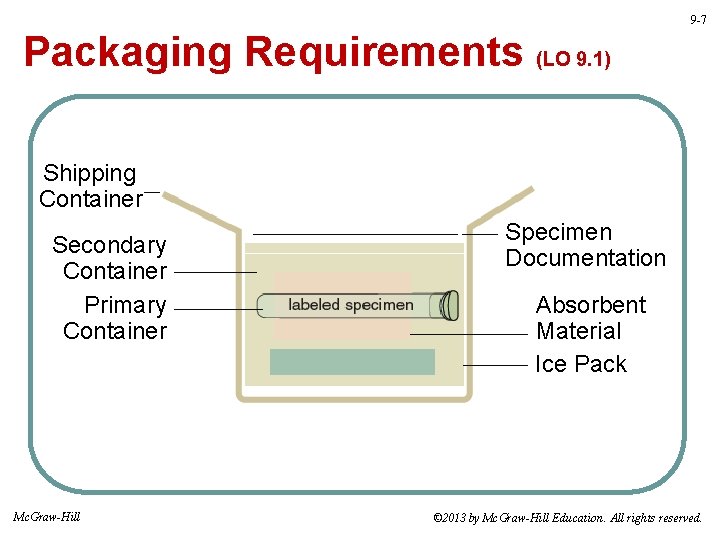
9 -7 Packaging Requirements (LO 9. 1) Shipping Container Secondary Container Primary Container Mc. Graw-Hill Specimen Documentation Absorbent Material Ice Pack © 2013 by Mc. Graw-Hill Education. All rights reserved.

Specimen Transit Tracking 9 -8 (LO 9. 1) l Transit information entered in LIS Manual entry l Bar code reader l Mc. Graw-Hill © 2013 by Mc. Graw-Hill Education. All rights reserved.
9 -9 Apply Your Knowledge (LO 9. 1) Name at least two ways in which specimens are transported to a laboratory. Answer: Walking to the lab, pneumatic tube system, dumbwaiter, courier pickup, mailing, express service. GREAT! Mc. Graw-Hill © 2013 by Mc. Graw-Hill Education. All rights reserved.
Pre-Examination Errors 9 -10 (LO 9. 2) l Errors that occur before, during, or after blood collection Patient identification errors l Specimen collection errors l Specimen handling errors l Mc. Graw-Hill © 2013 by Mc. Graw-Hill Education. All rights reserved.
Apply Your Knowledge 9 -11 (LO 9. 2) What errors are considered pre-examination errors? Answer: Patient identification errors, specimen collection errors, and specimen handling errors. GOOD JOB! Mc. Graw-Hill © 2013 by Mc. Graw-Hill Education. All rights reserved.
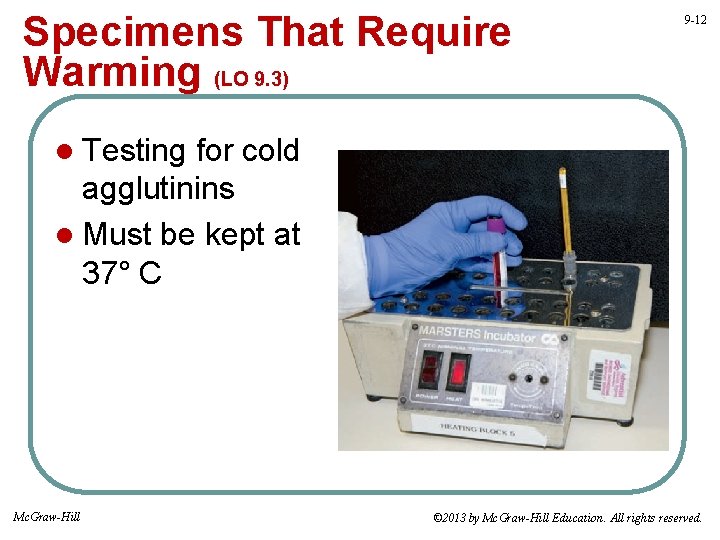
Specimens That Require Warming (LO 9. 3) 9 -12 l Testing for cold agglutinins l Must be kept at 37° C Mc. Graw-Hill © 2013 by Mc. Graw-Hill Education. All rights reserved.
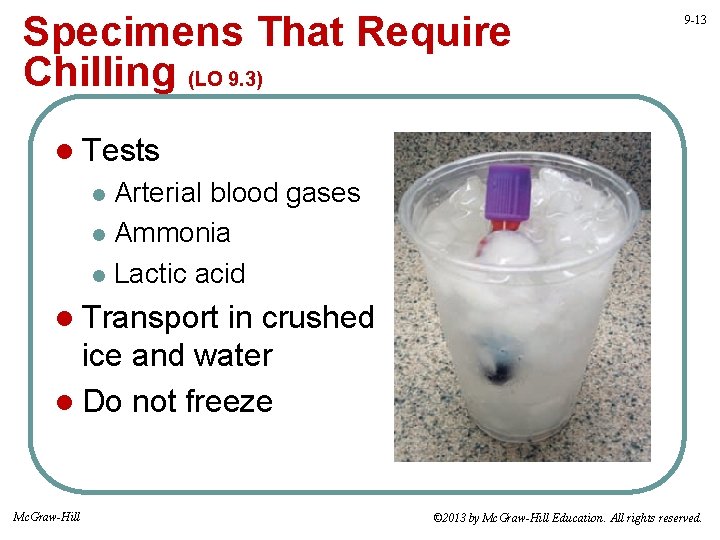
Specimens That Require Chilling (LO 9. 3) 9 -13 l Tests Arterial blood gases l Ammonia l Lactic acid l l Transport in crushed ice and water l Do not freeze Mc. Graw-Hill © 2013 by Mc. Graw-Hill Education. All rights reserved.

9 -14 Light-Sensitive Specimens (LO 9. 3) l Tests Bilirubin l Carotene l l Use amber tube l Wrap in foil Mc. Graw-Hill © 2013 by Mc. Graw-Hill Education. All rights reserved.
Specimens for Legal Matters 9 -15 (LO 9. 3) l Results may be used in court of law l Chain-of-custody Uninterrupted control of authorized personnel l If broken, specimen and tests are invalid l Mc. Graw-Hill © 2013 by Mc. Graw-Hill Education. All rights reserved.
9 -16 Blood Alcohol Specimens (LO 9. 3) l Proceeding without patient permission or court order = assault and battery l Requires chain-of-custody procedure l Do not use alcohol to cleanse site Alcohol prep pad l Iodine swab l Mc. Graw-Hill © 2013 by Mc. Graw-Hill Education. All rights reserved.
9 -17 Forensic Specimens (LO 9. 3) l Usually for legal cases l Require chain-of-custody procedure l Check specific guidelines at your facility Special evidence kits l Proper training l Mc. Graw-Hill © 2013 by Mc. Graw-Hill Education. All rights reserved.
9 -18 Toxicology Specimens (LO 9. 3) l Reasons for toxicology specimens Detect poisons, drugs, or medications l Detect trace elements l l Follow Mc. Graw-Hill your facility’s protocols © 2013 by Mc. Graw-Hill Education. All rights reserved.
No-Tourniquet Blood Collection 9 -19 (LO 9. 3) l Required for lactic acid tests l Tourniquet may be applied briefly to locate vein l Remove tourniquet before collection l Arm must be at rest for 2 minutes before collection l Place specimen on ice l Deliver to laboratory STAT Mc. Graw-Hill © 2013 by Mc. Graw-Hill Education. All rights reserved.
9 -20 Special Coagulation Studies (LO 9. 3) l Types of coagulation studies Factor assay l Platelet function studies l Coagulation inhibitor assays l l Follow strict order of draw l Perform procedure quickly l Invert tubes to mix l Deliver to laboratory immediately Mc. Graw-Hill © 2013 by Mc. Graw-Hill Education. All rights reserved.
9 -21 Separated Specimens (LO 9. 3) l Separation procedures Centrifuging l Aliquoting l l For most tests, separation should be done within 2 hours of collection l Wear PPE during specimen processing Mc. Graw-Hill © 2013 by Mc. Graw-Hill Education. All rights reserved.
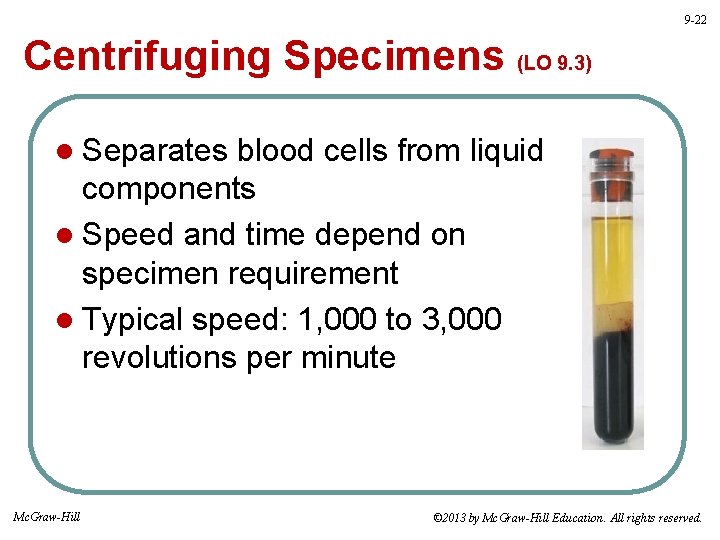
9 -22 Centrifuging Specimens (LO 9. 3) l Separates blood cells from liquid components l Speed and time depend on specimen requirement l Typical speed: 1, 000 to 3, 000 revolutions per minute Mc. Graw-Hill © 2013 by Mc. Graw-Hill Education. All rights reserved.
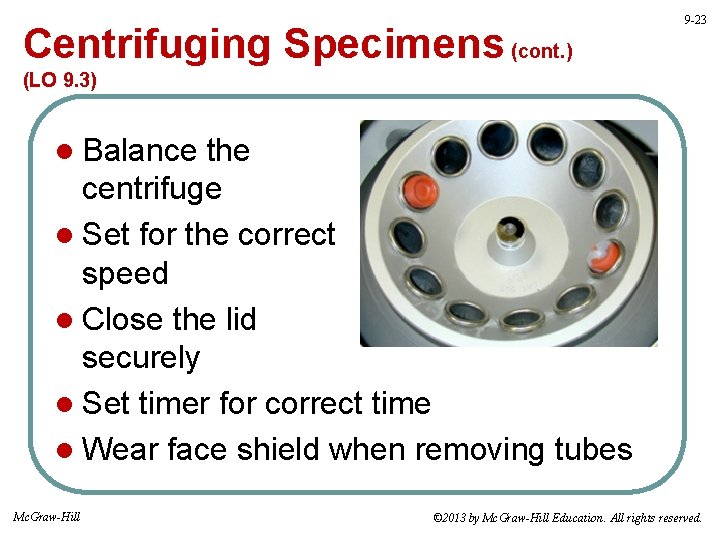
Centrifuging Specimens (cont. ) 9 -23 (LO 9. 3) l Balance the centrifuge l Set for the correct speed l Close the lid securely l Set timer for correct time l Wear face shield when removing tubes Mc. Graw-Hill © 2013 by Mc. Graw-Hill Education. All rights reserved.

9 -24 Aliquoting Specimens (LO 9. 3) l Take great care not to mix up samples Label transfer tube l Compare to specimen tube label l l Use pipet to transfer serum or plasma l Store properly for delivery to lab Mc. Graw-Hill © 2013 by Mc. Graw-Hill Education. All rights reserved.
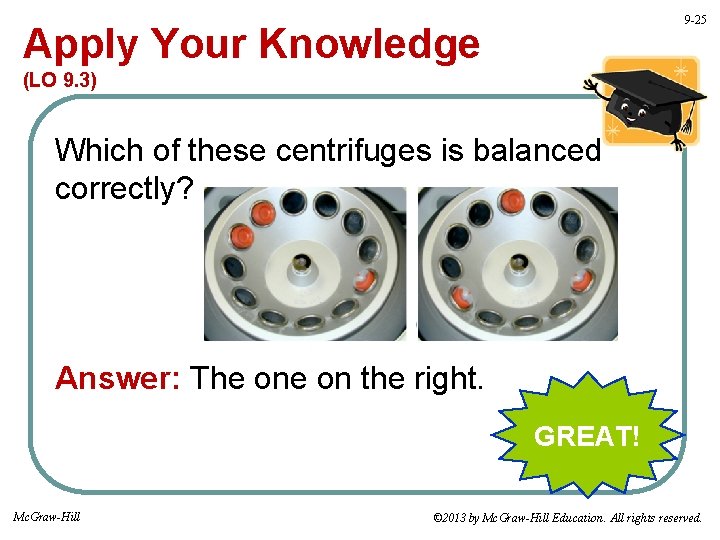
9 -25 Apply Your Knowledge (LO 9. 3) Which of these centrifuges is balanced correctly? Answer: The on the right. GREAT! Mc. Graw-Hill © 2013 by Mc. Graw-Hill Education. All rights reserved.
9 -26 Specimen Rejection (LO 9. 4) l Recollection may be required if abnormalities are detected l Accurate test results depend on specimens Errors may go unnoticed l Questionable results obtained l Mc. Graw-Hill © 2013 by Mc. Graw-Hill Education. All rights reserved.
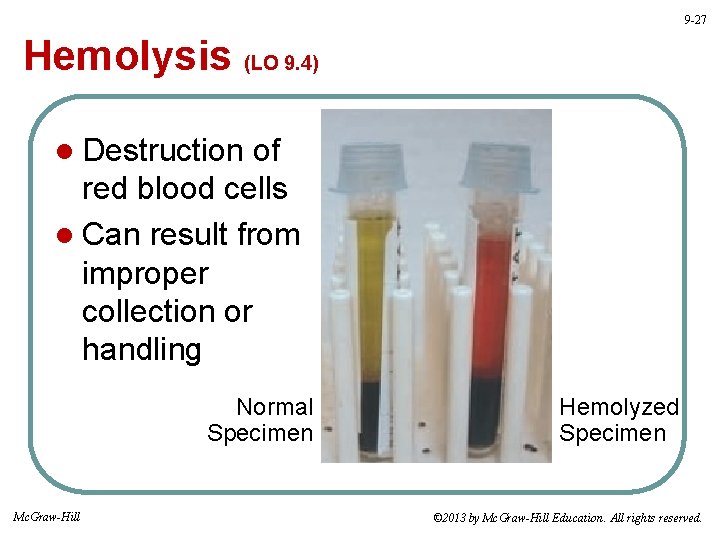
9 -27 Hemolysis (LO 9. 4) l Destruction of red blood cells l Can result from improper collection or handling Normal Specimen Mc. Graw-Hill Hemolyzed Specimen © 2013 by Mc. Graw-Hill Education. All rights reserved.
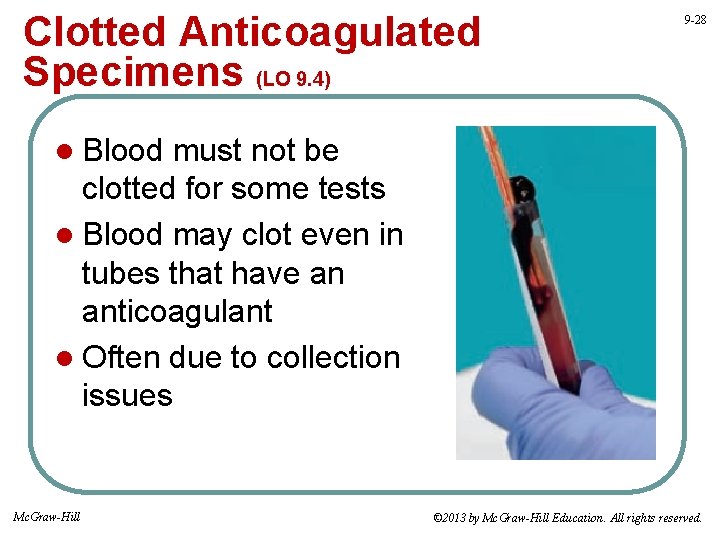
Clotted Anticoagulated Specimens (LO 9. 4) 9 -28 l Blood must not be clotted for some tests l Blood may clot even in tubes that have an anticoagulant l Often due to collection issues Mc. Graw-Hill © 2013 by Mc. Graw-Hill Education. All rights reserved.
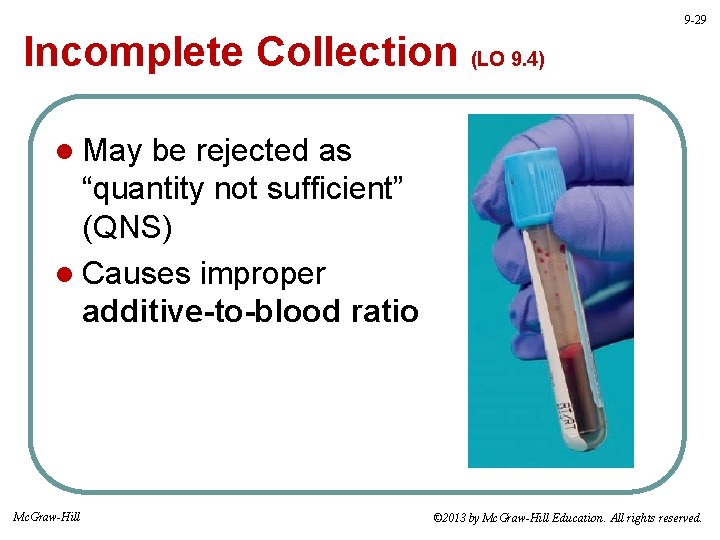
9 -29 Incomplete Collection (LO 9. 4) l May be rejected as “quantity not sufficient” (QNS) l Causes improper additive-to-blood ratio Mc. Graw-Hill © 2013 by Mc. Graw-Hill Education. All rights reserved.
9 -30 Other Causes for Rejection (LO 9. 4) l Incorrect tube collected l Incorrect order of draw l Hemoconcentration Not easily detected l Results may be questioned if delta check fails l l Contamination Mc. Graw-Hill by IV fluids © 2013 by Mc. Graw-Hill Education. All rights reserved.
Other Causes for Rejection (cont. ) 9 -31 (LO 9. 4) l Icterus Dark-yellow to greenish-yellow color l Caused by bilirubin l l Lipemia Cloudy plasma l Caused by abnormal amount of fats l l Special requirements not followed l Inadequate or missing documentation Mc. Graw-Hill © 2013 by Mc. Graw-Hill Education. All rights reserved.
9 -32 Apply Your Knowledge (LO 9. 4) Name two reasons why an incomplete collection may be rejected. Answer: The quantity collected may be insufficient for the test, and the additive-toblood ratio is not correct. D O GO Mc. Graw-Hill ! B JO © 2013 by Mc. Graw-Hill Education. All rights reserved.
9 -33 Chapter 9 Summary l Specimens must be transported to the laboratory in a timely manner. l Transport systems include hand delivery, pneumatic tube system, or automated transport systems. l Specimen packaging for transport by mail or express service must meet local, state, and federal safety standards. Mc. Graw-Hill © 2013 by Mc. Graw-Hill Education. All rights reserved.
9 -34 Chapter 9 Summary (cont. ) l Proper documentation of specimen collection and transport allows the specimen to be tracked. l Pre-examination variables that affect laboratory results include temperature control, exposure to light, and special draw techniques. Mc. Graw-Hill © 2013 by Mc. Graw-Hill Education. All rights reserved.
9 -35 Chapter 9 Summary (cont. ) l Specimen handling for legal specimens must include chain-of-custody procedures. l For blood alcohol testing, written patient consent or a court order is required. l Forensic specimens are collected as evidence to help prove or disprove a link between an individual and objects, places, or other individuals. Mc. Graw-Hill © 2013 by Mc. Graw-Hill Education. All rights reserved.
9 -36 Chapter 9 Summary (cont. ) l Toxicology specimens are collected to detect poisons, drugs, and medications. l The phlebotomist may be required to process specimens, including centrifugation and aliquoting. l Specimens may be rejected due to improper collection techniques or handling and processing errors. Mc. Graw-Hill © 2013 by Mc. Graw-Hill Education. All rights reserved.
9 -37 Chapter 9 Summary (cont. ) l Reasons for specimen rejection include hemolysis, clots, hemoconcentration, contamination, incomplete collection, incorrect tube or draw order, inadequate documentation, and failure to follow special requirements. Mc. Graw-Hill © 2013 by Mc. Graw-Hill Education. All rights reserved.
- Slides: 37