
Power Point Presentation Engine Operation Engine Components FourStroke
- Slides: 42
Power. Point® Presentation Engine Operation Engine Components • Four-Stroke Cycle Engines • Engine Output
Chapter 3 — Engine Operation Competencies w w w List the components of an engine block. Describe a cylinder head. Explain the operation and components of a crankshaft. Describe pistons and piston rings. Explain the function of connecting rods and bearings.
Chapter 3 — Engine Operation Competencies w Describe the flywheel and valve train. w Compare the operation of four-stroke cycle and twostroke cycle engines. w Describe valving systems. w Explain important features of diesel engines. w Explain measurement of engine output.
Chapter 3 — Engine Operation How it works w The internal combustion engine converts potential chemical energy into mechanical energy n Is done by heat derived from a fuel source w Approximately 30% of energy released in engine is converted into work n Remaining energy lost in form of heat & friction in engine
Chapter 3 — Engine Operation It’s Got To Hold Up w Components are designed to convert energy for maximum efficiency n n They must withstand heat and stress generated inside engine during operation Must meet size and weight requirements
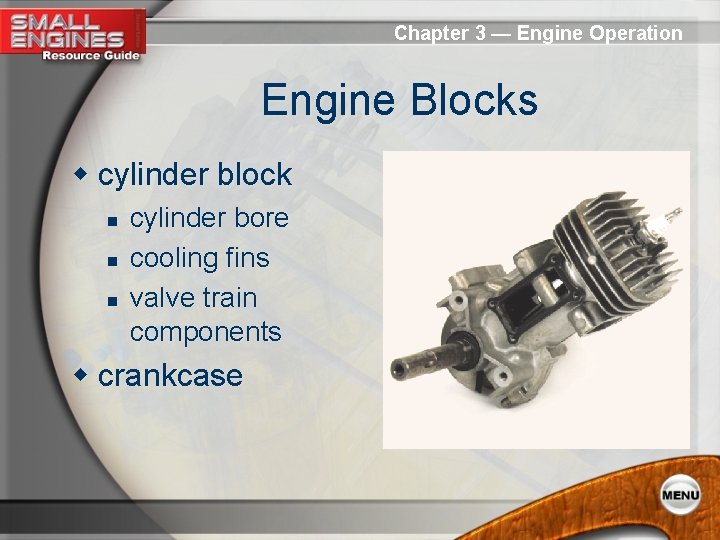
Chapter 3 — Engine Operation Engine Blocks w cylinder block n n n cylinder bore cooling fins valve train components w crankcase
Chapter 3 — Engine Operation Engine Block w Main structure of engine w Supports & maintains alignments of internal & external components w Block can be produced as one-piece or two-piece unit
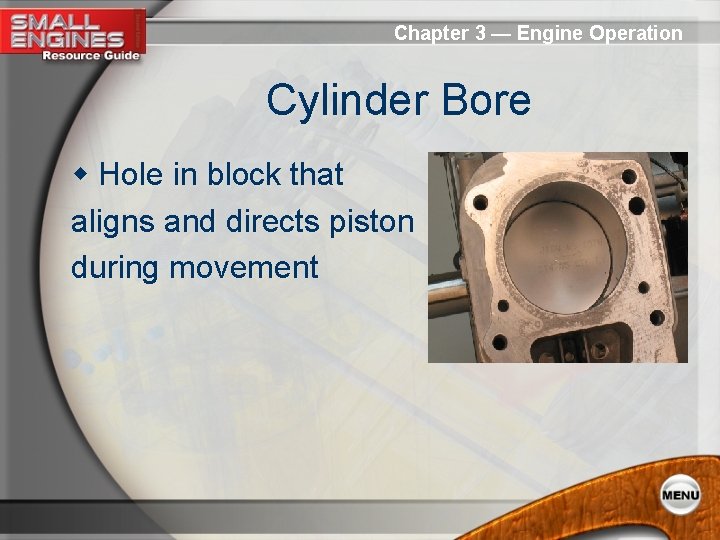
Chapter 3 — Engine Operation Cylinder Bore w Hole in block that aligns and directs piston during movement
Chapter 3 — Engine Operation Stroke w Stroke is the linear distance the piston travels in bore from top dead center (TDC) to bottom dead center (BDC) n n TDC point in which piston is closest to cylinder head before piston moves back down cylinder BDC point which piston is farthest from cylinder head before piston moves back up cylinder
Chapter 3 — Engine Operation Displacement w Displacement (swept volume) that a piston displaces in an engine when it travels from TDC to BDC during same piston stroke
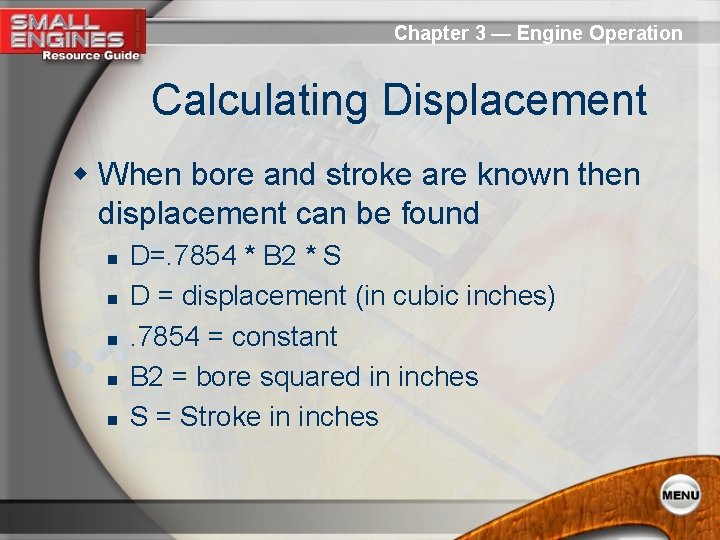
Chapter 3 — Engine Operation Calculating Displacement w When bore and stroke are known then displacement can be found n n n D=. 7854 * B 2 * S D = displacement (in cubic inches). 7854 = constant B 2 = bore squared in inches S = Stroke in inches
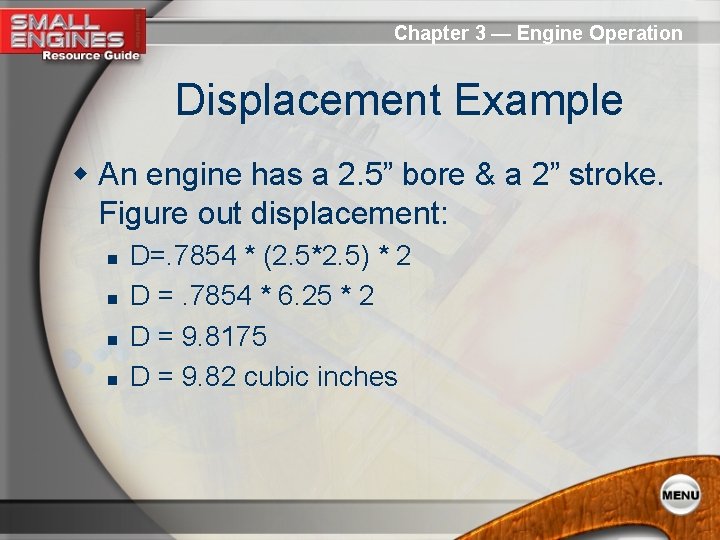
Chapter 3 — Engine Operation Displacement Example w An engine has a 2. 5” bore & a 2” stroke. Figure out displacement: n n D=. 7854 * (2. 5*2. 5) * 2 D =. 7854 * 6. 25 * 2 D = 9. 8175 D = 9. 82 cubic inches
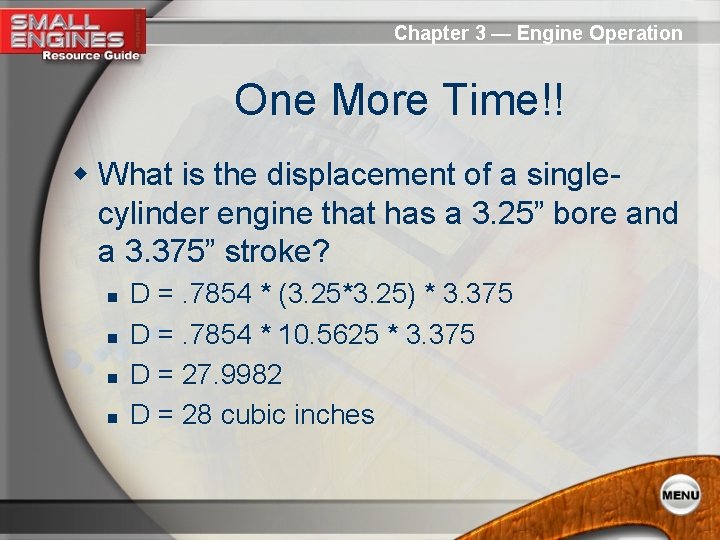
Chapter 3 — Engine Operation One More Time!! w What is the displacement of a singlecylinder engine that has a 3. 25” bore and a 3. 375” stroke? n n D =. 7854 * (3. 25*3. 25) * 3. 375 D =. 7854 * 10. 5625 * 3. 375 D = 27. 9982 D = 28 cubic inches
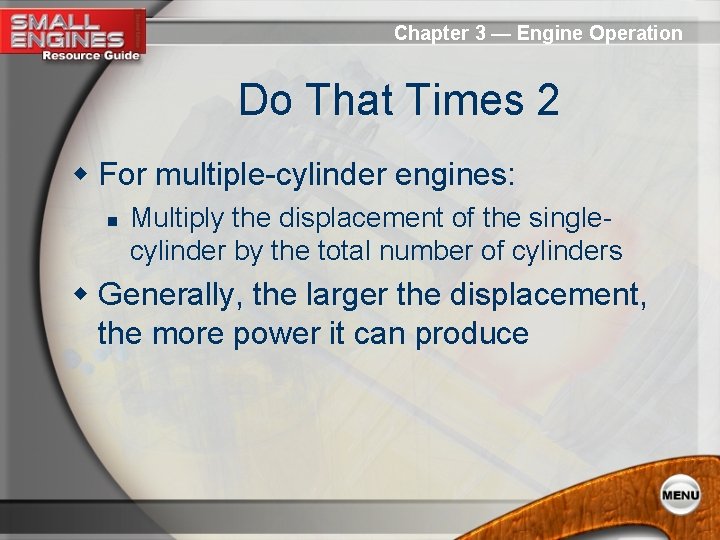
Chapter 3 — Engine Operation Do That Times 2 w For multiple-cylinder engines: n Multiply the displacement of the singlecylinder by the total number of cylinders w Generally, the larger the displacement, the more power it can produce
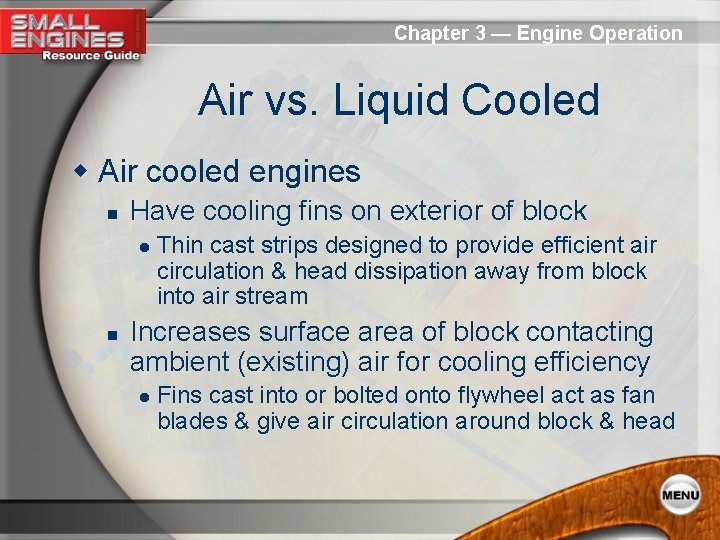
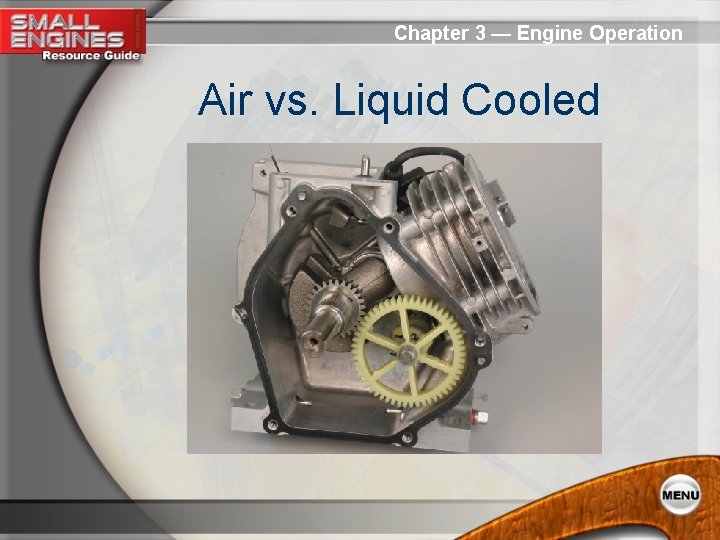
Chapter 3 — Engine Operation Air vs. Liquid Cooled w Air cooled engines n Have cooling fins on exterior of block l n Thin cast strips designed to provide efficient air circulation & head dissipation away from block into air stream Increases surface area of block contacting ambient (existing) air for cooling efficiency l Fins cast into or bolted onto flywheel act as fan blades & give air circulation around block & head
Chapter 3 — Engine Operation Air vs. Liquid Cooled
Chapter 3 — Engine Operation Air vs. Liquid Cooled w Liquid cooled engines n Have channels (sleeves) drilled or cast into block to allow coolant to pass through engine and cool it l Similar to engine in automobile
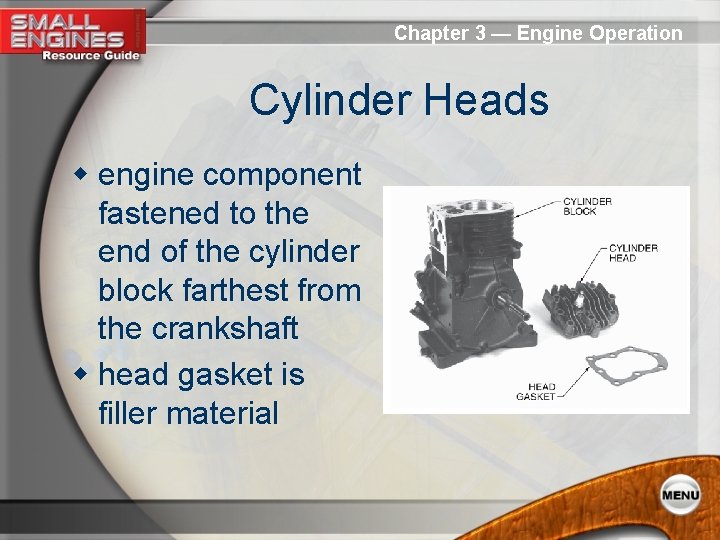
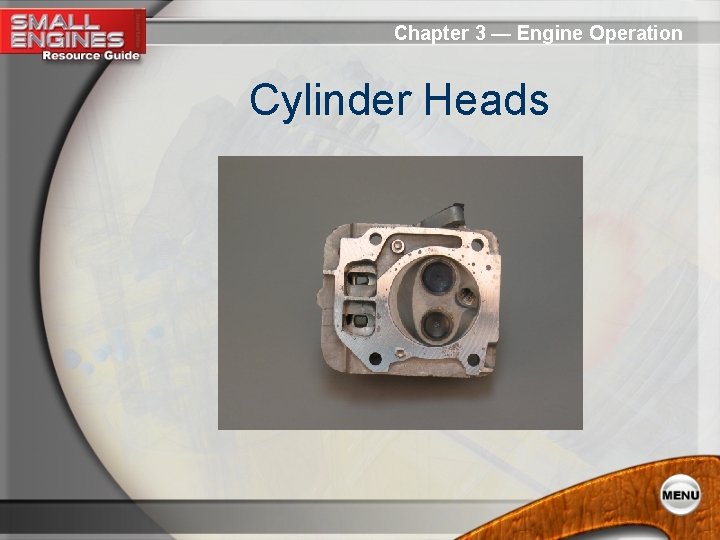
Chapter 3 — Engine Operation Cylinder Heads w engine component fastened to the end of the cylinder block farthest from the crankshaft w head gasket is filler material
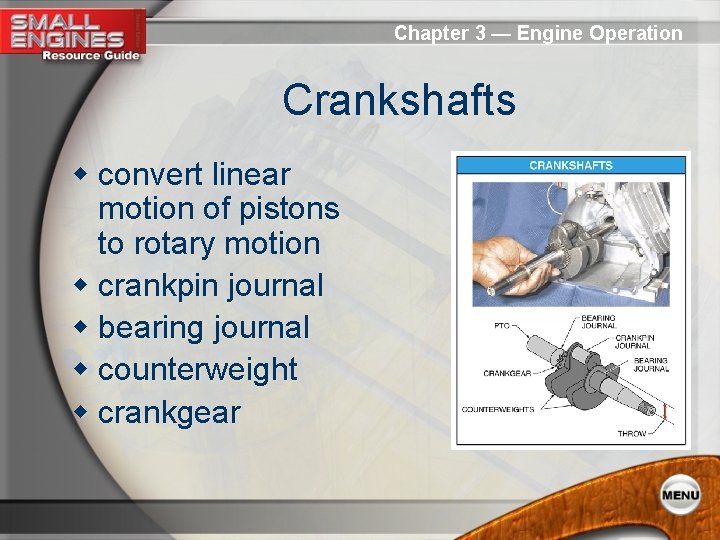
Chapter 3 — Engine Operation Crankshafts w convert linear motion of pistons to rotary motion w crankpin journal w bearing journal w counterweight w crankgear
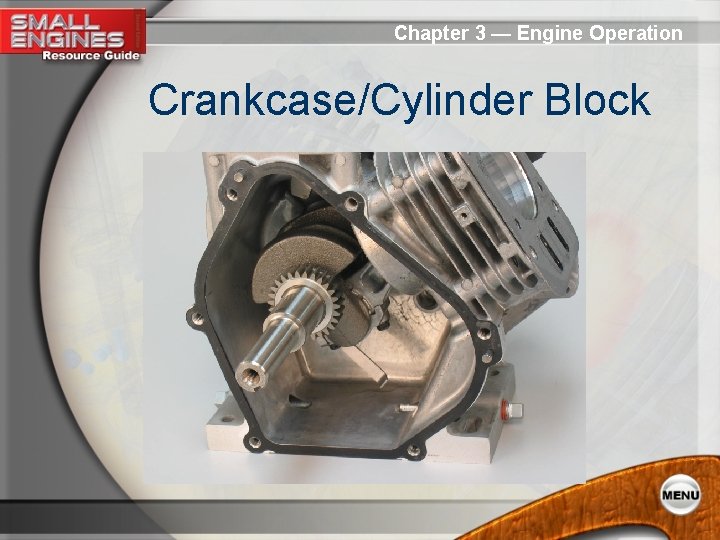
Chapter 3 — Engine Operation Crankcase w Houses and supports crankshaft w In 4 -stroke acts as oil reservoir for lubrication w May have multiple parts like a sump or crankcase cover n Sump is removable & acts like oil reservoir & provides access to internal parts l l n Has bearing surface for vertical shaft engines & forms lower section of engines Horizontal shaft engines have no sump as block serves as oil reservoir Crankcase cover provides access to internal parts in crankcase & supports crankcase
Chapter 3 — Engine Operation Crankcase Breather w Relieves crankcase pressure created by reciprocating motion of the piston during operation n n When piston moves towards TDC volume in crank increases resulting in lower existing pressure in crankcase When piston toward BDC volume in crankcase decreases generating higher than ambient pressure in crankcase
Chapter 3 — Engine Operation Crankcase Breather w Acts as a check valve allowing more air to escape than can enter crankcase n n Maintains pressure less than atmospheric pressure (14. 7 PSI at sea-level) Gases, partially spent combustion gases & other engine gases are then routed to carburetor w Also serves as a oil mist collector n n Prevents crankcase oil from escaping whenever breather opens Required on most 4 -stroke engines
Chapter 3 — Engine Operation Crankcase/Cylinder Block
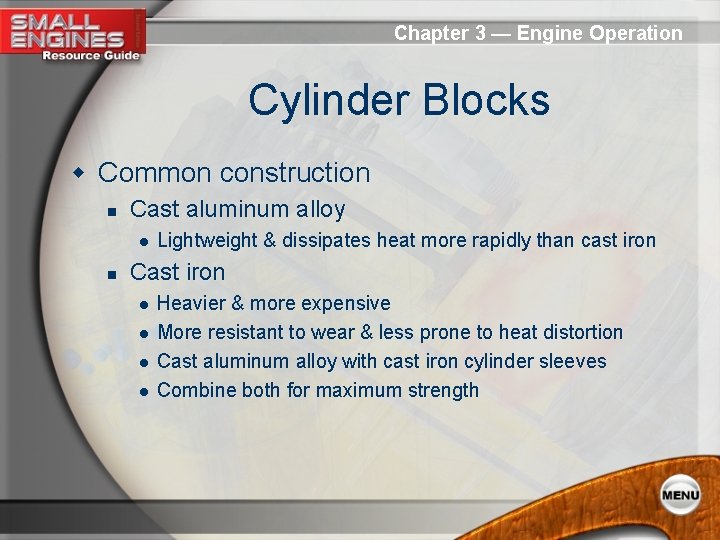
Chapter 3 — Engine Operation Cylinder Blocks w Cast from materials strong enough to withstand the heat & stress inside the engine during operation w Must meet size & weight requirements of specific application
Chapter 3 — Engine Operation Cylinder Blocks w Common construction n Cast aluminum alloy l n Lightweight & dissipates heat more rapidly than cast iron Cast iron l l Heavier & more expensive More resistant to wear & less prone to heat distortion Cast aluminum alloy with cast iron cylinder sleeves Combine both for maximum strength
Chapter 3 — Engine Operation Cylinder Heads
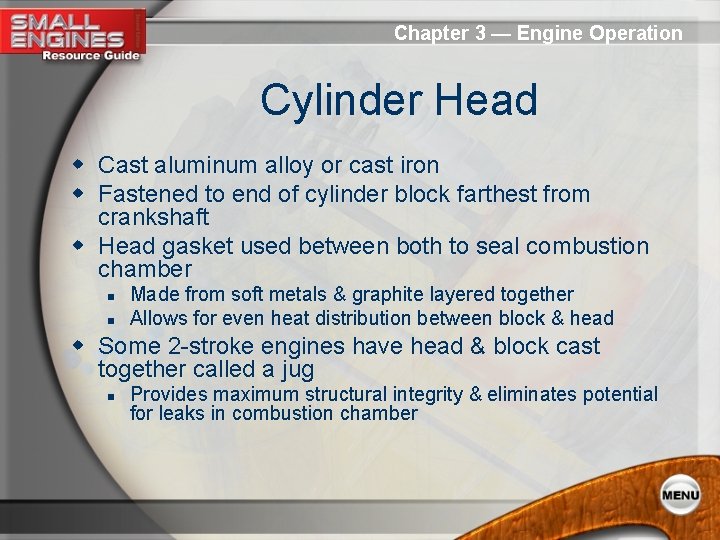
Chapter 3 — Engine Operation Cylinder Head w Cast aluminum alloy or cast iron w Fastened to end of cylinder block farthest from crankshaft w Head gasket used between both to seal combustion chamber n n Made from soft metals & graphite layered together Allows for even heat distribution between block & head w Some 2 -stroke engines have head & block cast together called a jug n Provides maximum structural integrity & eliminates potential for leaks in combustion chamber
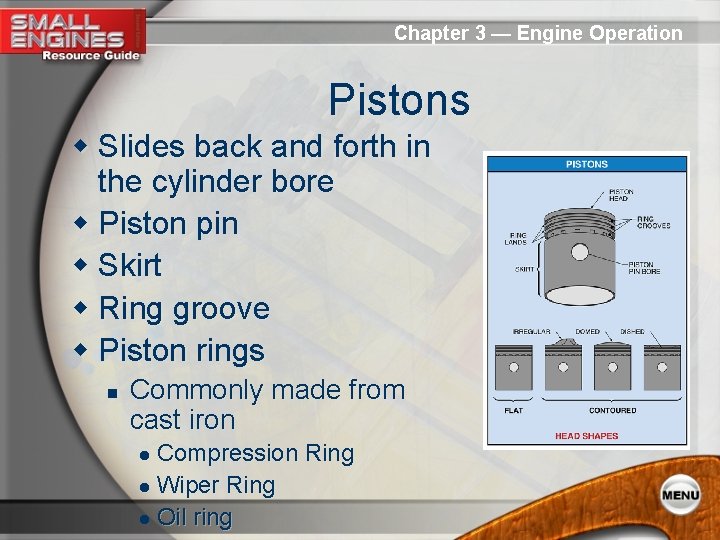
Chapter 3 — Engine Operation Pistons w Slides back and forth in the cylinder bore w Piston pin w Skirt w Ring groove w Piston rings n Commonly made from cast iron Compression Ring l Wiper Ring l Oil ring l
Chapter 3 — Engine Operation Pistons w Generally made of cast aluminum alloy w Material will always be different than engine block to prevent piston merging into block w Excellent thermal conductivity n n Ability of material to conduct & transfer heat Aluminum expands when heated so proper clearance must be provided l l Insufficient clearance can cause piston to seize in bore Excessive clearance can cause loss of compression & increase piston noise
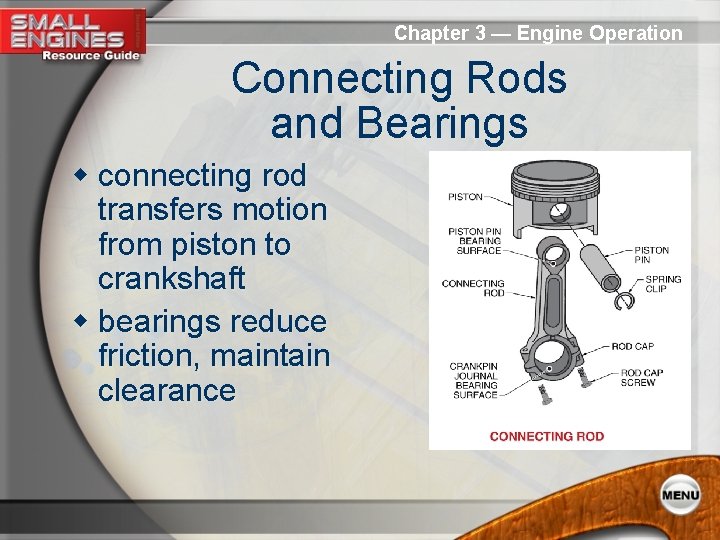
Chapter 3 — Engine Operation Connecting Rods and Bearings w connecting rod transfers motion from piston to crankshaft w bearings reduce friction, maintain clearance
Chapter 3 — Engine Operation Crankshaft
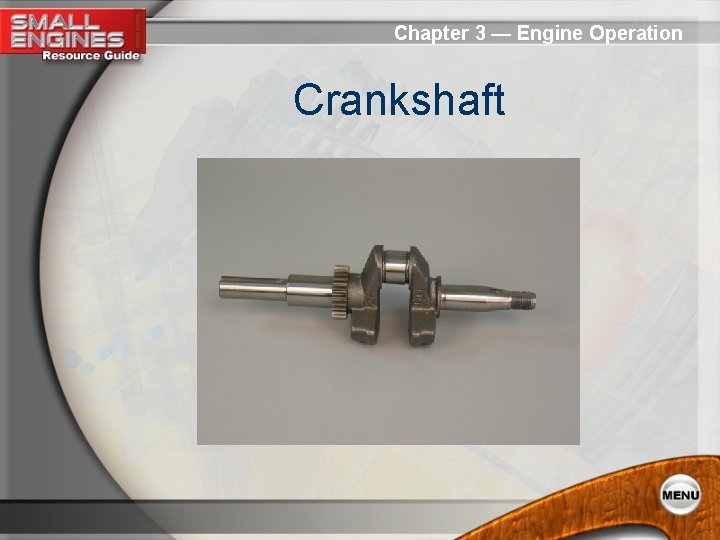
Chapter 3 — Engine Operation Crankshaft w Converts liner motion of piston into rotary motion w Main rotating component of engine w Commonly made of iron w Vertical or Horizontal orientation
Chapter 3 — Engine Operation Crankshaft w Components: n Crankpin Journal l n Precision ground surface provides pivot point to attach connecting rod to crankshaft Bearing Journals Precision ground surface which the crankshaft rotates l Mates with bearing surface in cylinder block l
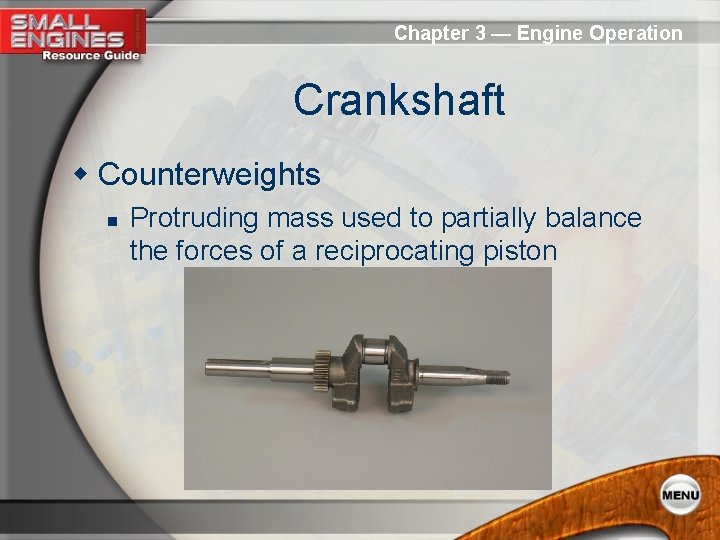
Chapter 3 — Engine Operation Crankshaft w Counterweights n Protruding mass used to partially balance the forces of a reciprocating piston
Chapter 3 — Engine Operation Crankshaft w Crank gear n n Gear located on crankshaft used to drive other parts of an engine Not required on all small engines w Power take-off (PTO) n Extension of crankshaft that allows engine to transmit power to an application
Chapter 3 — Engine Operation Flywheels and Valve Trains w a flywheel is a disk mounted at one end of a crankshaft n n provides inertia for the engine maintains crankshaft rotation between combustion intervals w a valve train controls the flow of gases into and out of the combustion chamber
Chapter 3 — Engine Operation w intake event n n introduces air and fuel (or just air in a diesel engine) to the combustion chamber piston moves from TCD to BDC w compression event n air and fuel (or just air in a diesel engine) in combustion chamber is compressed in the cylinder
Chapter 3 — Engine Operation w ignition (combustion) event n charge is ignited and rapidly oxidized to release energy w power event n expanding gases force the piston head away from the cylinder head
Chapter 3 — Engine Operation w exhaust event n spent gases are removed from the chamber and released to atmosphere w valve overlap is the point when both intake and exhaust valves are open
Chapter 3 — Engine Operation Engine Output w measured by torque and horsepower w units of measurement of horsepower n brake, friction, and indicated horsepower w dynamometer measures torque, load, speed, and horsepower
Chapter 3 — Engine Operation Engine Output w factors affecting engine output n n displacement volumetric efficiency thermal efficiency air density
Chapter 3 — Engine Operation Chapter 3 Review What is the function of a crankshaft? n A crankshaft is an engine component that converts the linear (reciprocating) motion of the piston into rotary motion. What are the five events of four-stroke cycle engines? n The five events of four-stroke cycle engines are intake, compression, ignition, power, and exhaust.