
Power Point Presentation by Charlie Cook Objectives After
Power. Point Presentation by Charlie Cook
Objectives After studying this chapter, you should be able to: 1. Summarize the general provisions of the Occupational Safety and Health Act (OSHA). 2. Describe what management can do to create a safe work environment. 3. Identify the measures that should be taken to control and eliminate health hazards. 4. Describe the organizational services and programs for building better health. 5. Explain the role of employee assistance programs in HRM. Copyright © 2004 South-Western. All rights reserved. 2
Objectives (cont’d) After studying this chapter, you should be able to: 6. Indicate methods for coping with stress. Copyright © 2004 South-Western. All rights reserved. 3
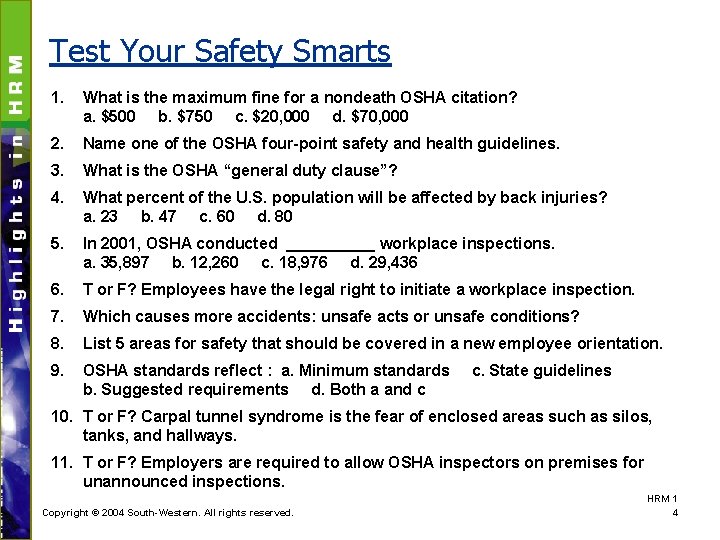
Test Your Safety Smarts 1. What is the maximum fine for a nondeath OSHA citation? a. $500 b. $750 c. $20, 000 d. $70, 000 2. Name one of the OSHA four-point safety and health guidelines. 3. What is the OSHA “general duty clause”? 4. What percent of the U. S. population will be affected by back injuries? a. 23 b. 47 c. 60 d. 80 5. In 2001, OSHA conducted _____ workplace inspections. a. 35, 897 b. 12, 260 c. 18, 976 d. 29, 436 6. T or F? Employees have the legal right to initiate a workplace inspection. 7. Which causes more accidents: unsafe acts or unsafe conditions? 8. List 5 areas for safety that should be covered in a new employee orientation. 9. OSHA standards reflect : a. Minimum standards b. Suggested requirements d. Both a and c c. State guidelines 10. T or F? Carpal tunnel syndrome is the fear of enclosed areas such as silos, tanks, and hallways. 11. T or F? Employers are required to allow OSHA inspectors on premises for unannounced inspections. Copyright © 2004 South-Western. All rights reserved. HRM 1 4
General Provisions of OSHA • Coverage of Employees Ø All nongovernmental employers and employees • OSHA Standards Ø Apply to general industry, maritime, construction, and agriculture Ø Cover the workplace, machinery and equipment, material, power sources, processing, protective clothing, first aid, and administrative requirements. Copyright © 2004 South-Western. All rights reserved. 5
General Provisions of OSHA (cont’d) • Enforcement of the Act Ø The Secretary of Labor is authorized by the Act to conduct workplace inspections, to issue citations, and to impose penalties on employers. Ø Inspections have been delegated to the Occupational Safety and Health Administration of the U. S. Department of Labor. Copyright © 2004 South-Western. All rights reserved. 6
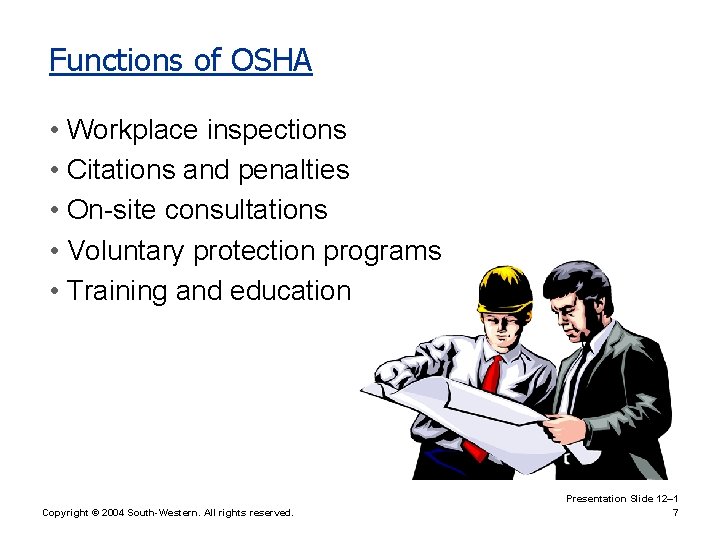
Functions of OSHA • Workplace inspections • Citations and penalties • On-site consultations • Voluntary protection programs • Training and education Copyright © 2004 South-Western. All rights reserved. Presentation Slide 12– 1 7
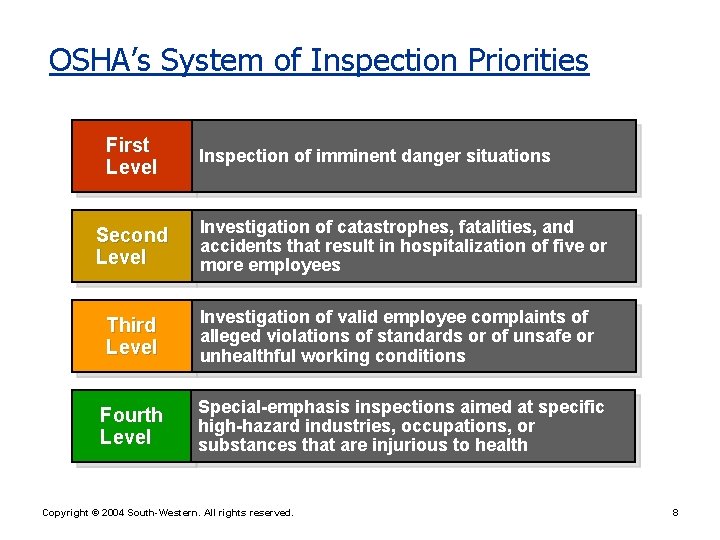
OSHA’s System of Inspection Priorities First Level Second Level Inspection of imminent danger situations Investigation of catastrophes, fatalities, and accidents that result in hospitalization of five or more employees Third Level Investigation of valid employee complaints of alleged violations of standards or of unsafe or unhealthful working conditions Fourth Level Special-emphasis inspections aimed at specific high-hazard industries, occupations, or substances that are injurious to health Copyright © 2004 South-Western. All rights reserved. 8
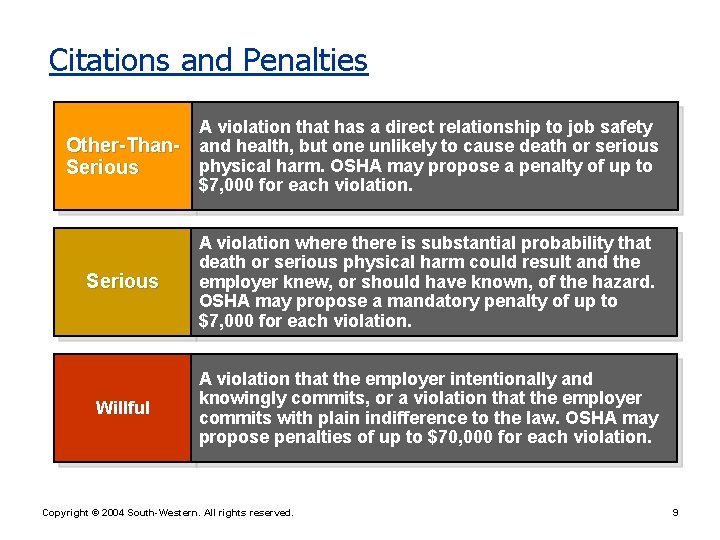
Citations and Penalties Other-Than. Serious A violation that has a direct relationship to job safety and health, but one unlikely to cause death or serious physical harm. OSHA may propose a penalty of up to $7, 000 for each violation. Serious A violation where there is substantial probability that death or serious physical harm could result and the employer knew, or should have known, of the hazard. OSHA may propose a mandatory penalty of up to $7, 000 for each violation. Willful A violation that the employer intentionally and knowingly commits, or a violation that the employer commits with plain indifference to the law. OSHA may propose penalties of up to $70, 000 for each violation. Copyright © 2004 South-Western. All rights reserved. 9

Voluntary Protection Programs (VPPs) • Programs that encourage employers to go beyond the minimum requirements of OSHA. Ø Star, Merit, and Demonstration programs Ø Purpose of VPPs: v Recognize outstanding achievement of those who have successfully incorporated comprehensive safety and health programs into their total management system. v Motivate others to achieve excellent safety and health results in the same outstanding way. v Establish a relationship among employers, employees, and OSHA that is based on cooperation rather than coercion. Copyright © 2004 South-Western. All rights reserved. 10
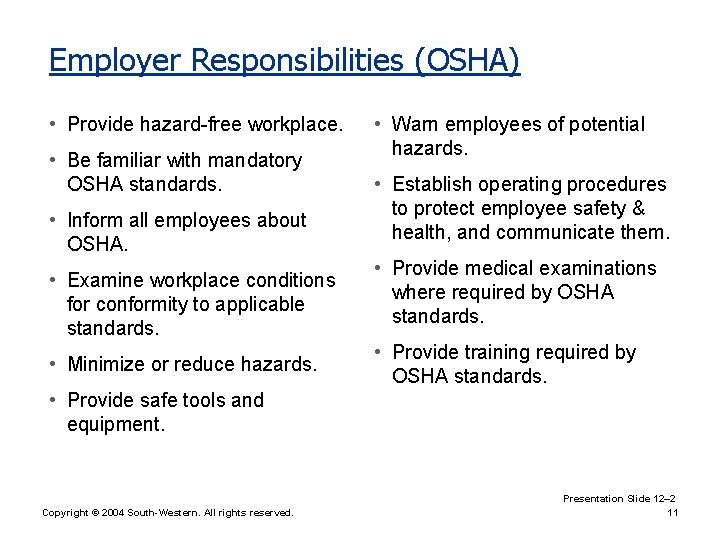
Employer Responsibilities (OSHA) • Provide hazard-free workplace. • Be familiar with mandatory OSHA standards. • Inform all employees about OSHA. • Examine workplace conditions for conformity to applicable standards. • Minimize or reduce hazards. • Warn employees of potential hazards. • Establish operating procedures to protect employee safety & health, and communicate them. • Provide medical examinations where required by OSHA standards. • Provide training required by OSHA standards. • Provide safe tools and equipment. Copyright © 2004 South-Western. All rights reserved. Presentation Slide 12– 2 11
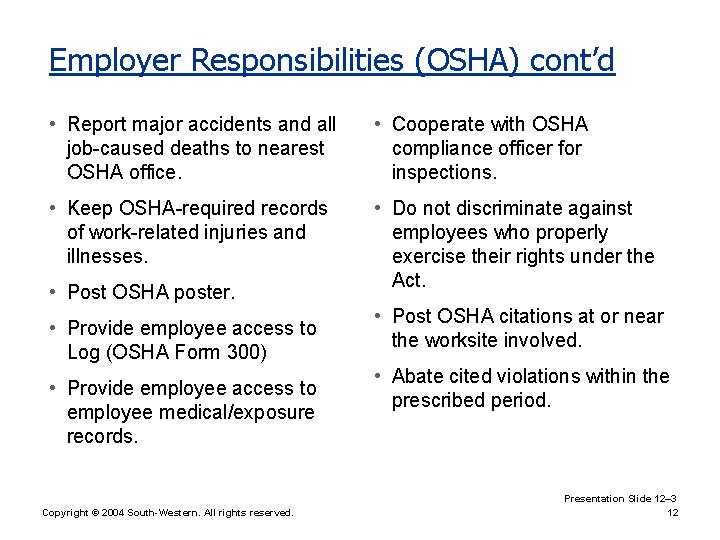
Employer Responsibilities (OSHA) cont’d • Report major accidents and all job-caused deaths to nearest OSHA office. • Cooperate with OSHA compliance officer for inspections. • Keep OSHA-required records of work-related injuries and illnesses. • Do not discriminate against employees who properly exercise their rights under the Act. • Post OSHA poster. • Provide employee access to Log (OSHA Form 300) • Provide employee access to employee medical/exposure records. Copyright © 2004 South-Western. All rights reserved. • Post OSHA citations at or near the worksite involved. • Abate cited violations within the prescribed period. Presentation Slide 12– 3 12

Employee Responsibilities (OSHA) • Read the OSHA poster at the jobsite. • Comply with all applicable OSHA standards. • Follow all employer safety and health rules and regulations. • Wear or use prescribed protective equipment at work. • Report any job-related injury or illness to the employer, and seek treatment promptly. • Cooperate with OSHA compliance officer on inspections. • Exercise employee rights under the Act in a responsible manner. • Report hazardous conditions to the supervisor. Copyright © 2004 South-Western. All rights reserved. Presentation Slide 12– 4 13
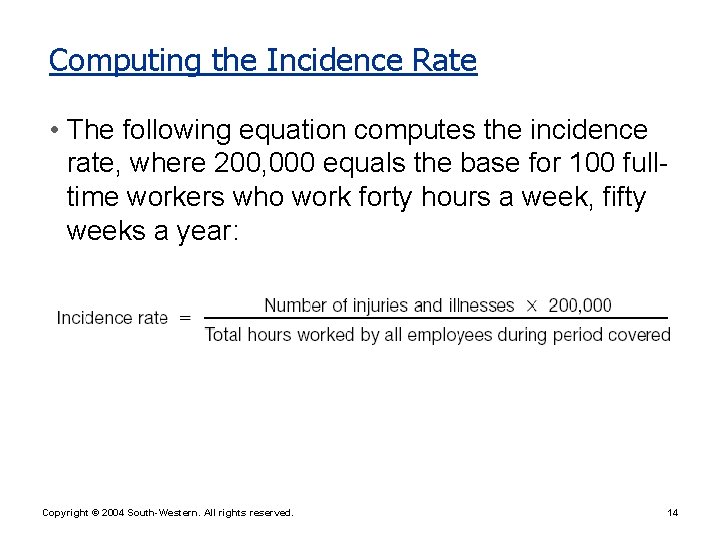
Computing the Incidence Rate • The following equation computes the incidence rate, where 200, 000 equals the base for 100 fulltime workers who work forty hours a week, fifty weeks a year: Copyright © 2004 South-Western. All rights reserved. 14
Hazardous Materials Regulation • Right-to-Know Laws Ø Laws that require employers to advise employees about the hazardous chemicals they handle. • Hazard Communication Standard (HCS) Ø OSHA-published hazardous chemical regulations known as the HCS prescribes a system for communicating data on health risks of handling certain materials. • Material Safety Data Sheets (MSDSs) Ø Documents that contain vital information about hazardous substances. Copyright © 2004 South-Western. All rights reserved. 15
Creating a Safe Work Environment Safety Motivation and Knowledge Safety Awareness Programs Elements in Creating a Safe Work Environment Enforcement of Safety Rules Copyright © 2004 South-Western. All rights reserved. Accident Investigations and Records 16
Creating a Safe Work Environment • Promoting Safety Awareness Ø The Key Role of the Supervisor v Communicating the need to work safely. Ø Proactive Safety Training Program Ø Information Technology and Safety Awareness and Training Copyright © 2004 South-Western. All rights reserved. 17
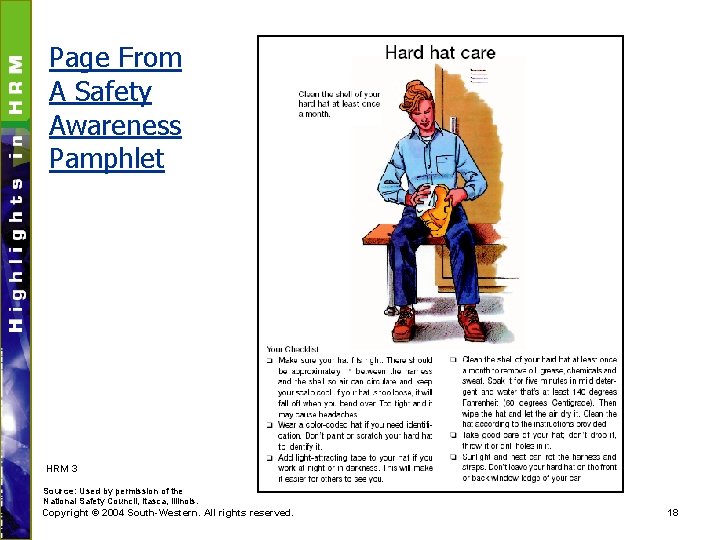
Page From A Safety Awareness Pamphlet HRM 3 Source: Used by permission of the National Safety Council, Itasca, Illinois. Copyright © 2004 South-Western. All rights reserved. 18
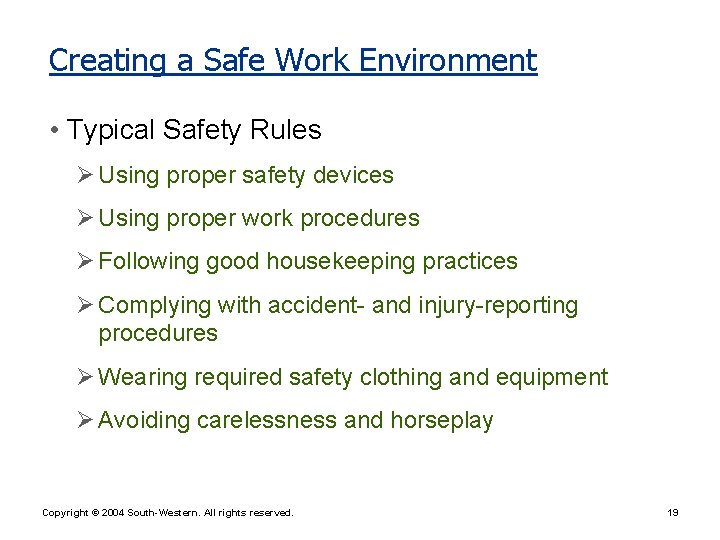
Creating a Safe Work Environment • Typical Safety Rules Ø Using proper safety devices Ø Using proper work procedures Ø Following good housekeeping practices Ø Complying with accident- and injury-reporting procedures Ø Wearing required safety clothing and equipment Ø Avoiding carelessness and horseplay Copyright © 2004 South-Western. All rights reserved. 19
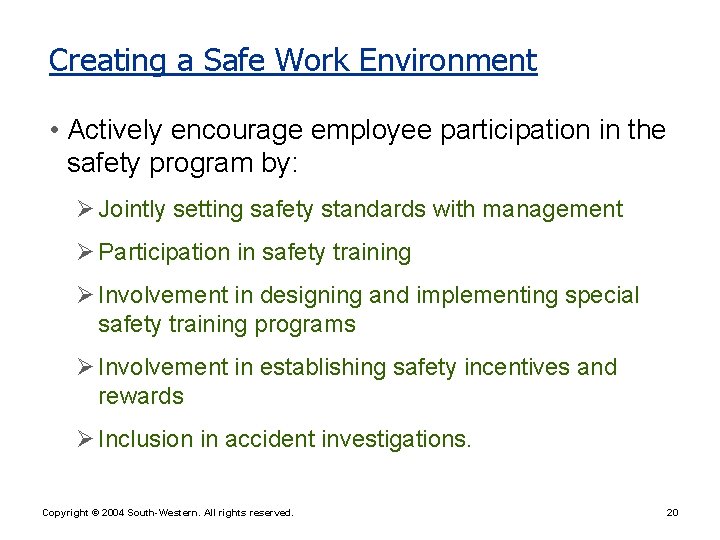
Creating a Safe Work Environment • Actively encourage employee participation in the safety program by: Ø Jointly setting safety standards with management Ø Participation in safety training Ø Involvement in designing and implementing special safety training programs Ø Involvement in establishing safety incentives and rewards Ø Inclusion in accident investigations. Copyright © 2004 South-Western. All rights reserved. 20
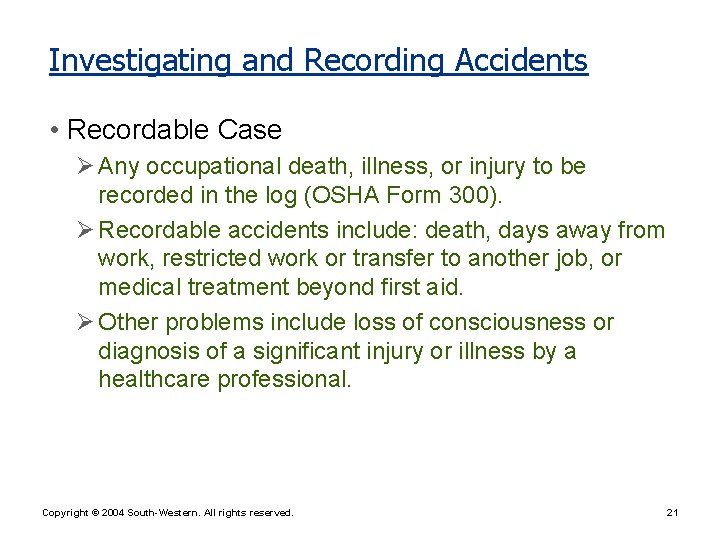
Investigating and Recording Accidents • Recordable Case Ø Any occupational death, illness, or injury to be recorded in the log (OSHA Form 300). Ø Recordable accidents include: death, days away from work, restricted work or transfer to another job, or medical treatment beyond first aid. Ø Other problems include loss of consciousness or diagnosis of a significant injury or illness by a healthcare professional. Copyright © 2004 South-Western. All rights reserved. 21
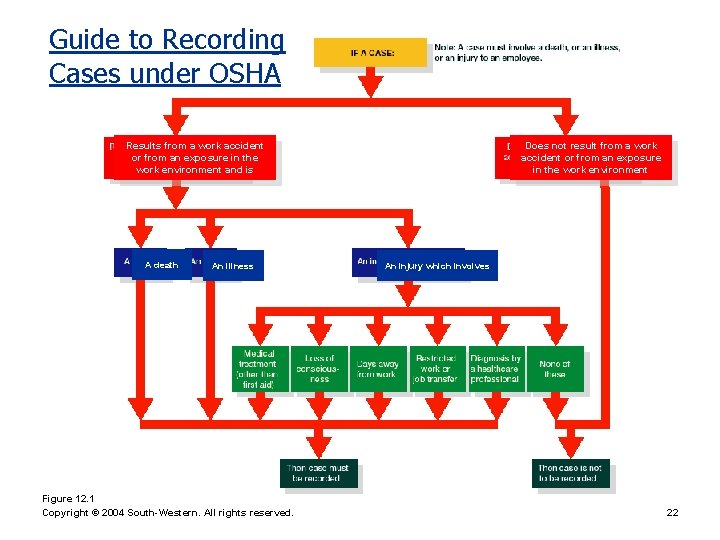
Guide to Recording Cases under OSHA Results from a work accident or from an exposure in the work environment and is A death An illness Figure 12. 1 Copyright © 2004 South-Western. All rights reserved. Does not result from a work accident or from an exposure in the work environment An injury which involves 22
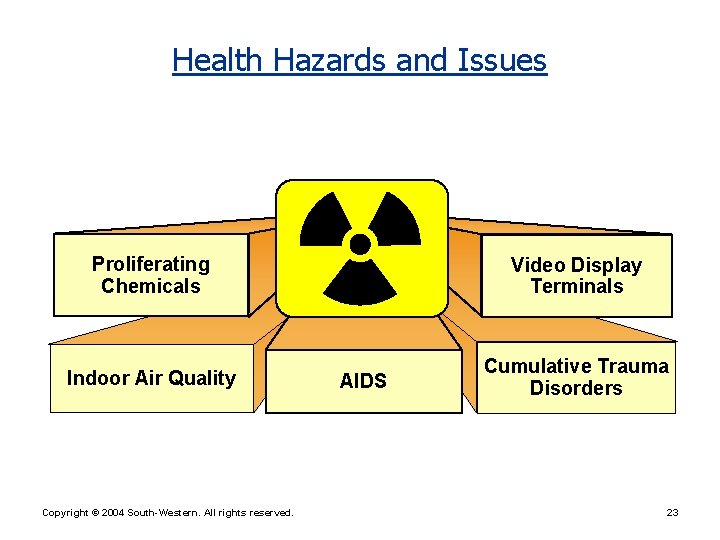
Health Hazards and Issues Proliferating Chemicals Video Display Terminals Indoor Air Quality Cumulative Trauma Disorders Copyright © 2004 South-Western. All rights reserved. AIDS 23
Creating a Healthy Work Environment • Recognizing and Controlling Health Hazards Related to Hazardous Materials and Processes Ø Use substitutes for hazardous materials. Ø Alter hazardous processes and engineering controls. Ø Enclose or isolate hazardous processes. Ø Issue clothing to protect against hazards. Ø Improve ventilation. Copyright © 2004 South-Western. All rights reserved. Presentation Slide 12– 5 24

Creating a Healthy Work Environment • Problems with Video Display Terminals (VDT) Ø Visual difficulties, muscular aches and pains, job Stress Ø Solutions: v Place the computer screen four to nine inches below eye level. Keep the monitor directly in front of you. v Sit in an adjustable-height chair and use a copyholder that attaches to both the desk and the monitor. v Use a screen with adjustable brightness and contrast controls. v Use shades or blinds to reduce the computer-screen glare created by window lighting. Copyright © 2004 South-Western. All rights reserved. 25
Key Elements for a Successful Ergonomics Program • Provide notice and training for employees. • Conduct pre-injury hazard assessment. • Involve employees. • Plan and execute. • File injury reports. • Evaluate and assess the ergonomics program. Copyright © 2004 South-Western. All rights reserved. Figure 12. 2 26
Creating a Healthy Work Environment • Health Services • Health-Improvement Ø First aid Ø Physical fitness programs Ø Medical diagnosis and treatment Ø Health bonuses Ø Physical exams • Employee Assistance Programs Ø Wellness programs Ø Help employees manage stress Ø Personal crises Ø Emotional problems Ø Alcoholism and drug abuse Copyright © 2004 South-Western. All rights reserved. Presentation Slide 12– 6 27
OSHA Workplace Violence Prevention • Reducing Violence in the Workplace Ø Commitment to prevent violence Ø Identify areas of potential violence Ø Develop violence prevention policies Ø Provide violence prevention training Ø Evaluate program effectiveness Copyright © 2004 South-Western. All rights reserved. 28
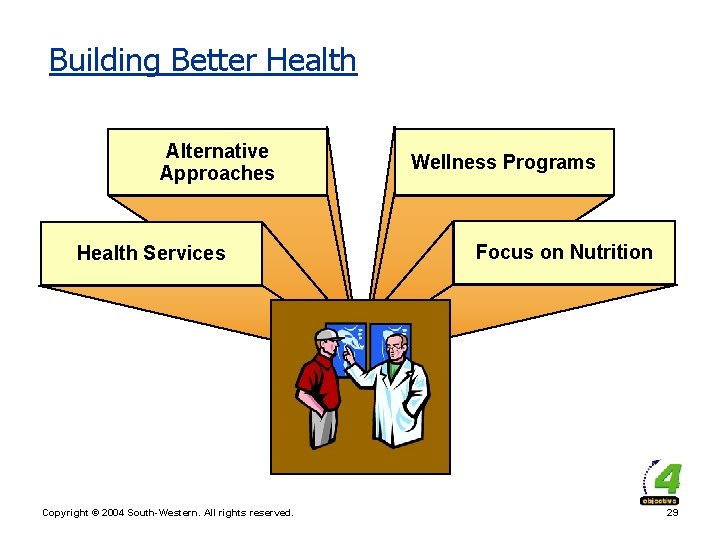
Building Better Health Alternative Approaches Health Services Copyright © 2004 South-Western. All rights reserved. Wellness Programs Focus on Nutrition 29
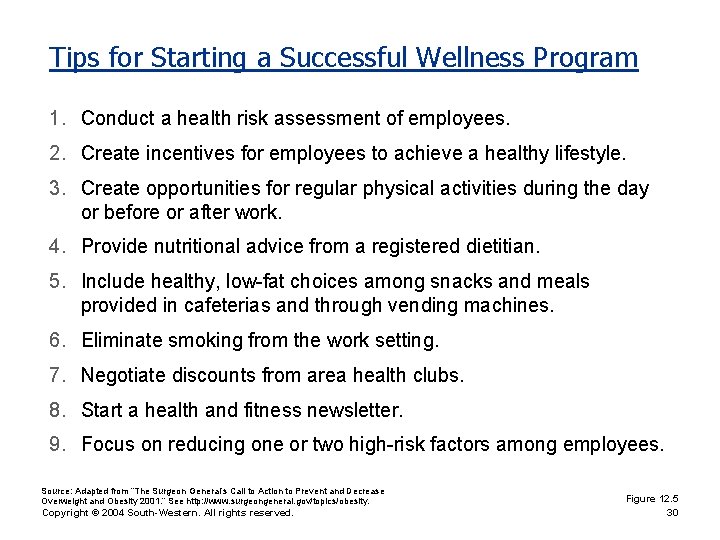
Tips for Starting a Successful Wellness Program 1. Conduct a health risk assessment of employees. 2. Create incentives for employees to achieve a healthy lifestyle. 3. Create opportunities for regular physical activities during the day or before or after work. 4. Provide nutritional advice from a registered dietitian. 5. Include healthy, low-fat choices among snacks and meals provided in cafeterias and through vending machines. 6. Eliminate smoking from the work setting. 7. Negotiate discounts from area health clubs. 8. Start a health and fitness newsletter. 9. Focus on reducing one or two high-risk factors among employees. Source: Adapted from “The Surgeon General’s Call to Action to Prevent and Decrease Overweight and Obesity 2001. ” See http: //www. surgeongeneral. gov/topics/obesity. Copyright © 2004 South-Western. All rights reserved. Figure 12. 5 30
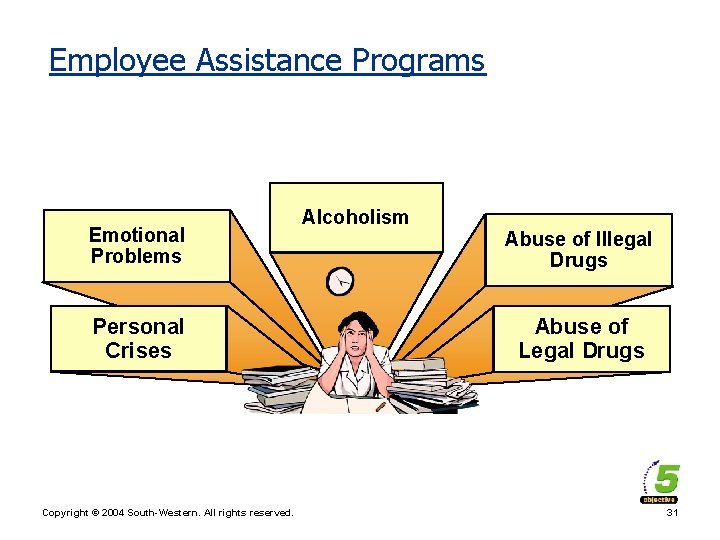
Employee Assistance Programs Emotional Problems Personal Crises Copyright © 2004 South-Western. All rights reserved. Alcoholism Abuse of Illegal Drugs Abuse of Legal Drugs 31
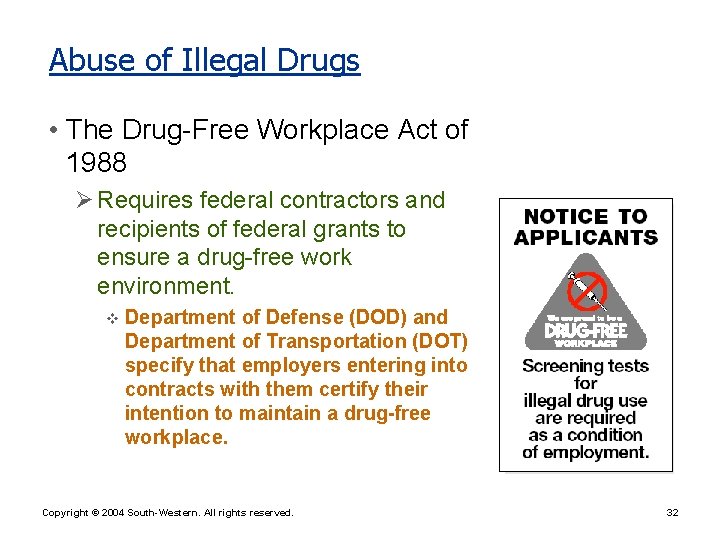
Abuse of Illegal Drugs • The Drug-Free Workplace Act of 1988 Ø Requires federal contractors and recipients of federal grants to ensure a drug-free work environment. v Department of Defense (DOD) and Department of Transportation (DOT) specify that employers entering into contracts with them certify their intention to maintain a drug-free workplace. Copyright © 2004 South-Western. All rights reserved. 32
What Is Stress? • Depression Ø Negative emotional state marked by feelings of low spirits, gloominess, sadness, and loss of pleasure in ordinary activities. • Stress Ø Any adjustive demand caused by physical, mental, or emotional factors that requires coping behavior. • Alarm Reaction Ø A response to stress that involves an elevated heart rate, increased respiration, elevated levels of adrenaline in the blood, and increased blood pressure. Copyright © 2004 South-Western. All rights reserved. 33
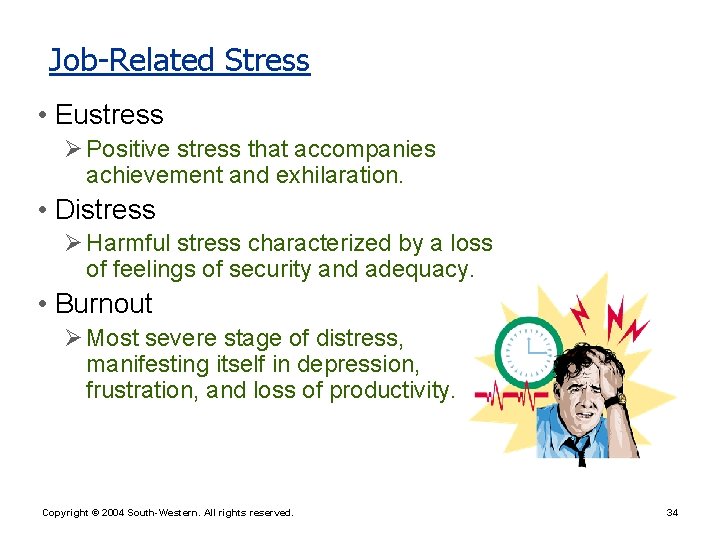
Job-Related Stress • Eustress Ø Positive stress that accompanies achievement and exhilaration. • Distress Ø Harmful stress characterized by a loss of feelings of security and adequacy. • Burnout Ø Most severe stage of distress, manifesting itself in depression, frustration, and loss of productivity. Copyright © 2004 South-Western. All rights reserved. 34
Coping with Stress • Major Stressors: Ø Responsibility without authority Ø Inability to voice complaints Ø Prejudice because of age, gender, race, or religion Ø Poor working conditions Ø Inadequate recognition Ø Lack of a clear job description or chain of command Ø Unfriendly interpersonal relationships Copyright © 2004 South-Western. All rights reserved. 35
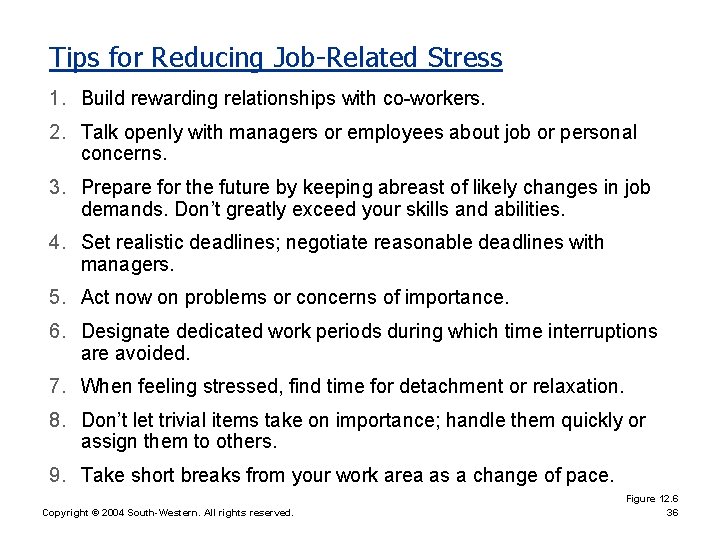
Tips for Reducing Job-Related Stress 1. Build rewarding relationships with co-workers. 2. Talk openly with managers or employees about job or personal concerns. 3. Prepare for the future by keeping abreast of likely changes in job demands. Don’t greatly exceed your skills and abilities. 4. Set realistic deadlines; negotiate reasonable deadlines with managers. 5. Act now on problems or concerns of importance. 6. Designate dedicated work periods during which time interruptions are avoided. 7. When feeling stressed, find time for detachment or relaxation. 8. Don’t let trivial items take on importance; handle them quickly or assign them to others. 9. Take short breaks from your work area as a change of pace. Copyright © 2004 South-Western. All rights reserved. Figure 12. 6 36
- Slides: 36