
Power Point Lecture Slides prepared by Vince Austin
Power. Point® Lecture Slides prepared by Vince Austin, Bluegrass Technical and Community College CHAPTER 12 The Central Nervous System: Part C Copyright © 2010 Pearson Education, Inc.
Functional Brain Systems • Networks of neurons that work together and span wide areas of the brain • Limbic system • Reticular formation Copyright © 2010 Pearson Education, Inc.
Limbic System • Includes parts of the diencephalon and some cerebral structures that encircle the brain stem Copyright © 2010 Pearson Education, Inc.
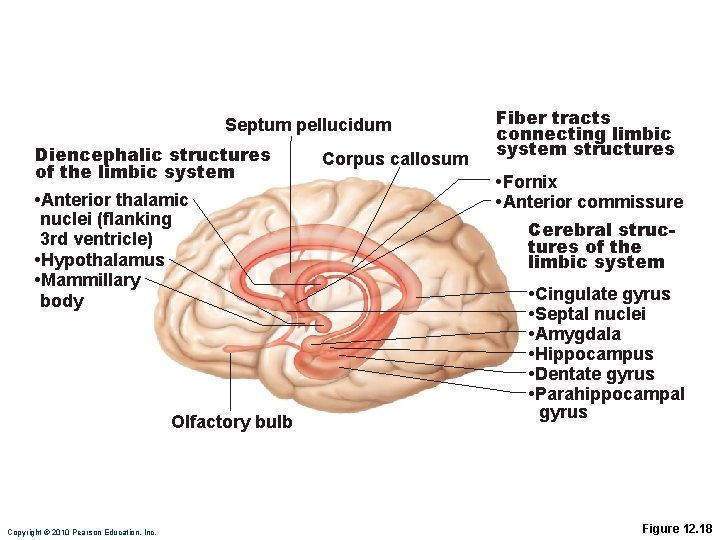
Septum pellucidum Diencephalic structures of the limbic system • Anterior thalamic nuclei (flanking 3 rd ventricle) • Hypothalamus • Mammillary body Olfactory bulb Copyright © 2010 Pearson Education, Inc. Corpus callosum Fiber tracts connecting limbic system structures • Fornix • Anterior commissure Cerebral structures of the limbic system • Cingulate gyrus • Septal nuclei • Amygdala • Hippocampus • Dentate gyrus • Parahippocampal gyrus Figure 12. 18
Limbic System • Emotional or affective brain • Amygdala—recognizes angry or fearful facial expressions, assesses danger, and elicits the fear response • Cingulate gyrus—plays a role in expressing emotions via gestures, and resolves mental conflict • Puts emotional responses to odors • Example: skunks smell bad Copyright © 2010 Pearson Education, Inc.

Limbic System: Emotion and Cognition • The limbic system interacts with the prefrontal lobes, therefore: • We can react emotionally to things we consciously understand to be happening • We are consciously aware of emotional richness in our lives • Hippocampus and amygdala—play a role in memory Copyright © 2010 Pearson Education, Inc.
Reticular Formation • Three broad columns along the length of the brain stem • Raphe nuclei • Medial (large cell) group of nuclei • Lateral (small cell) group of nuclei • Has far-flung axonal connections with hypothalamus, cerebral cortex, cerebellum, and spinal cord Copyright © 2010 Pearson Education, Inc.
Reticular Formation: RAS and Motor Function • RAS (reticular activating system) • Sends impulses to the cerebral cortex to keep it conscious and alert • Filters out repetitive and weak stimuli (~99% of all stimuli!) • Severe injury results in permanent unconsciousness (coma) Copyright © 2010 Pearson Education, Inc.
Reticular Formation: RAS and Motor Function • Motor function • Helps control coarse limb movements • Reticular autonomic centers regulate visceral motor functions • Vasomotor • Cardiac • Respiratory centers Copyright © 2010 Pearson Education, Inc.
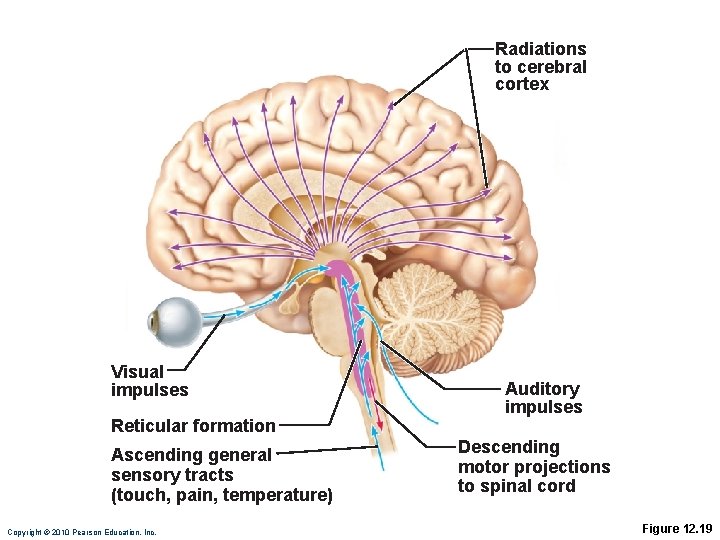
Radiations to cerebral cortex Visual impulses Reticular formation Ascending general sensory tracts (touch, pain, temperature) Copyright © 2010 Pearson Education, Inc. Auditory impulses Descending motor projections to spinal cord Figure 12. 19
Electroencephalogram (EEG) • Records electrical activity that accompanies brain function • Measures electrical potential differences between various cortical areas Copyright © 2010 Pearson Education, Inc.
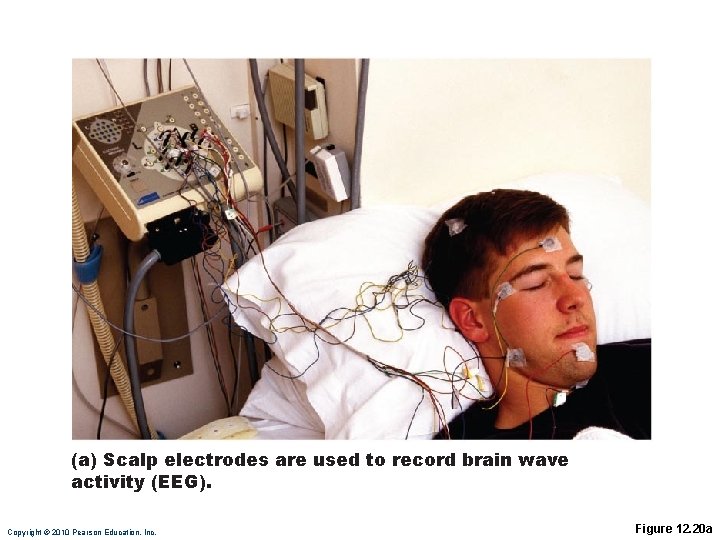
(a) Scalp electrodes are used to record brain wave activity (EEG). Copyright © 2010 Pearson Education, Inc. Figure 12. 20 a
Brain Waves • Patterns of neuronal electrical activity Copyright © 2010 Pearson Education, Inc.
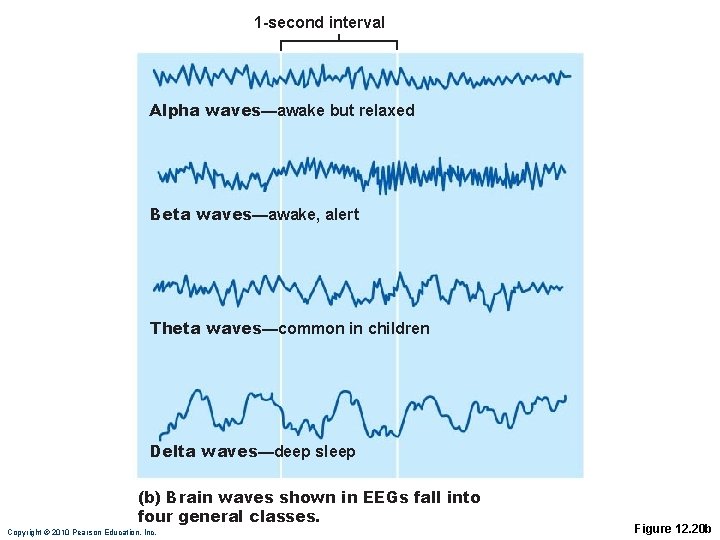
1 -second interval Alpha waves—awake but relaxed Beta waves—awake, alert Theta waves—common in children Delta waves—deep sleep (b) Brain waves shown in EEGs fall into four general classes. Copyright © 2010 Pearson Education, Inc. Figure 12. 20 b
Epilepsy • A victim of epilepsy may lose consciousness, fall stiffly, and have uncontrollable jerking • Epilepsy occurs in 1% of the population • not associated with intellectual impairments Copyright © 2010 Pearson Education, Inc.
Control of Epilepsy • Anticonvulsive drugs Copyright © 2010 Pearson Education, Inc.
Consciousness • Conscious perception of sensation Copyright © 2010 Pearson Education, Inc.
Consciousness • Clinically defined on a continuum that grades behavior in response to stimuli • Alertness • Drowsiness (lethargy) • Stupor • Coma Copyright © 2010 Pearson Education, Inc.
Sleep • State of partial unconsciousness from which a person can be aroused by stimulation • Two major types of sleep (defined by EEG patterns) • Nonrapid eye movement (NREM) • Rapid eye movement (REM) Copyright © 2010 Pearson Education, Inc.
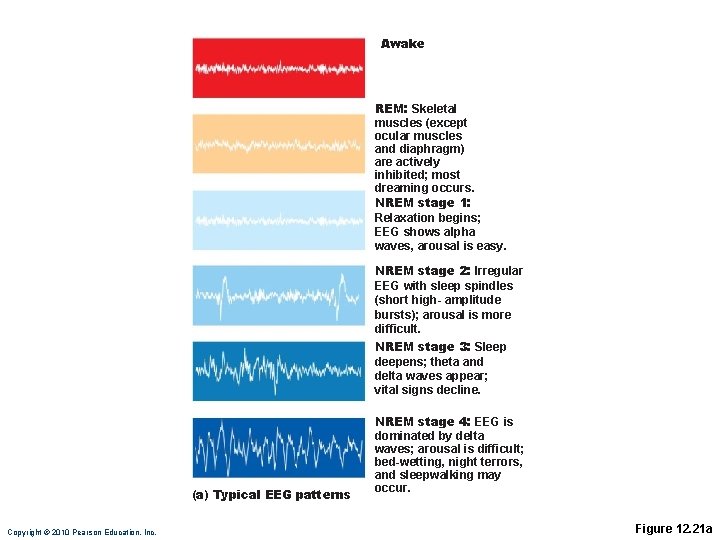
Awake REM: Skeletal muscles (except ocular muscles and diaphragm) are actively inhibited; most dreaming occurs. NREM stage 1: Relaxation begins; EEG shows alpha waves, arousal is easy. NREM stage 2: Irregular EEG with sleep spindles (short high- amplitude bursts); arousal is more difficult. NREM stage 3: Sleep deepens; theta and delta waves appear; vital signs decline. (a) Typical EEG patterns Copyright © 2010 Pearson Education, Inc. NREM stage 4: EEG is dominated by delta waves; arousal is difficult; bed-wetting, night terrors, and sleepwalking may occur. Figure 12. 21 a
Sleep Disorders • Narcolepsy • Lapsing abruptly into sleep from the awake state • Insomnia • Chronic inability to obtain the amount or quality of sleep needed • Sleep apnea • Temporary cessation of breathing during sleep Copyright © 2010 Pearson Education, Inc.
Language • Language implementation system • Broca’s area and Wernicke’s area (in the association cortex on the left side) Copyright © 2010 Pearson Education, Inc.
Memory • Storage and retrieval of information • Two stages of storage • Short-term memory (STM, or working memory) —temporary holding of information; limited to seven or eight pieces of information • Long-term memory (LTM) has limitless capacity Copyright © 2010 Pearson Education, Inc.
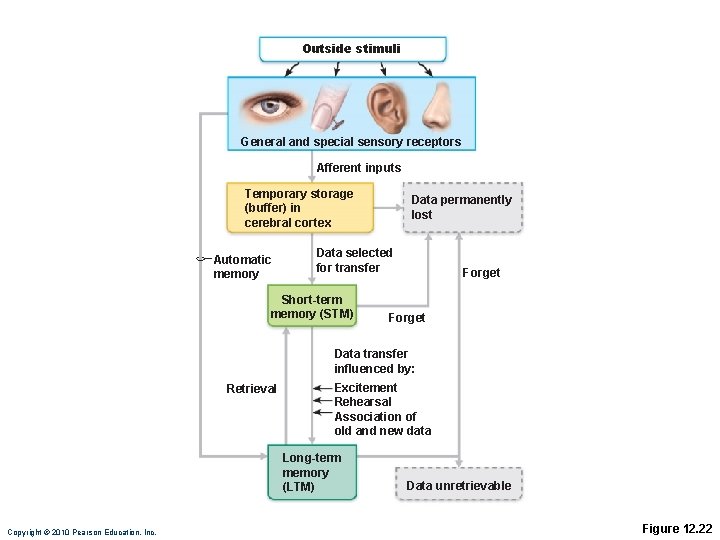
Outside stimuli General and special sensory receptors Afferent inputs Temporary storage (buffer) in cerebral cortex Automatic memory Data permanently lost Data selected for transfer Short-term memory (STM) Forget Data transfer influenced by: Retrieval Excitement Rehearsal Association of old and new data Long-term memory (LTM) Copyright © 2010 Pearson Education, Inc. Data unretrievable Figure 12. 22
Transfer from STM to LTM • Factors that affect transfer from STM to LTM • Emotional state—best if alert, motivated, surprised, and aroused • Rehearsal—repetition and practice • Association—tying new information with old memories • Automatic memory—subconscious information stored in LTM Copyright © 2010 Pearson Education, Inc.
Protection of the Brain • Bone (skull) • Membranes (meninges) • Watery cushion (cerebrospinal fluid) • Blood-brain barrier Copyright © 2010 Pearson Education, Inc.
Meninges • Cover and protect the CNS • Protect blood vessels and enclose venous sinuses • Contain cerebrospinal fluid (CSF) • Form partitions in the skull Copyright © 2010 Pearson Education, Inc.
Meninges • Three layers • Dura mater • Arachnoid mater • Pia mater Copyright © 2010 Pearson Education, Inc.
Cerebrospinal Fluid (CSF) • Composition • Watery solution • Less protein and different ion concentrations than plasma • Constant volume Copyright © 2010 Pearson Education, Inc.
Cerebrospinal Fluid (CSF) • Functions • Gives buoyancy to the CNS organs • Protects the CNS from blows and other trauma • Nourishes the brain and carries chemical signals Copyright © 2010 Pearson Education, Inc.
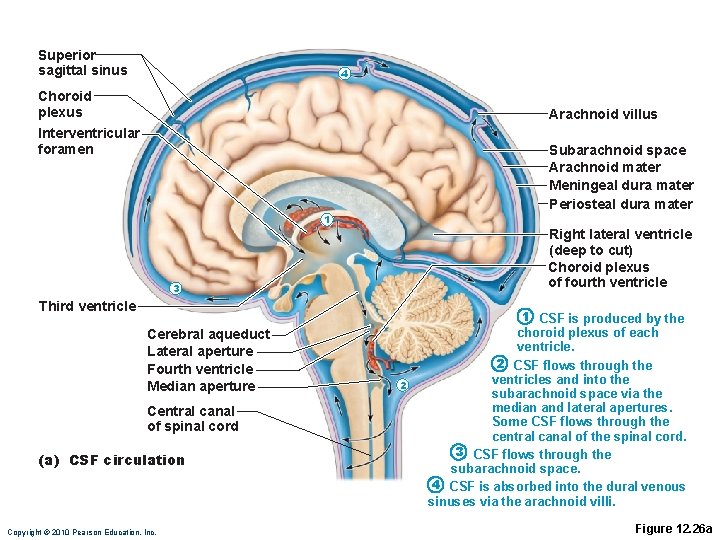
Superior sagittal sinus 4 Choroid plexus Arachnoid villus Interventricular foramen Subarachnoid space Arachnoid mater Meningeal dura mater Periosteal dura mater 1 Right lateral ventricle (deep to cut) Choroid plexus of fourth ventricle 3 Third ventricle 1 CSF is produced by the Cerebral aqueduct Lateral aperture Fourth ventricle Median aperture Central canal of spinal cord (a) CSF circulation Copyright © 2010 Pearson Education, Inc. 2 choroid plexus of each ventricle. 2 CSF flows through the ventricles and into the subarachnoid space via the median and lateral apertures. Some CSF flows through the central canal of the spinal cord. 3 CSF flows through the subarachnoid space. 4 CSF is absorbed into the dural venous sinuses via the arachnoid villi. Figure 12. 26 a
Choroid Plexuses • Hang from the roof of each ventricle • Clusters of capillaries enclosed by pia mater and a layer of ependymal cells Copyright © 2010 Pearson Education, Inc.
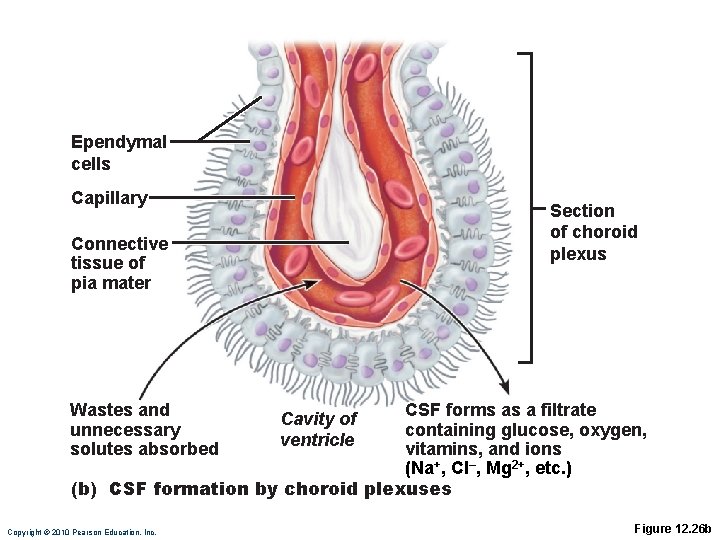
Ependymal cells Capillary Section of choroid plexus Connective tissue of pia mater Wastes and unnecessary solutes absorbed CSF forms as a filtrate containing glucose, oxygen, vitamins, and ions (Na+, Cl–, Mg 2+, etc. ) (b) CSF formation by choroid plexuses Copyright © 2010 Pearson Education, Inc. Cavity of ventricle Figure 12. 26 b
Blood-Brain Barrier • Helps maintain a stable environment for the brain • Separates neurons from some bloodborne substances Copyright © 2010 Pearson Education, Inc.
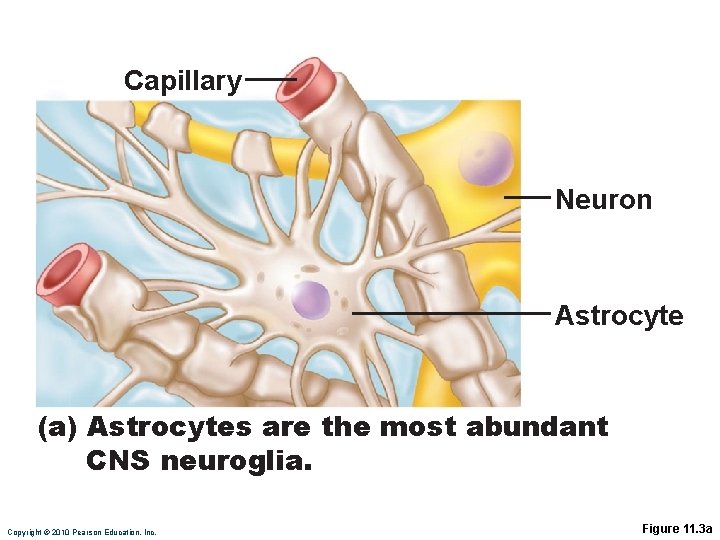
Capillary Neuron Astrocyte (a) Astrocytes are the most abundant CNS neuroglia. Copyright © 2010 Pearson Education, Inc. Figure 11. 3 a
Homeostatic Imbalances of the Brain • Cerebrovascular accidents (CVAs)(strokes) • Blood circulation is blocked and brain tissue dies, e. g. , blockage of a cerebral artery by a blood clot • Typically leads to hemiplegia, or sensory and speed deficits • Transient ischemic attacks (TIAs)—temporary episodes of reversible cerebral ischemia • Tissue plasminogen activator (TPA) is the only approved treatment for stroke Copyright © 2010 Pearson Education, Inc.
Homeostatic Imbalances of the Brain • Degenerative brain disorders • Alzheimer’s disease (AD): a progressive degenerative disease of the brain that results in dementia • Parkinson’s disease: degeneration of the dopaminereleasing neurons of the substantia nigra • Huntington’s disease: a fatal hereditary disorder caused by accumulation of the protein huntingtin that leads to degeneration of the basal nuclei and cerebral cortex Copyright © 2010 Pearson Education, Inc.
- Slides: 37