
Power Point Lecture Slides prepared by Vince Austin
Power. Point® Lecture Slides prepared by Vince Austin, University of Kentucky The Immune System: Innate and Adaptive Body Defenses Part A Human Anatomy & Physiology, Sixth Edition Elaine N. Marieb Copyright © 2004 Pearson Education, Inc. , publishing as Benjamin Cummings 21
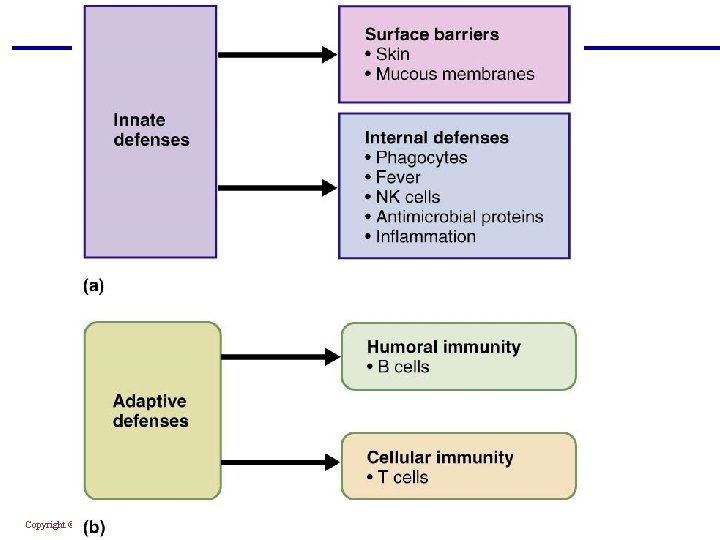
Immunity: Two Intrinsic Defense Systems § Innate (nonspecific) system responds quickly and consists of: § First line of defense – intact skin and mucosae prevent entry of microorganisms § Second line of defense – antimicrobial proteins, phagocytes, and other cells § Inhibit spread of invaders throughout the body § Inflammation is its hallmark and most important mechanism Copyright © 2004 Pearson Education, Inc. , publishing as Benjamin Cummings
Immunity: Two Intrinsic Defense Systems § Adaptive (specific) defense system § Third line of defense – mounts attack against particular foreign substances § Takes longer to react than the innate system § Works in conjunction with the innate system Copyright © 2004 Pearson Education, Inc. , publishing as Benjamin Cummings
Copyright © 2004 Pearson Education, Inc. , publishing as Benjamin Cummings
Surface Barriers § Skin, mucous membranes, and their secretions make up the first line of defense Copyright © 2004 Pearson Education, Inc. , publishing as Benjamin Cummings
Epithelial Chemical Barriers § Epithelial membranes produce protective chemicals that destroy microorganisms § Skin oils have acidity (p. H of 3 to 5)which inhibits bacterial growth § Stomach mucosae secrete concentrated HCl and protein-digesting enzymes § Saliva and lacrimal fluid contain lysozyme Copyright © 2004 Pearson Education, Inc. , publishing as Benjamin Cummings
Respiratory Tract Mucosae § Mucus-coated hairs in the nose trap inhaled particles § Mucosa of the upper respiratory tract is ciliated § Cilia sweep dust- and bacteria-laden mucus away from lower respiratory passages Copyright © 2004 Pearson Education, Inc. , publishing as Benjamin Cummings
Internal Defenses: Cells and Chemicals § The body uses nonspecific cellular and chemical devices to protect itself § Phagocytes § natural killer (NK) cells § Antimicrobial proteins in blood and tissue fluid § Inflammatory response enlists macrophages, mast cells, WBCs, and chemicals Copyright © 2004 Pearson Education, Inc. , publishing as Benjamin Cummings
Phagocytes § Macrophages are the chief phagocytic cells § Free macrophages wander throughout a region in search of cellular debris § Kupffer cells (liver) and microglia (brain) are fixed macrophages There are 3 types of specialized phagocytes. § Neutrophils become phagocytic when encountering infectious material § Eosinophils are weakly phagocytic against parasitic worms § Mast cells bind and ingest a wide range of bacteria Copyright © 2004 Pearson Education, Inc. , publishing as Benjamin Cummings
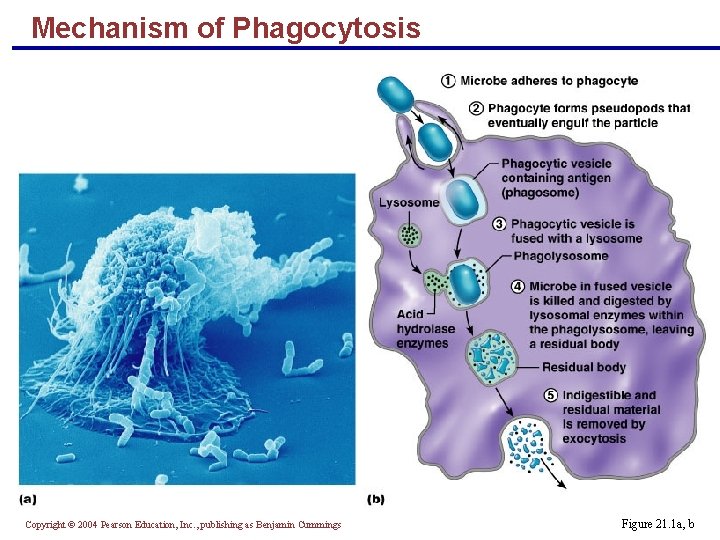
Mechanism of Phagocytosis Copyright © 2004 Pearson Education, Inc. , publishing as Benjamin Cummings Figure 21. 1 a, b
Natural Killer (NK) Cells § Cells that can lyse and kill cancer cells and virus-infected cells § Natural killer cells: § Are a small, distinct group of large granular lymphocytes § React nonspecifically and eliminate cancerous and virusinfected cells § Kill their target cells by releasing perforins and other cytolytic chemicals § Secrete potent chemicals that enhance the inflammatory response Copyright © 2004 Pearson Education, Inc. , publishing as Benjamin Cummings
Antimicrobial Proteins § Enhance the innate defenses by: § Attacking microorganisms directly § Hindering microorganisms’ ability to reproduce § The most important antimicrobial proteins are: § Interferon § Complement proteins Copyright © 2004 Pearson Education, Inc. , publishing as Benjamin Cummings
Interferon Family § Interferons are a family of related proteins each with slightly different physiological effects § Lymphocytes secrete gamma ( ) interferon, but most other WBCs secrete alpha ( ) interferon § Fibroblasts secrete beta ( ) interferon § Interferons also activate macrophages and mobilize NKs Copyright © 2004 Pearson Education, Inc. , publishing as Benjamin Cummings
Interferon (IFN) § Genes that synthesize IFN are activated when a host cell is invaded by a virus § Interferon molecules leave the infected cell and enter neighboring cells § Interferon stimulates the neighboring cells to activate genes for PKR (an antiviral protein) § PKR nonspecifically blocks viral reproduction in the neighboring cell Copyright © 2004 Pearson Education, Inc. , publishing as Benjamin Cummings
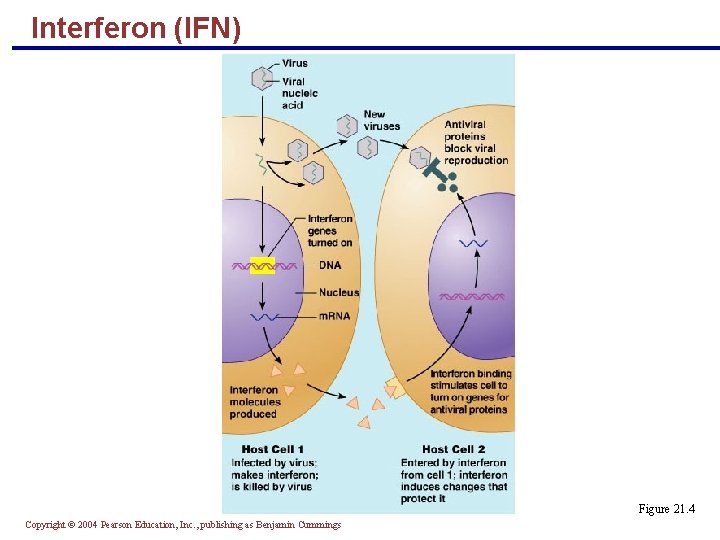
Interferon (IFN) Figure 21. 4 Copyright © 2004 Pearson Education, Inc. , publishing as Benjamin Cummings
Complement § 20 or so proteins that circulate in the blood in an inactive form § Provides a major mechanism for destroying foreign substances in the body § Amplifies all aspects of the inflammatory response § Kills bacteria and certain other cell types (our cells are immune to complement) § Enhances the effectiveness of both nonspecific and specific defenses Copyright © 2004 Pearson Education, Inc. , publishing as Benjamin Cummings
Complement Pathways § Complement can be activated by two pathways: classical and alternative § Classical pathway is linked to the immune system § Depends on the binding of antibodies to invading organisms § Subsequent binding of C 1(the first protein) to the antigen-antibody complexes (complement fixation) § Alternative pathway is triggered by interaction among factors B, D, and P, and polysaccharide molecules present on microorganisms Copyright © 2004 Pearson Education, Inc. , publishing as Benjamin Cummings
Complement Pathways § Each pathway involves a cascade in which complement proteins are activated in an orderly sequence and where each step catalyzes the next § Both pathways converge on C 3, which cleaves into C 3 a and C 3 b § C 3 b initiates formation of a membrane attack complex (MAC) § C 3 b also causes opsonization (identification of the invader), and C 3 a causes inflammation Copyright © 2004 Pearson Education, Inc. , publishing as Benjamin Cummings
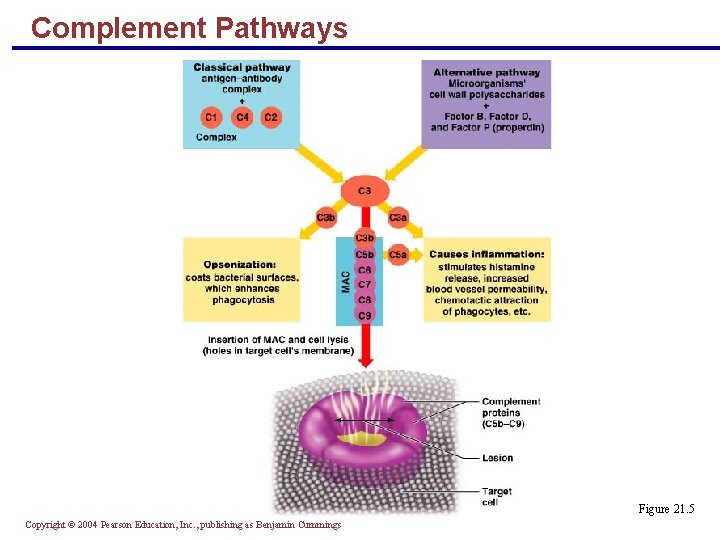
Complement Pathways Figure 21. 5 Copyright © 2004 Pearson Education, Inc. , publishing as Benjamin Cummings
C-reactive Protein (CRP) § CRP is produced by the liver in response to inflammatory molecules § CRP is a clinical marker used to assess for: § The presence of an acute infection § An inflammatory condition and its response to treatment Copyright © 2004 Pearson Education, Inc. , publishing as Benjamin Cummings
Fever § Abnormally high body temperature in response to invading microorganisms § The body’s thermostat is reset upwards in response to pyrogens, chemicals secreted by leukocytes and macrophages exposed to bacteria and other foreign substances Copyright © 2004 Pearson Education, Inc. , publishing as Benjamin Cummings
Fever § High fevers are dangerous as they can denature enzymes § Moderate fever can be beneficial, as it causes: § The liver and spleen to sequester iron and zinc (needed by microorganisms) § An increase in the metabolic rate, which speeds up tissue repair Copyright © 2004 Pearson Education, Inc. , publishing as Benjamin Cummings
Inflammation: Tissue Response to Injury § The inflammatory response is triggered whenever body tissues are injured § Prevents the spread of damaging agents to nearby tissues § Disposes of cell debris and pathogens § Sets the stage for repair processes § The four cardinal signs of acute inflammation are redness, heat, swelling, and pain Copyright © 2004 Pearson Education, Inc. , publishing as Benjamin Cummings
Inflammation Response § Begins by Macrophages and other immune cells recognizing an invader. § They do this with TLR’s (Toll Like Receptors), which are receptors on the membrane of the immune cell that can recognize by shape the specific class of microbe. Copyright © 2004 Pearson Education, Inc. , publishing as Benjamin Cummings
Chemical Mediators § Once a microbe has been identified a flood of inflammatory chemicals are released into the extracellular fluid § Inflammatory mediators: § Include Cytokines, histamines, kinins, prostaglandins (PGs), and complement. § Cause local small blood vessels to dilate, resulting in hyperemia. § Send out a chemical signal that attracts other white blood cells. Copyright © 2004 Pearson Education, Inc. , publishing as Benjamin Cummings
Inflammatory Response: Vascular Permeability § Chemicals liberated by the inflammatory response increase the permeability of local capillaries § Exudate (fluid containing proteins, clotting factors, and antibodies): § Seeps into tissue spaces causing local edema (swelling), which contributes to the sensation of pain Copyright © 2004 Pearson Education, Inc. , publishing as Benjamin Cummings
Inflammatory Response: Edema § The surge of protein-rich fluids into tissue spaces (edema): § Helps to dilute harmful substances § Brings in large quantities of oxygen and nutrients needed for repair § Allows entry of clotting proteins, which prevents the spread of bacteria Copyright © 2004 Pearson Education, Inc. , publishing as Benjamin Cummings
Inflammatory Response: Phagocytic Mobilization § Occurs in four main phases: § Leukocytosis – neutrophils are released from the bone marrow in response to chemical released by injured cells § Margination – neutrophils cling to the walls of capillaries in the injured area § Diapedesis – neutrophils squeeze through capillary walls and begin phagocytosis § Chemotaxis – inflammatory chemicals attract neutrophils to the injury site Copyright © 2004 Pearson Education, Inc. , publishing as Benjamin Cummings
Monocytes § Hours After the neutrophils have reached the injured site monocytes reach the area. § They swell, develop large numbers of lysosomes and become macrophages with insatiable appitites. § If these macrophages can not deal with the situation then a chemical signal will be sent for the adaptive immune system (T and B cells) to come to the rescue. Copyright © 2004 Pearson Education, Inc. , publishing as Benjamin Cummings
Platelets and Coagulation § Platelets do not stick to each other or the endothelium lining unless the lining is damaged. § When the endothelium is damaged the collagen fibers are exposed and the platelets adhere to the fibers. § This causes the platelets to undergo a change § They swell § Form spiked processes § Become sticky. Copyright © 2004 Pearson Education, Inc. , publishing as Benjamin Cummings
Coagulation § Coagulation is a complicated multistep process that involves over 30 different substances. § However, the process leads to the same end result, an enzyme called thrombin catalyzes the joining of fibrinogen in the plasma into a fibrin mesh around the wound. § This fibrin mesh traps red and white blood cells effectively sealing the damaged vessel. Copyright © 2004 Pearson Education, Inc. , publishing as Benjamin Cummings
Clot retraction and repair § With in 30 to 60 minutes of the fibrin mesh being created, platelets induce clot retraction. § Platelets actually contain actin and myosin which allows the platelets to draw both end of the damaged tissue or vessel together. § As this happens healing of the tissue has already begin stimulated by Platelet derived growth factors (PDGF) and Vascular endothelial growth factors (VEGF). Copyright © 2004 Pearson Education, Inc. , publishing as Benjamin Cummings
Clot Removal § Once healing has occurred the clot is removed by a fibrin digesting enzyme called plasmin. § Remember while all of this healing is occurring the inflammation process is drawing the necessary immune cells to the are. § The ultimate goal of inflammation is the clear the injured site and aid in tissue repair. Copyright © 2004 Pearson Education, Inc. , publishing as Benjamin Cummings
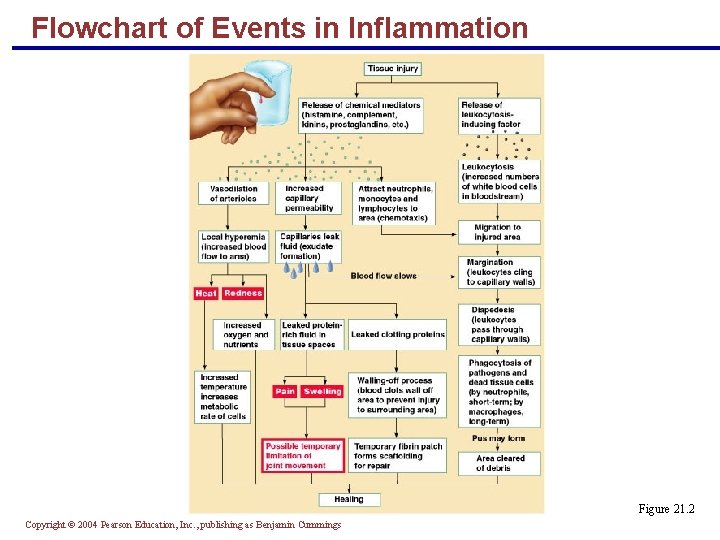
Flowchart of Events in Inflammation Figure 21. 2 Copyright © 2004 Pearson Education, Inc. , publishing as Benjamin Cummings
Adaptive (Specific) Defenses § The adaptive immune system is a functional system that: § Recognizes specific foreign substances § Acts to immobilize, neutralize, or destroy foreign substances § Amplifies inflammatory response and activates complement Copyright © 2004 Pearson Education, Inc. , publishing as Benjamin Cummings

Adaptive Immune Defenses § The adaptive immune system is antigen-specific, systemic, and has memory § It has two separate but overlapping arms § Humoral, or antibody-mediated immunity § Cellular, or cell-mediated immunity Copyright © 2004 Pearson Education, Inc. , publishing as Benjamin Cummings
Antigens § Substances that can mobilize the immune system and provoke an immune response § The ultimate targets of all immune responses are mostly large, complex molecules not normally found in the body (nonself) Copyright © 2004 Pearson Education, Inc. , publishing as Benjamin Cummings
Complete Antigens § Important functional properties: § Immunogenicity – the ability to stimulate proliferation of specific lymphocytes and antibody production § Reactivity – the ability to react with the products of the activated lymphocytes and the antibodies released in response to them § Complete antigens include foreign protein, nucleic acid, some lipids, and large polysaccharides Copyright © 2004 Pearson Education, Inc. , publishing as Benjamin Cummings
Haptens (Incomplete Antigens) § Small molecules, such as peptides, nucleotides, and many hormones, that are not immunogenic but are reactive when attached to protein carriers § If they link up with the body’s proteins, the adaptive immune system may recognize them as foreign and mount a harmful attack (allergy) § Haptens are found in poison ivy, dander, some detergents, and cosmetics Copyright © 2004 Pearson Education, Inc. , publishing as Benjamin Cummings
Antigenic Determinants § Only certain parts of an entire antigen are immunogenic § Antibodies and activated lymphocytes bind to these antigenic determinants § Most naturally occurring antigens have numerous antigenic determinants that: § Mobilize several different lymphocyte populations § Form different kinds of antibodies against it § Large, chemically simple molecules (e. g. , plastics) have little or no immunogenicity Copyright © 2004 Pearson Education, Inc. , publishing as Benjamin Cummings
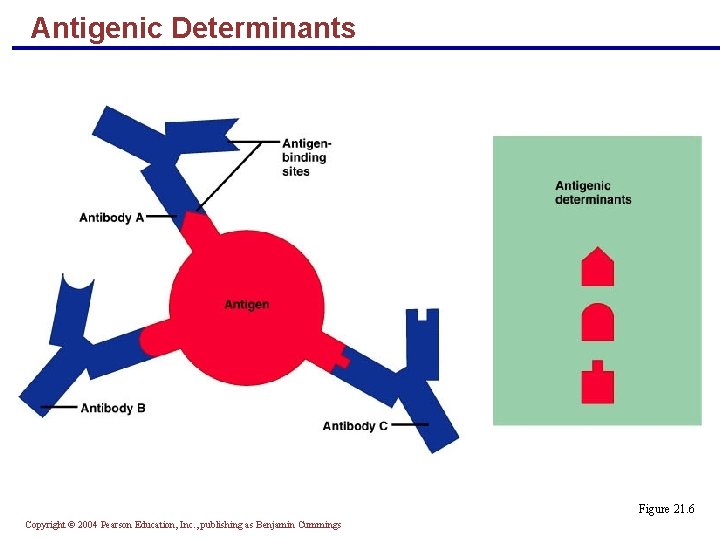
Antigenic Determinants Figure 21. 6 Copyright © 2004 Pearson Education, Inc. , publishing as Benjamin Cummings
Self-Antigens: MHC Proteins § Our cells are dotted with protein molecules (selfantigens) that are not antigenic to us but are strongly antigenic to others § One type of these, MHC proteins, mark a cell as self § The two classes of MHC proteins are: § Class I MHC proteins – found on virtually all body cells § Class II MHC proteins – found on certain cells in the immune response Copyright © 2004 Pearson Education, Inc. , publishing as Benjamin Cummings
MHC Proteins § Are coded for by genes of the major histocompatibility complex (MHC) and are unique to an individual § Each MHC molecule has a deep groove that displays a peptide, which is a normal cellular product of protein recycling § In infected cells, MHC proteins bind to fragments of foreign antigens, which play a crucial role in mobilizing the immune system Copyright © 2004 Pearson Education, Inc. , publishing as Benjamin Cummings
Cells of the Adaptive Immune System § Two types of lymphocytes § B lymphocytes – oversee humoral immunity § T lymphocytes – non-antibody-producing cells that constitute the cell-mediated arm of immunity § Antigen-presenting cells (APCs): § Do not respond to specific antigens § Play essential auxiliary roles in immunity Copyright © 2004 Pearson Education, Inc. , publishing as Benjamin Cummings
Lymphocytes § Immature lymphocytes released from bone marrow are essentially identical § Whether a lymphocyte matures into a B cell or a T cell depends on where in the body it becomes immunocompetent § B cells mature in the bone marrow § T cells mature in the thymus Copyright © 2004 Pearson Education, Inc. , publishing as Benjamin Cummings
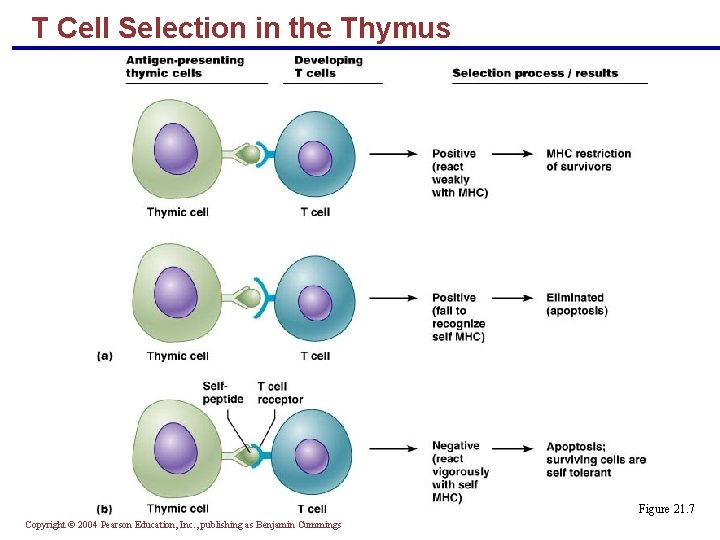
T Cell Selection in the Thymus Figure 21. 7 Copyright © 2004 Pearson Education, Inc. , publishing as Benjamin Cummings
T Cells § T cells mature in the thymus under negative and positive selection pressures § Negative selection – eliminates T cells that are strongly anti-self § Positive selection – selects T cells with a weak response to self-antigens, which thus become both immunocompetent and self-tolerant Copyright © 2004 Pearson Education, Inc. , publishing as Benjamin Cummings
B Cells § B cells become immunocompetent and self-tolerant in bone marrow § Some self-reactive B cells are inactivated (anergy) while others are killed § Other B cells undergo receptor editing in which there is a rearrangement of their receptors Copyright © 2004 Pearson Education, Inc. , publishing as Benjamin Cummings
Immunocompetent B or T cells § Display a unique type of receptor that responds to a distinct antigen § Become immunocompetent before they encounter antigens they may later attack § Are exported to secondary lymphoid tissue where encounters with antigens occur § Mature into fully functional antigen-activated cells upon binding with their recognized antigen § It is genes, not antigens, that determine which foreign substances our immune system will recognize and resist Copyright © 2004 Pearson Education, Inc. , publishing as Benjamin Cummings
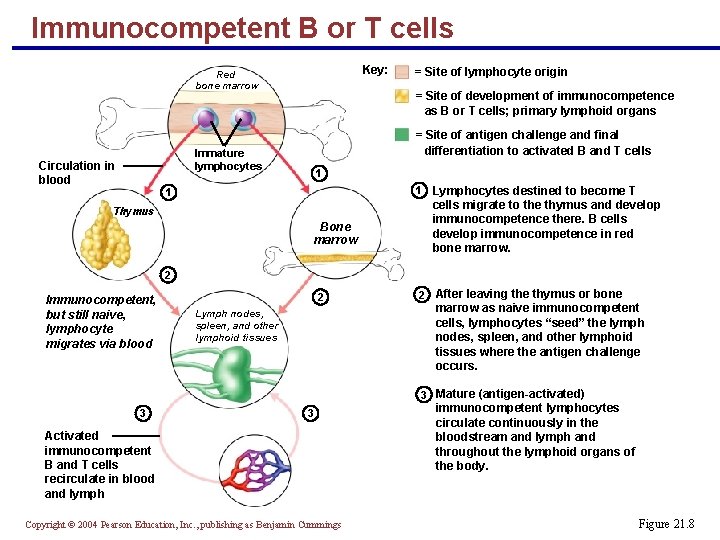
Immunocompetent B or T cells Key: Red bone marrow = Site of development of immunocompetence as B or T cells; primary lymphoid organs = Site of antigen challenge and final differentiation to activated B and T cells Immature lymphocytes Circulation in blood = Site of lymphocyte origin 1 1 Lymphocytes destined to become T 1 Thymus Bone marrow cells migrate to the thymus and develop immunocompetence there. B cells develop immunocompetence in red bone marrow. 2 Immunocompetent, but still naive, lymphocyte migrates via blood 2 Lymph nodes, spleen, and other lymphoid tissues 2 After leaving the thymus or bone marrow as naive immunocompetent cells, lymphocytes “seed” the lymph nodes, spleen, and other lymphoid tissues where the antigen challenge occurs. 3 Mature (antigen-activated) 3 3 Activated immunocompetent B and T cells recirculate in blood and lymph Copyright © 2004 Pearson Education, Inc. , publishing as Benjamin Cummings immunocompetent lymphocytes circulate continuously in the bloodstream and lymph and throughout the lymphoid organs of the body. Figure 21. 8
Antigen-Presenting Cells (APCs) § Major rolls in immunity are: § To engulf foreign particles § To present fragments of antigens on their own surfaces, to be recognized by T cells § Major APCs are dendritic cells (DCs), macrophages, and activated B cells § The major initiators of adaptive immunity are DCs, which actively migrate to the lymph nodes and secondary lymphoid organs and present antigens to T and B cells Copyright © 2004 Pearson Education, Inc. , publishing as Benjamin Cummings
Macrophages and Dendritic Cells § Secrete soluble proteins that activate T cells § Activated T cells in turn release chemicals that: § Rev up the maturation and mobilization of DCs § Prod macrophages to become activated macrophages, which are insatiable phagocytes that secrete bactericidal chemicals Copyright © 2004 Pearson Education, Inc. , publishing as Benjamin Cummings
Adaptive Immunity: Summary § Two-fisted defensive system that uses lymphocytes, APCs, and specific molecules to identify and destroy nonself particles § Its response depends upon the ability of its cells to: § Recognize foreign substances (antigens) by binding to them § Communicate with one another so that the whole system mounts a response specific to those antigens Copyright © 2004 Pearson Education, Inc. , publishing as Benjamin Cummings
Humoral Immunity Response § Antigen challenge – first encounter between an antigen and a naive immunocompetent cell § Takes place in the spleen or other lymphoid organ § If the lymphocyte is a B cell: § The challenging antigen provokes a humoral immune response § Antibodies are produced against the challenger Copyright © 2004 Pearson Education, Inc. , publishing as Benjamin Cummings
Clonal Selection § Stimulated B cell growth forms clones bearing the same antigen-specific receptors § A naive, immunocompetent B cell is activated when antigens bind to its surface receptors and cross-link adjacent receptors § Antigen binding is followed by receptor-mediated endocytosis of the cross-linked antigen-receptor complexes § These activating events, plus T cell interactions, trigger clonal selection Copyright © 2004 Pearson Education, Inc. , publishing as Benjamin Cummings
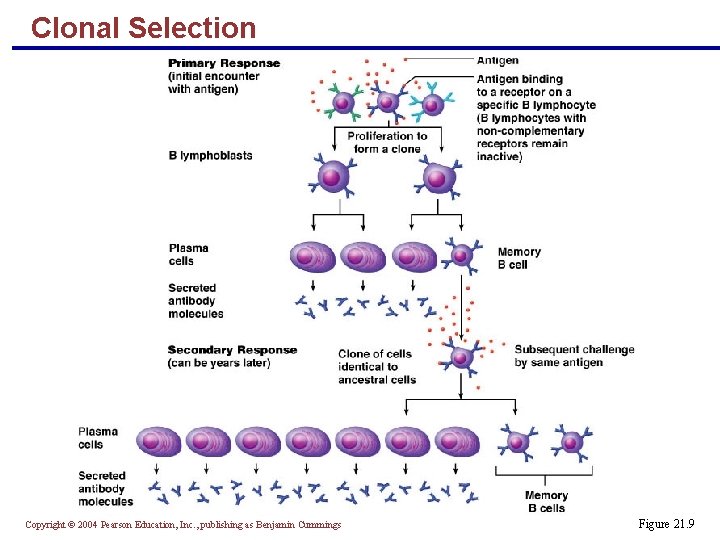
Clonal Selection Copyright © 2004 Pearson Education, Inc. , publishing as Benjamin Cummings Figure 21. 9
Fate of the Clones § Most clone cells become antibody-secreting plasma cells § Plasma cells secrete specific antibody at the rate of 2000 molecules per second Copyright © 2004 Pearson Education, Inc. , publishing as Benjamin Cummings
Fate of the Clones § Secreted antibodies: § Bind to free antigens § Mark the antigens for destruction by specific or nonspecific mechanisms § Clones that do not become plasma cells become memory cells that can mount an immediate response to subsequent exposures of the same antigen Copyright © 2004 Pearson Education, Inc. , publishing as Benjamin Cummings
Immunological Memory § Primary immune response – cellular differentiation and proliferation, which occurs on the first exposure to a specific antigen § Lag period: 3 to 6 days after antigen challenge § Peak levels of plasma antibody are achieved in 10 days § Antibody levels then decline Copyright © 2004 Pearson Education, Inc. , publishing as Benjamin Cummings
Immunological Memory § Secondary immune response – re-exposure to the same antigen § Sensitized memory cells respond within hours § Antibody levels peak in 2 to 3 days at much higher levels than in the primary response § Antibodies bind with greater affinity, and their levels in the blood can remain high for weeks to months Copyright © 2004 Pearson Education, Inc. , publishing as Benjamin Cummings
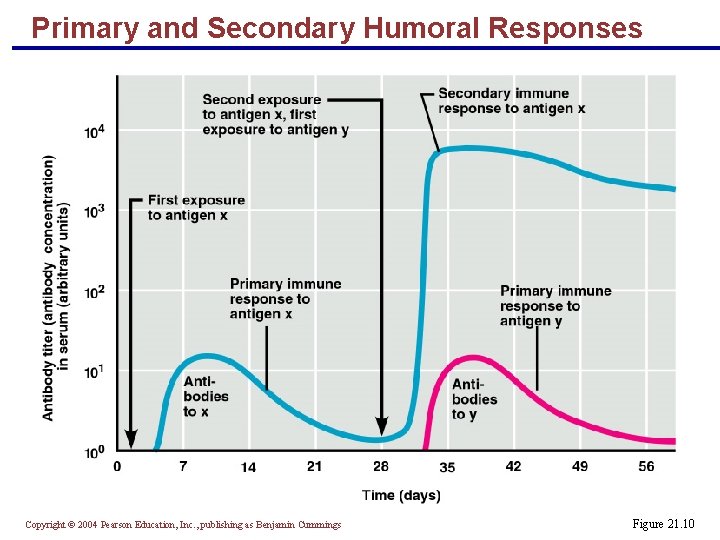
Primary and Secondary Humoral Responses Copyright © 2004 Pearson Education, Inc. , publishing as Benjamin Cummings Figure 21. 10
Active Humoral Immunity § B cells encounter antigens and produce antibodies against them § Naturally acquired – response to a bacterial or viral infection § Artificially acquired – response to a vaccine of dead or attenuated pathogens § Vaccines – spare us the symptoms of disease, and their weakened antigens provide antigenic determinants that are immunogenic and reactive Copyright © 2004 Pearson Education, Inc. , publishing as Benjamin Cummings
Passive Humoral Immunity § Differs from active immunity in the antibody source and the degree of protection § B cells are not challenged by antigens § Immunological memory does not occur § Protection ends when antigens naturally degrade in the body § Naturally acquired – from the mother to her fetus via the placenta § Artificially acquired – from the injection of serum, such as gamma globulin Copyright © 2004 Pearson Education, Inc. , publishing as Benjamin Cummings
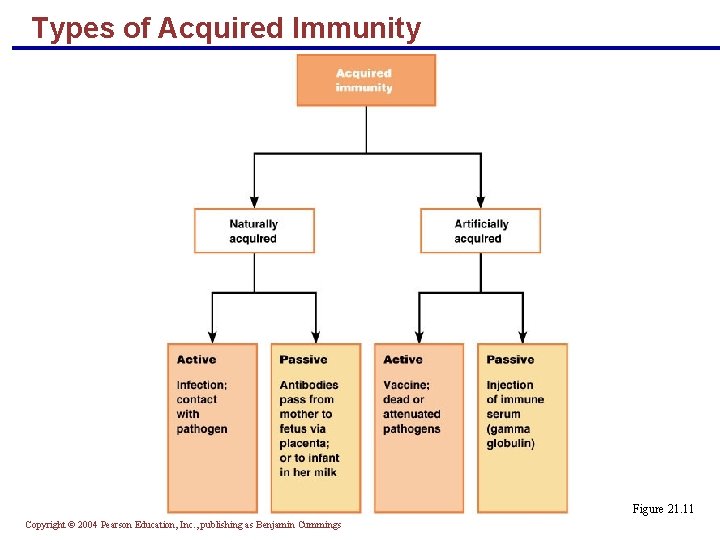
Types of Acquired Immunity Figure 21. 11 Copyright © 2004 Pearson Education, Inc. , publishing as Benjamin Cummings
- Slides: 64