
Power Point Lecture Slides prepared by Vince Austin
Power. Point® Lecture Slides prepared by Vince Austin, University of Kentucky Joints Human Anatomy & Physiology, Sixth Edition Elaine N. Marieb Copyright © 2004 Pearson Education, Inc. , publishing as Benjamin Cummings 8
Joints (Articulations) Weakest parts of the skeleton Articulation – site where two or more bones meet Functions of joints: § Give the skeleton mobility § Hold the skeleton together Copyright © 2004 Pearson Education, Inc. , publishing as Benjamin Cummings
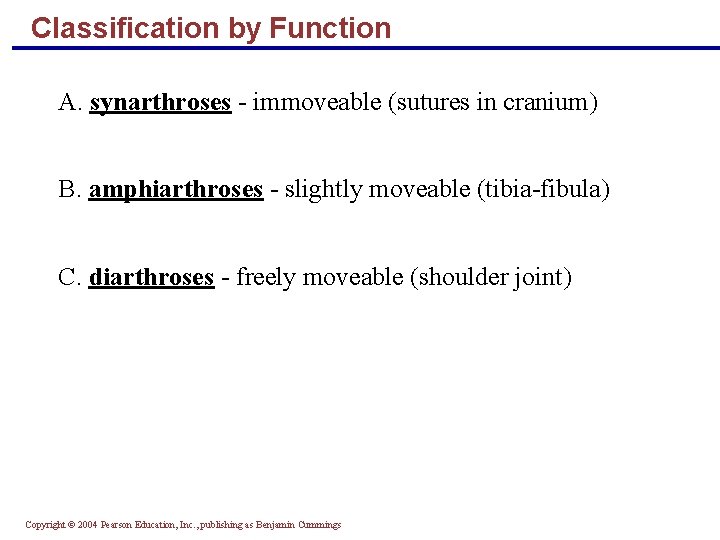
Classification by Function A. synarthroses - immoveable (sutures in cranium) B. amphiarthroses - slightly moveable (tibia-fibula) C. diarthroses - freely moveable (shoulder joint) Copyright © 2004 Pearson Education, Inc. , publishing as Benjamin Cummings
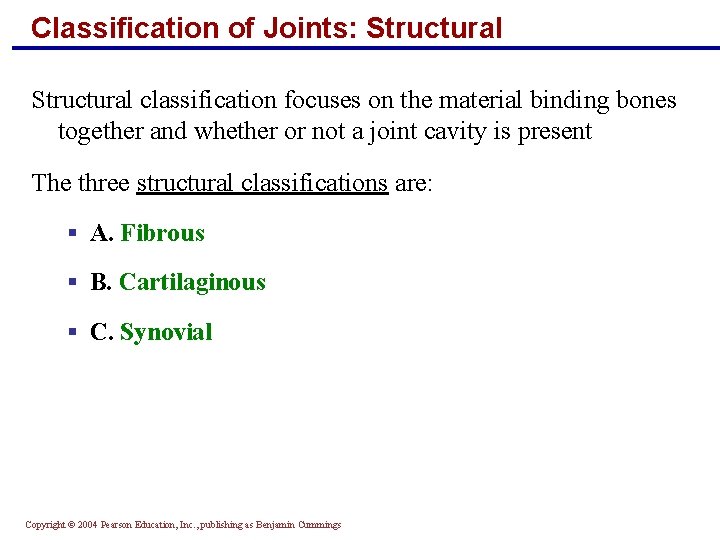
Classification of Joints: Structural classification focuses on the material binding bones together and whether or not a joint cavity is present The three structural classifications are: § A. Fibrous § B. Cartilaginous § C. Synovial Copyright © 2004 Pearson Education, Inc. , publishing as Benjamin Cummings
A. Fibrous Structural Joints § The bones are joined by fibrous tissues § There is no joint cavity § Most are immovable There are three types a. sutures b. syndesmoses c. gomphoses Copyright © 2004 Pearson Education, Inc. , publishing as Benjamin Cummings
Three Types of Fibrous Joints a. Sutures 1. between cranial bones 2. very tight, thin layer of connective tissue 3. synostoses - bone replaces connective in adult b. Syndesmoses 1. very little freedom for movement 2. interosseous membrane/ligament present c. Gomphoses 1. one part fit tightly into the other 2. periodontal tissue holds parts firmly together 3. example: teeth in the mandible and maxillae Copyright © 2004 Pearson Education, Inc. , publishing as Benjamin Cummings
-- Sutures § Occur between the bones of the skull § Comprised of interlocking junctions completely filled with connective tissue fibers § Bind bones tightly together, but allow for growth during youth Copyright © 2004 Pearson Education, Inc. , publishing as Benjamin Cummings
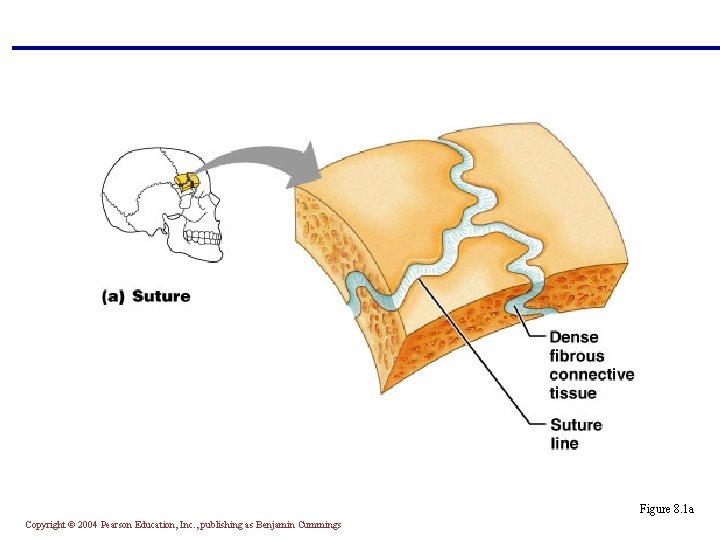
Figure 8. 1 a Copyright © 2004 Pearson Education, Inc. , publishing as Benjamin Cummings
-- Syndesmoses § Bones are connected by a fibrous tissue ligament § Movement varies from immovable to slightly variable § Examples include the connection between the tibia and fibula, and the radius and ulna Copyright © 2004 Pearson Education, Inc. , publishing as Benjamin Cummings
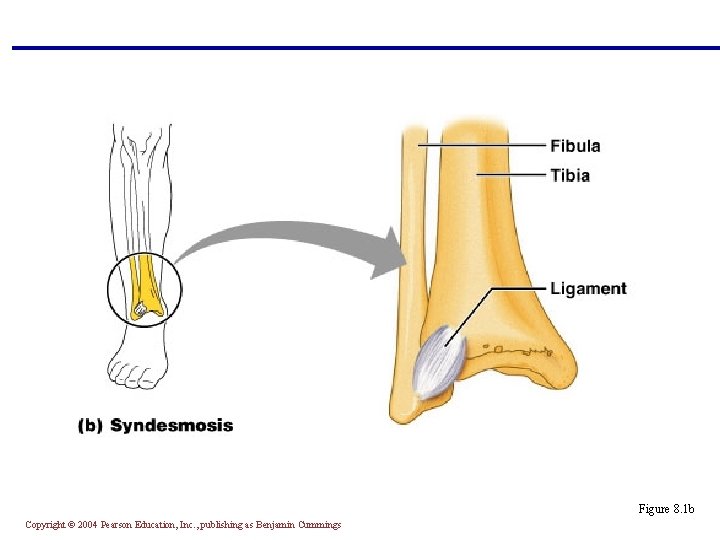
Figure 8. 1 b Copyright © 2004 Pearson Education, Inc. , publishing as Benjamin Cummings
-- Gomphoses § The peg-in-socket fibrous joint between a tooth and its alveolar socket § The fibrous connection is the periodontal ligament Copyright © 2004 Pearson Education, Inc. , publishing as Benjamin Cummings
B. Cartilaginous Joints § Articulating bones are united by cartilage § Lack a joint cavity § Two types – synchondroses and symphyses Copyright © 2004 Pearson Education, Inc. , publishing as Benjamin Cummings
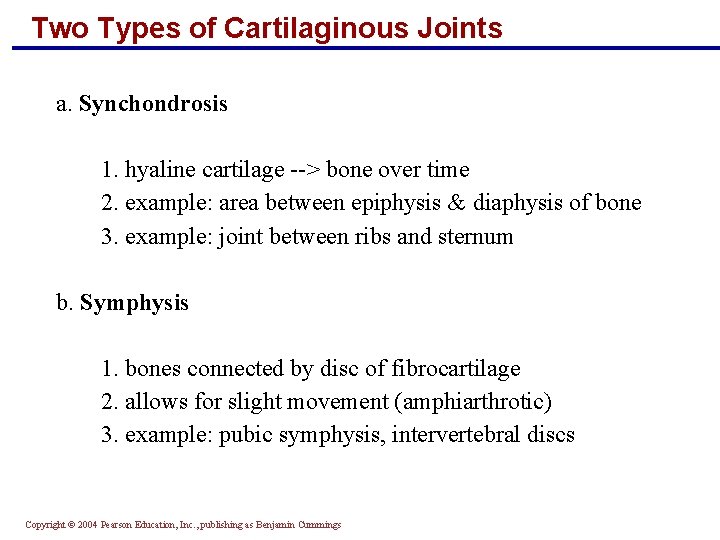
Two Types of Cartilaginous Joints a. Synchondrosis 1. hyaline cartilage --> bone over time 2. example: area between epiphysis & diaphysis of bone 3. example: joint between ribs and sternum b. Symphysis 1. bones connected by disc of fibrocartilage 2. allows for slight movement (amphiarthrotic) 3. example: pubic symphysis, intervertebral discs Copyright © 2004 Pearson Education, Inc. , publishing as Benjamin Cummings
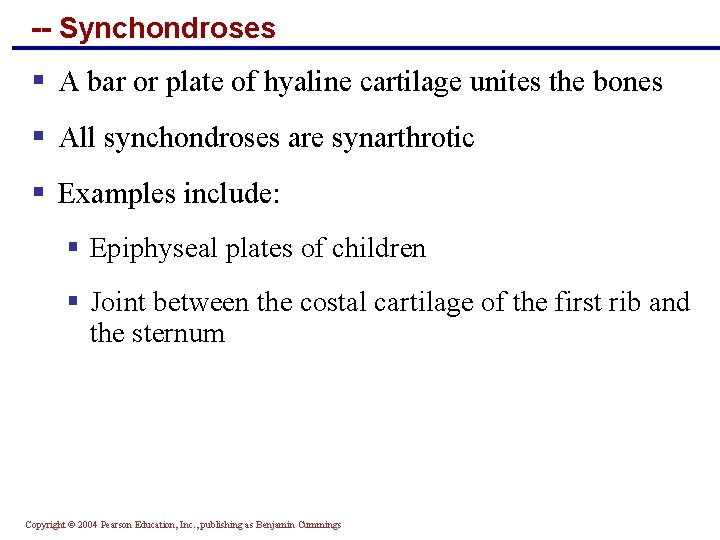
-- Synchondroses § A bar or plate of hyaline cartilage unites the bones § All synchondroses are synarthrotic § Examples include: § Epiphyseal plates of children § Joint between the costal cartilage of the first rib and the sternum Copyright © 2004 Pearson Education, Inc. , publishing as Benjamin Cummings
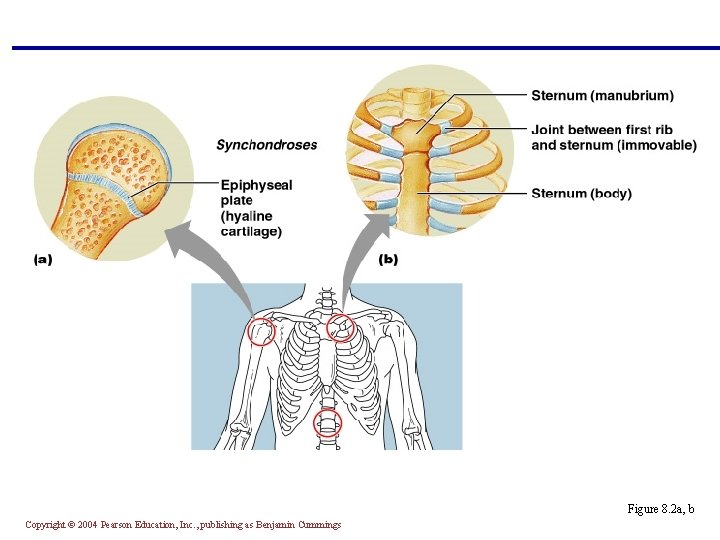
Figure 8. 2 a, b Copyright © 2004 Pearson Education, Inc. , publishing as Benjamin Cummings
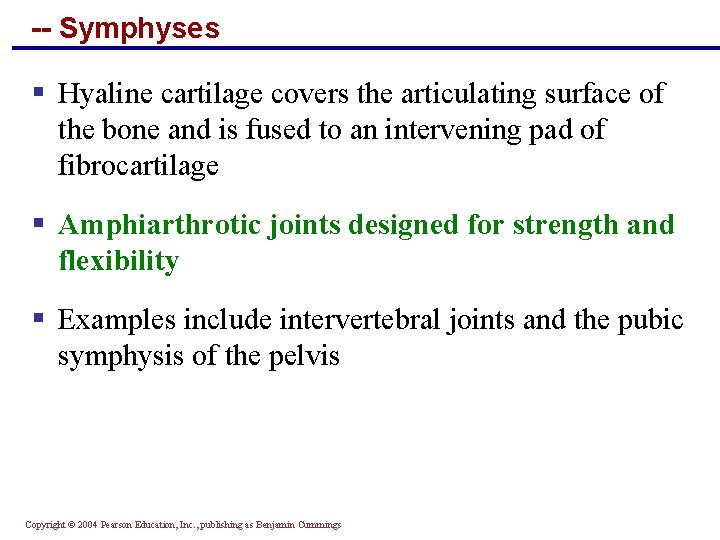
-- Symphyses § Hyaline cartilage covers the articulating surface of the bone and is fused to an intervening pad of fibrocartilage § Amphiarthrotic joints designed for strength and flexibility § Examples include intervertebral joints and the pubic symphysis of the pelvis Copyright © 2004 Pearson Education, Inc. , publishing as Benjamin Cummings
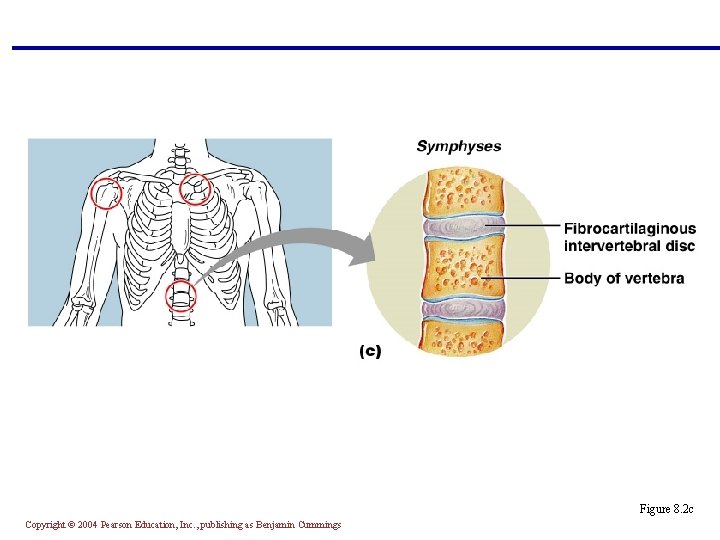
Figure 8. 2 c Copyright © 2004 Pearson Education, Inc. , publishing as Benjamin Cummings
C. Synovial Joints § Those joints in which the articulating bones are separated by a fluid-containing joint cavity § All are freely movable diarthroses § Examples – all limb joints, and most joints of the body Copyright © 2004 Pearson Education, Inc. , publishing as Benjamin Cummings
Synovial Joints: General Structure Synovial joints all have the following § Articular cartilage § Joint (synovial) cavity § Articular capsule § Synovial fluid § Reinforcing ligaments Copyright © 2004 Pearson Education, Inc. , publishing as Benjamin Cummings
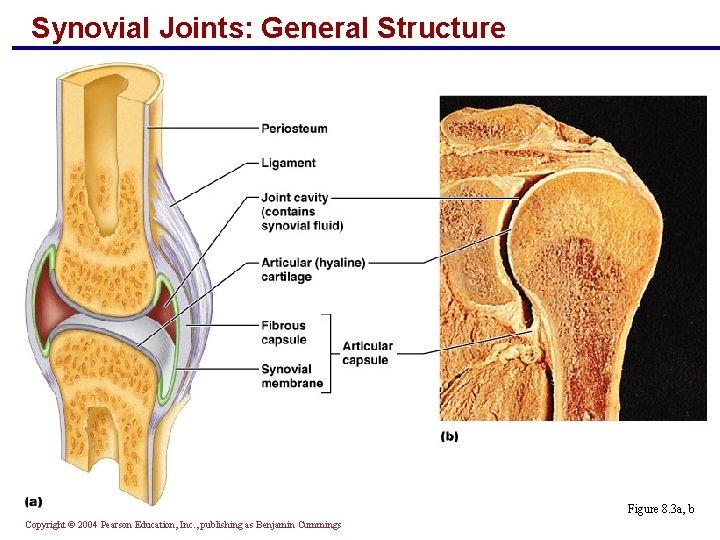
Synovial Joints: General Structure Figure 8. 3 a, b Copyright © 2004 Pearson Education, Inc. , publishing as Benjamin Cummings
Synovial Joints: Friction-Reducing Structures § Bursae – flattened, fibrous sacs lined with synovial membranes and containing synovial fluid § Common where ligaments, muscles, skin, tendons, or bones rub together § Tendon sheath – elongated bursa that wraps completely around a tendon Copyright © 2004 Pearson Education, Inc. , publishing as Benjamin Cummings
Synovial Joints: Movement § The two muscle attachments across a joint are: § Origin – attachment to the immovable bone § Insertion – attachment to the movable bone § Described as movement along transverse, frontal, or sagittal planes Copyright © 2004 Pearson Education, Inc. , publishing as Benjamin Cummings
Synovial Joints: Range of Motion § Nonaxial – slipping movements only § Uniaxial – movement in one plane § Biaxial – movement in two planes § Multiaxial – movement in or around all three planes Copyright © 2004 Pearson Education, Inc. , publishing as Benjamin Cummings
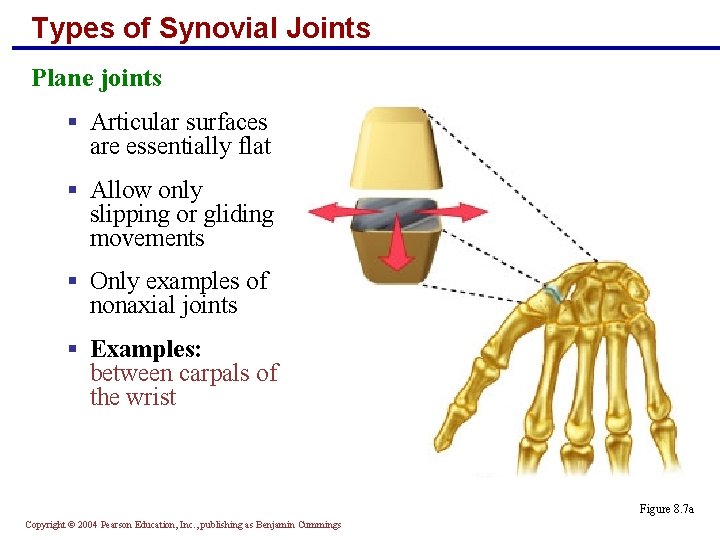
Types of Synovial Joints Plane joints § Articular surfaces are essentially flat § Allow only slipping or gliding movements § Only examples of nonaxial joints § Examples: between carpals of the wrist Figure 8. 7 a Copyright © 2004 Pearson Education, Inc. , publishing as Benjamin Cummings
Hinge joints § Cylindrical projections of one bone fits into a trough-shaped surface on another § Motion is along a single plane § Uniaxial joints permit flexion and extension only § Examples: elbow and interphalangeal joints Copyright © 2004 Pearson Education, Inc. , publishing as Benjamin Cummings
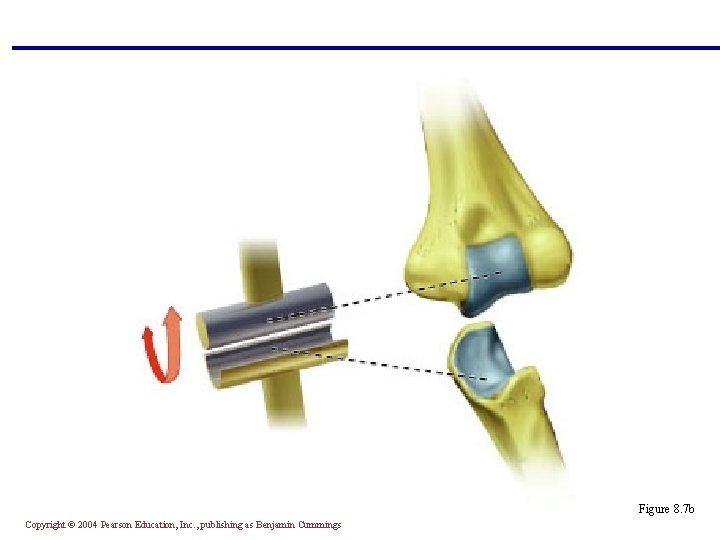
Figure 8. 7 b Copyright © 2004 Pearson Education, Inc. , publishing as Benjamin Cummings
Pivot Joints Pivot joints § Rounded end of one bone protrudes into a “sleeve, ” or ring, composed of bone (and possibly ligaments) of another § Only uniaxial movement allowed § Examples: joint between the axis and the dens, and the proximal radioulnar joint Copyright © 2004 Pearson Education, Inc. , publishing as Benjamin Cummings
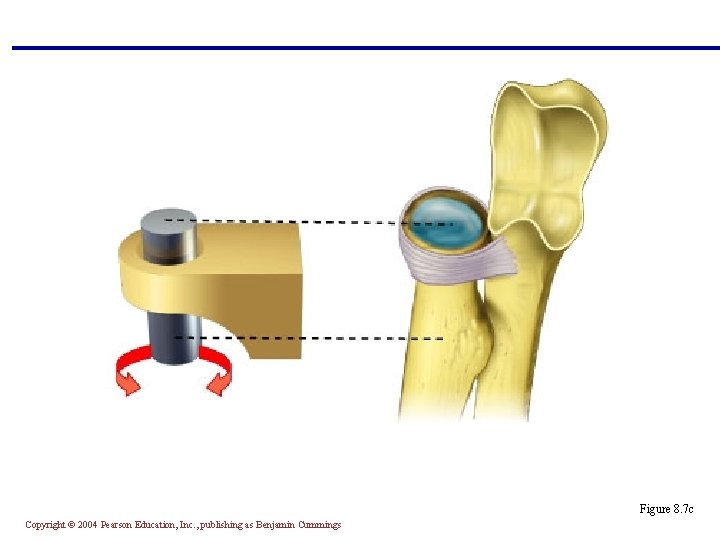
Figure 8. 7 c Copyright © 2004 Pearson Education, Inc. , publishing as Benjamin Cummings
Condyloid (Ellipsoidal) Joints Condyloid (Ellipsoidal) joints § Oval articular surface of one bone fits into a complementary depression in another § Both articular surfaces are oval § Biaxial joints permit all angular motions § Examples: radiocarpal (wrist) joints, and metacarpophalangeal (knuckle) joints Copyright © 2004 Pearson Education, Inc. , publishing as Benjamin Cummings
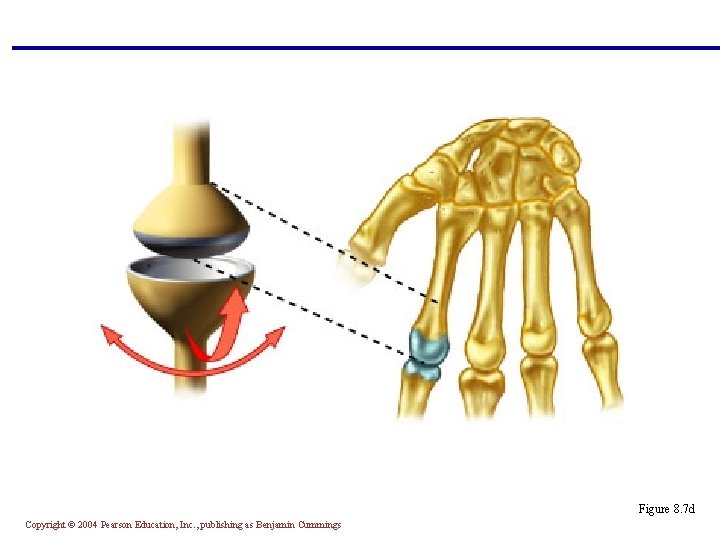
Figure 8. 7 d Copyright © 2004 Pearson Education, Inc. , publishing as Benjamin Cummings
Saddle Joints Saddle joints § Similar to condyloid joints but allow greater movement § Each articular surface has both a concave and a convex surface § Example: carpometacarpal joint of the thumb Copyright © 2004 Pearson Education, Inc. , publishing as Benjamin Cummings
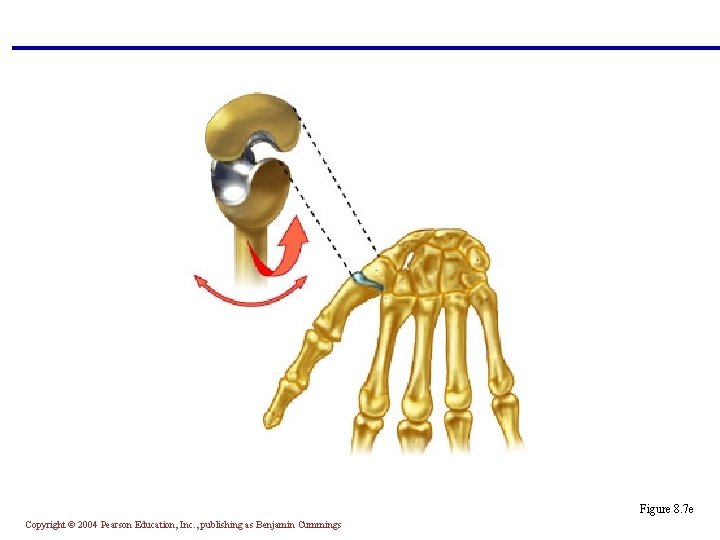
Figure 8. 7 e Copyright © 2004 Pearson Education, Inc. , publishing as Benjamin Cummings
Ball-and-Socket Joints Ball-and-socket joints § A spherical or hemispherical head of one bone articulates with a cuplike socket of another § Multiaxial joints permit the most freely moving synovial joints § Examples: shoulder and hip joints Copyright © 2004 Pearson Education, Inc. , publishing as Benjamin Cummings
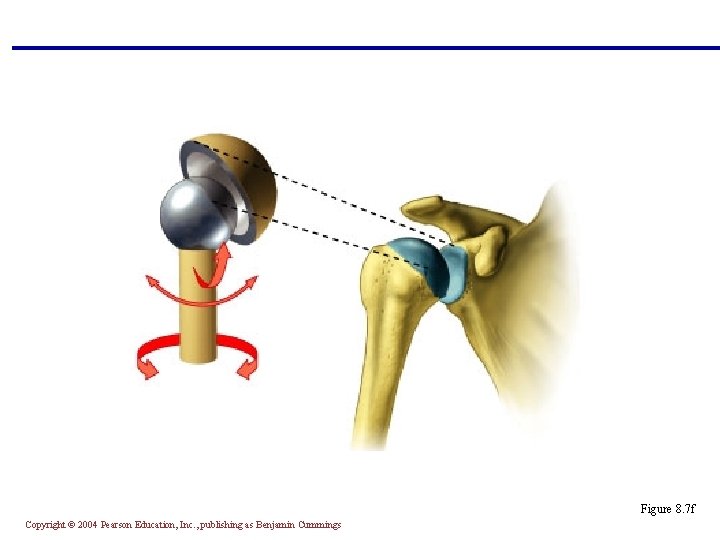
Figure 8. 7 f Copyright © 2004 Pearson Education, Inc. , publishing as Benjamin Cummings
Movements of Joints § It is VERY important that you learn the terminology for movements of joints. Muscles act mainly to cause movement or fixation of a joint!!!!!!! Copyright © 2004 Pearson Education, Inc. , publishing as Benjamin Cummings
Gliding Movements Gliding movements § One flat bone surface glides or slips over another similar surface § Examples – intercarpal and intertarsal joints, and between the flat articular processes of the vertebrae Copyright © 2004 Pearson Education, Inc. , publishing as Benjamin Cummings
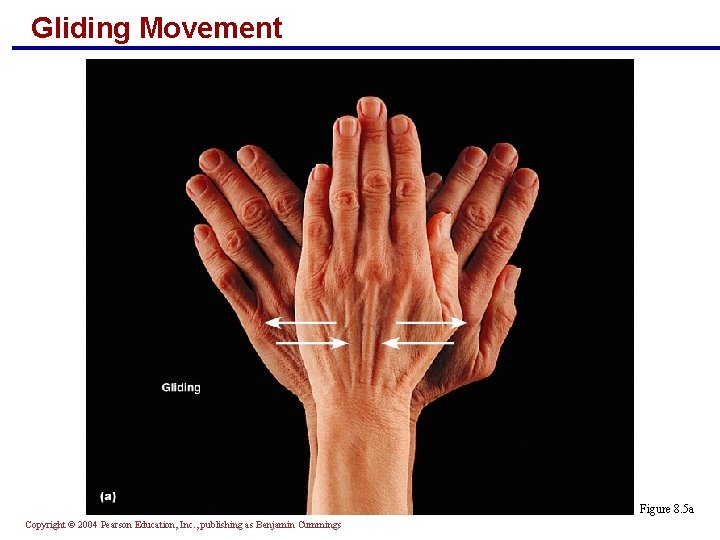
Gliding Movement Figure 8. 5 a Copyright © 2004 Pearson Education, Inc. , publishing as Benjamin Cummings
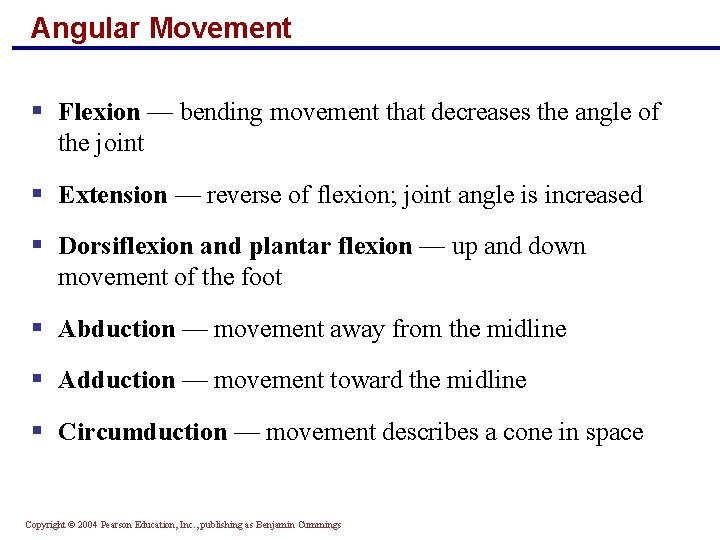
Angular Movement § Flexion — bending movement that decreases the angle of the joint § Extension — reverse of flexion; joint angle is increased § Dorsiflexion and plantar flexion — up and down movement of the foot § Abduction — movement away from the midline § Adduction — movement toward the midline § Circumduction — movement describes a cone in space Copyright © 2004 Pearson Education, Inc. , publishing as Benjamin Cummings
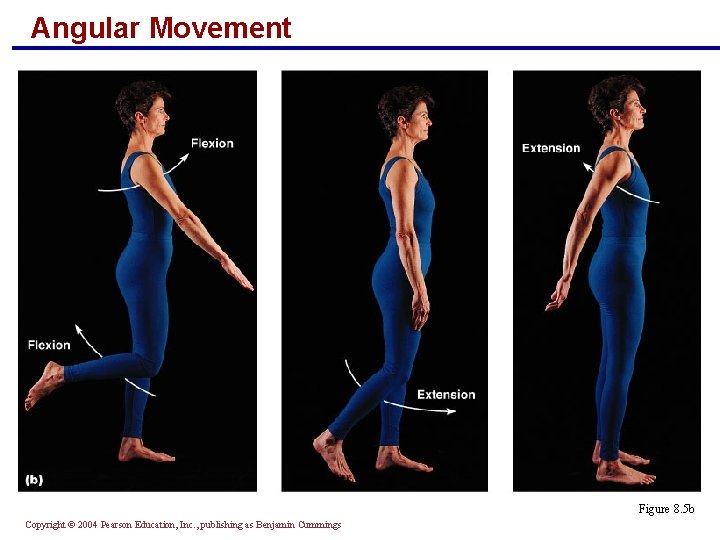
Angular Movement Figure 8. 5 b Copyright © 2004 Pearson Education, Inc. , publishing as Benjamin Cummings
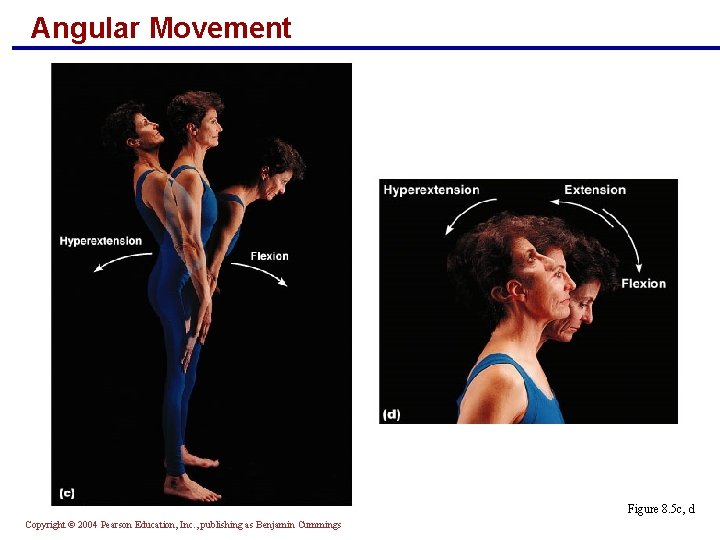
Angular Movement Figure 8. 5 c, d Copyright © 2004 Pearson Education, Inc. , publishing as Benjamin Cummings
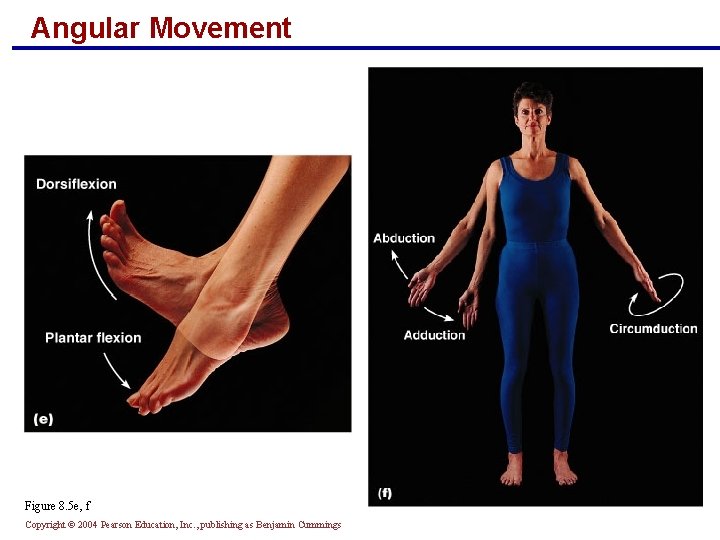
Angular Movement Figure 8. 5 e, f Copyright © 2004 Pearson Education, Inc. , publishing as Benjamin Cummings
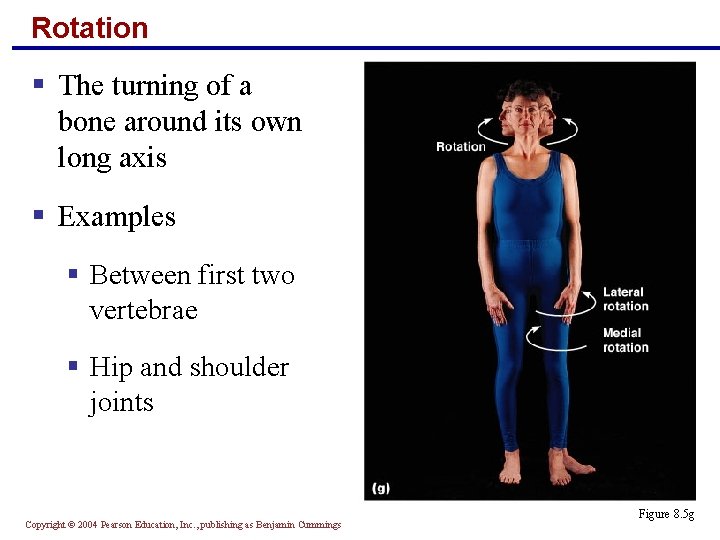
Rotation § The turning of a bone around its own long axis § Examples § Between first two vertebrae § Hip and shoulder joints Copyright © 2004 Pearson Education, Inc. , publishing as Benjamin Cummings Figure 8. 5 g
Special Movements § Supination and pronation § Inversion and eversion § Protraction and retraction § Elevation and depression Copyright © 2004 Pearson Education, Inc. , publishing as Benjamin Cummings
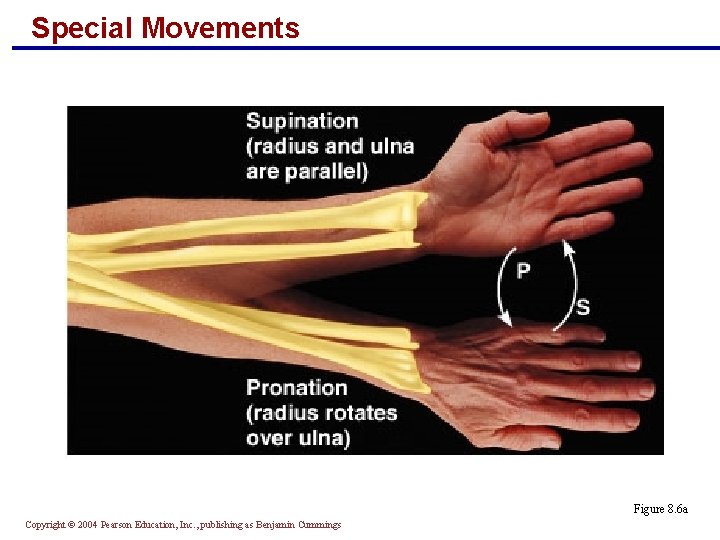
Special Movements Figure 8. 6 a Copyright © 2004 Pearson Education, Inc. , publishing as Benjamin Cummings
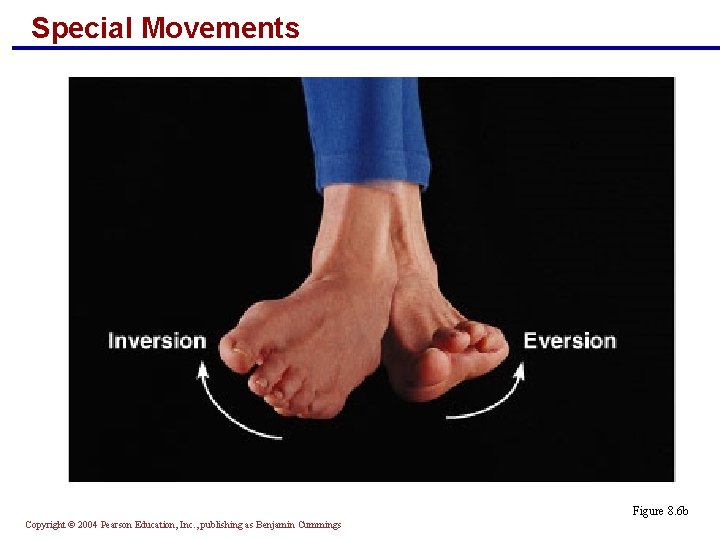
Special Movements Figure 8. 6 b Copyright © 2004 Pearson Education, Inc. , publishing as Benjamin Cummings
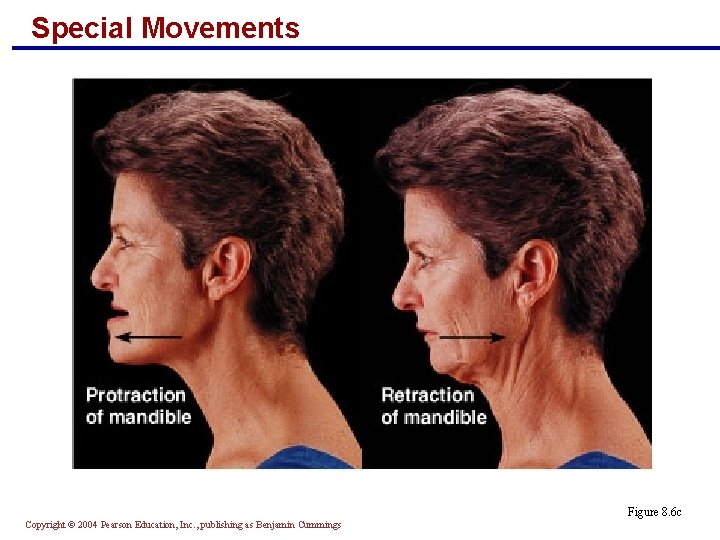
Special Movements Figure 8. 6 c Copyright © 2004 Pearson Education, Inc. , publishing as Benjamin Cummings
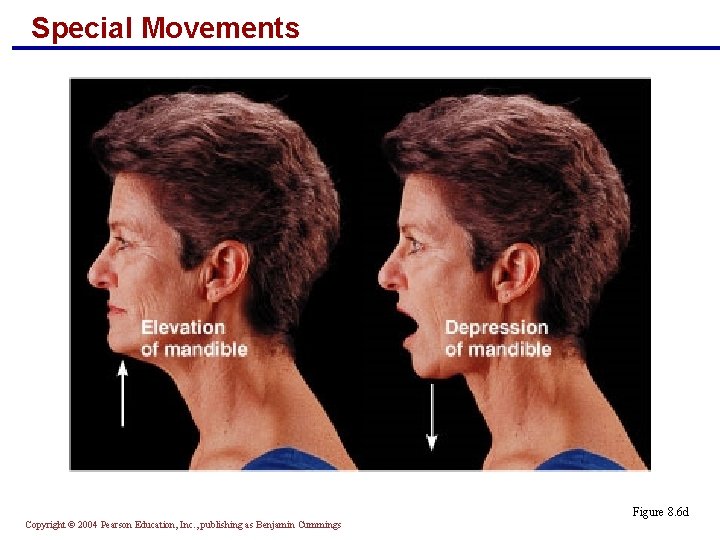
Special Movements Figure 8. 6 d Copyright © 2004 Pearson Education, Inc. , publishing as Benjamin Cummings
Knee Largest and most complex joint of the body Allows flexion, extension, and some rotation Three joints in one surrounded by a single joint cavity § Femoropatellar § Lateral and medial tibiofemoral joints Copyright © 2004 Pearson Education, Inc. , publishing as Benjamin Cummings
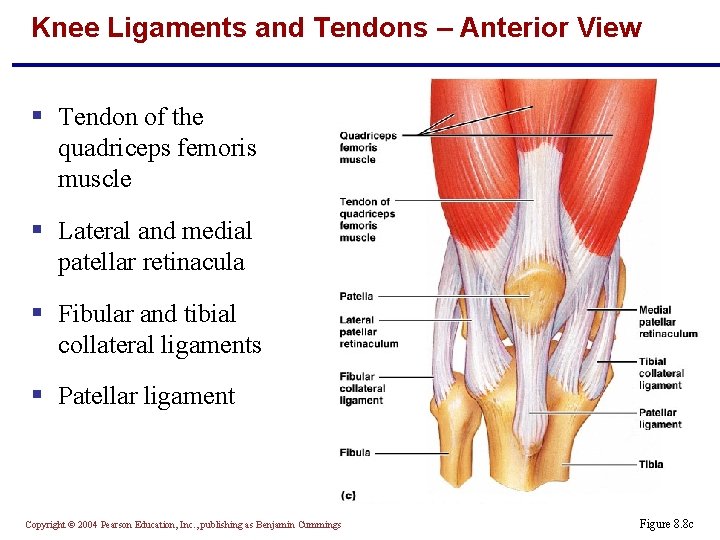
Knee Ligaments and Tendons – Anterior View § Tendon of the quadriceps femoris muscle § Lateral and medial patellar retinacula § Fibular and tibial collateral ligaments § Patellar ligament Copyright © 2004 Pearson Education, Inc. , publishing as Benjamin Cummings Figure 8. 8 c
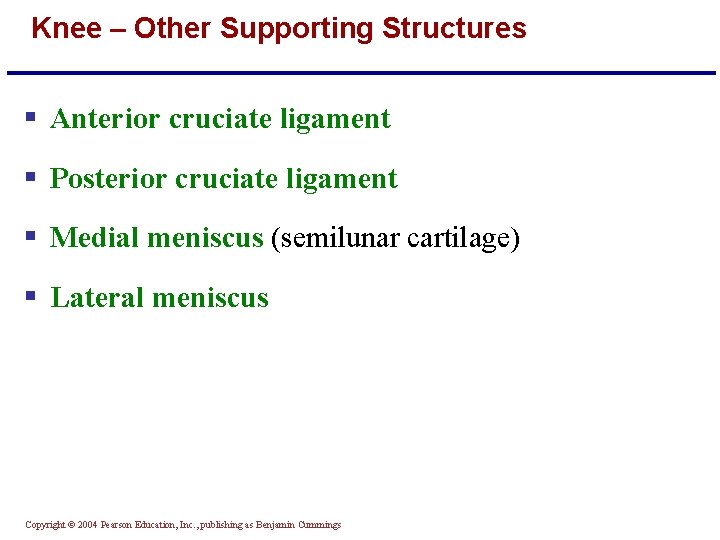
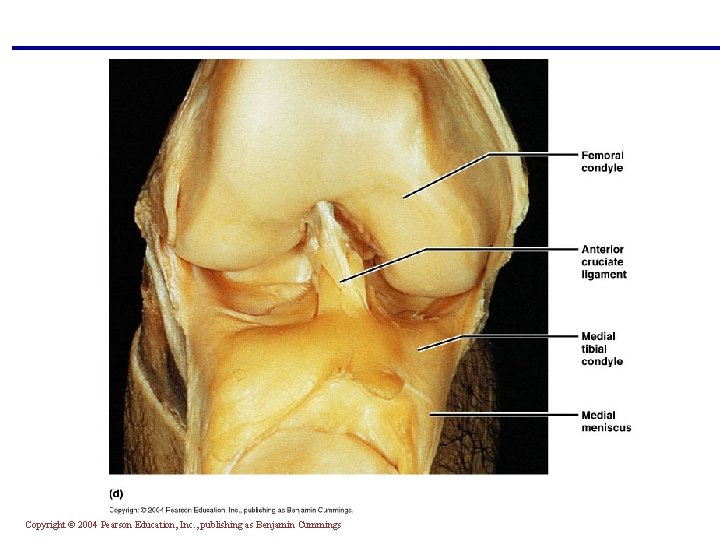
Knee – Other Supporting Structures § Anterior cruciate ligament § Posterior cruciate ligament § Medial meniscus (semilunar cartilage) § Lateral meniscus Copyright © 2004 Pearson Education, Inc. , publishing as Benjamin Cummings
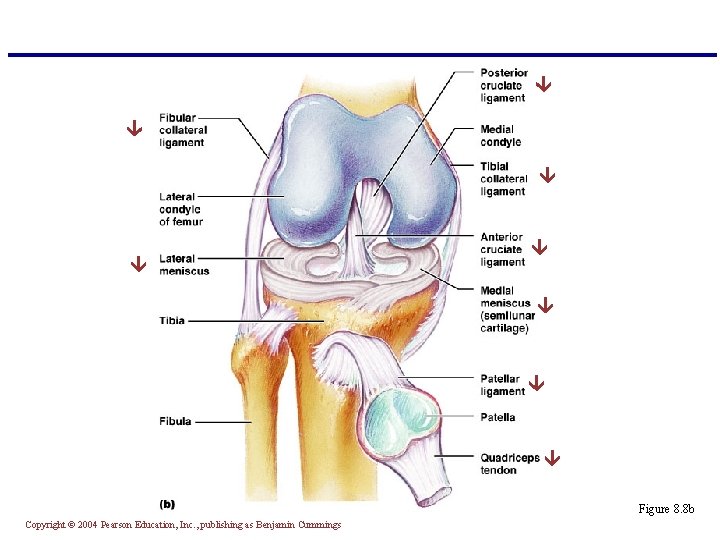
Figure 8. 8 b Copyright © 2004 Pearson Education, Inc. , publishing as Benjamin Cummings
Copyright © 2004 Pearson Education, Inc. , publishing as Benjamin Cummings
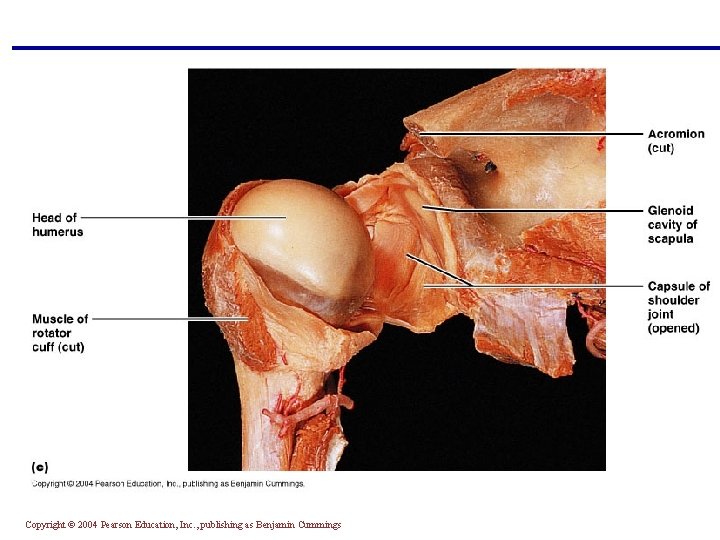
Shoulder (Glenohumeral) § Ball-and-socket joint in which stability is sacrificed to obtain greater freedom of movement § Head of humerus articulates with the glenoid fossa of the scapula Copyright © 2004 Pearson Education, Inc. , publishing as Benjamin Cummings
Synovial Joints: Shoulder Stability Weak stability is maintained by: § Thin, loose joint capsule § Four ligaments – coracohumeral, and three glenohumeral § Tendon of the long head of biceps, which travels through the intertubercular groove and secures the humerus to the glenoid cavity § Rotator cuff (four tendons) that encircles the shoulder joint and blends with the articular capsule Copyright © 2004 Pearson Education, Inc. , publishing as Benjamin Cummings
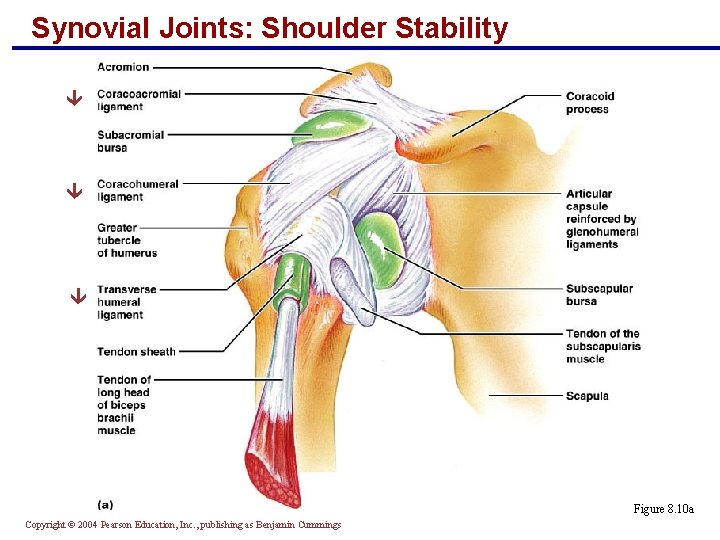
Synovial Joints: Shoulder Stability Figure 8. 10 a Copyright © 2004 Pearson Education, Inc. , publishing as Benjamin Cummings
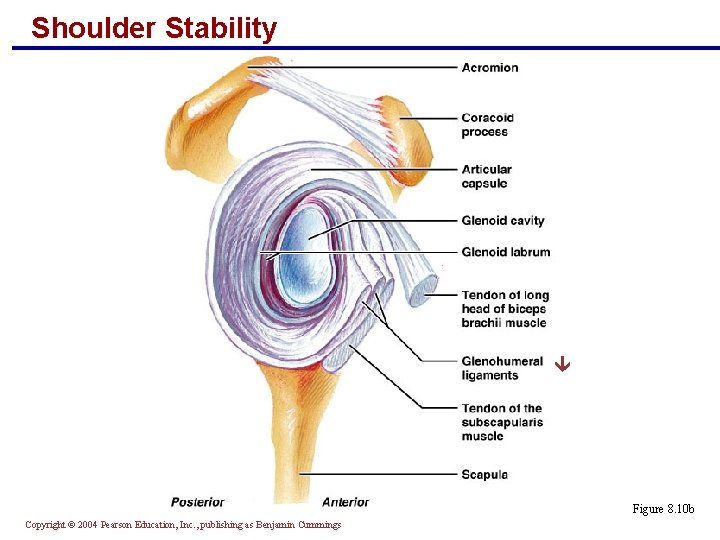
Shoulder Stability Figure 8. 10 b Copyright © 2004 Pearson Education, Inc. , publishing as Benjamin Cummings
Copyright © 2004 Pearson Education, Inc. , publishing as Benjamin Cummings
Hip (Coxal) Joint § Ball-and-socket joint § Head of the femur articulates with the acetabulum § Good range of motion, but limited by the deep socket and strong ligaments Copyright © 2004 Pearson Education, Inc. , publishing as Benjamin Cummings
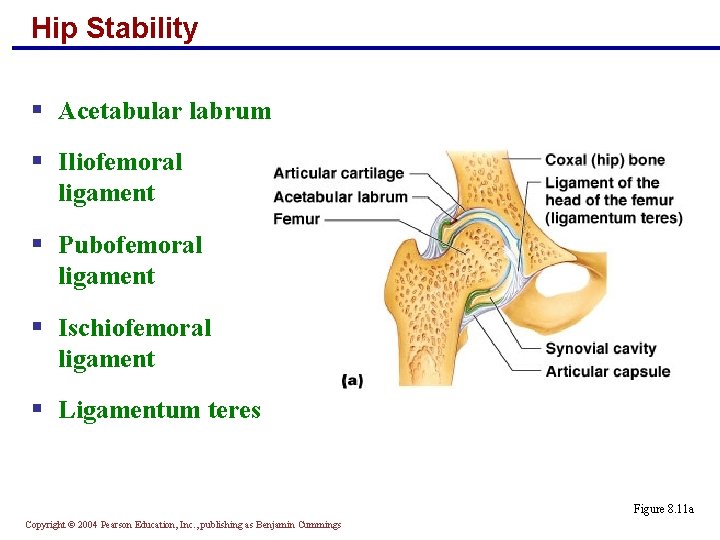
Hip Stability § Acetabular labrum § Iliofemoral ligament § Pubofemoral ligament § Ischiofemoral ligament § Ligamentum teres Figure 8. 11 a Copyright © 2004 Pearson Education, Inc. , publishing as Benjamin Cummings
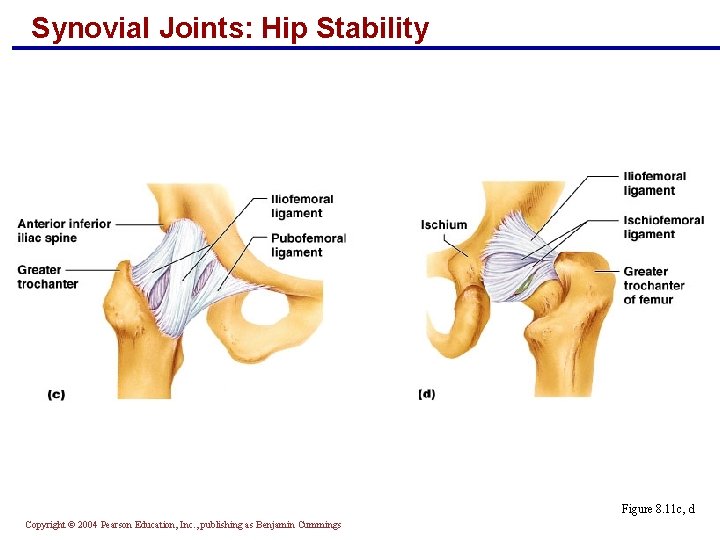
Synovial Joints: Hip Stability Figure 8. 11 c, d Copyright © 2004 Pearson Education, Inc. , publishing as Benjamin Cummings
Sprains The ligaments reinforcing a joint are stretched or torn § Partially torn ligaments slowly repair themselves § Completely torn ligaments require prompt surgical repair Copyright © 2004 Pearson Education, Inc. , publishing as Benjamin Cummings
Cartilage Injuries The snap and pop of overstressed cartilage § Common aerobics injury § Repaired with arthroscopic surgery Copyright © 2004 Pearson Education, Inc. , publishing as Benjamin Cummings
Dislocations § Occur when bones are forced out of alignment § Usually accompanied by sprains, inflammation, and joint immobilization § Caused by serious falls and are common sports injuries § Subluxation – partial dislocation of a joint Copyright © 2004 Pearson Education, Inc. , publishing as Benjamin Cummings
Inflammatory and Degenerative Conditions Bursitis § An inflammation of a bursa, usually caused by a blow or friction § Symptoms are pain and swelling § Treated with anti-inflammatory drugs; excessive fluid may be aspirated Tendonitis § Inflammation of tendon sheaths typically caused by overuse § Symptoms and treatment are similar to bursitis Copyright © 2004 Pearson Education, Inc. , publishing as Benjamin Cummings
Arthritis § More than 100 different types of inflammatory or degenerative diseases that damage the joints § Most widespread crippling disease in the U. S. § Symptoms – pain, stiffness, and swelling of a joint § Acute forms are caused by bacteria and are treated with antibiotics § Chronic forms include osteoarthritis, rheumatoid arthritis, and gouty arthritis Copyright © 2004 Pearson Education, Inc. , publishing as Benjamin Cummings
Osteoarthritis (OA) § Most common chronic arthritis; often called “wear-andtear” arthritis § Affects women more than men § 85% of all Americans develop OA § More prevalent in the aged, and is probably related to the normal aging process Copyright © 2004 Pearson Education, Inc. , publishing as Benjamin Cummings
Osteoarthritis: Course § OA reflects the years of abrasion and compression causing increased production of metalloproteinase enzymes that break down cartilage § As one ages, cartilage is destroyed more quickly than it is replaced § The exposed bone ends thicken, enlarge, form bone spurs, and restrict movement § Joints most affected are the cervical and lumbar spine, fingers, knuckles, knees, and hips Copyright © 2004 Pearson Education, Inc. , publishing as Benjamin Cummings
Osteoarthritis: Treatments § OA is slow and irreversible § Treatments include: § Mild pain relievers, along with moderate activity § Magnetic therapy § Glucosamine sulfate decreases pain and inflammation Copyright © 2004 Pearson Education, Inc. , publishing as Benjamin Cummings
Rheumatoid Arthritis (RA) § Chronic, inflammatory, autoimmune disease of unknown cause, with an insidious onset § Usually arises between the ages of 40 to 50, but may occur at any age § Signs and symptoms include joint tenderness, anemia, osteoporosis, muscle atrophy, and cardiovascular problems § The course of RA is marked with exacerbations and remissions Copyright © 2004 Pearson Education, Inc. , publishing as Benjamin Cummings
Rheumatoid Arthritis: Course § RA begins with synovitis of the affected joint § Inflammatory chemicals are inappropriately released § Inflammatory blood cells migrate to the joint, causing swelling § Inflamed synovial membrane thickens into a pannus § Pannus erodes cartilage, scar tissue forms, articulating bone ends connect § The end result, ankylosis, produces bent, deformed fingers Copyright © 2004 Pearson Education, Inc. , publishing as Benjamin Cummings
Rheumatoid Arthritis: Treatment § Conservative therapy – aspirin, long-term use of antibiotics, and physical therapy § Progressive treatment – anti-inflammatory drugs or immunosuppressants § The drug Enbrel (made by Amgen in Thousand Oaks) a biological response modifier, neutralizes the harmful properties of inflammatory chemicals Copyright © 2004 Pearson Education, Inc. , publishing as Benjamin Cummings
Gouty Arthritis § Deposition of uric acid crystals in joints and soft tissues, followed by an inflammation response § Typically, gouty arthritis affects the joint at the base of the great toe § In untreated gouty arthritis, the bone ends fuse and immobilize the joint § Treatment – colchicine, nonsteroidal anti-inflammatory (NSAID’s) drugs, and glucocorticoids Copyright © 2004 Pearson Education, Inc. , publishing as Benjamin Cummings
- Slides: 72