
Power Point Lecture Slides prepared by Janice Meeking
Power. Point® Lecture Slides prepared by Janice Meeking, Mount Royal College CHAPTER 26 Fluid, Electrolyte, and Acid. Base Balance Copyright © 2010 Pearson Education, Inc.
Body Water Content • Infants: 73% or more water (low body fat, low bone mass) • Adult males: ~60% water • Adult females: ~50% water (higher fat content, less skeletal muscle mass) • Water content declines to ~45% in old age Copyright © 2010 Pearson Education, Inc.
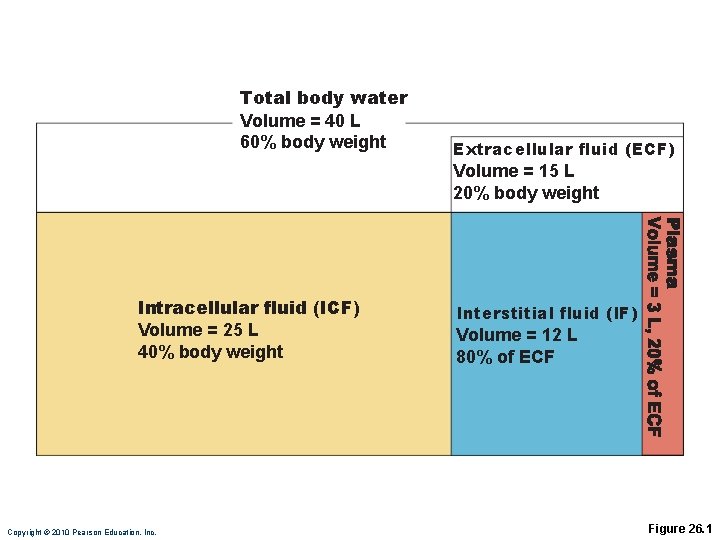
Total body water Volume = 40 L 60% body weight Extracellular fluid (ECF) Volume = 15 L 20% body weight Intracellular fluid (ICF) Volume = 25 L 40% body weight Copyright © 2010 Pearson Education, Inc. Interstitial fluid (IF) Volume = 12 L 80% of ECF Figure 26. 1
Composition of Body Fluids • Water: the universal solvent • Solvent = substances in which solutes are dissolved • Solutes: • Nonelectrolytes • Electrolytes Copyright © 2010 Pearson Education, Inc.
Composition of Body Fluid • Nonelectrolytes: have bonds that do not dissociate in water (no electrical charge) • most are organic • e. g. , glucose, lipids, creatinine, and urea • Electrolytes: dissociate into ions in water (have an electrical charge) • E. g. , inorganic salts, inorganic and organic acids and bases, some proteins Copyright © 2010 Pearson Education, Inc.
Composition of Body Fluids • Electrolytes • The most abundant (most numerous) solutes • Have greater osmotic power than nonelectrolytes because they dissociate and form two molecules, so may contribute to fluid shifts • E. g. , Na. Cl Na+, Cl- vs. glucose • Determine the chemical and physical reactions of fluids Copyright © 2010 Pearson Education, Inc.
Extracellular and Intracellular Fluids • Each fluid compartment has a distinctive pattern of electrolytes • ECF (interstitial fluid and plasma) • Similar compostion except higher protein content of plasma • Major cation: Na+ • Major anion: Cl– Copyright © 2010 Pearson Education, Inc.
Extracellular and Intracellular Fluids • ICF: • Low Na+ and Cl– • Major cation: K+ • Major anion HPO 42– (hydrogen phosphate) • K, Mg, phosphate ions are the predominant electrolytes ICF Copyright © 2010 Pearson Education, Inc.
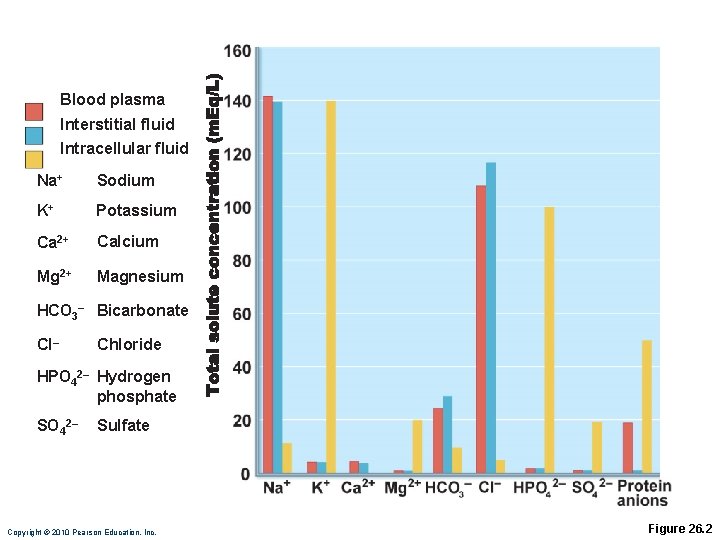
Blood plasma Interstitial fluid Intracellular fluid Na+ Sodium K+ Potassium Ca 2+ Calcium Mg 2+ Magnesium HCO 3– Bicarbonate Cl– Chloride HPO 42– Hydrogen phosphate SO 42– Sulfate Copyright © 2010 Pearson Education, Inc. Figure 26. 2
Fluid Movement Among Compartments • Osmotic and hydrostatic pressures regulate the continuous exchange and mixing of body fluids • Exchange between plasma and IF occur across capillary walls • Exchanges between the IF and ICF occur across plasma membranes Copyright © 2010 Pearson Education, Inc.
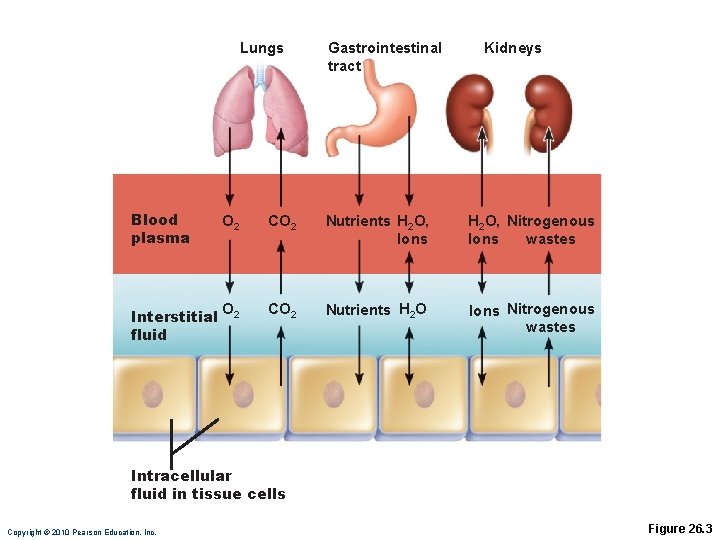
Lungs Gastrointestinal tract Kidneys Blood plasma O 2 CO 2 Nutrients H 2 O, Ions H 2 O, Nitrogenous Ions wastes Interstitial fluid O 2 CO 2 Nutrients H 2 O Ions Nitrogenous wastes Intracellular fluid in tissue cells Copyright © 2010 Pearson Education, Inc. Figure 26. 3
Water Balance and ECF Osmolality • Water intake = water output = 2500 ml/day • Water intake: beverages, food, and metabolic water • Water output: urine, insensible water loss (skin and lungs), perspiration, and feces Copyright © 2010 Pearson Education, Inc.
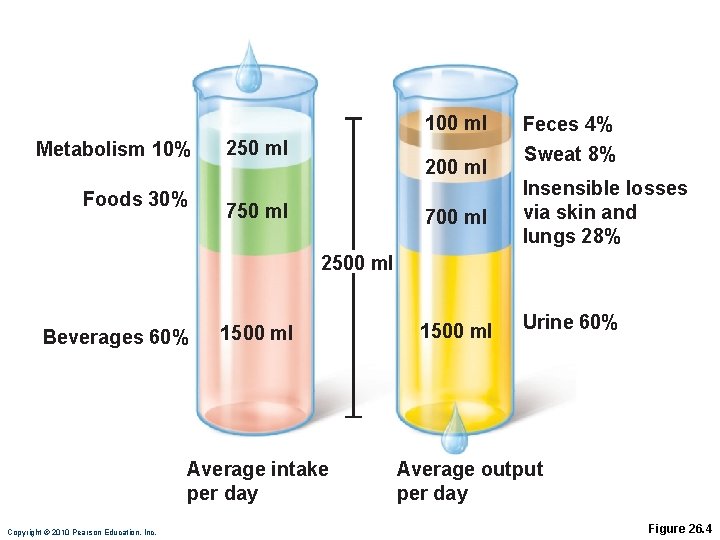
100 ml Metabolism 10% Foods 30% 250 ml 200 ml 750 ml Feces 4% Sweat 8% 700 ml Insensible losses via skin and lungs 28% 1500 ml Urine 60% 2500 ml Beverages 60% 1500 ml Average intake per day Copyright © 2010 Pearson Education, Inc. Average output per day Figure 26. 4
Regulation of Water Intake • Thirst mechanism is the driving force for water intake • The hypothalamic thirst center osmoreceptors are stimulated by • Increase in plasma osmolality of 2– 3% • Dry mouth • Substantial decrease in blood volume or pressure Copyright © 2010 Pearson Education, Inc.
Regulation of Water Intake • Drinking water creates inhibition of the thirst center • Inhibitory feedback signals include • Relief of dry mouth • Activation of stomach and intestinal stretch receptors • These signals inhibit the thirst center before water is absorbed to prevent overhydration Copyright © 2010 Pearson Education, Inc.
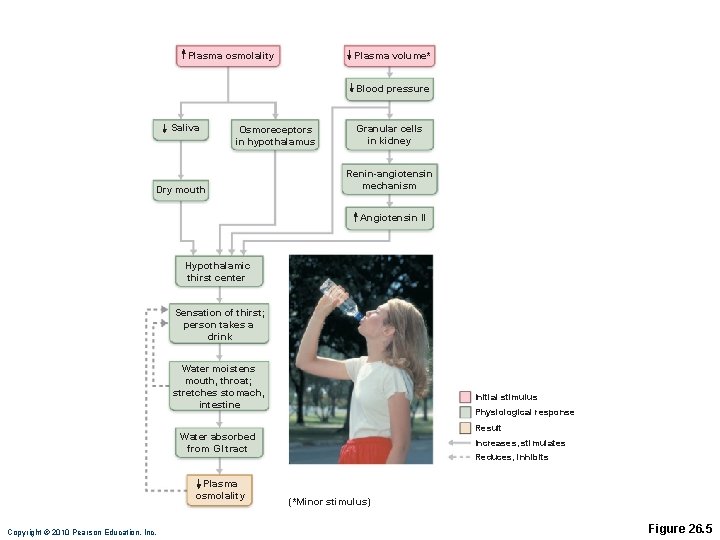
Plasma osmolality Plasma volume* Blood pressure Saliva Osmoreceptors in hypothalamus Dry mouth Granular cells in kidney Renin-angiotensin mechanism Angiotensin II Hypothalamic thirst center Sensation of thirst; person takes a drink Water moistens mouth, throat; stretches stomach, intestine Initial stimulus Physiological response Result Water absorbed from GI tract Plasma osmolality Copyright © 2010 Pearson Education, Increases, stimulates Reduces, inhibits (*Minor stimulus) Figure 26. 5
Regulation of Water Output: Influence of ADH • Water reabsorption in collecting ducts is proportional to ADH release • ADH dilute urine and volume of body fluids • ADH concentrated urine and volume of body fluids Copyright © 2010 Pearson Education, Inc.
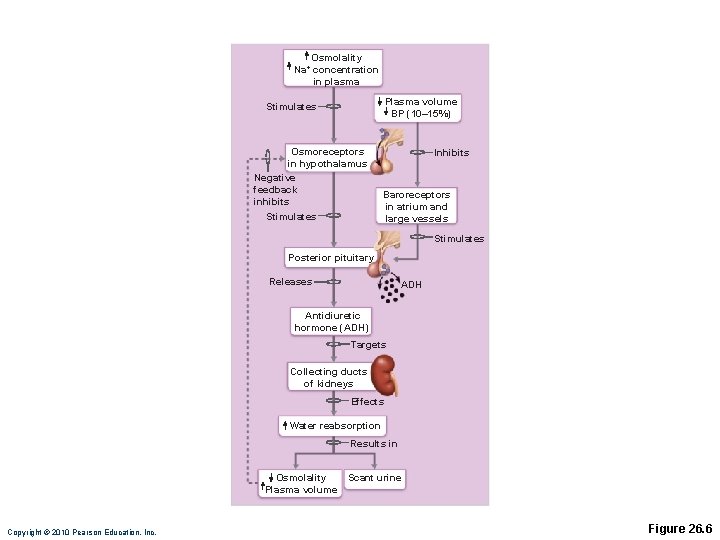
Osmolality Na+ concentration in plasma Plasma volume BP (10– 15%) Stimulates Osmoreceptors in hypothalamus Negative feedback inhibits Stimulates Inhibits Baroreceptors in atrium and large vessels Stimulates Posterior pituitary Releases ADH Antidiuretic hormone (ADH) Targets Collecting ducts of kidneys Effects Water reabsorption Results in Osmolality Plasma volume Copyright © 2010 Pearson Education, Inc. Scant urine Figure 26. 6
Disorders of Water Balance: Dehydration • Negative fluid balance • ECF water loss due to: hemorrhage, severe burns, prolonged vomiting or diarrhea, profuse sweating, water deprivation, diuretic abuse • Signs and symptoms: thirst, dry flushed skin, oliguria (less than 400 ml output of urine) • May lead to weight loss, fever, mental confusion, hypovolemic shock, and loss of electrolytes Copyright © 2010 Pearson Education, Inc.
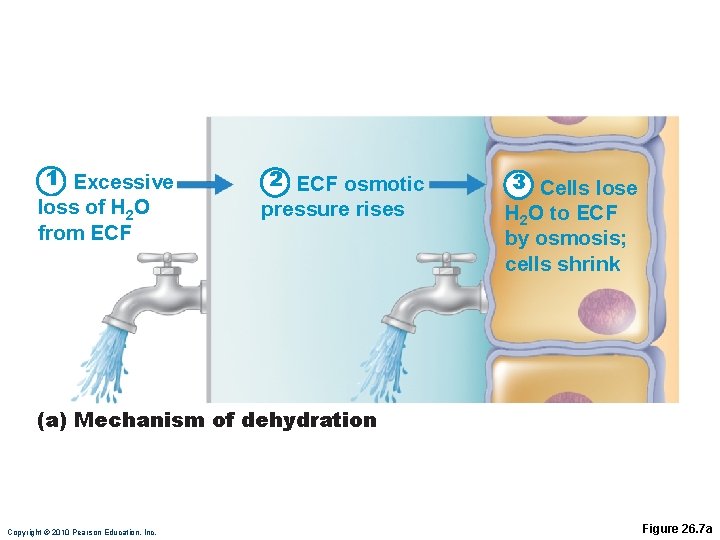
1 Excessive loss of H 2 O from ECF 2 ECF osmotic pressure rises 3 Cells lose H 2 O to ECF by osmosis; cells shrink (a) Mechanism of dehydration Copyright © 2010 Pearson Education, Inc. Figure 26. 7 a
Disorders of Water Balance: Hypotonic Hydration • Cellular overhydration, or water intoxication • Occurs with renal insufficiency or rapid excess water ingestion • ECF is diluted hyponatremia net osmosis into tissue cells swelling of cells severe metabolic disturbances (nausea, vomiting, muscular cramping, cerebral edema) possible death Copyright © 2010 Pearson Education, Inc.
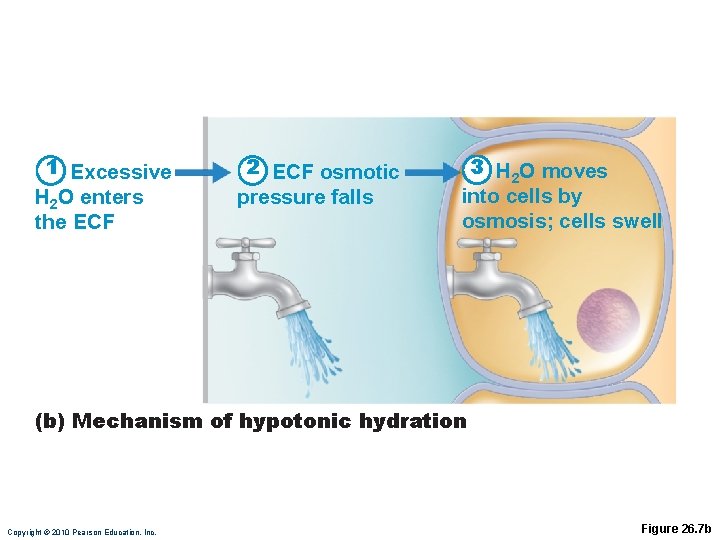
1 Excessive H 2 O enters the ECF 2 ECF osmotic pressure falls 3 H 2 O moves into cells by osmosis; cells swell (b) Mechanism of hypotonic hydration Copyright © 2010 Pearson Education, Inc. Figure 26. 7 b
Disorders of Water Balance: Edema • Atypical accumulation of IF fluid tissue swelling • Due to anything that increases flow of fluid out of the blood or hinders its return • Blood pressure • Capillary permeability (usually due to inflammatory chemicals) • Incompetent venous valves, localized blood vessel blockage • Congestive heart failure, hypertension, blood volume Copyright © 2010 Pearson Education, Inc.
Edema • Hindered fluid return occurs with an imbalance in colloid osmotic (oncotic) pressures, e. g. , hypoproteinemia ( plasma proteins) • Fluids fail to return at the venous ends of capillary beds • Results from protein malnutrition, liver disease, or glomerulonephritis, PPIs/acid blockers Copyright © 2010 Pearson Education, Inc.
Edema • Blocked (or surgically removed) lymph vessels • Cause leaked proteins to accumulate in IF • Colloid osmotic (oncotic) pressure of IF draws fluid from the blood • Results in low blood pressure and severely impaired circulation Copyright © 2010 Pearson Education, Inc.
Electrolyte Balance Copyright © 2010 Pearson Education, Inc.
Electrolyte Balance • Generally refers to salt balance • Important in controlling fluid movement and provide minerals essential for excitability, secretory activity, and membrane permeability • Most important: Na • In ECF, main cation that contributes to osmotic pressure • REMEMBER: WATER FOLLOWS SALT • Kidneys regulate balance of Na, K Copyright © 2010 Pearson Education, Inc.
Regulation of Sodium Balance: Aldosterone • Na balance is key in blood pressure/volume • Na+ reabsorption • 65% is reabsorbed in the proximal tubules • 25% is reclaimed in the loops of Henle • Aldosterone active reabsorption of remaining Na+ in DCT and collecting duct • Water follows Na+ • Through aquaporins if ADH is present • Or from ICF Copyright © 2010 Pearson Education, Inc.
Regulation of Sodium Balance: Aldosterone • Renin-angiotensin mechanism is the main trigger for aldosterone release • Granular cells of JGA secrete renin in response to • Sympathetic nervous system stimulation • Filtrate osmolality • Stretch (due to blood pressure) Copyright © 2010 Pearson Education, Inc.
Regulation of Sodium Balance: Aldosterone • Renin catalyzes the production of angiotensin II, which prompts aldosterone release from the adrenal cortex • Aldosterone release is also triggered by elevated K+ levels in the ECF • Aldosterone brings about its effects slowly (hours to days) Copyright © 2010 Pearson Education, Inc.
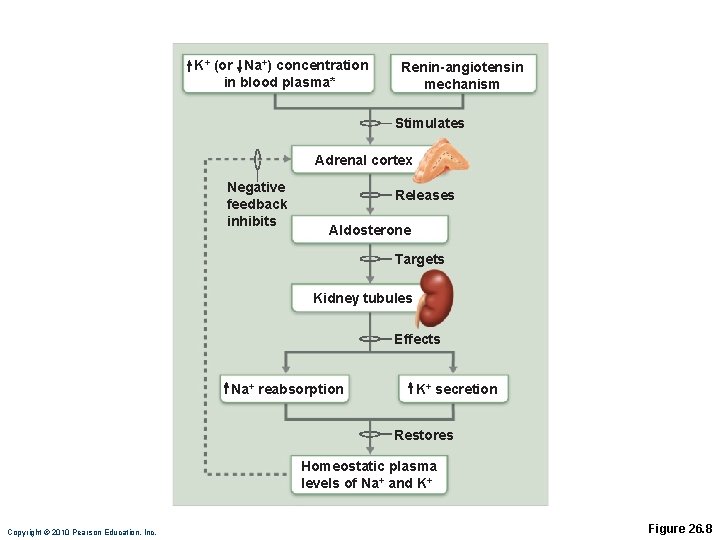
K+ (or Na+) concentration in blood plasma* Renin-angiotensin mechanism Stimulates Adrenal cortex Negative feedback inhibits Releases Aldosterone Targets Kidney tubules Effects Na+ reabsorption K+ secretion Restores Homeostatic plasma levels of Na+ and K+ Copyright © 2010 Pearson Education, Inc. Figure 26. 8
Regulation of Sodium Balance: ANP • Released by atrial cells in response to stretch ( blood pressure) • Effects • Decreases blood pressure and blood volume: • ADH, renin and aldosterone production • Excretion of Na+ and water • Promotes vasodilation directly and also by decreasing production of angiotensin II Copyright © 2010 Pearson Education, Inc.
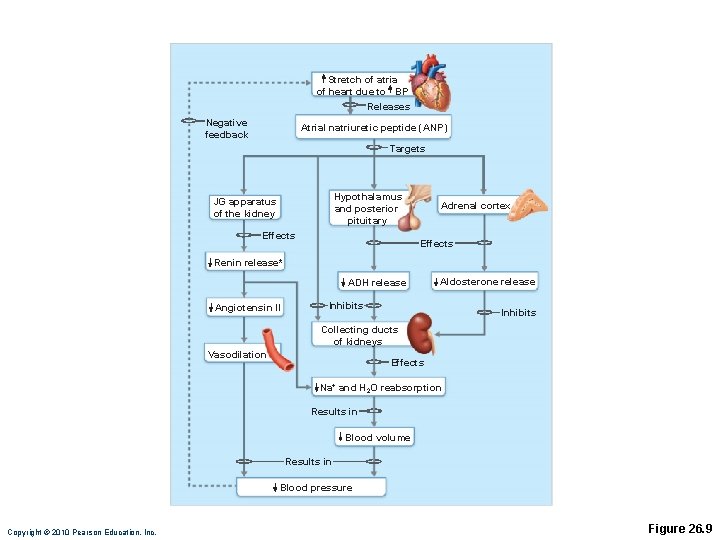
Stretch of atria of heart due to BP Releases Negative feedback Atrial natriuretic peptide (ANP) Targets Hypothalamus and posterior pituitary JG apparatus of the kidney Effects Adrenal cortex Effects Renin release* ADH release Angiotensin II Aldosterone release Inhibits Collecting ducts of kidneys Vasodilation Effects Na+ and H 2 O reabsorption Results in Blood volume Results in Blood pressure Copyright © 2010 Pearson Education, Inc. Figure 26. 9
Influence of Other Hormones • Estrogens: Na. Cl reabsorption (like aldosterone) • H 2 O retention during menstrual cycles and pregnancy • Progesterone: Na+ reabsorption (blocks aldosterone) • Promotes Na+ and H 2 O loss • Glucocorticoids: Na+ reabsorption and promote edema Copyright © 2010 Pearson Education, Inc.
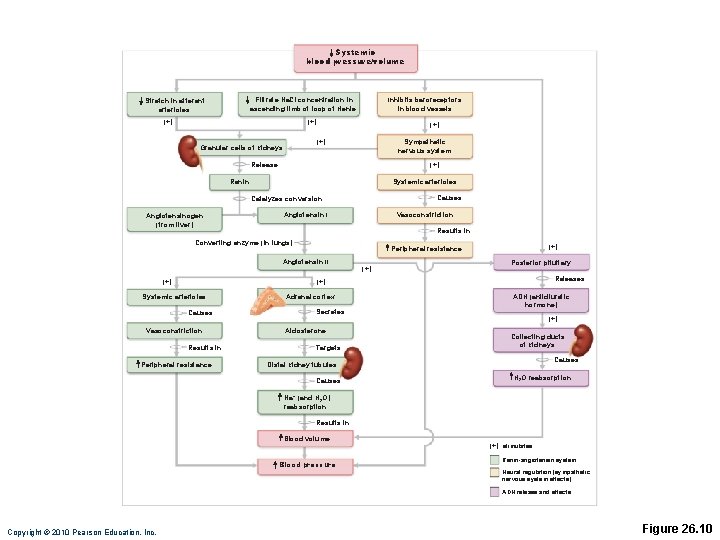
Systemic blood pressure/volume Filtrate Na. Cl concentration in ascending limb of loop of Henle Stretch in afferent arterioles (+) Inhibits baroreceptors in blood vessels (+) (+) Granular cells of kidneys Sympathetic nervous system Release (+) Renin Systemic arterioles Causes Catalyzes conversion Angiotensinogen (from liver) Angiotensin I Vasoconstriction Results in Converting enzyme (in lungs) (+) Peripheral resistance Angiotensin II (+) Posterior pituitary Releases (+) Systemic arterioles Causes Vasoconstriction Results in Peripheral resistance Adrenal cortex Secretes Aldosterone Targets ADH (antidiuretic hormone) (+) Collecting ducts of kidneys Causes Distal kidney tubules Causes H 2 O reabsorption Na+ (and H 2 O) reabsorption Results in Blood volume Blood pressure (+) stimulates Renin-angiotensin system Neural regulation (sympathetic nervous system effects) ADH release and effects Copyright © 2010 Pearson Education, Inc. Figure 26. 10
Potassium Balance • Chief intracellular cation • Required for normal neuromuscular functioning and metabolic activities • The heart is very sensitive to K balance Copyright © 2010 Pearson Education, Inc.
Regulation of Potassium Balance • Importance of potassium: • Affects RMP in neurons and muscle cells (especially cardiac muscle) • ECF [K+] RMP depolarization reduced excitability • ECF [K+] hyperpolarization and nonresponsiveness Copyright © 2010 Pearson Education, Inc.
Regulation of Potassium Balance • H+ shift in and out of cells • Leads to corresponding shifts in K+ in the opposite direction to maintain cation balance • Interferes with activity of excitable cells • ECF K levels rise with acidosis as K leaves and H+ enters the cell • ECF K levels fall with alkalosis as K enters the cell and H+ leaves the cell Copyright © 2010 Pearson Education, Inc.
Regulation of Potassium Balance • Influence of aldosterone • Stimulates K+ secretion (and Na+ reabsorption) by principal cells • Increased K+ in the adrenal cortex causes • Release of aldosterone • Potassium secretion Copyright © 2010 Pearson Education, Inc.
Regulation of Calcium • Ca 2+ in ECF is important for • Neuromuscular excitability • Blood clotting • Cell membrane permeability • Secretory activities Copyright © 2010 Pearson Education, Inc.
Regulation of Calcium • Hypocalcemia excitability and muscle tetany • Hypercalcemia Inhibits neurons and muscle cells, may cause heart arrhythmias • Calcium balance is controlled by parathyroid hormone (PTH) and calcitonin Copyright © 2010 Pearson Education, Inc.
Influence of PTH • Bones are the largest reservoir for Ca 2+ and phosphates • PTH promotes increase in calcium levels by targeting bones, kidneys, and small intestine (indirectly through vitamin D) • Calcium reabsorption and phosphate excretion go hand in hand Copyright © 2010 Pearson Education, Inc.
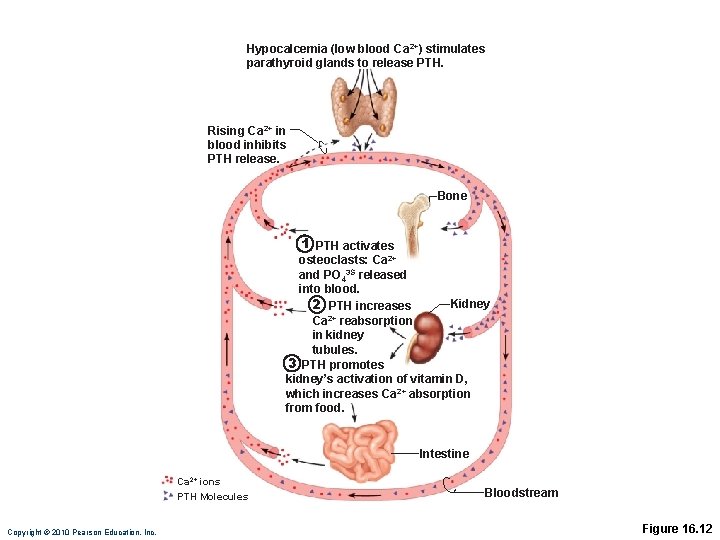
Hypocalcemia (low blood Ca 2+) stimulates parathyroid glands to release PTH. Rising Ca 2+ in blood inhibits PTH release. Bone 1 PTH activates osteoclasts: Ca 2+ and PO 43 S released into blood. Kidney 2 PTH increases 2+ Ca reabsorption in kidney tubules. 3 PTH promotes kidney’s activation of vitamin D, which increases Ca 2+ absorption from food. Intestine Ca 2+ ions PTH Molecules Copyright © 2010 Pearson Education, Inc. Bloodstream Figure 16. 12
Influence of PTH • Normally 75% of filtered phosphates are actively reabsorbed in the PCT (follows Na) • PTH inhibits this by decreasing the Tm Copyright © 2010 Pearson Education, Inc.
Regulation of Anions • Cl– is the major anion in the ECF • Helps maintain the osmotic pressure of the blood • 99% of Cl– is reabsorbed under normal p. H conditions • When acidosis occurs, fewer chloride ions are reabsorbed (more HCO 3 - reabsorbed to restore blood p. H) • Other anions have transport maximums and excesses are excreted in urine Copyright © 2010 Pearson Education, Inc.
Acid-Base Balance • p. H affects all functional proteins and biochemical reactions • Normal p. H of body fluids • Arterial blood: p. H 7. 4 • Venous blood and IF fluid: p. H 7. 35 • ICF: p. H 7. 0 • Alkalosis or alkalemia: arterial blood p. H >7. 45 • Acidosis or acidemia: arterial p. H < 7. 35 Copyright © 2010 Pearson Education, Inc.
Acid-Base Balance • Most H+ is produced by metabolism • Phosphoric acid from breakdown of phosphorus-containing proteins in ECF • Lactic acid from anaerobic respiration of glucose • Fatty acids and ketone bodies from fat metabolism • H+ liberated when CO 2 is converted to HCO 3– in blood Copyright © 2010 Pearson Education, Inc.
Chemical Buffer Systems • Chemical buffer: system of one or more compounds that act to resist p. H changes when strong acid or base is added 1. Bicarbonate buffer system 2. Phosphate buffer system 3. Protein buffer system Copyright © 2010 Pearson Education, Inc.
Bicarbonate Buffer System • Mixture of H 2 CO 3 (weak acid) and salts of HCO 3– (e. g. , Na. HCO 3, a weak base) • Buffers ICF and ECF • The only important ECF buffer Copyright © 2010 Pearson Education, Inc.
Physiological Buffer Systems • Respiratory and renal systems • Act more slowly than chemical buffer systems • Have more capacity than chemical buffer systems Copyright © 2010 Pearson Education, Inc.
Respiratory Regulation of H+ • Respiratory system eliminates CO 2 • A reversible equilibrium exists in the blood: • CO 2 + H 2 O H 2 CO 3 H+ + HCO 3– • During CO 2 unloading the reaction shifts to the left (and H+ is incorporated into H 2 O) • During CO 2 loading the reaction shifts to the right (and H+ is buffered by proteins) Copyright © 2010 Pearson Education, Inc.
Respiratory Regulation of H+ • Hypercapnia (increased H+) activates medullary chemoreceptors • Rising plasma H+ activates peripheral chemoreceptors • More CO 2 is removed from the blood • H+ concentration is reduced Copyright © 2010 Pearson Education, Inc.
Respiratory Regulation of H+ • Alkalosis depresses the respiratory center • Respiratory rate and depth decrease • H+ concentration increases • Respiratory system impairment causes acidbase imbalances • Hypoventilation respiratory acidosis • Hyperventilation respiratory alkalosis Copyright © 2010 Pearson Education, Inc.
Acid-Base Balance • Chemical buffers cannot eliminate excess acids or bases from the body • Lungs eliminate volatile carbonic acid by eliminating CO 2 • Kidneys eliminate other fixed metabolic acids (phosphoric, uric, and lactic acids and ketones) and prevent metabolic acidosis Copyright © 2010 Pearson Education, Inc.
Renal Mechanisms of Acid-Base Balance • Most important renal mechanisms • Conserving (reabsorbing) or generating new HCO 3– • Excreting HCO 3– • Generating or reabsorbing one HCO 3– is the same as losing one H+ • Excreting one HCO 3– is the same as gaining one H+ Copyright © 2010 Pearson Education, Inc.
Renal Mechanisms of Acid-Base Balance • Renal regulation of acid-base balance depends on secretion of H+ • H+ secretion occurs in the PCT and in collecting duct type A intercalated cells: • The H+ comes from H 2 CO 3 produced in reactions catalyzed by carbonic anhydrase inside the cells • See Steps 1 and 2 of the following figure Copyright © 2010 Pearson Education, Inc.
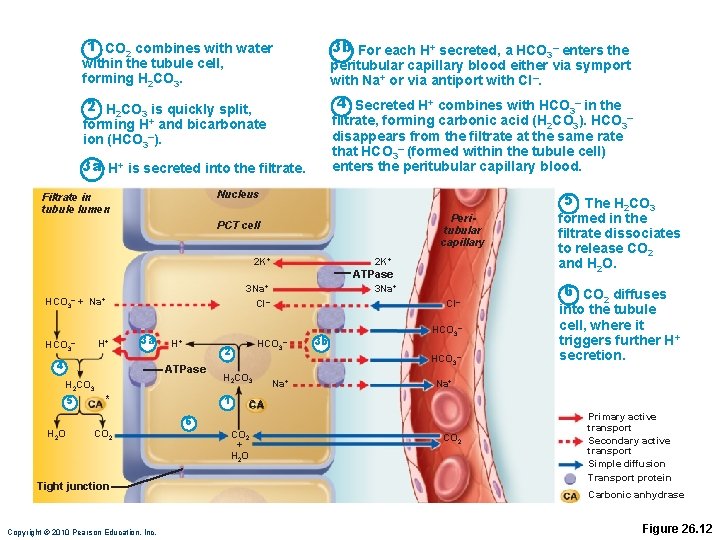
1 CO 2 combines with water 3 b For each H+ secreted, a HCO 3– enters the within the tubule cell, forming H 2 CO 3. peritubular capillary blood either via symport with Na+ or via antiport with CI–. 4 Secreted H+ combines with HCO 3– in the 2 H 2 CO 3 is quickly split, filtrate, forming carbonic acid (H 2 CO 3). HCO 3– disappears from the filtrate at the same rate that HCO 3– (formed within the tubule cell) enters the peritubular capillary blood. forming H+ and bicarbonate ion (HCO 3–). 3 a H+ is secreted into the filtrate. Nucleus Filtrate in tubule lumen Peritubular capillary PCT cell 2 K+ ATPase 3 Na+ HCO 3– + Na+ Cl– H+ HCO 3– 3 a 4 H+ H 2 CO 3 3 b HCO 3– H 2 CO 3 1 * Cl– HCO 3– 2 ATPase 5 3 Na+ CO 2 Tight junction Copyright © 2010 Pearson Education, Inc. CO 2 + H 2 O formed in the filtrate dissociates to release CO 2 and H 2 O. 6 CO 2 diffuses into the tubule cell, where it triggers further H+ secretion. Na+ CA 6 H 2 O 5 The H 2 CO 3 CO 2 Primary active transport Secondary active transport Simple diffusion Transport protein Carbonic anhydrase Figure 26. 12
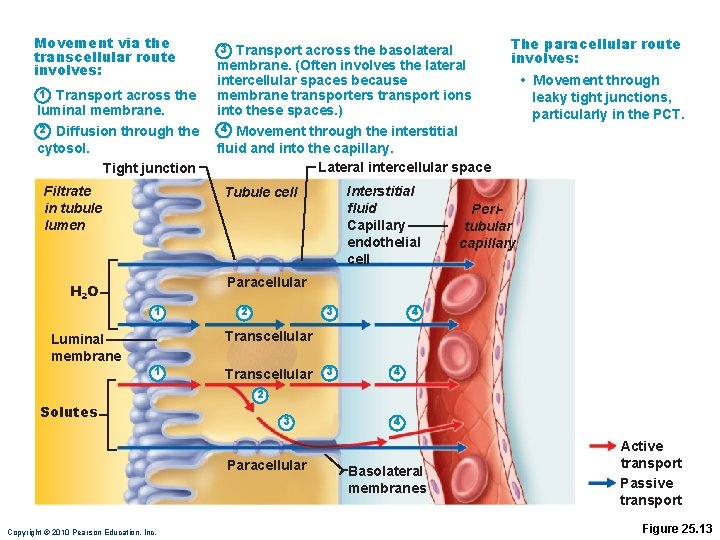
Movement via the transcellular route involves: 1 Transport across the luminal membrane. 2 Diffusion through the cytosol. Tight junction Filtrate in tubule lumen Transport across the basolateral membrane. (Often involves the lateral intercellular spaces because membrane transporters transport ions into these spaces. ) The paracellular route involves: 4 • Movement through leaky tight junctions, particularly in the PCT. Movement through the interstitial fluid and into the capillary. Lateral intercellular space Interstitial fluid Capillary endothelial cell Tubule cell Peritubular capillary Paracellular H 2 O 1 Luminal membrane 3 2 3 4 Transcellular 1 Transcellular 3 4 2 Solutes 3 Paracellular Copyright © 2010 Pearson Education, Inc. 4 Basolateral membranes Active transport Passive transport Figure 25. 13
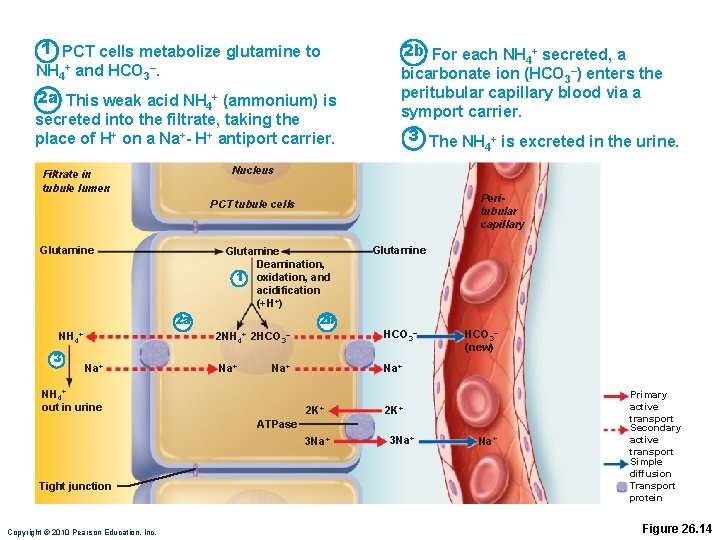
1 PCT cells metabolize glutamine to NH 4+ and HCO 3–. 2 a This weak acid NH 4+ (ammonium) is secreted into the filtrate, taking the place of H+ on a Na+- H+ antiport carrier. 2 b For each NH 4+ secreted, a bicarbonate ion (HCO 3–) enters the peritubular capillary blood via a symport carrier. 3 The NH + is excreted in the urine. 4 Nucleus Filtrate in tubule lumen Peritubular capillary PCT tubule cells Glutamine Deamination, 1 oxidation, and acidification (+H+) 2 a NH 4+ 3 Na+ 2 b Glutamine 2 NH 4+ 2 HCO 3– Na+ Na+ NH 4+ out in urine 2 K+ HCO 3– (new) 2 K+ ATPase 3 Na+ Tight junction Copyright © 2010 Pearson Education, Inc. 3 Na+ Primary active transport Secondary active transport Simple diffusion Transport protein Figure 26. 14
Abnormalities of Acid-Base Balance • Respiratory acidosis and alkalosis • Metabolic acidosis and alkalosis Copyright © 2010 Pearson Education, Inc.
Respiratory Acidosis and Alkalosis • The most important indicator of adequacy of respiratory function is PCO 2 level (normally 35– 45 mm Hg) • PCO 2 above 45 mm Hg respiratory acidosis • Most common cause of acid-base imbalances • Due to decrease in ventilation or gas exchange • Characterized by falling blood p. H and rising PCO 2 Copyright © 2010 Pearson Education, Inc.
Respiratory Acidosis and Alkalosis • PCO 2 below 35 mm Hg respiratory alkalosis • A common result of hyperventilation due to stress or pain Copyright © 2010 Pearson Education, Inc.
Metabolic Acidosis and Alkalosis • Any p. H imbalance not caused by abnormal blood CO 2 levels • Indicated by abnormal HCO 3– levels Copyright © 2010 Pearson Education, Inc.
Metabolic Acidosis and Alkalosis • Causes of metabolic acidosis • Ingestion of too much alcohol ( acetic acid) • Excessive loss of HCO 3– (e. g. , persistent diarrhea) • Accumulation of lactic acid, shock, ketosis in diabetic crisis, starvation, and kidney failure Copyright © 2010 Pearson Education, Inc.
Metabolic Acidosis and Alkalosis • Metabolic alkalosis is much less common than metabolic acidosis • Indicated by rising blood p. H and HCO 3– • Caused by vomiting of the acid contents of the stomach or by intake of excess base (e. g. , antacids) Copyright © 2010 Pearson Education, Inc.
Effects of Acidosis and Alkalosis • Blood p. H below 7 (acidosis) depression of CNS coma death • Blood p. H above 7. 8 (alkalosis) excitation of nervous system muscle tetany, extreme nervousness, convulsions, respiratory arrest Copyright © 2010 Pearson Education, Inc.
Respiratory and Renal Compensations • If acid-base imbalance is due to malfunction of a physiological buffer system, the other one compensates • Respiratory system attempts to correct metabolic acid-base imbalances • Kidneys attempt to correct respiratory acidbase imbalances Copyright © 2010 Pearson Education, Inc.
Respiratory Compensation • In metabolic acidosis • High H+ levels stimulate the respiratory centers • Rate and depth of breathing are elevated • Blood p. H is below 7. 35 and HCO 3– level is low • As CO 2 is eliminated by the respiratory system, PCO 2 falls below normal Copyright © 2010 Pearson Education, Inc.
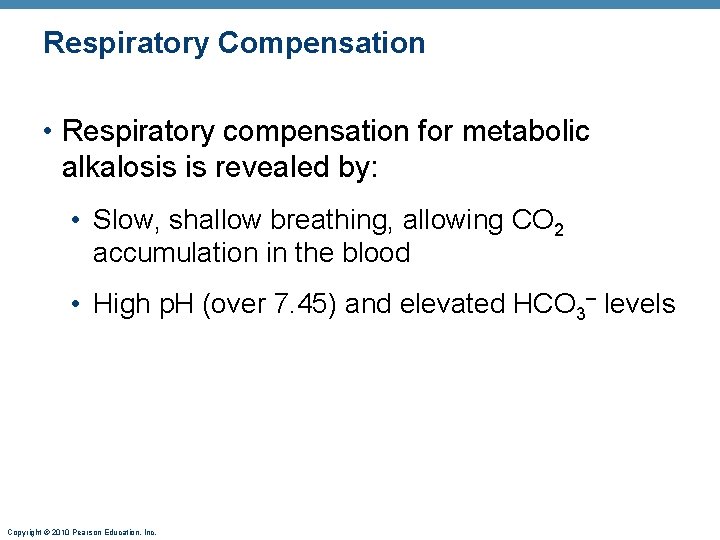
Respiratory Compensation • Respiratory compensation for metabolic alkalosis is revealed by: • Slow, shallow breathing, allowing CO 2 accumulation in the blood • High p. H (over 7. 45) and elevated HCO 3– levels Copyright © 2010 Pearson Education, Inc.
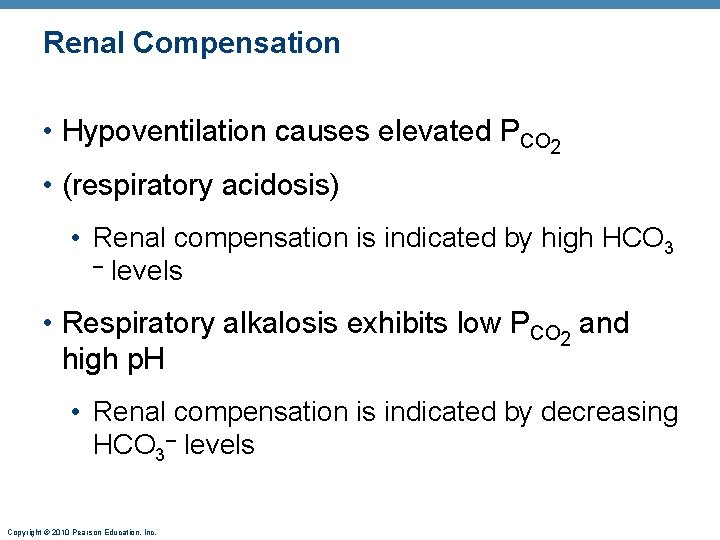
Renal Compensation • Hypoventilation causes elevated PCO 2 • (respiratory acidosis) • Renal compensation is indicated by high HCO 3 – levels • Respiratory alkalosis exhibits low PCO 2 and high p. H • Renal compensation is indicated by decreasing HCO 3– levels Copyright © 2010 Pearson Education, Inc.
QUESTIONS TO TEST WHAT YOU NOW KNOW!!! Copyright © 2010 Pearson Education, Inc.
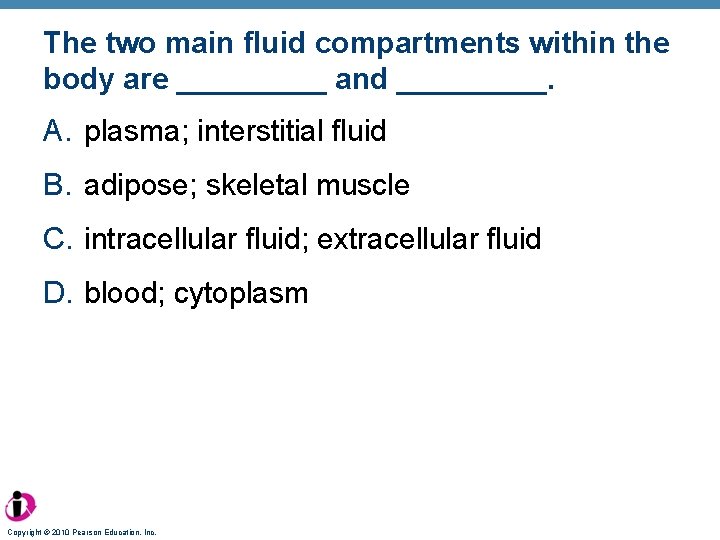
The two main fluid compartments within the body are _____ and _____. A. plasma; interstitial fluid B. adipose; skeletal muscle C. intracellular fluid; extracellular fluid D. blood; cytoplasm Copyright © 2010 Pearson Education, Inc.
The most abundant cation of the ECF is _______ and the most abundant anion in the ECF is _______. A. K+; HPO 42– B. Mg 2+; HCO 3– C. Ca 2+; SO 42– D. Na+; Cl– Copyright © 2010 Pearson Education, Inc.
Which of the following accounts for the most water loss, second only to urine output? A. Insensible perspiration B. Sweating C. Defecation D. Tears Copyright © 2010 Pearson Education, Inc.
Which is the most potent stimulus for thirst? A. Dry mouth B. An increase in plasma osmolarity C. An increase in blood volume D. The sight of a cold drink Copyright © 2010 Pearson Education, Inc.
You were thirsty and drank a full glass of water only to have your thirst return an hour later. This is because: A. thirst is continuously communicated to the brain. B. the kidneys produced a large volume of urine. C. distension of the stomach temporarily inhibits the thirst center. D. the stomach absorbs water slowly. Copyright © 2010 Pearson Education, Inc.
When ADH levels are low, the kidneys produce _____ urine. A. dilute B. concentrated C. a low volume of D. isotonic Copyright © 2010 Pearson Education, Inc.
An overheated marathon runner accepts cups of plain water at each refreshment area. When the race ends, the runner is very disoriented and collapses. What is the best explanation for her condition? A. The runner overexerted herself. B. The runner needs more water because she is dehydrated. C. The runner is suffering from hypotonic hydration and her cell fluids are overdiluted. D. The runner’s ICF is hypotonic to her ECF. Copyright © 2010 Pearson Education, Inc.
What might be a probable explanation for an intense craving for heavily salted food? A. Diabetes mellitus, which causes excessive urine output B. Addison’s disease, in which insufficient aldosterone is available to reabsorb Na. Cl from the filtrate C. Diabetes insipidus, which is manifested by hyposecretion of ADH D. Hypersecretion of aldosterone Copyright © 2010 Pearson Education, Inc.
Which of the following statements best summarizes the relationship between the sodium content of fluids and water movement? A. Water follows salt. B. Salt follows water. C. Water equals salt. D. Water solubilizes salt. Copyright © 2010 Pearson Education, Inc.
Which two hormones are essential for reabsorption of water at the collecting duct? A. Renin and aldosterone B. ADH and aquaporin C. Aldosterone and ADH D. ADH and renin Copyright © 2010 Pearson Education, Inc.
Blood sodium levels are indirectly assessed by _____. A. sodium chemoreceptors B. chloride chemoreceptors C. baroreceptors D. PH receptors Copyright © 2010 Pearson Education, Inc.
The _______ contains the largest percentage of water in the body. A. extracellular fluid B. intracellular fluid C. blood plasma D. lymph Copyright © 2010 Pearson Education, Inc.
You would expect blood levels of ANP to increase when _____. A. blood pressure is increased B. blood Na+ is elevated C. the walls of the atria are stretched D. all of the above occur Copyright © 2010 Pearson Education, Inc.
A patient suffering from hyperthyroidism may experience heart malfunction. Consequently, this patient must also tightly regulate his potassium intake. Which of the following is the best explanation for why he must carefully watch dietary potassium? A. Even slight changes in K+ are not detectable by the heart. B. Both hyper- and hypokalemia can disrupt electrical conduction in the heart. C. The kidney is unable to excrete K+ in someone with hyperthyroidism. D. Dietary intake of K+ causes hyperthyroidism. Copyright © 2010 Pearson Education, Inc.
PTH affects calcium blood levels via which of the following mechanisms? A. PTH stimulates osteoclasts to resorb bone. B. PTH stimulates increased Ca 2+ absorption in the intestine. C. PTH stimulates increased Ca 2+ reabsorption by renal tubules. D. All of the above are ways PTH affects calcium blood levels. Copyright © 2010 Pearson Education, Inc.
Which of the following is the initial H+ regulatory mechanism in the body? A. Renal excretion B. Chemical buffers C. Brain stem respiratory centers D. Lactic acid production Copyright © 2010 Pearson Education, Inc.
If the blood p. H lowers, what change would you expect from the respiratory system? A. The respiration rate would increase. B. The respiration rate would decrease. C. The respiration rate would remain unchanged. D. The respiration rate would be erratic. Copyright © 2010 Pearson Education, Inc.
- Slides: 88