
Power Point Lecture Slides prepared by Barbara Heard
Power. Point® Lecture Slides prepared by Barbara Heard, Atlantic Cape Community College CHAPTER 18 The Cardiovascular System: Modified by Dr. Par Mohammadian © Annie Leibovitz/Contact Press Images © 2013 Pearson Education, Inc.
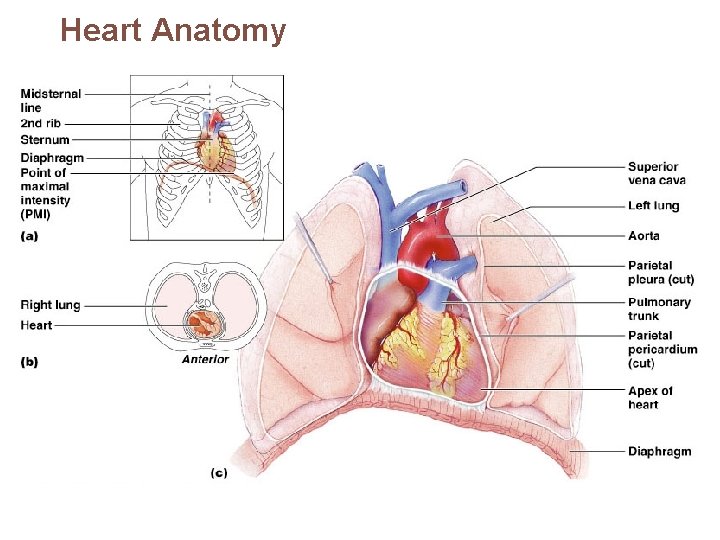
Heart Anatomy • Approximately size of fist • Location: – In mediastinum (medial cavity of the thorax) between 2 nd rib and 5 th intercostal space – On superior surface of diaphragm – Two-thirds of heart to left of midsternal line – Anterior to vertebral column, posterior to sternum © 2013 Pearson Education, Inc.
Heart Anatomy • Base (posterior surface) leans toward right shoulder • Apex points toward left hip • Apical impulse palpated between fifth and sixth ribs, just below left nipple © 2013 Pearson Education, Inc.
Heart Anatomy
Coverings of the Heart: Physiology The pericardium: A double-walled sac around the heart – Protects and anchors the heart – Prevents overfilling of the heart with blood – Allows for the heart to work in a relatively frictionfree environment

Coverings of the Heart: Anatomy • Pericardium is composed of: – A superficial fibrous pericardium – A deep two-layer serous pericardium • The parietal layer lines the internal surface of the fibrous pericardium • The visceral layer or epicardium lines the surface of the heart • They are separated by the fluid-filled pericardial cavity Pulmonary trunk Fibrous pericardium Parietal layer of serous pericardium Myocardium Pericardial cavity Epicardium (visceral layer of serous pericardium) Myocardium Endocardium Heart chamber Heart wall
Layers of the Heart Wall • Three layers of heart wall: – Epicardium – Myocardium – Endocardium • Epicardium – Visceral layer of serous pericardium © 2013 Pearson Education, Inc.
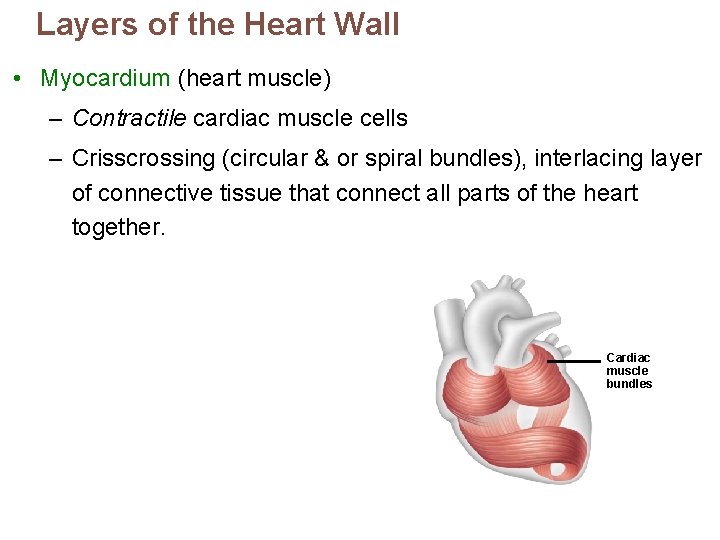
Layers of the Heart Wall • Myocardium (heart muscle) – Contractile cardiac muscle cells – Crisscrossing (circular & or spiral bundles), interlacing layer of connective tissue that connect all parts of the heart together. Cardiac muscle bundles
Layers of the Heart Wall §Fibrous cardiac skeleton: Anchors cardiac muscle fibers Supports great vessels and valves from becoming stretched (caused by continuous stress of blood pulsing through them). Not electrically excitable => Limits spread of action potentials to specific paths • Endocardium (inside the heart) located on the inner myocardial surface, lines the heart chambers, covers the fibrous skeleton • Continuous with the endothelial linings of blood vessels leaving and entering the heart.
Chambers • Four chambers: – Two superior atria – Two inferior ventricles • Interatrial septum – separates atria • Interventricular septum – separates ventricles
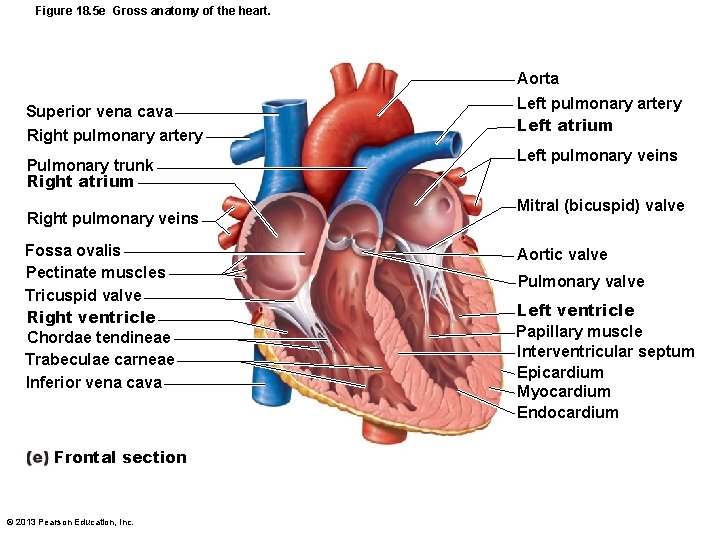
Figure 18. 5 e Gross anatomy of the heart. Aorta Superior vena cava Right pulmonary artery Pulmonary trunk Right atrium Right pulmonary veins Fossa ovalis Pectinate muscles Tricuspid valve Right ventricle Chordae tendineae Trabeculae carneae Inferior vena cava Frontal section © 2013 Pearson Education, Inc. Left pulmonary artery Left atrium Left pulmonary veins Mitral (bicuspid) valve Aortic valve Pulmonary valve Left ventricle Papillary muscle Interventricular septum Epicardium Myocardium Endocardium
Chambers and Associated Great Vessels • Coronary sulcus (AV- atrioventricular groove) – Encircles junction of atria and ventricles • Anterior interventricular sulcus – Anterior position of interventricular septum • Posterior interventricular sulcus – Landmark on posteroinferior surface © 2013 Pearson Education, Inc.

Aorta Superior vena cava Left pulmonary artery Right pulmonary veins Left pulmonary veins Auricle of left atrium Left atrium Great cardiac vein Posterior vein of left ventricle Left ventricle Apex Posterior surface view Right atrium Inferior vena cava Coronary sinus Right coronary artery (in coronary sulcus) Posterior interventricular artery (in posterior interventricular sulcus) Middle cardiac vein Right ventricle
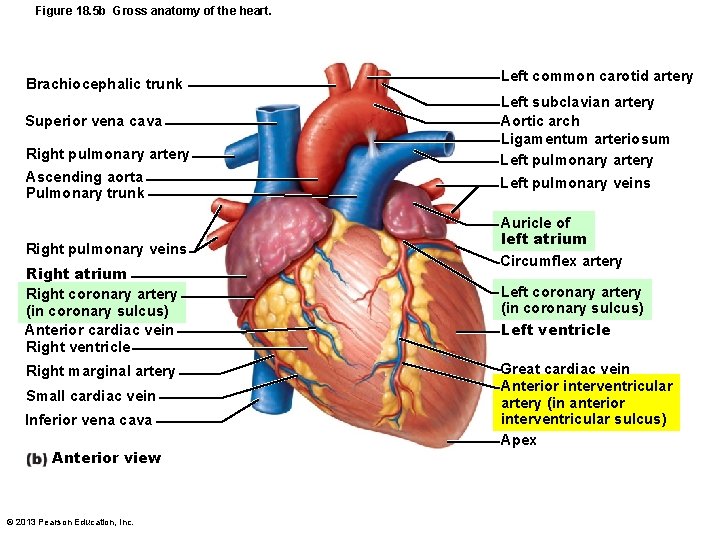
Figure 18. 5 b Gross anatomy of the heart. Brachiocephalic trunk Superior vena cava Right pulmonary artery Ascending aorta Pulmonary trunk Right pulmonary veins Right atrium Right coronary artery (in coronary sulcus) Anterior cardiac vein Right ventricle Right marginal artery Small cardiac vein Inferior vena cava Anterior view © 2013 Pearson Education, Inc. Left common carotid artery Left subclavian artery Aortic arch Ligamentum arteriosum Left pulmonary artery Left pulmonary veins Auricle of left atrium Circumflex artery Left coronary artery (in coronary sulcus) Left ventricle Great cardiac vein Anterior interventricular artery (in anterior interventricular sulcus) Apex
Atria: The Receiving Chambers • Auricles – Small, wrinkled appendages that increase atrial volume • Right atrium – Pectinate muscles (= teeth of the comb; muscle tissues form ridges in the wall) – Posterior and anterior regions separated by C shaped ridge - crista terminalis • Left atrium – Smooth & Pectinate muscles found only in auricles – fossa ovalis: marks the spot where an opening, the foramen ovale, existed in the fetal heart.
Atria: The Receiving Chambers • Small, thin-walled • Contribute little to propulsion of blood • Three veins empty into right atrium: – Superior vena cava, – Inferior vena cava, – Coronary sinus (collects blood draining from the myocardium) • Four pulmonary veins empty into left atrium © 2013 Pearson Education, Inc.
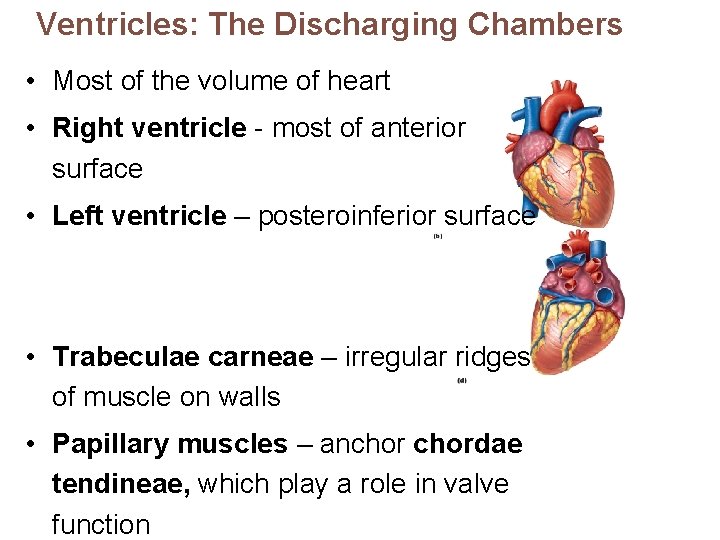
Ventricles: The Discharging Chambers • Most of the volume of heart • Right ventricle - most of anterior surface • Left ventricle – posteroinferior surface • Trabeculae carneae – irregular ridges of muscle on walls • Papillary muscles – anchordae tendineae, which play a role in valve function
Ventricles: The Discharging Chambers • Thicker walls than atria • Actual pumps of heart • Right ventricle – Pumps blood into pulmonary trunk • Left ventricle – Pumps blood into aorta (largest artery in body) © 2013 Pearson Education, Inc.
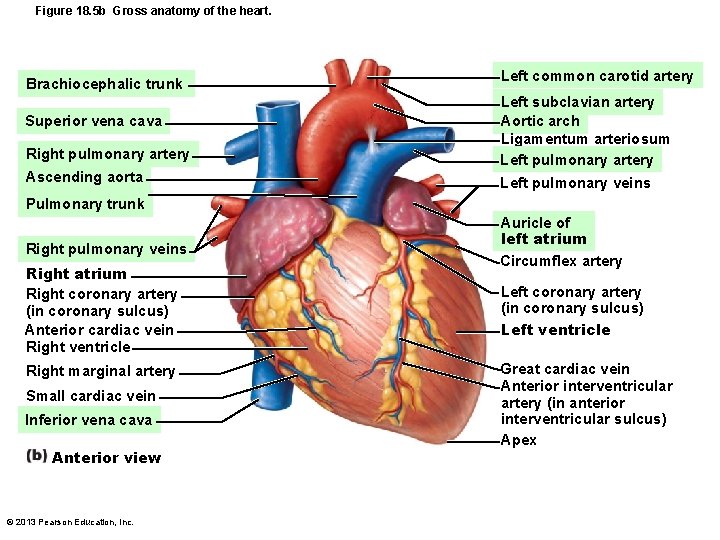
Figure 18. 5 b Gross anatomy of the heart. Brachiocephalic trunk Left common carotid artery Right pulmonary artery Left subclavian artery Aortic arch Ligamentum arteriosum Left pulmonary artery Ascending aorta Left pulmonary veins Superior vena cava Pulmonary trunk Right pulmonary veins Right atrium Right coronary artery (in coronary sulcus) Anterior cardiac vein Right ventricle Right marginal artery Small cardiac vein Inferior vena cava Anterior view © 2013 Pearson Education, Inc. Auricle of left atrium Circumflex artery Left coronary artery (in coronary sulcus) Left ventricle Great cardiac vein Anterior interventricular artery (in anterior interventricular sulcus) Apex
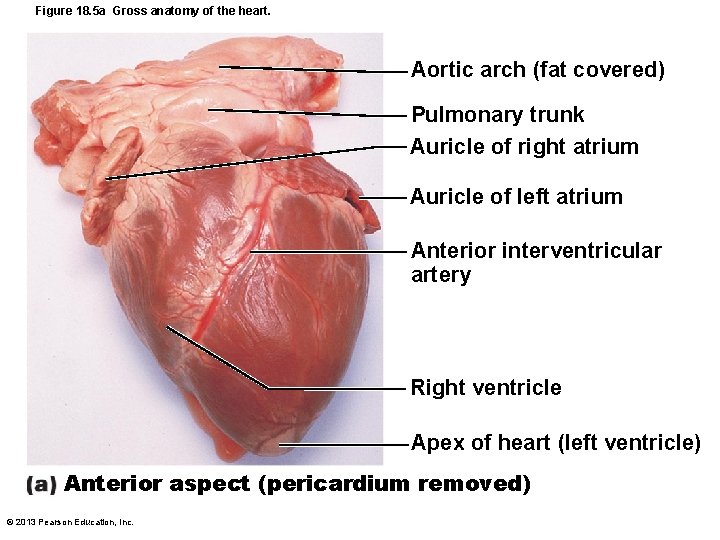
Figure 18. 5 a Gross anatomy of the heart. Aortic arch (fat covered) Pulmonary trunk Auricle of right atrium Auricle of left atrium Anterior interventricular artery Right ventricle Apex of heart (left ventricle) Anterior aspect (pericardium removed) © 2013 Pearson Education, Inc.
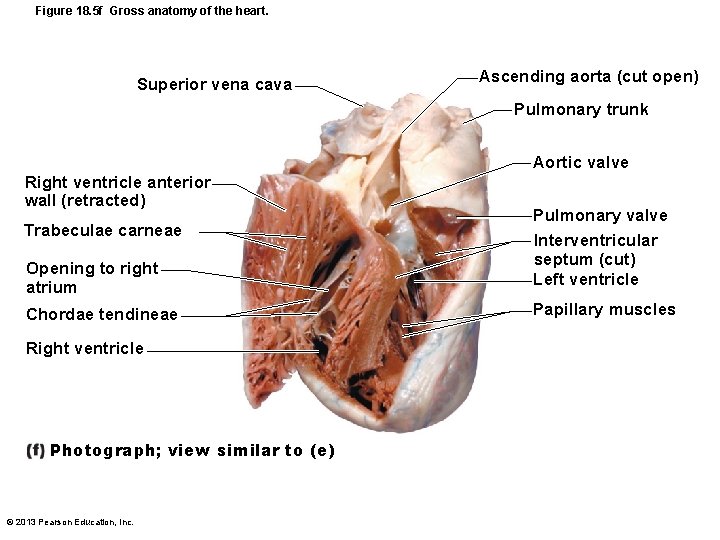
Figure 18. 5 f Gross anatomy of the heart. Superior vena cava Ascending aorta (cut open) Pulmonary trunk Aortic valve Right ventricle anterior wall (retracted) Opening to right atrium Pulmonary valve Interventricular septum (cut) Left ventricle Chordae tendineae Papillary muscles Trabeculae carneae Right ventricle Photograph; view similar to (e) © 2013 Pearson Education, Inc.
Heart Valves • Ensure unidirectional blood flow through heart • Open and close in response to pressure changes • Two atrioventricular (AV) valves – Prevent backflow into atria when ventricles contract – Tricuspid valve (right AV valve) – Mitral valve (left AV valve, bicuspid valve) – Chordae tendineae anchor cusps to papillary muscles • Hold valve flaps in closed position © 2013 Pearson Education, Inc.
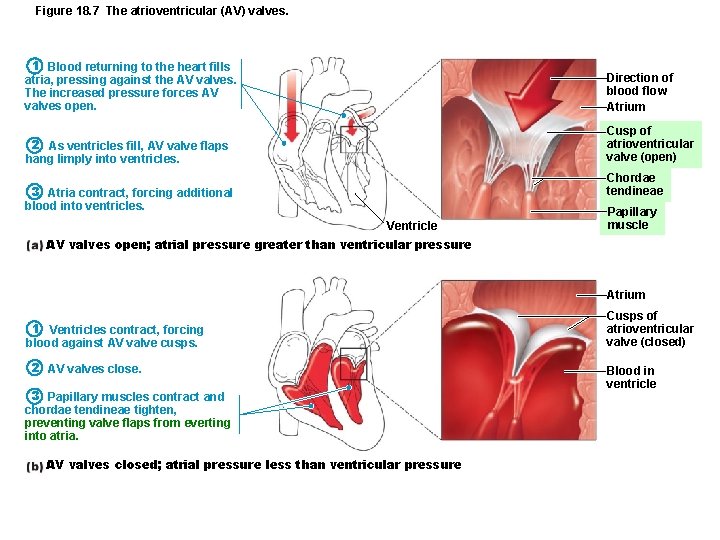
Figure 18. 7 The atrioventricular (AV) valves. 1 Blood returning to the heart fills atria, pressing against the AV valves. The increased pressure forces AV valves open. Direction of blood flow Atrium 2 As ventricles fill, AV valve flaps hang limply into ventricles. Cusp of atrioventricular valve (open) Chordae tendineae 3 Atria contract, forcing additional blood into ventricles. Ventricle Papillary muscle AV valves open; atrial pressure greater than ventricular pressure Atrium 1 Ventricles contract, forcing blood against AV valve cusps. 2 AV valves close. 3 Papillary muscles contract and chordae tendineae tighten, preventing valve flaps from everting into atria. AV valves closed; atrial pressure less than ventricular pressure Cusps of atrioventricular valve (closed) Blood in ventricle
Heart Valves • Two semilunar (SL) valves – Prevent backflow into ventricles when ventricles relax – Open and close in response to pressure changes – Aortic semilunar valve – Pulmonary semilunar valve © 2013 Pearson Education, Inc.
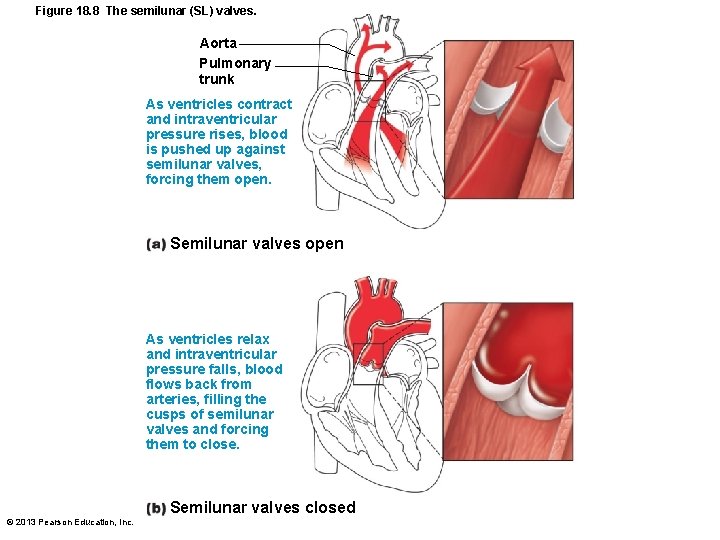
Figure 18. 8 The semilunar (SL) valves. Aorta Pulmonary trunk As ventricles contract and intraventricular pressure rises, blood is pushed up against semilunar valves, forcing them open. Semilunar valves open As ventricles relax and intraventricular pressure falls, blood flows back from arteries, filling the cusps of semilunar valves and forcing them to close. Semilunar valves closed © 2013 Pearson Education, Inc.
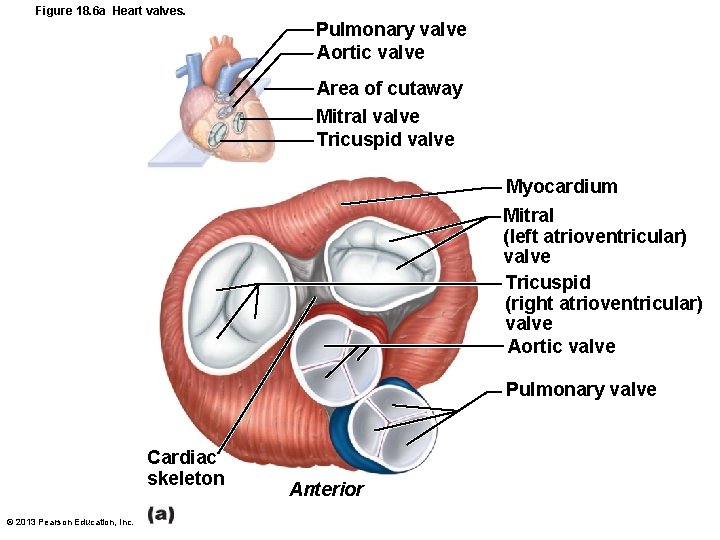
Figure 18. 6 a Heart valves. Pulmonary valve Aortic valve Area of cutaway Mitral valve Tricuspid valve Myocardium Mitral (left atrioventricular) valve Tricuspid (right atrioventricular) valve Aortic valve Pulmonary valve Cardiac skeleton © 2013 Pearson Education, Inc. Anterior
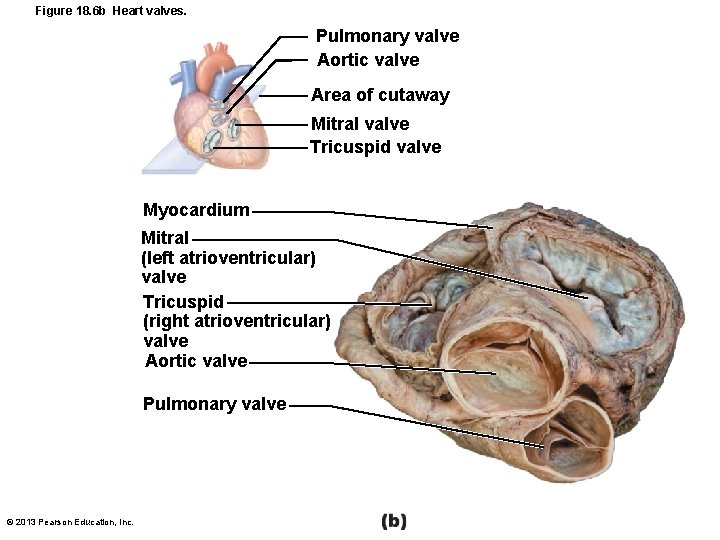
Figure 18. 6 b Heart valves. Pulmonary valve Aortic valve Area of cutaway Mitral valve Tricuspid valve Myocardium Mitral (left atrioventricular) valve Tricuspid (right atrioventricular) valve Aortic valve Pulmonary valve © 2013 Pearson Education, Inc.
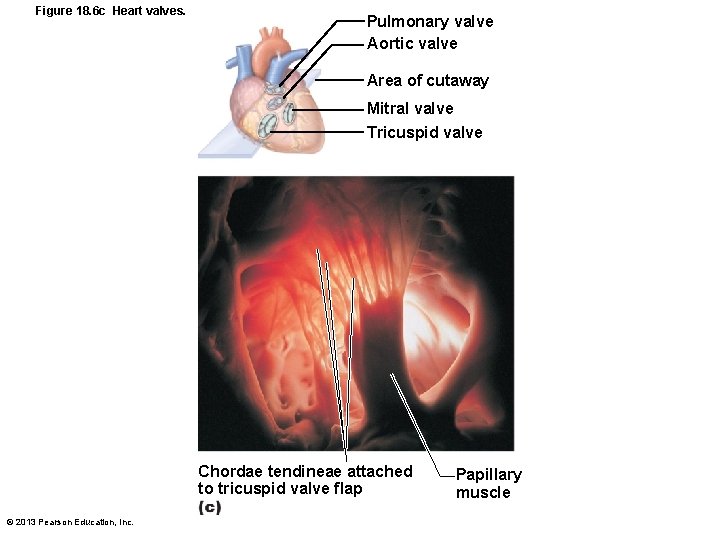
Figure 18. 6 c Heart valves. Pulmonary valve Aortic valve Area of cutaway Mitral valve Tricuspid valve Chordae tendineae attached to tricuspid valve flap © 2013 Pearson Education, Inc. Papillary muscle
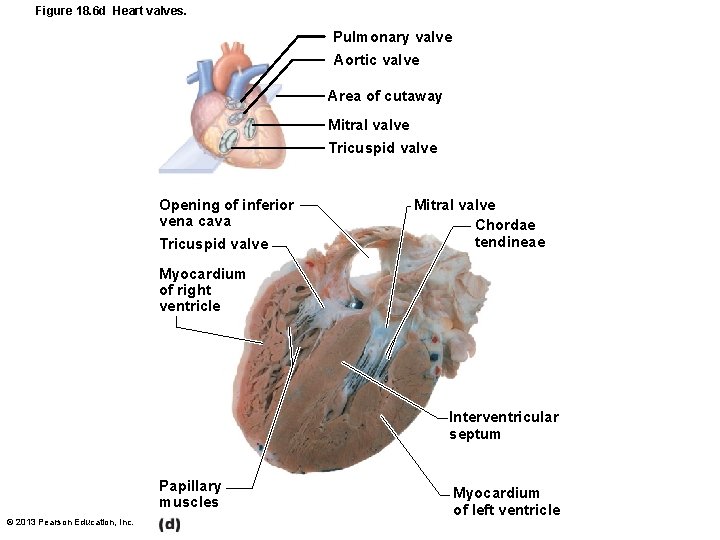
Figure 18. 6 d Heart valves. Pulmonary valve Aortic valve Area of cutaway Mitral valve Tricuspid valve Opening of inferior vena cava Tricuspid valve Mitral valve Chordae tendineae Myocardium of right ventricle Interventricular septum Papillary muscles © 2013 Pearson Education, Inc. Myocardium of left ventricle
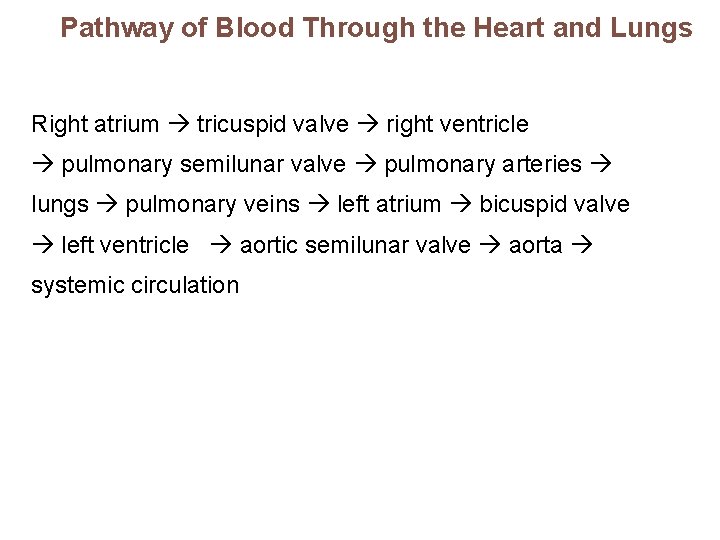
Pathway of Blood Through the Heart and Lungs Right atrium tricuspid valve right ventricle pulmonary semilunar valve pulmonary arteries lungs pulmonary veins left atrium bicuspid valve left ventricle aortic semilunar valve aorta systemic circulation
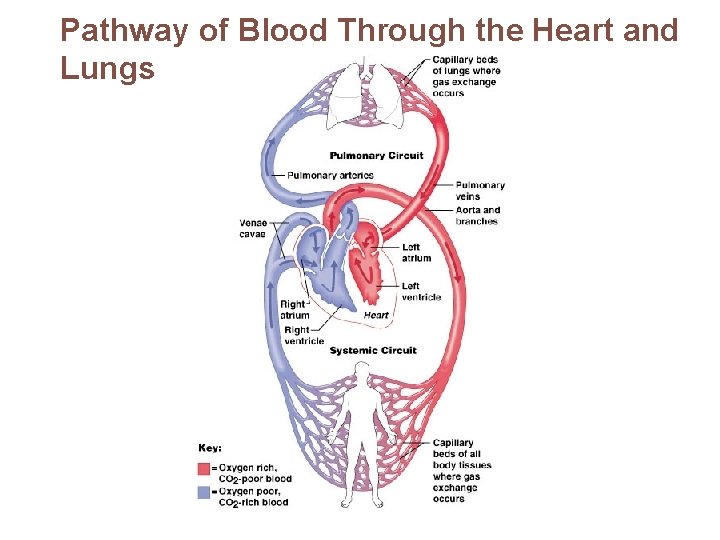
Pathway of Blood Through the Heart and Lungs
Coronary Circulation: Functional blood supply to heart muscle itself • The heart continuously filled with blood but this blood does not nourish the heart tissues => left & right coronary arteries arise from the base of aorta & encircle the heart in the coronary sulcus. § Delivered when heart relaxed § Left ventricle receives most blood supply § Arterial supply varies among individuals © 2013 Pearson Education, Inc.
Coronary Circulation: Arteries • Arteries arise from base of aorta • Left coronary artery branches – anterior interventricular artery – circumflex artery Supplies interventricular septum, anterior ventricular walls, left atrium, and posterior wall of left ventricle • Right coronary artery branches – right marginal artery – posterior interventricular artery Supplies right atrium and most of right ventricle
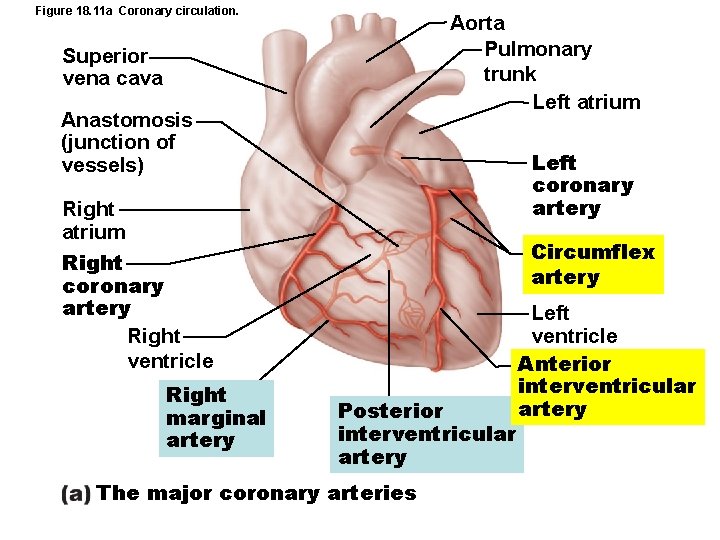
Figure 18. 11 a Coronary circulation. Aorta Pulmonary trunk Left atrium Superior vena cava Anastomosis (junction of vessels) Left coronary artery Right atrium Right coronary artery Right ventricle Right marginal artery Circumflex artery Posterior interventricular artery The major coronary arteries Left ventricle Anterior interventricular artery
Coronary Circulation: Veins • Cardiac veins: Collect blood from capillary beds • Coronary sinus empties into right atrium; formed by merging cardiac veins – Great cardiac vein of anterior interventricular sulcus – Middle cardiac vein in posterior interventricular sulcus – Small cardiac vein from inferior margin • Several anterior cardiac veins empty directly into right atrium anteriorly
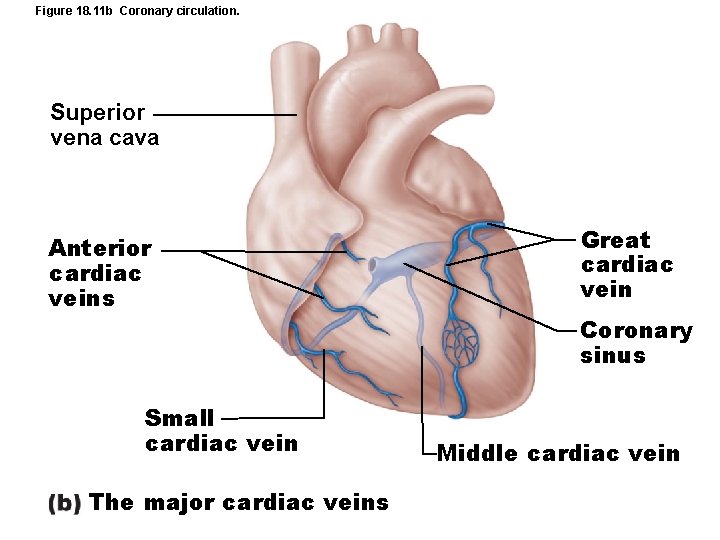
Figure 18. 11 b Coronary circulation. Superior vena cava Anterior cardiac veins Small cardiac vein The major cardiac veins Great cardiac vein Coronary sinus Middle cardiac vein
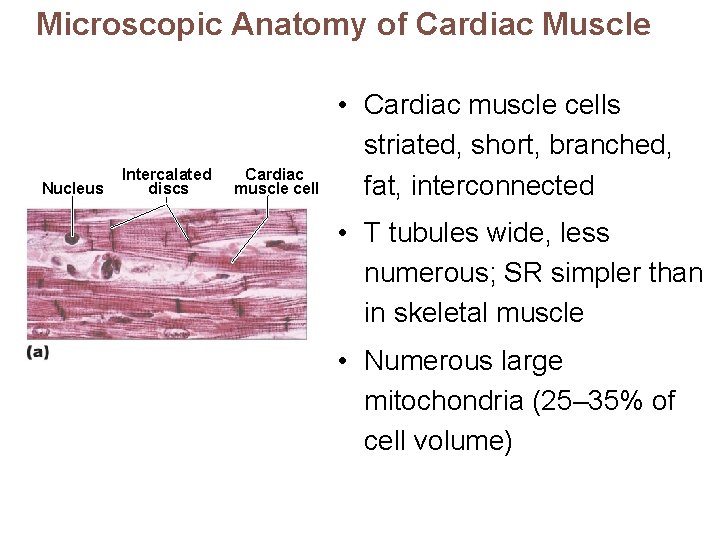
Microscopic Anatomy of Cardiac Muscle Nucleus Intercalated discs Cardiac muscle cell • Cardiac muscle cells striated, short, branched, fat, interconnected • T tubules wide, less numerous; SR simpler than in skeletal muscle • Numerous large mitochondria (25– 35% of cell volume)
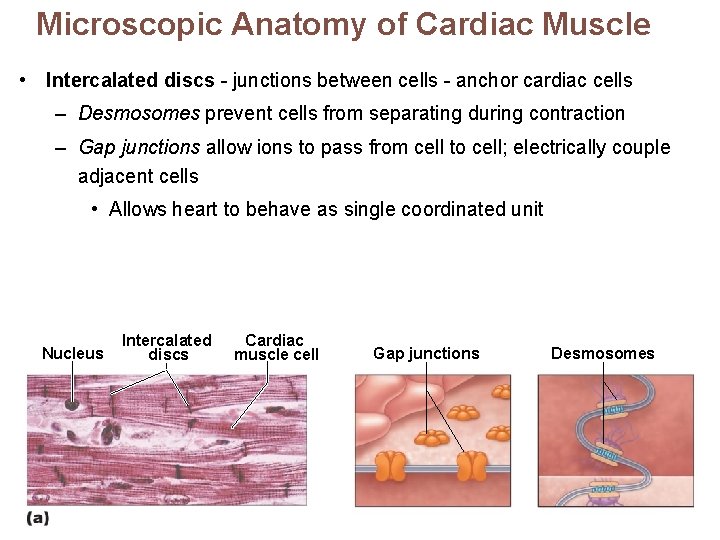
Microscopic Anatomy of Cardiac Muscle • Intercalated discs - junctions between cells - anchor cardiac cells – Desmosomes prevent cells from separating during contraction – Gap junctions allow ions to pass from cell to cell; electrically couple adjacent cells • Allows heart to behave as single coordinated unit Nucleus Intercalated discs Cardiac muscle cell Gap junctions Desmosomes
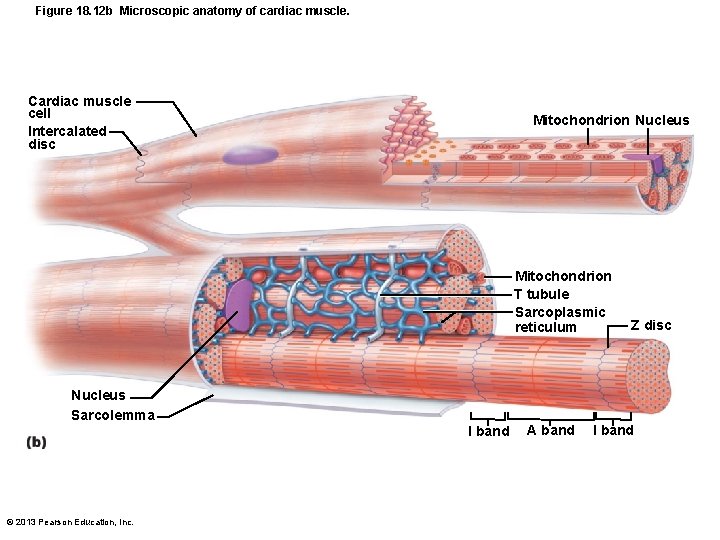
Figure 18. 12 b Microscopic anatomy of cardiac muscle. Cardiac muscle cell Intercalated disc Mitochondrion Nucleus Mitochondrion T tubule Sarcoplasmic reticulum Nucleus Sarcolemma I band © 2013 Pearson Education, Inc. A band Z disc I band
- Slides: 39