
Power Point Lecture Slide Presentation by Patty BostwickTaylor
Power. Point® Lecture Slide Presentation by Patty Bostwick-Taylor, Florence-Darlington Technical College The Nervous System: Structure 7 PART A Copyright © 2009 Pearson Education, Inc. , publishing as Benjamin Cummings
Nervous Tissue: Support Cells § Support cells in the CNS are grouped together as “neuroglia” § Function: to support, insulate, and protect neurons Copyright © 2009 Pearson Education, Inc. , publishing as Benjamin Cummings
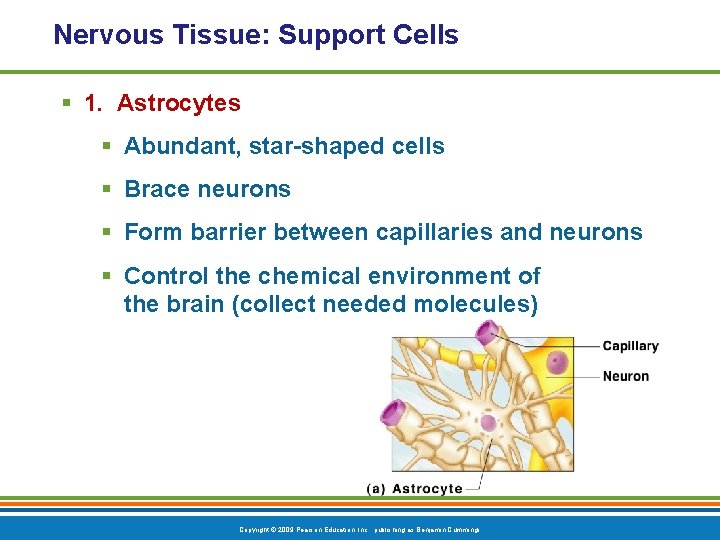
Nervous Tissue: Support Cells § 1. Astrocytes § Abundant, star-shaped cells § Brace neurons § Form barrier between capillaries and neurons § Control the chemical environment of the brain (collect needed molecules) Copyright © 2009 Pearson Education, Inc. , publishing as Benjamin Cummings
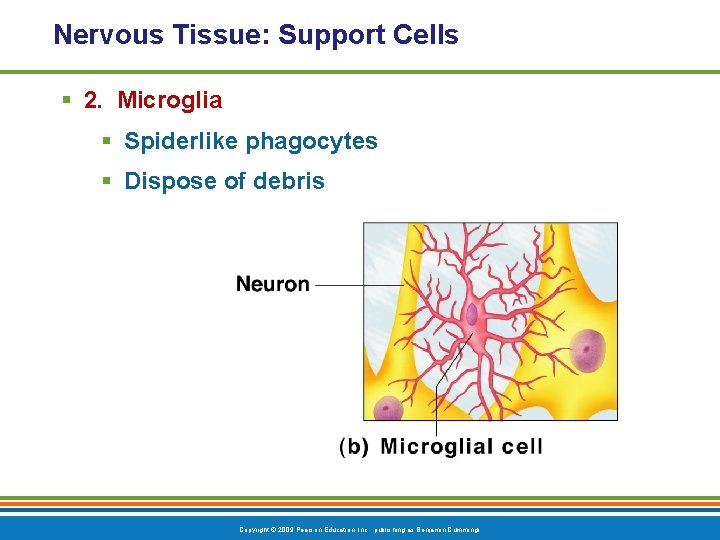
Nervous Tissue: Support Cells § 2. Microglia § Spiderlike phagocytes § Dispose of debris Copyright © 2009 Pearson Education, Inc. , publishing as Benjamin Cummings
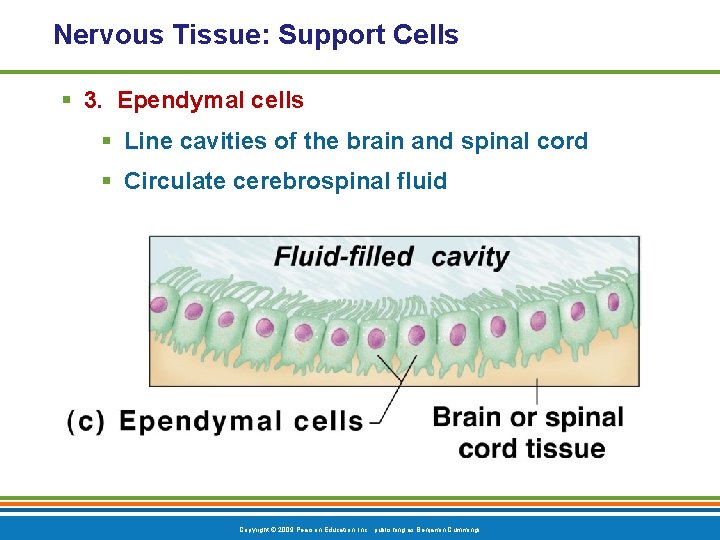
Nervous Tissue: Support Cells § 3. Ependymal cells § Line cavities of the brain and spinal cord § Circulate cerebrospinal fluid Copyright © 2009 Pearson Education, Inc. , publishing as Benjamin Cummings
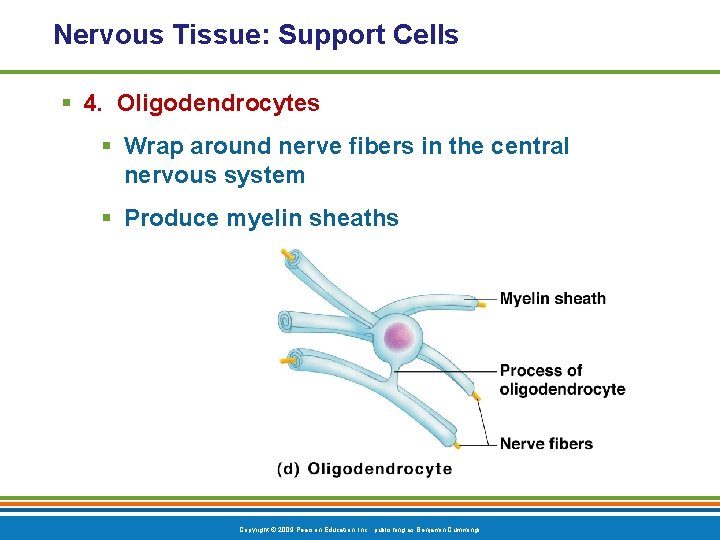
Nervous Tissue: Support Cells § 4. Oligodendrocytes § Wrap around nerve fibers in the central nervous system § Produce myelin sheaths Copyright © 2009 Pearson Education, Inc. , publishing as Benjamin Cummings
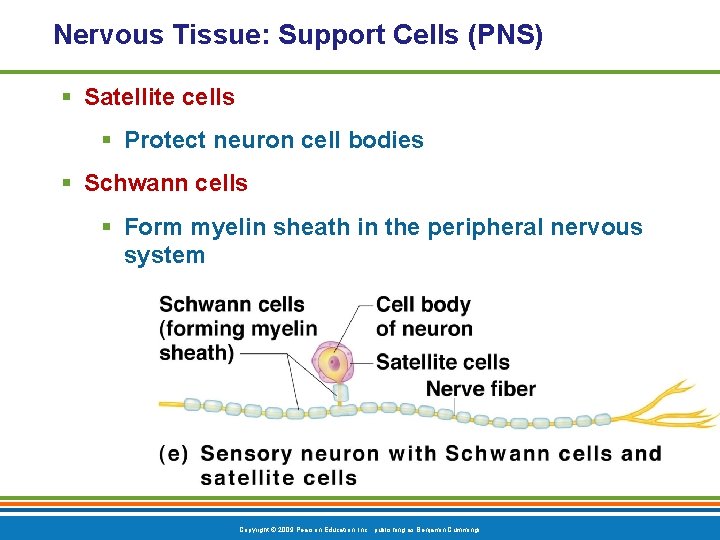
Nervous Tissue: Support Cells (PNS) § Satellite cells § Protect neuron cell bodies § Schwann cells § Form myelin sheath in the peripheral nervous system Copyright © 2009 Pearson Education, Inc. , publishing as Benjamin Cummings
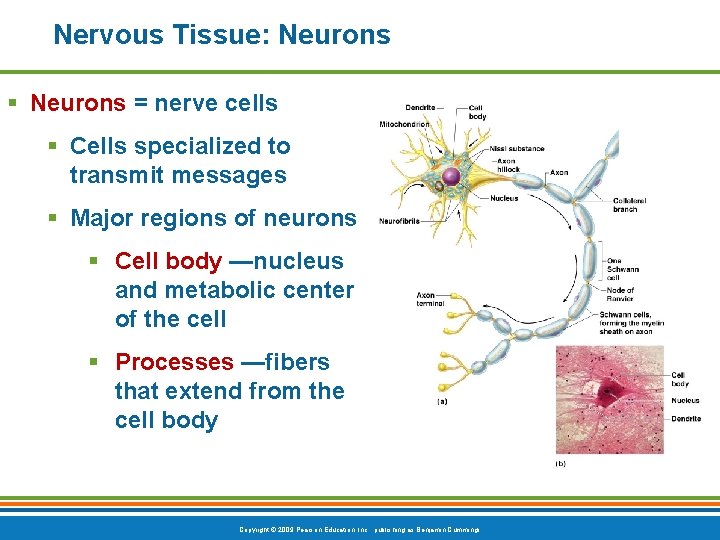
Nervous Tissue: Neurons § Neurons = nerve cells § Cells specialized to transmit messages § Major regions of neurons § Cell body —nucleus and metabolic center of the cell § Processes —fibers that extend from the cell body Copyright © 2009 Pearson Education, Inc. , publishing as Benjamin Cummings
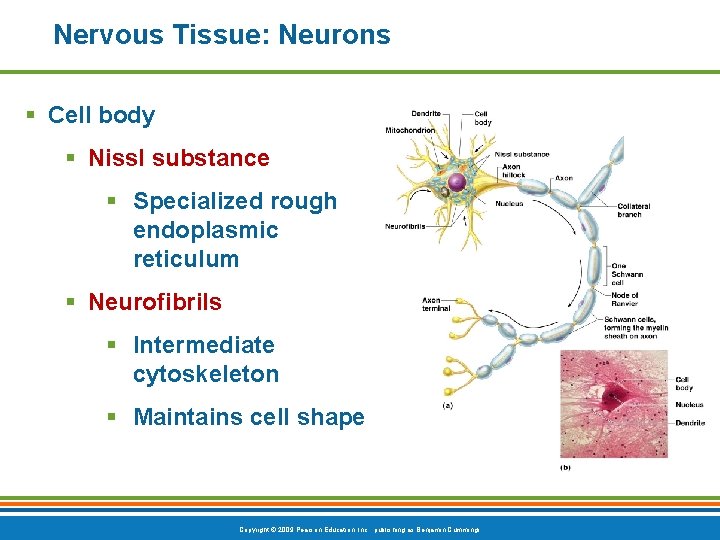
Nervous Tissue: Neurons § Cell body § Nissl substance § Specialized rough endoplasmic reticulum § Neurofibrils § Intermediate cytoskeleton § Maintains cell shape Copyright © 2009 Pearson Education, Inc. , publishing as Benjamin Cummings
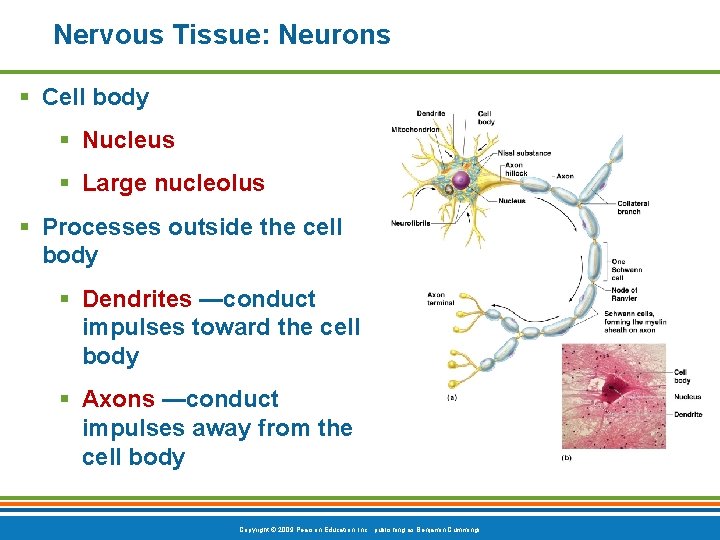
Nervous Tissue: Neurons § Cell body § Nucleus § Large nucleolus § Processes outside the cell body § Dendrites —conduct impulses toward the cell body § Axons —conduct impulses away from the cell body Copyright © 2009 Pearson Education, Inc. , publishing as Benjamin Cummings
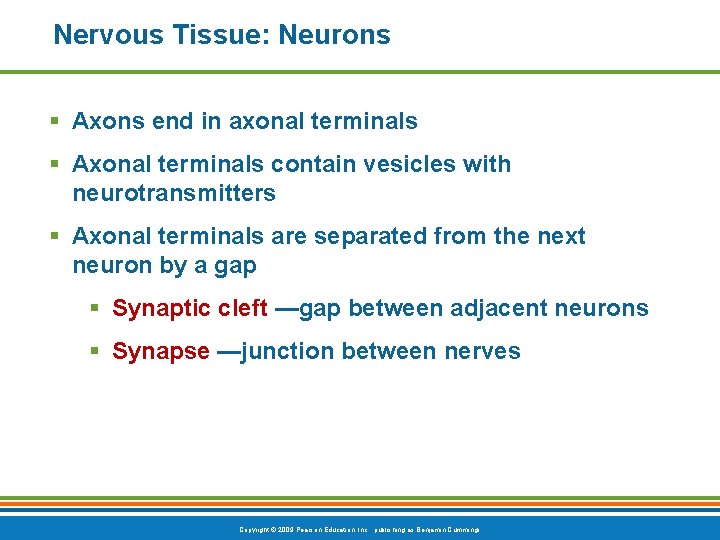
Nervous Tissue: Neurons § Axons end in axonal terminals § Axonal terminals contain vesicles with neurotransmitters § Axonal terminals are separated from the next neuron by a gap § Synaptic cleft —gap between adjacent neurons § Synapse —junction between nerves Copyright © 2009 Pearson Education, Inc. , publishing as Benjamin Cummings
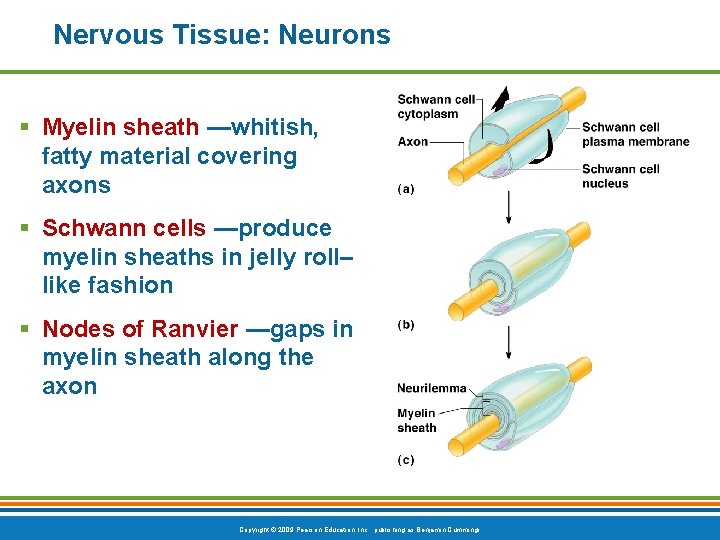
Nervous Tissue: Neurons § Myelin sheath —whitish, fatty material covering axons § Schwann cells —produce myelin sheaths in jelly roll– like fashion § Nodes of Ranvier —gaps in myelin sheath along the axon Copyright © 2009 Pearson Education, Inc. , publishing as Benjamin Cummings
Neuron Cell Body Location § Most neuron cell bodies are found in the central nervous system § Gray matter —cell bodies and unmyelinated fibers § Nuclei —clusters of cell bodies within the white matter of the central nervous system § Ganglia —collections of cell bodies outside the central nervous system Copyright © 2009 Pearson Education, Inc. , publishing as Benjamin Cummings
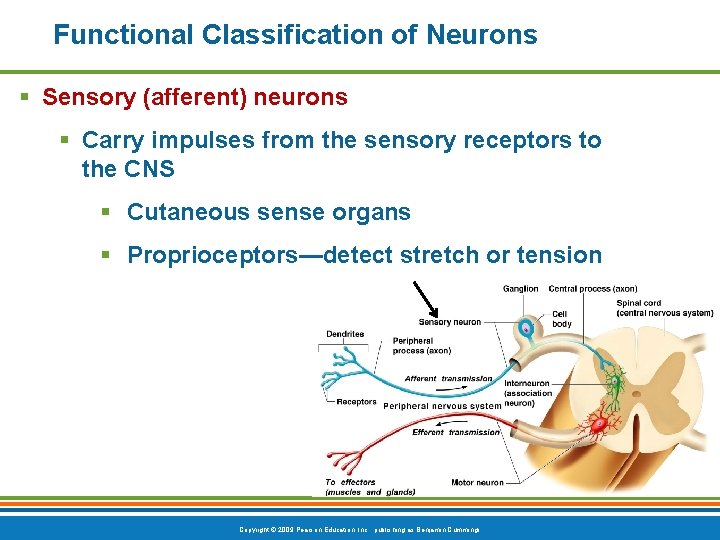
Functional Classification of Neurons § Sensory (afferent) neurons § Carry impulses from the sensory receptors to the CNS § Cutaneous sense organs § Proprioceptors—detect stretch or tension Copyright © 2009 Pearson Education, Inc. , publishing as Benjamin Cummings
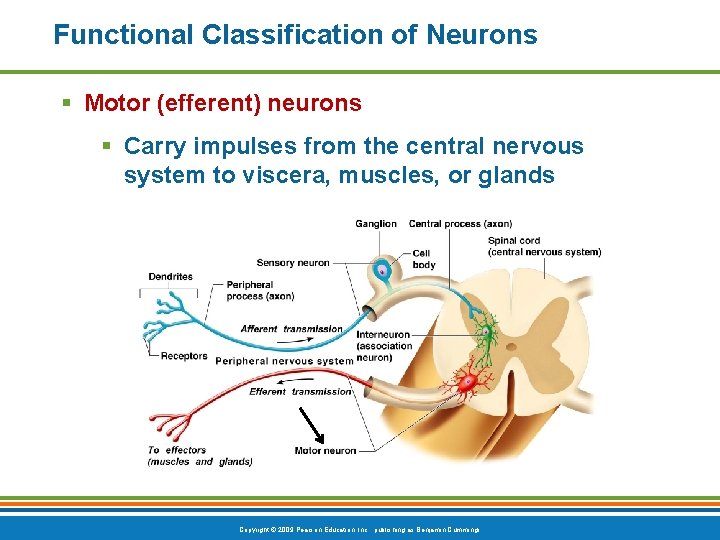
Functional Classification of Neurons § Motor (efferent) neurons § Carry impulses from the central nervous system to viscera, muscles, or glands Copyright © 2009 Pearson Education, Inc. , publishing as Benjamin Cummings
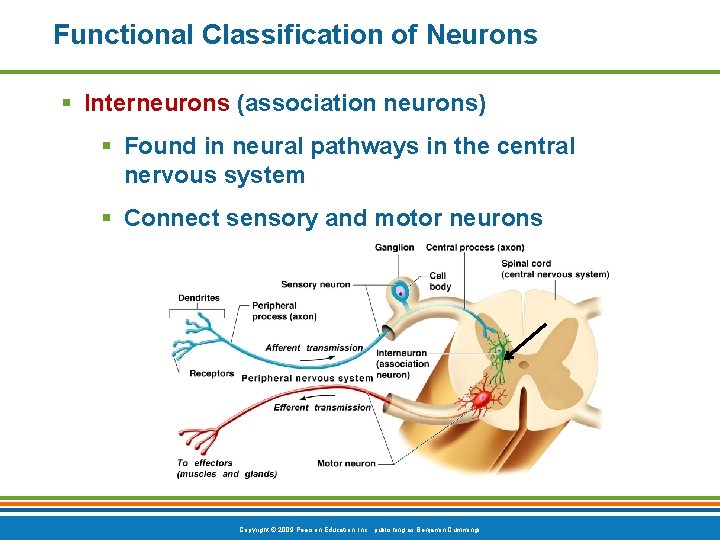
Functional Classification of Neurons § Interneurons (association neurons) § Found in neural pathways in the central nervous system § Connect sensory and motor neurons Copyright © 2009 Pearson Education, Inc. , publishing as Benjamin Cummings
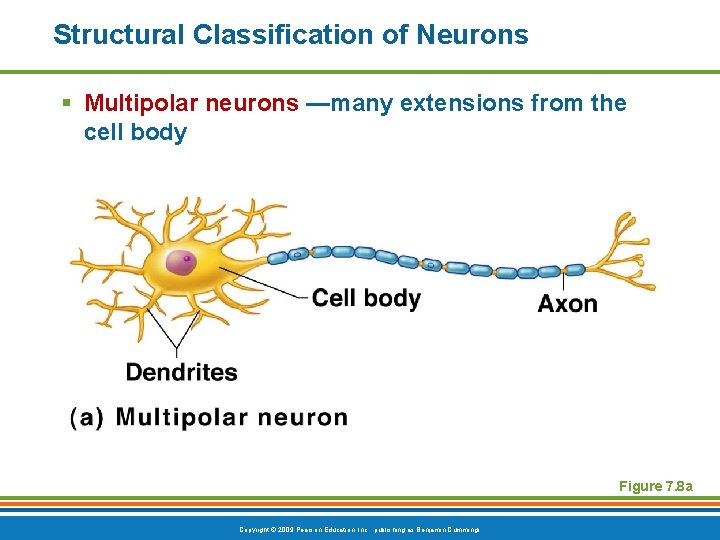
Structural Classification of Neurons § Multipolar neurons —many extensions from the cell body Figure 7. 8 a Copyright © 2009 Pearson Education, Inc. , publishing as Benjamin Cummings
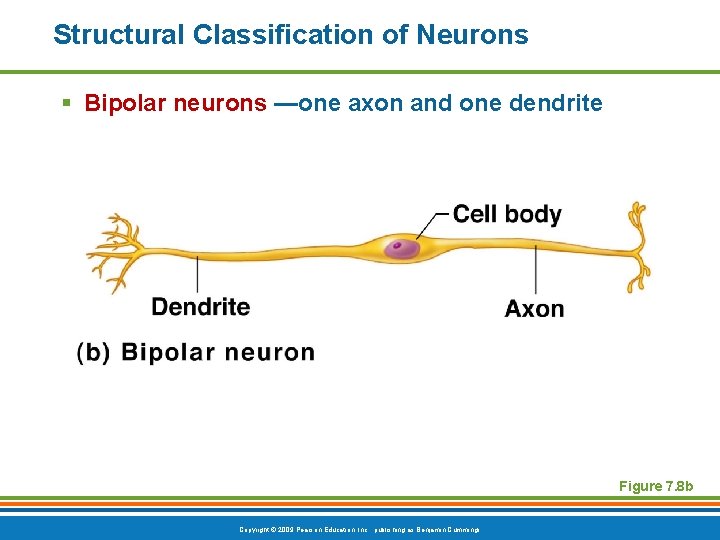
Structural Classification of Neurons § Bipolar neurons —one axon and one dendrite Figure 7. 8 b Copyright © 2009 Pearson Education, Inc. , publishing as Benjamin Cummings
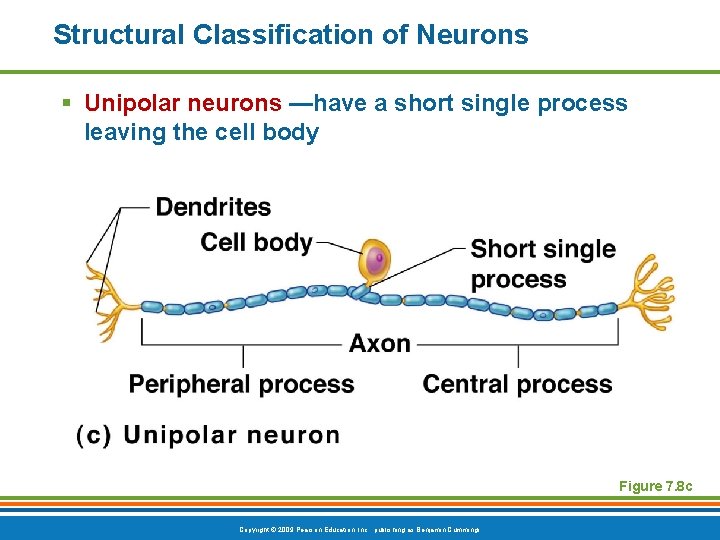
Structural Classification of Neurons § Unipolar neurons —have a short single process leaving the cell body Figure 7. 8 c Copyright © 2009 Pearson Education, Inc. , publishing as Benjamin Cummings
- Slides: 19