
Power Point Lecture Notes Presentation Chapter 6 Anxiety

- Slides: 43
Power. Point Lecture Notes Presentation Chapter 6 Anxiety Disorders Abnormal Psychology, Thirteenth Edition, DSM-5 Update by Ann M. Kring, Sheri L. Johnson, Gerald C. Davison, & John M. Neale © 2015 John Wiley & Sons, Inc. All rights reserved.
Chapter Outline �Chapter I. III. IV. 6: Anxiety Disorders Clinical Descriptions of Anxiety Disorders Common Risk Factors Across the Anxiety Disorders Etiology of Specific Anxiety Disorders Treatments of Anxiety Disorders © 2015 John Wiley & Sons, Inc. All rights reserved.
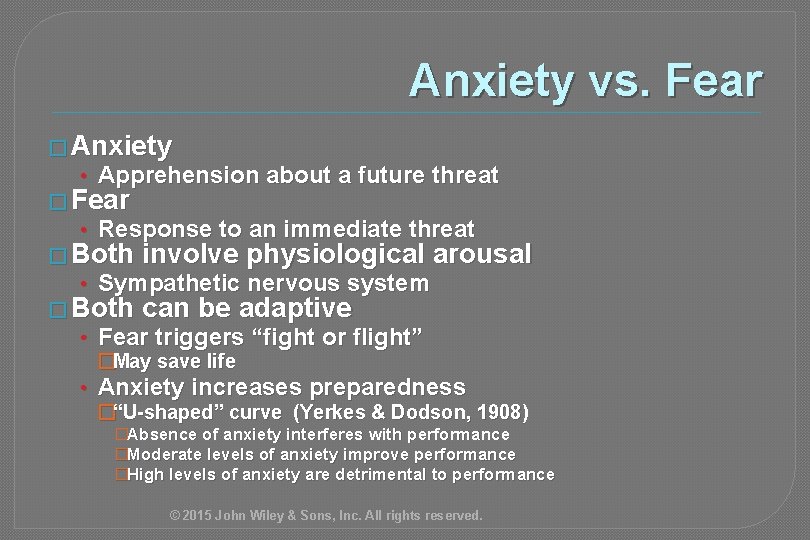
Anxiety vs. Fear � Anxiety • Apprehension about a future threat � Fear • Response to an immediate threat � Both involve physiological arousal � Both can be adaptive • Sympathetic nervous system • Fear triggers “fight or flight” �May save life • Anxiety increases preparedness �“U-shaped” curve (Yerkes & Dodson, 1908) �Absence of anxiety interferes with performance �Moderate levels of anxiety improve performance �High levels of anxiety are detrimental to performance © 2015 John Wiley & Sons, Inc. All rights reserved.
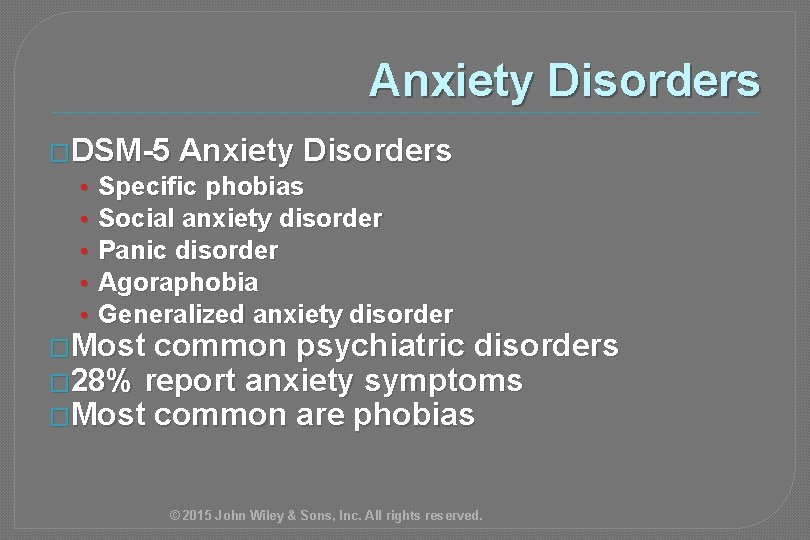
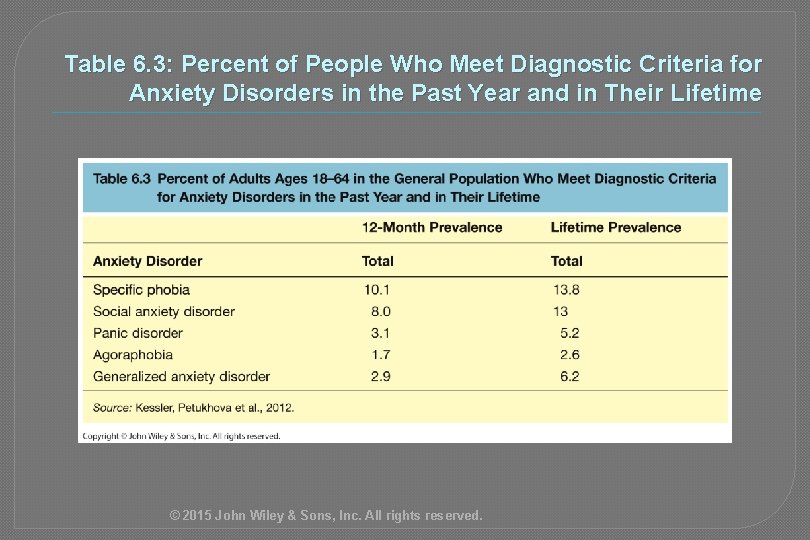
Anxiety Disorders �DSM-5 Anxiety Disorders • Specific phobias • Social anxiety disorder • Panic disorder • Agoraphobia • Generalized anxiety disorder �Most common psychiatric disorders � 28% report anxiety symptoms �Most common are phobias © 2015 John Wiley & Sons, Inc. All rights reserved.
Criteria for Anxiety Disorders �DSM-5 criteria for each disorder: • Symptoms interfere with important areas of functioning or cause marked distress • Symptoms are not caused by a drug or a medical condition • Symptoms persist for at least 6 months or at least 1 month for panic disorder • The fears and anxieties are distinct from the symptoms of another anxiety disorder © 2015 John Wiley & Sons, Inc. All rights reserved.
Phobias � Disruptive • • • fear of a particular object or situation Fear out of proportion to actual threat Awareness that fear is excessive Must be severe enough to cause distress or interfere with job or social life �Avoidance © 2015 John Wiley & Sons, Inc. All rights reserved.
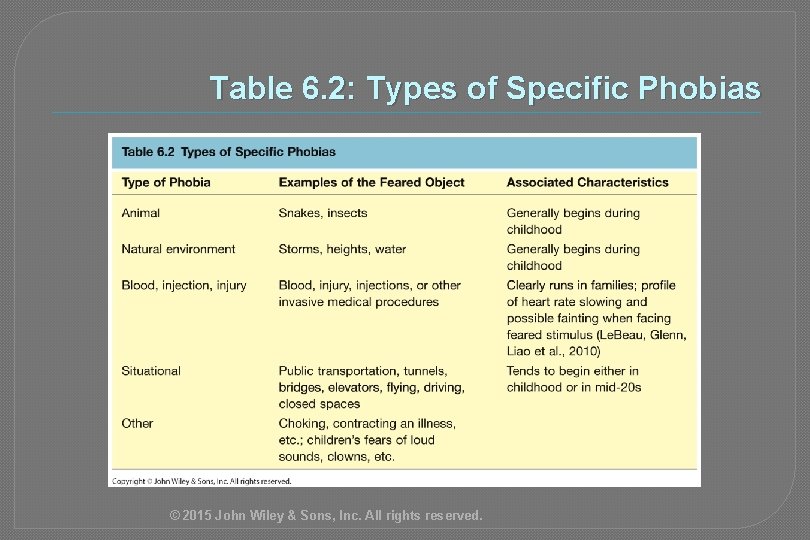
Specific Phobia � Disproportionate fear of a particular object or situation Common examples: fear of flying, snakes, heights, etc. Fear out of proportion to actual threat Awareness that fear is excessive Most specific phobias cluster around a few feared objects and situations • High comorbidity of specific phobias • • © 2015 John Wiley & Sons, Inc. All rights reserved.
DSM-5 Criteria for Specific Phobia � Marked and disproportionate fear consistently triggered by specific objects or situations � The object or situation is avoided or else endured with intense anxiety � Symptoms persist for at least 6 months © 2015 John Wiley & Sons, Inc. All rights reserved.
Table 6. 2: Types of Specific Phobias © 2015 John Wiley & Sons, Inc. All rights reserved.
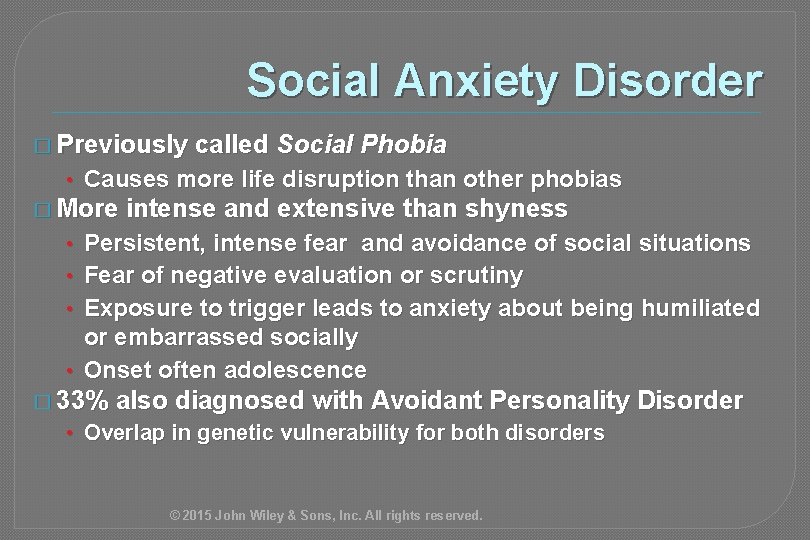
Social Anxiety Disorder � Previously called Social Phobia • Causes more life disruption than other phobias � More intense and extensive than shyness Persistent, intense fear and avoidance of social situations Fear of negative evaluation or scrutiny Exposure to trigger leads to anxiety about being humiliated or embarrassed socially • Onset often adolescence • • • � 33% also diagnosed with Avoidant Personality Disorder • Overlap in genetic vulnerability for both disorders © 2015 John Wiley & Sons, Inc. All rights reserved.
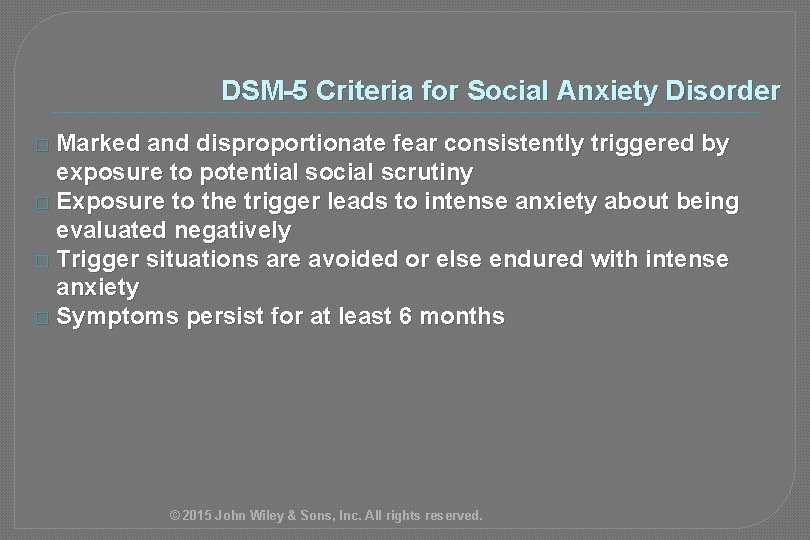
DSM-5 Criteria for Social Anxiety Disorder � Marked and disproportionate fear consistently triggered by exposure to potential social scrutiny � Exposure to the trigger leads to intense anxiety about being evaluated negatively � Trigger situations are avoided or else endured with intense anxiety � Symptoms persist for at least 6 months © 2015 John Wiley & Sons, Inc. All rights reserved.
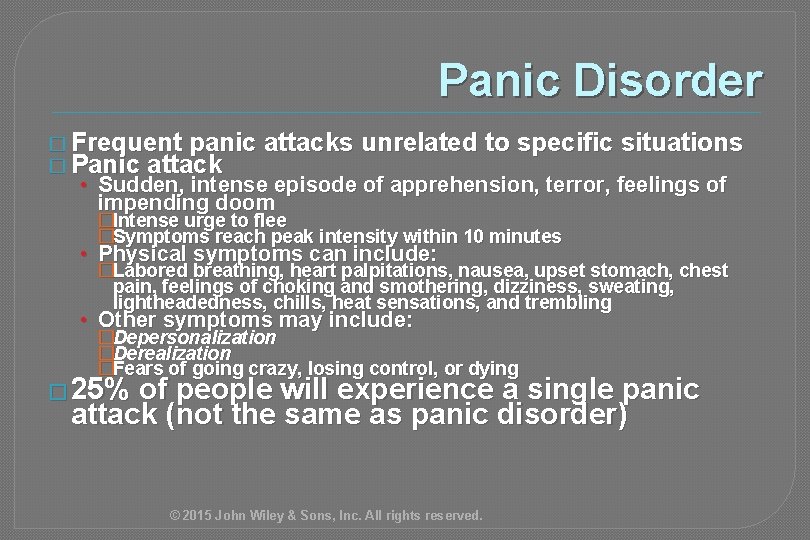
Panic Disorder � Frequent panic � Panic attacks unrelated to specific situations • Sudden, intense episode of apprehension, terror, feelings of impending doom �Intense urge to flee �Symptoms reach peak intensity within 10 minutes • Physical symptoms can include: �Labored breathing, heart palpitations, nausea, upset stomach, chest pain, feelings of choking and smothering, dizziness, sweating, lightheadedness, chills, heat sensations, and trembling • Other symptoms may include: �Depersonalization �Derealization �Fears of going crazy, losing control, or dying � 25% of people will experience a single panic attack (not the same as panic disorder) © 2015 John Wiley & Sons, Inc. All rights reserved.
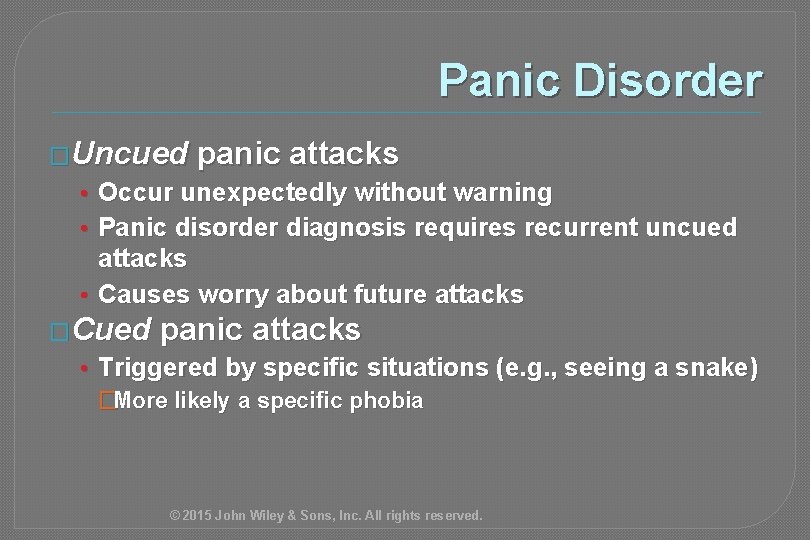
Panic Disorder �Uncued panic attacks • Occur unexpectedly without warning • Panic disorder diagnosis requires recurrent uncued attacks • Causes worry about future attacks �Cued panic attacks • Triggered by specific situations (e. g. , seeing a snake) �More likely a specific phobia © 2015 John Wiley & Sons, Inc. All rights reserved.
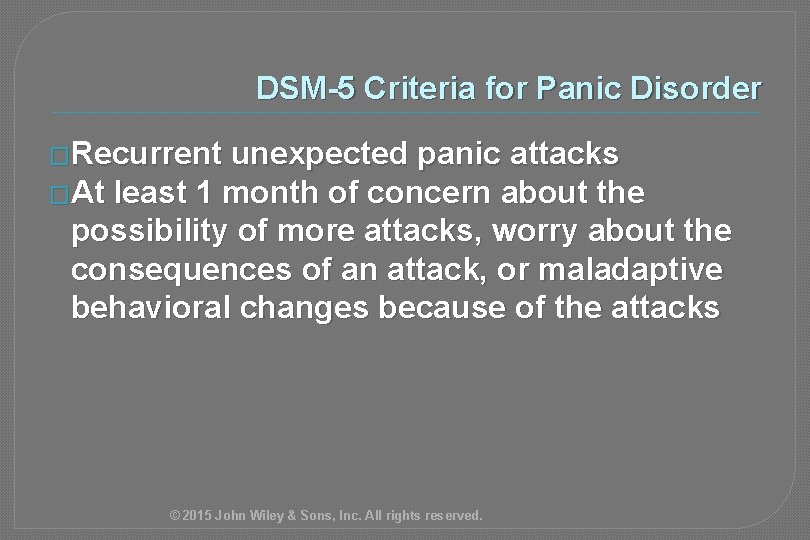
DSM-5 Criteria for Panic Disorder �Recurrent unexpected panic attacks �At least 1 month of concern about the possibility of more attacks, worry about the consequences of an attack, or maladaptive behavioral changes because of the attacks © 2015 John Wiley & Sons, Inc. All rights reserved.
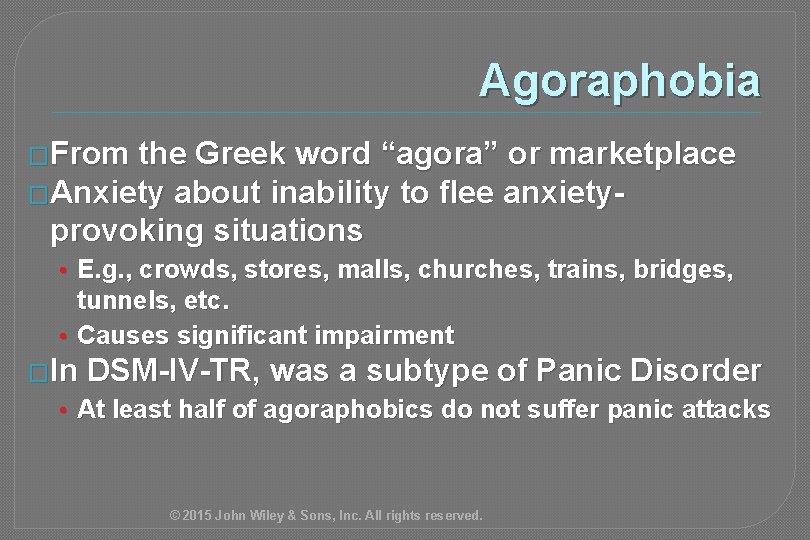
Agoraphobia �From the Greek word “agora” or marketplace �Anxiety about inability to flee anxietyprovoking situations • E. g. , crowds, stores, malls, churches, trains, bridges, tunnels, etc. • Causes significant impairment �In DSM-IV-TR, was a subtype of Panic Disorder • At least half of agoraphobics do not suffer panic attacks © 2015 John Wiley & Sons, Inc. All rights reserved.
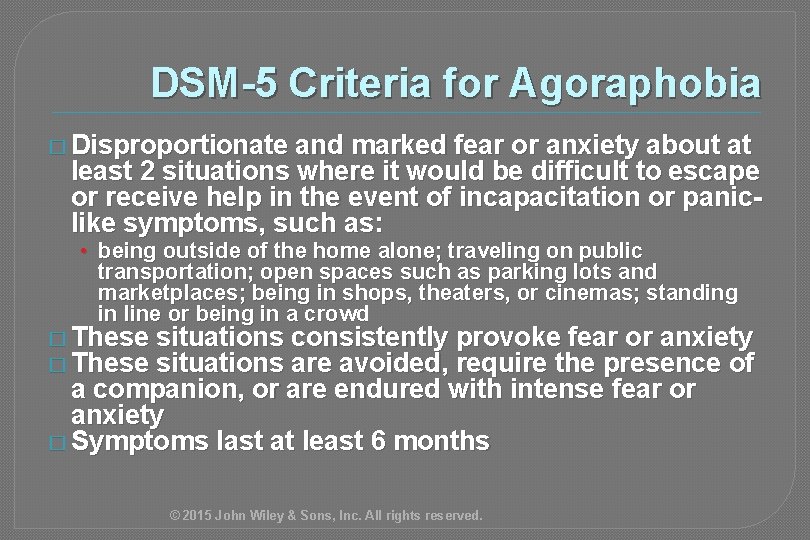
DSM-5 Criteria for Agoraphobia � Disproportionate and marked fear or anxiety about at least 2 situations where it would be difficult to escape or receive help in the event of incapacitation or paniclike symptoms, such as: • being outside of the home alone; traveling on public transportation; open spaces such as parking lots and marketplaces; being in shops, theaters, or cinemas; standing in line or being in a crowd � These situations consistently provoke fear or anxiety situations are avoided, require the presence of a companion, or are endured with intense fear or anxiety � Symptoms last at least 6 months © 2015 John Wiley & Sons, Inc. All rights reserved.
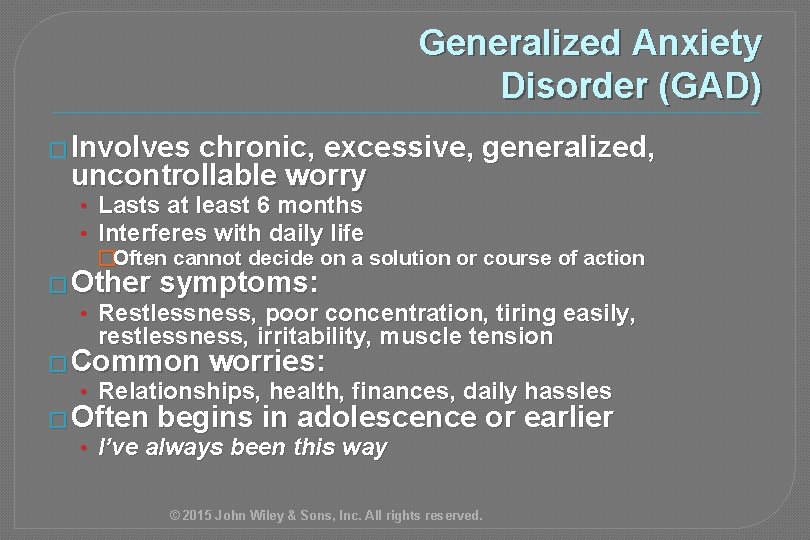
Generalized Anxiety Disorder (GAD) � Involves chronic, excessive, generalized, uncontrollable worry • Lasts at least 6 months • Interferes with daily life �Often cannot decide on a solution or course of action � Other symptoms: • Restlessness, poor concentration, tiring easily, restlessness, irritability, muscle tension � Common worries: • Relationships, health, finances, daily hassles � Often begins in adolescence or earlier • I’ve always been this way © 2015 John Wiley & Sons, Inc. All rights reserved.
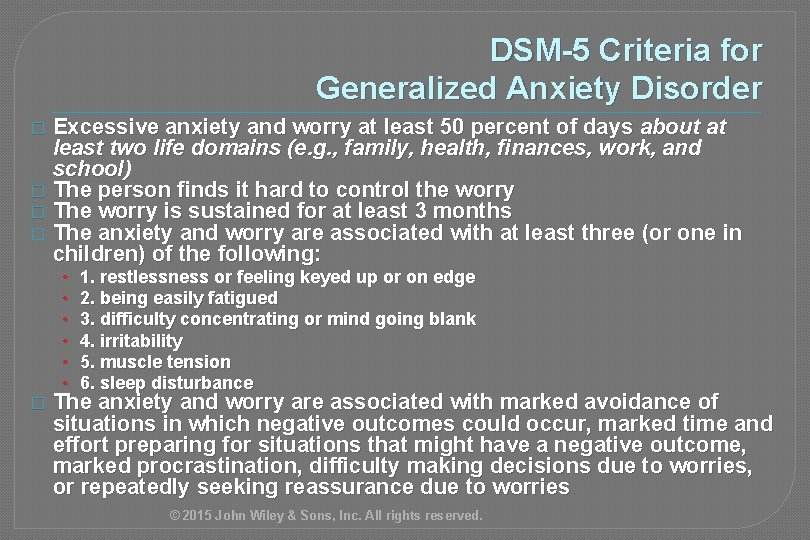
DSM-5 Criteria for Generalized Anxiety Disorder Excessive anxiety and worry at least 50 percent of days about at least two life domains (e. g. , family, health, finances, work, and school) � The person finds it hard to control the worry � The worry is sustained for at least 3 months � The anxiety and worry are associated with at least three (or one in children) of the following: � • • • � 1. restlessness or feeling keyed up or on edge 2. being easily fatigued 3. difficulty concentrating or mind going blank 4. irritability 5. muscle tension 6. sleep disturbance The anxiety and worry are associated with marked avoidance of situations in which negative outcomes could occur, marked time and effort preparing for situations that might have a negative outcome, marked procrastination, difficulty making decisions due to worries, or repeatedly seeking reassurance due to worries © 2015 John Wiley & Sons, Inc. All rights reserved.
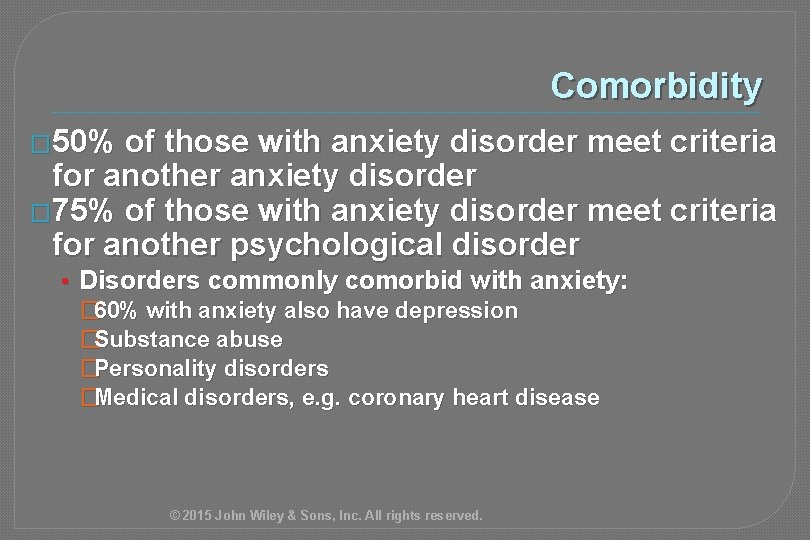
Comorbidity � 50% of those with anxiety disorder meet criteria for another anxiety disorder � 75% of those with anxiety disorder meet criteria for another psychological disorder • Disorders commonly comorbid with anxiety: � 60% with anxiety also have depression �Substance abuse �Personality disorders �Medical disorders, e. g. coronary heart disease © 2015 John Wiley & Sons, Inc. All rights reserved.
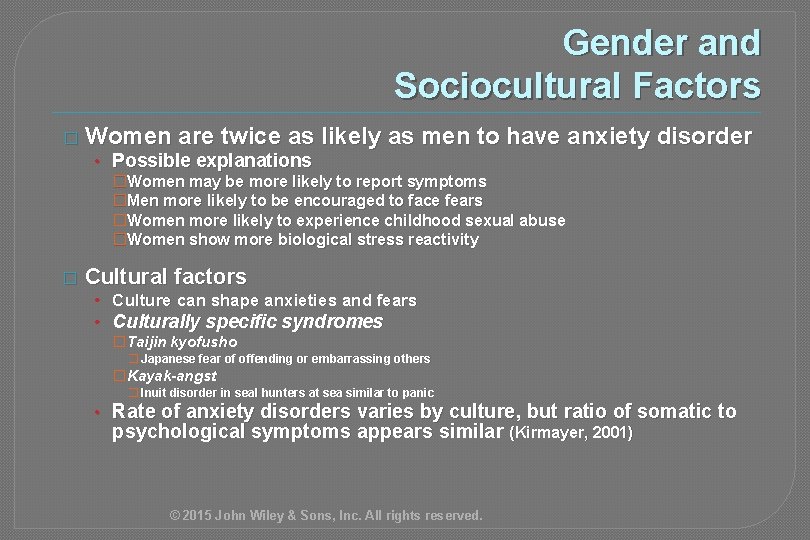
Gender and Sociocultural Factors � Women are twice as likely as men to have anxiety • Possible explanations �Women may be more likely to report symptoms �Men more likely to be encouraged to face fears �Women more likely to experience childhood sexual abuse �Women show more biological stress reactivity � disorder Cultural factors • Culture can shape anxieties and fears • Culturally specific syndromes �Taijin kyofusho � Japanese fear of offending or embarrassing others �Kayak-angst � Inuit disorder in seal hunters at sea similar to panic • Rate of anxiety disorders varies by culture, but ratio of somatic to psychological symptoms appears similar (Kirmayer, 2001) © 2015 John Wiley & Sons, Inc. All rights reserved.
Table 6. 3: Percent of People Who Meet Diagnostic Criteria for Anxiety Disorders in the Past Year and in Their Lifetime © 2015 John Wiley & Sons, Inc. All rights reserved.
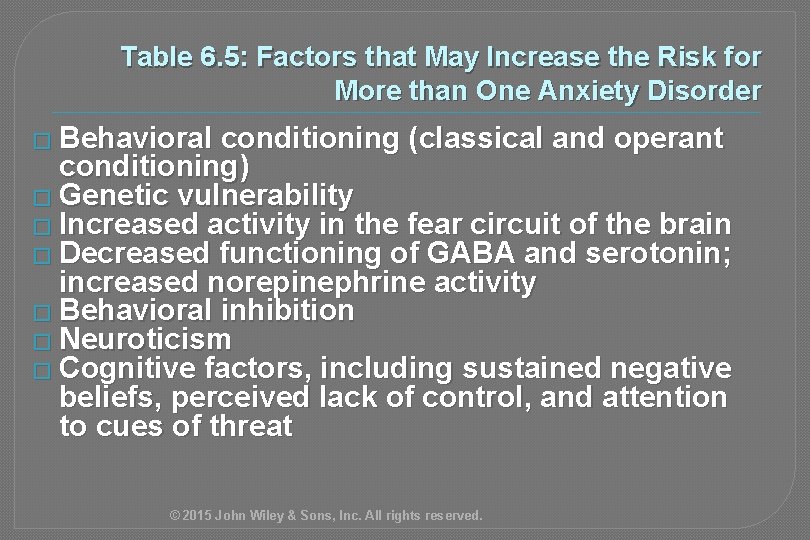
Table 6. 5: Factors that May Increase the Risk for More than One Anxiety Disorder � Behavioral conditioning (classical and operant conditioning) � Genetic vulnerability � Increased activity in the fear circuit of the brain � Decreased functioning of GABA and serotonin; increased norepinephrine activity � Behavioral inhibition � Neuroticism � Cognitive factors, including sustained negative beliefs, perceived lack of control, and attention to cues of threat © 2015 John Wiley & Sons, Inc. All rights reserved.
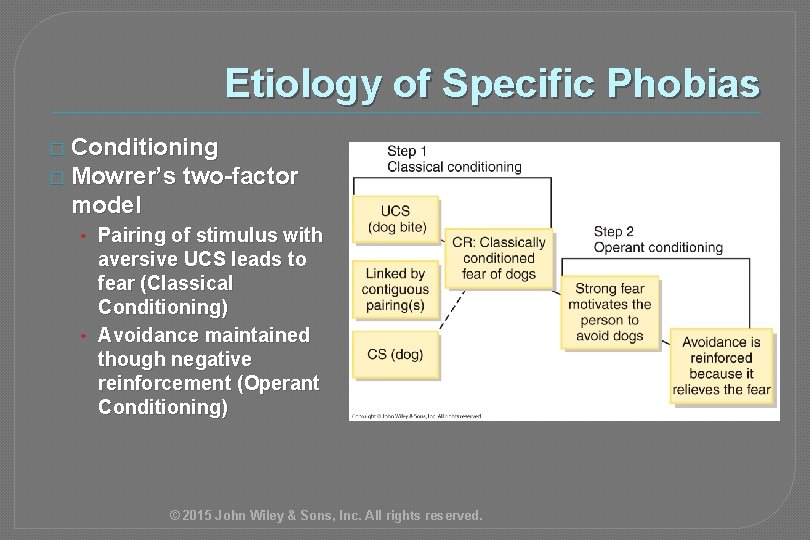
Etiology of Specific Phobias � Conditioning � Mowrer’s two-factor model • Pairing of stimulus with aversive UCS leads to fear (Classical Conditioning) • Avoidance maintained though negative reinforcement (Operant Conditioning) © 2015 John Wiley & Sons, Inc. All rights reserved.
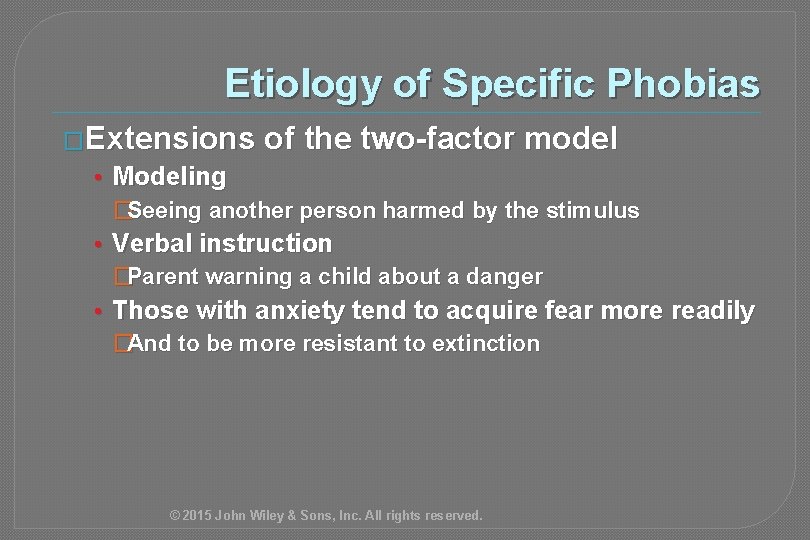
Etiology of Specific Phobias �Extensions of the two-factor model • Modeling �Seeing another person harmed by the stimulus • Verbal instruction �Parent warning a child about a danger • Those with anxiety tend to acquire fear more readily �And to be more resistant to extinction © 2015 John Wiley & Sons, Inc. All rights reserved.
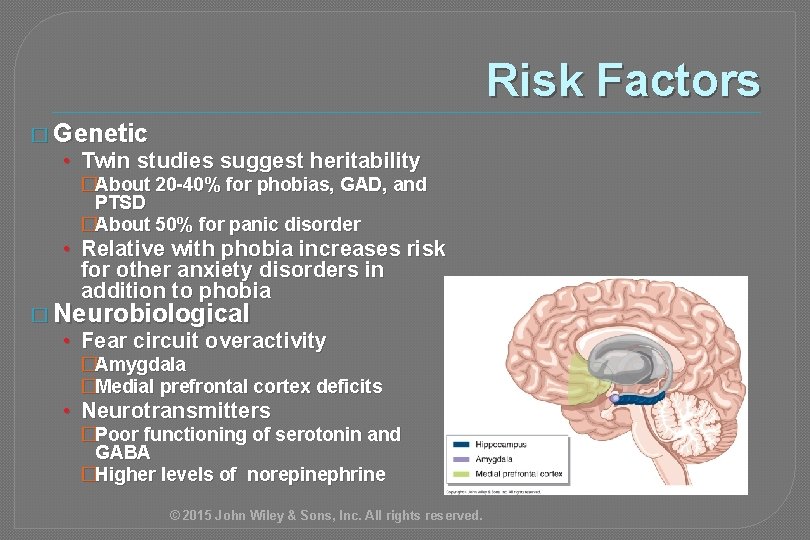
Risk Factors � Genetic • Twin studies suggest heritability �About 20 -40% for phobias, GAD, and PTSD �About 50% for panic disorder • Relative with phobia increases risk for other anxiety disorders in addition to phobia � Neurobiological • Fear circuit overactivity �Amygdala �Medial prefrontal cortex deficits • Neurotransmitters �Poor functioning of serotonin and GABA �Higher levels of norepinephrine © 2015 John Wiley & Sons, Inc. All rights reserved.
Risk Factors: Personality � Behavioral inhibition • Tendency to be agitated, distressed, and cry in unfamiliar or novel settings �Observed in infants as young as 4 months �May be inherited • Predicts anxiety in childhood and social anxiety in adolescence � Neuroticism • • • Tendency to react with frequent negative affect Linked to anxiety and depression Higher levels linked to double the likelihood of developing anxiety disorders © 2015 John Wiley & Sons, Inc. All rights reserved.
Risk Factors: Cognitive �Sustained negative beliefs about future • Bad things will happen • Engage in safety behaviors �Belief that one lacks control over environment • More vulnerable to developing anxiety disorder �Childhood trauma or punitive parenting may foster beliefs �Serious life events can threaten sense of control �Attention to threat • Tendency to notice negative environmental cues �Selective attention to signs of threat © 2015 John Wiley & Sons, Inc. All rights reserved.
Etiology of Specific Phobias �Two-factor model of behavioral conditioning • Conditioned responses to threat • Sustained by avoidance or safety behaviors �Avoid eye contact, appear aloof, stand apart from others in social settings �Risk factors act as diatheses • Vulnerabilities influence development of phobias �Prepared learning • Evolutionary preparation to fear certain stimuli �Potentially life-threatening (heights, snakes, etc. ) © 2015 John Wiley & Sons, Inc. All rights reserved.
Etiology of Social Anxiety Disorder �Behavioral factors • Factors similar to specific phobia (i. e. , classical and operant conditioning) �Cognitive factors • Unrealistic negative beliefs about consequences of behaviors • Excessive attention to internal cues • Fear of negative evaluation by others �Expect others to dislike them • Negative self-evaluation �Harsh, punitive self-judgment © 2015 John Wiley & Sons, Inc. All rights reserved.
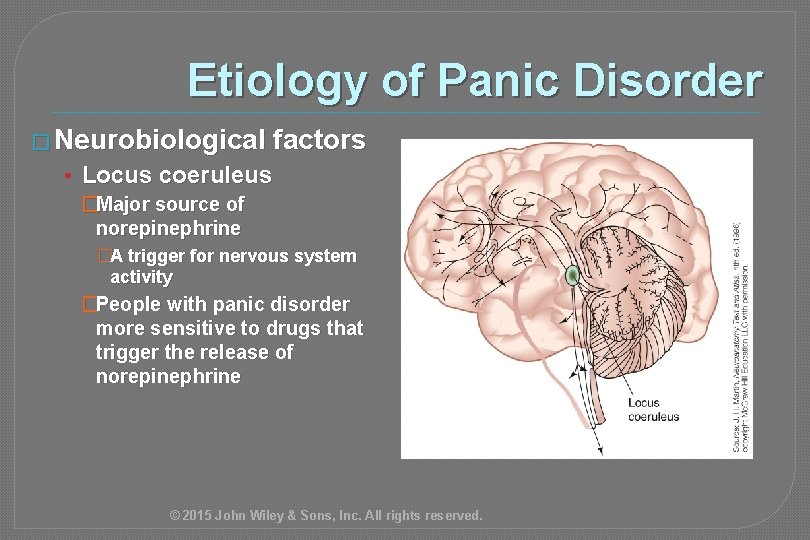
Etiology of Panic Disorder � Neurobiological factors • Locus coeruleus �Major source of norepinephrine �A trigger for nervous system activity �People with panic disorder more sensitive to drugs that trigger the release of norepinephrine © 2015 John Wiley & Sons, Inc. All rights reserved.
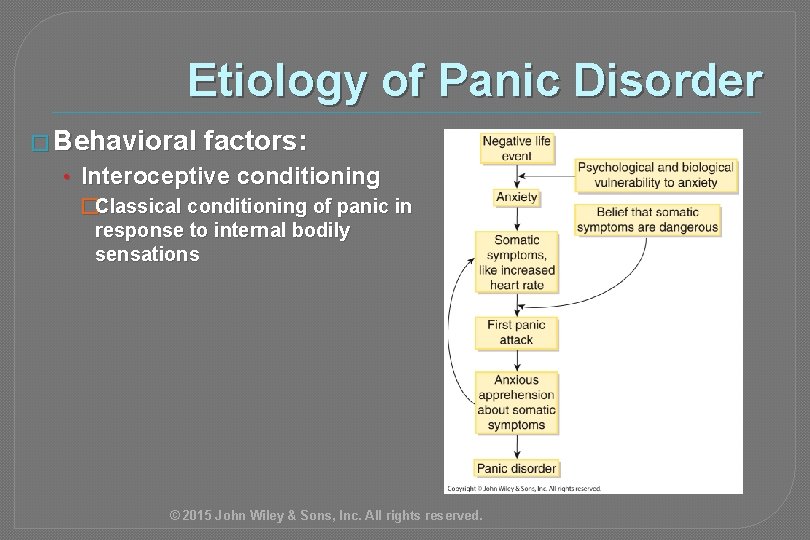
Etiology of Panic Disorder � Behavioral factors: • Interoceptive conditioning �Classical conditioning of panic in response to internal bodily sensations © 2015 John Wiley & Sons, Inc. All rights reserved.
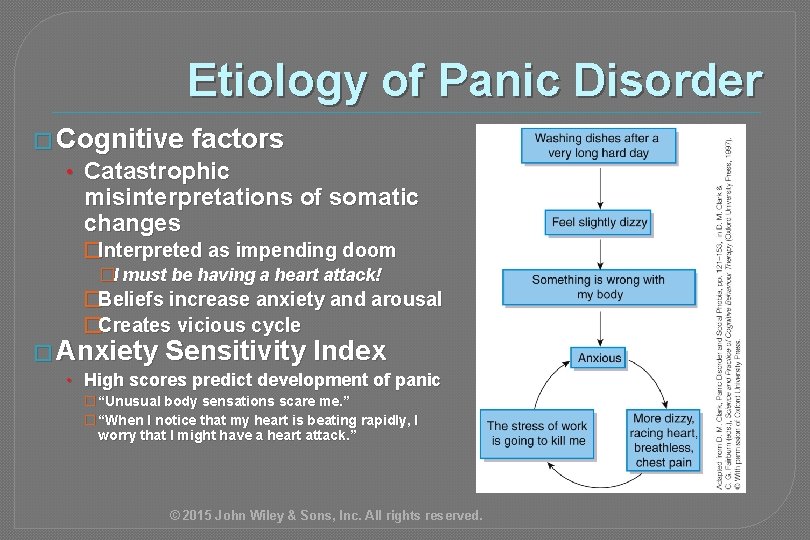
Etiology of Panic Disorder � Cognitive factors • Catastrophic misinterpretations of somatic changes �Interpreted as impending doom �I must be having a heart attack! �Beliefs increase anxiety and arousal �Creates vicious cycle � Anxiety Sensitivity Index • High scores predict development of panic � “Unusual body sensations scare me. ” � “When I notice that my heart is beating rapidly, I worry that I might have a heart attack. ” © 2015 John Wiley & Sons, Inc. All rights reserved.
Etiology of Panic Disorder �Genetic risk • Polymorphism in a gene guiding neuropeptide S function, the NPSR 1 gene, has been tied to an increased risk of panic disorder and is associated with: �Amygdala response to threat �Cortisol response �Higher anxiety sensitivity scores • Genetic risk shapes stress responses and hypersensitivity to somatic changes, and this may then increase the risk for panic disorder. © 2015 John Wiley & Sons, Inc. All rights reserved.
Etiology of Agoraphobia �Fear-of-fear hypothesis (Goldstein & Chambless, 1978) • Expectations about the catastrophic consequences of having a public panic attack �What will people think of me? !? ! © 2015 John Wiley & Sons, Inc. All rights reserved.
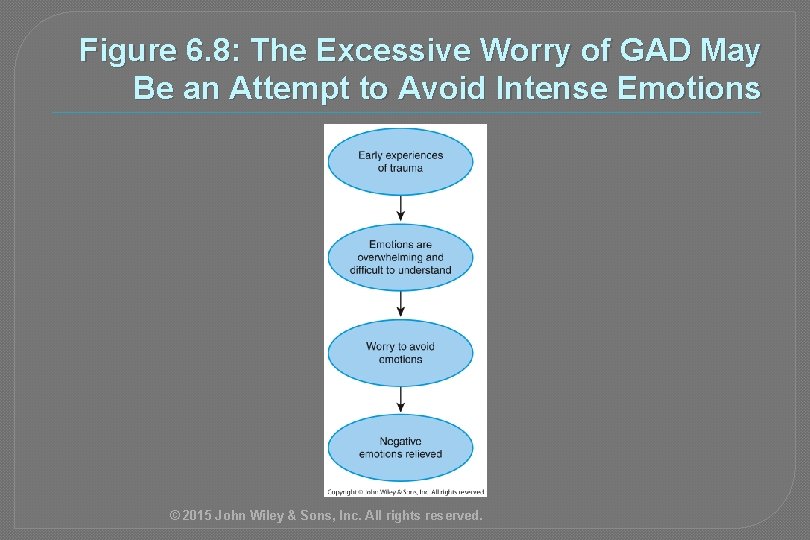
Etiology of GAD �GABA system deficits �Borkovec’s cognitive model: • Worry reinforcing because it distracts from negative emotions and images • Allows avoidance of more disturbing emotions �e. g. , distress of previous trauma • Worrying decreases psychophysiological arousal • Avoidance prevents extinction of underlying anxiety © 2015 John Wiley & Sons, Inc. All rights reserved.
Figure 6. 8: The Excessive Worry of GAD May Be an Attempt to Avoid Intense Emotions © 2015 John Wiley & Sons, Inc. All rights reserved.
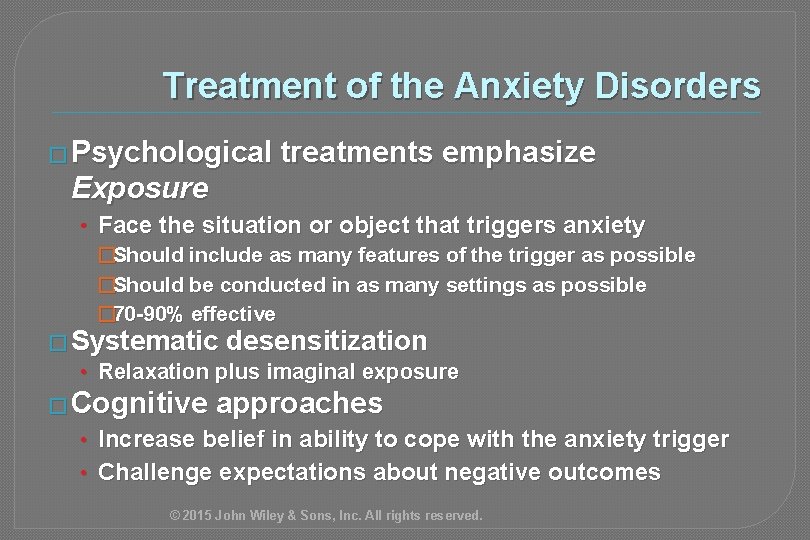
Treatment of the Anxiety Disorders � Psychological treatments emphasize Exposure • Face the situation or object that triggers anxiety �Should include as many features of the trigger as possible �Should be conducted in as many settings as possible � 70 -90% effective � Systematic desensitization • Relaxation plus imaginal exposure � Cognitive approaches • Increase belief in ability to cope with the anxiety trigger • Challenge expectations about negative outcomes © 2015 John Wiley & Sons, Inc. All rights reserved.
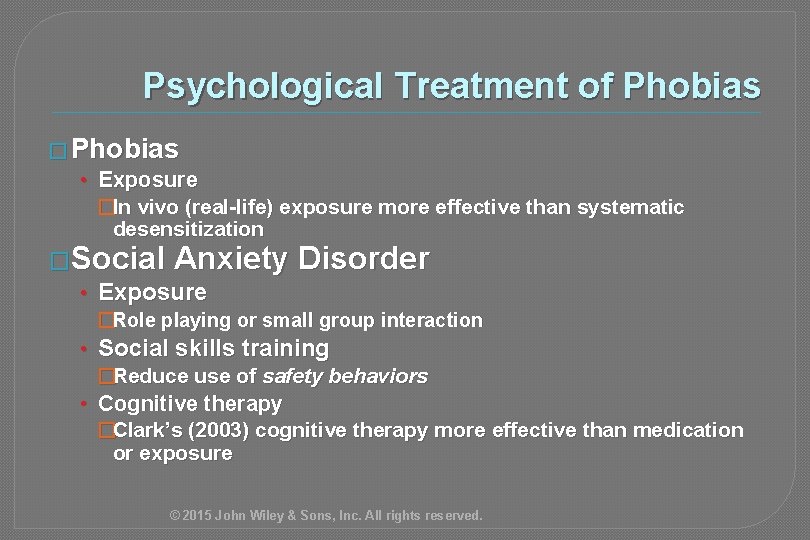
Psychological Treatment of Phobias � Phobias • Exposure �In vivo (real-life) exposure more effective than systematic desensitization �Social Anxiety • Exposure Disorder �Role playing or small group interaction • Social skills training �Reduce use of safety behaviors • Cognitive therapy �Clark’s (2003) cognitive therapy more effective than medication or exposure © 2015 John Wiley & Sons, Inc. All rights reserved.
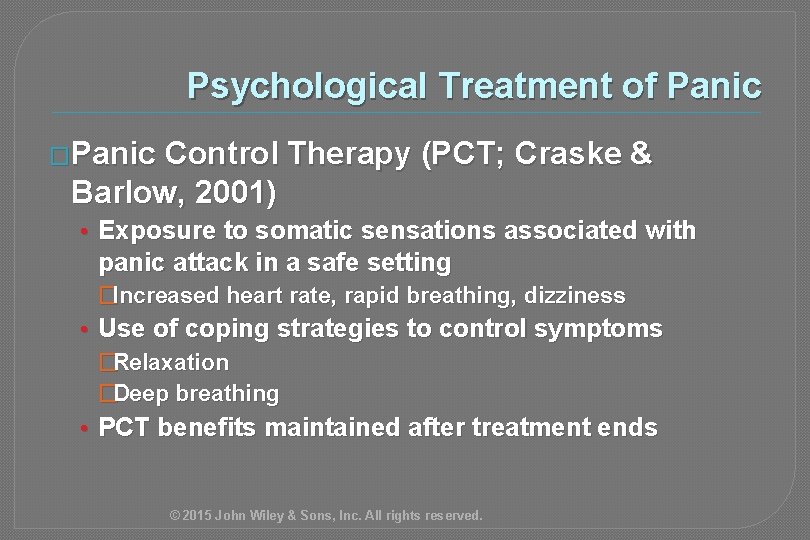
Psychological Treatment of Panic �Panic Control Therapy (PCT; Craske & Barlow, 2001) • Exposure to somatic sensations associated with panic attack in a safe setting �Increased heart rate, rapid breathing, dizziness • Use of coping strategies to control symptoms �Relaxation �Deep breathing • PCT benefits maintained after treatment ends © 2015 John Wiley & Sons, Inc. All rights reserved.
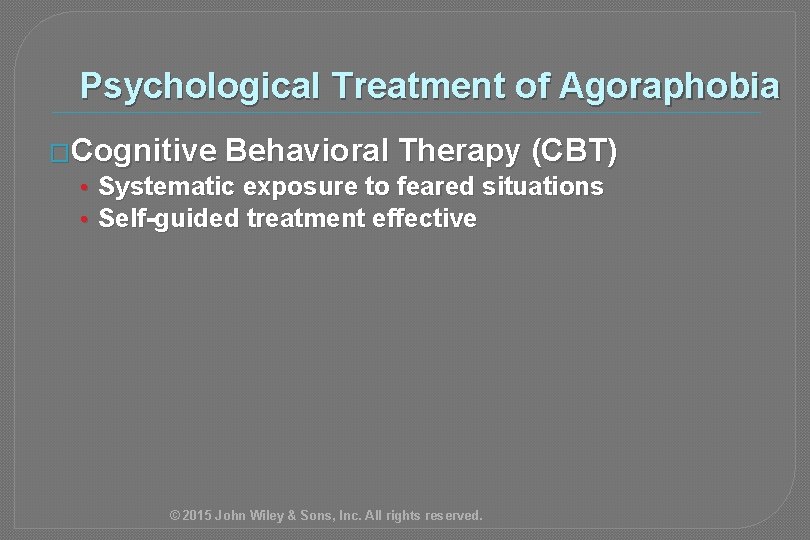
Psychological Treatment of Agoraphobia �Cognitive Behavioral Therapy (CBT) • Systematic exposure to feared situations • Self-guided treatment effective © 2015 John Wiley & Sons, Inc. All rights reserved.
Psychological Treatment of GAD � Relaxation training � Cognitive behavioral methods • • Challenge and modify negative thoughts Increase ability to tolerate uncertainty Worry only during “scheduled” times Focus on present moment © 2015 John Wiley & Sons, Inc. All rights reserved.
Medications � Anxiolytics: drugs • Benzodiazepenes that reduce anxiety �Valium � Xanax • Antidepressants �Tricyclics �Selective Serotonin Reuptake Inhibitors (SSRIs) �Serotonin-Norepinephrine Reuptake Inhibitors (SNRIs) • Side effects can be problematic with continuing medication �D-cycloserine (DCS) �Enhances learning and can bolstered treatment effectiveness © 2015 John Wiley & Sons, Inc. All rights reserved.
COPYRIGHT Copyright 2015 by John Wiley & Sons, Inc. All rights reserved. No part of the material protected by this copyright may be reproduced or utilized in any form or by any means, electronic or mechanical, including photocopying, recording or by any information storage and retrieval system, without written permission of the copyright owner. © 2015 John Wiley & Sons, Inc. All rights reserved.