
Power Point for Optoelectronics and Photonics Principles and



- Slides: 60
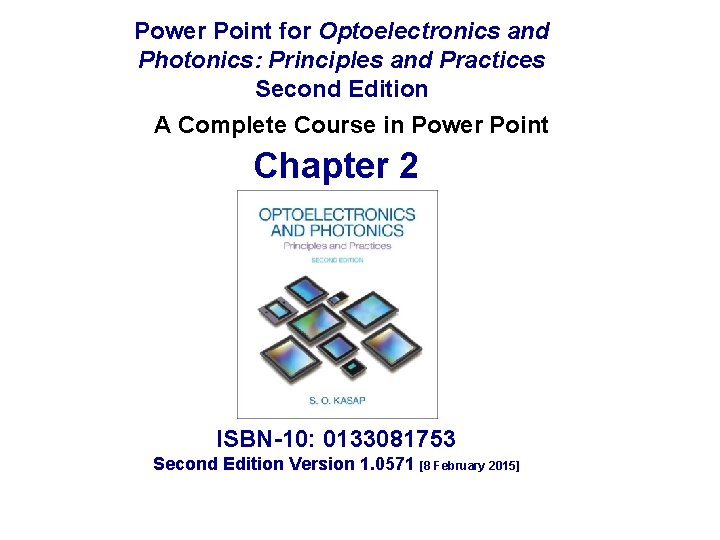
Power Point for Optoelectronics and Photonics: Principles and Practices Second Edition A Complete Course in Power Point Chapter 2 ISBN-10: 0133081753 Second Edition Version 1. 0571 [8 February 2015]
Updates and Corrected Slides Class Demonstrations Class Problems Check author’s website http: //optoelectronics. usask. ca Email errors and corrections to safa. kasap@yahoo. com
Slides on Selected Topics on Optoelectronics may be available at the author website http: //optoelectronics. usask. ca Email errors and corrections to safa. kasap@yahoo. com
Copyright Information and Permission: Part I This Power Point presentation is a copyrighted supplemental material to the textbook Optoelectronics and Photonics: Principles & Practices, Second Edition, S. O. Kasap, Pearson Education (USA), ISBN-10: 0132151499, ISBN-13: 9780132151498. © 2013 Pearson Education. Permission is given to instructors to use these Power Point slides in their lectures provided that the above book has been adopted as a primary required textbook for the course. Slides may be used in research seminars at research meetings, symposia and conferences provided that the author, book title, and copyright information are clearly displayed under each figure. It is unlawful to use the slides for teaching if the textbook is not a required primary book for the course. The slides cannot be distributed in any form whatsoever, especially on the internet, without the written permission of Pearson Education. Please report typos and errors directly to the author: safa. kasap@yahoo. com
PEARSON Copyright Information and Permission: Part II This Power Point presentation is a copyrighted supplemental material to the textbook Optoelectronics and Photonics: Principles & Practices, Second Edition, S. O. Kasap, Pearson Education (USA), ISBN-10: 0132151499, ISBN-13: 9780132151498. © 2013 Pearson Education. The slides cannot be distributed in any form whatsoever, electronically or in print form, without the written permission of Pearson Education. It is unlawful to post these slides, or part of a slide or slides, on the internet. Copyright © 2013, 2001 by Pearson Education, Inc. , Upper Saddle River, New Jersey, 07458. All rights reserved. Printed in the United States of America. This publication is protected by Copyright and permission should be obtained from the publisher prior to any prohibited reproduction, storage in a retrieval system, or transmission in any form or by any means, electronic, mechanical, photocopying, recording, or likewise. For information regarding permission(s), write to: Rights and Permissions Department.
Important Note You may use color illustrations from this Power Point in your research-related seminars or research-related presentations at scientific or technical meetings, symposia or conferences provided that you fully cite the following reference under each figure From: S. O. Kasap, Optoelectronics and Photonics: Principles and Practices, Second Edition, © 2013 Pearson Education, USA
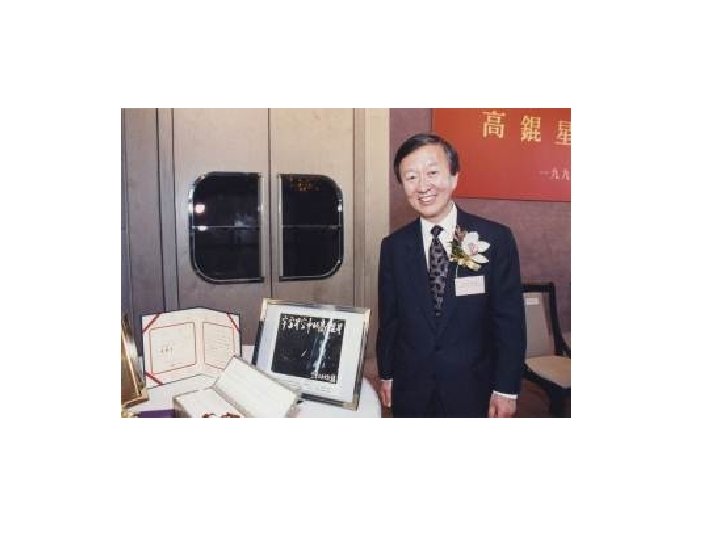
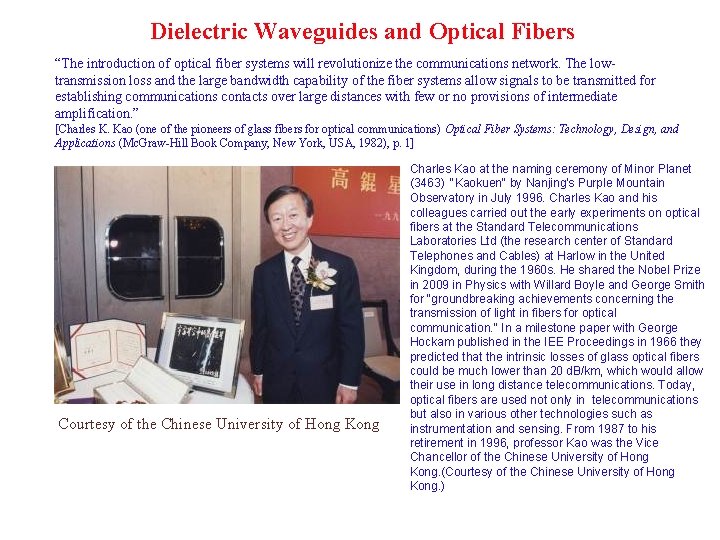
Chapter 2 Dielectric Waveguides and Optical Fibers Charles Kao, Nobel Laureate (2009) Courtesy of the Chinese University of Hong Kong
Dielectric Waveguides and Optical Fibers “The introduction of optical fiber systems will revolutionize the communications network. The lowtransmission loss and the large bandwidth capability of the fiber systems allow signals to be transmitted for establishing communications contacts over large distances with few or no provisions of intermediate amplification. ” [Charles K. Kao (one of the pioneers of glass fibers for optical communications) Optical Fiber Systems: Technology, Design, and Applications (Mc. Graw-Hill Book Company, New York, USA, 1982), p. 1] Courtesy of the Chinese University of Hong Kong Charles Kao at the naming ceremony of Minor Planet (3463) "Kaokuen" by Nanjing's Purple Mountain Observatory in July 1996. Charles Kao and his colleagues carried out the early experiments on optical fibers at the Standard Telecommunications Laboratories Ltd (the research center of Standard Telephones and Cables) at Harlow in the United Kingdom, during the 1960 s. He shared the Nobel Prize in 2009 in Physics with Willard Boyle and George Smith for "groundbreaking achievements concerning the transmission of light in fibers for optical communication. " In a milestone paper with George Hockam published in the IEE Proceedings in 1966 they predicted that the intrinsic losses of glass optical fibers could be much lower than 20 d. B/km, which would allow their use in long distance telecommunications. Today, optical fibers are used not only in telecommunications but also in various other technologies such as instrumentation and sensing. From 1987 to his retirement in 1996, professor Kao was the Vice Chancellor of the Chinese University of Hong Kong. (Courtesy of the Chinese University of Hong Kong. )
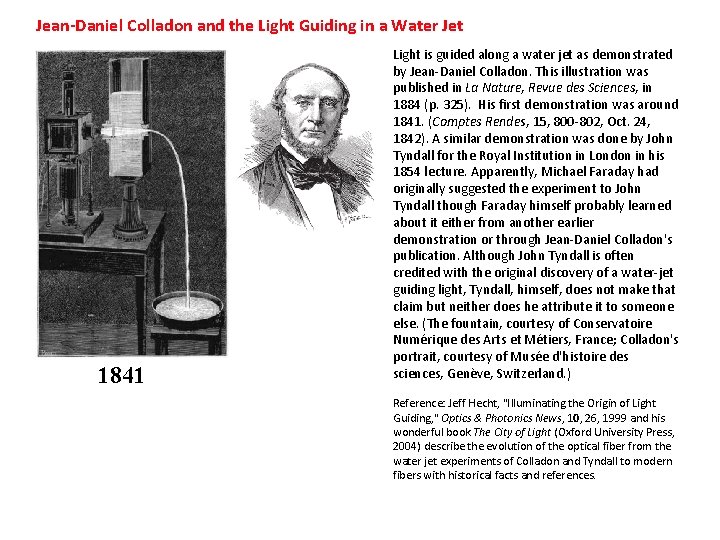
Jean-Daniel Colladon and the Light Guiding in a Water Jet 1841 Light is guided along a water jet as demonstrated by Jean-Daniel Colladon. This illustration was published in La Nature, Revue des Sciences, in 1884 (p. 325). His first demonstration was around 1841. (Comptes Rendes, 15, 800 -802, Oct. 24, 1842). A similar demonstration was done by John Tyndall for the Royal Institution in London in his 1854 lecture. Apparently, Michael Faraday had originally suggested the experiment to John Tyndall though Faraday himself probably learned about it either from another earlier demonstration or through Jean-Daniel Colladon's publication. Although John Tyndall is often credited with the original discovery of a water-jet guiding light, Tyndall, himself, does not make that claim but neither does he attribute it to someone else. (The fountain, courtesy of Conservatoire Numérique des Arts et Métiers, France; Colladon's portrait, courtesy of Musée d'histoire des sciences, Genève, Switzerland. ) Reference: Jeff Hecht, "Illuminating the Origin of Light Guiding, " Optics & Photonics News, 10, 26, 1999 and his wonderful book The City of Light (Oxford University Press, 2004) describe the evolution of the optical fiber from the water jet experiments of Colladon and Tyndall to modern fibers with historical facts and references.
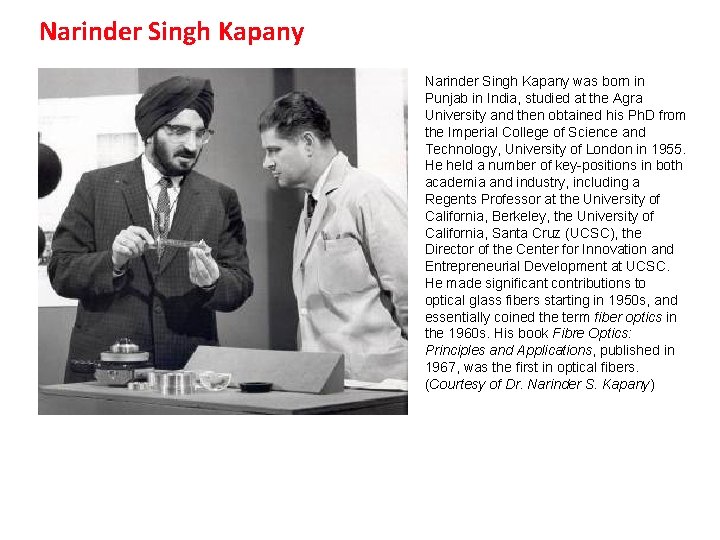
Narinder Singh Kapany was born in Punjab in India, studied at the Agra University and then obtained his Ph. D from the Imperial College of Science and Technology, University of London in 1955. He held a number of key-positions in both academia and industry, including a Regents Professor at the University of California, Berkeley, the University of California, Santa Cruz (UCSC), the Director of the Center for Innovation and Entrepreneurial Development at UCSC. He made significant contributions to optical glass fibers starting in 1950 s, and essentially coined the term fiber optics in the 1960 s. His book Fibre Optics: Principles and Applications, published in 1967, was the first in optical fibers. (Courtesy of Dr. Narinder S. Kapany)
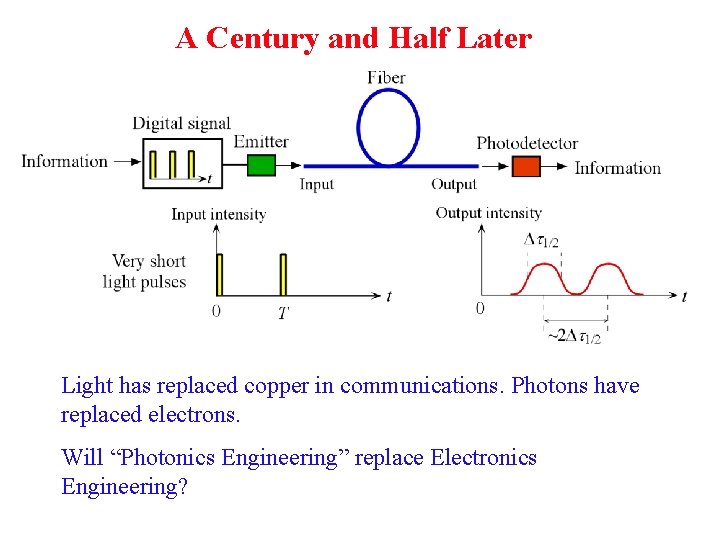
A Century and Half Later Light has replaced copper in communications. Photons have replaced electrons. Will “Photonics Engineering” replace Electronics Engineering?
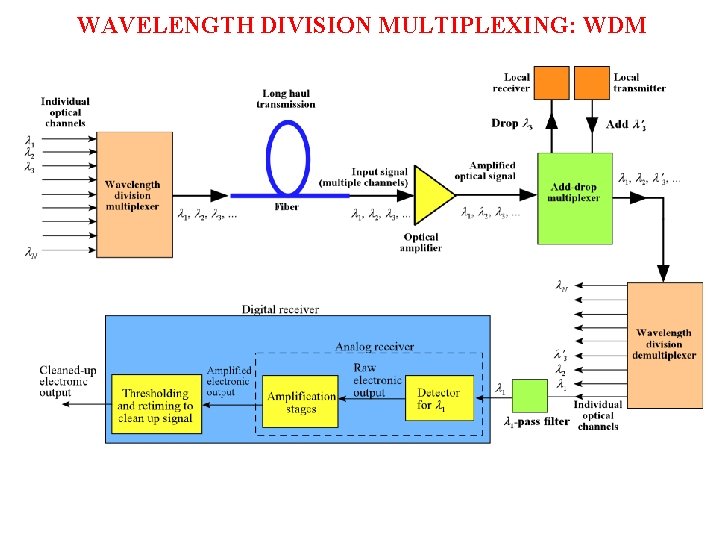
WAVELENGTH DIVISION MULTIPLEXING: WDM
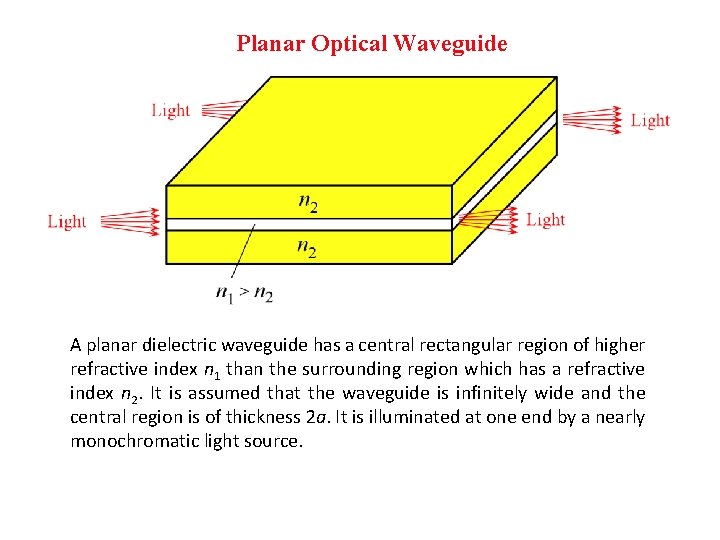
Planar Optical Waveguide A planar dielectric waveguide has a central rectangular region of higher refractive index n 1 than the surrounding region which has a refractive index n 2. It is assumed that the waveguide is infinitely wide and the central region is of thickness 2 a. It is illuminated at one end by a nearly monochromatic light source.
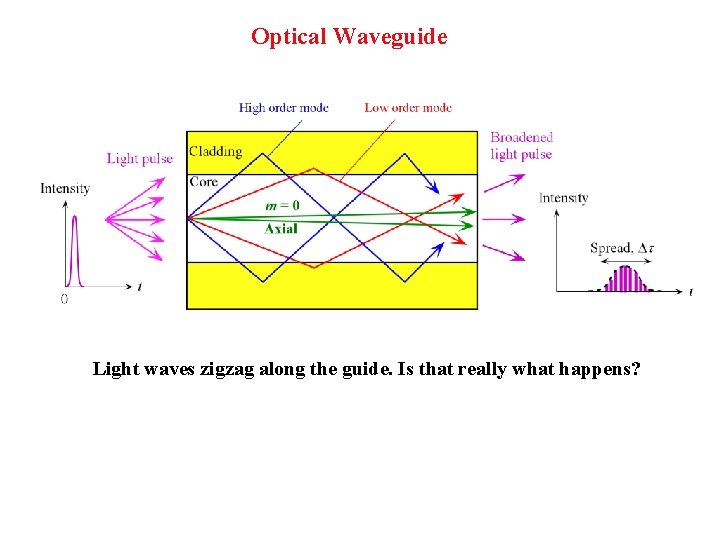
Optical Waveguide Light waves zigzag along the guide. Is that really what happens?
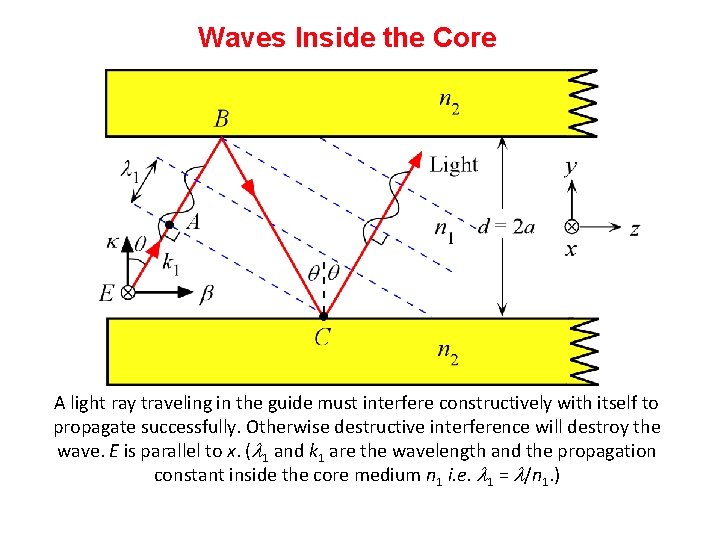
Waves Inside the Core A light ray traveling in the guide must interfere constructively with itself to propagate successfully. Otherwise destructive interference will destroy the wave. E is parallel to x. ( 1 and k 1 are the wavelength and the propagation constant inside the core medium n 1 i. e. 1 = /n 1. )
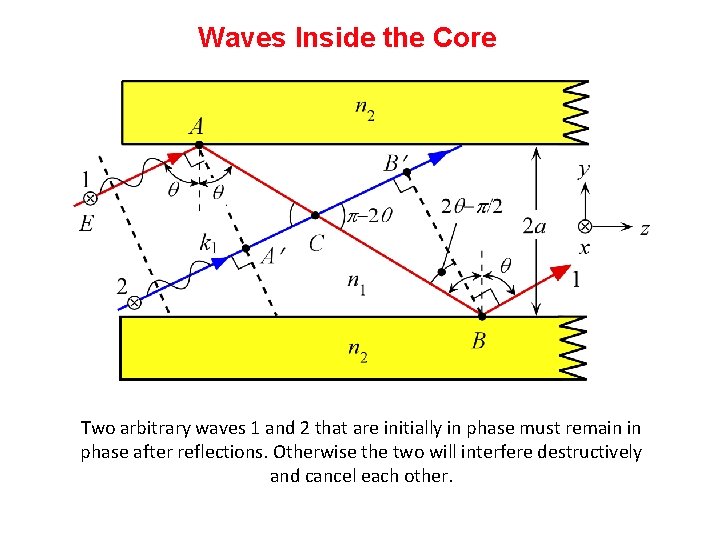
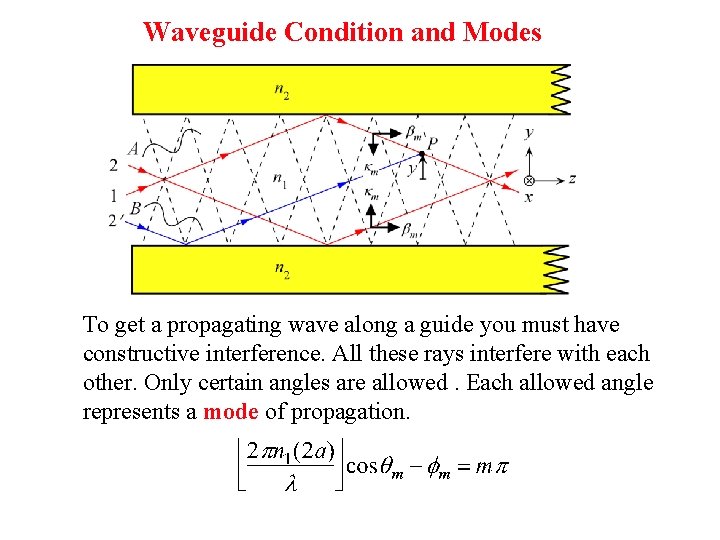
Waves Inside the Core Two arbitrary waves 1 and 2 that are initially in phase must remain in phase after reflections. Otherwise the two will interfere destructively and cancel each other.
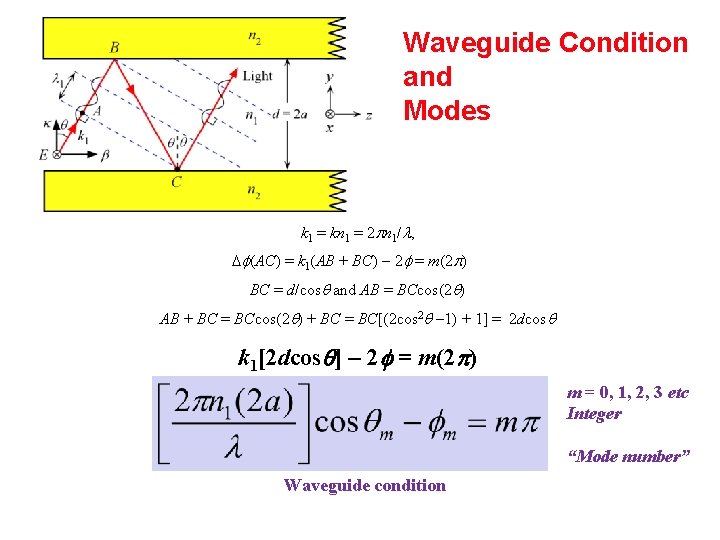
Waveguide Condition and Modes k 1 = kn 1 = 2 n 1/ , f(AC) = k 1(AB + BC) 2 f = m(2 ) BC = d/cosq and AB = BCcos(2 q) AB + BC = BCcos(2 q) + BC = BC[(2 cos 2 q 1) + 1] = 2 dcosq k 1[2 dcosq] - 2 = m(2 p) m = 0, 1, 2, 3 etc Integer “Mode number” Waveguide condition
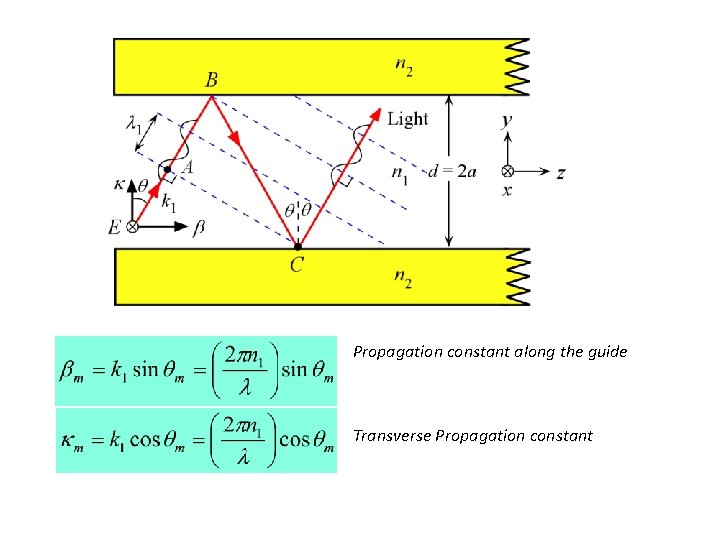
Propagation constant along the guide Transverse Propagation constant
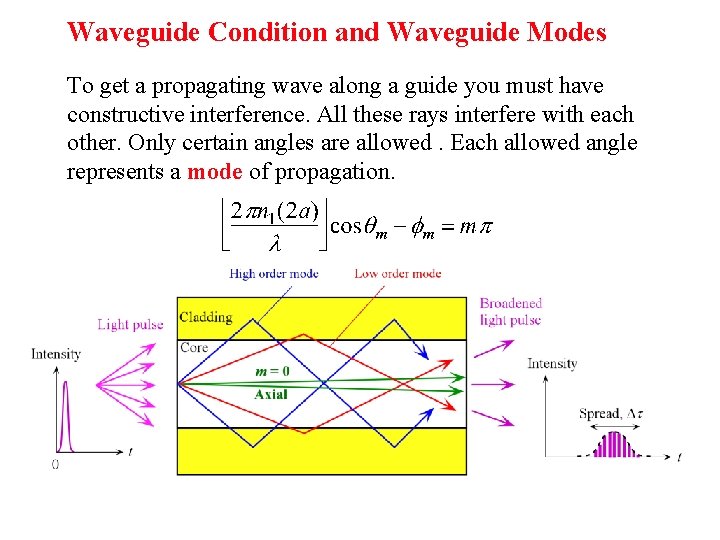
Waveguide Condition and Waveguide Modes To get a propagating wave along a guide you must have constructive interference. All these rays interfere with each other. Only certain angles are allowed. Each allowed angle represents a mode of propagation.
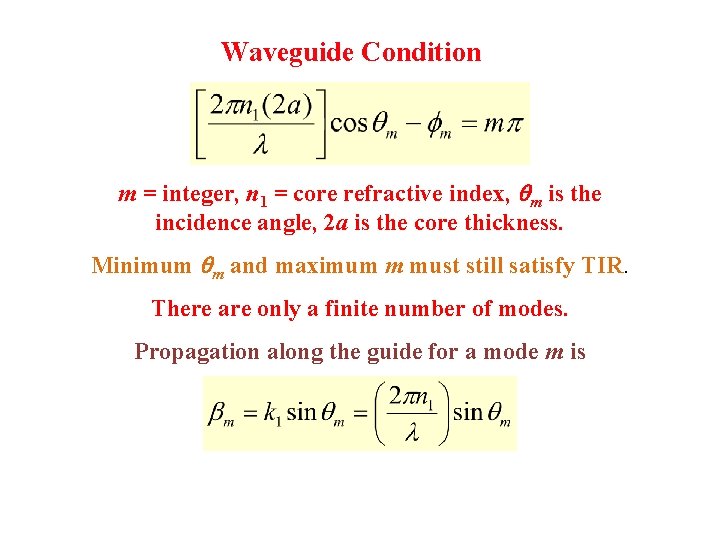
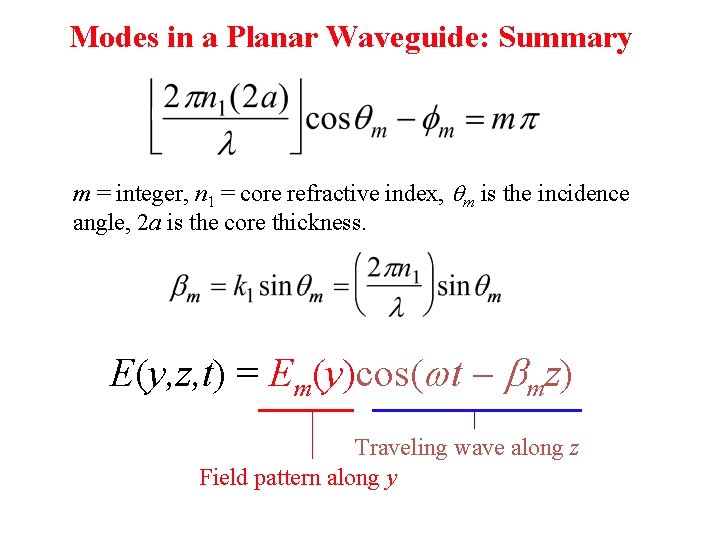
Waveguide Condition m = integer, n 1 = core refractive index, qm is the incidence angle, 2 a is the core thickness. Minimum qm and maximum m must still satisfy TIR. There are only a finite number of modes. Propagation along the guide for a mode m is
Waveguide Condition and Modes To get a propagating wave along a guide you must have constructive interference. All these rays interfere with each other. Only certain angles are allowed. Each allowed angle represents a mode of propagation.
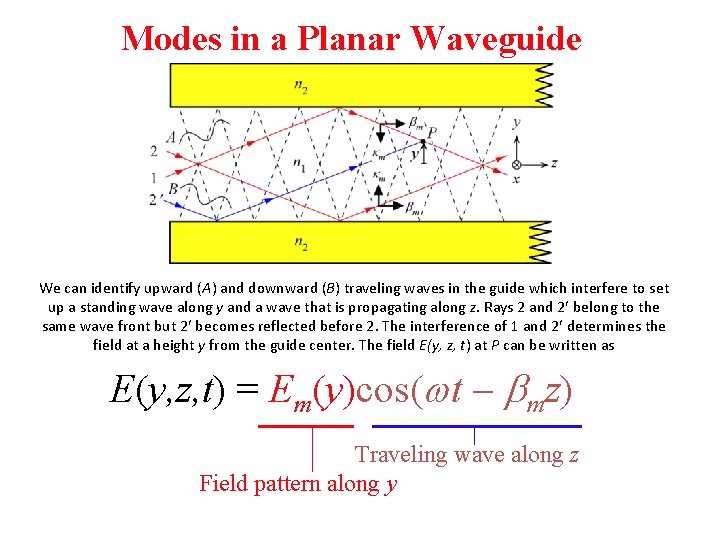
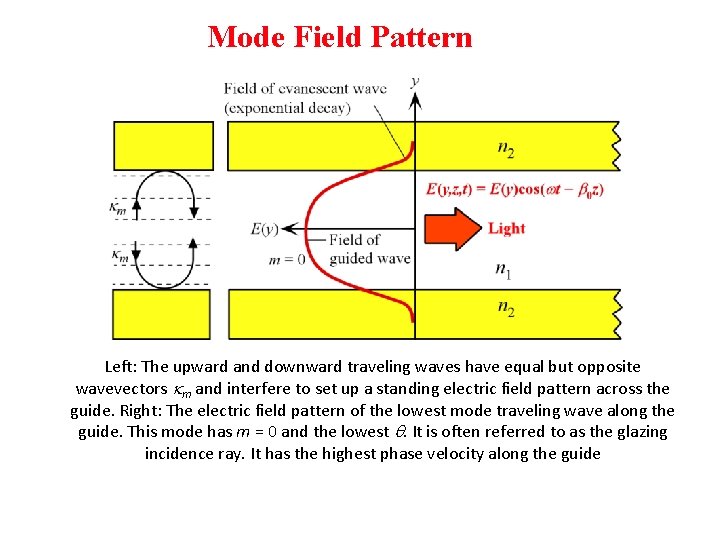
Modes in a Planar Waveguide We can identify upward (A) and downward (B) traveling waves in the guide which interfere to set up a standing wave along y and a wave that is propagating along z. Rays 2 and 2 belong to the same wave front but 2 becomes reflected before 2. The interference of 1 and 2 determines the field at a height y from the guide center. The field E(y, z, t) at P can be written as E(y, z, t) = Em(y)cos(wt bmz) Traveling wave along z Field pattern along y
Modes in a Planar Waveguide: Summary m = integer, n 1 = core refractive index, qm is the incidence angle, 2 a is the core thickness. E(y, z, t) = Em(y)cos(wt bmz) Traveling wave along z Field pattern along y
Mode Field Pattern Left: The upward and downward traveling waves have equal but opposite wavevectors km and interfere to set up a standing electric field pattern across the guide. Right: The electric field pattern of the lowest mode traveling wave along the guide. This mode has m = 0 and the lowest q. It is often referred to as the glazing incidence ray. It has the highest phase velocity along the guide
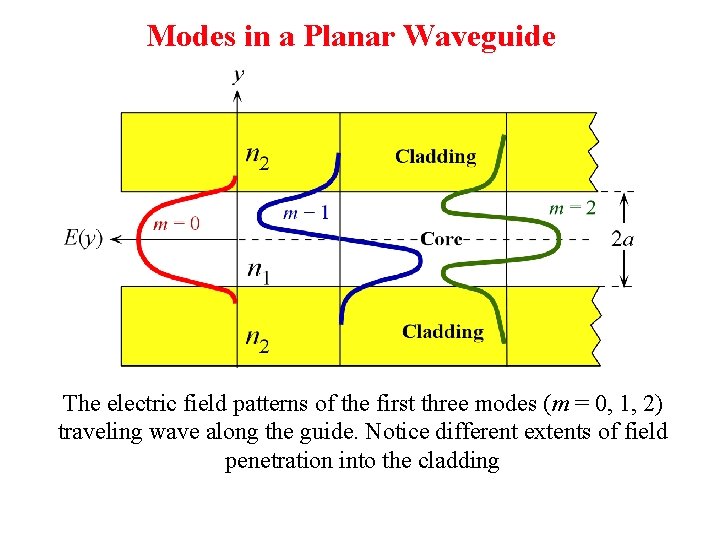
Modes in a Planar Waveguide The electric field patterns of the first three modes (m = 0, 1, 2) traveling wave along the guide. Notice different extents of field penetration into the cladding
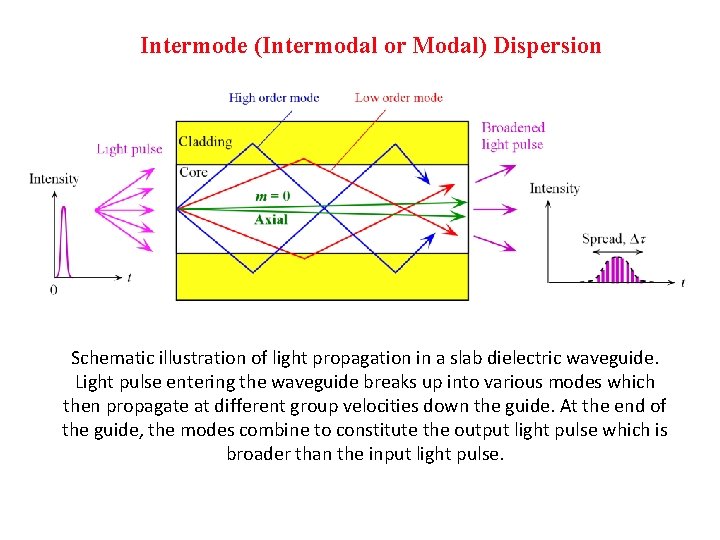
Intermode (Intermodal or Modal) Dispersion Schematic illustration of light propagation in a slab dielectric waveguide. Light pulse entering the waveguide breaks up into various modes which then propagate at different group velocities down the guide. At the end of the guide, the modes combine to constitute the output light pulse which is broader than the input light pulse.
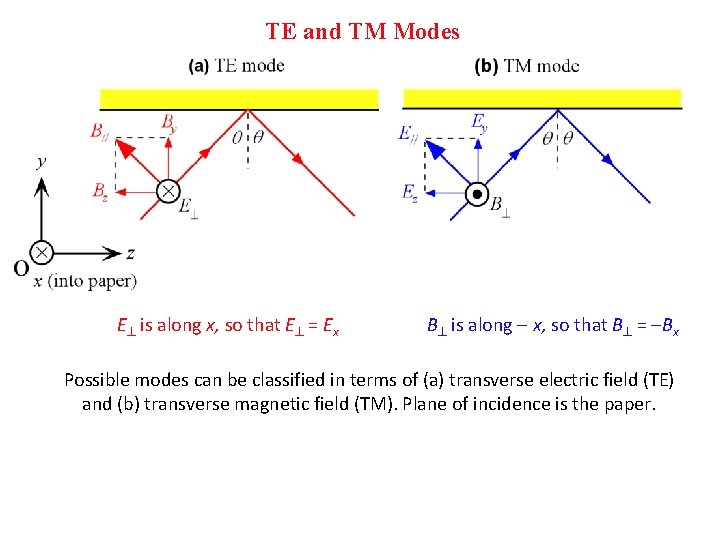
TE and TM Modes E^ is along x, so that E^ = Ex B^ is along x, so that B^ = Bx Possible modes can be classified in terms of (a) transverse electric field (TE) and (b) transverse magnetic field (TM). Plane of incidence is the paper.
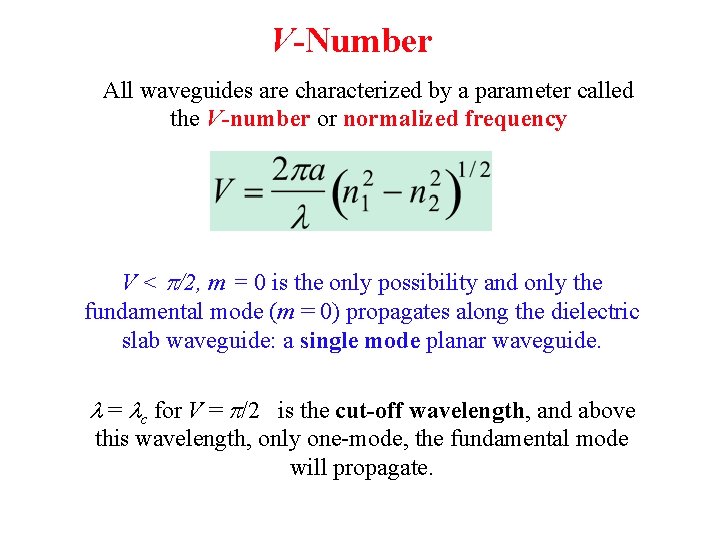
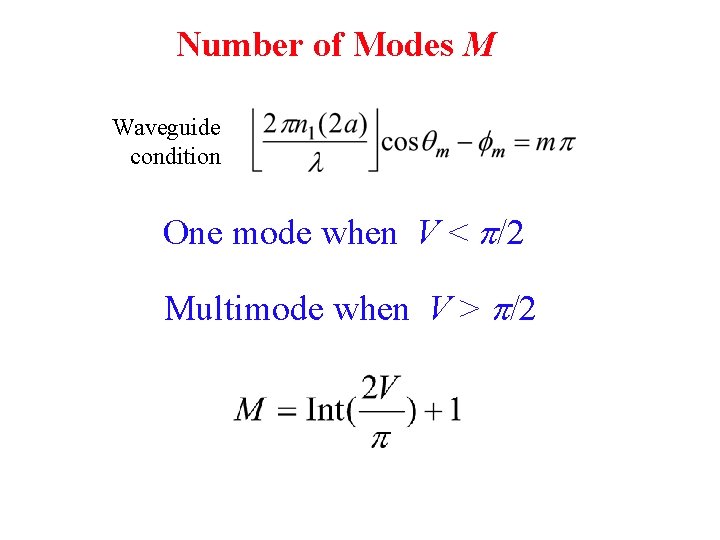
V-Number All waveguides are characterized by a parameter called the V-number or normalized frequency V < /2, m = 0 is the only possibility and only the fundamental mode (m = 0) propagates along the dielectric slab waveguide: a single mode planar waveguide. = c for V = /2 is the cut-off wavelength, and above this wavelength, only one-mode, the fundamental mode will propagate.
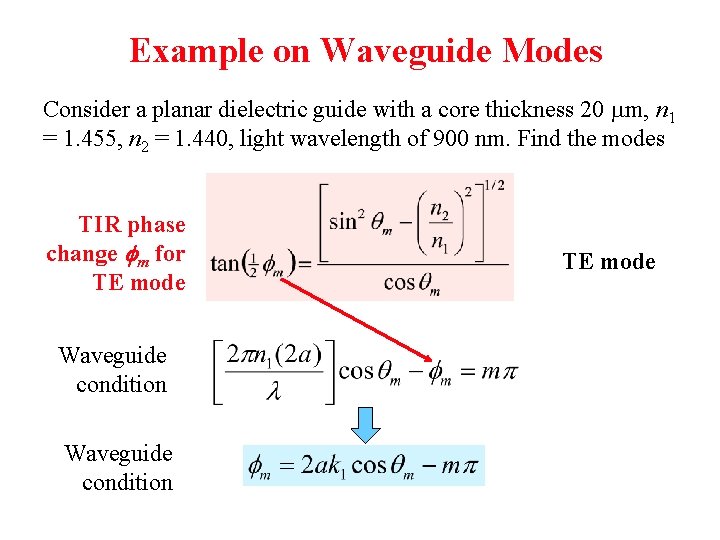
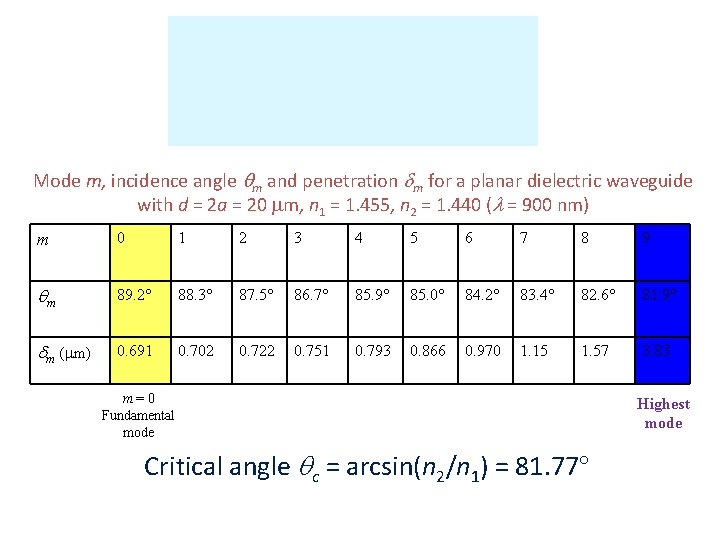
Example on Waveguide Modes Consider a planar dielectric guide with a core thickness 20 m, n 1 = 1. 455, n 2 = 1. 440, light wavelength of 900 nm. Find the modes TIR phase change m for TE mode Waveguide condition TE mode
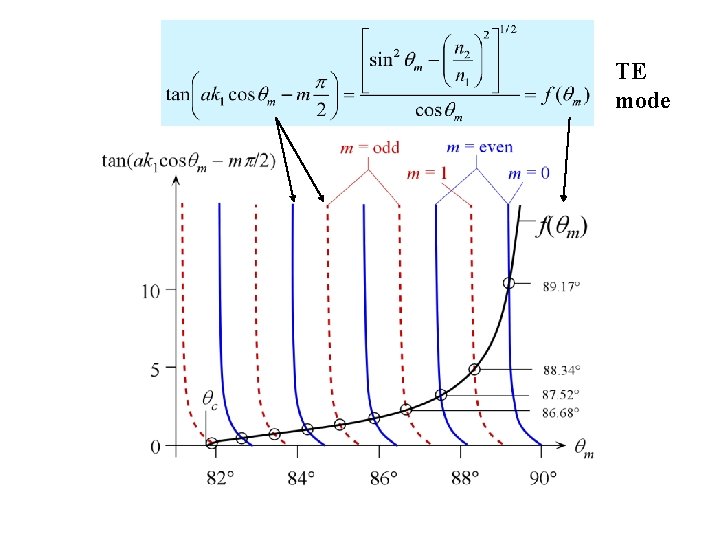
TE mode
Mode m, incidence angle qm and penetration dm for a planar dielectric waveguide with d = 2 a = 20 m, n 1 = 1. 455, n 2 = 1. 440 ( = 900 nm) m 0 1 2 3 4 5 6 7 8 9 qm 89. 2° 88. 3° 87. 5° 86. 7° 85. 9° 85. 0° 84. 2° 83. 4° 82. 6° 81. 9° dm ( m) 0. 691 0. 702 0. 722 0. 751 0. 793 0. 866 0. 970 1. 15 1. 57 3. 83 m=0 Fundamental mode Critical angle qc = arcsin(n 2/n 1) = 81. 77° Highest mode
Number of Modes M Waveguide condition One mode when V < /2 Multimode when V > /2
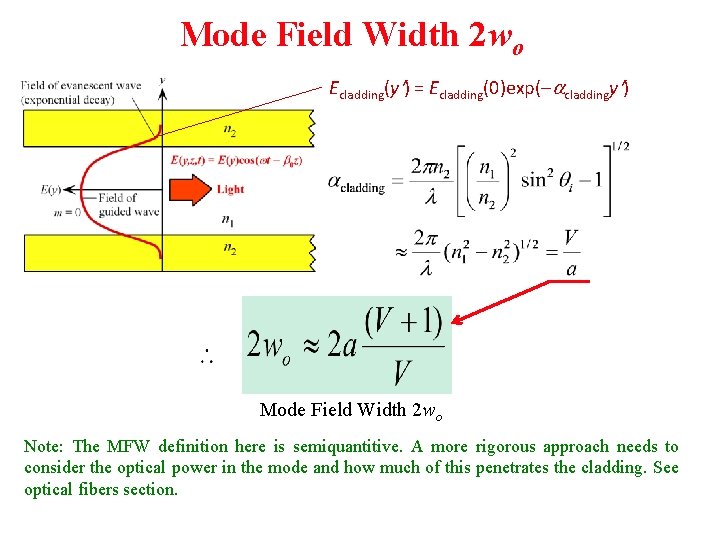
Mode Field Width 2 wo Ecladding(y¢) = Ecladding(0)exp( acladdingy¢) Mode Field Width 2 wo Note: The MFW definition here is semiquantitive. A more rigorous approach needs to consider the optical power in the mode and how much of this penetrates the cladding. See optical fibers section.
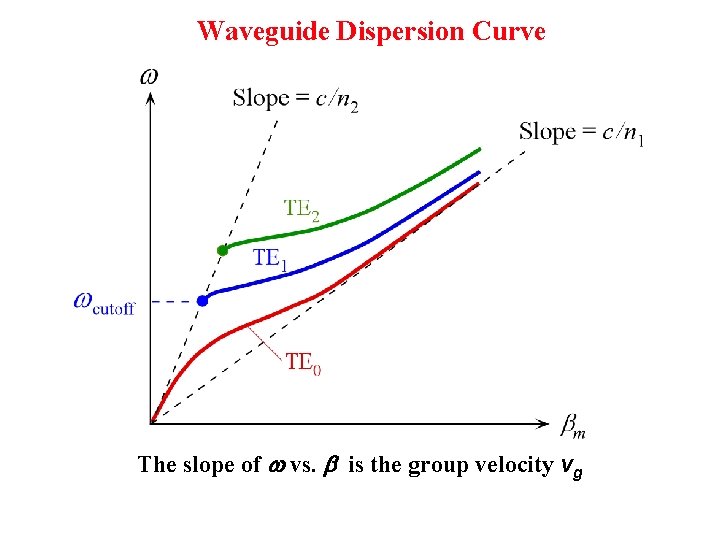
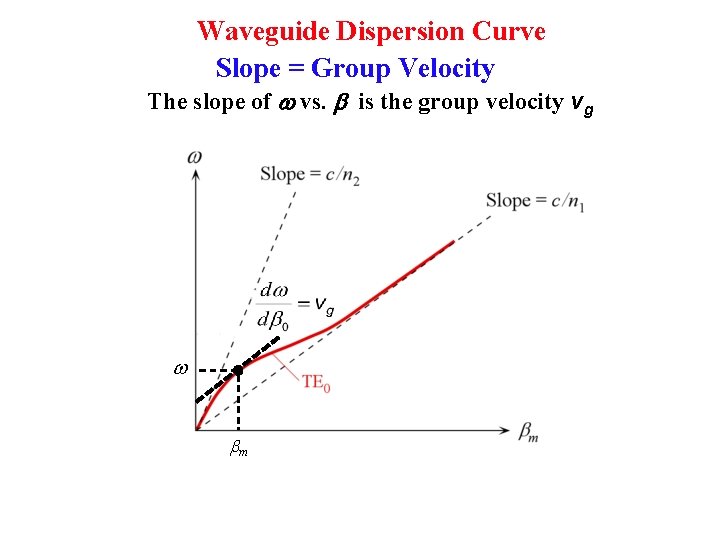
Waveguide Dispersion Curve The slope of w vs. is the group velocity vg
Waveguide Dispersion Curve Slope = Group Velocity The slope of w vs. is the group velocity vg w bm
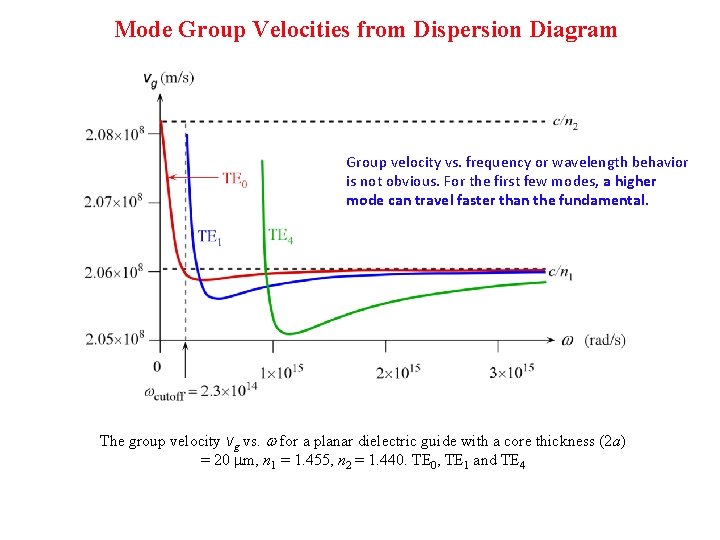
Mode Group Velocities from Dispersion Diagram Group velocity vs. frequency or wavelength behavior is not obvious. For the first few modes, a higher mode can travel faster than the fundamental. The group velocity vg vs. w for a planar dielectric guide with a core thickness (2 a) = 20 m, n 1 = 1. 455, n 2 = 1. 440. TE 0, TE 1 and TE 4
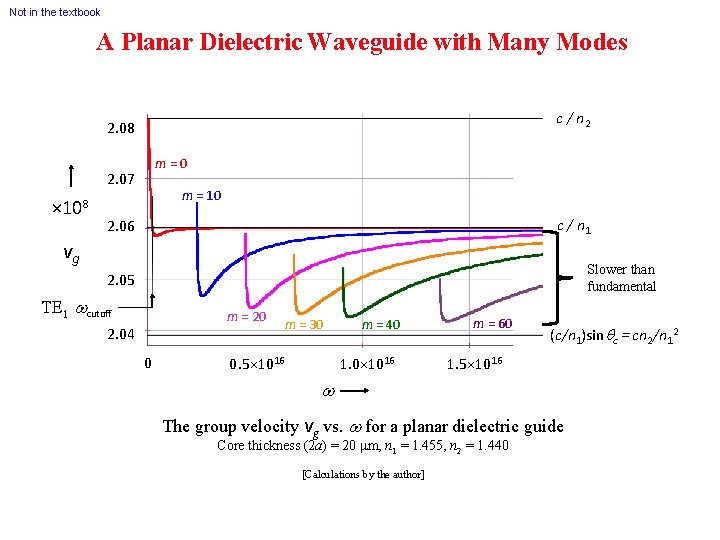
Not in the textbook A Planar Dielectric Waveguide with Many Modes c / n 2 2. 08 m = 0 2. 07 × 108 m = 10 c / n 1 2. 06 vg Slower than fundamental 2. 05 TE 1 wcutoff m = 20 2. 04 0 m = 30 0. 5× 10¹⁶ m = 40 1. 0× 1016 m = 60 (c/n 1)sinqc = cn 2/n 12 1. 5× 10¹⁶ w The group velocity vg vs. w for a planar dielectric guide Core thickness (2 a) = 20 m, n 1 = 1. 455, n 2 = 1. 440 [Calculations by the author]
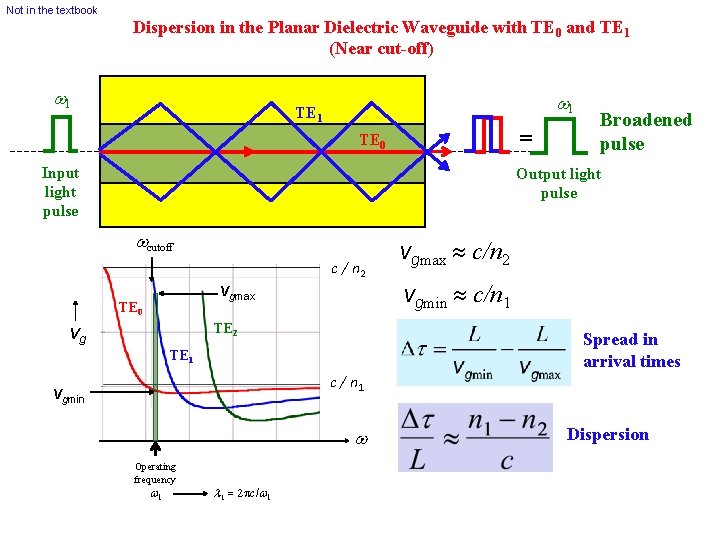
Not in the textbook Dispersion in the Planar Dielectric Waveguide with TE 0 and TE 1 (Near cut-off) w 1 TE 1 = TE 0 Input light pulse Broadened pulse Output light pulse wcutoff vgmax TE 0 c / n 2 TE 2 vg vgmax c/n 2 vgmin c/n 1 Spread in arrival times TE 1 c / n 1 vgmin w Operating frequency w 1 1 2 pc/w 1 Dispersion
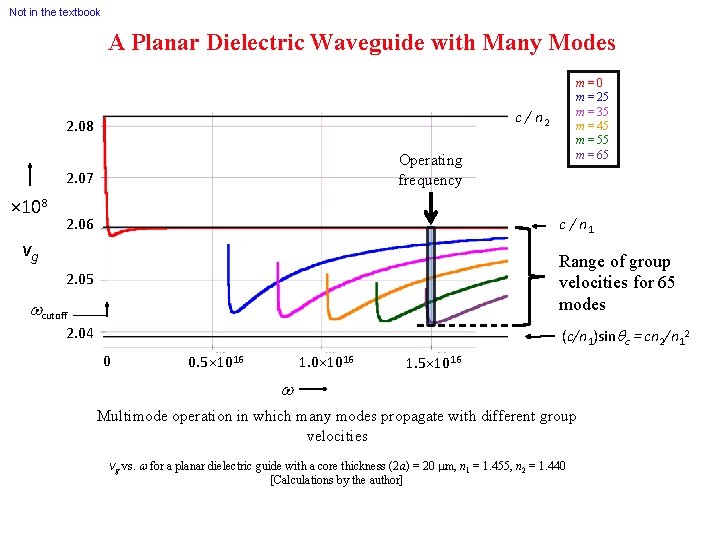
Not in the textbook A Planar Dielectric Waveguide with Many Modes c / n 2 2. 08 Operating frequency 2. 07 × 108 m=0 m = 25 m = 35 m = 45 m = 55 m = 65 2. 06 c / n 1 2. 05 Range of group velocities for 65 modes vg wcutoff 2. 04 (c/n 1)sinqc = cn 2/n 12 0 0. 5× 10¹⁶ 1. 0× 1016 1. 5× 10¹⁶ w Multimode operation in which many modes propagate with different group velocities vg vs. w for a planar dielectric guide with a core thickness (2 a) = 20 m, n 1 = 1. 455, n 2 = 1. 440 [Calculations by the author]
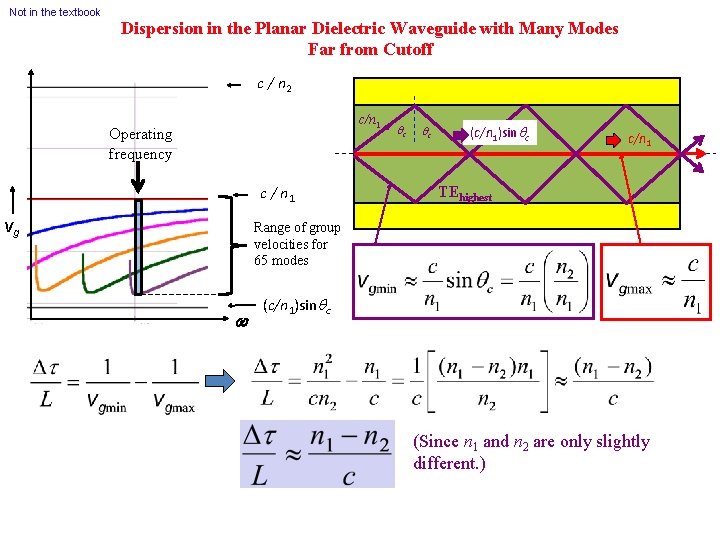
Not in the textbook Dispersion in the Planar Dielectric Waveguide with Many Modes Far from Cutoff c / n 2 c/n 1 Operating frequency c / n 1 vg qc qc (c/n 1)sinqc c/n 1 TEhighest Range of group velocities for 65 modes w (c/n 1)sinqc (Since n 1 and n 2 are only slightly different. )
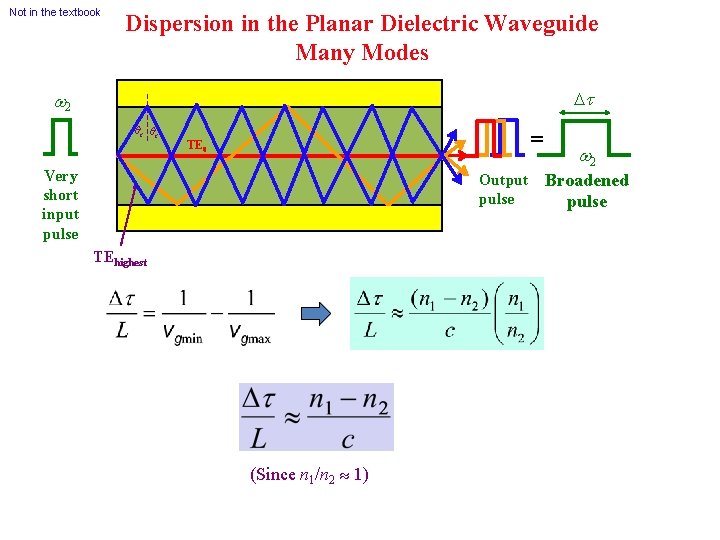
Not in the textbook Dispersion in the Planar Dielectric Waveguide Many Modes t w 2 qc qc = TE 0 Very short input pulse Output pulse TEhighest (Since n 1/n 2 1) w 2 Broadened pulse
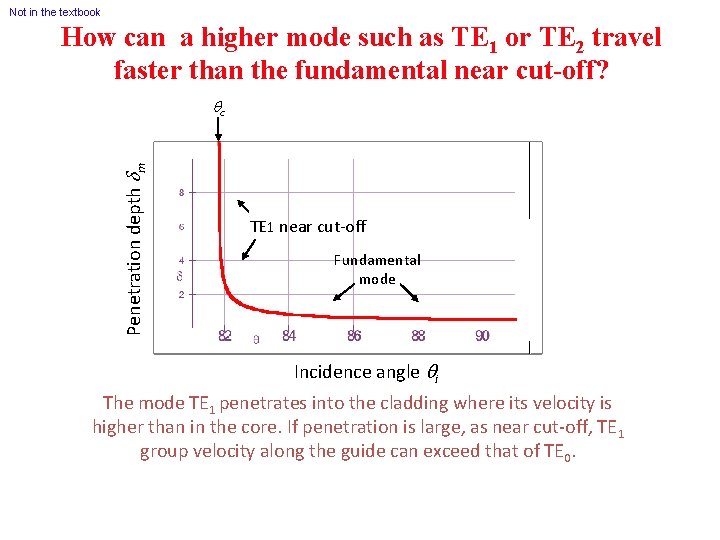
Not in the textbook How can a higher mode such as TE 1 or TE 2 travel faster than the fundamental near cut-off? Penetration depth dm qc TE 1 near cut-off Fundamental mode Incidence angle qi The mode TE 1 penetrates into the cladding where its velocity is higher than in the core. If penetration is large, as near cut-off, TE 1 group velocity along the guide can exceed that of TE 0.
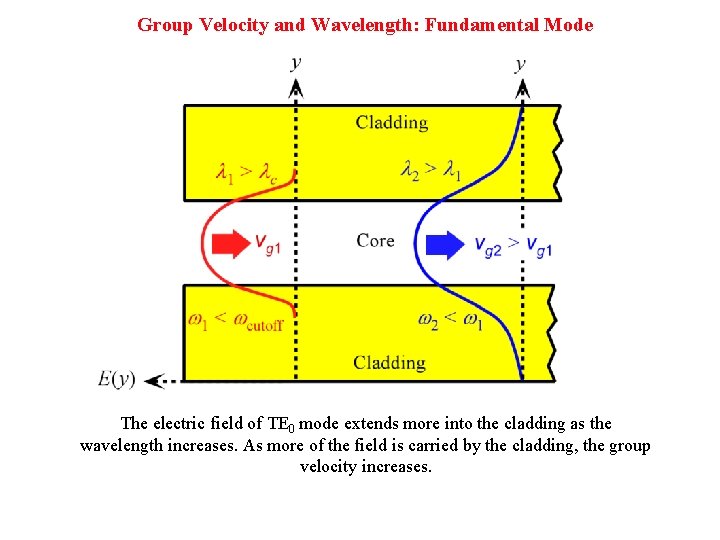
Group Velocity and Wavelength: Fundamental Mode The electric field of TE 0 mode extends more into the cladding as the wavelength increases. As more of the field is carried by the cladding, the group velocity increases.
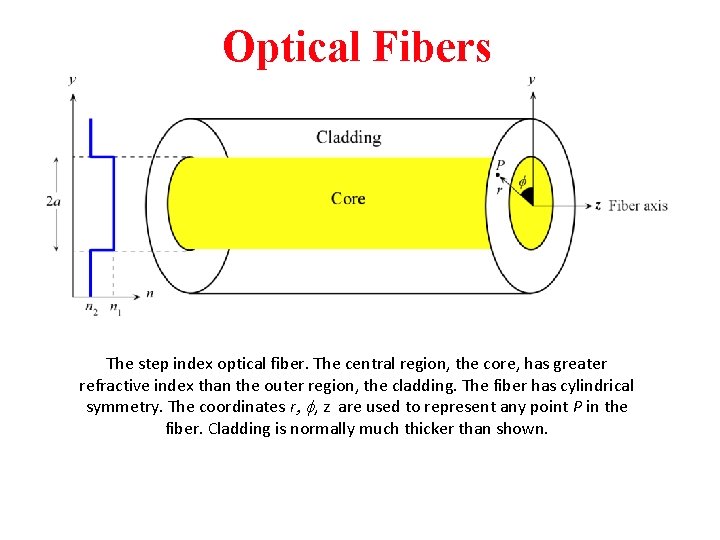
Optical Fibers The step index optical fiber. The central region, the core, has greater refractive index than the outer region, the cladding. The fiber has cylindrical symmetry. The coordinates r, f, z are used to represent any point P in the fiber. Cladding is normally much thicker than shown.
Meridional ray enters the fiber through the fiber axis and hence also crosses the fiber axis on each reflection as it zigzags down the fiber. It travels in a plane that contains the fiber axis. Skew ray enters the fiber off the fiber axis and zigzags down the fiber without crossing the axis
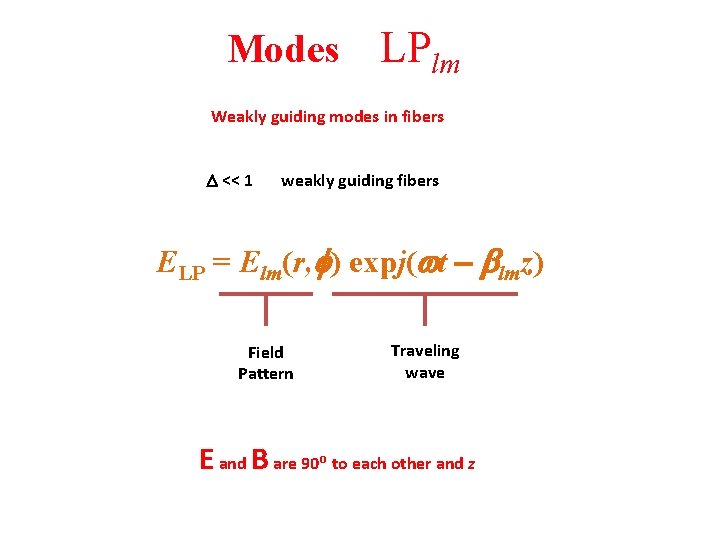
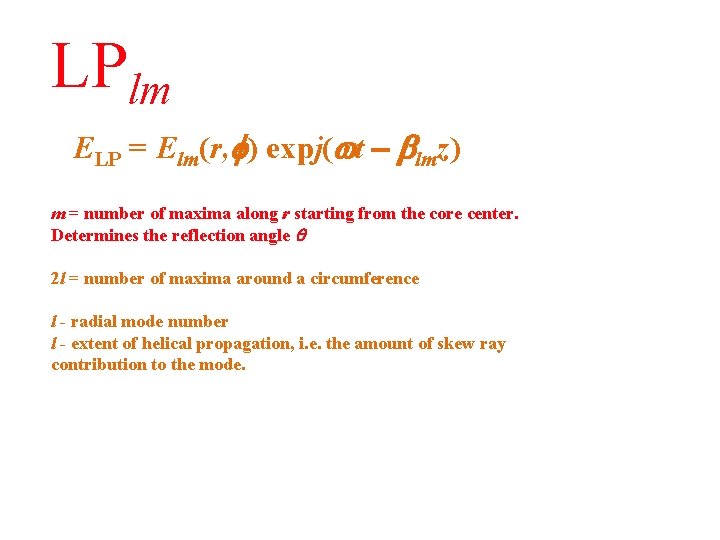
Modes LPlm Weakly guiding modes in fibers << 1 weakly guiding fibers ELP = Elm(r, ) expj(wt - lmz) Field Pattern Traveling wave E and B are 90 o to each other and z
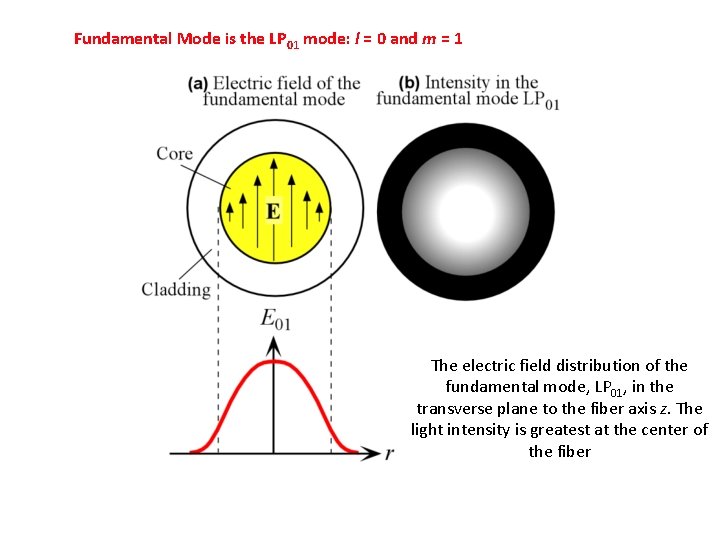
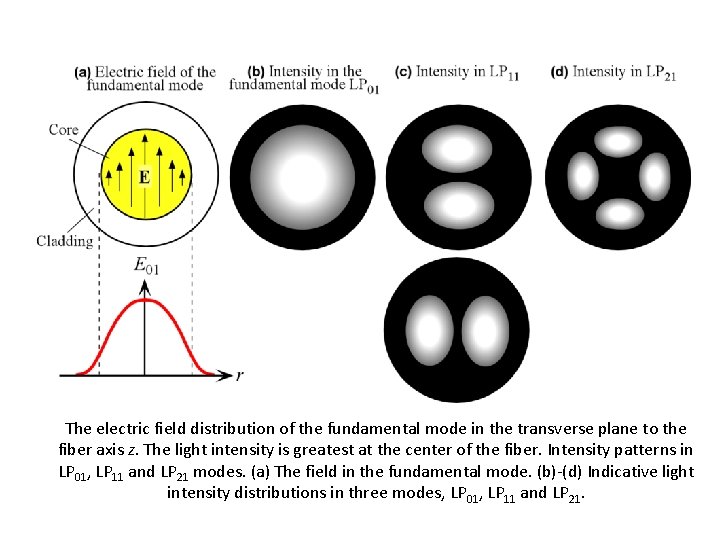
Fundamental Mode is the LP 01 mode: l = 0 and m = 1 The electric field distribution of the fundamental mode, LP 01, in the transverse plane to the fiber axis z. The light intensity is greatest at the center of the fiber
The electric field distribution of the fundamental mode in the transverse plane to the fiber axis z. The light intensity is greatest at the center of the fiber. Intensity patterns in LP 01, LP 11 and LP 21 modes. (a) The field in the fundamental mode. (b)-(d) Indicative light intensity distributions in three modes, LP 01, LP 11 and LP 21.
LPlm ELP = Elm(r, ) expj(wt - lmz) m = number of maxima along r starting from the core center. Determines the reflection angle q 2 l = number of maxima around a circumference l - radial mode number l - extent of helical propagation, i. e. the amount of skew ray contribution to the mode.
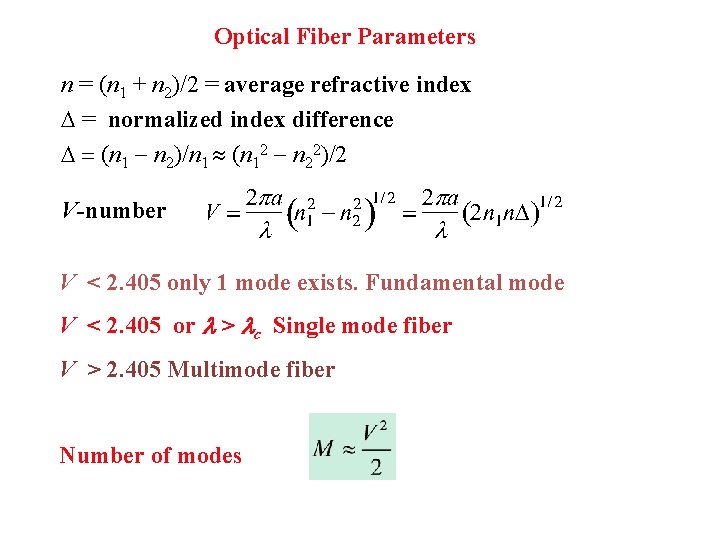
Optical Fiber Parameters n = (n 1 + n 2)/2 = average refractive index = normalized index difference (n 1 n 2)/n 1 (n 12 n 22)/2 V-number V < 2. 405 only 1 mode exists. Fundamental mode V < 2. 405 or > c Single mode fiber V > 2. 405 Multimode fiber Number of modes
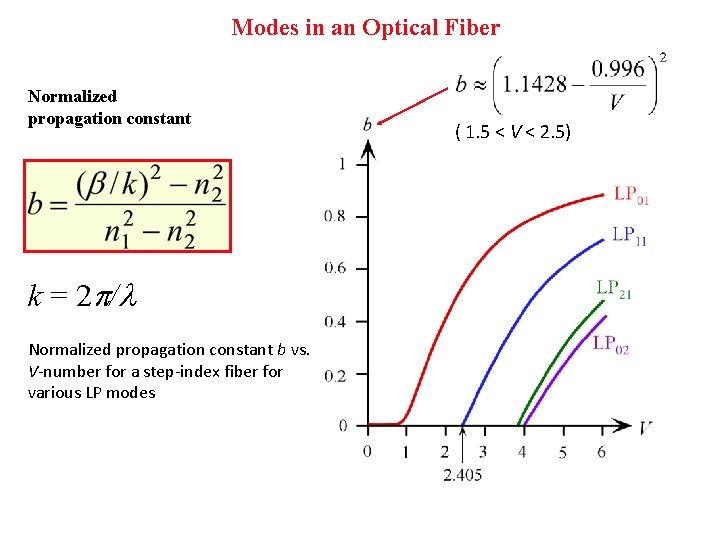
Modes in an Optical Fiber Normalized propagation constant k = 2 / Normalized propagation constant b vs. V-number for a step-index fiber for various LP modes ( 1. 5 < V < 2. 5)
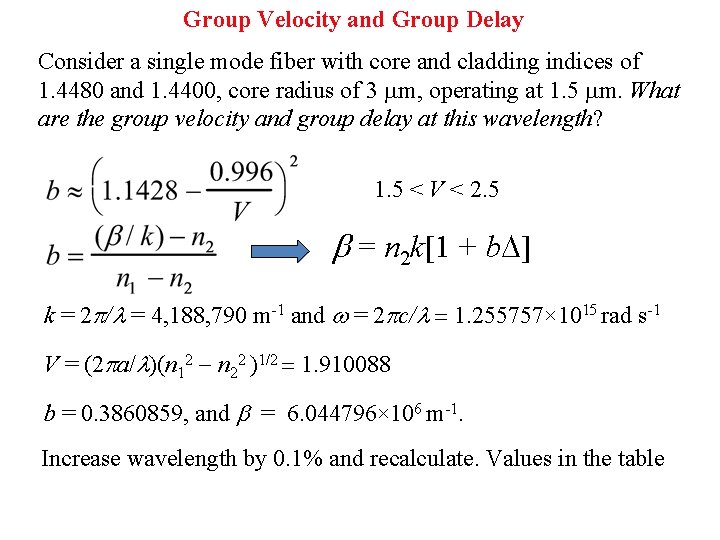
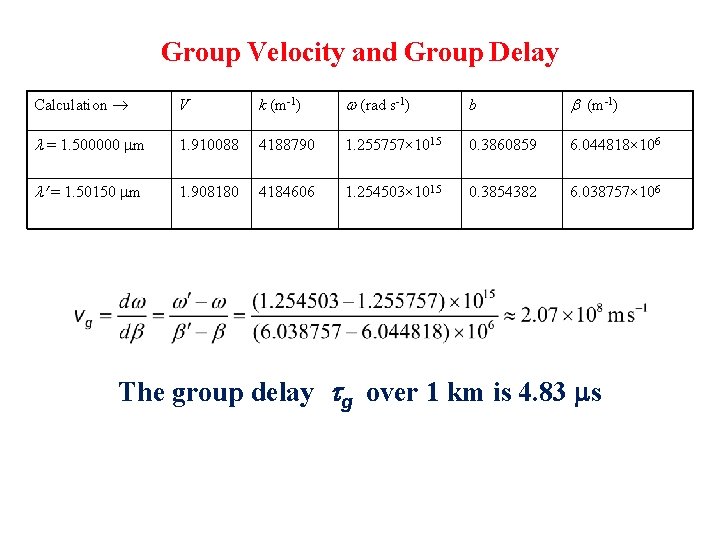
Group Velocity and Group Delay Consider a single mode fiber with core and cladding indices of 1. 4480 and 1. 4400, core radius of 3 m, operating at 1. 5 m. What are the group velocity and group delay at this wavelength? 1. 5 < V < 2. 5 b = n 2 k[1 + b ] k = 2 / = 4, 188, 790 m-1 and w = 2 c/ 1. 255757× 1015 rad s-1 V = (2 a/ )(n 12 n 22 )1/2 1. 910088 b = 0. 3860859, and b = 6. 044796× 106 m-1. Increase wavelength by 0. 1% and recalculate. Values in the table
Group Velocity and Group Delay Calculation V k (m-1) w (rad s-1) b b (m-1) = 1. 500000 m 1. 910088 4188790 1. 255757× 1015 0. 3860859 6. 044818× 106 ¢ = 1. 50150 m 1. 908180 4184606 1. 254503× 1015 0. 3854382 6. 038757× 106 The group delay tg over 1 km is 4. 83 s
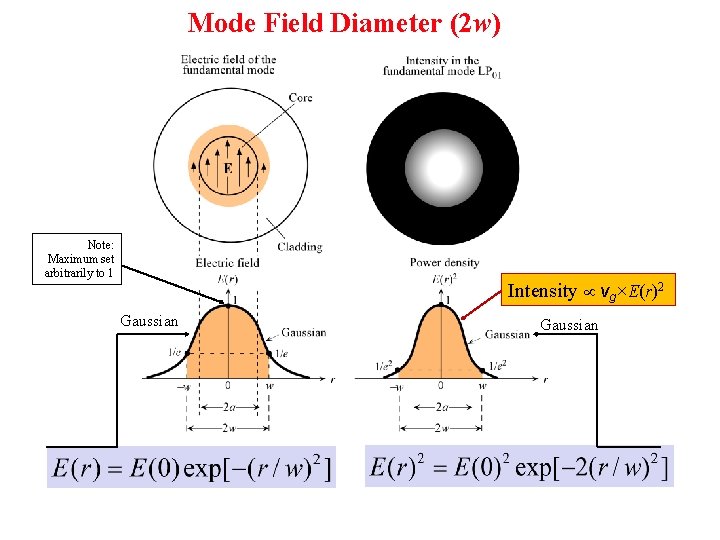
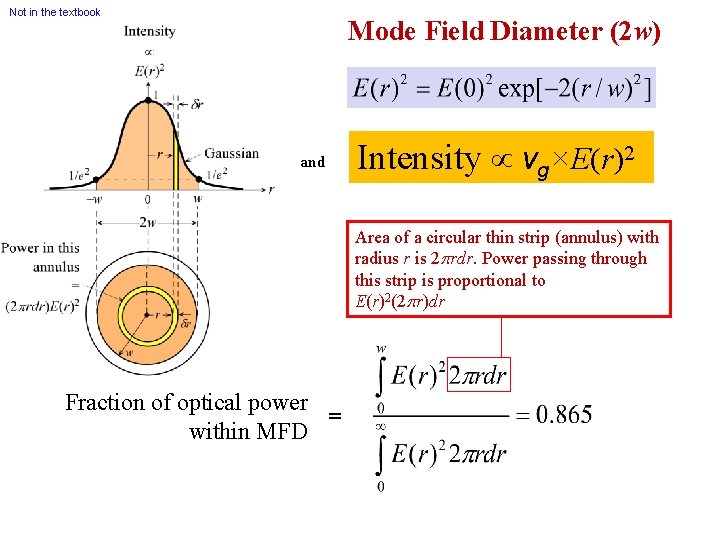
Mode Field Diameter (2 w) Note: Maximum set arbitrarily to 1 Intensity vg×E(r)2 Gaussian
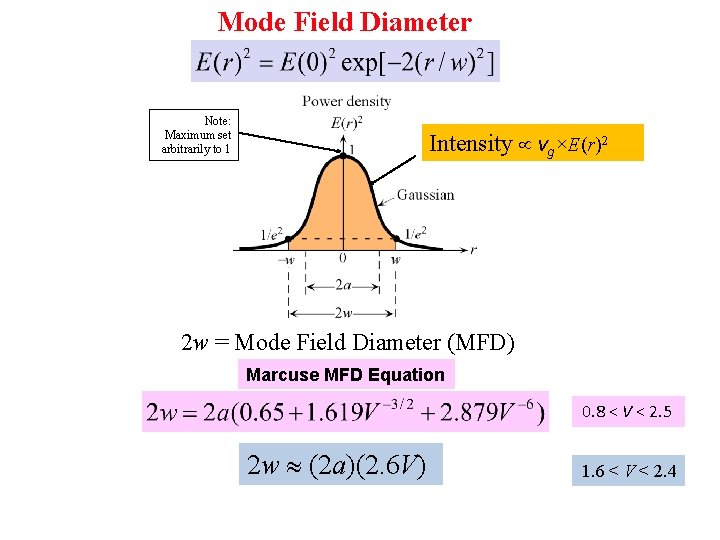
Mode Field Diameter Note: Maximum set arbitrarily to 1 Intensity vg×E(r)2 2 w = Mode Field Diameter (MFD) Marcuse MFD Equation 0. 8 < V < 2. 5 2 w (2 a)(2. 6 V) 1. 6 < V < 2. 4
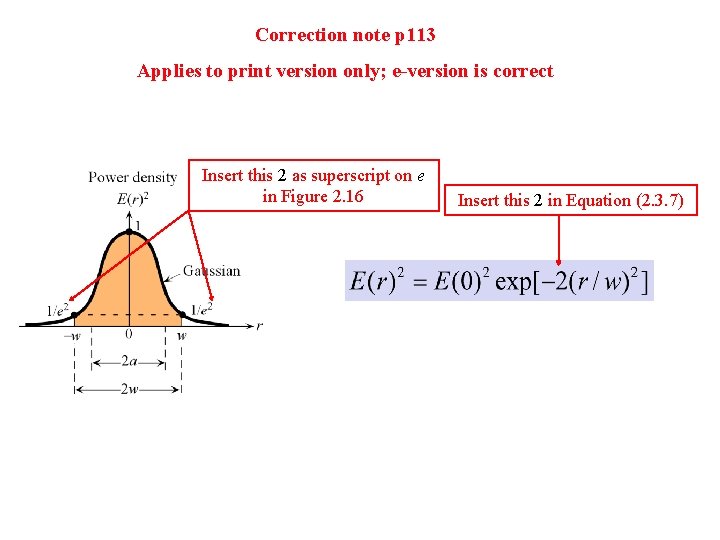
Correction note p 113 Applies to print version only; e-version is correct Insert this 2 as superscript on e in Figure 2. 16 Insert this 2 in Equation (2. 3. 7)
Not in the textbook Mode Field Diameter (2 w) and Intensity vg×E(r)2 Area of a circular thin strip (annulus) with radius r is 2 rdr. Power passing through this strip is proportional to E(r)2(2 r)dr Fraction of optical power = within MFD
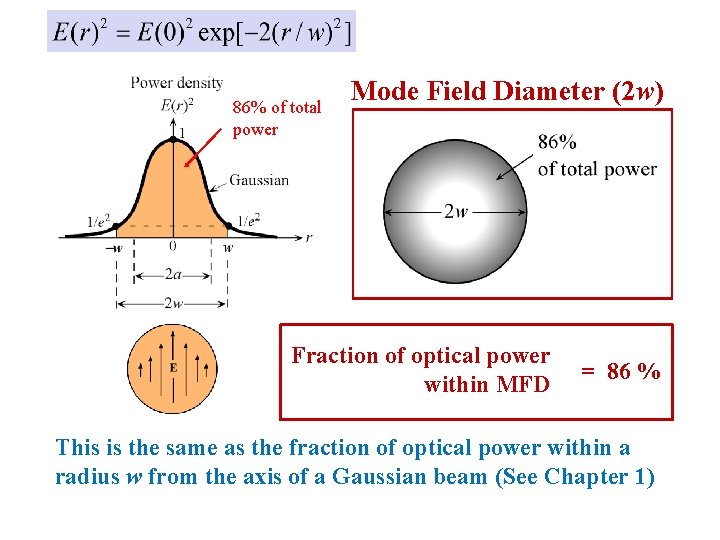
86% of total power Mode Field Diameter (2 w) Fraction of optical power within MFD = 86 % This is the same as the fraction of optical power within a radius w from the axis of a Gaussian beam (See Chapter 1)
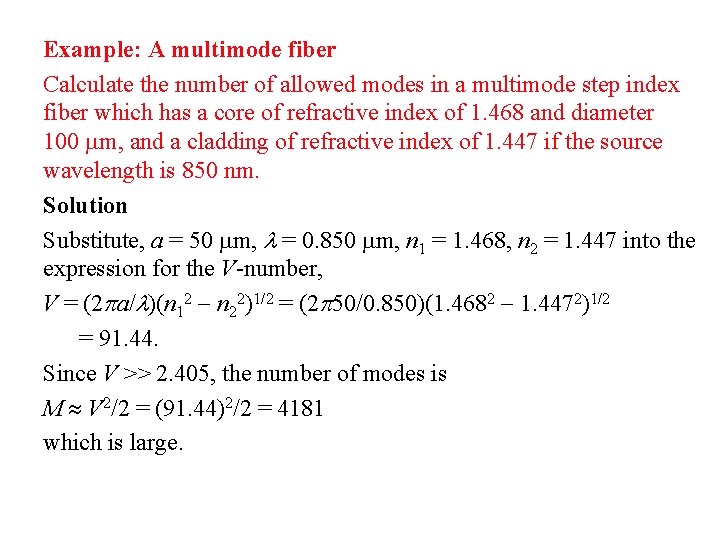
Example: A multimode fiber Calculate the number of allowed modes in a multimode step index fiber which has a core of refractive index of 1. 468 and diameter 100 m, and a cladding of refractive index of 1. 447 if the source wavelength is 850 nm. Solution Substitute, a = 50 m, = 0. 850 m, n 1 = 1. 468, n 2 = 1. 447 into the expression for the V-number, V = (2 a/ )(n 12 n 22)1/2 = (2 50/0. 850)(1. 4682 1. 4472)1/2 = 91. 44. Since V >> 2. 405, the number of modes is M V 2/2 = (91. 44)2/2 = 4181 which is large.
Example: A single mode fiber What should be the core radius of a single mode fiber which has a core of n 1 = 1. 4680, cladding of n 2 = 1. 447 and it is to be used with a source wavelength of 1. 3 m? Solution For single mode propagation, V 2. 405. We need, V = (2 a/ )(n 12 n 22)1/2 2. 405 or [2 a/(1. 3 m)](1. 4682 1. 4472)1/2 2. 405 which gives a 2. 01 m. Rather thin for easy coupling of the fiber to a light source or to another fiber; a is comparable to which means that the geometric ray picture, strictly, cannot be used to describe light propagation.