
Power Plant Technology Fuel and Combustion Lecture 2
Power Plant Technology Fuel and Combustion (Lecture 2) by Mohamad Firdaus Basrawi, Dr. (Eng) Mechanical Engineering Faculty mfirdausb@ump. edu. my
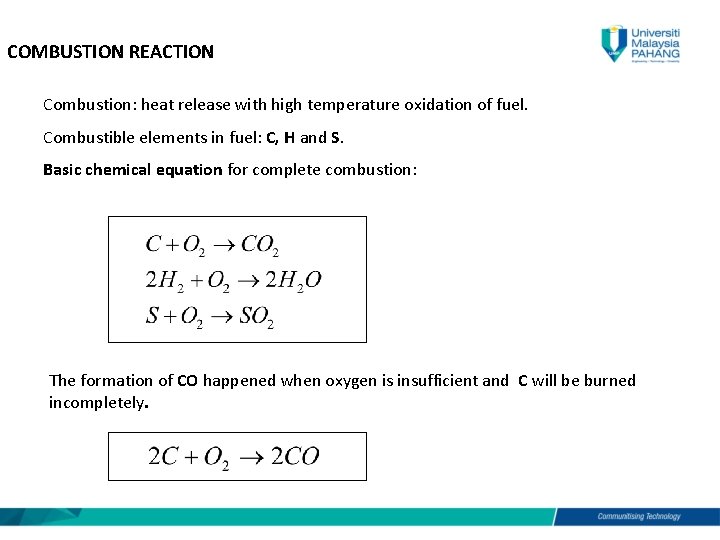
COMBUSTION REACTION Combustion: heat release with high temperature oxidation of fuel. Combustible elements in fuel: C, H and S. Basic chemical equation for complete combustion: The formation of CO happened when oxygen is insufficient and C will be burned incompletely.
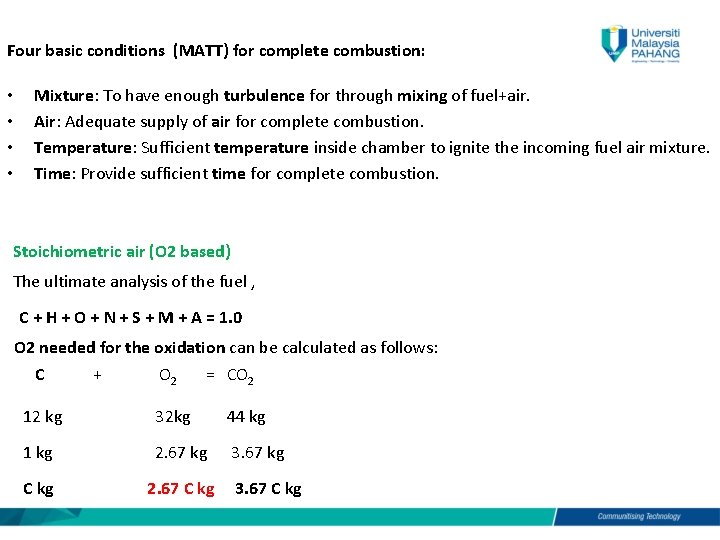
Four basic conditions (MATT) for complete combustion: • • Mixture: To have enough turbulence for through mixing of fuel+air. Air: Adequate supply of air for complete combustion. Temperature: Sufficient temperature inside chamber to ignite the incoming fuel air mixture. Time: Provide sufficient time for complete combustion. Stoichiometric air (O 2 based) The ultimate analysis of the fuel , C + H + O + N + S + M + A = 1. 0 O 2 needed for the oxidation can be calculated as follows: C + O 2 = CO 2 12 kg 32 kg 44 kg 1 kg 2. 67 kg 3. 67 kg C kg 2. 67 C kg 3. 67 C kg
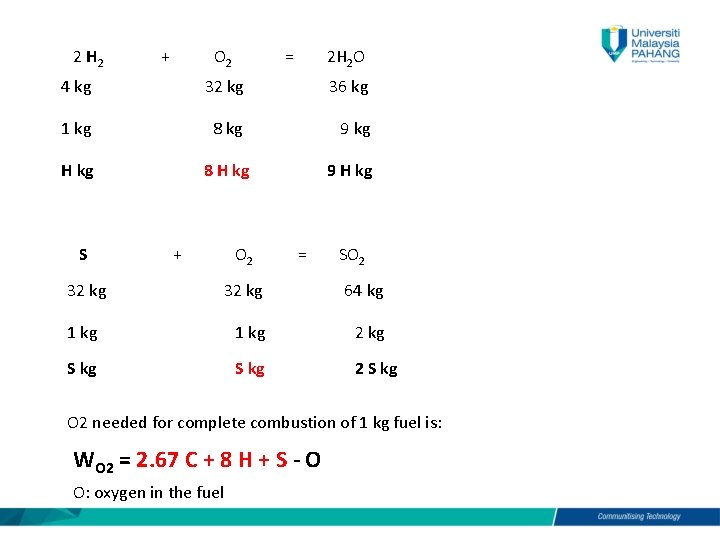
2 H 2 + O 2 = 2 H 2 O 4 kg 32 kg 36 kg 1 kg 8 kg 9 kg H kg 8 H kg S 32 kg + O 2 9 H kg = SO 2 32 kg 64 kg 1 kg 2 kg S kg 2 S kg O 2 needed for complete combustion of 1 kg fuel is: WO 2 = 2. 67 C + 8 H + S - O O: oxygen in the fuel
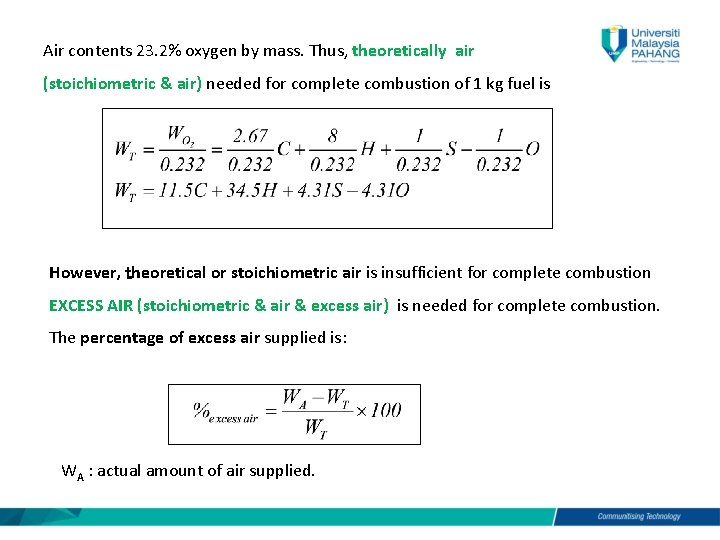
Air contents 23. 2% oxygen by mass. Thus, theoretically air (stoichiometric & air) needed for complete combustion of 1 kg fuel is However, theoretical or stoichiometric air is insufficient for complete combustion EXCESS AIR (stoichiometric & air & excess air) is needed for complete combustion. The percentage of excess air supplied is: WA : actual amount of air supplied.

The dilution coefficient d, is given by In the combustion of the methane CH 4 + 2 O 2 CO 2 + 2 H 2 O Considering N 2 in chemical equation (Stoichiometric & air & N 2) Atmospheric air contains Oxygen: 21%v , nitrogen: 78%v, argon: 1%v. *In combustion calculations, the argon is neglected Thus, nitrogen: 79%v. Since 21 O 2 -> 79 N 2, 1 O 2 -> 3. 76 N 2 Thus, if 2 O 2 -> 2(3. 76)N 2 The combustion of methane, the reaction can be written as: CH 4 + 2 O 2 + 2 (3. 76)N 2 CO 2 + 2 H 2 O + 7. 52 N 2
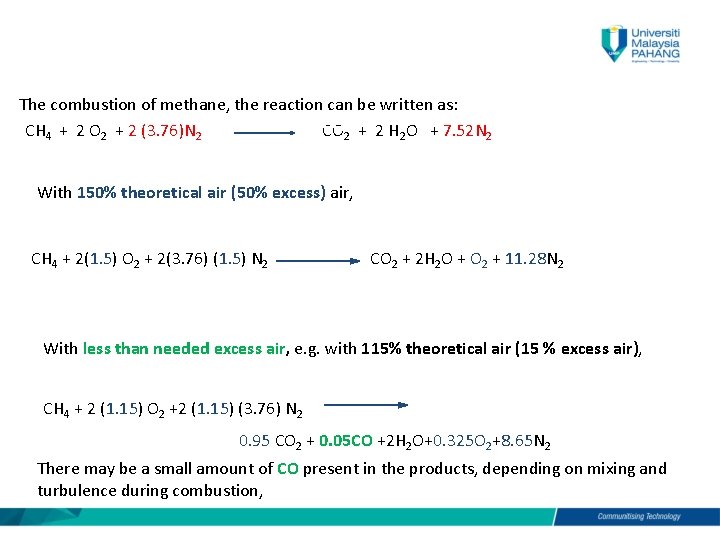
The combustion of methane, the reaction can be written as: CH 4 + 2 O 2 + 2 (3. 76)N 2 CO 2 + 2 H 2 O + 7. 52 N 2 With 150% theoretical air (50% excess) air, CH 4 + 2(1. 5) O 2 + 2(3. 76) (1. 5) N 2 CO 2 + 2 H 2 O + O 2 + 11. 28 N 2 With less than needed excess air, e. g. with 115% theoretical air (15 % excess air), CH 4 + 2 (1. 15) O 2 +2 (1. 15) (3. 76) N 2 0. 95 CO 2 + 0. 05 CO +2 H 2 O+0. 325 O 2+8. 65 N 2 There may be a small amount of CO present in the products, depending on mixing and turbulence during combustion,
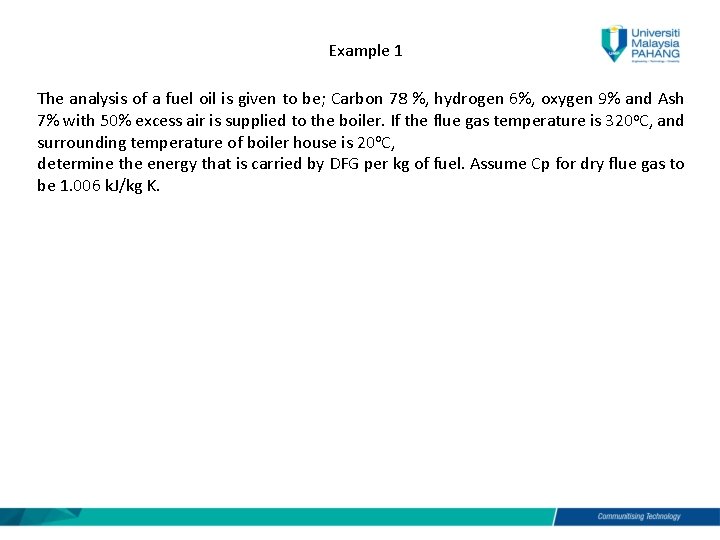
Example 1 The analysis of a fuel oil is given to be; Carbon 78 %, hydrogen 6%, oxygen 9% and Ash 7% with 50% excess air is supplied to the boiler. If the flue gas temperature is 320 o. C, and surrounding temperature of boiler house is 20 o. C, determine the energy that is carried by DFG per kg of fuel. Assume Cp for dry flue gas to be 1. 006 k. J/kg K.
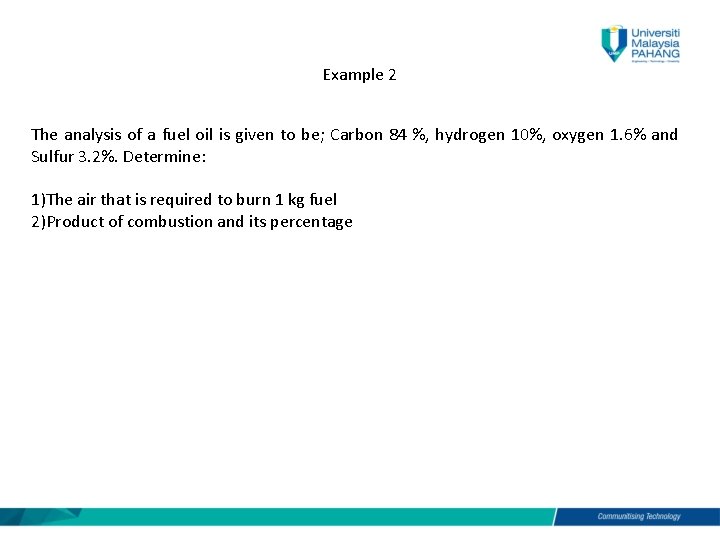
Example 2 The analysis of a fuel oil is given to be; Carbon 84 %, hydrogen 10%, oxygen 1. 6% and Sulfur 3. 2%. Determine: 1)The air that is required to burn 1 kg fuel 2)Product of combustion and its percentage
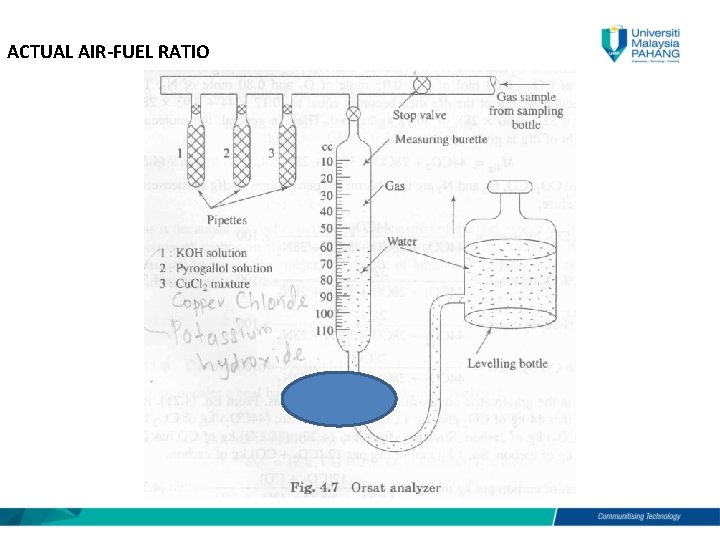
ACTUAL AIR-FUEL RATIO
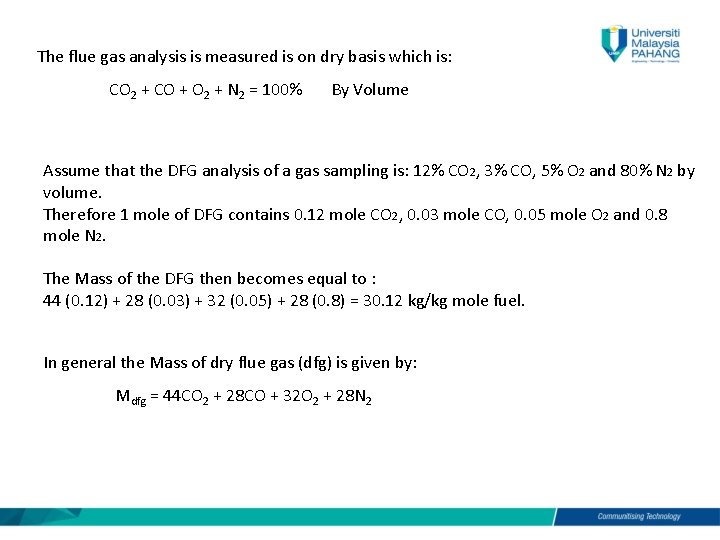
The flue gas analysis is measured is on dry basis which is: CO 2 + CO + O 2 + N 2 = 100% By Volume Assume that the DFG analysis of a gas sampling is: 12% CO 2, 3% CO, 5% O 2 and 80% N 2 by volume. Therefore 1 mole of DFG contains 0. 12 mole CO 2, 0. 03 mole CO, 0. 05 mole O 2 and 0. 8 mole N 2. The Mass of the DFG then becomes equal to : 44 (0. 12) + 28 (0. 03) + 32 (0. 05) + 28 (0. 8) = 30. 12 kg/kg mole fuel. In general the Mass of dry flue gas (dfg) is given by: Mdfg = 44 CO 2 + 28 CO + 32 O 2 + 28 N 2
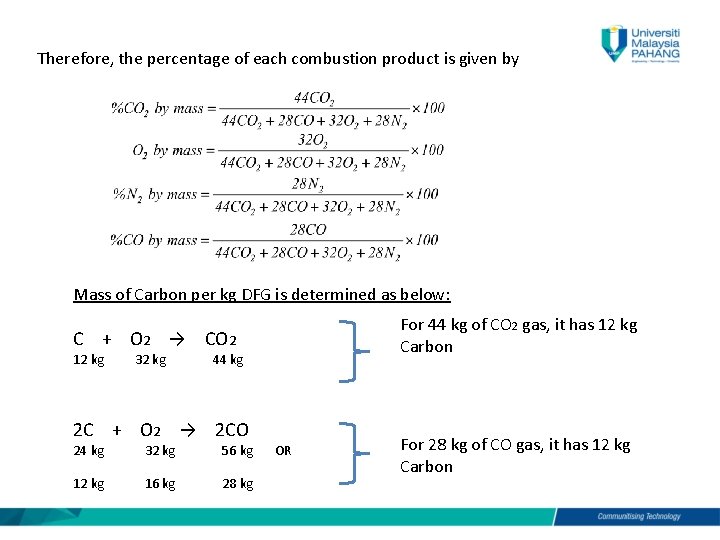
Therefore, the percentage of each combustion product is given by Mass of Carbon per kg DFG is determined as below: For 44 kg of CO 2 gas, it has 12 kg Carbon C + O 2 → CO 2 12 kg 32 kg 44 kg 2 C + O 2 → 2 CO 24 kg 32 kg 56 kg 12 kg 16 kg 28 kg OR For 28 kg of CO gas, it has 12 kg Carbon
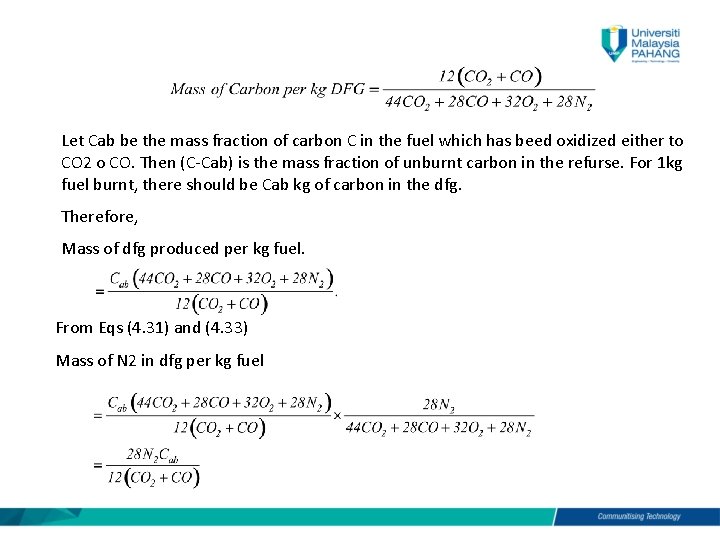
Let Cab be the mass fraction of carbon C in the fuel which has beed oxidized either to CO 2 o CO. Then (C-Cab) is the mass fraction of unburnt carbon in the refurse. For 1 kg fuel burnt, there should be Cab kg of carbon in the dfg. Therefore, Mass of dfg produced per kg fuel. From Eqs (4. 31) and (4. 33) Mass of N 2 in dfg per kg fuel
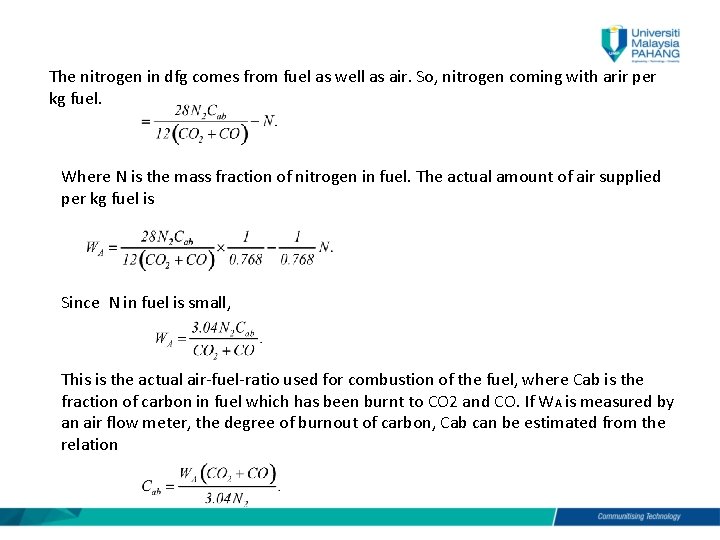
The nitrogen in dfg comes from fuel as well as air. So, nitrogen coming with arir per kg fuel. Where N is the mass fraction of nitrogen in fuel. The actual amount of air supplied per kg fuel is Since N in fuel is small, This is the actual air-fuel-ratio used for combustion of the fuel, where Cab is the fraction of carbon in fuel which has been burnt to CO 2 and CO. If WA is measured by an air flow meter, the degree of burnout of carbon, Cab can be estimated from the relation

Combustion Equation (With Excess air) Consider a coal have the results of ultimate analysis as below: C-60%, H-4%, S-3. 2%, O-4. 8%, N-2%, M-5%, and A-21%. Exhaust gas has the volumetric analysis as below: CO 2 + SO 2=12%, CO=2%, O 2=4% and N 2=82% Let a mole of O 2 is supplied to the 100 kg of coal. Write the combustion equation.
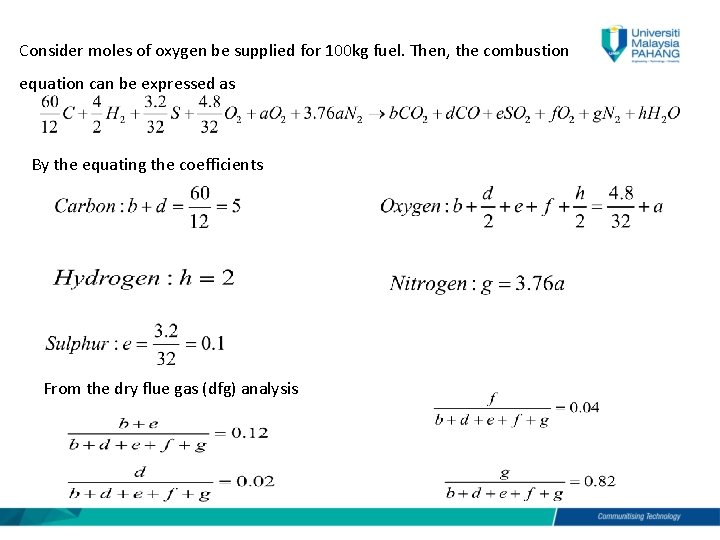
Consider moles of oxygen be supplied for 100 kg fuel. Then, the combustion equation can be expressed as By the equating the coefficients From the dry flue gas (dfg) analysis
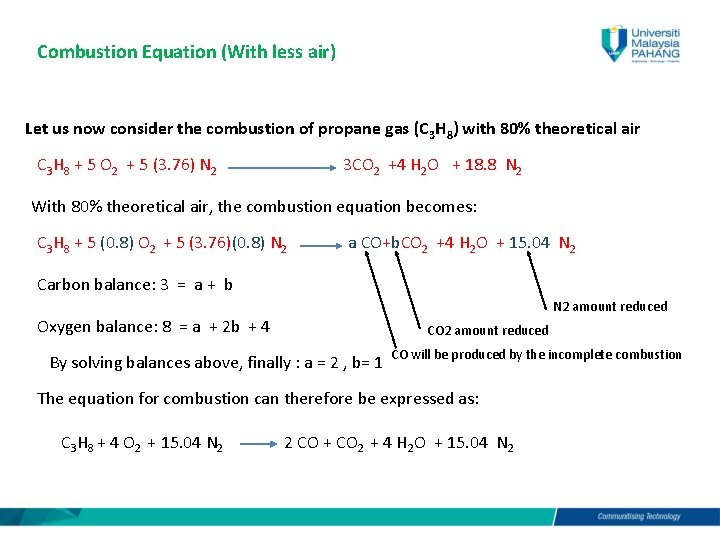
Combustion Equation (With less air) Let us now consider the combustion of propane gas (C 3 H 8) with 80% theoretical air C 3 H 8 + 5 O 2 + 5 (3. 76) N 2 3 CO 2 +4 H 2 O + 18. 8 N 2 With 80% theoretical air, the combustion equation becomes: C 3 H 8 + 5 (0. 8) O 2 + 5 (3. 76)(0. 8) N 2 a CO+b. CO 2 +4 H 2 O + 15. 04 N 2 Carbon balance: 3 = a + b N 2 amount reduced Oxygen balance: 8 = a + 2 b + 4 CO 2 amount reduced By solving balances above, finally : a = 2 , b= 1 CO will be produced by the incomplete combustion The equation for combustion can therefore be expressed as: C 3 H 8 + 4 O 2 + 15. 04 N 2 2 CO + CO 2 + 4 H 2 O + 15. 04 N 2
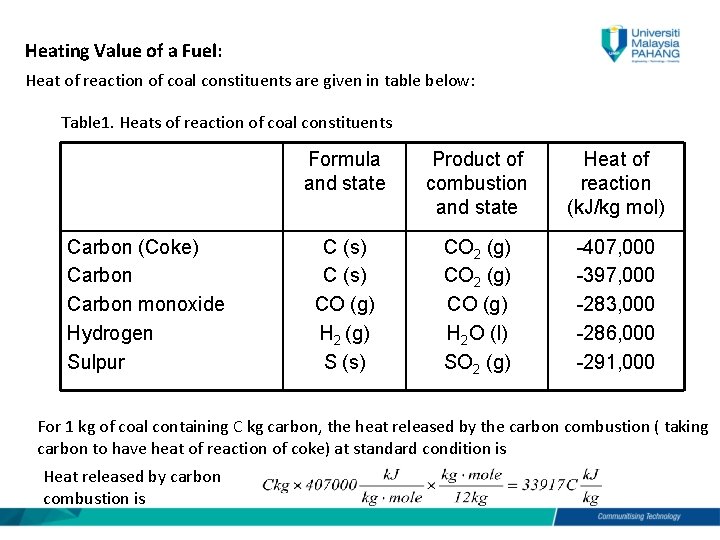
Heating Value of a Fuel: Heat of reaction of coal constituents are given in table below: Table 1. Heats of reaction of coal constituents Carbon (Coke) Carbon monoxide Hydrogen Sulpur Formula and state Product of combustion and state Heat of reaction (k. J/kg mol) C (s) CO (g) H 2 (g) S (s) CO 2 (g) CO (g) H 2 O (l) SO 2 (g) -407, 000 -397, 000 -283, 000 -286, 000 -291, 000 For 1 kg of coal containing C kg carbon, the heat released by the carbon combustion ( taking carbon to have heat of reaction of coke) at standard condition is Heat released by carbon combustion is
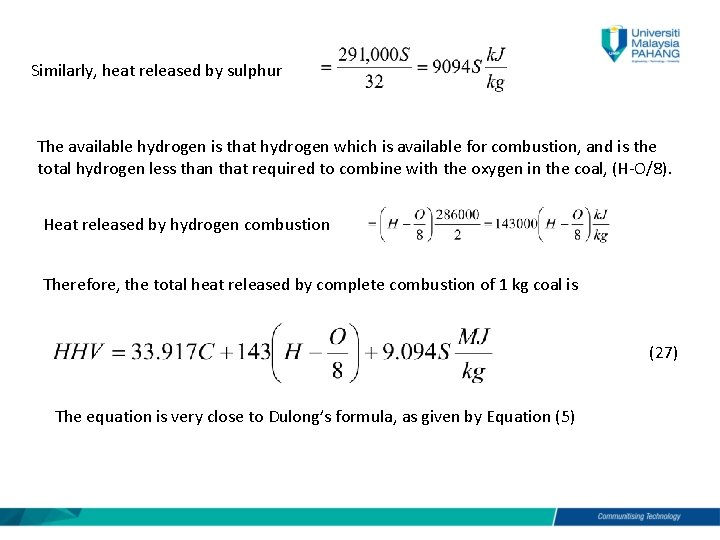
Similarly, heat released by sulphur The available hydrogen is that hydrogen which is available for combustion, and is the total hydrogen less than that required to combine with the oxygen in the coal, (H-O/8). Heat released by hydrogen combustion Therefore, the total heat released by complete combustion of 1 kg coal is (27) The equation is very close to Dulong’s formula, as given by Equation (5)
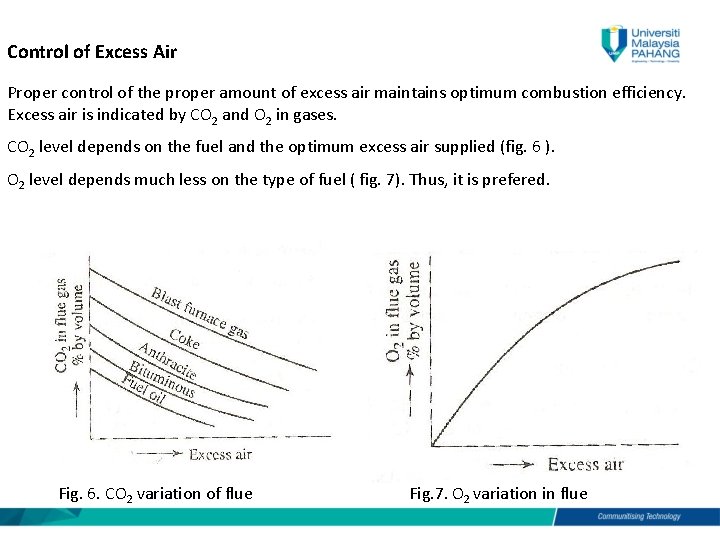
Control of Excess Air Proper control of the proper amount of excess air maintains optimum combustion efficiency. Excess air is indicated by CO 2 and O 2 in gases. CO 2 level depends on the fuel and the optimum excess air supplied (fig. 6 ). O 2 level depends much less on the type of fuel ( fig. 7). Thus, it is prefered. Fig. 6. CO 2 variation of flue Fig. 7. O 2 variation in flue

The excess air is than adjusted by controlling the amount air supply to show the optimum value of CO 2 and O 2. The optimum value of excess air for the best combustion efficiency is as below (fig. 8). Fig. 8. Optimum excess air for maximum combustion efficiency
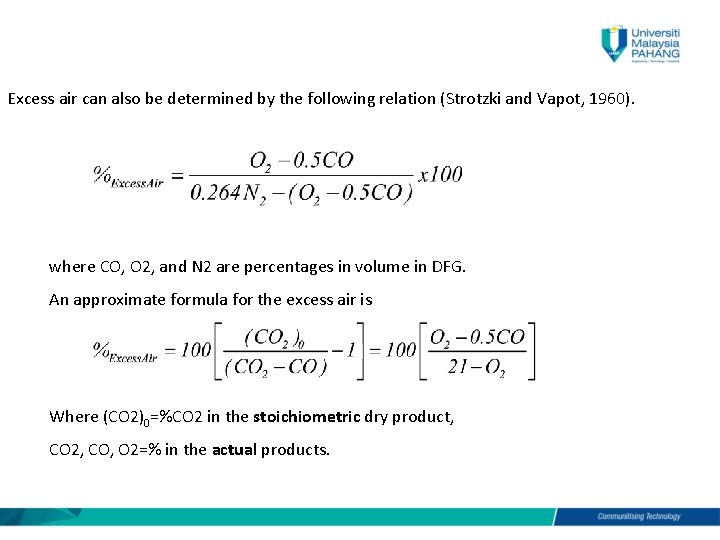
Excess air can also be determined by the following relation (Strotzki and Vapot, 1960). where CO, O 2, and N 2 are percentages in volume in DFG. An approximate formula for the excess air is Where (CO 2)0=%CO 2 in the stoichiometric dry product, CO 2, CO, O 2=% in the actual products.
CL 2 A The ultimate analyis of coal was 85% Carbon, 4. 5% Hydrogen, 4% Sulphur the remaining is ash. 100 kg of coal. On the other hand, the analysis of DFG was 14% Carbon dioxide, 4% Oxygen and 3% Sulphur Dioxide and Nitrogen 79% by volume. Determine: 1) Combustion equation 2) Actual air supplied for the combustion 3) Theoretical air required 4) Percentage of excess air
CL 2 B Explain the Mechanism of Pulverized Coal Firing System • • Overall system Crusher Pulverizer Firing
CL 2 B Study on the history and current utilization of Anthracite, Bituminous, Lignite and Peat • Requirement: 5 pages Double Column A 4 size Font: 12 point Reference must be clearly cited
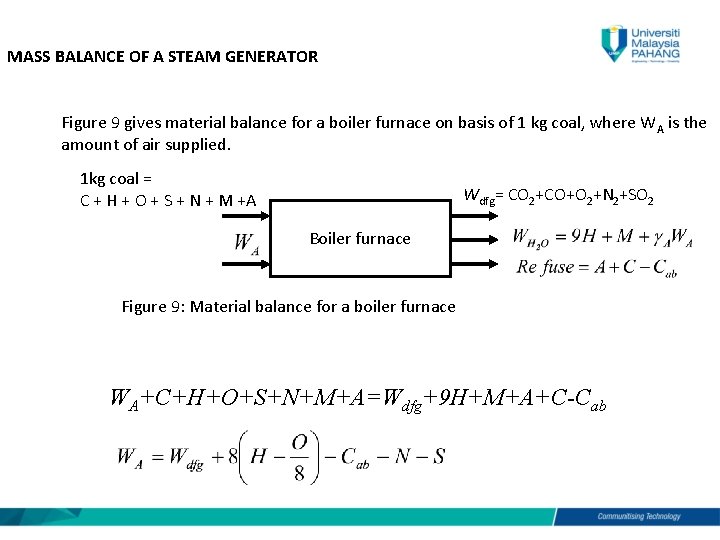
MASS BALANCE OF A STEAM GENERATOR Figure 9 gives material balance for a boiler furnace on basis of 1 kg coal, where W A is the amount of air supplied. 1 kg coal = C + H + O + S + N + M +A Wdfg= CO 2+CO+O 2+N 2+SO 2 Boiler furnace Figure 9: Material balance for a boiler furnace WA+C+H+O+S+N+M+A=Wdfg+9 H+M+A+C-Cab
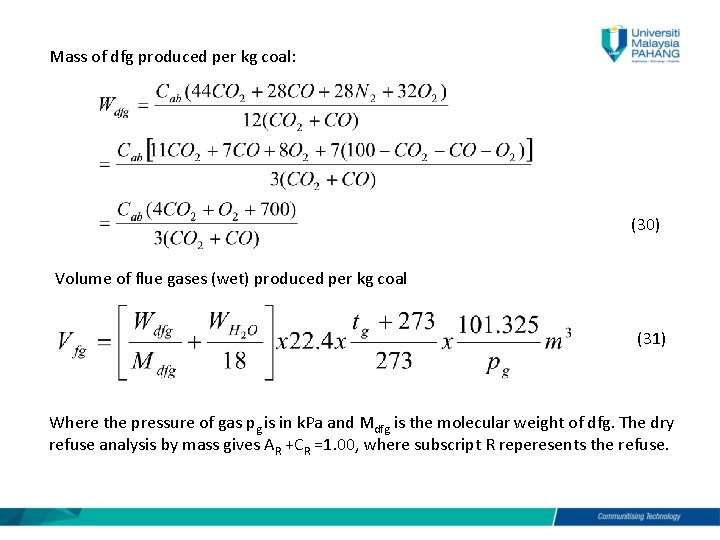
Mass of dfg produced per kg coal: (30) Volume of flue gases (wet) produced per kg coal (31) Where the pressure of gas pg is in k. Pa and Mdfg is the molecular weight of dfg. The dry refuse analysis by mass gives AR +CR =1. 00, where subscript R reperesents the refuse.
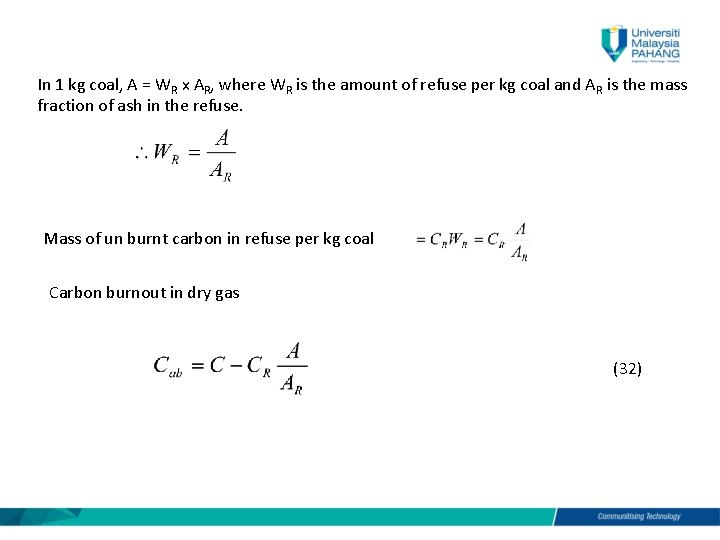
In 1 kg coal, A = WR x AR, where WR is the amount of refuse per kg coal and AR is the mass fraction of ash in the refuse. Mass of un burnt carbon in refuse per kg coal Carbon burnout in dry gas (32)
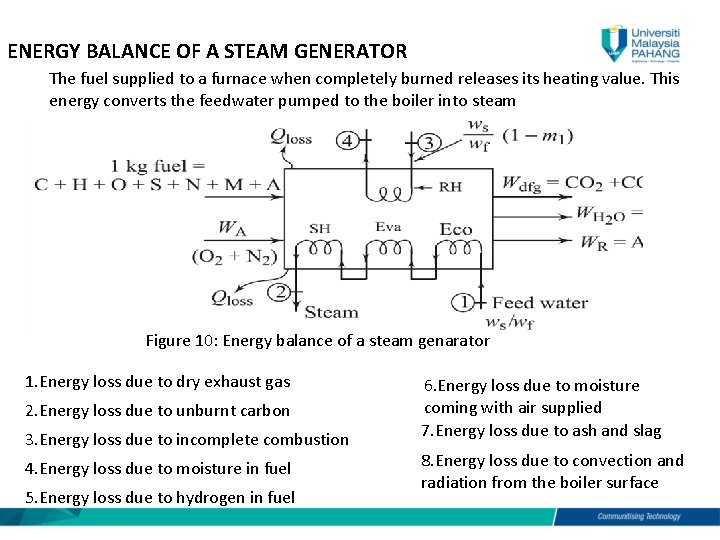
ENERGY BALANCE OF A STEAM GENERATOR The fuel supplied to a furnace when completely burned releases its heating value. This energy converts the feedwater pumped to the boiler into steam Figure 10: Energy balance of a steam genarator 1. Energy loss due to dry exhaust gas 2. Energy loss due to unburnt carbon 3. Energy loss due to incomplete combustion 4. Energy loss due to moisture in fuel 5. Energy loss due to hydrogen in fuel 6. Energy loss due to moisture coming with air supplied 7. Energy loss due to ash and slag 8. Energy loss due to convection and radiation from the boiler surface
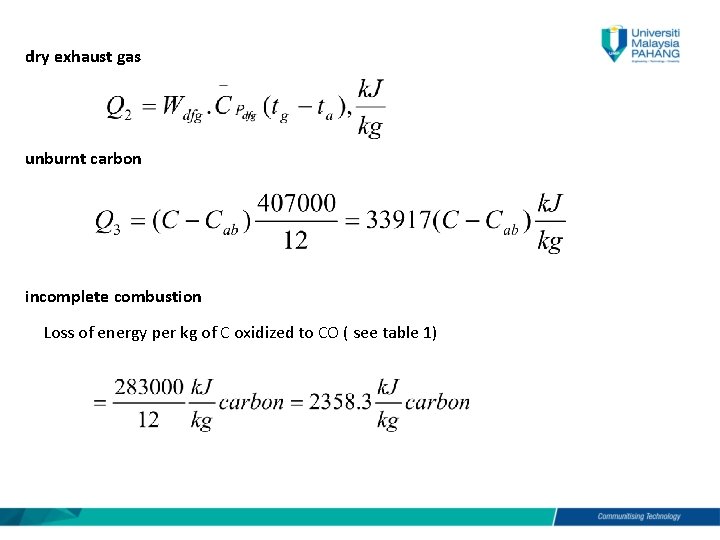
dry exhaust gas unburnt carbon incomplete combustion Loss of energy per kg of C oxidized to CO ( see table 1)
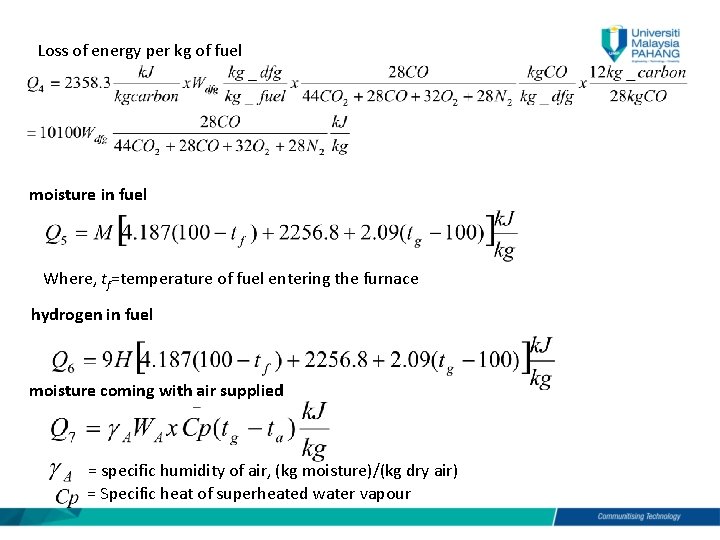
Loss of energy per kg of fuel moisture in fuel Where, tf=temperature of fuel entering the furnace hydrogen in fuel moisture coming with air supplied = specific humidity of air, (kg moisture)/(kg dry air) = Specific heat of superheated water vapour
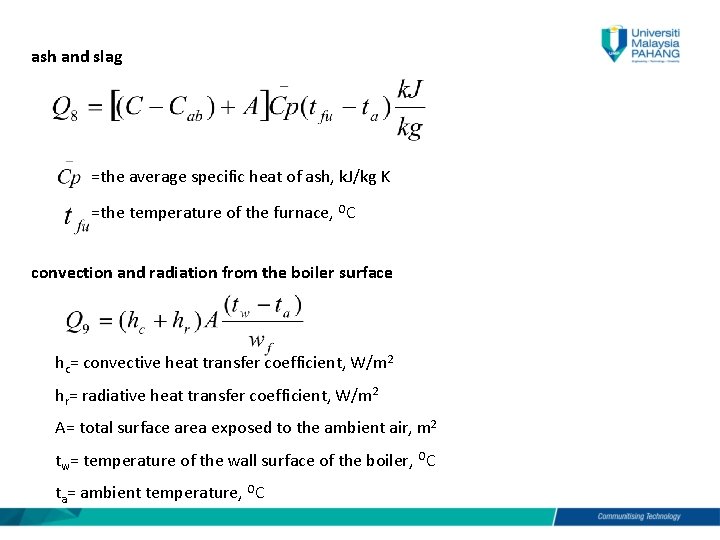
ash and slag =the average specific heat of ash, k. J/kg K =the temperature of the furnace, OC convection and radiation from the boiler surface hc= convective heat transfer coefficient, W/m 2 hr= radiative heat transfer coefficient, W/m 2 A= total surface area exposed to the ambient air, m 2 tw= temperature of the wall surface of the boiler, OC ta= ambient temperature, OC
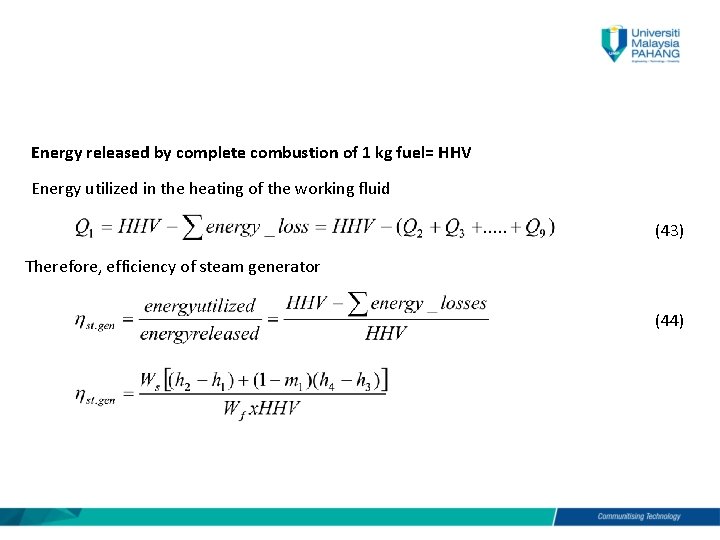
Energy released by complete combustion of 1 kg fuel= HHV Energy utilized in the heating of the working fluid (43) Therefore, efficiency of steam generator (44)
- Slides: 33