
Power Optimization of Realtime Systems on Variable Speed
Power Optimization of Real-time Systems on Variable Speed Processors Ly K. Le EE 590
Contents Why need power reduction? Ø Low power fixed priority scheduling (LPFPS) Ø § § § Overview of the approach Sources of idle intervals Methods of power reduction Experimental results Ø Conclusion Ø
Why need power reduction? Ø Power consumption – a critical design constraint in real-time systems § § Increase of system functionalities Demand of long battery time NEED POWER REDUCTION!!!
LPFPS Fixed priority preemptive scheduling Ø Rate-monotonic scheduling § § Off-line priority assignment Hard periodic deadline tasks Ø Widely used method in real-time systems § § Simplementation and timing analysis Low overhead and predictability Implementation Ø Active task, Run Queue, Delay Queue
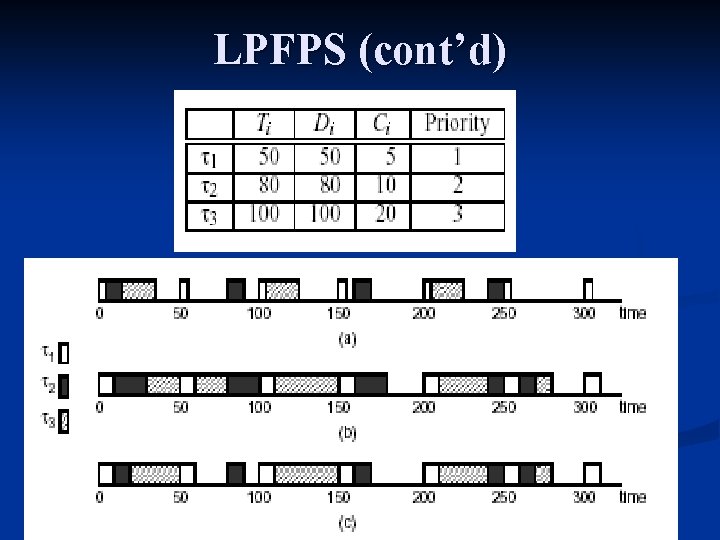
LPFPS (cont’d) Reduce power consumption get rid of idle intervals in the scheduler Ø Identify three sources of idle intervals Ø § § § Non tightly-designed system Tightly-designed system Variable execution time system • • Data-dependent computation Over-estimation of worst case execution time =>
LPFPS (cont’d)
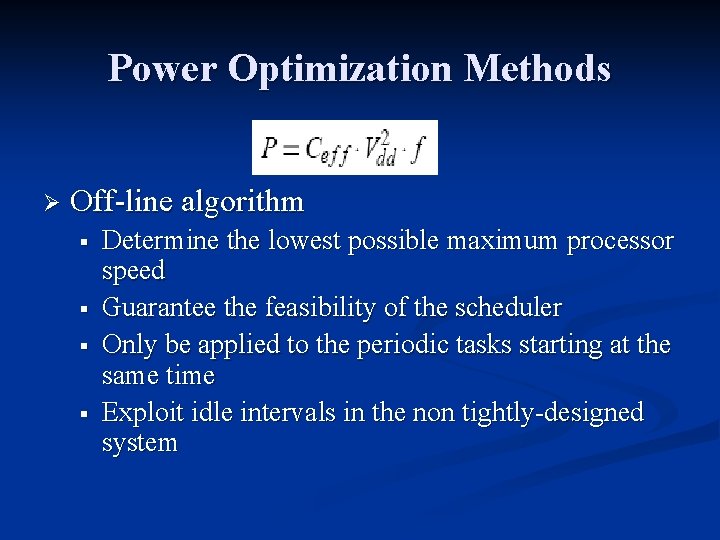
Power Optimization Methods Ø Off-line algorithm § § Determine the lowest possible maximum processor speed Guarantee the feasibility of the scheduler Only be applied to the periodic tasks starting at the same time Exploit idle intervals in the non tightly-designed system
Computation of the maximum processor speed Ci : worst case execution time of task i Ti: period of task i Di: deadline of task i ni: speed scaling factor of task i n: speed scaling factor of the system n = max (ni) where i = 1, 2, …. . , (tasks)
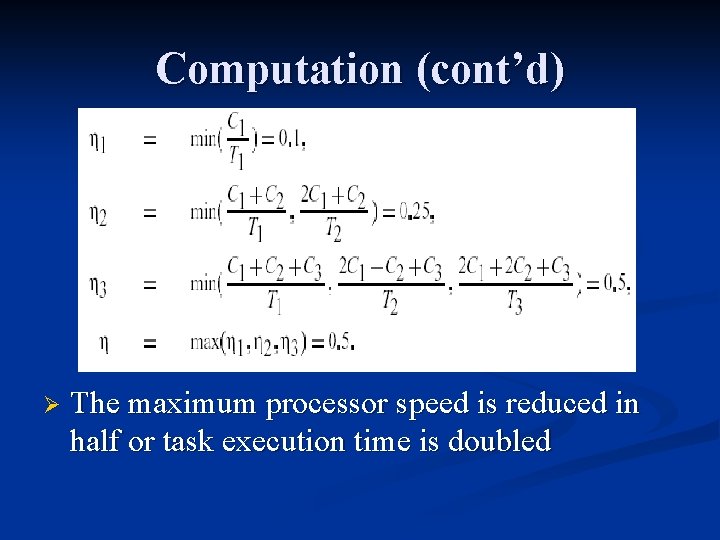
Computation (cont’d) Ø The maximum processor speed is reduced in half or task execution time is doubled
Power Optimization Methods (cont’d) Ø On-line algorithm § § Ø Vary the processor speed or use the power-down mode Exploit idle intervals in both tightly-designed system and variable execution time system Save more power if both on-line and off-line algorithms are combined
Power-down Mode Conventional method: power-down after predefined idle period Ø Predictive system shutdown Ø Only clock and timers kept running Ø
Variable Processor Speed Clock frequency is varied due to idle intervals and variable execution time Ø Power consumption of VSP is less than that of the constant speed processor Ø More variable speed rates the processor has, more power the system saves. Ø
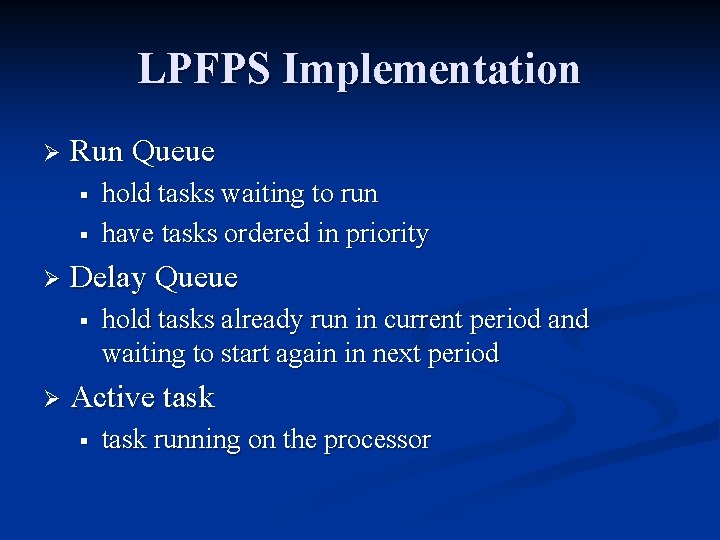
LPFPS Implementation Ø Run Queue § § Ø Delay Queue § Ø hold tasks waiting to run have tasks ordered in priority hold tasks already run in current period and waiting to start again in next period Active task § task running on the processor
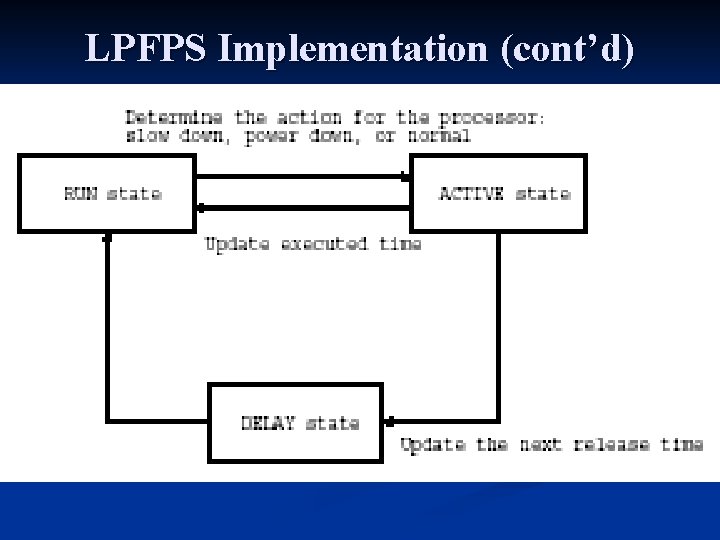
LPFPS Implementation (cont’d)
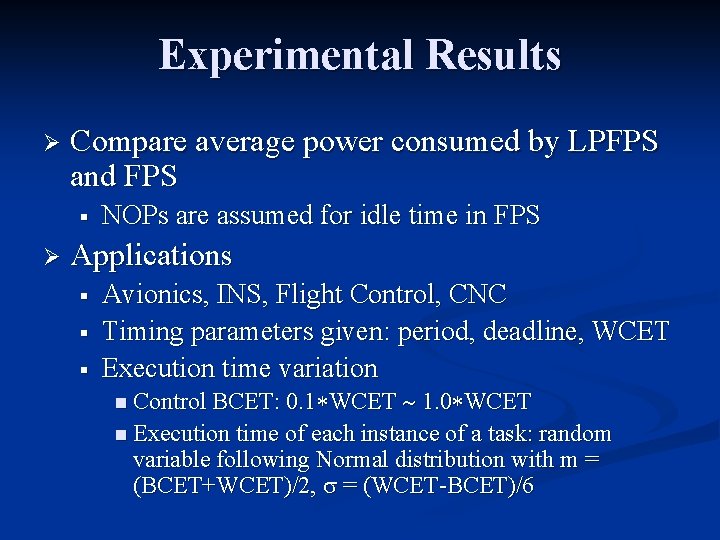
Experimental Results Ø Compare average power consumed by LPFPS and FPS § Ø NOPs are assumed for idle time in FPS Applications § § § Avionics, INS, Flight Control, CNC Timing parameters given: period, deadline, WCET Execution time variation n Control BCET: 0. 1 WCET 1. 0 WCET n Execution time of each instance of a task: random variable following Normal distribution with m = (BCET+WCET)/2, = (WCET-BCET)/6
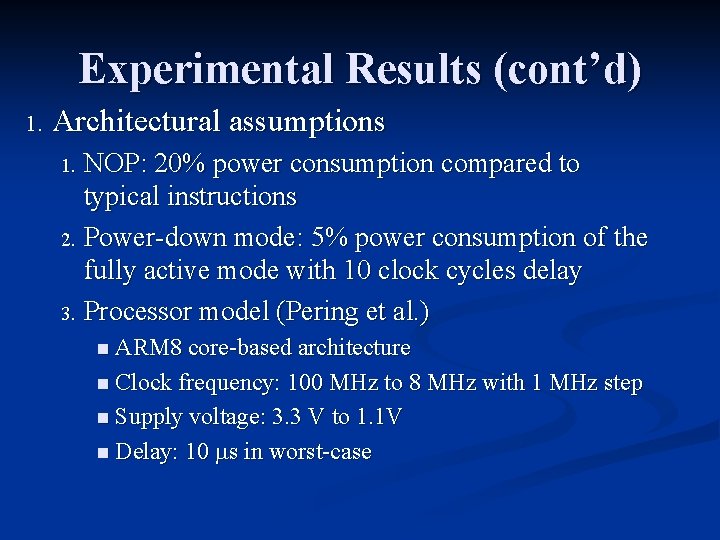
Experimental Results (cont’d) 1. Architectural assumptions NOP: 20% power consumption compared to typical instructions 2. Power-down mode: 5% power consumption of the fully active mode with 10 clock cycles delay 3. Processor model (Pering et al. ) 1. n ARM 8 core-based architecture n Clock frequency: 100 MHz to 8 MHz with 1 MHz step n Supply voltage: 3. 3 V to 1. 1 V n Delay: 10 s in worst-case
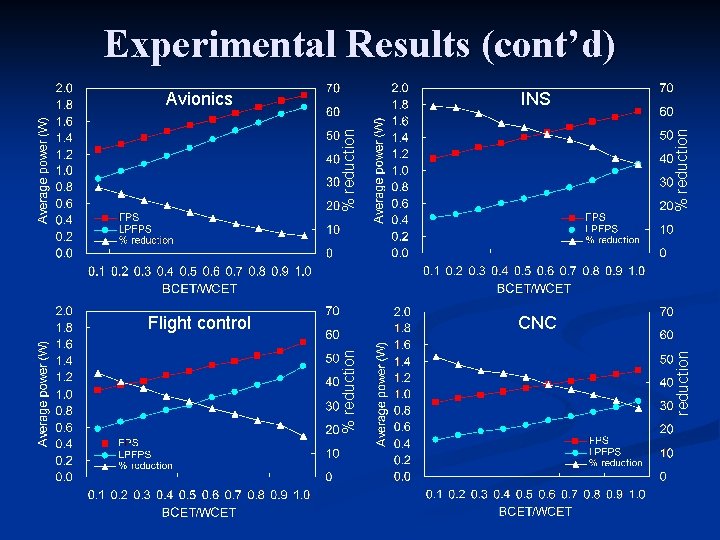
Experimental Results (cont’d) INS Flight control % reduction Avionics % reduction CNC
Conclusion 1. Propose a power optimization method for fixed priority scheduled real-time systems Exploit both power-down mode and dynamically changing the speed of the processor 2. Run time mechanism is simple enough for realtime analysis and implementation 3. Obtains a significant power reduction across several applications 1.
References n n n http: //poppy. snu. ac. kr/papers/iccad 01_ysshin. pdf http: //www. sigda. org/Archives/Proceeding. Archives/Dac 20 01/papers/2001/dac 01/pdffiles/49_1. pdf http: //faculty. cs. tamu. edu/rabi/Technical%20 Reports/CASES 022. pdf http: //www. netrino. com/Publications/Glossary/RMA. html http: //www. sigda. org/Archives/Proceeding. Archives/Dac 99/ papers/1999/dac 99/slides/dp 08_03. ppt
- Slides: 19