
Power of One Background It is a semiautobiographical

Power of One
Background It is a semi-autobiographical novel called The Power of One by Bryce Courtenay. Set in a racially divided South Africa, it follows the spiritual journey of the protagonist Peekay as he transforms from a small, scared boy who is victimized by bullies to a young man who has mastered “the power of one. ”
Annotations Read annotate the novel. This is mandatory. Your annotations will include questions, comments, and ideas that you want to explore as you interact with the text. You may write in the margins or use sticky-notes for your annotations.

Coming of Age What do we know?
![ˈComing of Age. Bildungsroman In literary criticism, a Bildungsroman (bil-du ŋ(k)s-rōˌmän), [a] novel of](http://slidetodoc.com/presentation_image_h2/ddc027debf86145619d6797fc2315326/image-5.jpg "ˈComing of Age. Bildungsroman In literary criticism, a Bildungsroman (bil-du ŋ(k)s-rōˌmän), [a] novel of")
ˈComing of Age. Bildungsroman In literary criticism, a Bildungsroman (bil-du ŋ(k)s-rōˌmän), [a] novel of formation, novel of education, or coming-of-age story is a literary genre that focuses on the psychological and moral growth of the protagonist from youth to adulthood, and in which, therefore, character change is extremely important.
Hero’s Journey Our hero is situated in a time and a place. Peekay’s early tribulations are addressed and he is given weapons to deal with them. Peekay learns that there are ways to cope with injustice. Peekay has the ability to rise to the surface despite how different he is to his companions. Peekay is constantly made aware that people in this society are unrelenting in their notion of social hierarchy. This idea of looking at the world from his own point of view rather than be directed by others is what makes Peekay his own person, someone who will lead the way for others.
DEMOCRACY What is it? Examples?
Types of Governments Socialism- The Grapes of Wrath By John Steinbeck Communism- Anthem By Ayn Rand Governments based on Politics -Fahreneheit 451 By Ray Bradbury's Totalitarianism-1984 By George Orwell Theocracy-The Scarlet Letter By Nathaniel Hawthorne Monarchy— Beowulf Parliamentary— The Canterbury Tales By Geoffrey Chaucer Anarchy—War and Peace By Leo Tolstoy Democracy—The Jungle By Upton Sinclair

History
The Boer War “The Boer War had created great malevolent feelings against the English, who were called rooineks. It was a hate that had entered the Afrikaner bloodstream and pocked the hearts and minds of the next generation” A century of bloodshed, oppression, resentment. . . and war. The conflict known to history as the Boer War (1899— 1902), which ended in the victory of the English, was actually the second war fought between the Boers and the British. The first took place from 1880 to 1881 and ended in victory for the Boers, though it was destined to be a short-lived triumph. The Boers were fiercely independent farmers of mainly Dutch and German stock who went to what is now South Africa beginning in the late 1600 s, seeking to make their fortunes and to practice their conservative brand of Protestant Christianity. One strong component of their religious convictions was a belief in a biblically ordained separation of races and the superiority of the “white race. ”
World War II in South Africa World War II casts a long, dark shadow over The Power of One and over the life of its young protagonist, Peekay. It has an almost mythological presence, one of a malign fairy tale, as when the Judge torments Peekay with talk of Hitler coming to march all the English into the sea–a monstrous updating of the Pied Piper of Hamelin legend. Nonetheless, a brief overview of the history may provide helpful background for readers.
Origins and Early History of Apartheid Throughout The Power of One, readers are witness to a degree of racism against non-whites that is shocking in its casual brutality. It is obvious that for the majority of Boers and British alike, blacks and coloreds, as the nonwhite populations of South Africa were classified, are viewed as little more than animals, to be discriminated against, beaten, or even killed with impunity.
Themes, Symbols, Motifs

“Idea of Power” Power struggles exist among any group of people. Seeing the power that Peekay attains without his seeking it points to the power inside him The power of one person to make a change.
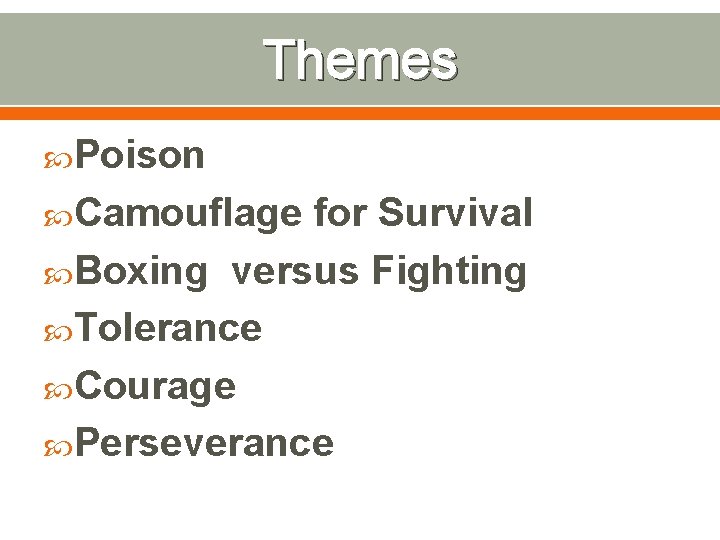
Themes Poison Camouflage for Survival Boxing versus Fighting Tolerance Courage Perseverance
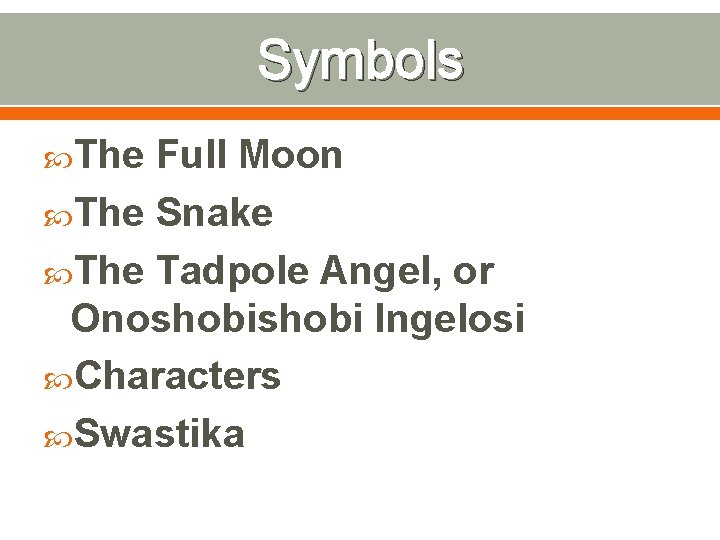
Symbols The Full Moon The Snake The Tadpole Angel, or Onoshobi Ingelosi Characters Swastika
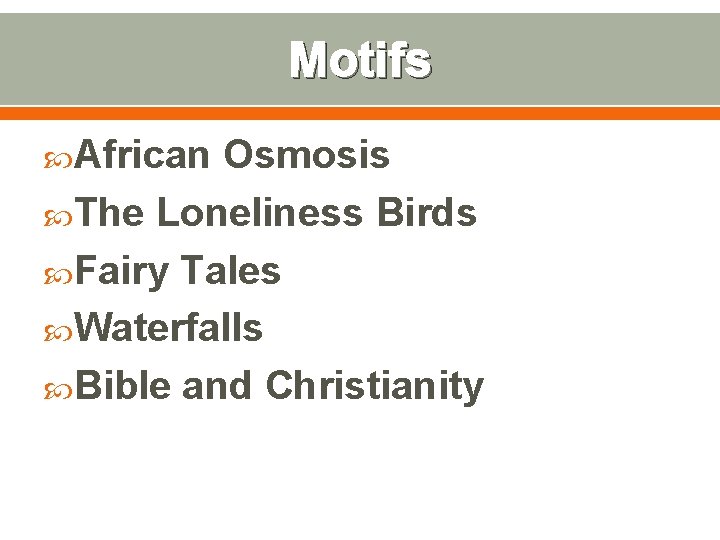
Motifs African Osmosis The Loneliness Birds Fairy Tales Waterfalls Bible and Christianity
Elements of Human Nature Desire for power Falling in love Feeling envious of others' possessions and station in society Wanting to understand their place in the general scheme of things.
Thoughts to Ponder
Chapters 1 -9 How does the opening of the book set the tone for the story? How does the Judge function as a symbol of the political climate? What does Hoppie symbolize? What did Peekay gain from his brief association with Big Hettie? Meeting Doc is a major turning point in Peekay's life. What role does Doc fulfill in Peekay's world? Why was this significant?
Chapter 10 -15 Doc's time in jail provides Peekay with many opportunities. What does Peekay learn about music, boxing, treatment of prisoners, and the unfairness of laws? Why is Geel Piet function in the book successful? How does the letter-writing project, his win in the ring, the boots from Geel Piet and the other prisoners, and his new name, and Tadpole Angel effect Peekay’s integrity? What are the results of the prison concert? How do these events figure in Peekay's journey to maturity? Why would Borman’s role in the novel be considered ironic?
Chapters 16 -22 What is the importance of being chosen by "Singe 'n' Burn"? Why does Peekay see Barberton differently when he comes home from school? How does Courtenay introduce political unrest? How is Peekay's fight against Gideon symbolic? Describe the crystal cave and what it means to Doc, to Peekay, and in relation to theme of the book.
- Slides: 22