
power of hydrogen p H scale logarithmic scale
![p. H scale • logarithmic scale – expressing H+1 concentration, [H+1] • If p.](https://slidetodoc.com/presentation_image_h2/1edc613c33e89533b8ee2eb00f93a1f9/image-3.jpg "p. H scale • logarithmic scale – expressing H+1 concentration, [H+1] • If p.")

![Molarity to p. H To determine p. H: • express [H+1] in scientific notation](https://slidetodoc.com/presentation_image_h2/1edc613c33e89533b8ee2eb00f93a1f9/image-5.jpg "Molarity to p. H To determine p. H: • express [H+1] in scientific notation")

![p. H [H+1] p. H 1 M or 1 X 100 M 0 0.](https://slidetodoc.com/presentation_image_h2/1edc613c33e89533b8ee2eb00f93a1f9/image-7.jpg "p. H [H+1] p. H 1 M or 1 X 100 M 0 0.")


![ACID or BASE? • acids: [H+1] [OH-1] • bases: [OH-1] [H+1]](https://slidetodoc.com/presentation_image_h2/1edc613c33e89533b8ee2eb00f93a1f9/image-11.jpg "ACID or BASE? • acids: [H+1] [OH-1] • bases: [OH-1] [H+1]")

![Relationships of: +1 -1 p. H, p. OH, [H ] and [OH ] •](https://slidetodoc.com/presentation_image_h2/1edc613c33e89533b8ee2eb00f93a1f9/image-13.jpg "Relationships of: +1 -1 p. H, p. OH, [H ] and [OH ] •")

![• if p. H = 4 • [H+1] = ? • p. OH](https://slidetodoc.com/presentation_image_h2/1edc613c33e89533b8ee2eb00f93a1f9/image-15.jpg "• if p. H = 4 • [H+1] = ? • p. OH")
![• if the [OH-1] = 1 X 10 -3 • p. OH =](https://slidetodoc.com/presentation_image_h2/1edc613c33e89533b8ee2eb00f93a1f9/image-16.jpg "• if the [OH-1] = 1 X 10 -3 • p. OH =")

![[H+] (M) p. H [OH-] (M) p. OH Acidic or Basic 1 x 10](https://slidetodoc.com/presentation_image_h2/1edc613c33e89533b8ee2eb00f93a1f9/image-18.jpg "[H+] (M) p. H [OH-] (M) p. OH Acidic or Basic 1 x 10")




- Slides: 23
power of hydrogen
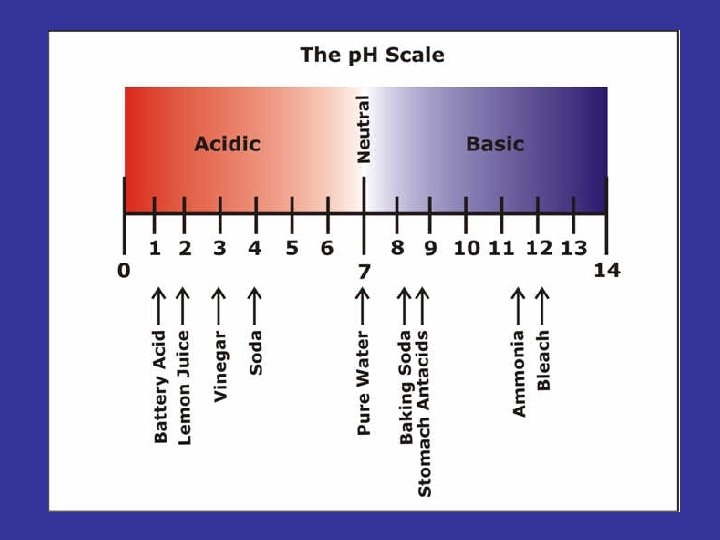
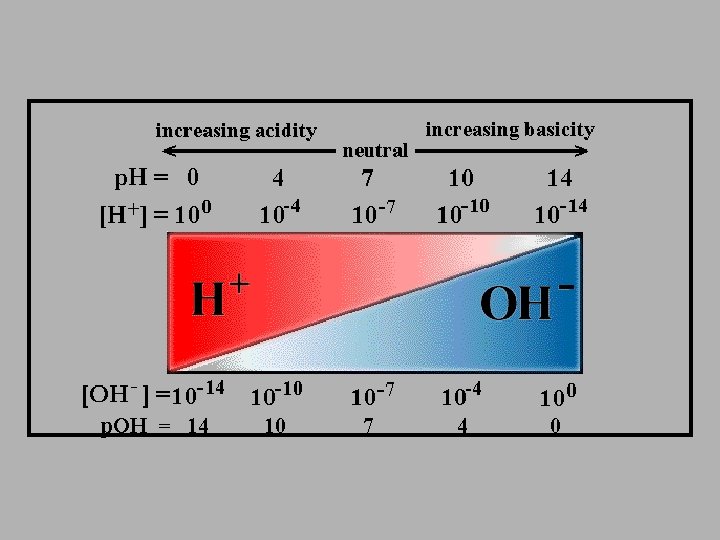
p. H scale • logarithmic scale – expressing H+1 concentration, [H+1] • If p. H changes by factor of 1, [H+1] changes by factor of 10 • p. H = -log[H+1]
Molarity to p. H To determine p. H: • express [H+1] in scientific notation • remember, [ ] means concentration of whatever is inside brackets • log is the power of 10
Molarity to p. H for Pure water tiny bit of ionization in pure water: H 2 O H+1 + OH-1 • [H+1] = [OH-1] = 1 X 10 -7 M • p. H = -log[H+1] = -(-7) -7 = 7
p. H [H+1] p. H 1 M or 1 X 100 M 0 0. 1 M 0. 01 M. 001 M or or or 1 X 10 -1 1 X 10 -2 1 X 10 -3 M M M 1 2 3
p. OH = 14 10 7 4 0
p. H range • 0 to 14 (7 is neutral) • p. H = 0, strongly acidic • p. H = 14, strongly basic
ACID or BASE? • acids: [H+1] [OH-1] • bases: [OH-1] [H+1]
Relationships of: +1 -1 p. H, p. OH, [H ] and [OH ] • product of [H+1] and [OH-1] is always 1 x 10 -1 M • add exponents when multiple in scientific notation • sum of p. H and p. OH is always 14
p. H + p. OH = 14 • • • p. H = 3, p. OH = p. H = 7, p. OH = p. H = 10, p. OH = p. H = 9, p. OH = p. H = 1, p. OH = 11 7 4 5 13
• if p. H = 4 • [H+1] = ? • p. OH = ? • [OH-1] = ? 1 x 10 -4 M 10 1 x 10 -10 M
• if the [OH-1] = 1 X 10 -3 • p. OH = ? • p. H = ? • +1 [H ] =? 3 14 – 3 = 11 1 x 10 -11 M
[H+] (M) p. H [OH-] (M) p. OH Acidic or Basic 1 x 10 -3 3 1 x 10 -11 11 A 9 1 x 10 -5 5 B 1 x 10 -2 2 1 x 10 -12 12 A 1 x 10 -8 8 1 x 10 -6 6 B 1 x 10 -9
How to safely test p. H • use instruments – p. H meter • use indicators – litmus paper or liquid indicators • see if substance reacts with a metal other than Cu, Ag, or Au • NEVER “taste”
p. H meters
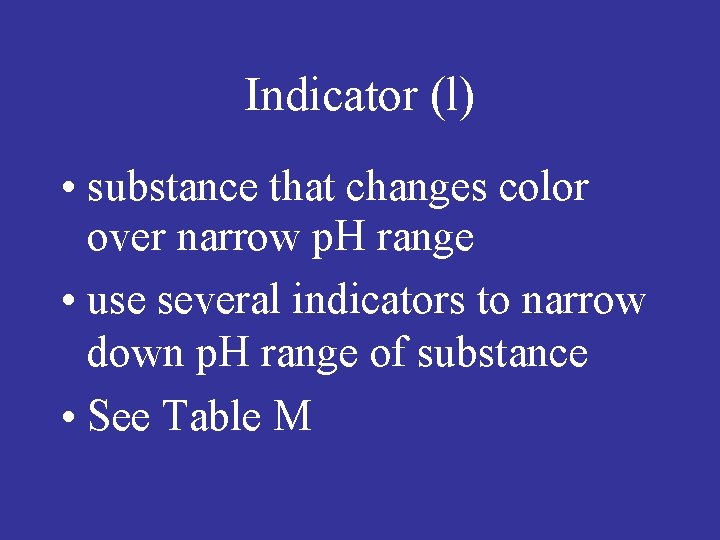
Indicator (l) • substance that changes color over narrow p. H range • use several indicators to narrow down p. H range of substance • See Table M