
Power Machines N 6 Module 1 Revision of

- Slides: 39
Power Machines N 6
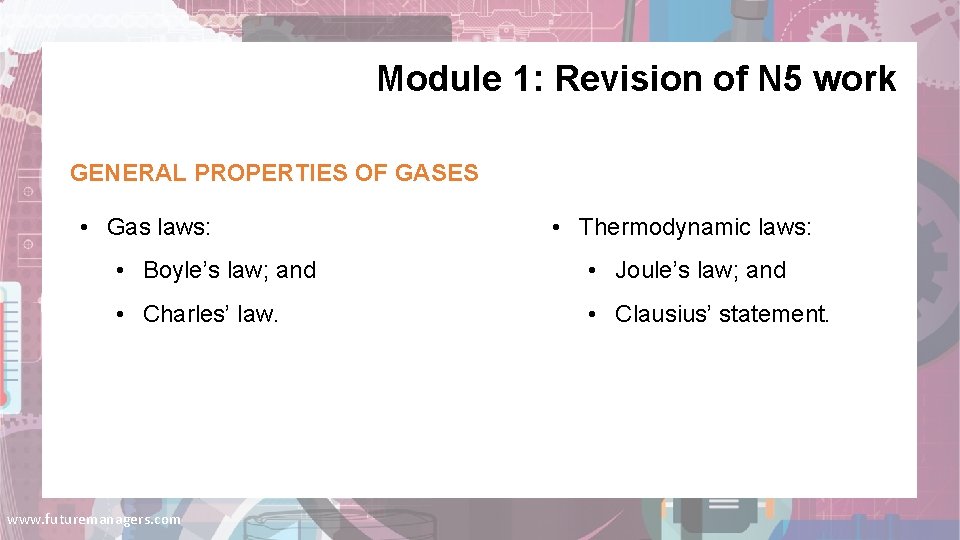
Module 1: Revision of N 5 work GENERAL PROPERTIES OF GASES • Gas laws: • Thermodynamic laws: • Boyle’s law; and • Joule’s law; and • Charles’ law. • Clausius’ statement. www. futuremanagers. com
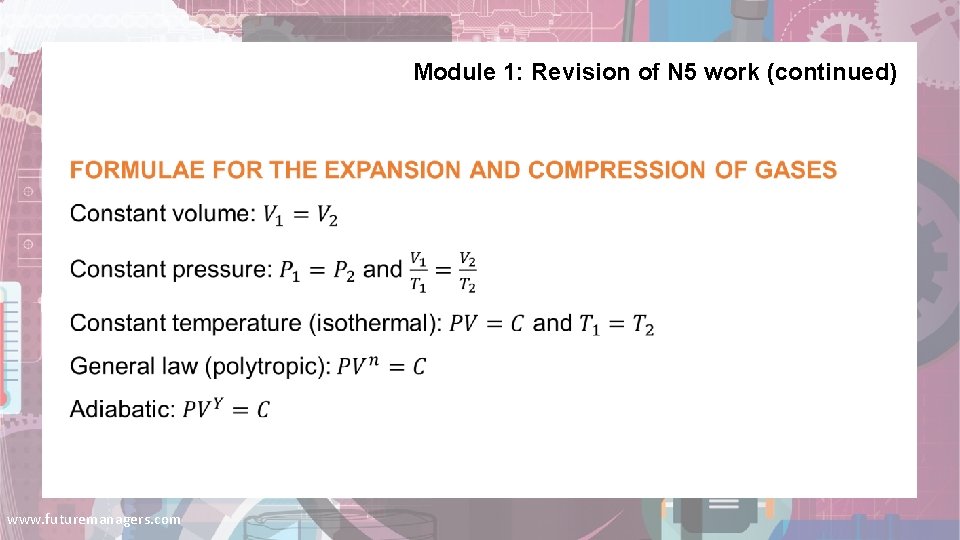
Module 1: Revision of N 5 work (continued) www. futuremanagers. com
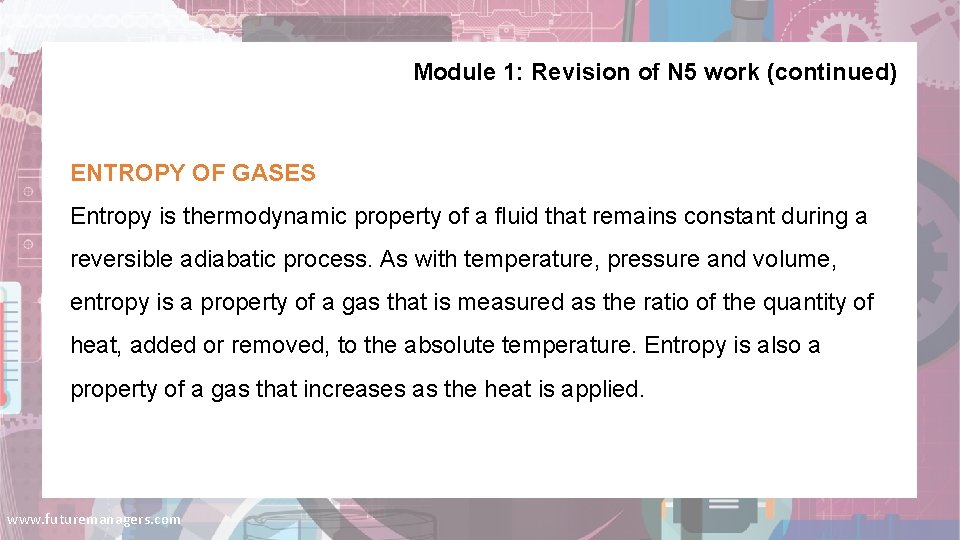
Module 1: Revision of N 5 work (continued) ENTROPY OF GASES Entropy is thermodynamic property of a fluid that remains constant during a reversible adiabatic process. As with temperature, pressure and volume, entropy is a property of a gas that is measured as the ratio of the quantity of heat, added or removed, to the absolute temperature. Entropy is also a property of a gas that increases as the heat is applied. www. futuremanagers. com
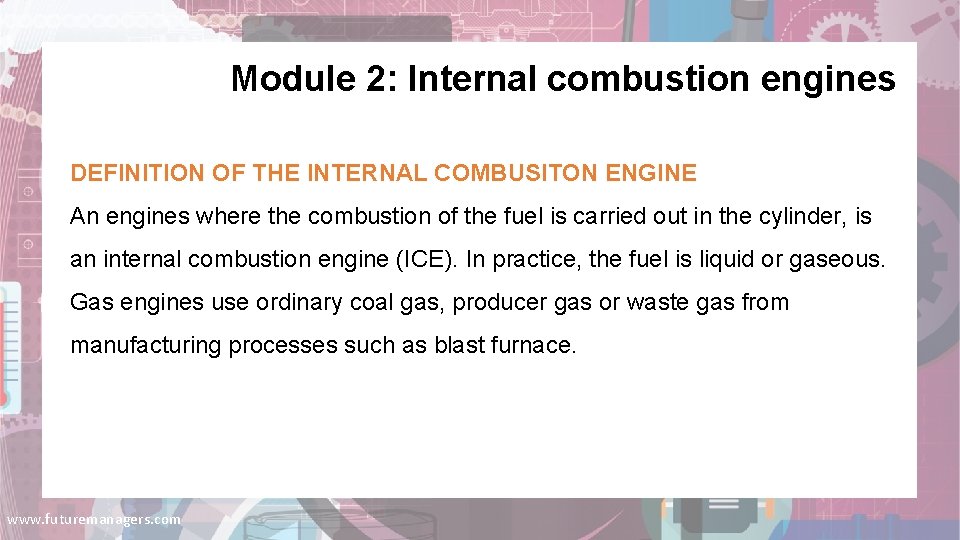
Module 2: Internal combustion engines DEFINITION OF THE INTERNAL COMBUSITON ENGINE An engines where the combustion of the fuel is carried out in the cylinder, is an internal combustion engine (ICE). In practice, the fuel is liquid or gaseous. Gas engines use ordinary coal gas, producer gas or waste gas from manufacturing processes such as blast furnace. www. futuremanagers. com
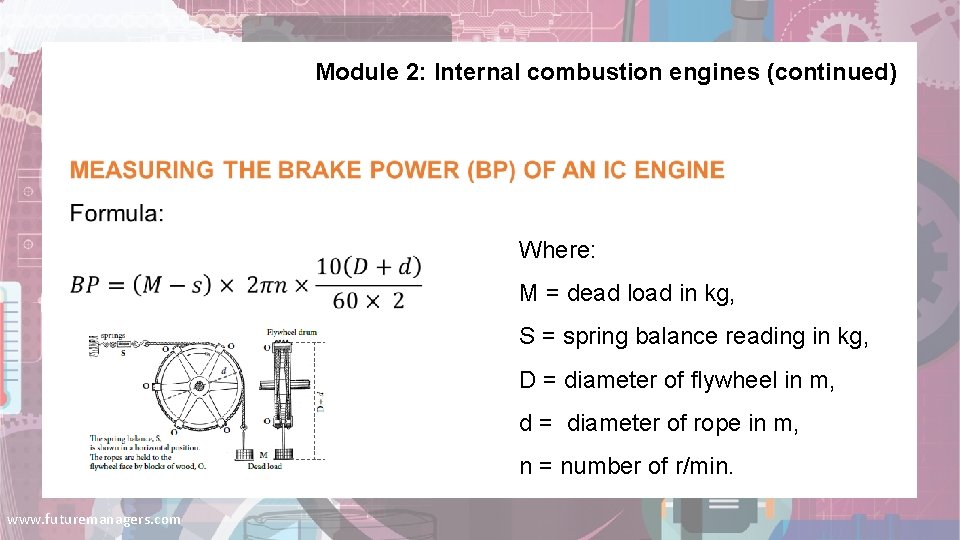
Module 2: Internal combustion engines (continued) Where: M = dead load in kg, S = spring balance reading in kg, D = diameter of flywheel in m, d = diameter of rope in m, n = number of r/min. www. futuremanagers. com
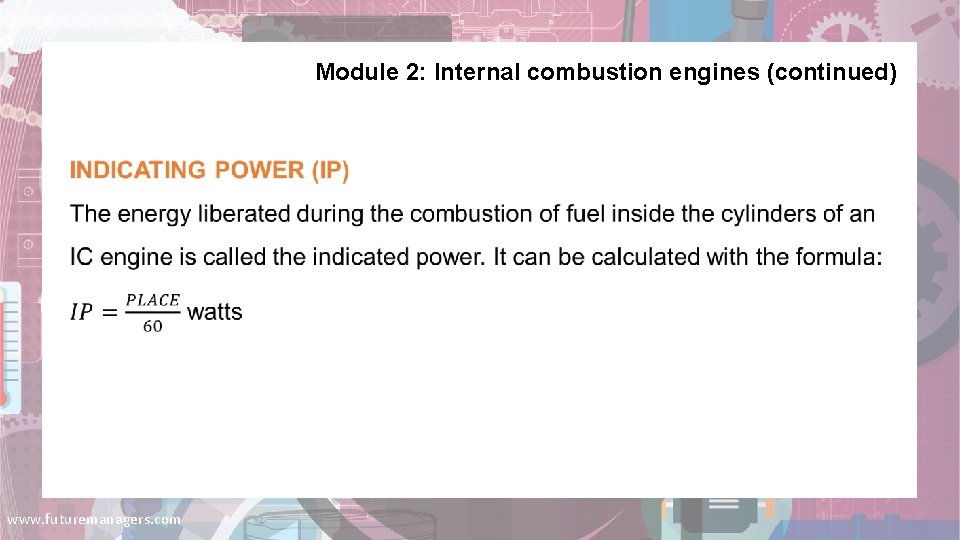
Module 2: Internal combustion engines (continued) www. futuremanagers. com
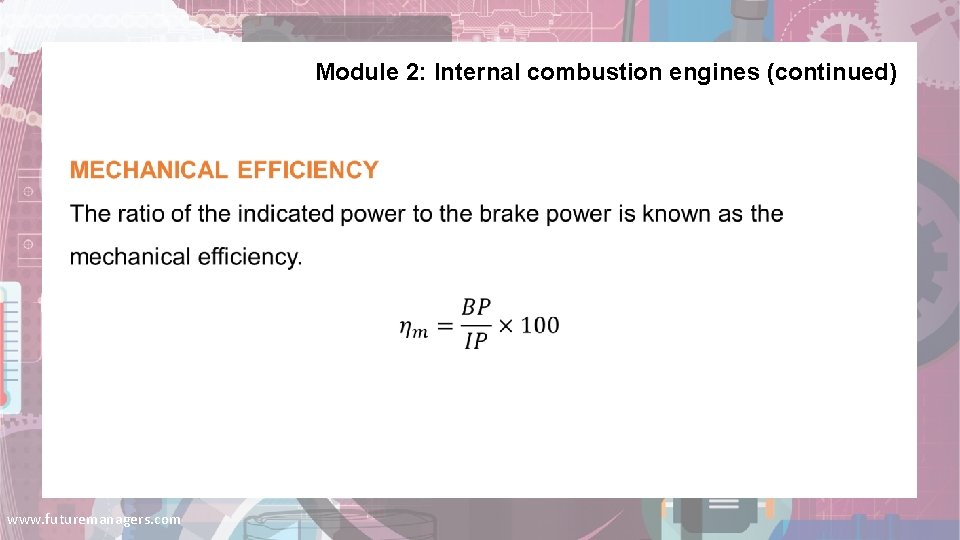
Module 2: Internal combustion engines (continued) www. futuremanagers. com
Module 2: Internal combustion engines (continued) THE INDICATED MEAN EFFECTIVE PRESSURE OF AN IC ENGINE The indicated mean effective pressure (IMEP) of an IC engine is measured with an engine indicator. To find the amount of work done on the cylinder of such an engine, it is essential to plot a pressure–volume diagram during the movement of the piston inside the cylinder. www. futuremanagers. com
Module 2: Internal combustion engines (continued) www. futuremanagers. com
Module 2: Internal combustion engines (continued) www. futuremanagers. com
Module 2: Internal combustion engines (continued) www. futuremanagers. com
Module 2: Internal combustion engines (continued) HEAT BALANCE SHEET FOR AN INTERNAL COMBUSTION ENERGY To draw up a heat balance sheet for an ICE, a complete test should be done on the engine running at constant load. Measurements should be taken of all quantities of heat energy supplied or emitted during the test. www. futuremanagers. com
Module 2: Internal combustion engines (continued) INDICATED POWER BY MORSE TEST One method to obtain a close estimate of the indicated power of a multicylinder internal combustion engine is the Morse test. This method can only be used on engines with more than one cylinder. The engine being tested is coupled to a suitable brake and, at the test condition, the brake power output is determined. www. futuremanagers. com
Module 3: Cycles THE CONSTANT VOLUME OR OTTO CYCLE In petrol and gas engines, the heat is taken in rapidly from the combustion of the fuel, while there is negligible movement of the piston at the top-deadcentre (TDC) position. Similarly, the heat is rejected rapidly from the cylinder when the exhaust valve opens at or about bottom-dead-centre (BDC). So, the heat exchange operations occur while the volume of the gases in the cylinder remains constant. The ideal cycle corresponding to this arrangement is called the constant volume cycle. www. futuremanagers. com
Module 3: Cycles (continued) THE DUAL COMBUSTION CYCLE This cycle is used in some modern oil engines. It is a combination of the Otto and diesel cycles as fuel is partly burnt at constant volume and partly at constant pressure, hence the name dual-combustion cycle (or composite cycle). www. futuremanagers. com
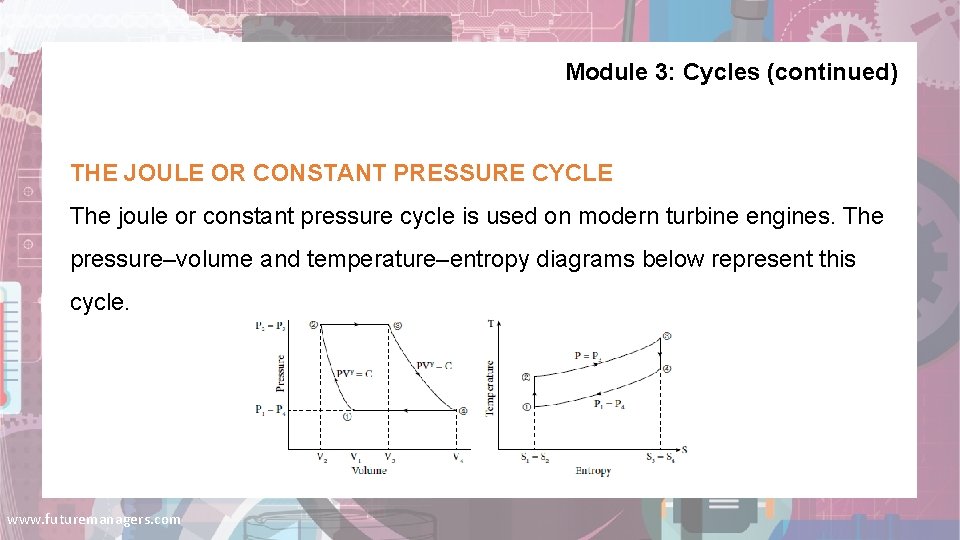
Module 3: Cycles (continued) THE JOULE OR CONSTANT PRESSURE CYCLE The joule or constant pressure cycle is used on modern turbine engines. The pressure–volume and temperature–entropy diagrams below represent this cycle. www. futuremanagers. com
Module 4: Air compressors THE FUNCTION OF AIR COMPRESSORS An air compressor takes in a definite quantity of fluid (usually a gas, most often air) and delivers it at a required pressure. An efficient compressor will accomplish this with the minimum input of mechanical work. www. futuremanagers. com
Module 4: Air compressors (continued) TYPES OF COMPRESSORS Air compressors fall into two distinct types. There are important differences in the fundamental behaviour of the two types: • The reciprocating compressor which has characteristics of a low mass rate of flow and high pressure ratios; and • The rotary (or centrifugal) compressor which has a high mass rate of flow and low pressure ratios. www. futuremanagers. com
Module 4: Air compressors (continued) THE EFFECT OF CLEARANCE ON A RECIPROCATING COMPRESSOR The clearance volume on the cylinder of the compressor should be as small as possible, since it seriously affects the volumetric efficiency. www. futuremanagers. com
Module 4: Air compressors (continued) VOLUMETRIC EFFICIENCY Volumetric efficiency is the volume of air delivered, measured at free air pressure and temperature, and divided by the swept volume of the cylinder. www. futuremanagers. com
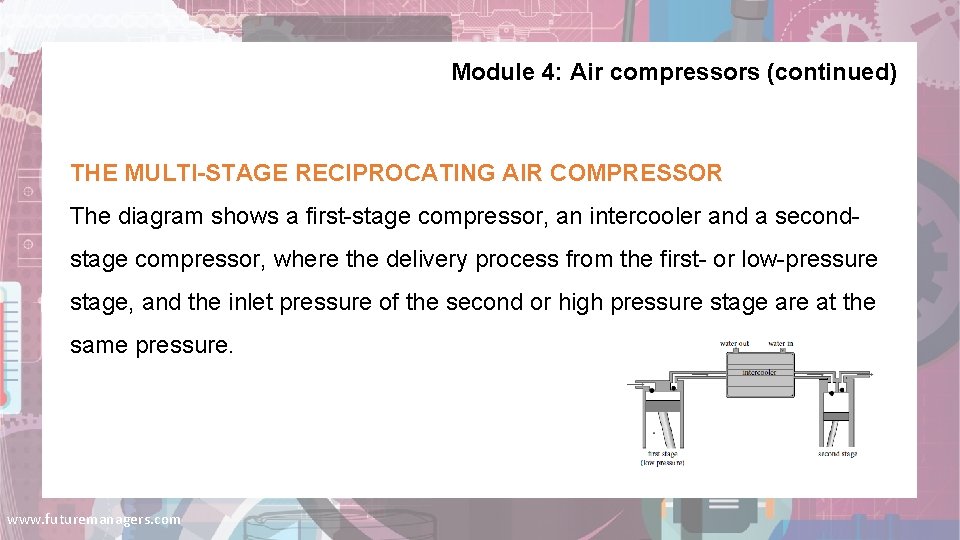
Module 4: Air compressors (continued) THE MULTI-STAGE RECIPROCATING AIR COMPRESSOR The diagram shows a first-stage compressor, an intercooler and a secondstage compressor, where the delivery process from the first- or low-pressure stage, and the inlet pressure of the second or high pressure stage are at the same pressure. www. futuremanagers. com
Module 5: Nozzles THE DEFINITION OF A GAS NOZZLE A nozzle is a duct of smoothly varying cross-sectional area where a steadily flowing fluid can be made to accelerate by a pressure drop along the duct. Many applications (steam and gas turbines, jet engines, rocket motors, flow measurements, and so on) require a high velocity stream of fluid, and the nozzle is the best way to obtain this. www. futuremanagers. com
Module 5: Nozzles (continued) NOZZLE SHAPE The shape of the nozzle should allow the conversion from internal energy to kinetic energy efficiently. Two types of nozzle, convergent and convergent divergent nozzle, are used. www. futuremanagers. com
Module 5: Nozzles (continued) CRITICAL PRESSURE RATIO The velocity at the throat of a correctly designed nozzle is the velocity of sound. Similarly, for a nozzle that is converged only, the fluid will attain sonic velocity at exit if the pressure drop across the nozzle is large enough. The ratio of the pressure at the section where sonic velocity is attained to the inlet pressure of a nozzle, is called the critical pressure ratio. www. futuremanagers. com
Module 5: Nozzles (continued) NOZZLE FOR STEAM FLOW The flow of steam through a nozzle could be regarded, in its simplest form, as an adiabatic expansion. The steam enters the nozzle with a relatively small velocity and a high initial pressure. As the steam expands, the velocity will increase as the heat energy at the steam is converted to kinetic energy. www. futuremanagers. com
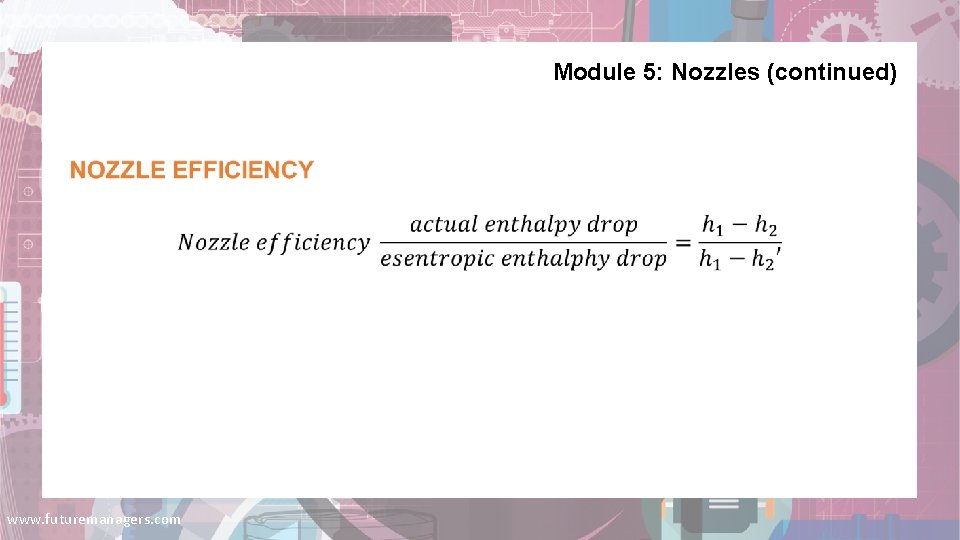
Module 5: Nozzles (continued) www. futuremanagers. com
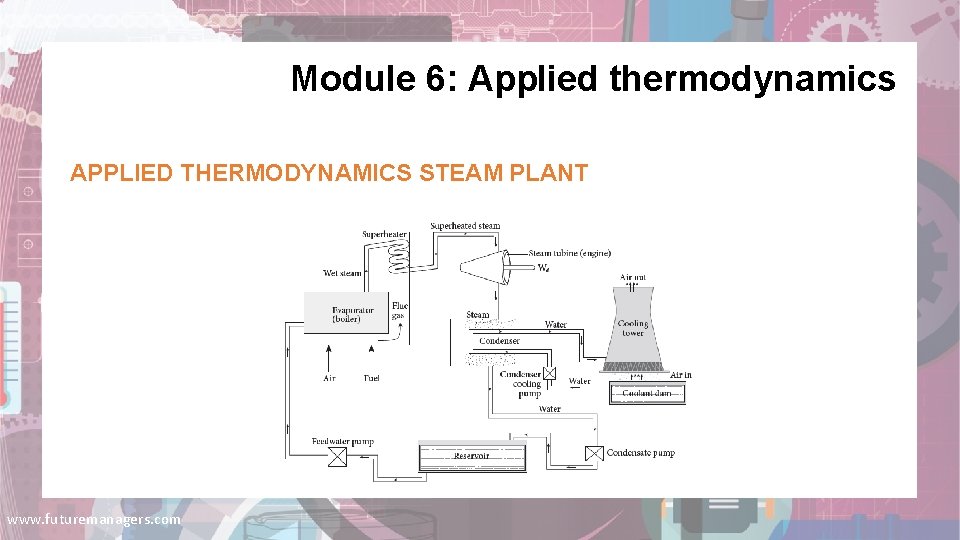
Module 6: Applied thermodynamics APPLIED THERMODYNAMICS STEAM PLANT www. futuremanagers. com
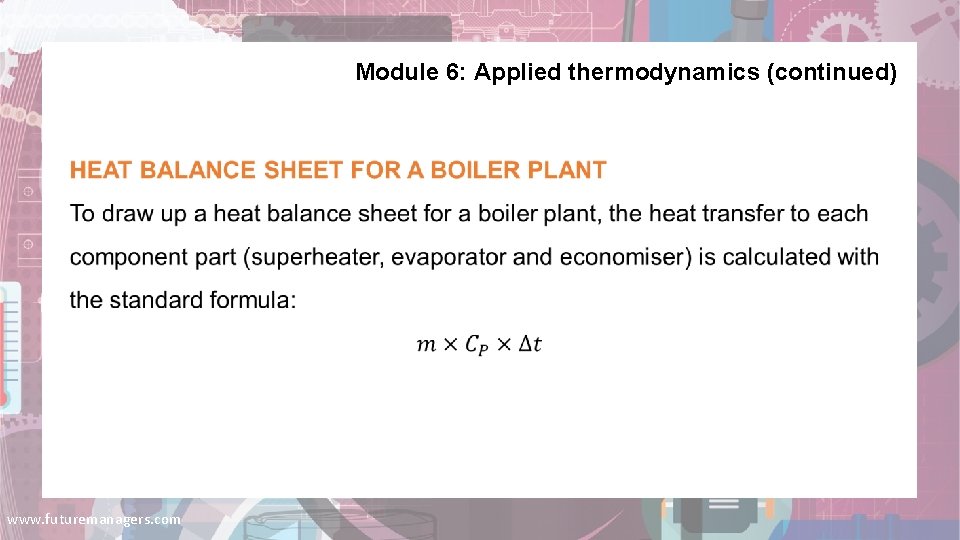
Module 6: Applied thermodynamics (continued) www. futuremanagers. com
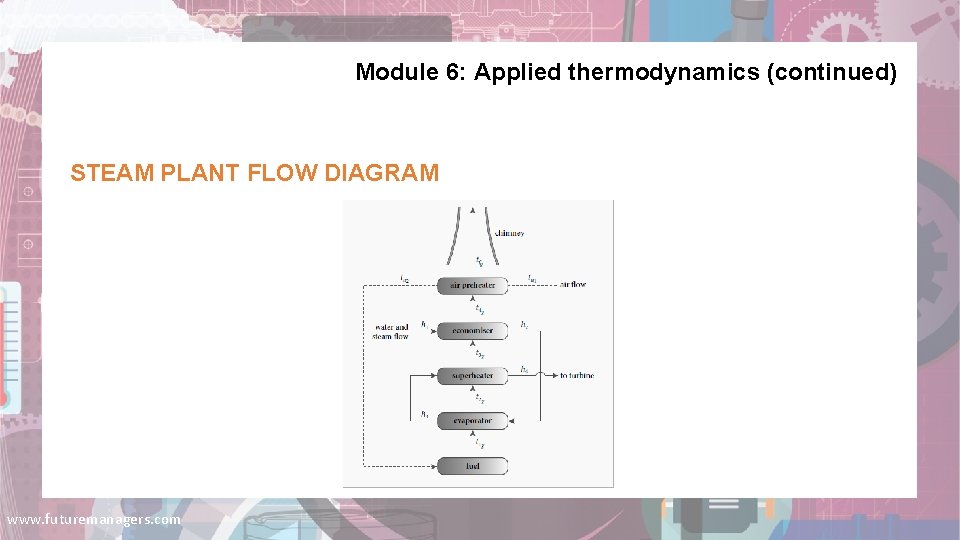
Module 6: Applied thermodynamics (continued) STEAM PLANT FLOW DIAGRAM www. futuremanagers. com
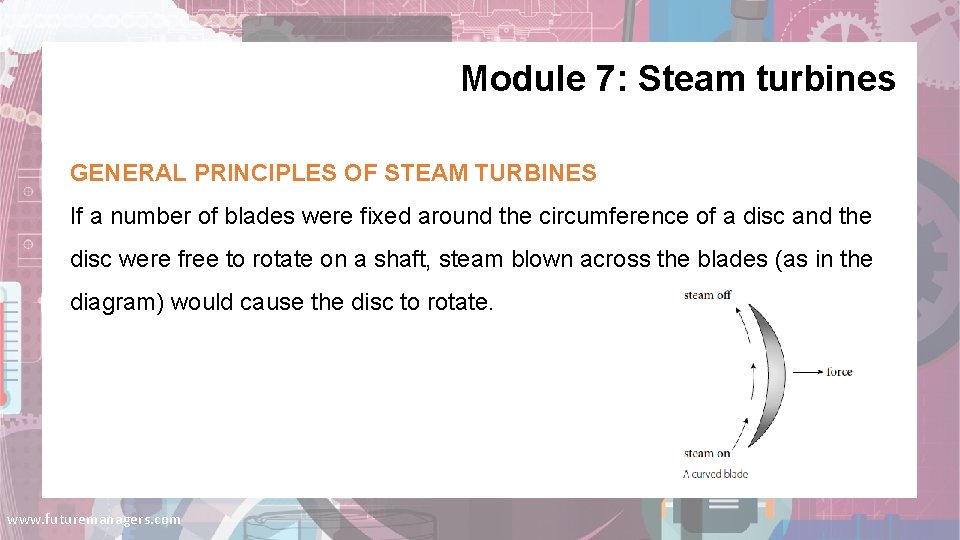
Module 7: Steam turbines GENERAL PRINCIPLES OF STEAM TURBINES If a number of blades were fixed around the circumference of a disc and the disc were free to rotate on a shaft, steam blown across the blades (as in the diagram) would cause the disc to rotate. www. futuremanagers. com
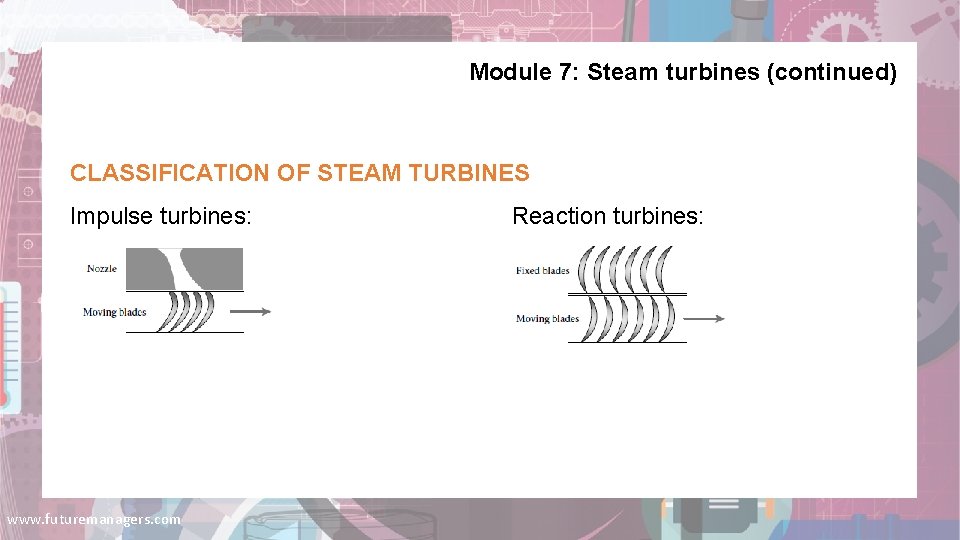
Module 7: Steam turbines (continued) CLASSIFICATION OF STEAM TURBINES Impulse turbines: www. futuremanagers. com Reaction turbines:
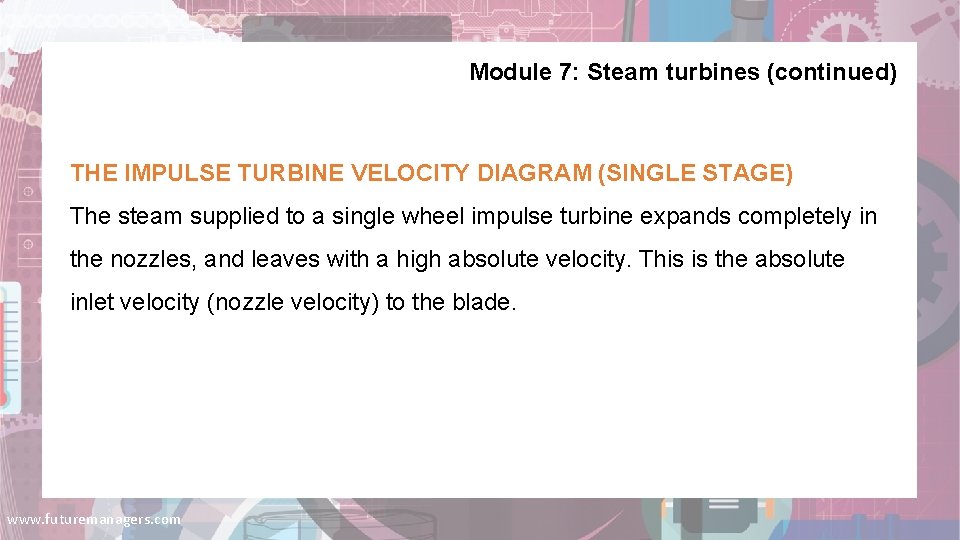
Module 7: Steam turbines (continued) THE IMPULSE TURBINE VELOCITY DIAGRAM (SINGLE STAGE) The steam supplied to a single wheel impulse turbine expands completely in the nozzles, and leaves with a high absolute velocity. This is the absolute inlet velocity (nozzle velocity) to the blade. www. futuremanagers. com
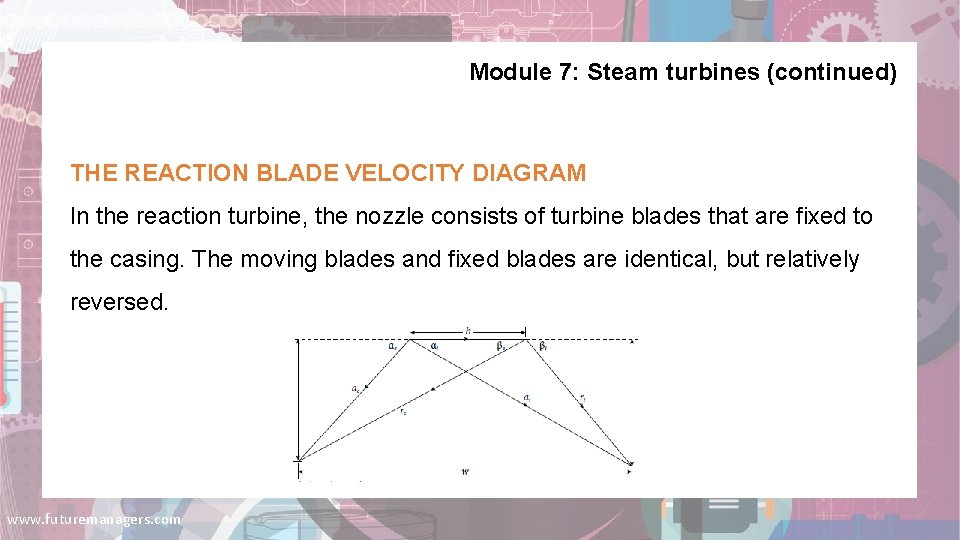
Module 7: Steam turbines (continued) THE REACTION BLADE VELOCITY DIAGRAM In the reaction turbine, the nozzle consists of turbine blades that are fixed to the casing. The moving blades and fixed blades are identical, but relatively reversed. www. futuremanagers. com
Module 7: Steam turbines (continued) PRESSURE COMPOUNDED IMPULSE TURBINES The pressure drop available to the turbine is used in a series of small increments, each associated with one stage of the turbine. The nozzles are carried in diaphragms, which separate each stage from the next one. The steam pressure in the space between each pair of diaphragms is constant, but there is a pressure drop across each diaphragm, as required by the nozzles. www. futuremanagers. com
Module 7: Steam turbines (continued) VELOCITY COMPOUNDED IMPULSE TURBINES The velocity compounded stage (named the Curtis stage for its designer) is used for lower blade speeds and a higher utilisation of the kinetic energy of the steam. In this type of turbine all the expansion takes place in a single set of nozzles, and the steam then passes through a series of blades attached to a single wheel or rotor. www. futuremanagers. com
Module 8: Refrigeration THE REFRIGERATION PROCESS The cycle process whereby natural heat transfer down a temperature gradient is returned up the temperature gradient by the supply of external energy, is refrigeration. The refrigeration cycle is the reverse of the heat engine cycle. www. futuremanagers. com
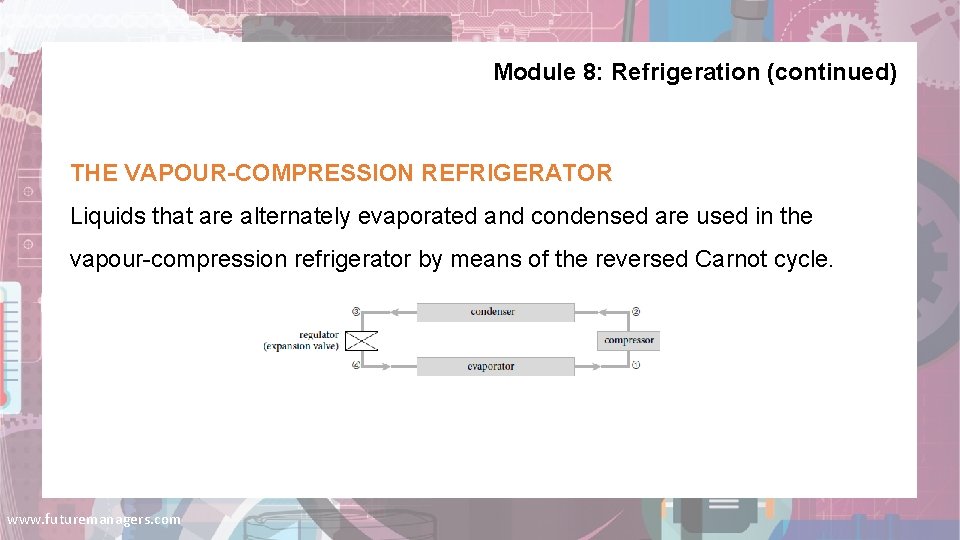
Module 8: Refrigeration (continued) THE VAPOUR-COMPRESSION REFRIGERATOR Liquids that are alternately evaporated and condensed are used in the vapour-compression refrigerator by means of the reversed Carnot cycle. www. futuremanagers. com
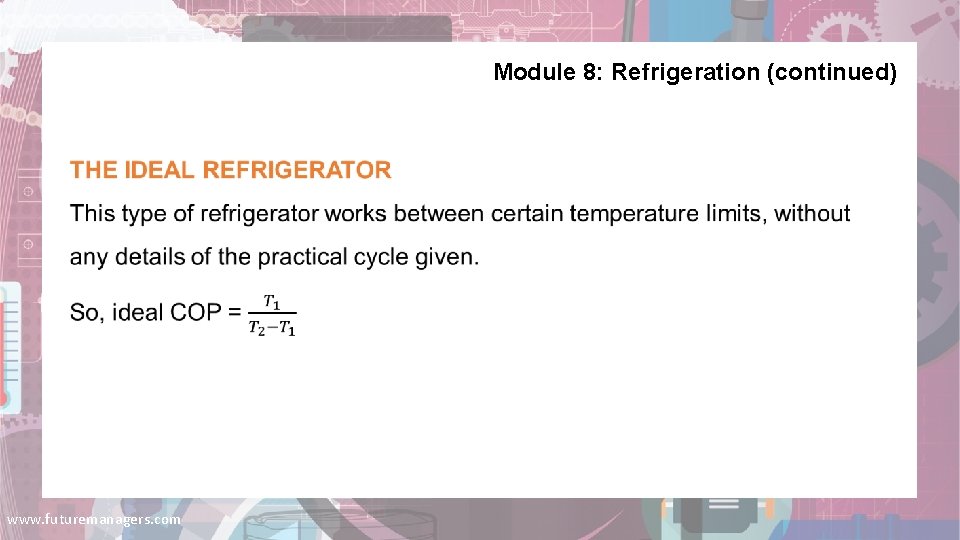
Module 8: Refrigeration (continued) www. futuremanagers. com