
POWER GENERATED BY A TOPSPIN VS A SLICE
POWER GENERATED BY A TOPSPIN VS. A SLICE Ali Kazmi April 30, 2012
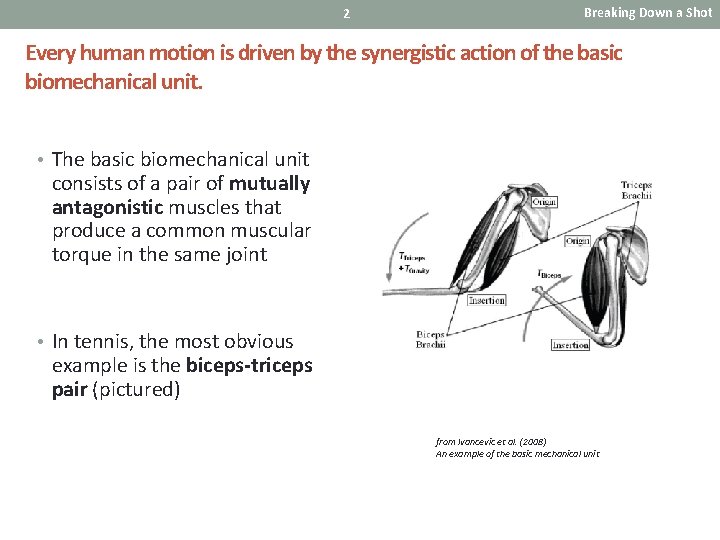
2 Breaking Down a Shot Every human motion is driven by the synergistic action of the basic biomechanical unit. • The basic biomechanical unit consists of a pair of mutually antagonistic muscles that produce a common muscular torque in the same joint • In tennis, the most obvious example is the biceps-triceps pair (pictured) from Ivancevic et al. (2008) An example of the basic mechanical unit
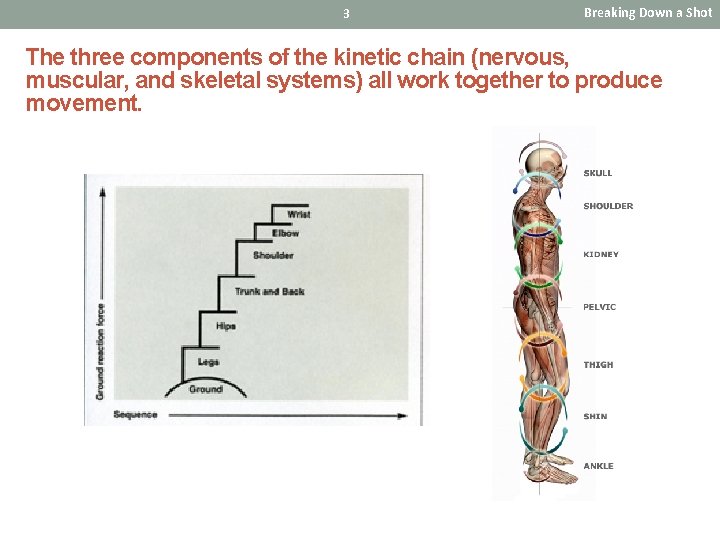
3 Breaking Down a Shot The three components of the kinetic chain (nervous, muscular, and skeletal systems) all work together to produce movement.
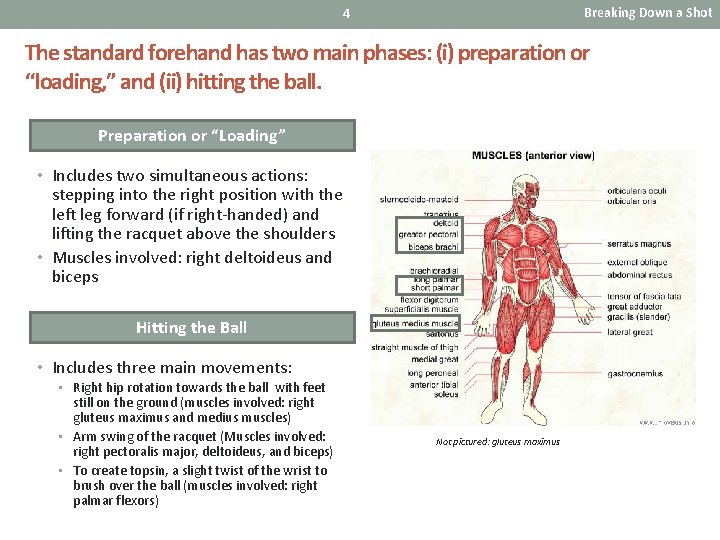
Breaking Down a Shot 4 The standard forehand has two main phases: (i) preparation or “loading, ” and (ii) hitting the ball. Preparation or “Loading” • Includes two simultaneous actions: stepping into the right position with the left leg forward (if right-handed) and lifting the racquet above the shoulders • Muscles involved: right deltoideus and biceps Hitting the Ball • Includes three main movements: • Right hip rotation towards the ball with feet still on the ground (muscles involved: right gluteus maximus and medius muscles) • Arm swing of the racquet (Muscles involved: right pectoralis major, deltoideus, and biceps) • To create topsin, a slight twist of the wrist to brush over the ball (muscles involved: right palmar flexors) Not pictured: gluteus maximus
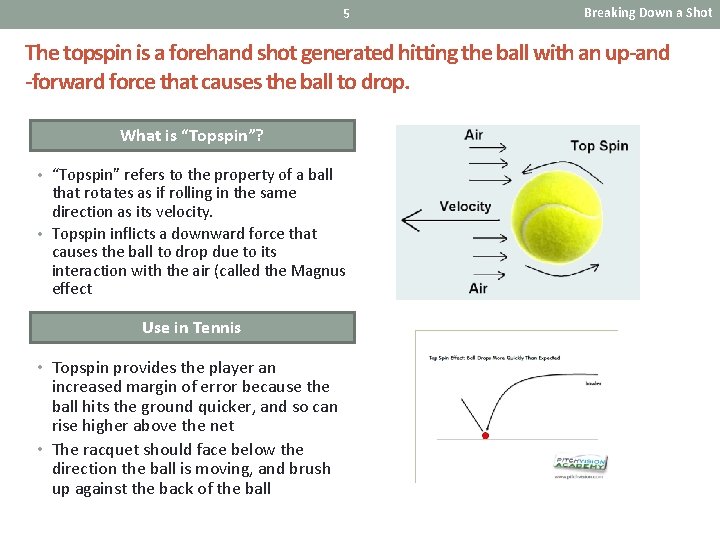
5 Breaking Down a Shot The topspin is a forehand shot generated hitting the ball with an up-and -forward force that causes the ball to drop. What is “Topspin”? • “Topspin” refers to the property of a ball that rotates as if rolling in the same direction as its velocity. • Topspin inflicts a downward force that causes the ball to drop due to its interaction with the air (called the Magnus effect Use in Tennis • Topspin provides the player an increased margin of error because the ball hits the ground quicker, and so can rise higher above the net • The racquet should face below the direction the ball is moving, and brush up against the back of the ball
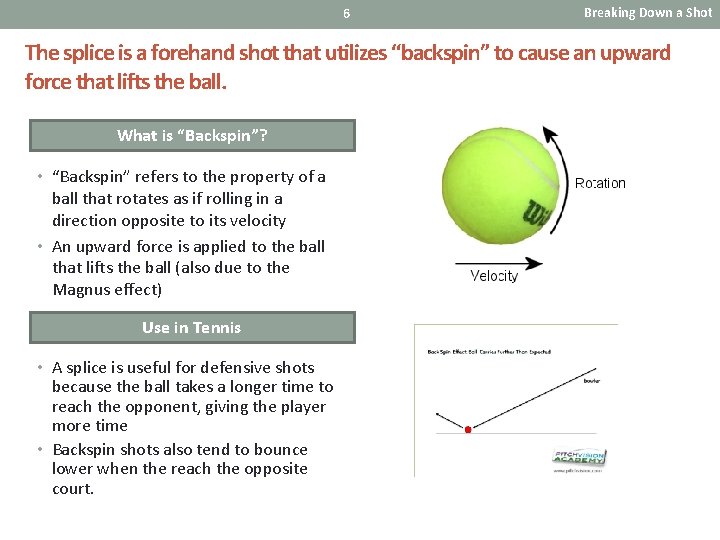
6 Breaking Down a Shot The splice is a forehand shot that utilizes “backspin” to cause an upward force that lifts the ball. What is “Backspin”? • “Backspin” refers to the property of a ball that rotates as if rolling in a direction opposite to its velocity • An upward force is applied to the ball that lifts the ball (also due to the Magnus effect) Use in Tennis • A splice is useful for defensive shots because the ball takes a longer time to reach the opponent, giving the player more time • Backspin shots also tend to bounce lower when the reach the opposite court.
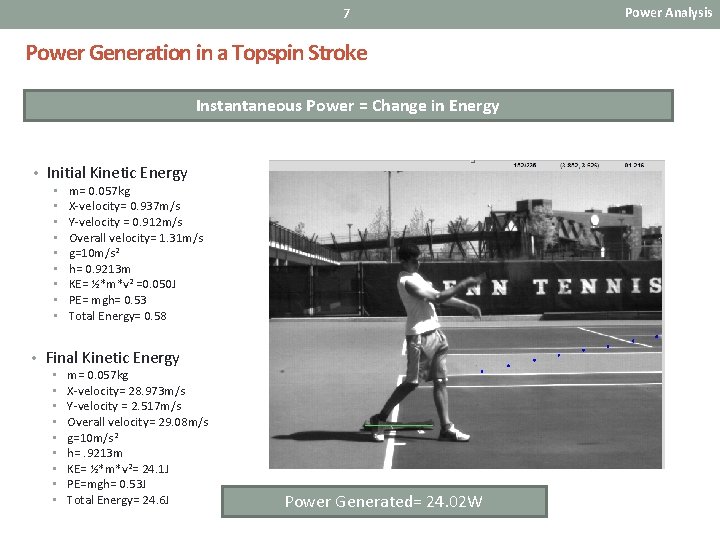
7 Power Generation in a Topspin Stroke Instantaneous Power = Change in Energy • Initial Kinetic Energy • • • m= 0. 057 kg X-velocity= 0. 937 m/s Y-velocity = 0. 912 m/s Overall velocity= 1. 31 m/s g=10 m/s 2 h= 0. 9213 m KE= ½*m*v 2 =0. 050 J PE= mgh= 0. 53 Total Energy= 0. 58 • Final Kinetic Energy • • • m= 0. 057 kg X-velocity= 28. 973 m/s Y-velocity = 2. 517 m/s Overall velocity= 29. 08 m/s g=10 m/s 2 h=. 9213 m KE= ½*m*v 2= 24. 1 J PE=mgh= 0. 53 J Total Energy= 24. 6 J Power Generated= 24. 02 W Power Analysis
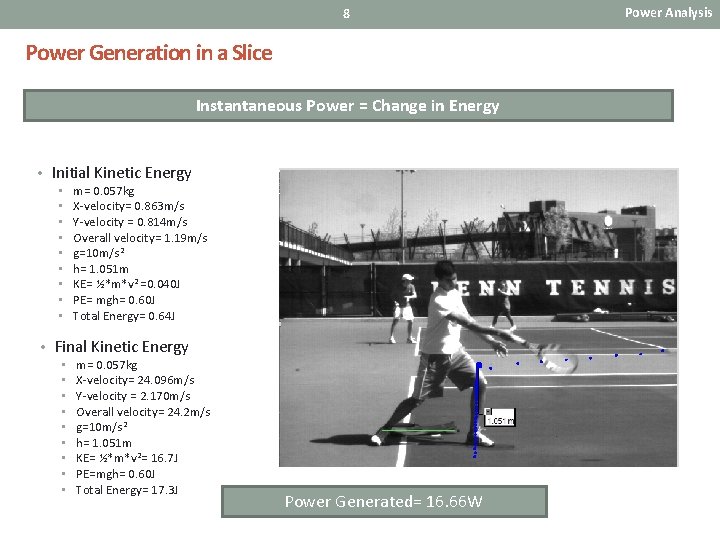
8 Power Generation in a Slice Instantaneous Power = Change in Energy • Initial Kinetic Energy • • • m= 0. 057 kg X-velocity= 0. 863 m/s Y-velocity = 0. 814 m/s Overall velocity= 1. 19 m/s g=10 m/s 2 h= 1. 051 m KE= ½*m*v 2 =0. 040 J PE= mgh= 0. 60 J Total Energy= 0. 64 J • Final Kinetic Energy • • • m= 0. 057 kg X-velocity= 24. 096 m/s Y-velocity = 2. 170 m/s Overall velocity= 24. 2 m/s g=10 m/s 2 h= 1. 051 m KE= ½*m*v 2= 16. 7 J PE=mgh= 0. 60 J Total Energy= 17. 3 J Power Generated= 16. 66 W Power Analysis
9 Future Directions • Further detailed analysis of impact rotation kinetic energy changes • Energy transfer measurements • Strategic considerations • Impact of elasticity of strings of racquet • Frequency of usage of different types of shots and success/failure ratios
10 References • Elliott, B. "Biomechanics and Tennis. " British Journal of Sports Medicine 40. 5 (2006): 392 -96. Print. • Ivancevic, T. “Biomechanical Analysis of Shots and Ball Motion in Tennis and the Analogy with Handball Throws. ” Physical Education and Sport 6. 1 (2008): 51 -66. Print
- Slides: 10