
Power Distribution System PDS Design and RD Status
Power Distribution System (PDS) Design and R&D Status Christopher Nantista SLAC SCRF Meeting @ Fermilab April 24, 2008
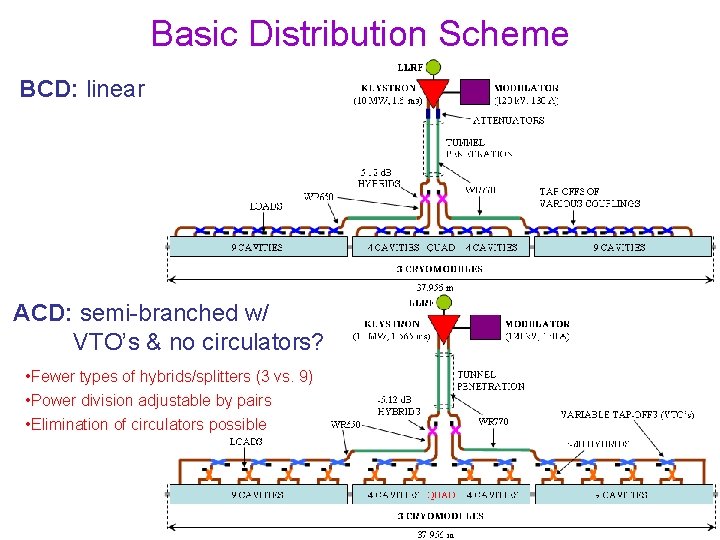
Basic Distribution Scheme BCD: linear ACD: semi-branched w/ VTO’s & no circulators? • Fewer types of hybrids/splitters (3 vs. 9) • Power division adjustable by pairs • Elimination of circulators possible
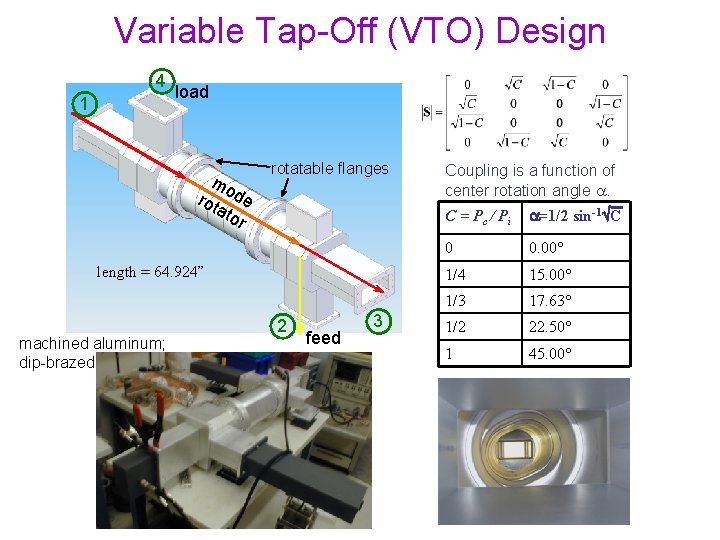
Variable Tap-Off (VTO) Design 4 1 load mo rot de ato r rotatable flanges length = 64. 924” machined aluminum; dip-brazed 2 feed 3 Coupling is a function of center rotation angle a. C = P c / Pi a=1/2 sin-1 C 0 0. 00° 1/4 15. 00° 1/3 17. 63° 1/2 22. 50° 1 45. 00°
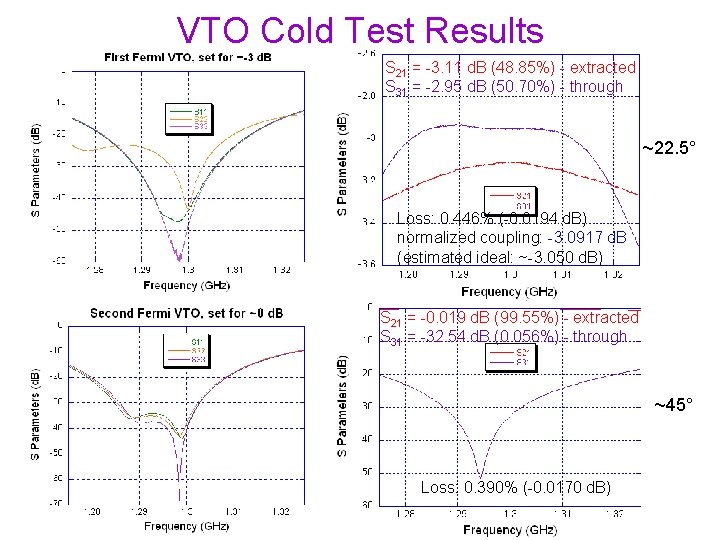
VTO Cold Test Results S 21 = -3. 11 d. B (48. 85%) - extracted S 31 = -2. 95 d. B (50. 70%) - through ~22. 5° Loss: 0. 446% (-0. 0194 d. B) normalized coupling: -3. 0917 d. B (estimated ideal: ~-3. 050 d. B) S 21 = -0. 019 d. B (99. 55%) - extracted S 31 = -32. 54 d. B (0. 056%) - through ~45° Loss: 0. 390% (-0. 0170 d. B)
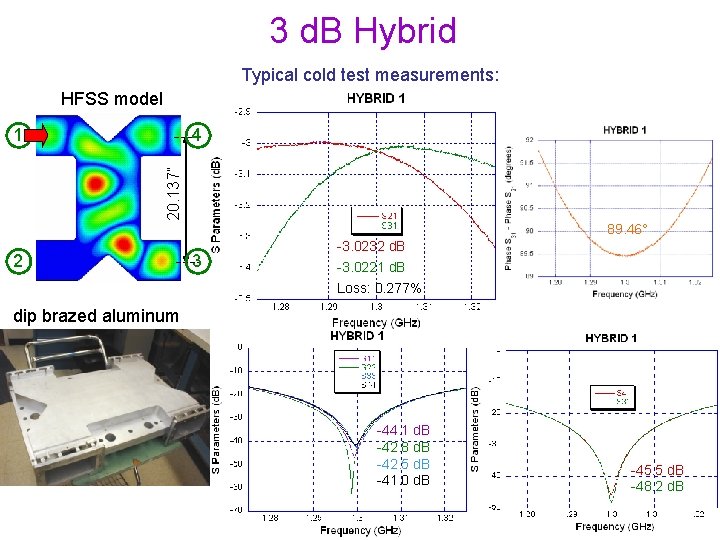
3 d. B Hybrid Typical cold test measurements: HFSS model 4 20. 137” 1 89. 46° 2 3 -3. 0232 d. B -3. 0221 d. B Loss: 0. 277% dip brazed aluminum -44. 1 d. B -42. 8 d. B -42. 5 d. B -41. 0 d. B -45. 5 d. B -48. 2 d. B
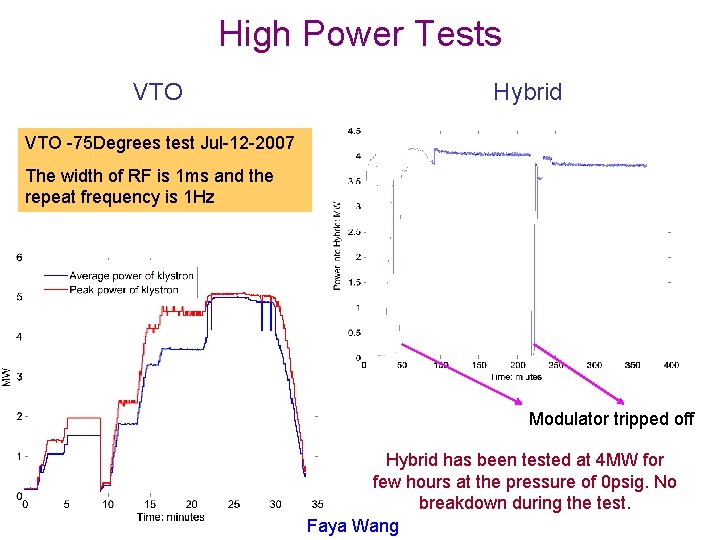
High Power Tests VTO Hybrid VTO -75 Degrees test Jul-12 -2007 The width of RF is 1 ms and the repeat frequency is 1 Hz Modulator tripped off Hybrid has been tested at 4 MW for few hours at the pressure of 0 psig. No breakdown during the test. Faya Wang

Isolator (Circulator w/ Load) 1 MW Load S. P. A. Ferrite Ltd. St. Petersburg, Russia Typical cold test measurements: Typical load match < -35 d. B Loss: ~1. 6%
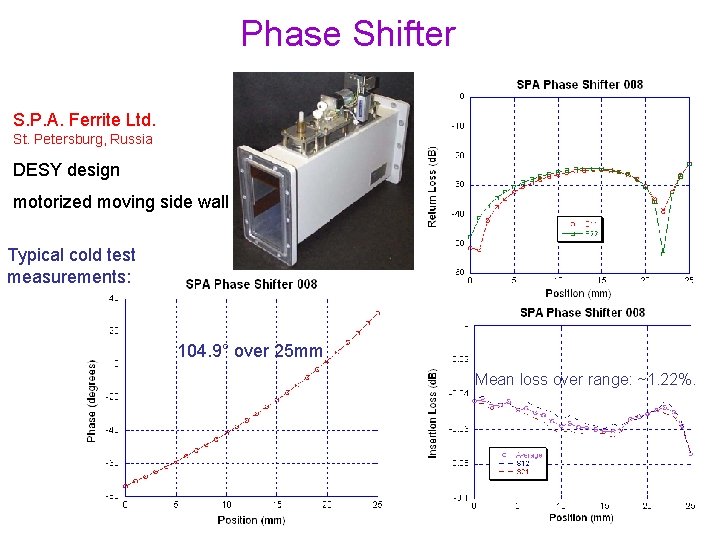
Phase Shifter S. P. A. Ferrite Ltd. St. Petersburg, Russia DESY design motorized moving side wall Typical cold test measurements: 104. 9° over 25 mm Mean loss over range: ~1. 22%.
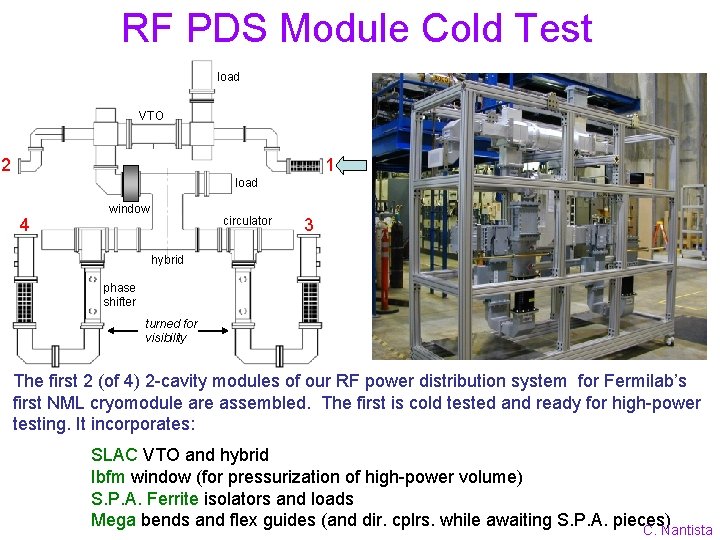
RF PDS Module Cold Test load VTO 2 1 load 4 window circulator 3 hybrid phase shifter turned for visibility The first 2 (of 4) 2 -cavity modules of our RF power distribution system for Fermilab’s first NML cryomodule are assembled. The first is cold tested and ready for high-power testing. It incorporates: SLAC VTO and hybrid Ibfm window (for pressurization of high-power volume) S. P. A. Ferrite isolators and loads Mega bends and flex guides (and dir. cplrs. while awaiting S. P. A. pieces) C. Nantista
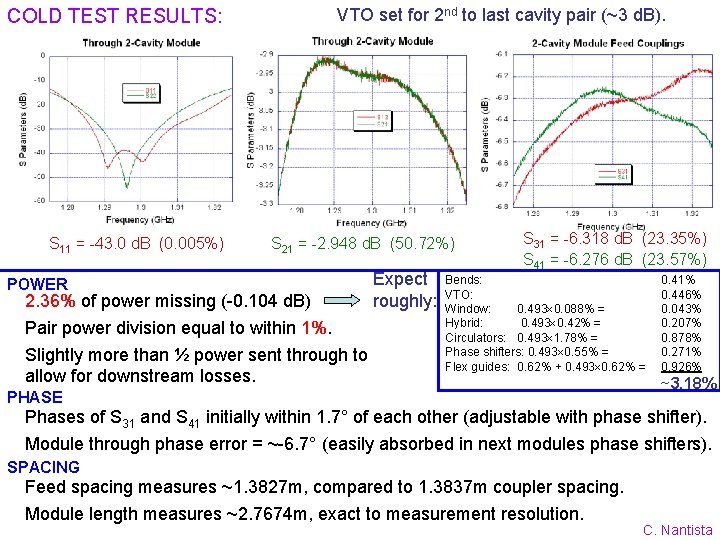
VTO set for 2 nd to last cavity pair (~3 d. B). COLD TEST RESULTS: S 11 = -43. 0 d. B (0. 005%) S 21 = -2. 948 d. B (50. 72%) POWER 2. 36% of power missing (-0. 104 d. B) Pair power division equal to within 1%. Slightly more than ½ power sent through to allow for downstream losses. Expect roughly: S 31 = -6. 318 d. B (23. 35%) S 41 = -6. 276 d. B (23. 57%) Bends: VTO: Window: 0. 493 0. 088% = Hybrid: 0. 493 0. 42% = Circulators: 0. 493 1. 78% = Phase shifters: 0. 493 0. 55% = Flex guides: 0. 62% + 0. 493 0. 62% = PHASE 0. 41% 0. 446% 0. 043% 0. 207% 0. 878% 0. 271% 0. 926% ~3. 18% Phases of S 31 and S 41 initially within 1. 7° of each other (adjustable with phase shifter). Module through phase error = ~-6. 7° (easily absorbed in next modules phase shifters). SPACING Feed spacing measures ~1. 3827 m, compared to 1. 3837 m coupler spacing. Module length measures ~2. 7674 m, exact to measurement resolution. C. Nantista
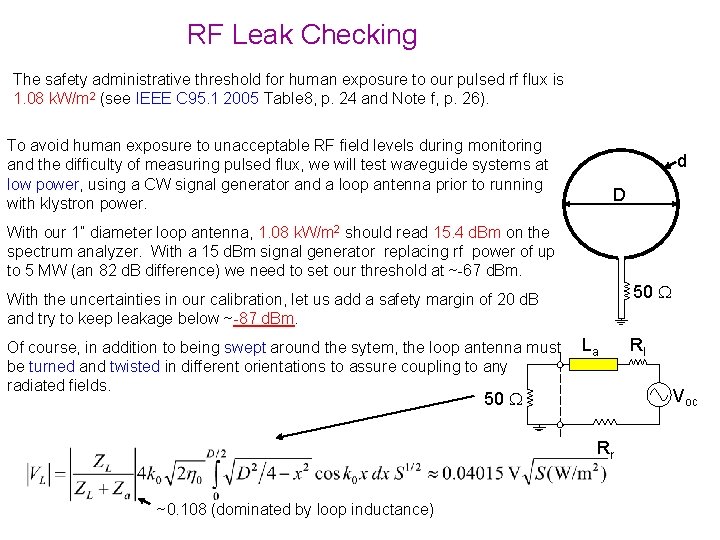
RF Leak Checking The safety administrative threshold for human exposure to our pulsed rf flux is 1. 08 k. W/m 2 (see IEEE C 95. 1 2005 Table 8, p. 24 and Note f, p. 26). To avoid human exposure to unacceptable RF field levels during monitoring and the difficulty of measuring pulsed flux, we will test waveguide systems at low power, using a CW signal generator and a loop antenna prior to running with klystron power. d D With our 1” diameter loop antenna, 1. 08 k. W/m 2 should read 15. 4 d. Bm on the spectrum analyzer. With a 15 d. Bm signal generator replacing rf power of up to 5 MW (an 82 d. B difference) we need to set our threshold at ~-67 d. Bm. 50 W With the uncertainties in our calibration, let us add a safety margin of 20 d. B and try to keep leakage below ~-87 d. Bm. Of course, in addition to being swept around the sytem, the loop antenna must be turned and twisted in different orientations to assure coupling to any radiated fields. La Voc 50 W Rr ~0. 108 (dominated by loop inductance) Rl

Alternative RF Distribution Layout with circulators: loads RF VTO flex guide load hybrid beam directional couplers circulators VTO’s allow pair-wise adjustment of power distribution. without circulators: RF H-plane bends beam Hybrid feeding of equal-Q cavity pairs directs reflected power into hybrid loads.
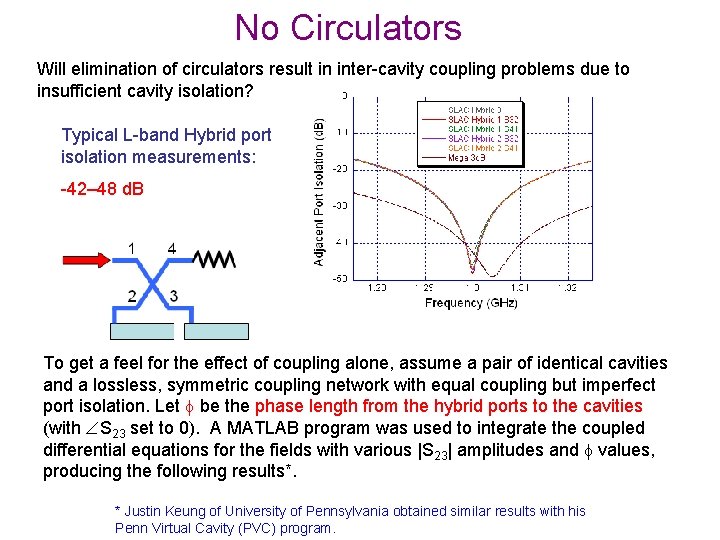
No Circulators Will elimination of circulators result in inter-cavity coupling problems due to insufficient cavity isolation? Typical L-band Hybrid port isolation measurements: -42– 48 d. B To get a feel for the effect of coupling alone, assume a pair of identical cavities and a lossless, symmetric coupling network with equal coupling but imperfect port isolation. Let f be the phase length from the hybrid ports to the cavities (with S 23 set to 0). A MATLAB program was used to integrate the coupled differential equations for the fields with various |S 23| amplitudes and f values, producing the following results*. * Justin Keung of University of Pennsylvania obtained similar results with his Penn Virtual Cavity (PVC) program.
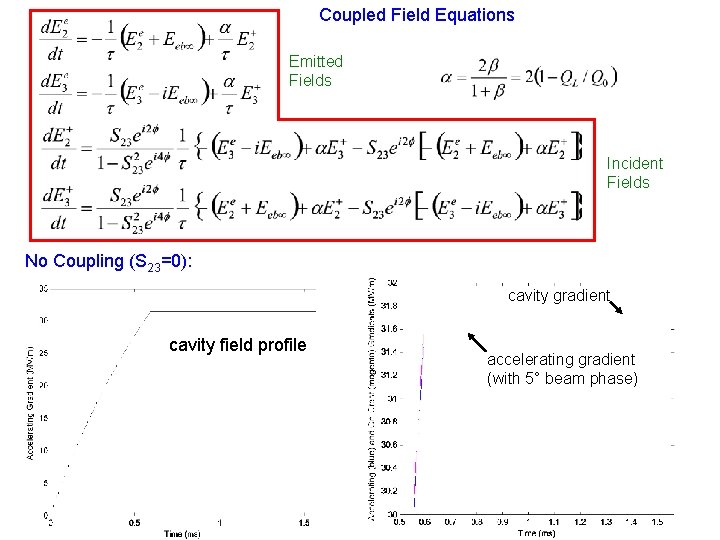
Coupled Field Equations Emitted Fields Incident Fields No Coupling (S 23=0): cavity gradient cavity field profile accelerating gradient (with 5° beam phase)
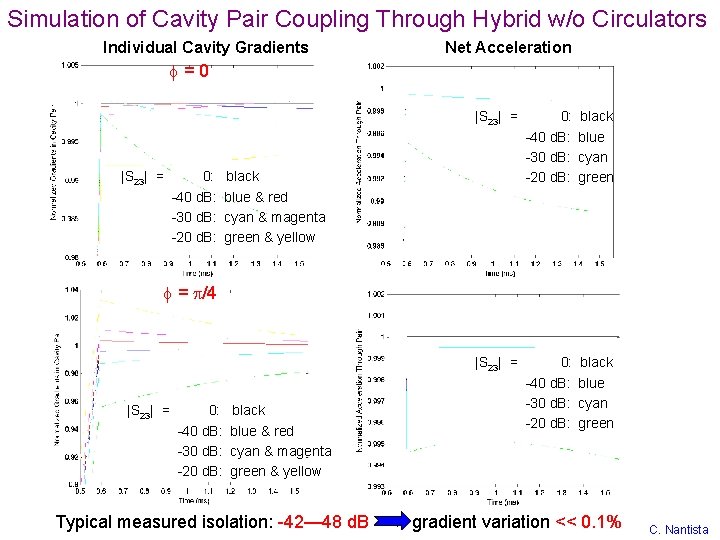
Simulation of Cavity Pair Coupling Through Hybrid w/o Circulators Individual Cavity Gradients Net Acceleration f=0 |S 23| = 0: -40 d. B: -30 d. B: -20 d. B: black blue cyan green black blue & red cyan & magenta green & yellow f = p/4 |S 23| = 0: -40 d. B: -30 d. B: -20 d. B: black blue & red cyan & magenta green & yellow Typical measured isolation: -42— 48 d. B → gradient variation << 0. 1% C. Nantista
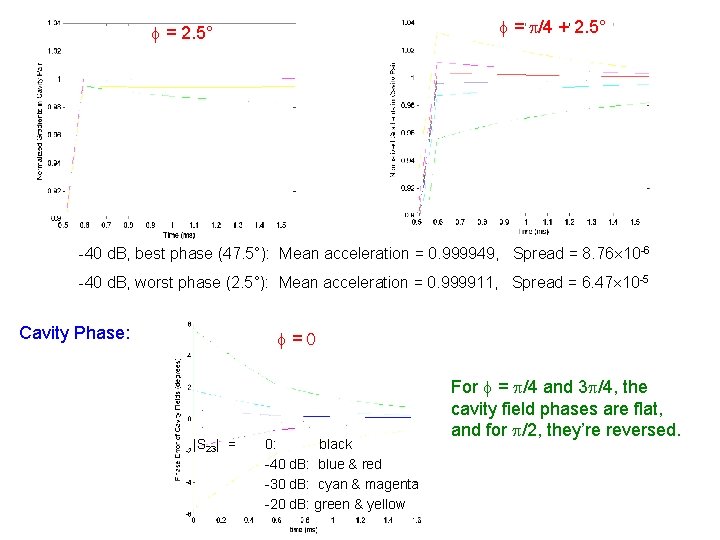
f = p/4 + 2. 5° f = 2. 5° -40 d. B, best phase (47. 5°): Mean acceleration = 0. 999949, Spread = 8. 76 10 -6 -40 d. B, worst phase (2. 5°): Mean acceleration = 0. 999911, Spread = 6. 47 10 -5 Cavity Phase: f=0 |S 23| = 0: black -40 d. B: blue & red -30 d. B: cyan & magenta -20 d. B: green & yellow For f = p/4 and 3 p/4, the cavity field phases are flat, and for p/2, they’re reversed.
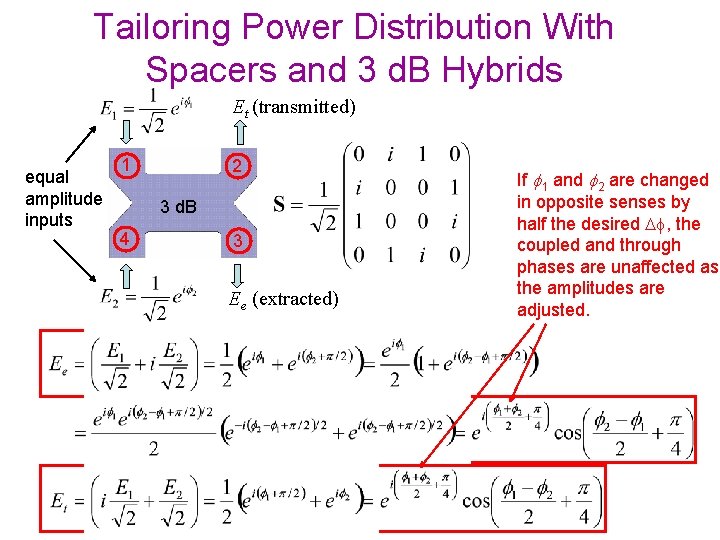
Tailoring Power Distribution With Spacers and 3 d. B Hybrids Et (transmitted) equal amplitude inputs 1 2 3 d. B 4 3 Ee (extracted) If f 1 and f 2 are changed in opposite senses by half the desired Df, the coupled and through phases are unaffected as the amplitudes are adjusted.
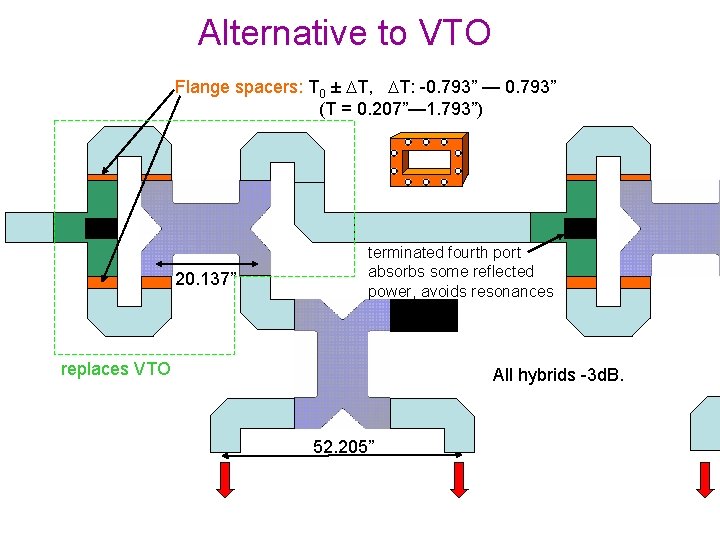
Alternative to VTO Flange spacers: T 0 ± DT, DT: -0. 793” — 0. 793” (T = 0. 207”— 1. 793”) 20. 137” terminated fourth port absorbs some reflected power, avoids resonances replaces VTO All hybrids -3 d. B. 52. 205”
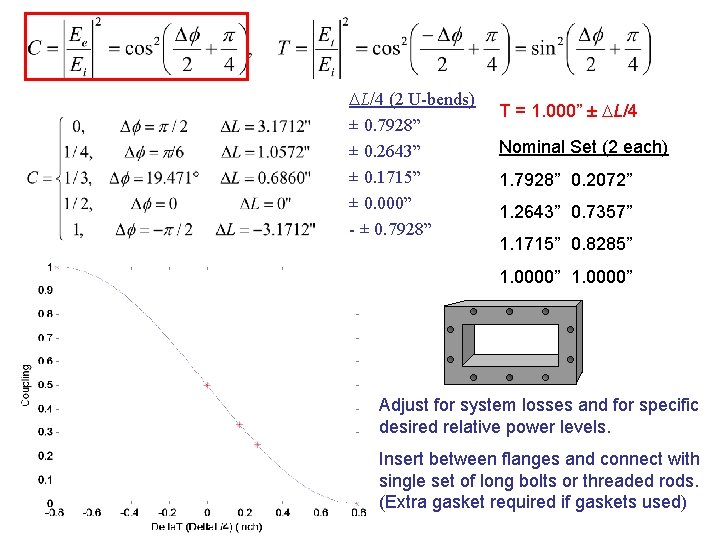
DL/4 (2 U-bends) ± 0. 7928” ± 0. 2643” ± 0. 1715” ± 0. 000” - ± 0. 7928” T = 1. 000” ± DL/4 Nominal Set (2 each) 1. 7928” 0. 2072” 1. 2643” 0. 7357” 1. 1715” 0. 8285” 1. 0000” . 00881”/degree in thickness of spacers Adjust for system losses and for specific desired relative power levels. Insert between flanges and connect with single set of long bolts or threaded rods. (Extra gasket required if gaskets used)
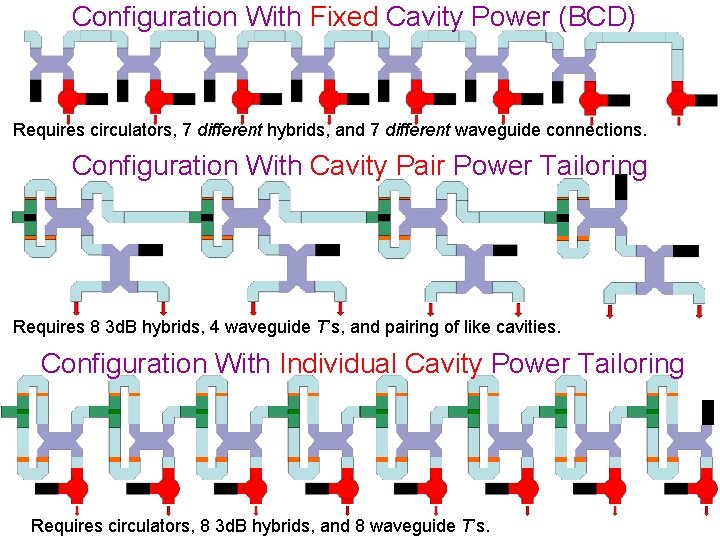
Configuration With Fixed Cavity Power (BCD) Requires circulators, 7 different hybrids, and 7 different waveguide connections. Configuration With Cavity Pair Power Tailoring Requires 8 3 d. B hybrids, 4 waveguide T’s, and pairing of like cavities. Configuration With Individual Cavity Power Tailoring Requires circulators, 8 3 d. B hybrids, and 8 waveguide T’s.
Conclusions & Plans • We have all parts for the Fermilab NML RF distribution system (except for overdue dir. cplrs. ). 2 of 4 modules are assembled and awaiting high-power testing. After testing, the modules will be shipped assembled to Fermilab for installation. • Simulations suggest that with pairing of cavities to allow identical QL’s, elimination of circulators should not pose a problem to field stabilization. This will be experimentally demonstrated when we run at NML in the circulatorless configuration. • We are exploring other options to reduce the system cost, including eliminating phase shifters, simplifying the VTO fabrication or replacing the latter with alternate assemblies. A balance will have to be struck between system flexibility and cost (see Chris Adolphsen’s talk later).
- Slides: 21