
Power Distribution Scheduling for Electric Vehicles in Wireless
Power Distribution Scheduling for Electric Vehicles in Wireless Power Transfer Systems Chenxi Qiu*, Ankur Sarker† and Haiying Shen† *College of Information Science and Technology, Pennsylvania State University †Department of Computer Science, University of Virginia
Outline • • Introduction The wireless power transfer system Performance Evaluation Conclusion 2
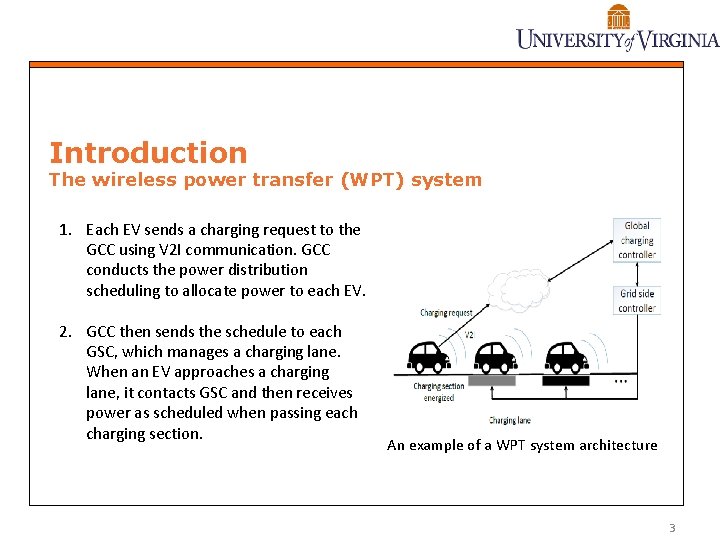
Introduction The wireless power transfer (WPT) system 1. Each EV sends a charging request to the GCC using V 2 I communication. GCC conducts the power distribution scheduling to allocate power to each EV. 2. GCC then sends the schedule to each GSC, which manages a charging lane. When an EV approaches a charging lane, it contacts GSC and then receives power as scheduled when passing each charging section. An example of a WPT system architecture 3
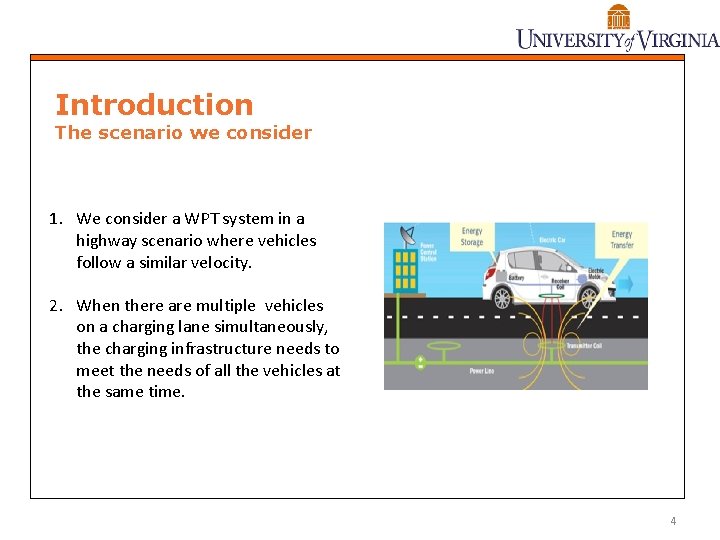
Introduction The scenario we consider 1. We consider a WPT system in a highway scenario where vehicles follow a similar velocity. 2. When there are multiple vehicles on a charging lane simultaneously, the charging infrastructure needs to meet the needs of all the vehicles at the same time. 4
Introduction Challenges When the infrastructure cannot fulfill the demands from all EVs on a charging lane, how to allocate the limited power to the EVs so that they have sufficient power to arrive at the next charging lane or their destinations. 5
Introduction Related work Study on the WPT systems and EVs techniques 1. Analyze the existing technologies in the WPT system p [Li, JESTPE 2015] 2. Examine the technical aspects and charging topology of inmotion wireless power charging of EVs p [Onar, APEC 2011] Implementation of the WPT systems for EVs 1. Design of optimized core structure and electric components p [Shin, Trans. IE 2014] 2. General design requirements and analysis of WPT systems p [Yilmaz, ITEC 2012] 3. A dynamic model for identifying the maximum pickup in the WPT system p [Lee, Trans. PE 2015] 6
Introduction Four problems to be formulated i. SOC-B: balancing the state of charge (SOC) of the EVs, ii. Power-B: balancing the amount of stored power of the EVs, iii. Power-M: minimizing the total power charged. Solution 1. i)-ii) are convex: use the subgradient method or greedy approach to solve the problems. 2. iii) is a linear programming problem: can be solved by the simplex method. We also design a greedy algorithm to solve the problem. 7
Introduction Contributions 1. We formulate four new power distribution scheduling problems: SOC-B, Power-B, and Power-M, to discuss how a GSC distributes power to enable the EVs to reach their destinations, while balancing EV’s SOC, stored energy, or minimizing the charged energy. 2. We prove both SOC-B and Power-B to be convex. We showed Power-M is a linear programming problem, and also design a time efficient greedy algorithm to achieve the optimal solution of Power -M. 3. We conduct extensive simulation using both Mat. Lab and SUMO to confirm that our solutions are effective in achieving their respective goals while enabling EVs to reach their destinations. 8
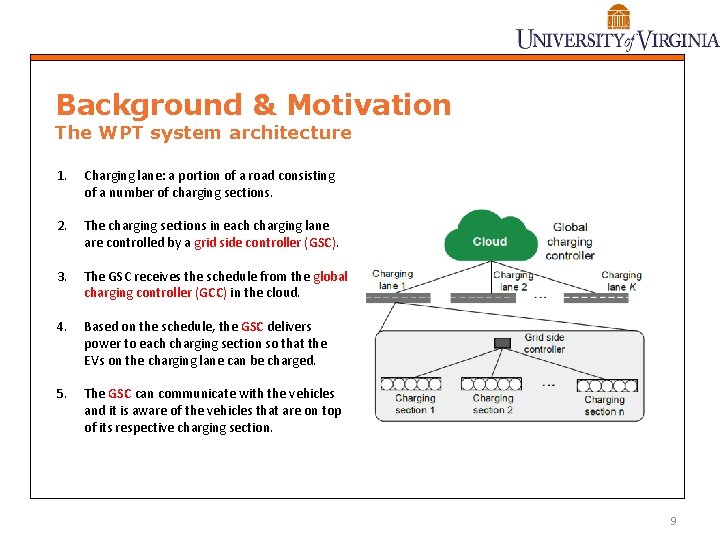
Background & Motivation The WPT system architecture 1. Charging lane: a portion of a road consisting of a number of charging sections. 2. The charging sections in each charging lane are controlled by a grid side controller (GSC). 3. The GSC receives the schedule from the global charging controller (GCC) in the cloud. 4. Based on the schedule, the GSC delivers power to each charging section so that the EVs on the charging lane can be charged. 5. The GSC can communicate with the vehicles and it is aware of the vehicles that are on top of its respective charging section. 9

Power Distribution Scheduling EV Traffic Model we will consider 1. A discrete time system where time = 1, 2, … 2. n charging sections c 1, c 2, …, cn in a charging lane 3. m heterogeneous EVs {1, 2, …, m} based on the EVs’ current stored energy in the batteries. 4. The maximum capacity of the GSC is A 5. The maximum power that each charging section j can provide is aj , 10
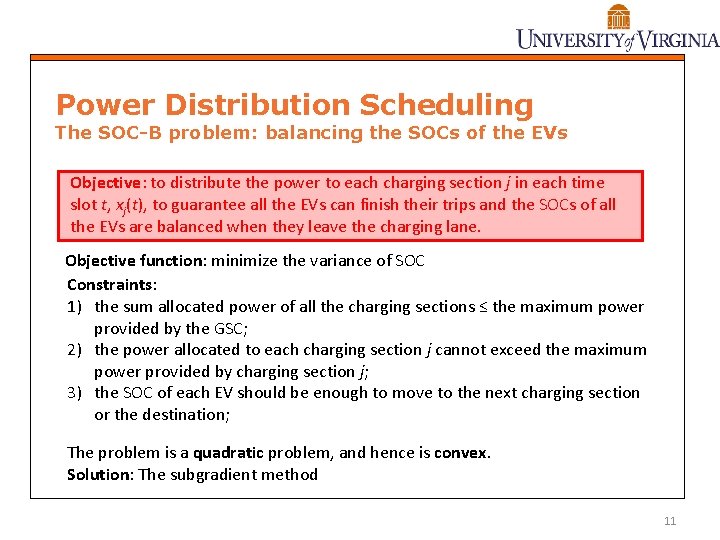
Power Distribution Scheduling The SOC-B problem: balancing the SOCs of the EVs Objective: to distribute the power to each charging section j in each time slot t, xj(t), to guarantee all the EVs can finish their trips and the SOCs of all the EVs are balanced when they leave the charging lane. Objective function: minimize the variance of SOC Constraints: 1) the sum allocated power of all the charging sections ≤ the maximum power provided by the GSC; 2) the power allocated to each charging section j cannot exceed the maximum power provided by charging section j; 3) the SOC of each EV should be enough to move to the next charging section or the destination; The problem is a quadratic problem, and hence is convex. Solution: The subgradient method 11
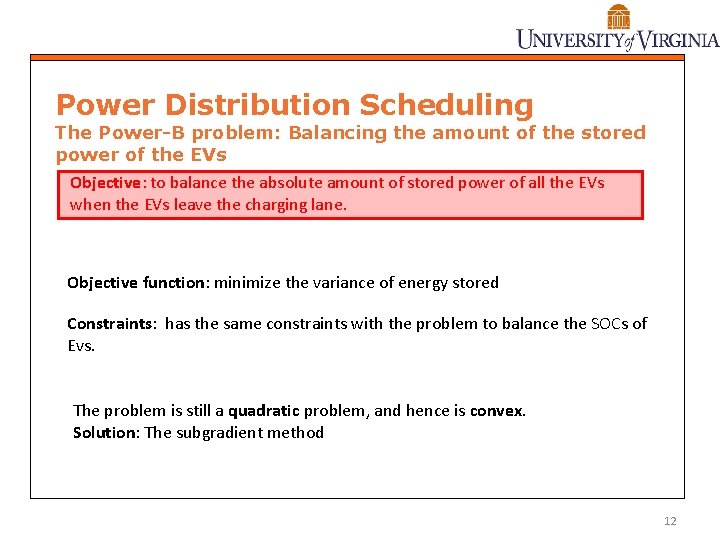
Power Distribution Scheduling The Power-B problem: Balancing the amount of the stored power of the EVs Objective: to balance the absolute amount of stored power of all the EVs when the EVs leave the charging lane. Objective function: minimize the variance of energy stored Constraints: has the same constraints with the problem to balance the SOCs of Evs. The problem is still a quadratic problem, and hence is convex. Solution: The subgradient method 12
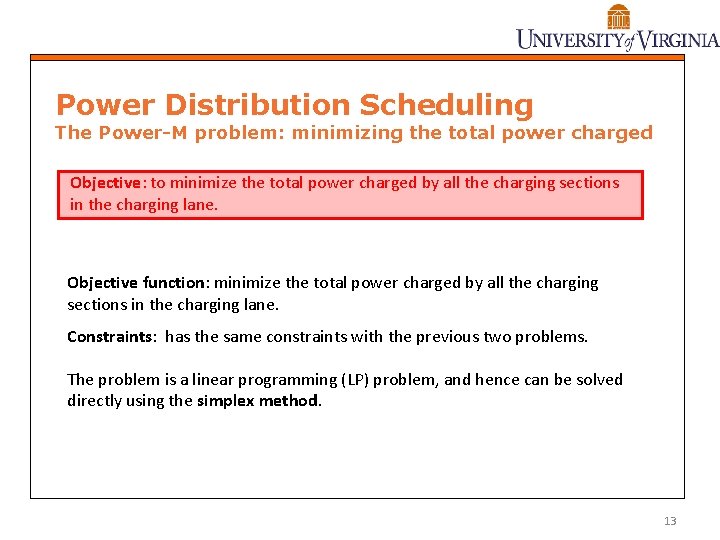
Power Distribution Scheduling The Power-M problem: minimizing the total power charged Objective: to minimize the total power charged by all the charging sections in the charging lane. Objective function: minimize the total power charged by all the charging sections in the charging lane. Constraints: has the same constraints with the previous two problems. The problem is a linear programming (LP) problem, and hence can be solved directly using the simplex method. 13
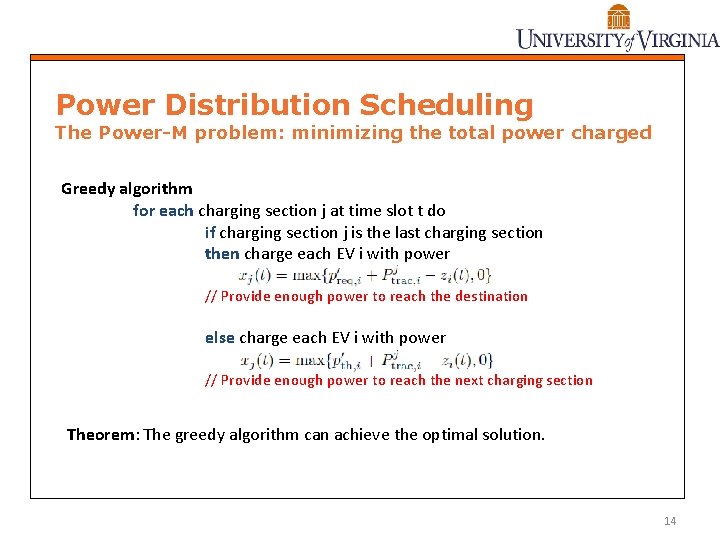
Power Distribution Scheduling The Power-M problem: minimizing the total power charged Greedy algorithm for each charging section j at time slot t do if charging section j is the last charging section then charge each EV i with power // Provide enough power to reach the destination else charge each EV i with power // Provide enough power to reach the next charging section Theorem: The greedy algorithm can achieve the optimal solution. 14
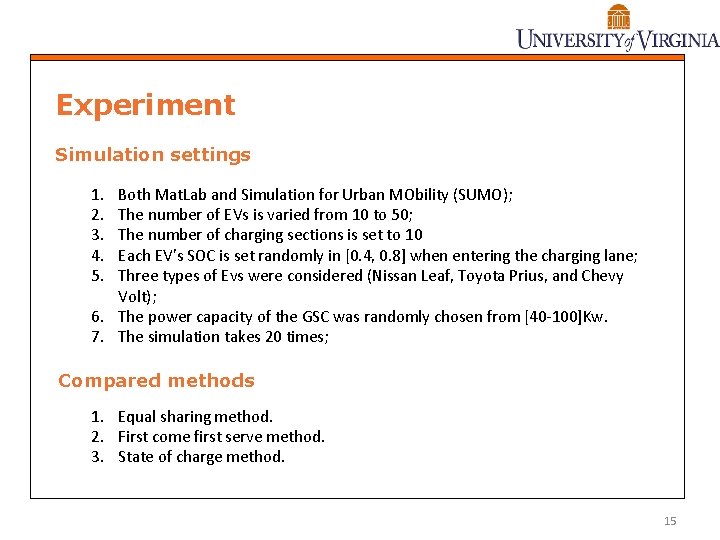
Experiment Simulation settings 1. 2. 3. 4. 5. Both Mat. Lab and Simulation for Urban MObility (SUMO); The number of EVs is varied from 10 to 50; The number of charging sections is set to 10 Each EV’s SOC is set randomly in [0. 4, 0. 8] when entering the charging lane; Three types of Evs were considered (Nissan Leaf, Toyota Prius, and Chevy Volt); 6. The power capacity of the GSC was randomly chosen from [40 -100]Kw. 7. The simulation takes 20 times; Compared methods 1. Equal sharing method. 2. First come first serve method. 3. State of charge method. 15
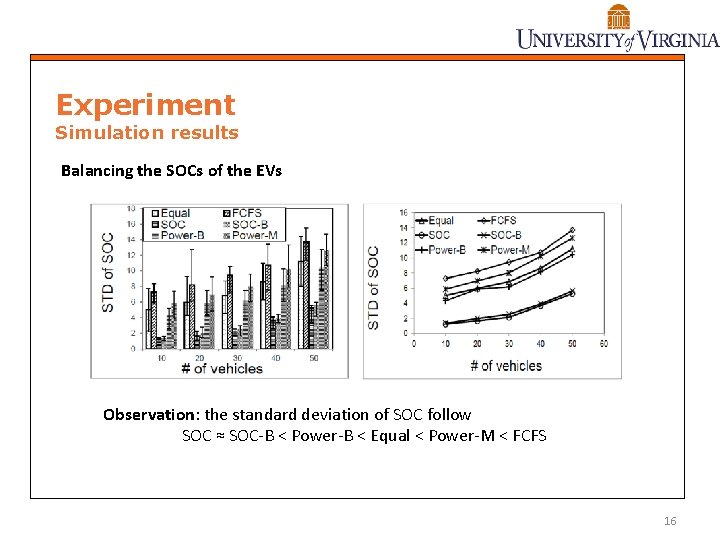
Experiment Simulation results Balancing the SOCs of the EVs Observation: the standard deviation of SOC follow SOC ≈ SOC-B < Power-B < Equal < Power-M < FCFS 16
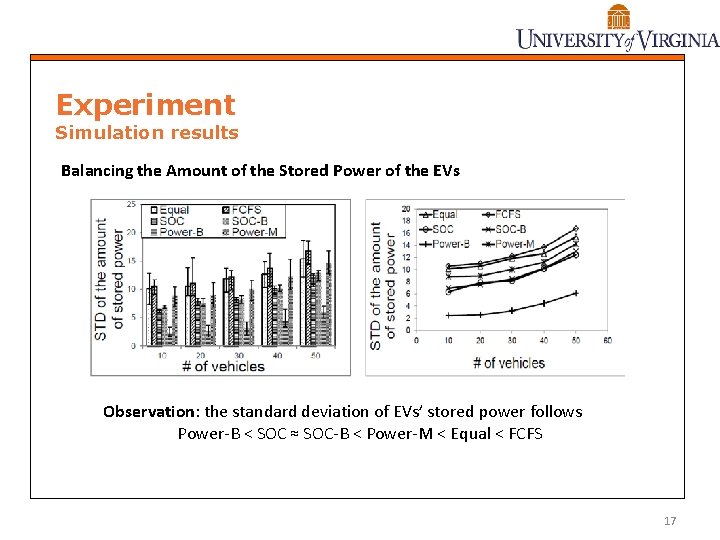
Experiment Simulation results Balancing the Amount of the Stored Power of the EVs Observation: the standard deviation of EVs’ stored power follows Power-B < SOC ≈ SOC-B < Power-M < Equal < FCFS 17
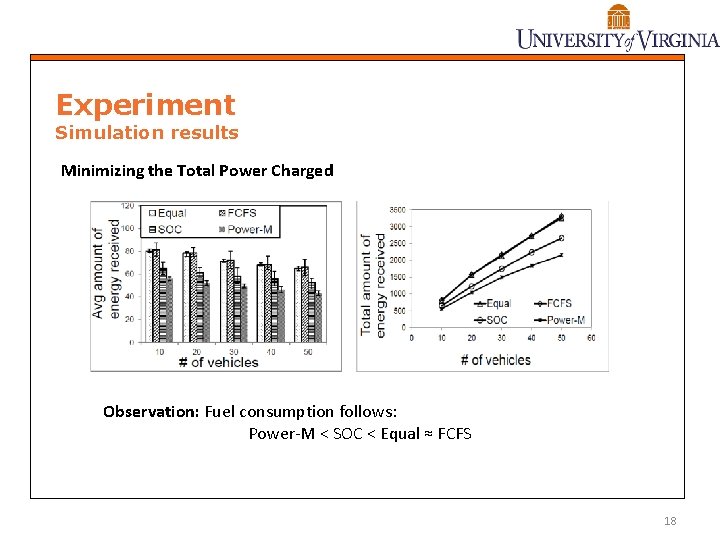
Experiment Simulation results Minimizing the Total Power Charged Observation: Fuel consumption follows: Power-M < SOC < Equal ≈ FCFS 18
Conclusions 1. We studied the power distribution scheduling problems, SOC-B, Power-B, and Power-M, about how a GSC distributes power to enable the EVs to receive enough power to reach their destinations and meanwhile achieve a goal. 2. We showed that SOC-B and Power-B are convex, which can be directly solved using the subgradient method. We also designed a greedy algorithm to achieve the optimal solution for Power-M. 3. We conducted extensive experiments to confirm that our solutions are effective in achieving their respective goals while enabling EVs to reach their destinations. Future work We will consider different velocities and velocity variation of vehicles in general roads 19
QUESTIONS ? ? ? Thank you! Questions & Comments? Haiying Shen 20
- Slides: 20